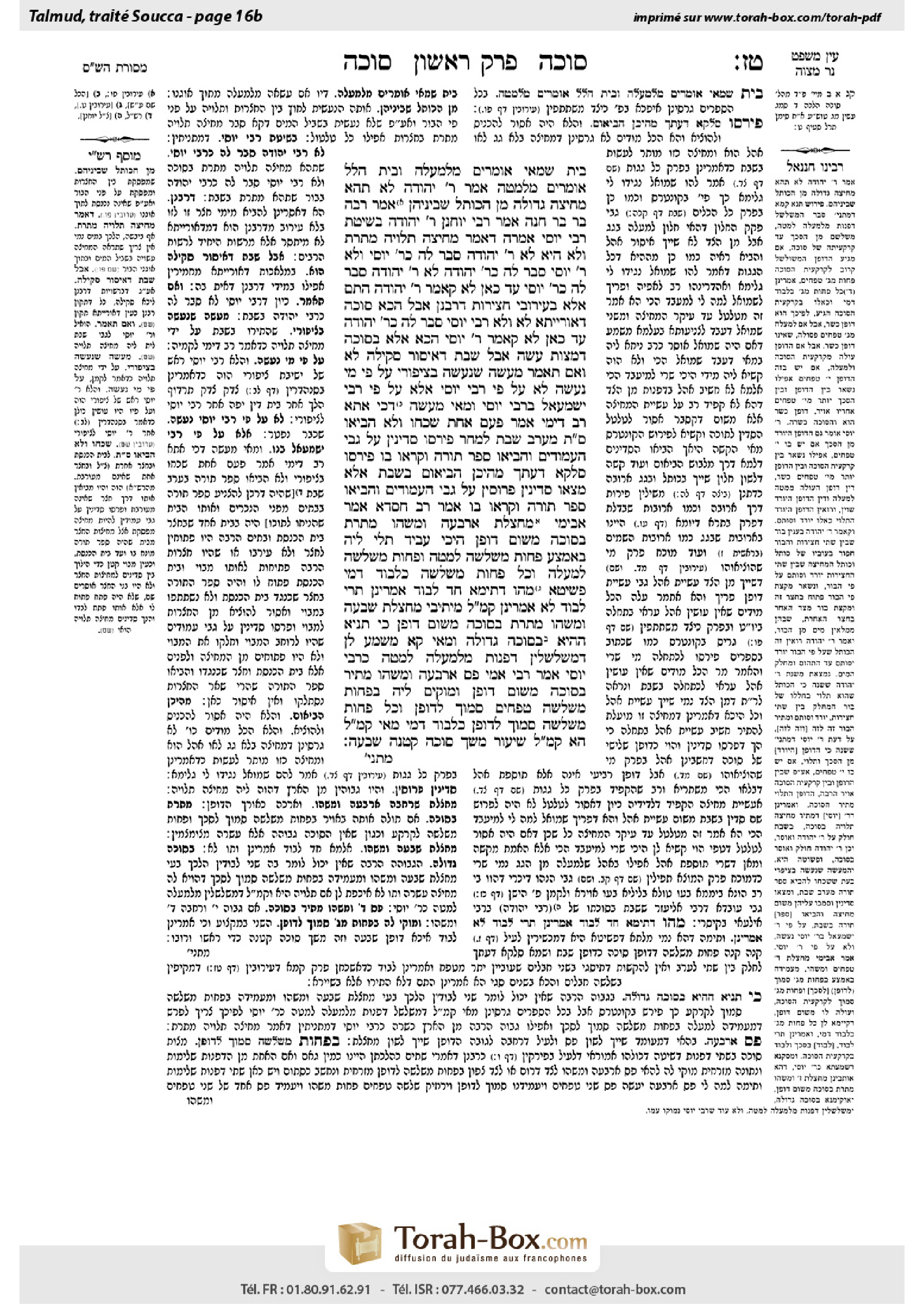
Sukkah 16b: Talmud study for Daf Yomi
Daf Yomi is the daily study of one Talmud folio. Explore 37 tractates with scans, Hebrew text, Sefaria English and AI-generated French translations where annotated.
Passage selection and English or AI-generated French translation are available where the scan has annotations. Daf Study is independent of Torah-Box and Sefaria.
Browse Sukkah · סוכה · All tractatesSukkah 16b text and translations
This page of Sukkah includes the Aramaic text, an English translation and an AI-generated French translation, alongside the scan above.
סוכה י״ו ב · Aramaic and Hebrew text
בֵּית שַׁמַּאי אוֹמְרִים מִלְמַעְלָה, וּבֵית הִלֵּל אוֹמְרִים מִלְּמַטָּה. אָמַר רַבִּי יְהוּדָה: לֹא תְּהֵא מְחִיצָה גְּדוֹלָה מִן הַכּוֹתֶל שֶׁבֵּינֵיהֶן.
אָמַר רַבָּה בַּר בַּר חָנָה אָמַר רַבִּי יוֹחָנָן: רַבִּי יְהוּדָה בְּשִׁיטַת רַבִּי יוֹסֵי אֲמָרָהּ, דְּאָמַר מְחִיצָה תְּלוּיָה מַתֶּרֶת.
וְלָא הִיא, לָא רַבִּי יְהוּדָה סָבַר לַהּ כְּרַבִּי יוֹסֵי, וְלָא רַבִּי יוֹסֵי סָבַר לַהּ כְּרַבִּי יְהוּדָה.
לָא רַבִּי יְהוּדָה סָבַר לַהּ כְּרַבִּי יוֹסֵי: עַד כָּאן לָא קָאָמַר רַבִּי יְהוּדָה הָתָם, אֶלָּא בְּעֵירוּבֵי חֲצֵירוֹת דְּרַבָּנַן. אֲבָל הָכָא, סוּכָּה דְּאוֹרָיְיתָא — לָא.
וְלָא רַבִּי יוֹסֵי סָבַר לַהּ כְּרַבִּי יְהוּדָה: עַד כָּאן לָא קָאָמַר רַבִּי יוֹסֵי הָכָא, אֶלָּא בְּסוּכָּה דְּמִצְוַת עֲשֵׂה. אֲבָל שַׁבָּת, דְּאִיסּוּר סְקִילָה — לָא.
וְאִם תֹּאמַר: מַעֲשֶׂה שֶׁנַּעֲשָׂה בְּצִיפּוֹרִי, עַל פִּי מִי נַעֲשָׂה? לֹא עַל פִּי רַבִּי יוֹסֵי, אֶלָּא עַל פִּי רַבִּי יִשְׁמָעֵאל בְּרַבִּי יוֹסֵי.
וּמַאי מַעֲשֶׂה — דְּכִי אֲתָא רַב דִּימִי, אָמַר: פַּעַם אַחַת שָׁכְחוּ וְלֹא הֵבִיאוּ סֵפֶר תּוֹרָה מֵעֶרֶב שַׁבָּת, לְמָחָר פֵּירְסוּ סְדִינִין עַל גַּבֵּי הָעַמּוּדִים, וְהֵבִיאוּ סֵפֶר תּוֹרָה וְקָרְאוּ בּוֹ.
פֵּירְסוּ סָלְקָא דַּעְתָּךְ? מֵהֵיכָן הֱבִיאוּם בְּשַׁבָּת! אֶלָּא, מָצְאוּ סְדִינִין פְּרוּסִין עַל גַּבֵּי הָעַמּוּדִים וְהֵבִיאוּ סֵפֶר תּוֹרָה וְקָרְאוּ בּוֹ.
אָמַר רַב חִסְדָּא אָמַר אֲבִימִי: מַחְצֶלֶת אַרְבָּעָה וּמַשֶּׁהוּ — מַתֶּרֶת בְּסוּכָּה מִשּׁוּם דּוֹפֶן. הֵיכִי עָבֵיד? תָּלֵי לֵיהּ בָּאֶמְצַע, פָּחוֹת מִשְּׁלֹשָׁה לְמַטָּה וּפָחוֹת מִשְּׁלֹשָׁה לְמַעְלָה, וְכׇל פָּחוֹת מִשְּׁלֹשָׁה כְּלָבוּד דָּמֵי.
פְּשִׁיטָא? מַהוּ דְּתֵימָא: חַד לָבוּד אָמְרִינַן, תְּרֵי לָבוּד לָא אָמְרִינַן — קָא מַשְׁמַע לַן.
מֵיתִיבִי: מַחְצֶלֶת שִׁבְעָה וּמַשֶּׁהוּ מַתֶּרֶת בְּסוּכָּה מִשּׁוּם דּוֹפֶן. כִּי תַּנְיָא הָהִיא, בְּסוּכָּה גְּדוֹלָה. וּמַאי קָא מַשְׁמַע לַן — דִּמְשַׁלְשְׁלִין דְּפָנוֹת מִלְמַעְלָה לְמַטָּה כְּרַבִּי יוֹסֵי.
אָמַר רַבִּי אַמֵּי: פַּס אַרְבָּעָה וּמַשֶּׁהוּ — מַתִּיר בְּסוּכָּה מִשּׁוּם דּוֹפֶן. וּמוֹקֵים לֵיהּ בְּפָחוֹת מִשְּׁלֹשָׁה טְפָחִים סָמוּךְ דּוֹפֶן, וְכׇל פָּחוֹת מִשְּׁלֹשָׁה סָמוּךְ לַדּוֹפֶן כְּלָבוּד דָּמֵי.
מַאי קָא מַשְׁמַע לַן? הָא קָא מַשְׁמַע לַן — שִׁיעוּר מֶשֶׁךְ סוּכָּה קְטַנָּה שִׁבְעָה.
Sukkah 16b · English translation
Beit Shammai say: The partition that permits drawing water may be placed below; and Beit Hillel said it must be placed above. Rabbi Yehuda said: A partition for the cistern should be no more stringent than the wall serving as a partition between the two courtyards. Once there is a wall between courtyards, there is no need to erect an additional partition specifically for the cistern.
Rabba bar bar Ḥana said that Rabbi Yoḥanan said: Rabbi Yehuda stated his opinion in accordance with the opinion of Rabbi Yosei, who said that a suspended partition permits one to carry, and therefore the wall between the courtyards suffices to divide the cistern as well.
The Gemara rejects this equation. And that is not so, as neither does Rabbi Yehuda hold in accordance with the opinion of Rabbi Yosei, nor does Rabbi Yosei hold in accordance with the opinion of Rabbi Yehuda.
The Gemara elaborates: Neither does Rabbi Yehuda hold in accordance with the opinion of Rabbi Yosei, as Rabbi Yehuda states his opinion that a suspended partition suffices only there, with regard to the joining of the courtyards, which is an obligation by rabbinic law. However, here, with regard to sukka, which is by Torah law, a suspended partition does not suffice.
Nor does Rabbi Yosei hold in accordance with the opinion of Rabbi Yehuda, as Rabbi Yosei states his opinion that a suspended partition suffices only here, with regard to a sukka, which is a positive mitzva. However, in the case of carrying between courtyards on Shabbat, which is a prohibition that is punishable by stoning, no, a suspended partition does not suffice.
The Gemara asks: And if you say: Since Rabbi Yosei does not hold in accordance with the opinion of Rabbi Yehuda with regard to the laws of Shabbat, according to whose opinion was the action that was taken in Tzippori performed, where they relied on suspended partitions even on Shabbat? The Gemara answers: It was not performed according to the opinion of Rabbi Yosei but rather on the authority of Rabbi Yishmael, son of Rabbi Yosei.
And what was that incident? When Rav Dimi came from Eretz Yisrael to Babylonia, he said: One time they forgot and did not bring a Torah scroll to the synagogue on Shabbat eve prior to the onset of Shabbat. The next day, on Shabbat, to avoid violating the prohibition against carrying, they spread and suspended sheets on posts that were fixed along the path from the house in which the Torah scroll was stored to the synagogue, establishing partitions. And they brought a Torah scroll along that path and read from it.
The Gemara asks: Does it enter your mind that they spread the sheets on Shabbat? Carrying before the partitions were established was prohibited. From where did they bring these sheets on Shabbat? Rather, they found sheets already spread on the posts, and they brought a Torah scroll and read from it. They relied on a suspended partition even in this matter related to Torah law. They relied neither on the opinion of Rabbi Yehuda nor on the opinion of Rabbi Yosei; rather, they relied on the authority of a third tanna.
§ Rav Ḥisda said that Avimi said: A mat that is four handbreadths and a bit wide can permit the use of a sukka as a wall. The Gemara explains: How does one accomplish this? He suspends it in the middle of a space ten handbreadths high, with less than three handbreadths below it and less than three handbreadths above it. And the principle states: The legal status of any objects that have a gap of less than three handbreadths between them is as if they were joined [lavud]. Therefore, a mat four handbreadths and a bit wide can constitute a fit partition of ten handbreadths.
The Gemara asks: This is obvious. The principle of joining with regard to a gap of less than three handbreadths is well known. There is no need to teach this halakha. The Gemara answers: Lest you say that we state the principle of lavud once with regard to a particular surface but we do not state the principle of lavud twice to consider it joined in different directions, Avimi teaches us that one may implement the principle twice.
The Gemara raises an objection to the opinion of Avimi from a baraita: A mat that is seven handbreadths and a bit wide can permit use of a sukka as a wall. Apparently, a mat can serve as the wall of a sukka only when the principle of joined objects is implemented once. The Gemara answers: When that baraita was taught, it was with regard to a large sukka, one considerably higher than ten handbreadths. One suspends the mat from a bit less than three handbreadths from the roofing, and it is considered a fit sukka wall although it is a significant distance off the ground. And what does it teach us? It teaches that one may lower walls from up downward, in accordance with the opinion of Rabbi Yosei.
Apropos forming a sukka wall based on the principle of lavud, the Gemara cites that Rabbi Ami said: A board that measures four handbreadths and a bit can permit the use of a sukka, serving as a wall, and it is effective if one establishes it less than three handbreadths from the adjacent wall. And the principle states: The legal status of any objects with a gap of less than three handbreadths between them is as if they were joined.
The Gemara asks: What is he teaching us? The principle of lavud is well known. The Gemara answers: He comes to teach us that the minimum measure of the horizontal extension of the wall of a small sukka is seven handbreadths. Therefore, it is possible to establish a wall for the sukka using a board that measures four handbreadths and a bit.
Sukkah 16b · Traduction française (IA)
Beit Shammaï disent : La cloison qui permet de puiser de l’eau peut être placée en dessous, tandis que Beit Hillel disent qu’elle doit être placée au-dessus. Rabbi Yehouda dit : La cloison de la citerne ne doit pas être soumise à des exigences plus strictes que le mur qui sépare les deux cours. Dès lors qu’il y a un mur entre les cours, il n’est pas nécessaire d’ériger une cloison supplémentaire spécifiquement pour la citerne.
Rabba bar bar Ḥana a dit au nom de Rabbi Yoḥanan : Rabbi Yehouda a exprimé son opinion conformément à celle de Rabbi Yosei, qui dit qu’une cloison suspendue permet de transporter. Le mur entre les cours suffit donc également à séparer la citerne.
La Guemara rejette cette équivalence : il n’en est rien. Rabbi Yehouda ne soutient pas l’opinion de Rabbi Yosei, pas plus que Rabbi Yosei ne soutient celle de Rabbi Yehouda.
La Guemara développe : Rabbi Yehouda ne soutient pas l’opinion de Rabbi Yosei, car, selon Rabbi Yehouda, une cloison suspendue suffit uniquement dans ce cas, celui de l’union des cours, qui relève d’une obligation rabbinique. En revanche, ici, pour la soukka, dont l’obligation relève de la Torah, une cloison suspendue ne suffit pas.
Rabbi Yosei ne soutient pas non plus l’opinion de Rabbi Yehouda, car, selon Rabbi Yosei, une cloison suspendue suffit uniquement ici, pour la soukka, qui relève d’une mitsva positive. En revanche, dans le cas du transport entre des cours le Chabbat, qui est interdit sous peine de lapidation, une cloison suspendue ne suffit pas.
La Guemara demande : Et si tu dis que Rabbi Yosei ne soutient pas l’opinion de Rabbi Yehouda en ce qui concerne les lois du Chabbat, selon l’opinion de qui l’action menée à Tzippori a-t-elle été réalisée, puisque l’on s’y est appuyé sur des cloisons suspendues même le Chabbat ? La Guemara répond : Elle n’a pas été réalisée selon l’opinion de Rabbi Yosei, mais sous l’autorité de Rabbi Yishmael, fils de Rabbi Yosei.
Et quel était cet épisode ? Lorsque Rav Dimi vint d’Eretz Yisrael en Babylonie, il dit : Un jour, on oublia d’apporter un rouleau de Torah à la synagogue le vendredi, avant l’entrée du Chabbat. Le lendemain, le Chabbat, pour éviter d’enfreindre l’interdiction de transporter, on déploya des étoffes et on les suspendit aux poteaux fixés le long du chemin allant de la maison où était conservé le rouleau de Torah jusqu’à la synagogue, établissant ainsi des cloisons. On fit alors passer un rouleau de Torah par ce chemin et on y lut.
La Guemara demande : Peut-on imaginer qu’ils aient déployé les étoffes le Chabbat ? Il était interdit de transporter des objets avant que les cloisons ne soient établies. D’où auraient-ils apporté ces étoffes le Chabbat ? Ils trouvèrent plutôt les étoffes déjà suspendues aux poteaux, apportèrent un rouleau de Torah et y lurent. Ils s’appuyèrent sur une cloison suspendue même dans cette affaire relevant de la Torah. Ils ne s’appuyèrent ni sur l’opinion de Rabbi Yehouda ni sur celle de Rabbi Yosei, mais sur l’autorité d’un troisième tanna.
§ Rav Ḥisda a dit au nom d’Avimi : Une natte large de quatre paumes et un peu plus peut servir de paroi à une soukka. La Guemara explique : Comment procède-t-on ? On la suspend au milieu d’un espace de dix paumes de hauteur, en laissant moins de trois paumes en dessous et moins de trois paumes au-dessus. Or, le principe veut que des objets séparés par un intervalle inférieur à trois paumes soient considérés comme joints [lavud]. Par conséquent, une natte large de quatre paumes et un peu plus peut constituer une paroi valide de dix paumes.
La Guemara demande : Cela va de soi. Le principe selon lequel un intervalle inférieur à trois paumes est considéré comme comblé est bien connu. Il n’est pas nécessaire d’enseigner cette halakha. La Guemara répond : On pourrait penser que le principe de lavud s’applique une fois à une surface donnée, mais pas deux fois pour considérer que des éléments sont joints dans des directions différentes. Avimi nous enseigne qu’on peut appliquer ce principe deux fois.
La Guemara soulève une objection à l’opinion d’Avimi à partir d’une baraïta : Une natte large de sept paumes et un peu plus peut servir de paroi à une soukka. Il semblerait donc qu’une natte ne puisse servir de paroi à une soukka que si le principe des éléments joints est appliqué une seule fois. La Guemara répond : Cette baraïta a été enseignée à propos d’une grande soukka, considérablement plus haute que dix paumes. On suspend la natte à un peu moins de trois paumes de la couverture ; elle est alors considérée comme une paroi valide de soukka, bien qu’elle se trouve à une distance importante du sol. Et que nous enseigne-t-elle ? Qu’on peut faire descendre les parois depuis le haut, conformément à l’opinion de Rabbi Yosei.
À propos de la formation d’une paroi de soukka selon le principe de lavud, la Guemara rapporte que Rabbi Ami a dit : Une planche mesurant quatre paumes et un peu plus peut servir de paroi à une soukka si on la place à moins de trois paumes du mur adjacent. Or, le principe veut que des objets séparés par un intervalle inférieur à trois paumes soient considérés comme joints.
La Guemara demande : Que nous enseigne-t-il ? Le principe de lavud est bien connu. La Guemara répond : Il vient nous enseigner que la mesure horizontale minimale de la paroi d’une petite soukka est de sept paumes. Il est donc possible d’établir une paroi de soukka au moyen d’une planche mesurant quatre paumes et un peu plus.
Traduction française générée par IA à partir de l’édition anglaise de Sefaria. Vérifie toujours un passage avec le texte source.
Text from Sefaria: William Davidson Edition - Vocalized Aramaic (CC BY NC); William Davidson Edition - English (CC BY NC).