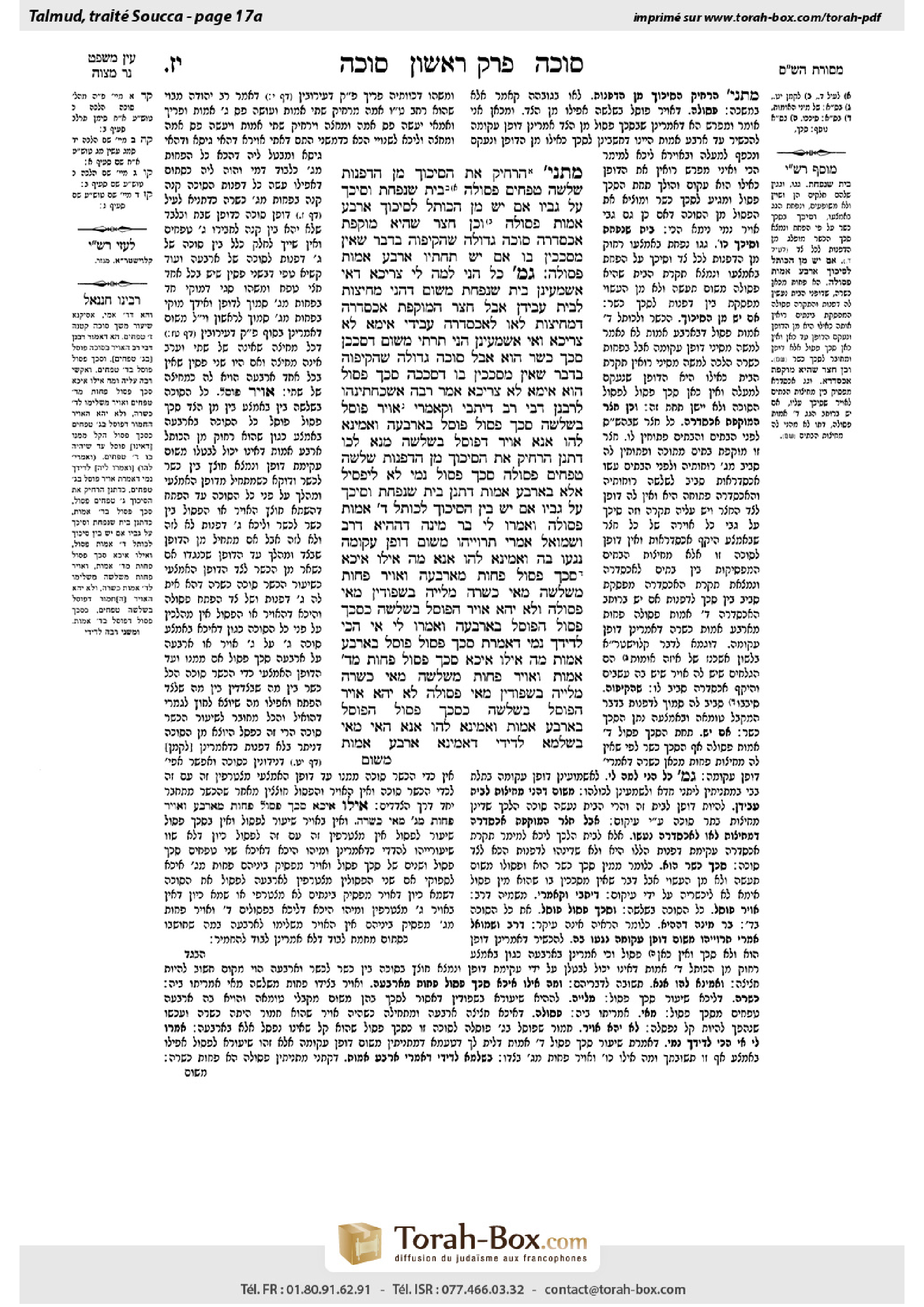
Sukkah 17a: Talmud study for Daf Yomi
Daf Yomi is the daily study of one Talmud folio. Explore 37 tractates with scans, Hebrew text, Sefaria English and AI-generated French translations where annotated.
Passage selection and English or AI-generated French translation are available where the scan has annotations. Daf Study is independent of Torah-Box and Sefaria.
Browse Sukkah · סוכה · All tractatesSukkah 17a text and translations
This page of Sukkah includes the Aramaic text, an English translation and an AI-generated French translation, alongside the scan above.
סוכה י״ז א · Aramaic and Hebrew text
מַתְנִי׳ הִרְחִיק אֶת הַסִּיכּוּךְ מִן הַדְּפָנוֹת שְׁלֹשָׁה טְפָחִים — פְּסוּלָה.
בַּיִת שֶׁנִּפְחַת וְסִיכֵּךְ עַל גַּבָּיו — אִם יֵשׁ מִן הַכּוֹתֶל לַסִּיכּוּךְ אַרְבַּע אַמּוֹת, פְּסוּלָה.
וְכֵן חָצֵר שֶׁהִיא מוּקֶּפֶת אַכְסַדְרָה, סוּכָּה גְּדוֹלָה שֶׁהִקִּיפוּהָ בְּדָבָר שֶׁאֵין מְסַכְּכִין בּוֹ — אִם יֵשׁ תַּחְתָּיו אַרְבַּע אַמּוֹת, פְּסוּלָה.
גְּמָ׳ כׇּל הָנֵי לְמָה לִי? צְרִיכָא: דְּאִי אַשְׁמְעִינַן בַּיִת שֶׁנִּפְחַת — מִשּׁוּם דְּהָנֵי מְחִיצוֹת לְבַיִת עֲבִידָן. אֲבָל חָצֵר הַמּוּקֶּפֶת אַכְסַדְרָה, דִּמְחִיצוֹת לָאו לְאַכְסַדְרָה עֲבִידִי — אֵימָא לָא, צְרִיכָא.
וְאִי אַשְׁמְעִינַן הָנֵי תַּרְתֵּי, מִשּׁוּם דִּסְכָכָן סְכָךְ כָּשֵׁר הוּא, אֲבָל סוּכָּה גְּדוֹלָה שֶׁהִקִּיפוּהָ בְּדָבָר שֶׁאֵין מְסַכְּכִין בּוֹ, דִּסְכָכָהּ סְכָךְ פָּסוּל הוּא — אֵימָא לָא, צְרִיכָא.
אָמַר רַבָּה: אַשְׁכַּחְתִּינְהוּ לְרַבָּנַן דְּבֵי רַב דְּיָתְבִי וְקָאָמְרִי: אֲוִיר פּוֹסֵל בִּשְׁלֹשָׁה, סְכָךְ פָּסוּל פּוֹסֵל בְּאַרְבָּעָה.
וְאָמֵינָא לְהוּ אֲנָא: אֲוִיר דְּפוֹסֵל בִּשְׁלֹשָׁה מְנָא לְכוּ — דִּתְנַן: הִרְחִיק אֶת הַסִּיכּוּךְ מִן הַדְּפָנוֹת שְׁלֹשָׁה טְפָחִים — פְּסוּלָה. סְכָךְ פָּסוּל נָמֵי לָא לִיפְסֹיל אֶלָּא בְּאַרְבַּע אַמּוֹת, דִּתְנַן: בַּיִת שֶׁנִּפְחַת וְסִיכֵּךְ עַל גַּבָּיו, אִם יֵשׁ בֵּין הַסִּיכּוּךְ לַכּוֹתֶל אַרְבַּע אַמּוֹת — פְּסוּלָה!
וַאֲמַרוּ לִי: בַּר מִינַּהּ דְּהַהִיא, דְּרַב וּשְׁמוּאֵל אָמְרִי תַּרְוַיְיהוּ: מִשּׁוּם דּוֹפֶן עֲקוּמָּה נָגְעוּ בָּהּ.
וְאָמֵינָא לְהוּ אֲנָא: מָה אִילּוּ אִיכָּא סְכָךְ פָּסוּל פָּחוֹת מֵאַרְבָּעָה וַאֲוִיר פָּחוֹת מִשְּׁלֹשָׁה מַאי? כְּשֵׁרָה. מַלְּיֵיהּ בְּשַׁפּוּדִין מַאי — פְּסוּלָה, וְלֹא יְהֵא אֲוִיר הַפּוֹסֵל בִּשְׁלֹשָׁה כִּסְכָךְ פָּסוּל הַפּוֹסֵל בְּאַרְבָּעָה!
וַאֲמַרוּ לִי: אִי הָכִי, לְדִידָךְ נָמֵי דְּאָמְרַתְּ סְכָךְ פָּסוּל פּוֹסֵל בְּאַרְבַּע אַמּוֹת, מָה אִילּוּ אִיכָּא סְכָךְ פָּסוּל פָּחוֹת מֵאַרְבַּע אַמּוֹת וַאֲוִיר פָּחוֹת מִשְּׁלֹשָׁה, מַאי? כְּשֵׁרָה. מַלְּיֵיהּ בְּשַׁפּוּדִין מַאי — פְּסוּלָה. לֹא יְהֵא אֲוִיר הַפּוֹסֵל בִּשְׁלֹשָׁה כִּסְכָךְ פָּסוּל הַפּוֹסֵל בְּאַרְבַּע אַמּוֹת!
וְאָמֵינָא לְהוּ אֲנָא: הַאי מַאי? בִּשְׁלָמָא לְדִידִי דְּאָמֵינָא אַרְבַּע אַמּוֹת —
Sukkah 17a · English translation
MISHNA: If one distanced the roofing from the walls of the sukka at a distance of three handbreadths the sukka is unfit, because three handbreadths of open space, even adjacent to the walls, render the sukka unfit.
In the case of a house that was breached, creating a hole in the middle of the roof, and one roofed over the breach, if from the wall to the roofing there are four or more cubits of the remaining original roof, it is an unfit sukka. If the roofing is less than four cubits from the wall, the sukka is fit, based on the principle of curved wall; the remaining intact ceiling is considered an extension of the vertical wall.
And likewise, in the case of a courtyard that is surrounded on three sides by a portico, which has a roof but no walls, if one placed roofing over the courtyard between the different sides of the portico and the roof of the portico is four cubits wide, the sukka is unfit. Similarly, a large sukka that was surrounded at the edge of its roofing with material with which one may not roof a sukka, e.g., vessels susceptible to ritual impurity, if there are four cubits beneath the unfit roofing, the sukka is unfit. The principle of curved wall does not apply to unfit roofing that measures four cubits or more.
GEMARA: The Gemara asks: Why do I need all these cases based on the identical principle of curved wall? The Gemara explains: It is necessary to cite all the cases, as, if the mishna had taught us only the case of the house that was breached, I would have said that the principle of curved wall applies there because those walls were established for the house. Therefore, when the house is transformed into a sukka, the walls continue to serve their original function as walls of the sukka. However, with regard to a courtyard surrounded on each of the three sides by a portico, where its walls were established not for the portico but for the house that opens into the portico, and they happen to serve as the interior walls of the portico, I could say no, they are not considered as connected to the roofing at all. Consequently, it is necessary for the mishna to cite that case as well.
And if the mishna taught us only these two cases, one would have said that the principle of curved wall can apply because all of their roofing is fit roofing, and the preexisting roof of the house and the portico is unfit only due to the principle: Prepare it, and not from that which has already been prepared. However, here, in the case of a large sukka that was surrounded at the edge of its roofing with material with which one may not roof a sukka, where some of its roofing is unfit and the fit roofing does not actually reach the wall, one could say no, the roofing is unfit. Therefore, it is necessary to state that case as well.
§ Rabba said: I found the Sages of the school of Rav, who were sitting and saying in the name of Rav: Space without roofing renders the sukka unfit with a measure of three handbreadths of space. However, unfit roofing renders the sukka unfit with a measure of four handbreadths.
And I said to them: From where do you derive that space renders the sukka unfit when it amounts to three handbreadths? It is as we learned in the mishna: If one distanced the roofing from the walls of the sukka at a distance of three handbreadths, the sukka is unfit. If, indeed, this mishna is the source of the halakha, also in the case of unfit roofing, let it render the sukka unfit only if the roofing measures four cubits, as we learned in the same mishna: With regard to a house that was breached and one roofed over the breach, if from the wall to the roofing there is four or more cubits of the remaining original roof, the sukka is unfit.
And they said to me: Cite proof from the mishna, apart from this case, as both Rav and Shmuel said that in this case, the Sages in the mishna touched upon the principle of curved wall. In other words, the fact that this house is a fit sukka is unrelated to the minimum measure of unfit roofing. It is fit due to the principle of curved wall.
And I said to them: What if there is a sukka with less than four handbreadths of unfit roofing and an adjacent space of less than three handbreadths; what would be the status of the sukka? The sukka would be fit, since it lacks the minimum measure of both space and unfit roofing that renders a sukka unfit. If one then filled the space with skewers, what would be the status of the sukka? It would be unfit, as there would be more than four handbreadths of unfit roofing. But shouldn’t space, which is more stringent, as it renders the sukka unfit with only three handbreadths, be as stringent as unfit roofing, which renders the sukka unfit only with four handbreadths of unfit roofing?
And they said to me: If so, according to you, who said that unfit roofing renders a sukka unfit only with four cubits of unfit roofing, the same question arises. Just as, if there were a sukka with less than four cubits of unfit roofing and an adjacent space measuring less than three handbreadths, what would be its status? It would be fit. If one then filled the space with skewers, what would be its status? It would be unfit. Here too, the question arises: Shouldn’t space, which is more stringent, as it renders the sukka unfit with only three handbreadths of space, be as stringent as unfit roofing, which renders the sukka unfit with only four cubits of unfit roofing?
And I said to them: What is this comparison? Granted, according to my opinion, that I say that the measure of unfit roofing that renders a sukka unfit is four cubits,
Sukkah 17a · Traduction française (IA)
MICHNA : Si l’on a éloigné le s’chakh des parois de la soukka de trois téfa’him, la soukka est invalide, car un espace de trois téfa’him, même adjacent aux parois, invalide la soukka.
Dans le cas d’une maison dont le toit a été éventré en son milieu et dont on a recouvert l’ouverture avec du s’chakh, si la distance entre la paroi et le s’chakh est de quatre coudées ou plus — correspondant à la partie restante de l’ancien toit —, la soukka est invalide. Si le s’chakh se trouve à moins de quatre coudées de la paroi, la soukka est valide, selon le principe de la paroi courbe : le plafond intact restant est considéré comme le prolongement de la paroi verticale.
De même, dans le cas d’une cour entourée sur trois côtés d’une galerie couverte mais dépourvue de parois, si l’on a placé du s’chakh au-dessus de la cour, entre les différents côtés de la galerie, et que le toit de la galerie mesure quatre coudées de largeur, la soukka est invalide. De même, une grande soukka dont on a entouré le bord du s’chakh d’un matériau impropre à couvrir une soukka — par exemple, des récipients susceptibles de contracter l’impureté rituelle — est invalide si la partie située sous cette couverture impropre mesure quatre coudées. Le principe de la paroi courbe ne s’applique pas à une couverture impropre d’une largeur de quatre coudées ou plus.
GUEMARA : La Guemara demande : Pourquoi faut-il rapporter tous ces cas, qui reposent sur le même principe de la paroi courbe ? La Guemara explique : Il est nécessaire de les rapporter tous. En effet, si la Michna nous avait enseigné uniquement le cas de la maison dont le toit a été éventré, j’aurais dit que le principe de la paroi courbe s’y applique parce que ces parois avaient été construites pour la maison. Par conséquent, lorsque la maison est transformée en soukka, les parois continuent à remplir leur fonction initiale de parois de la soukka. Toutefois, dans le cas d’une cour entourée sur chacun de ses trois côtés d’une galerie, dont les parois n’ont pas été construites pour la galerie mais pour la maison qui s’ouvre sur celle-ci, et qui se trouvent simplement faire office de parois intérieures de la galerie, j’aurais pu dire que non, elles ne sont pas du tout considérées comme reliées au s’chakh. Il est donc nécessaire que la Michna rapporte également ce cas.
Et si la Michna nous avait enseigné uniquement ces deux cas, on aurait dit que le principe de la paroi courbe peut s’appliquer parce que toute leur couverture est du s’chakh apte à couvrir une soukka, tandis que le toit préexistant de la maison et de la galerie est impropre uniquement en vertu du principe : « Prépare-le, mais non à partir de ce qui a déjà été préparé. » Mais ici, dans le cas d’une grande soukka dont on a entouré le bord du s’chakh d’un matériau impropre à couvrir une soukka, où une partie de la couverture est impropre et où le s’chakh apte à couvrir ne rejoint pas réellement la paroi, on pourrait dire que non, la couverture est invalide. Il est donc nécessaire de rapporter également ce cas.
§ Rabba dit : J’ai trouvé les Sages de l’école de Rav, assis et enseignant au nom de Rav : Un espace dépourvu de s’chakh invalide la soukka à partir de trois téfa’him. En revanche, une couverture impropre invalide la soukka à partir de quatre téfa’him.
Je leur ai dit : D’où déduisez-vous qu’un espace invalide la soukka lorsqu’il atteint trois téfa’him ? C’est ce que nous avons appris dans la Michna : Si l’on a éloigné le s’chakh des parois de la soukka de trois téfa’him, la soukka est invalide. Si cette Michna est effectivement la source de la halakha, alors, dans le cas d’une couverture impropre, qu’elle n’invalide également la soukka que si elle mesure quatre coudées, comme nous l’avons appris dans la même Michna : Au sujet d’une maison dont le toit a été éventré et dont on a recouvert l’ouverture, si la distance entre la paroi et le s’chakh est de quatre coudées ou plus — correspondant à la partie restante de l’ancien toit —, la soukka est invalide.
Ils m’ont dit : Cite une preuve tirée de la Michna, en dehors de ce cas, car Rav et Chmouel ont tous deux dit que, dans ce cas, les Sages de la Michna ont évoqué le principe de la paroi courbe. Autrement dit, le fait que cette maison constitue une soukka valide n’a aucun rapport avec la mesure minimale de couverture impropre. Elle est valide en vertu du principe de la paroi courbe.
Je leur ai dit : Quel serait le statut d’une soukka comportant moins de quatre téfa’him de couverture impropre et, à côté, un espace de moins de trois téfa’him ? La soukka serait valide, puisqu’elle n’atteint la mesure minimale ni pour l’espace ni pour la couverture impropre qui invalident une soukka. Si l’on remplissait ensuite l’espace avec des broches, quel serait le statut de la soukka ? Elle serait invalide, car il y aurait alors plus de quatre téfa’him de couverture impropre. Mais l’espace, qui est plus rigoureux puisqu’il invalide la soukka dès trois téfa’him, ne devrait-il pas être aussi rigoureux que la couverture impropre, qui n’invalide la soukka qu’à partir de quatre téfa’him de couverture impropre ?
Ils m’ont dit : Dans ce cas, selon toi, qui soutiens qu’une couverture impropre n’invalide la soukka qu’à partir de quatre coudées de couverture impropre, la même question se pose. Si une soukka comportait moins de quatre coudées de couverture impropre et, à côté, un espace de moins de trois téfa’him, quel serait son statut ? Elle serait valide. Si l’on remplissait ensuite l’espace avec des broches, quel serait son statut ? Elle serait invalide. Ici aussi, la question se pose : l’espace, qui est plus rigoureux puisqu’il invalide la soukka dès trois téfa’him, ne devrait-il pas être aussi rigoureux que la couverture impropre, qui n’invalide la soukka qu’à partir de quatre coudées de couverture impropre ?
Je leur ai dit : Quelle est cette comparaison ? Certes, selon mon opinion, puisque je soutiens que la mesure de couverture impropre qui invalide une soukka est de quatre coudées,
Traduction française générée par IA à partir de l’édition anglaise de Sefaria. Vérifie toujours un passage avec le texte source.
Text from Sefaria: William Davidson Edition - Vocalized Aramaic (CC BY NC); William Davidson Edition - English (CC BY NC).