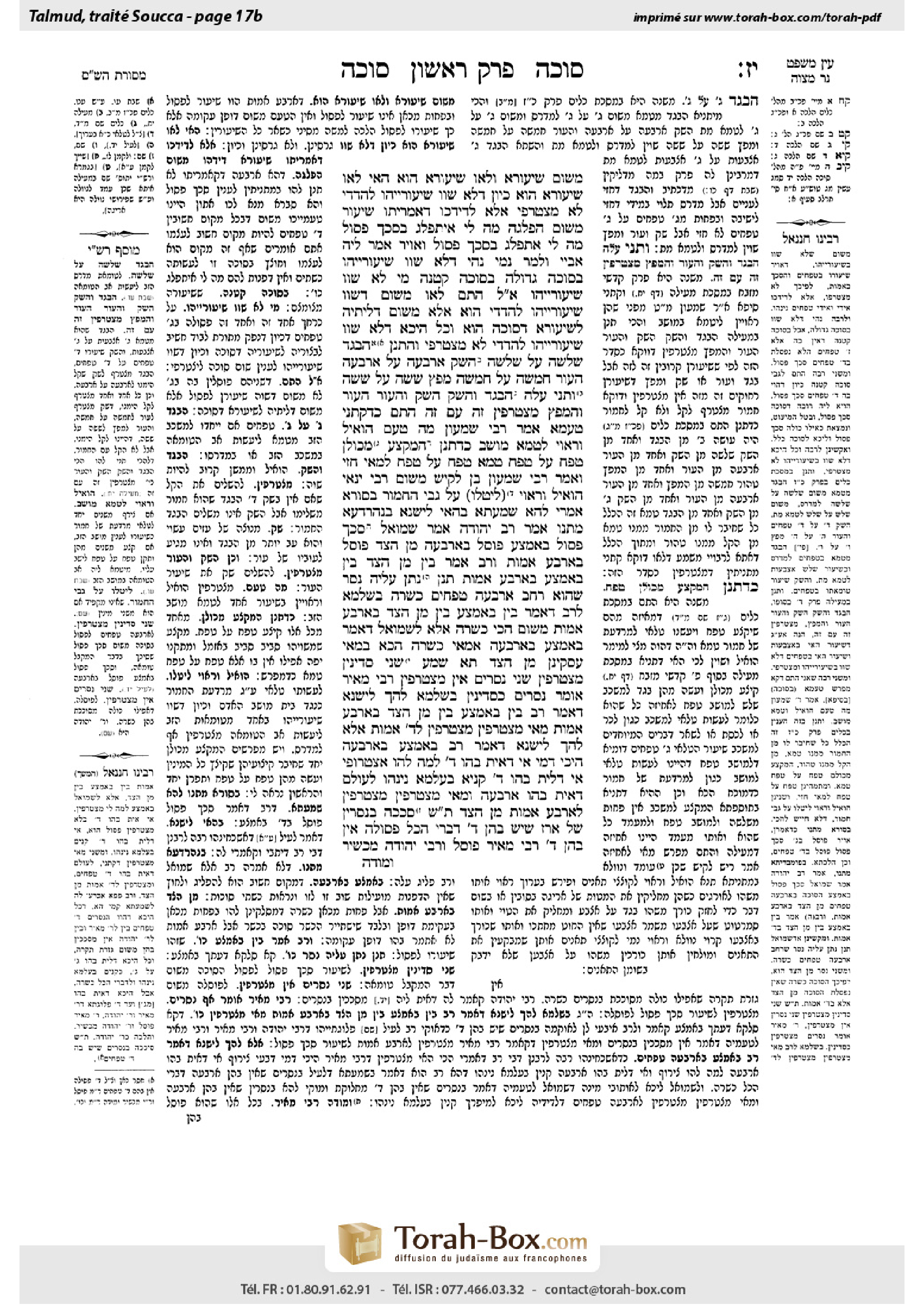
Sukkah 17b: Talmud study for Daf Yomi
Daf Yomi is the daily study of one Talmud folio. Explore 37 tractates with scans, Hebrew text, Sefaria English and AI-generated French translations where annotated.
Passage selection and English or AI-generated French translation are available where the scan has annotations. Daf Study is independent of Torah-Box and Sefaria.
Browse Sukkah · סוכה · All tractatesSukkah 17b text and translations
This page of Sukkah includes the Aramaic text, an English translation and an AI-generated French translation, alongside the scan above.
סוכה י״ז ב · Aramaic and Hebrew text
מִשּׁוּם שִׁיעוּרָא וְלָאו שִׁיעוּרָא הוּא. הַאי לָאו שִׁיעוּרָא הוּא, כֵּיוָן דְּלָא שָׁווּ שִׁיעוּרַיְיהוּ לַהֲדָדֵי — לָא מִצְטָרְפִי.
אֶלָּא לְדִידְכוּ דְּאָמְרִיתוּ שִׁיעוּר מִשּׁוּם הַפְלָגָה — מָה לִי אִיתַּפְלַג בִּסְכָךְ פָּסוּל, מָה לִי אִתַּפְלַג בִּסְכָךְ פָּסוּל וַאֲוִיר.
אֲמַר לֵיהּ אַבָּיֵי: וּלְמָר נָמֵי, נְהִי דְּלָא שָׁווּ שִׁיעוּרַיְיהוּ בְּסוּכָּה גְּדוֹלָה, בְּסוּכָּה קְטַנָּה מִי לָא שָׁווּ שִׁיעוּרַיְיהוּ?
אֲמַר לֵיהּ: הָתָם לָאו מִשּׁוּם דְּשָׁווּ שִׁיעוּרַיְיהוּ לַהֲדָדֵי הוּא, אֶלָּא מִשּׁוּם דְּלֵיתֵיהּ לְשִׁיעוּרָא דְסוּכָּה הוּא.
וְכׇל הֵיכָא דְּלָא שָׁווּ שִׁיעוּרַיְיהוּ לַהֲדָדֵי לָא מִצְטָרְפִי? וְהָתְנַן: הַבֶּגֶד שְׁלֹשָׁה עַל שְׁלֹשָׁה, הַשַּׂק אַרְבָּעָה עַל אַרְבָּעָה, הָעוֹר חֲמִשָּׁה עַל חֲמִשָּׁה, מַפָּץ שִׁשָּׁה עַל שִׁשָּׁה.
וְתָנֵי עֲלַהּ: הַבֶּגֶד וְהַשַּׂק, הַשַּׂק וְהָעוֹר, הָעוֹר וְהַמַּפָּץ — מִצְטָרְפִין זֶה עִם זֶה.
הָתָם כִּדְקָתָנֵי טַעְמָא, אָמַר רַבִּי שִׁמְעוֹן: מָה טַעַם — הוֹאִיל וְרָאוּי לְטַמֵּא מוֹשָׁב. כְּדִתְנַן: הַמְקַצֵּעַ מִכּוּלָּן טֶפַח עַל טֶפַח — טָמֵא.
טֶפַח עַל טֶפַח לְמַאי חֲזֵי? וְאָמַר רַבִּי שִׁמְעוֹן בֶּן לָקִישׁ מִשּׁוּם רַבִּי יַנַּאי: הוֹאִיל וְרָאוּי (לִיטְּלוֹ) עַל גַּבֵּי הַחֲמוֹר.
בְּסוּרָא אָמְרִי לְהָא שְׁמַעְתָּא בְּהַאי לִישָּׁנָא. בִּנְהַרְדְּעָא מַתְנוּ: אָמַר רַב יְהוּדָה אָמַר שְׁמוּאֵל: סְכָךְ פָּסוּל בָּאֶמְצַע — פּוֹסֵל בְּאַרְבָּעָה. מִן הַצַּד — פּוֹסֵל בְּאַרְבַּע אַמּוֹת. וְרַב אָמַר: בֵּין מִן הַצַּד בֵּין בָּאֶמְצַע — בְּאַרְבַּע אַמּוֹת.
תְּנַן: נָתַן עָלֶיהָ נֶסֶר שֶׁהוּא רָחָב אַרְבָּעָה טְפָחִים — כְּשֵׁרָה. בִּשְׁלָמָא לְרַב דְּאָמַר בֵּין בָּאֶמְצַע בֵּין מִן הַצַּד בְּאַרְבַּע אַמּוֹת, מִשּׁוּם הָכִי כְּשֵׁרָה. אֶלָּא לִשְׁמוּאֵל דְּאָמַר בָּאֶמְצַע בְּאַרְבָּעָה — אַמַּאי כְּשֵׁרָה? הָכָא בְּמַאי עָסְקִינַן — מִן הַצַּד.
תָּא שְׁמַע: שְׁנֵי סְדִינִין — מִצְטָרְפִין. שְׁנֵי נְסָרִים — אֵין מִצְטָרְפִין. רַבִּי מֵאִיר אוֹמֵר: נְסָרִים כִּסְדִינִין.
בִּשְׁלָמָא לְהָךְ לִישָּׁנָא דְּאָמַר רַב בֵּין בָּאֶמְצַע בֵּין מִן הַצַּד בְּאַרְבַּע אַמּוֹת, מַאי ״מִצְטָרְפִין״ — מִצְטָרְפִין לְאַרְבַּע אַמּוֹת. אֶלָּא לְהָךְ לִישָּׁנָא דְּאָמַר רַב בָּאֶמְצַע בְּאַרְבָּעָה, הֵיכִי דָּמֵי? אִי דְּאִית בְּהוּ אַרְבָּעָה, לְמָה לְהוּ אִצְטְרוֹפֵי? אִי דְּלֵית בְּהוּ אַרְבָּעָה, קַנְיָא בְּעָלְמָא נִינְהוּ?
לְעוֹלָם דְּאִית בְּהוּ אַרְבָּעָה, וּמַאי ״מִצְטָרְפִין״ — מִצְטָרְפִין לְאַרְבַּע אַמּוֹת מִן הַצַּד.
תָּא שְׁמַע: סִכְּכָהּ בִּנְסָרִין שֶׁל אֶרֶז שֶׁיֵּשׁ בָּהֶן אַרְבָּעָה — דִּבְרֵי הַכֹּל פְּסוּלָה. אֵין בָּהֶן אַרְבָּעָה — רַבִּי מֵאִיר פּוֹסֵל וְרַבִּי יְהוּדָה מַכְשִׁיר.
Sukkah 17b · English translation
the status of the sukka is determined on the basis of whether it is the requisite measure or it is not the requisite measure. In other words, the difference between unfit roofing that is four cubits and unfit roofing that is less is a unique halakha, completely unrelated to the principle of curved wall. Similarly, it is a unique halakha that three handbreadths of space in a roof render a sukka unfit. In this case, there is not the requisite measure according to either halakha; and since their measures are not equal to each other, they do not combine to render the sukka unfit. The sukka is rendered unfit only when the measure of unfit roofing reaches four cubits.
However, according to you, who say that the measure of four handbreadths for unfit roofing is due to the distance between the wall and the fit roofing, which renders the sukka unfit, what is the difference to me if it was distanced due to unfit roofing, and what is the difference to me if it was distanced due to a combination of unfit roofing and space? In either case, the distance between the roofing and the wall should prevent connecting the roofing to the wall. This concludes Rabba’s account of his exchange with the Sages of the school of Rav.
Abaye said to Rabba: And according to the Master, too, although their measures are not equal in a large sukka, which is larger than four cubits, in a small sukka aren’t their measures equal? In a minimally sized sukka, seven by seven handbreadths, three handbreadths of unfit roofing must render the sukka unfit. If the measure of fitness were to remain up to four handbreadths, that would mean that a sukka with a majority of unfit roofing is fit, which is unreasonable. Therefore, Rabba’s contention that the measures of unfit roofing and space are totally different is not precise.
Rabba said to him: There, in the case of the minimally-sized sukka, the fact that the sukka is unfit is not due to the fact that their measures are equal. Rather, it is due to the fact that in a case where the unfit roofing is three handbreadths, the sukka lacks the minimum required measure of fit roofing. In other words, it is not the amount of unfit roofing that creates the problem; rather, it is that the fit area of the sukka is too small.
Rabba maintains that since the two requisite measures of unfitness are not equal, they do not join together. The Gemara asks: And anywhere that their measures are not equal, do they not combine to constitute the requisite measure? But didn’t we learn in the mishna: The garment must be at least three by three handbreadths in order to become a primary source of ritual impurity by means of ritual impurity imparted by treading of a zav; and the sackcloth made from goats’ hair must be at least four by four handbreadths; and the animal hide must be five by five; and a mat must be six by six?
And a baraita is taught concerning the mishna: The garment and the sackcloth, the sackcloth and the hide, and the hide and the mat join together with one another. If one attaches a piece of material that has a smaller, more stringent measure for ritual impurity to a piece of material that has a larger, more lenient measure, the combined cloth is susceptible to contract ritual impurity if together they compose the larger measure. Apparently, two items whose measures are not equal combine to compose the more lenient measure.
The Gemara rejects this. There, it is as the reason is taught that Rabbi Shimon said: What is the reason that these different fabrics combine? They combine since all the component materials are fit to become ritually impure through the ritual impurity imparted to a seat upon which a zav sits, as they can each be used to patch a saddle or saddlecloth. Since they are all suitable for the same use, they join together with regard to the halakhot of ritual impurity. As we learned in a mishna: In the case of one who trims and processes a piece of any of the above-mentioned materials measuring one handbreadth by one handbreadth, that piece is capable of becoming ritually impure. There is a certain halakha for which each of the different materials has the same measure; they therefore join together in other areas as well.
The Gemara asks: For what use is a cloth that is one handbreadth by one handbreadth fit? After all, a rag that has no use does not contract ritual impurity. Rabbi Shimon ben Lakish said in the name of Rabbi Yannai: Since it is suitable for use as a patch on a donkey’s saddlecloth, it is capable of contracting ritual impurity. This ends the discussion of the exchange between Rabba and the Sages of the school of Rav.
The Gemara notes: In Sura, they stated this halakha in that language cited above. In Neharde’a, however, they taught it as follows: Rav Yehuda said that Shmuel said: Unfit roofing in the center of the sukka renders the sukka unfit with a measure of four handbreadths of unfit roofing. Along the side of the sukka, it renders the sukka unfit with a measure of four cubits of unfit roofing. And Rav said: Both along the side and in the center, it renders the sukka unfit with a measure of four cubits of unfit roofing.
We learned in a mishna: If one placed a board that is four handbreadths wide atop the sukka, the sukka is fit. And the Gemara asks: Granted, according to Rav, who said that both along the side and in the center, a sukka is rendered unfit with a measure of four cubits of unfit roofing, it is due to that reason that the sukka is fit. However, according to Shmuel, who said that in the center of the sukka, the sukka is rendered unfit with a measure of four handbreadths of unfit roofing, why is the sukka fit? The Gemara answers: With what are we dealing here? It is with a case where he placed the beam along the side; but had he placed it in the center, then according to Shmuel the sukka would indeed be unfit.
The Gemara cites a proof with regard to Rav’s opinion. Come and hear: Two sheets placed over the roofing of the sukka join together to render the sukka unfit. However, two boards placed on the sukka do not combine to render the sukka unfit. Rabbi Meir says: Even boards have the same legal status as sheets, and they combine to render the sukka unfit.
The Gemara clarifies: Granted, according to that version from Neharde’a that Rav said: Both along the side and in the center, a sukka is rendered unfit with a measure of four cubits of unfit roofing, what is the meaning of join together? It means that the two unfit objects join together to comprise four cubits. However, according to this version from Sura, in which Rav said: A sukka is rendered unfit with a measure of four handbreadths of unfit roofing in the center, what are the circumstances? If each of the boards has four handbreadths in its width, why must they join together to render the sukka unfit? If each board is four handbreadths wide, each is capable of rendering the sukka unfit on its own, and if each of the boards does not have four handbreadths in its width, why would Rabbi Meir prohibit their use; they are merely reeds?
The Gemara answers: Actually, it is a case where each of the boards has four handbreadths in its width, and what is the meaning of join together? It means they join together to constitute four cubits along the side. This understanding fits both versions of Rav’s opinion.
Come and hear proof from another baraita: If one roofed the entire sukka with cedar beams that have four handbreadths in their width, everyone agrees that the sukka is unfit. If they do not have four handbreadths in their width, Rabbi Meir deems the sukka unfit and Rabbi Yehuda deems it fit.
Sukkah 17b · Traduction française (IA)
Le statut de la soukka est déterminé selon qu’elle atteint ou non la mesure requise. Autrement dit, la différence entre une couverture impropre de quatre coudées et une couverture impropre de moindre largeur relève d’une halakha particulière, entièrement étrangère au principe du mur courbe. De même, le fait que trois téfa’him d’espace dans la toiture rendent une soukka impropre relève d’une halakha particulière. En l’occurrence, la mesure requise n’est atteinte selon aucune des deux halakhot ; et puisque leurs mesures ne sont pas égales, elles ne se combinent pas pour rendre la soukka impropre. La soukka ne devient impropre que lorsque la mesure de la couverture impropre atteint quatre coudées.
Cependant, selon toi, qui dis que la mesure de quatre téfa’him de couverture impropre s’explique par la distance entre le mur et la couverture apte, distance qui rend la soukka impropre, quelle importance y a-t-il à ce que cette distance soit due à une couverture impropre ou à une combinaison de couverture impropre et d’espace ? Dans les deux cas, la distance entre la couverture et le mur devrait empêcher de rattacher la couverture au mur. Ainsi s’achève le récit de Rabba au sujet de son échange avec les Sages de l’école de Rav.
Abayé dit à Rabba : Même selon le maître, bien que leurs mesures ne soient pas égales dans une grande soukka, de plus de quatre coudées, dans une petite soukka, leurs mesures ne sont-elles pas égales ? Dans une soukka de taille minimale, de sept téfa’him sur sept, trois téfa’him de couverture impropre doivent rendre la soukka impropre. Si la mesure requise de couverture apte était de quatre téfa’him, cela signifierait qu’une soukka dont la majorité de la couverture est impropre serait apte, ce qui est déraisonnable. Par conséquent, l’affirmation de Rabba selon laquelle les mesures de la couverture impropre et de l’espace sont entièrement différentes n’est pas exacte.
Rabba lui dit : Dans le cas de la soukka de taille minimale, celle-ci est impropre non pas parce que les mesures sont égales, mais parce que, lorsque la couverture impropre mesure trois téfa’him, la soukka ne comporte pas la mesure minimale requise de couverture apte. Autrement dit, le problème ne vient pas de la quantité de couverture impropre ; c’est plutôt la surface apte de la soukka qui est trop petite.
Rabba estime que, puisque les deux mesures requises qui rendent la soukka impropre ne sont pas égales, elles ne se combinent pas. La Guemara demande : Mais partout où leurs mesures ne sont pas égales, ne se combinent-elles pas pour constituer la mesure requise ? N’avons-nous pas appris dans la Michna : Un vêtement doit mesurer au moins trois téfa’him sur trois pour devenir une source primaire d’impureté rituelle par l’impureté transmise par le piétinement d’un zav ; le sac en poil de chèvre doit mesurer au moins quatre téfa’him sur quatre ; la peau de bête, cinq téfa’him sur cinq ; et une natte, six téfa’him sur six ?
Et une baraïta est enseignée à propos de la Michna : Le vêtement et le sac en poil de chèvre, le sac en poil de chèvre et la peau, ainsi que la peau et la natte se combinent. Si l’on attache un morceau de matière dont la mesure requise pour contracter l’impureté rituelle est plus petite, et donc plus stricte, à un morceau dont la mesure requise est plus grande, et donc plus souple, l’ensemble est susceptible de contracter l’impureté rituelle si les deux morceaux atteignent ensemble la mesure la plus grande. Il apparaît donc que deux objets dont les mesures ne sont pas égales se combinent pour atteindre la mesure la plus souple.
La Guemara rejette cette preuve. Dans ce cas, la raison est enseignée, comme l’a dit Rabbi Shimon : Pour quelle raison ces différentes étoffes se combinent-elles ? Elles se combinent parce que toutes les matières qui les composent sont susceptibles de contracter l’impureté rituelle d’un siège sur lequel s’assied un zav, puisque chacune peut servir à réparer une selle ou un tapis de selle. Comme elles conviennent toutes au même usage, elles se combinent pour les halakhot de l’impureté rituelle. En effet, nous avons appris dans une Michna : Celui qui taille et apprête un morceau d’une des matières mentionnées ci-dessus, mesurant un téfa’h sur un téfa’h, rend ce morceau susceptible de contracter l’impureté rituelle. Pour une certaine halakha, chacune des différentes matières a la même mesure requise ; elles se combinent donc aussi dans d’autres domaines.
La Guemara demande : À quel usage peut servir une étoffe d’un téfa’h sur un téfa’h ? Après tout, un chiffon qui n’a aucune utilité ne contracte pas l’impureté rituelle. Rabbi Shimon ben Lakish a dit au nom de Rabbi Yannai : Puisqu’elle peut servir de pièce de réparation au tapis de selle d’un âne, elle est susceptible de contracter l’impureté rituelle. La discussion de l’échange entre Rabba et les Sages de l’école de Rav prend fin ici.
La Guemara relève : À Soura, ils ont formulé cette halakha dans les termes cités plus haut. À Nehardéa, en revanche, ils l’ont enseignée ainsi : Rav Yehouda a dit que Shmouel a dit : Une couverture impropre au centre de la soukka la rend impropre à partir d’une mesure de quatre téfa’him. Sur le côté de la soukka, elle la rend impropre à partir d’une mesure de quatre coudées. Et Rav a dit : Sur le côté comme au centre, une couverture impropre rend la soukka impropre à partir d’une mesure de quatre coudées.
Nous avons appris dans une Michna : Si quelqu’un pose une planche large de quatre téfa’him sur la soukka, celle-ci est apte. La Guemara demande : Cela se comprend selon Rav, qui a dit que, sur le côté comme au centre, une soukka devient impropre à partir d’une mesure de quatre coudées de couverture impropre ; c’est pour cette raison que la soukka est apte. Mais selon Shmouel, qui a dit qu’au centre de la soukka, celle-ci devient impropre à partir d’une mesure de quatre téfa’him de couverture impropre, pourquoi la soukka est-elle apte ? La Guemara répond : De quel cas s’agit-il ici ? D’un cas où il a posé la planche sur le côté ; mais s’il l’avait posée au centre, la soukka serait effectivement impropre selon Shmouel.
La Guemara apporte une preuve concernant l’opinion de Rav. Viens et entends : Deux étoffes placées au-dessus de la toiture de la soukka se combinent pour la rendre impropre. En revanche, deux planches placées sur la soukka ne se combinent pas pour la rendre impropre. Rabbi Meïr dit : Les planches ont le même statut que les étoffes et se combinent pour rendre la soukka impropre.
La Guemara précise : Cela se comprend selon la version de Nehardéa, selon laquelle Rav a dit : Sur le côté comme au centre, une soukka devient impropre à partir d’une mesure de quatre coudées de couverture impropre. Que signifie alors « se combiner » ? Cela signifie que les deux éléments impropres se combinent pour atteindre quatre coudées. Mais selon la version de Soura, où Rav a dit qu’une soukka devient impropre au centre à partir d’une mesure de quatre téfa’him de couverture impropre, quelles sont les circonstances ? Si chacune des planches mesure quatre téfa’him de large, pourquoi faut-il qu’elles se combinent pour rendre la soukka impropre ? Si chaque planche mesure quatre téfa’him de large, chacune peut rendre la soukka impropre à elle seule ; et si aucune des planches ne mesure quatre téfa’him de large, pourquoi Rabbi Meïr interdirait-il de les utiliser ? Ce ne sont que des roseaux.
La Guemara répond : En réalité, il s’agit d’un cas où chacune des planches mesure quatre téfa’him de large. Que signifie alors « se combiner » ? Cela signifie qu’elles se combinent pour atteindre quatre coudées sur le côté. Cette interprétation convient aux deux versions de l’opinion de Rav.
Viens et entends une preuve tirée d’une autre baraïta : Si quelqu’un couvre toute la soukka avec des poutres de cèdre larges de quatre téfa’him, tous conviennent que la soukka est impropre. Si elles ne mesurent pas quatre téfa’him de large, Rabbi Meïr considère la soukka comme impropre et Rabbi Yehouda la considère comme apte.
Traduction française générée par IA à partir de l’édition anglaise de Sefaria. Vérifie toujours un passage avec le texte source.
Text from Sefaria: William Davidson Edition - Vocalized Aramaic (CC BY NC); William Davidson Edition - English (CC BY NC).