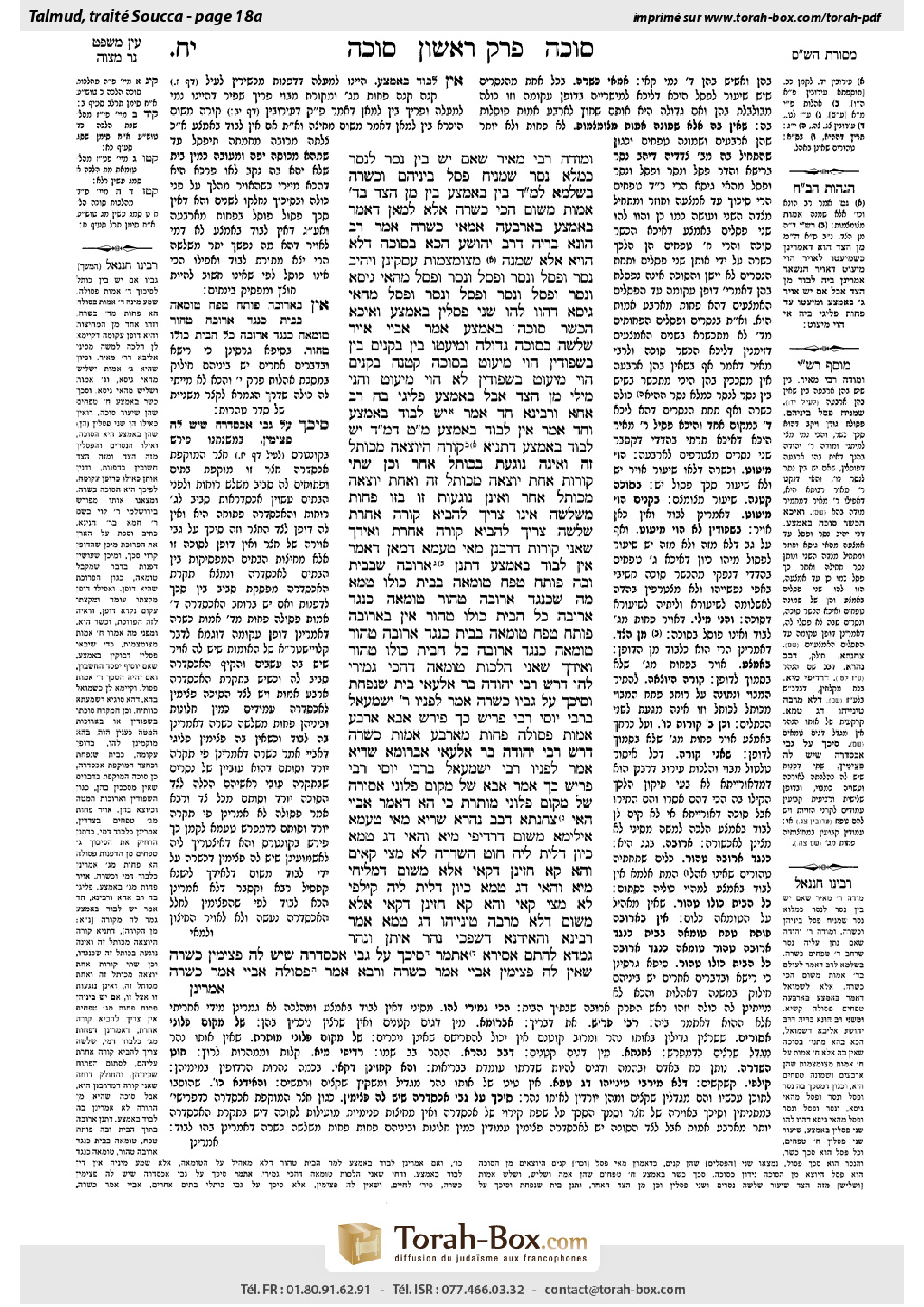
Sukkah 18a: Talmud study for Daf Yomi
Daf Yomi is the daily study of one Talmud folio. Explore 37 tractates with scans, Hebrew text, Sefaria English and AI-generated French translations where annotated.
Passage selection and English or AI-generated French translation are available where the scan has annotations. Daf Study is independent of Torah-Box and Sefaria.
Browse Sukkah · סוכה · All tractatesSukkah 18a text and translations
This page of Sukkah includes the Aramaic text, an English translation and an AI-generated French translation, alongside the scan above.
סוכה י״ח א · Aramaic and Hebrew text
וּמוֹדֶה רַבִּי מֵאִיר שֶׁאִם יֵשׁ בֵּין נֶסֶר לְנֶסֶר כִּמְלֹא נֶסֶר — שֶׁמַּנִּיחַ פְּסָל בֵּינֵיהֶם וּכְשֵׁרָה.
בִּשְׁלָמָא לְמַאן דְּאָמַר בֵּין בָּאֶמְצַע בֵּין מִן הַצַּד בְּאַרְבַּע אַמּוֹת — מִשּׁוּם הָכִי כְּשֵׁרָה. אֶלָּא לְמַאן דְּאָמַר בָּאֶמְצַע בְּאַרְבָּעָה, אַמַּאי כְּשֵׁרָה?
אָמַר רַב הוּנָא בְּרֵיהּ דְּרַב יְהוֹשֻׁעַ: הָכָא בְּסוּכָּה דְּלָא הָוְיָא אֶלָּא שְׁמֹנֶה מְצוּמְצָמוֹת עָסְקִינַן, וְיָהֵיב נֶסֶר וּפְסָל וְנֶסֶר וּפְסָל וְנֶסֶר וּפְסָל מֵהַאי גִּיסָא, וְנֶסֶר וּפְסָל וְנֶסֶר וּפְסָל וְנֶסֶר וּפְסָל מֵהַאי גִּיסָא,
דְּהָווּ לְהוּ שְׁנֵי פְסָלִין בָּאֶמְצַע, וְאִיכָּא הֶכְשֵׁר סוּכָּה בָּאֶמְצַע.
אָמַר אַבָּיֵי: אֲוִיר שְׁלֹשָׁה בְּסוּכָּה גְּדוֹלָה וּמִיעֲטוֹ, בֵּין בְּקָנִים בֵּין בְּשַׁפּוּדִין — הָוֵי מִיעוּט. בְּסוּכָּה קְטַנָּה, בְּקָנִים — הָוֵי מִיעוּט, בְּשַׁפּוּדִין — לָא הָוֵי מִיעוּט.
וְהָנֵי מִילֵּי מִן הַצַּד. אֲבָל בָּאֶמְצַע — פְּלִיגִי בַּהּ רַב אַחָא וְרָבִינָא, חַד אָמַר: יֵשׁ לָבוּד בָּאֶמְצַע, וְחַד אָמַר: אֵין לָבוּד בָּאֶמְצַע.
מַאי טַעְמֵיהּ דְּמַאן דְּאָמַר יֵשׁ לָבוּד בָּאֶמְצַע — דְּתַנְיָא: קוֹרָה הַיּוֹצְאָה מִכּוֹתֶל זֶה וְאֵינָהּ נוֹגַעַת בְּכוֹתֶל אַחֵר, וְכֵן שְׁתֵּי קוֹרוֹת, אַחַת יוֹצְאָה מִכּוֹתֶל זֶה וְאַחַת יוֹצְאָה מִכּוֹתֶל אַחֵר וְאֵינָן נוֹגְעוֹת זוֹ בָּזוֹ — פָּחוֹת מִשְּׁלֹשָׁה, אֵינוֹ צָרִיךְ לְהָבִיא קוֹרָה אַחֶרֶת. שְׁלֹשָׁה — צָרִיךְ לְהָבִיא קוֹרָה אַחֶרֶת.
וְאִידַּךְ — שָׁאנֵי קוֹרוֹת דְּרַבָּנַן.
מַאי טַעְמָא דְּמַאן דְּאָמַר אֵין לָבוּד בָּאֶמְצַע — דִּתְנַן: אֲרוּבָּה שֶׁבַּבַּיִת וּבָהּ פּוֹתֵחַ טֶפַח, טוּמְאָה בַּבַּיִת — כּוּלּוֹ טָמֵא, מַה שֶּׁכְּנֶגֶד אֲרוּבָּה — טָהוֹר. טוּמְאָה כְּנֶגֶד אֲרוּבָּה — כָּל הַבַּיִת כּוּלּוֹ טָהוֹר.
אֵין בָּאֲרוּבָּה פּוֹתֵחַ טֶפַח, טוּמְאָה בַּבַּיִת — כְּנֶגֶד אֲרוּבָּה, טָהוֹר. טוּמְאָה כְּנֶגֶד אֲרוּבָּה — כָּל הַבַּיִת כּוּלּוֹ טָהוֹר.
וְאִידַּךְ? שָׁאנֵי הִלְכוֹת טוּמְאָה דְּהָכִי גְּמִירִי לְהוּ.
דָּרֵשׁ רַבִּי יְהוּדָה בַּר אִלְעַאי: בַּיִת שֶׁנִּפְחַת וְסִיכֵּךְ עַל גַּבָּיו — כְּשֵׁרָה. אָמַר לְפָנָיו רַבִּי יִשְׁמָעֵאל בְּרַבִּי יוֹסֵי: רַבִּי, פָּרֵישׁ, כָּךְ פֵּירַשׁ אַבָּא: אַרְבַּע אַמּוֹת פְּסוּלָה, פָּחוֹת מֵאַרְבַּע אַמּוֹת כְּשֵׁרָה.
דָּרֵשׁ רַבִּי יְהוּדָה בַּר אִלְעַאי: אַבְרוּמָא שַׁרְיָא. אֲמַר לְפָנָיו רַבִּי יִשְׁמָעֵאל בְּרַבִּי יוֹסֵי: רַבִּי, פָּרֵישׁ, כָּךְ אָמַר אַבָּא: שֶׁל מָקוֹם פְּלוֹנִי — אֲסוּרָה, שֶׁל מָקוֹם פְּלוֹנִי — מוּתֶּרֶת.
כִּי הָא דְּאָמַר אַבָּיֵי: הַאי צַחַנְתָּא דְּבָב נַהֲרָא שַׁרְיָא. מַאי טַעְמָא? אִילֵּימָא מִשּׁוּם דִּרְדִיפִי מַיָּא, וְהַאי דָּג טָמֵא כֵּיוָן דְּלֵית לֵיהּ חוּט הַשִּׁדְרָה לָא מָצֵי קָאֵים — וְהָא קָא חָזֵינַן דְּקָאֵי!
אֶלָּא מִשּׁוּם דִּמְלִיחִי מַיָּא, וְהַאי דָּג טָמֵא, כֵּיוָן דְּלֵית לֵיהּ קִילְפֵי לָא מָצֵי קָאֵי — וְהָא קָא חָזֵינַן דְּקָאֵי! אֶלָּא: מִשּׁוּם דְּלָא מְרַבֵּה טִינַיְיהוּ דָּג טָמֵא. אֲמַר רָבִינָא: וְהָאִידָּנָא, דְּשָׁפְכִי נְהַר אֵיתָן וּנְהַר גַּמְדָּא לְהָתָם, אֲסִירָא.
אִתְּמַר: סִיכֵּךְ עַל גַּבֵּי אַכְסַדְרָה שֶׁיֵּשׁ לָהּ פַּצִּימִין — כְּשֵׁרָה. שֶׁאֵין לָהּ פַּצִּימִין, אַבָּיֵי אָמַר: כְּשֵׁרָה, וְרָבָא אָמַר: פְּסוּלָה. אַבָּיֵי אָמַר כְּשֵׁרָה —
Sukkah 18a · English translation
And Rabbi Meir concedes that if there is between one board and another board a gap the complete width of a board, then one places fit roofing from the waste of the threshing floor and the winepress, and the sukka is fit.
The Gemara clarifies: Granted, according to the one who said: Both along the side and in the center a sukka is rendered unfit with a measure of four cubits of unfit roofing, it is due to that reason that the sukka under discussion is fit, as none of the boards is four cubits wide. However, according to the one who said that a sukka is rendered unfit with a measure of four handbreadths of unfit roofing in the center, why is the sukka fit? Each board is capable on its own of rendering the sukka unfit.
Rav Huna, son of Rav Yehoshua, said: Here, we are dealing with a sukka that is exactly eight cubits, i.e., forty-eight handbreadths, wide, and one began placing the roofing from the side. And he places a four-handbreadth board and then four handbreadths of waste, and another board and waste, and a board and waste, from this side, so that the total measure of roofing from that side is twenty-four handbreadths. And then a beam and waste, a beam and waste, and a beam and waste, from that side, so that the total measure of roofing from that side is twenty-four handbreadths.
The result is that the sukka has two four-handbreadth stretches of waste in the middle of the sukka, totaling eight handbreadths. In that case, there is the minimum measure of fit roofing required for fitness of a sukka in the middle, and everyone agrees that the unfit roofing in the rest of the sukka cannot render it unfit. Since the unfit roofing measures less than four cubits on either side, the sukka is fit both according to the principle of curved wall and according to the opinion that unfit roofing renders the sukka unfit with four cubits.
§ Abaye said: If there is space measuring three handbreadths in a large sukka, which is defined as one larger than seven by seven handbreadths, and one diminished the space, whether he did so with branches, fit for roofing, or whether he did so with metal skewers, unfit roofing, it is an effective diminution, as there is neither sufficient space nor sufficient unfit roofing to render the sukka unfit. However, in a small sukka, if one diminished the space with branches it is an effective diminution; if he diminished the space with skewers, it is not an effective diminution and the sukka is unfit. The three handbreadths of skewers, while insufficient to render the sukka unfit, diminish the fit area of the sukka to the point that the measure that remains does not constitute a fit sukka.
The Gemara notes: And this applies only if the space is along the side of the sukka, in which case the principle of lavud applies. However, if the space is in the center of the sukka, Rav Aḥa and Ravina disagree with regard to the ruling. One said: The principle of lavud is applied even in the center of the sukka. And one said: The principle of lavud is not applied in the center of the sukka. Even if one diminished the space, the two sides of the roofing are not considered joined.
The Gemara explains: What is the rationale for the opinion of the one who said: The principle of lavud is applied even in the center of the sukka? It is as it is taught in the Tosefta: With regard to a cross beam of the merging of alleyways that projects from this wall of an alleyway but does not touch the other opposite wall, and similarly, with regard to two cross beams, one projecting from this wall and one projecting from the other opposite wall and they do not touch each other, if there is a gap of less than three handbreadths between the beam and the wall or between the two beams respectively, one need not bring another cross beam to render the alleyway fit for one to carry within it, as they are considered joined based on the principle of lavud. However, if there is a gap of three handbreadths, one must bring another cross beam. Apparently, the principle of lavud is applied even in the center.
The Gemara asks: And the other Sage, who holds that lavud does not apply in the center, how would he explain the Tosefta? The Gemara clarifies that he would say that beams are different because the prohibition against carrying in an alleyway is a decree by rabbinic law, and it is a rabbinic ordinance that beams may be placed at the entrance to the alleyway to permit carrying therein, the Sages were lenient. Therefore, proof cannot be cited from the case of the beams with regard to other situations.
What is the reason for the opinion of the one who said: The principle of lavud does not apply in the center? It is as we learned in a mishna: In the case of a skylight in the roof of a house whose opening is one square handbreadth, if there is a source of ritual impurity imparted by a corpse inside the house, all the objects in the entire house become ritually impure, as the legal status of the roof is that of a tent over a corpse. However, the objects that are directly opposite the skylight are ritually pure, as the roof does not cover that part of the house. If the source of ritual impurity is itself situated aligned with the skylight, all the objects in the entire house are ritually pure, as there is no roof over the source of impurity.
If the skylight does not have an opening of a square handbreadth and there is ritual impurity in the house, the objects opposite the skylight remain ritually pure. If the source of ritual impurity is aligned with the skylight, the objects in the entire house are ritually pure. Apparently, the principle of lavud is not applied in the center; if it were, all the objects in the house would become ritually impure regardless of the location of the source of impurity. The opening of the skylight should be considered closed, as the distance between the two sides of its opening is less than three handbreadths.
The Gemara asks: And the other Sage, who holds that lavud applies in the center, how would he explain the mishna? The Gemara answers: The halakhot of ritual impurity are different, as that is the way they learned them through tradition. The halakhot of tents and ritual impurity are halakhot transmitted to Moses from Sinai. Therefore, their details are unique, and other areas of halakha cannot be derived from them.
§ Rabbi Yehuda bar Elai taught: A house that was breached and one roofed over it is a fit sukka. Rabbi Yishmael, son of Rabbi Yosei, said to him: My teacher, explain your opinion. Rabbi Yehuda bar Elai said that this is how my father explained it: If the ceiling between the wall and the breach is four cubits long, the sukka is unfit. If it is less than four cubits, the sukka is fit.
Rabbi Yehuda bar Elai taught: With regard to the abramis [avroma], it is permitted to eat it, despite the fact that it is a very small fish that is typically caught in a net with many similar, non-kosher, fish, and it is difficult to distinguish between them. Rabbi Yishmael, son of Rabbi Yosei, said to him: My teacher, explain your opinion. Rabbi Yehuda bar Elai said that this is how my father explained it: The abramis found in the rivers of place so-and-so, where there are also non-kosher fish, is prohibited; however, the abramis of a different place so-and-so, where there are no non-kosher fish, is permitted.
The Gemara notes that this is similar to that which Abaye said: These small fish [tzaḥanta] of the Bav River are permitted. The Gemara asks: What is the reason that Abaye unequivocally permitted eating these fish and was not concerned about the potential presence of non-kosher fish among them? If we say that it is due to the fact that the water flows rapidly, and these non-kosher fish, since they do not have a spinal cord, are not able to exist in that water, as the current carries the non-kosher fish out of the Bav River, and consequently all the remaining fish are kosher, that is not the case. Don’t we see that non-kosher fish exist in rivers with strong currents?
Rather, perhaps Abaye permitted it because the water is salty, and these non-kosher fish are not able to exist in that water because they do not have scales. This, too, is not the case, as don’t we see that non-kosher fish exist in salty water? Rather, Abaye permitted the small fish in the Bav River because the mud in that river is not suited for non-kosher fish to reproduce. The conditions in the river render it an unproductive habitat for non-kosher fish. Ravina said: And today, since the government built canals between the rivers, and the Eitan River and the Gamda River spill into the Bav, it is prohibited to eat the small fish without thorough inspection.
§ It was stated that the amora’im disagree: If one roofed a portico that has posts on its open side, the sukka is fit. If one roofed a portico that does not have posts on its open side, Abaye said: The sukka is fit, and Rava said: The sukka is unfit. The Gemara elaborates: Abaye said: The sukka is fit,
Sukkah 18a · Traduction française (IA)
Et Rabbi Meïr reconnaît que si l’espace entre deux planches mesure la largeur entière d’une planche, on place entre elles un sekhakh valide constitué des déchets de l’aire de battage et du pressoir, et la soukka est valide.
La Guemara précise : Certes, selon celui qui dit qu’une soukka est invalide si elle comporte quatre coudées de sekhakh invalide, aussi bien sur le côté qu’au milieu, c’est pour cette raison que la soukka dont il est question est valide : aucune des planches ne mesure quatre coudées de large. Mais selon celui qui dit qu’une soukka est invalide si elle comporte quatre téfaḥim de sekhakh invalide au milieu, pourquoi cette soukka est-elle valide ? Chaque planche, à elle seule, est susceptible de rendre la soukka invalide.
Rav Houna, fils de Rav Yehochoua, dit : Ici, il s’agit d’une soukka qui mesure exactement huit coudées, soit quarante-huit téfaḥim, de large, et dont on a commencé à poser le sekhakh depuis un côté. On pose, de ce côté, une planche de quatre téfaḥim, puis quatre téfaḥim de déchets, puis une autre planche et des déchets, puis encore une planche et des déchets, de sorte que la largeur totale du sekhakh posé depuis ce côté est de vingt-quatre téfaḥim. Puis, depuis l’autre côté, on pose une poutre et des déchets, une poutre et des déchets, puis encore une poutre et des déchets, de sorte que la largeur totale du sekhakh posé depuis ce côté est également de vingt-quatre téfaḥim.
Il en résulte que la soukka comporte au milieu deux sections de déchets de quatre téfaḥim, soit huit téfaḥim au total. Dans ce cas, elle comporte au milieu la mesure minimale de sekhakh valide requise pour qu’une soukka soit valide, et tous reconnaissent que le sekhakh invalide dans le reste de la soukka ne peut pas la rendre invalide. Comme le sekhakh invalide mesure moins de quatre coudées de chaque côté, la soukka est valide aussi bien selon le principe du mur courbe que selon l’opinion d’après laquelle quatre coudées de sekhakh invalide rendent la soukka invalide.
§ Abayé dit : S’il y a un espace de trois téfaḥim dans une grande soukka, c’est-à-dire une soukka dont les dimensions dépassent sept téfaḥim sur sept, et qu’on réduit cet espace, que ce soit avec des branches propres au sekhakh ou avec des broches métalliques, qui constituent un sekhakh invalide, la réduction est efficace, car ni l’espace ni la quantité de sekhakh invalide ne suffisent à rendre la soukka invalide. En revanche, dans une petite soukka, si l’on réduit l’espace avec des branches, la réduction est efficace ; si on le réduit avec des broches, elle ne l’est pas et la soukka est invalide. Les trois téfaḥim de broches, bien qu’insuffisants pour rendre la soukka invalide, réduisent la surface valide de la soukka au point que la mesure restante ne constitue pas une soukka valide.
La Guemara précise : Cela ne s’applique que si l’espace se trouve le long du côté de la soukka, auquel cas le principe de lavoud s’applique. Mais si l’espace se trouve au milieu de la soukka, Rav Aḥa et Ravina sont en désaccord sur la halakha. L’un dit que le principe de lavoud s’applique même au milieu de la soukka. L’autre dit qu’il ne s’y applique pas. Même si l’on réduit l’espace, les deux parties du sekhakh ne sont pas considérées comme jointes.
La Guemara explique : Quel est le fondement de l’opinion de celui qui dit que le principe de lavoud s’applique même au milieu de la soukka ? C’est ce qui est enseigné dans la Tossefta : S’agissant d’une poutre transversale qui dépasse de ce mur d’une ruelle sans toucher le mur opposé, et de même, s’agissant de deux poutres transversales, l’une dépassant de ce mur et l’autre du mur opposé, sans qu’elles se touchent, s’il y a un espace de moins de trois téfaḥim entre la poutre et le mur ou entre les deux poutres, selon le cas, il n’est pas nécessaire d’apporter une autre poutre pour rendre la ruelle apte au transport d’objets, car les éléments sont considérés comme joints selon le principe de lavoud. Mais si l’espace est de trois téfaḥim, il faut apporter une autre poutre. Il ressort de là que le principe de lavoud s’applique même au milieu.
La Guemara demande : Et l’autre Sage, qui estime que le principe de lavoud ne s’applique pas au milieu, comment expliquerait-il la Tossefta ? La Guemara précise qu’il répondrait que les poutres constituent un cas différent, car l’interdiction de transporter des objets dans une ruelle relève d’un décret rabbinique ; puisque les Sages ont institué qu’on peut placer des poutres à l’entrée de la ruelle pour y permettre le transport, ils se sont montrés indulgents. On ne peut donc pas tirer de preuve du cas des poutres pour d’autres situations.
Quel est le fondement de l’opinion de celui qui dit que le principe de lavoud ne s’applique pas au milieu ? C’est ce que nous avons appris dans une Michna : Dans le cas d’une lucarne percée dans le toit d’une maison, dont l’ouverture mesure un téfaḥ carré, s’il y a une source d’impureté rituelle provenant d’un cadavre à l’intérieur de la maison, tous les objets de la maison deviennent rituellement impurs, car le toit est considéré comme une tente au-dessus d’un cadavre. Toutefois, les objets situés directement sous la lucarne sont rituellement purs, puisque le toit ne couvre pas cette partie de la maison. Si la source d’impureté rituelle se trouve elle-même à l’aplomb de la lucarne, tous les objets de la maison sont rituellement purs, car il n’y a pas de toit au-dessus de la source d’impureté.
Si l’ouverture de la lucarne ne mesure pas un téfaḥ carré et qu’il y a une source d’impureté rituelle dans la maison, les objets situés sous la lucarne restent rituellement purs. Si la source d’impureté rituelle se trouve à l’aplomb de la lucarne, les objets de toute la maison sont rituellement purs. Il ressort de là que le principe de lavoud ne s’applique pas au milieu ; s’il s’y appliquait, tous les objets de la maison deviendraient rituellement impurs, quelle que soit la position de la source d’impureté. L’ouverture de la lucarne devrait être considérée comme fermée, puisque la distance entre ses deux côtés est inférieure à trois téfaḥim.
La Guemara demande : Et l’autre Sage, qui estime que le principe de lavoud s’applique au milieu, comment expliquerait-il la Michna ? La Guemara répond : Les lois de l’impureté rituelle constituent un cas différent, car c’est ainsi qu’elles ont été transmises par tradition. Les lois des tentes et de l’impureté rituelle sont des halakhot transmises à Moïse au Sinaï. Leurs détails sont donc particuliers, et on ne peut pas en déduire des règles dans d’autres domaines de la halakha.
§ Rabbi Yehouda bar Elaï enseignait : Une maison dont le toit a été éventré et qu’on a recouverte de sekhakh constitue une soukka valide. Rabbi Yichmaël, fils de Rabbi Yossi, lui dit : Mon maître, explique ton opinion. Rabbi Yehouda bar Elaï dit que son père l’expliquait ainsi : Si la portion de plafond entre le mur et la brèche mesure quatre coudées de long, la soukka est invalide. Si elle mesure moins de quatre coudées, la soukka est valide.
Rabbi Yehouda bar Elaï enseignait : Il est permis de manger l’abramis [avroma], bien que ce soit un très petit poisson, généralement capturé dans un filet avec de nombreux poissons non casher qui lui ressemblent, parmi lesquels il est difficile de le distinguer. Rabbi Yichmaël, fils de Rabbi Yossi, lui dit : Mon maître, explique ton opinion. Rabbi Yehouda bar Elaï dit que son père l’expliquait ainsi : L’abramis que l’on trouve dans les rivières d’un certain endroit, où se trouvent aussi des poissons non casher, est interdit ; en revanche, l’abramis d’un autre endroit, où il n’y a pas de poissons non casher, est permis.
La Guemara note que cela ressemble à ce qu’Abayé a dit : Ces petits poissons [tzaḥanta] du fleuve Bav sont permis. La Guemara demande : Pour quelle raison Abayé a-t-il permis sans réserve de manger ces poissons, sans craindre que des poissons non casher se trouvent parmi eux ? Si l’on dit que c’est parce que l’eau y a un fort courant et que ces poissons non casher, puisqu’ils n’ont pas de moelle épinière, ne peuvent pas y survivre, le courant emportant les poissons non casher hors du fleuve Bav, de sorte que tous les poissons restants sont casher, ce n’est pas le cas. Ne voyons-nous pas que des poissons non casher vivent dans des rivières à fort courant ?
Peut-être, au contraire, Abayé l’a-t-il permis parce que l’eau est salée et que ces poissons non casher ne peuvent pas y survivre parce qu’ils n’ont pas d’écailles. Cela non plus n’est pas le cas : ne voyons-nous pas que des poissons non casher vivent dans l’eau salée ? Abayé a plutôt permis les petits poissons du fleuve Bav parce que la vase de ce fleuve ne convient pas à la reproduction des poissons non casher. Les conditions du fleuve en font un habitat impropre à leur reproduction. Ravina dit : Aujourd’hui, puisque le gouvernement a construit des canaux entre les fleuves, et que le fleuve Eitan et le fleuve Gamda se déversent dans le Bav, il est interdit de manger les petits poissons sans les examiner minutieusement.
§ Il a été rapporté que les amoraïm sont en désaccord : Si l’on a posé du sekhakh sur une galerie dont le côté ouvert est muni de poteaux, la soukka est valide. Si l’on a posé du sekhakh sur une galerie dont le côté ouvert n’est pas muni de poteaux, Abayé dit que la soukka est valide, tandis que Rava dit qu’elle est invalide. La Guemara développe : Abayé dit que la soukka est valide,
Traduction française générée par IA à partir de l’édition anglaise de Sefaria. Vérifie toujours un passage avec le texte source.
Text from Sefaria: William Davidson Edition - Vocalized Aramaic (CC BY NC); William Davidson Edition - English (CC BY NC).