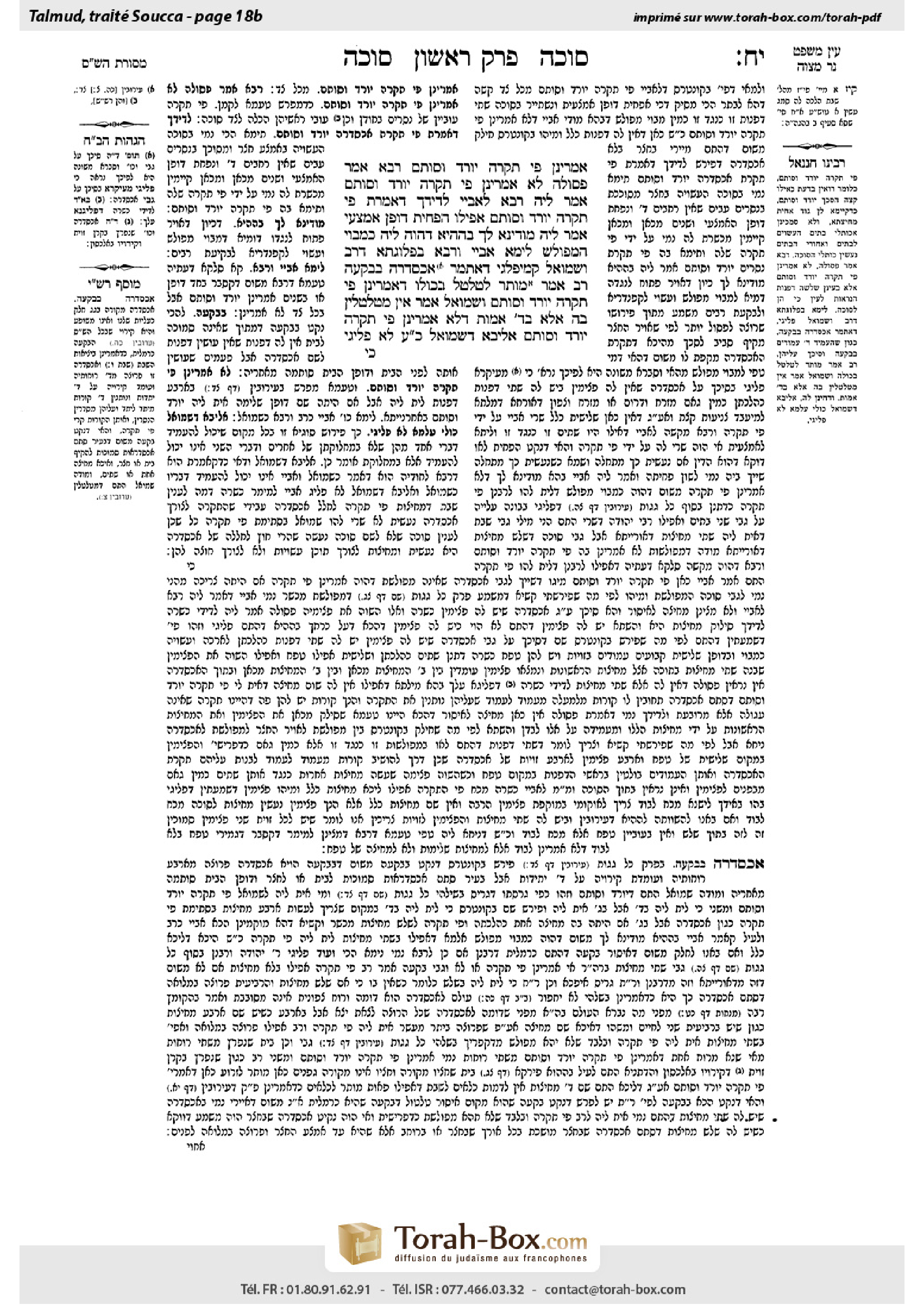
Sukkah 18b: Talmud study for Daf Yomi
Daf Yomi is the daily study of one Talmud folio. Explore 37 tractates with scans, Hebrew text, Sefaria English and AI-generated French translations where annotated.
Passage selection and English or AI-generated French translation are available where the scan has annotations. Daf Study is independent of Torah-Box and Sefaria.
Browse Sukkah · סוכה · All tractatesSukkah 18b text and translations
This page of Sukkah includes the Aramaic text, an English translation and an AI-generated French translation, alongside the scan above.
סוכה י״ח ב · Aramaic and Hebrew text
אָמְרִינַן פִּי תִקְרָה יוֹרֵד וְסוֹתֵם. רָבָא אָמַר פְּסוּלָה — לָא אָמְרִינַן פִּי תִקְרָה יוֹרֵד וְסוֹתֵם.
אֲמַר לֵיהּ רָבָא: אַבָּיֵי, לְדִידָךְ דְּאָמְרַתְּ פִּי תִקְרָה יוֹרֵד וְסוֹתֵם, אֲפִילּוּ הִפְחִית דּוֹפֶן אֶמְצָעִי! אֲמַר לֵיהּ: מוֹדֵינָא לָךְ בְּהָהִיא, דְּהָוֵה לֵיהּ כְּמָבוֹי הַמְפוּלָּשׁ.
לֵימָא אַבָּיֵי וְרָבָא בִּפְלוּגְתָּא דְּרַב וּשְׁמוּאֵל קָמִיפַּלְגִי. דְּאִתְּמַר: אַכְסַדְרָה בְּבִקְעָה, רַב אָמַר: מוּתָּר לְטַלְטֵל בְּכוּלּוֹ, דְּאָמְרִינַן פִּי תִּקְרָה יוֹרֵד וְסוֹתֵם. וּשְׁמוּאֵל אָמַר: אֵין מְטַלְטְלִין בָּהּ אֶלָּא בְּאַרְבַּע אַמּוֹת, דְּלָא אָמְרִינַן פִּי תִקְרָה יוֹרֵד וְסוֹתֵם.
אַלִּיבָּא דִּשְׁמוּאֵל, כּוּלֵּי עָלְמָא לָא פְּלִיגִי.
Sukkah 18b · English translation
as we say that the edge of the roof descends and seals the opening. The edge of the roof itself is considered as though it were a small partition that extends downward and forms a wall. Rava said: This sukka is unfit, as we do not say that the edge of the roof descends and seals.
Rava said to Abaye: According to you, who said: The edge of the roof descends and seals the opening like a wall, then in a case where the roofing of the sukka consists of straight beams, even if one removed the middle wall, leaving the sukka with only two parallel walls, the sukka would nevertheless be fit. Since the edge of the roof descends and seals, the legal status of that sukka is the same as one that has walls on all sides. Abaye said to him: I concede to you that in that particular case the principle: The edge of the roof descends and seals, does not apply, as it is considered like an open alleyway, through which the multitudes pass on two opposite sides. In other cases, the principle applies.
The Gemara suggests: Let us say that Abaye and Rava disagree with regard to the same issue that was the subject in the dispute of Rav and Shmuel; they are merely elaborating on a fundamental dispute between other amora’im. As it was stated: Amora’im disagree with regard to a portico, which has a roof and no walls or incomplete walls, located in a field, which is a karmelit. Rav said: It is permitted to move an object throughout the entire portico, as we say that the edge of the roof descends and seals the opening, rendering the portico a private domain, as it is effectively surrounded by partitions. And Shmuel said: One may move an object in the portico only within four cubits, as we do not say that the edge of the roof descends and seals the opening. Therefore, the portico’s legal status is that of the surrounding field. Ostensibly, the basis of the dispute between Abaye and Rava is identical to the basis of the dispute between Rav and Shmuel.
The Gemara rejects this comparison and says: According to the opinion of Shmuel, everyone, even Abaye, agrees that one does not apply the principle: The edge of the roof descends and seals, to the case of a sukka.
Sukkah 18b · Traduction française (IA)
comme nous disons que le bord du toit descend et ferme l’ouverture. Le bord du toit lui-même est considéré comme une petite cloison qui se prolonge vers le bas et forme un mur. Rava dit : Cette soukka est invalide, car nous ne disons pas que le bord du toit descend et ferme l’ouverture.
Rava dit à Abayé : Selon toi, qui affirmes que le bord du toit descend et ferme l’ouverture comme un mur, même si, dans le cas où la couverture de la soukka est constituée de poutres droites, on retirait le mur du milieu, de sorte qu’il ne reste à la soukka que deux murs parallèles, elle serait néanmoins valide. Puisque le bord du toit descend et ferme l’ouverture, le statut de cette soukka serait le même que celui d’une soukka entourée de murs de tous côtés. Abayé lui dit : Je te concède que, dans ce cas précis, le principe selon lequel le bord du toit descend et ferme l’ouverture ne s’applique pas, car elle est considérée comme une ruelle ouverte, où les foules passent de part et d’autre. Dans les autres cas, le principe s’applique.
La Guemara suggère : Peut-on dire qu’Abayé et Rava sont en désaccord sur la même question que celle qui faisait l’objet de la controverse entre Rav et Chmouel, et qu’ils ne font qu’expliciter un désaccord fondamental entre d’autres amoraïm ? En effet, il a été enseigné que des amoraïm sont en désaccord au sujet d’un portique, qui a un toit et pas de murs ou des murs incomplets, situé dans un champ, lequel constitue un karmelit. Rav dit : Il est permis de transporter un objet dans tout le portique, car nous disons que le bord du toit descend et ferme l’ouverture, faisant du portique un domaine privé, puisqu’il est de fait entouré de cloisons. Et Chmouel dit : On ne peut transporter un objet dans le portique que dans un espace de quatre coudées, car nous ne disons pas que le bord du toit descend et ferme l’ouverture. Le statut du portique est donc celui du champ qui l’entoure. Apparemment, le fondement du désaccord entre Abayé et Rava est identique à celui du désaccord entre Rav et Chmouel.
La Guemara rejette cette comparaison et dit : Selon l’opinion de Chmouel, tous, même Abayé, conviennent que le principe selon lequel le bord du toit descend et ferme l’ouverture ne s’applique pas au cas d’une soukka.
Traduction française générée par IA à partir de l’édition anglaise de Sefaria. Vérifie toujours un passage avec le texte source.
Text from Sefaria: William Davidson Edition - Vocalized Aramaic (CC BY NC); William Davidson Edition - English (CC BY NC).