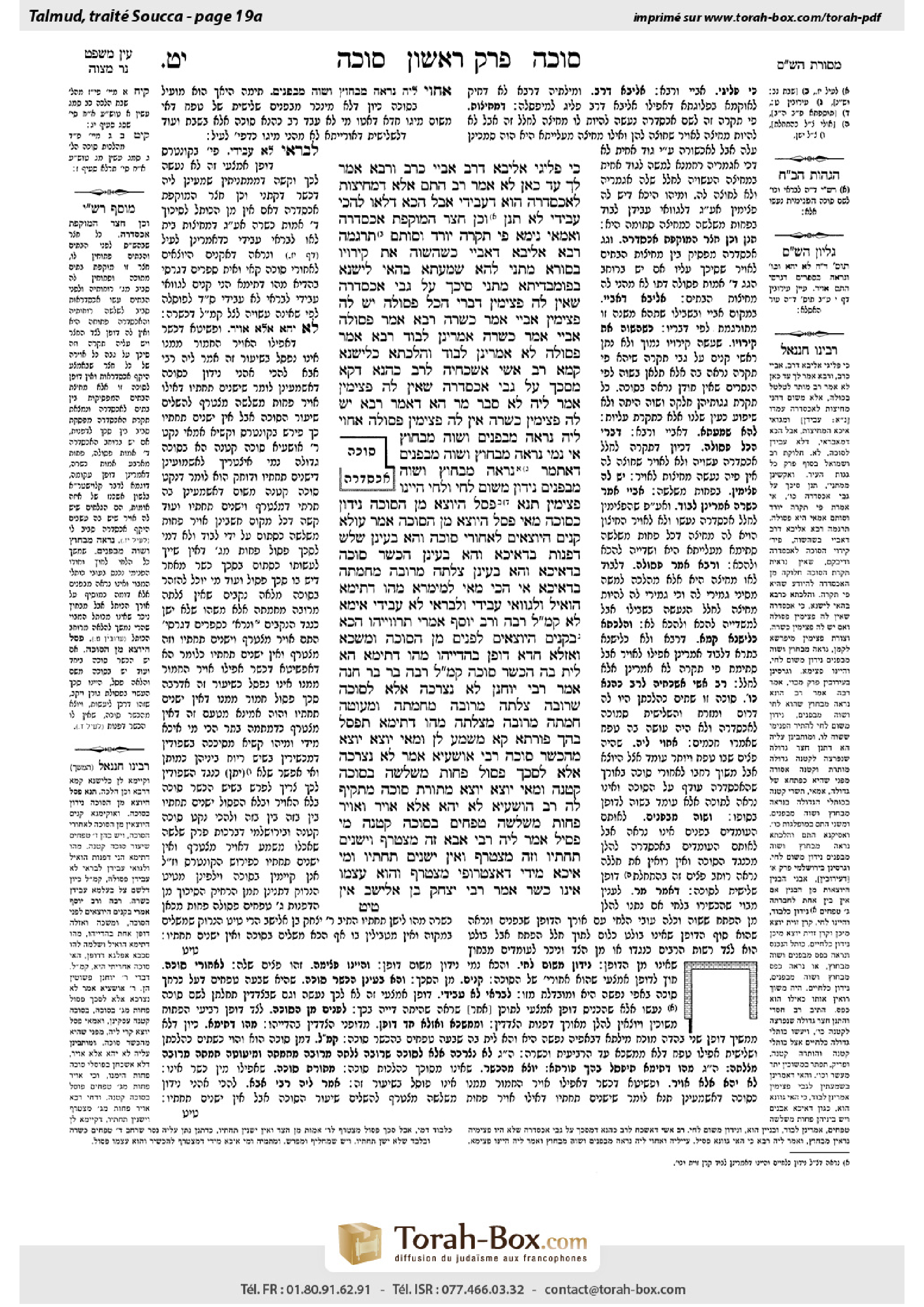
Sukkah 19a: Talmud study for Daf Yomi
Daf Yomi is the daily study of one Talmud folio. Explore 37 tractates with scans, Hebrew text, Sefaria English and AI-generated French translations where annotated.
Passage selection and English or AI-generated French translation are available where the scan has annotations. Daf Study is independent of Torah-Box and Sefaria.
Browse Sukkah · סוכה · All tractatesSukkah 19a text and translations
This page of Sukkah includes the Aramaic text, an English translation and an AI-generated French translation, alongside the scan above.
סוכה י״ט א · Aramaic and Hebrew text
כִּי פְּלִיגִי אַלִּיבָּא דְּרַב. אַבָּיֵי כְּרַב, וְרָבָא אָמַר לָךְ: עַד כָּאן לָא אָמַר רַב הָתָם אֶלָּא דִּמְחִיצוֹת לְאַכְסַדְרָה הוּא דַּעֲבִידִי, אֲבָל הָכָא דְּלָאו לְהָכִי עֲבִידִי, לָא.
תְּנַן: וְכֵן חָצֵר הַמּוּקֶּפֶת אַכְסַדְרָה. וְאַמַּאי? נֵימָא פִּי תִקְרָה יוֹרֵד וְסוֹתֵם!
תַּרְגְּמַהּ רָבָא אַלִּיבָּא דְּאַבָּיֵי: כְּשֶׁהִשְׁוָה אֶת קֵירוּיוֹ.
בְּסוּרָא מַתְנִי לְהָא שְׁמַעְתָּא בְּהַאי לִישָּׁנָא. בְּפוּמְבְּדִיתָא מַתְנִי: סִיכֵּךְ עַל גַּבֵּי אַכְסַדְרָה שֶׁאֵין לָהּ פַּצִּימִין, דִּבְרֵי הַכֹּל פְּסוּלָה. יֵשׁ לָהּ פַּצִּימִין, אַבָּיֵי אָמַר: כְּשֵׁרָה, רָבָא אָמַר: פְּסוּלָה. אַבָּיֵי אָמַר כְּשֵׁרָה — אָמְרִינַן לָבוּד. רָבָא אָמַר פְּסוּלָה — לָא אָמְרִינַן לָבוּד. וְהִלְכְתָא כְּלִישָּׁנָא קַמָּא.
רַב אָשֵׁי אַשְׁכְּחֵיהּ לְרַב כָּהֲנָא דְּקָא מְסַכֵּךְ עַל גַּבֵּי אַכְסַדְרָה שֶׁאֵין לָהּ פַּצִּימִין. אֲמַר לֵיהּ: לָא סָבַר מָר הָא דְּאָמַר רָבָא: יֵשׁ לָהּ פַּצִּימִין כְּשֵׁרָה, אֵין לָהּ פַּצִּימִין פְּסוּלָה! אַחְוִי לֵיהּ, נִרְאֶה מִבִּפְנִים וְשָׁוֶה מִבַּחוּץ.
אִי נָמֵי, נִרְאֶה מִבַּחוּץ וְשָׁוֶה מִבִּפְנִים.
דְּאִתְּמַר: נִרְאֶה מִבַּחוּץ וְשָׁוֶה מִבִּפְנִים, נִידּוֹן מִשּׁוּם לֶחִי. וְלֶחִי הַיְינוּ פַּצִּימִין.
תָּנָא: פְּסָל הַיּוֹצֵא מִן הַסּוּכָּה — נִידּוֹן כַּסּוּכָּה. מַאי פְּסָל הַיּוֹצֵא מִן הַסּוּכָּה? אָמַר עוּלָּא: קָנִים הַיּוֹצְאִים לַאֲחוֹרֵי סוּכָּה.
וְהָא בָּעֵינַן שָׁלֹשׁ דְּפָנוֹת! בִּדְאִיכָּא. וְהָא בָּעֵינַן הֶכְשֵׁר סוּכָּה! בִּדְאִיכָּא. וְהָא בָּעֵינַן צִלָּתָהּ מְרוּבָּה מֵחַמָּתָהּ! בִּדְאִיכָּא.
אִי הָכִי מַאי לְמֵימְרָא? מַהוּ דְּתֵימָא: הוֹאִיל וּלְגַוַּואי עֲבִידִי וּלְבָרַאי לָא עֲבִידִי — אֵימָא לָא, קָא מַשְׁמַע לַן.
רַבָּה וְרַב יוֹסֵף אָמְרִי תַּרְוַויְיהוּ: הָכָא בְּקָנִים הַיּוֹצְאִים לִפְנִים מִן הַסּוּכָּה, וּמָשְׁכָא וְאָזְלָא חֲדָא דּוֹפֶן בַּהֲדַיְיהוּ. מַהוּ דְּתֵימָא: הָא לֵית בַּהּ הֶכְשֵׁר סוּכָּה, קָא מַשְׁמַע לַן.
רַבָּה בַּר בַּר חָנָה אָמַר רַבִּי יוֹחָנָן: לֹא נִצְרְכָה אֶלָּא לְסוּכָּה שֶׁרוּבָּהּ צִלָּתָהּ מְרוּבָּה מֵחַמָּתָהּ, וּמִעוּטָהּ חֲמָתָהּ מְרוּבָּה מְצִלָּתָהּ. מַהוּ דְּתֵימָא: תִּפְּסַל בְּהָךְ פּוּרְתָּא, קָא מַשְׁמַע לַן. וּמַאי יוֹצֵא — יוֹצֵא מֵהֶכְשֵׁר סוּכָּה.
רַבִּי אוֹשַׁעְיָא אָמַר: לֹא נִצְרְכָה אֶלָּא לִסְכָךְ פָּסוּל פָּחוֹת מִשְּׁלֹשָׁה, בְּסוּכָּה קְטַנָּה. וּמַאי ״יוֹצֵא״ — יוֹצֵא מִתּוֹרַת סוּכָּה.
מַתְקֵיף לַהּ רַב הוֹשַׁעְיָא: לֹא יְהֵא אֶלָּא אֲוִיר, וַאֲוִיר פָּחוֹת מִשְּׁלֹשָׁה טְפָחִים בְּסוּכָּה קְטַנָּה מִי פָּסֵיל?
אֲמַר לֵיהּ רַבִּי אַבָּא: זֶה מִצְטָרֵף וִישֵׁנִים תַּחְתָּיו, וְזֶה מִצְטָרֵף וְאֵין יְשֵׁנִים תַּחְתָּיו.
וּמִי אִיכָּא מִידֵּי דְּאִצְטְרוֹפֵי מִצְטָרֵף וְהוּא עַצְמוֹ אֵינוֹ כָּשֵׁר? אָמַר רַבִּי יִצְחָק בֶּן אֶלְיָשִׁב: אִין,
Sukkah 19a · English translation
When they disagree is according to the opinion of Rav. Abaye holds in accordance with the opinion of Rav: The edge of the roof descends and seals both in the portico in the field and in the portico that one roofed as a sukka. And Rava could have said to you: Rav stated his opinion only there, with regard to a portico in the field, because the partitions formed by the descent of the edge of the roof are partitions established for the portico. However, here, in the case of a sukka, where the partitions formed by the descent of the edge of the roof are not partitions established for the portico, no, Rav would not say that the edge of the roof descends and seals.
The Gemara cites another proof. We learned in the mishna: With regard to a courtyard that is surrounded on three sides by a portico, if there are four cubits beneath the unfit roofing, the sukka is unfit. The Gemara asks: And why is the sukka unfit? Let us say that the edge of the roof descends and seals, forming a fit partition at the point where the roofing of the sukka begins?
Rava interpreted the mishna in accordance with the opinion of Abaye: It is a case where one equalized the level of its roofing, i.e., the roofing of the sukka with the level of the roof of the portico. Since the edge of the roof of the portico is not visible inside the sukka, the principle: The edge of the roof descends and seals, does not apply.
In Sura, they would teach this halakha in that language cited above. In Pumbedita they would teach it differently: If one roofed a portico that does not have posts on its open side, everyone agrees that the sukka is unfit. In the case of a portico that has posts less than three handbreadths apart on its open side, Abaye said: The sukka is fit, and Rava said: The sukka is unfit. Abaye said: The sukka is fit, as we say that the principle of lavud applies here; the posts are joined and form a partition for both the portico and the sukka in the courtyard outside the portico. Rava said: The sukka is unfit, as we do not say that the principle of lavud forms a partition for the sukka. The Gemara concludes: And the halakha is ruled in accordance with the first version.
The Gemara relates: Rav Ashi found Rav Kahana, who was placing roofing for a sukka atop a portico that did not have posts. He said to him: Doesn’t the Master hold in accordance with that which Rava said: If it has posts, the sukka is fit; if it does not have posts it is unfit? How can you use this as a sukka? Rav Kahana showed him that in this sukka the disparity between the sukka and the portico was visible from the inside and even from the outside. From outside, the portico and the sukka appeared to be one continuous structure. However, from inside, one of the walls of the portico was visibly thicker than the wall of the sukka, and that one handbreadth thickness serves as the third wall of the sukka.
Alternatively, in this case that disparity was visible from the outside and even from the inside. The exterior walls of the portico and of the sukka were not even. From the outside, it was plainly discernible that they were two separate structures. However, from the inside the sukka appeared to be a direct extension of the portico with no post protruding. In both cases, the protruding segment serves as the third wall of the sukka, which measures one handbreadth, and the sukka is fit.
This distinction is as it was stated in the context of merging courtyards that open into an alleyway that is open on one side to allow carrying there on Shabbat, one must establish a side post on one side of its opening: Any object that protrudes and is visible from outside the alleyway but is even with the wall on the inside of the alleyway has legal status of a side post, since it can be discerned from the outside. And the provisions that apply to a side post in the case of merging of alleyways are the same as those that apply to posts in the case of sukka. Rav Kahana’s sukka was essentially a portico with a post, and was fit for use as a sukka.
§ It was taught in the Tosefta: Fit roofing that consists of different kinds of agricultural waste products that extend from the sukka has the legal status like that of the sukka. The Gemara asks: What is the meaning of: Waste products that extend from the sukka? Ulla said: Branches that extend behind the sukka and are not limited to the area within the sukka walls.
The Gemara asks: But don’t we require three walls to render an area covered with roofing a fit sukka? The Gemara answers: It is referring to a case where there are three walls. The two side walls of the sukka do not end at the middle wall between them; rather, they too extend behind the sukka, forming a second sukka. The Gemara asks: But don’t we require seven by seven handbreadths as the minimum area for fitness of a sukka? The Gemara answers: It is referring to a case where there is the requisite minimum area. The Gemara asks: But don’t we require that its shade exceeds its sunlight? The Gemara answers: It is referring to a case where there is more shade than sunlight.
After noting that the sukka has three walls, the requisite area, and sufficient shade, the Gemara asks: If so, what purpose is there to state this halakha? The fact that this sukka extends from another is not relevant. The Gemara answers: Nevertheless, there is a novel element in this halakha. Lest you say that since, as evidenced by the placement of the connecting middle wall, these walls were initially established for inside the original sukka but not for outside the original sukka; and therefore you say no, the middle wall cannot be considered a wall for the additional sukka, Ulla teaches us that the initial intention is not relevant.
Rabba and Rav Yosef both say with regard to the case in the Tosefta: Here, it is referring to a case with branches that extend before the front entrance of the sukka, and one of the side walls extends together with the roofing. Lest you say that this extension does not have the minimum requisite size for the fitness of a sukka, in terms of its area and number of walls, therefore, Ulla teaches us that it is fit because it is considered an extension of the sukka.
Rabba bar bar Ḥana said that Rabbi Yoḥanan said: The Tosefta was needed only to teach the case of a sukka where in its majority its shade exceeds its sunlight, and in its minority its sunlight exceeds its shade. Lest you say that since the extension lacks this basic requirement of a sukka, it is treated as if it were not there at all, and consequently the entire sukka should be rendered unfit due to that little area, therefore, Ulla teaches us that the entire area is one fit sukka. The Gemara asks: According to that understanding of the Tosefta, what is the meaning of: Waste that extends from the sukka? It means that the roofing extends beyond the halakhic parameters for fitness of a sukka. It does not refer to a physical extension of the sukka.
Rabbi Oshaya said: This Tosefta was needed only to teach the case of unfit roofing that measures less than three handbreadths in a small sukka. And what is the meaning of: Waste that extends from the sukka? It means that the roofing extends beyond the halakhic status of a fit sukka; it is not referring to a physical extension of the sukka. Nevertheless, it does not render the entire sukka unfit.
Rav Hoshaya strongly objects to this: What is the novel element in this Tosefta? Let the status of unfit roofing be only as strict as the status of empty space. And does space measuring less than three handbreadths in a small sukka render the entire sukka unfit? If less than three handbreadths of space, which has a stringent measure for rendering the sukka unfit, does not render the sukka unfit, clearly the same measure of unfit roofing does not render the sukka unfit.
Rabbi Abba said to him: There is a distinction between unfit roofing and empty space. This unfit roofing combines with the fit roofing to compose the requisite measure. And one may even sleep beneath it, since the unfit roofing is nullified by the majority of fit roofing and completely incorporated into it. However, that space, although it too combines with the fit roofing to comprise the requisite measure of the sukka, one may not sleep beneath it, as it is not transformed into fit roofing. Therefore, there is a novel element in the explanation of Rabbi Hoshaya as well.
The Gemara questions this contention. Is there any item that combines with other items to engender fitness, but the item itself is not fit? Rabbi Yitzḥak ben Elyashiv said: Yes, that model exists in other areas of halakha as well.
Sukkah 19a · Traduction française (IA)
Leur désaccord porte sur l’opinion de Rav. Abayé est conforme à l’opinion de Rav : le bord du toit descend et ferme l’espace, aussi bien dans le portique situé dans un champ que dans celui que l’on a couvert pour en faire une soukka. Rava aurait pu te répondre : Rav n’a énoncé son opinion que dans ce cas, celui d’un portique situé dans un champ, car les cloisons formées par la descente du bord du toit sont des cloisons prévues pour le portique. Mais ici, dans le cas d’une soukka, où les cloisons formées par la descente du bord du toit ne sont pas des cloisons prévues pour le portique, non, Rav ne dirait pas que le bord du toit descend et ferme l’espace.
La Guemara cite une autre preuve. Nous avons appris dans la Michna : au sujet d’une cour entourée sur trois côtés par un portique, si la distance sous la couverture impropre est de quatre coudées, la soukka est impropre. La Guemara demande : pourquoi la soukka est-elle impropre ? Ne devrait-on pas dire que le bord du toit descend et ferme l’espace, formant ainsi une cloison valable à l’endroit où commence la couverture de la soukka ?
Rava interpréta la Michna conformément à l’opinion d’Abayé : il s’agit d’un cas où l’on a placé la couverture de la soukka au même niveau que le toit du portique. Puisque le bord du toit du portique n’est pas visible depuis l’intérieur de la soukka, le principe selon lequel le bord du toit descend et ferme l’espace ne s’applique pas.
À Soura, on enseignait cette halakha dans les termes cités plus haut. À Poumbedita, on l’enseignait autrement : si l’on couvre un portique qui n’a pas de poteaux sur son côté ouvert, tous sont d’accord pour dire que la soukka est impropre. Dans le cas d’un portique qui a, sur son côté ouvert, des poteaux espacés de moins de trois palmes, Abayé dit : la soukka est valable ; Rava dit : la soukka est impropre. Abayé dit que la soukka est valable, car nous appliquons ici le principe de lavoud : les poteaux sont considérés comme joints et forment une cloison pour le portique comme pour la soukka dans la cour située au-delà du portique. Rava dit que la soukka est impropre, car nous ne considérons pas que le principe de lavoud forme une cloison pour la soukka. La Guemara conclut : la halakha est tranchée conformément à la première version.
La Guemara rapporte : Rav Achi trouva Rav Kahana en train de poser une couverture de soukka au-dessus d’un portique dépourvu de poteaux. Il lui dit : « Maître ne tient-il pas pour conforme à l’opinion de Rava, selon laquelle, s’il y a des poteaux, la soukka est valable, et s’il n’y en a pas, elle est impropre ? Comment peux-tu t’en servir comme soukka ? » Rav Kahana lui montra que, dans cette soukka, la différence entre la soukka et le portique était visible depuis l’intérieur, et même depuis l’extérieur. De l’extérieur, le portique et la soukka semblaient former une seule structure continue. Mais de l’intérieur, l’un des murs du portique était visiblement plus épais que le mur de la soukka ; cette épaisseur d’une palme faisait office de troisième mur de la soukka.
Autre possibilité : dans ce cas, cette différence était visible de l’extérieur, et même de l’intérieur. Les murs extérieurs du portique et de la soukka n’étaient pas alignés. De l’extérieur, on discernait clairement qu’il s’agissait de deux structures distinctes. Mais de l’intérieur, la soukka semblait prolonger directement le portique, sans qu’aucun poteau ne dépasse. Dans les deux cas, la partie saillante, d’une largeur d’une palme, fait office de troisième mur de la soukka, qui est donc valable.
Cette distinction est celle qui a été énoncée à propos de la fusion des cours donnant sur une ruelle ouverte d’un côté, afin d’y permettre le transport d’objets pendant le Chabbat : il faut placer un poteau latéral d’un côté de l’entrée de la ruelle. Tout objet qui dépasse et qui est visible depuis l’extérieur de la ruelle, mais qui est aligné avec le mur à l’intérieur de celle-ci, a le statut de poteau latéral, puisqu’on peut le distinguer de l’extérieur. Les règles applicables à un poteau latéral dans le cas de la fusion des ruelles sont les mêmes que celles qui s’appliquent aux poteaux dans le cas d’une soukka. La soukka de Rav Kahana était en fait un portique muni d’un poteau, et elle était valable pour servir de soukka.
§ Il a été enseigné dans la Tosefta : une couverture valable constituée de différents types de déchets agricoles qui se prolonge au-delà de la soukka a le même statut que la soukka. La Guemara demande : que signifie « les déchets qui se prolongent au-delà de la soukka » ? Oulla dit : il s’agit de branches qui se prolongent derrière la soukka et ne sont pas limitées à l’espace compris entre les murs de la soukka.
La Guemara demande : mais n’exige-t-on pas trois murs pour qu’un espace couvert soit une soukka valable ? La Guemara répond : il s’agit d’un cas où il y a trois murs. Les deux murs latéraux de la soukka ne s’arrêtent pas au mur du fond situé entre eux ; eux aussi se prolongent derrière la soukka, formant ainsi une seconde soukka. La Guemara demande : mais n’exige-t-on pas une superficie minimale de sept palmes sur sept pour qu’une soukka soit valable ? La Guemara répond : il s’agit d’un cas où la superficie minimale requise est présente. La Guemara demande : mais n’exige-t-on pas que l’ombre soit plus importante que l’ensoleillement ? La Guemara répond : il s’agit d’un cas où l’ombre est plus importante que l’ensoleillement.
Après avoir noté que la soukka possède trois murs, la superficie requise et une ombre suffisante, la Guemara demande : dans ce cas, à quoi sert-il d’énoncer cette halakha ? Le fait que cette soukka se prolonge à partir d’une autre n’est pas pertinent. La Guemara répond : néanmoins, cette halakha présente un élément nouveau. On pourrait penser que, puisque la position du mur central qui relie ces murs montre qu’ils ont été établis au départ pour l’intérieur de la soukka initiale, mais non pour l’espace situé au-delà, le mur central ne peut pas être considéré comme un mur de la soukka supplémentaire. Oulla nous enseigne que l’intention initiale n’est pas pertinente.
Rabba et Rav Yossef disent tous deux, à propos du cas de la Tosefta : il s’agit ici d’un cas où des branches se prolongent devant l’entrée de la soukka et où l’un des murs latéraux se prolonge avec la couverture. On pourrait penser que cette extension n’a pas les dimensions minimales requises pour qu’une soukka soit valable, ni en superficie ni en nombre de murs. Oulla nous enseigne donc qu’elle est valable, car elle est considérée comme un prolongement de la soukka.
Rabba bar bar Ḥana dit au nom de Rabbi Yoḥanan : la Tosefta n’était nécessaire que pour enseigner le cas d’une soukka dont l’ombre est plus importante que l’ensoleillement sur la majeure partie, mais dont l’ensoleillement est plus important que l’ombre sur une partie moindre. On pourrait penser que, puisque cette extension ne remplit pas cette condition fondamentale d’une soukka, elle est considérée comme inexistante et que, par conséquent, toute la soukka devrait être déclarée impropre à cause de cette petite zone. Oulla nous enseigne donc que toute la superficie constitue une seule soukka valable. La Guemara demande : selon cette interprétation de la Tosefta, que signifie « les déchets qui se prolongent au-delà de la soukka » ? Cela signifie que la couverture s’étend au-delà des limites halakhiques d’une soukka valable. Il ne s’agit pas d’un prolongement matériel de la soukka.
Rabbi Ochaya dit : cette Tosefta n’était nécessaire que pour enseigner le cas d’une couverture impropre de moins de trois palmes dans une petite soukka. Que signifie « les déchets qui se prolongent au-delà de la soukka » ? Cela signifie que la couverture s’étend au-delà des limites du statut halakhique d’une soukka valable ; il ne s’agit pas d’un prolongement matériel de la soukka. Néanmoins, cela ne rend pas toute la soukka impropre.
Rav Hoshaya soulève une objection vigoureuse : quel est l’élément nouveau de cette Tosefta ? Que le statut de la couverture impropre ne soit soumis qu’à la même rigueur que celui de l’espace vide. Or, un espace de moins de trois palmes dans une petite soukka rend-il toute la soukka impropre ? Si un espace vide de moins de trois palmes, alors qu’il s’agit d’une mesure stricte pour rendre la soukka impropre, ne la rend pas impropre, il est évident qu’une même mesure de couverture impropre ne la rend pas impropre non plus.
Rabbi Abba lui dit : il y a une différence entre une couverture impropre et un espace vide. Cette couverture impropre s’associe à la couverture valable pour atteindre la mesure requise. On peut même dormir dessous, puisque la couverture impropre est annulée par la majorité de couverture valable et entièrement intégrée à celle-ci. Mais on ne peut pas dormir sous cet espace vide, bien qu’il s’associe lui aussi à la couverture valable pour atteindre la mesure requise de la soukka, car il ne se transforme pas en couverture valable. Ainsi, même l’explication de Rabbi Hoshaya comporte un élément nouveau.
La Guemara remet cette affirmation en question. Existe-t-il un élément qui s’associe à d’autres éléments pour conférer la validité, alors qu’il n’est pas valable en lui-même ? Rabbi Yitzḥak ben Elyashiv dit : oui, ce principe existe également dans d’autres domaines de la halakha.
Traduction française générée par IA à partir de l’édition anglaise de Sefaria. Vérifie toujours un passage avec le texte source.
Text from Sefaria: William Davidson Edition - Vocalized Aramaic (CC BY NC); William Davidson Edition - English (CC BY NC).