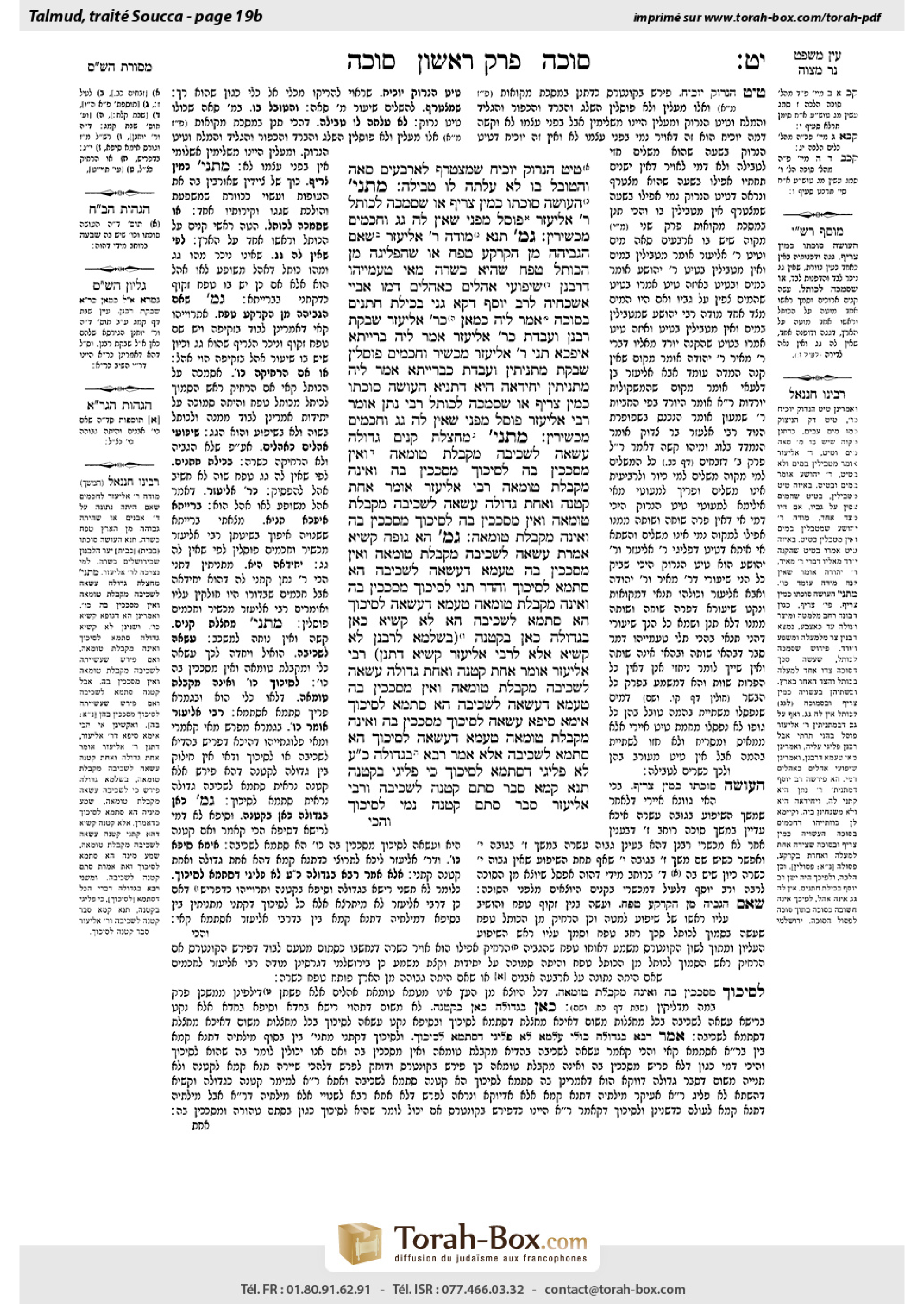
Sukkah 19b: Talmud study for Daf Yomi
Daf Yomi is the daily study of one Talmud folio. Explore 37 tractates with scans, Hebrew text, Sefaria English and AI-generated French translations where annotated.
Passage selection and English or AI-generated French translation are available where the scan has annotations. Daf Study is independent of Torah-Box and Sefaria.
Browse Sukkah · סוכה · All tractatesSukkah 19b text and translations
This page of Sukkah includes the Aramaic text, an English translation and an AI-generated French translation, alongside the scan above.
סוכה י״ט ב · Aramaic and Hebrew text
טִיט הַנָּרוֹק יוֹכִיחַ, שֶׁמִּצְטָרֵף לְאַרְבָּעִים סְאָה, וְהַטּוֹבֵל בּוֹ — לֹא עָלְתָה לוֹ טְבִילָה.
מַתְנִי׳ הָעוֹשֶׂה סוּכָּתוֹ כְּמִין צְרִיף, אוֹ שֶׁסְּמָכָהּ לְכוֹתֶל — רַבִּי אֱלִיעֶזֶר פּוֹסֵל מִפְּנֵי שֶׁאֵין לָהּ גַּג, וַחֲכָמִים מַכְשִׁירִין.
גְּמָ׳ תָּנָא: מוֹדֶה רַבִּי אֱלִיעֶזֶר שֶׁאִם הִגְבִּיהָהּ מִן הַקַּרְקַע טֶפַח, אוֹ שֶׁהִפְלִיגָהּ מִן הַכּוֹתֶל טֶפַח — שֶׁהִיא כְּשֵׁרָה.
מַאי טַעְמַיְיהוּ דְּרַבָּנַן? שִׁיפּוּעֵי אֹהָלִים כְּאֹהָלִים דָּמוּ.
אַבָּיֵי אַשְׁכְּחֵיהּ לְרַב יוֹסֵף דְּקָא גָּנֵי בְּכִילַּת חֲתָנִים בַּסּוּכָּה. אֲמַר לֵיהּ: כְּמַאן — כְּרַבִּי אֱלִיעֶזֶר? שָׁבְקַתְּ רַבָּנַן וְעָבְדַתְּ כְּרַבִּי אֱלִיעֶזֶר!
אֲמַר לֵיהּ, בָּרַיְיתָא אִיפְּכָא תָּנֵי: רַבִּי אֱלִיעֶזֶר מַכְשִׁיר וַחֲכָמִים פּוֹסְלִין. שָׁבְקַתְּ מַתְנִיתִין וְעָבְדַתְּ כְּבָרַיְיתָא?
אֲמַר לֵיהּ: מַתְנִיתִין יְחִידָאָה הִיא. דְּתַנְיָא: הָעוֹשֶׂה סוּכָּתוֹ כְּמִין צְרִיף אוֹ שֶׁסְּמָכָהּ לְכוֹתֶל, רַבִּי נָתָן אוֹמֵר: רַבִּי אֱלִיעֶזֶר פּוֹסֵל מִפְּנֵי שֶׁאֵין לָהּ גַּג, וַחֲכָמִים מַכְשִׁירִין.
מַתְנִי׳ מַחְצֶלֶת קָנִים גְּדוֹלָה, עֲשָׂאָהּ לִשְׁכִיבָה — מְקַבֶּלֶת טוּמְאָה, וְאֵין מְסַכְּכִין בָּהּ. לְסִיכּוּךְ — מְסַכְּכִין בָּהּ, וְאֵינָהּ מְקַבֶּלֶת טוּמְאָה. רַבִּי אֱלִיעֶזֶר אוֹמֵר: אַחַת קְטַנָּה וְאַחַת גְּדוֹלָה, עֲשָׂאָהּ לִשְׁכִיבָה — מְקַבֶּלֶת טוּמְאָה וְאֵין מְסַכְּכִין בָּהּ, לְסִיכּוּךְ — מְסַכְּכִין בָּהּ, וְאֵינָהּ מְקַבֶּלֶת טוּמְאָה.
גְּמָ׳ הָא גּוּפַהּ קַשְׁיָא. אָמְרַתְּ: עֲשָׂאָהּ לִשְׁכִיבָה — מְקַבֶּלֶת טוּמְאָה וְאֵין מְסַכְּכִין בָּהּ. טַעְמָא דַּעֲשָׂאָהּ לִשְׁכִיבָה, הָא סְתָמָא — לְסִיכּוּךְ.
וַהֲדַר תָּנֵי: לְסִיכּוּךְ מְסַכְּכִין בָּהּ וְאֵינָהּ מְקַבֶּלֶת טוּמְאָה, טַעְמָא דַּעֲשָׂאָהּ לְסִיכּוּךְ, הָא סְתָמָא — לִשְׁכִיבָה!
הָא לָא קַשְׁיָא: כָּאן בִּגְדוֹלָה, כָּאן בִּקְטַנָּה.
(בִּשְׁלָמָא לְרַבָּנַן לָא קַשְׁיָא, אֶלָּא לְרַבִּי אֱלִיעֶזֶר קַשְׁיָא, דִּתְנַן:) רַבִּי אֱלִיעֶזֶר אוֹמֵר: אַחַת קְטַנָּה וְאַחַת גְּדוֹלָה, עֲשָׂאָהּ לִשְׁכִיבָה — מְקַבֶּלֶת טוּמְאָה וְאֵין מְסַכְּכִין בָּהּ. טַעְמָא דַּעֲשָׂאָהּ לִשְׁכִיבָה, הָא סְתָמָא — לְסִיכּוּךְ.
אֵימָא סֵיפָא: עֲשָׂאָהּ לְסִיכּוּךְ — מְסַכְּכִין בָּהּ וְאֵינָהּ מְקַבֶּלֶת טוּמְאָה. טַעְמָא דַּעֲשָׂאָהּ לְסִיכּוּךְ, הָא סְתָמָא — לִשְׁכִיבָה!
אֶלָּא אָמַר רָבָא: בִּגְדוֹלָה כּוּלֵּי עָלְמָא לָא פְּלִיגִי דִּסְתָמָא לְסִיכּוּךְ. כִּי פְּלִיגִי בִּקְטַנָּה. תַּנָּא קַמָּא סָבַר: סְתָם קְטַנָּה לִשְׁכִיבָה, וְרַבִּי אֱלִיעֶזֶר סָבַר: סְתָם קְטַנָּה נָמֵי לְסִיכּוּךְ.
Sukkah 19b · English translation
The case of mortar that is liquid and can be poured proves that there are situations where items that themselves are unfit render other items fit, as, on the one hand, it combines with water to complete the requisite measure of forty se’a to render a ritual bath fit to purify. But, on the other hand, one who immerses in a bath filled only with mortar, the immersion does not fulfill his obligation.
MISHNA: One who establishes his sukka like a type of circular hut, with no roof whose walls slope down from the center or who rested the sukka against the wall, by taking long branches and placing one end on the ground and leaning the other end against the wall to establish a structure with no roof, Rabbi Eliezer deems it unfit because it does not have a roof, and the Rabbis deem it fit; as, in their opinion, the roof and the walls may be a single entity, indistinguishable from each other.
GEMARA: It was taught in a baraita: Rabbi Eliezer concedes that if one lifted one of these types of sukkot off the ground at least one handbreadth, thereby creating a vertical wall, or if one distanced the sukka resting against the wall one handbreadth from the wall, the sukka is fit. In these cases, the difference between the wall and the roof is conspicuous.
The Gemara asks: What is the rationale for the opinion of the Rabbis, who deem a sukka fit even where it is an inclined roof rather than a flat one? The Gemara answers: In their opinion, the legal status of the incline of a tent is like that of a tent. As long as it provides shelter, there is no need for a distinct, conspicuous roof for it to be a fit sukka.
It is related: Abaye found Rav Yosef, his teacher, who was sleeping inside a netted bridal canopy, whose netting inclines down, inside a sukka. Ostensibly, Rav Yosef did not fulfill his obligation, as he slept in the tent formed by the canopy and not directly in the sukka. Abaye said to him: In accordance with whose opinion do you hold, that you do not consider this netting a tent? Is it in accordance with the opinion of Rabbi Eliezer, who maintains that a structure without a distinct roof does not have the legal status of a tent, and therefore the netting does not constitute a barrier between the roofing of the sukka and the person sleeping below? Did you abandon the opinion of the Rabbis, who maintain that the netting constitutes a barrier because the legal status of a structure without a distinct roof is that of a tent, and act in accordance with the opinion of Rabbi Eliezer? In disputes between an individual Sage and multiple Sages, the halakha is in accordance with the multiple Sages, i.e., the Rabbis.
Rav Yosef said to him: In the baraita, the opposite is taught. Rabbi Eliezer deems it fit and the Rabbis deem it unfit. Abaye asked him: Did you abandon the mishna, whose formulation is authoritative, and act in accordance with a baraita, which may not be accurate?
Rav Yosef said to him: I have proof that the formulation of this particular baraita is precise, as the formulation of the mishna is an individual version of the dispute, and most of the Sages adopt the version of the baraita, as it is taught in another baraita: One who establishes his sukka like a type of circular hut or rests the sukka against the wall, Rabbi Natan says that Rabbi Eliezer deems the structure unfit because it does not have a roof, and the Rabbis deem it fit. Apparently, the mishna reflects only Rabbi Natan’s version of the argument. According to most of the Sages, the correct formulation of the dispute is that of the baraita: Rabbi Eliezer deems it fit and the Rabbis deem it unfit. The halakha is in accordance with the latter version of the dispute, and therefore it is permitted to sleep inside a bridal canopy in a sukka.
MISHNA: In the case of a large mat of reeds, if one initially produced it for the purpose of lying upon it, it is susceptible to ritual impurity like any other vessel, and therefore one may not roof a sukka with it. If one initially produced it for roofing, one may roof a sukka with it, and it is not susceptible to ritual impurity, as its legal status is not that of a vessel. Rabbi Eliezer says that the distinction between mats is based on use, not size. Therefore, with regard to both a small mat and a large mat, if one produced it for the purpose of lying upon it, it is susceptible to ritual impurity and one may not roof a sukka with it. If one produced it for roofing, one may roof a sukka with it, and it is not susceptible to ritual impurity.
GEMARA: The Gemara analyzes the formulation of the mishna and raises a difficulty. This mishna itself is difficult, as it contains an apparent contradiction. On the one hand, you said: If one produced it for the purpose of lying upon it, it is susceptible to ritual impurity and one may not roof a sukka with it. The reason it is unfit for roofing is due to the fact that one produced it specifically for the purpose of lying upon it. Presumably, a mat produced without designation is for roofing, and therefore one may roof a sukka with it.
And then it is taught in the mishna: If one produced it for roofing, one may roof a sukka with it, and it is not susceptible to ritual impurity. The reason it is fit roofing is due to the fact that one produced it specifically for roofing. This implies that a mat that one produced without designation is presumably for the purpose of lying upon it, and therefore one may not roof a sukka with it. The inferences drawn from these two clauses in the mishna about a mat produced without designation contradict each other.
The Gemara answers: This is not difficult. Here, in the first clause of the mishna, it is referring to a large mat, which is typically not produced for the purpose of lying upon it. Therefore, it is unfit for roofing only if it is produced specifically for the purpose of lying upon it. If it is produced without designation, it is presumably for roofing, and one may roof a sukka with it. There, in the second clause of the mishna, it is referring to a small mat, which is typically not produced for roofing. Therefore, one may roof a sukka with it only if it is produced specifically for roofing. If it is produced without designation, it is presumably for the purpose of lying upon it, and one may not roof a sukka with it.
The Gemara notes: Granted, according to the Rabbis this is not difficult; as the above distinction resolves the apparent contradiction in the mishna. However, according to Rabbi Eliezer, the contradiction remains difficult, as we learned in a mishna that Rabbi Eliezer says: With regard to both a small mat and a large mat, if one produced it for the purpose of lying upon it, it is susceptible to ritual impurity and one may not roof a sukka with it. The reason it is unfit for roofing is due to the fact that one produced it specifically for the purpose of lying upon it. This implies that a mat that one produced without designation is presumably for roofing, and therefore one may roof a sukka with it.
And say that in the latter clause of the mishna, where Rabbi Eliezer continues: If one produced it for roofing, one may roof a sukka with it and it is not susceptible to ritual impurity, the reason it is fit roofing is due to the fact that one produced it specifically for roofing. However, by inference, a mat that one produced without designation is presumably for the purpose of lying upon it, and therefore one may not roof a sukka with it. The inferences drawn from these two clauses in the mishna contradict each other. The resolution cited above cannot resolve the contradiction according to Rabbi Eliezer, as he does not distinguish between a large mat and a small mat.
Rather, Rava said: The above resolution is rejected. With regard to a large mat, everyone agrees that if it was produced without designation, presumably it is for roofing. Where they disagree, is with regard to a small mat: The first tanna holds that a small mat produced without designation is presumably for the purpose of lying upon it, and Rabbi Eliezer holds that a small mat produced without designation is also presumably for roofing.
Sukkah 19b · Traduction française (IA)
Le cas du mortier liquide, que l’on peut verser, prouve qu’il existe des situations où des éléments impropres en eux-mêmes rendent d’autres éléments aptes. D’une part, le mortier se combine à l’eau pour compléter la mesure requise de quarante séa et rendre ainsi un mikvé apte à purifier. Mais, d’autre part, celui qui s’immerge dans un bassin rempli uniquement de mortier ne s’acquitte pas de son obligation.
MICHNA : Celui qui construit sa soukka à la manière d’une sorte de hutte circulaire, dont les parois descendent en pente depuis le centre et qui n’a pas de toit, ou qui appuie la soukka contre un mur en prenant de longues branches, en posant une extrémité au sol et en appuyant l’autre contre le mur pour former une structure sans toit, Rabbi Eliezer la juge impropre parce qu’elle n’a pas de toit, tandis que les Sages la jugent apte, car, à leur avis, le toit et les parois peuvent former une seule entité, sans distinction entre eux.
GUEMARA : Il a été enseigné dans une baraïta : Rabbi Eliezer reconnaît que si l’on a surélevé l’une de ces sortes de soukkot d’au moins un téfa’h au-dessus du sol, créant ainsi une paroi verticale, ou si l’on a éloigné d’un téfa’h du mur la soukka appuyée contre celui-ci, la soukka est apte. Dans ces cas, la distinction entre la paroi et le toit est manifeste.
La Guemara demande : Quel est le fondement de l’avis des Sages, qui jugent une soukka apte même lorsque son toit est incliné plutôt que plat ? La Guemara répond : À leur avis, l’inclinaison d’une tente a le même statut juridique qu’une tente. Dès lors qu’elle offre un abri, il n’est pas nécessaire qu’elle ait un toit distinct et manifeste pour être une soukka apte.
Il est rapporté qu’Abayé trouva Rav Yossef, son maître, endormi sous un dais nuptial en résille, dont le filet descend en pente, à l’intérieur d’une soukka. Apparemment, Rav Yossef ne s’était pas acquitté de son obligation, puisqu’il dormait dans la tente formée par le dais et non directement dans la soukka. Abayé lui dit : Selon l’avis de qui agis-tu, en ne considérant pas ce filet comme une tente ? Est-ce selon l’avis de Rabbi Eliezer, qui soutient qu’une structure sans toit distinct n’a pas le statut juridique d’une tente et que le filet ne constitue donc pas une séparation entre le skakh de la soukka et la personne qui dort en dessous ? As-tu abandonné l’avis des Sages, qui soutiennent que le filet constitue une séparation parce qu’une structure sans toit distinct a le statut juridique d’une tente, et agis-tu selon l’avis de Rabbi Eliezer ? Dans les controverses opposant un Sage à plusieurs Sages, la halakha suit les Sages, c’est-à-dire le groupe majoritaire.
Rav Yossef lui dit : Dans la baraïta, c’est l’inverse qui est enseigné : Rabbi Eliezer la juge apte, tandis que les Sages la jugent impropre. Abayé lui demanda : As-tu abandonné la Michna, dont la formulation fait autorité, pour suivre une baraïta, qui peut ne pas être exacte ?
Rav Yossef lui dit : J’ai la preuve que la formulation de cette baraïta est exacte, car la Michna rapporte une version minoritaire de la controverse, tandis que la plupart des Sages adoptent la version de la baraïta, comme l’enseigne une autre baraïta : Celui qui construit sa soukka à la manière d’une sorte de hutte circulaire ou l’appuie contre un mur, Rabbi Natan dit que Rabbi Eliezer juge la structure impropre parce qu’elle n’a pas de toit, tandis que les Sages la jugent apte. Il apparaît que la Michna ne rapporte que la version de Rabbi Natan. Selon la majorité des Sages, la formulation exacte de la controverse est celle de la baraïta : Rabbi Eliezer la juge apte et les Sages la jugent impropre. La halakha suit cette dernière version de la controverse ; il est donc permis de dormir sous un dais nuptial dans une soukka.
MICHNA : S’agissant d’une grande natte de roseaux, si on l’a fabriquée au départ pour s’y allonger, elle est susceptible d’impureté rituelle comme tout autre ustensile ; on ne peut donc pas l’utiliser comme skakh pour une soukka. Si on l’a fabriquée au départ pour servir de couverture, on peut l’utiliser comme skakh pour une soukka et elle n’est pas susceptible d’impureté rituelle, car elle n’a pas le statut juridique d’un ustensile. Rabbi Eliezer dit que la distinction entre les nattes dépend de leur usage et non de leur taille. Ainsi, qu’il s’agisse d’une petite ou d’une grande natte, si on l’a fabriquée pour s’y allonger, elle est susceptible d’impureté rituelle et on ne peut pas l’utiliser comme skakh pour une soukka. Si on l’a fabriquée pour servir de couverture, on peut l’utiliser comme skakh pour une soukka et elle n’est pas susceptible d’impureté rituelle.
GUEMARA : La Guemara analyse la formulation de la Michna et soulève une difficulté. Cette Michna est elle-même difficile, car elle contient une contradiction apparente. D’une part, tu as dit : Si on l’a fabriquée pour s’y allonger, elle est susceptible d’impureté rituelle et on ne peut pas l’utiliser comme skakh pour une soukka. Si elle ne convient pas pour couvrir la soukka, c’est parce qu’on l’a fabriquée précisément pour s’y allonger. On peut en déduire qu’une natte fabriquée sans affectation particulière est destinée à servir de couverture, et qu’on peut donc l’utiliser comme skakh pour une soukka.
Puis la Michna enseigne : Si on l’a fabriquée pour servir de couverture, on peut l’utiliser comme skakh pour une soukka et elle n’est pas susceptible d’impureté rituelle. Si elle convient comme couverture, c’est parce qu’on l’a fabriquée précisément à cette fin. Cela implique qu’une natte fabriquée sans affectation particulière est vraisemblablement destinée à s’y allonger, et qu’on ne peut donc pas l’utiliser comme skakh pour une soukka. Les déductions tirées de ces deux clauses de la Michna concernant une natte fabriquée sans affectation particulière se contredisent.
La Guemara répond : Il n’y a pas de difficulté. Ici, dans la première clause de la Michna, il s’agit d’une grande natte, qui n’est généralement pas fabriquée pour s’y allonger. Elle n’est donc impropre à servir de couverture que si on l’a fabriquée précisément pour s’y allonger. Si elle a été fabriquée sans affectation particulière, elle est vraisemblablement destinée à servir de couverture, et on peut l’utiliser comme skakh pour une soukka. Là, dans la seconde clause de la Michna, il s’agit d’une petite natte, qui n’est généralement pas fabriquée pour servir de couverture. On ne peut donc l’utiliser comme skakh pour une soukka que si on l’a fabriquée précisément à cette fin. Si elle a été fabriquée sans affectation particulière, elle est vraisemblablement destinée à s’y allonger, et on ne peut pas l’utiliser comme skakh pour une soukka.
La Guemara fait remarquer : Certes, selon les Sages, il n’y a pas de difficulté, car la distinction exposée ci-dessus résout la contradiction apparente dans la Michna. Cependant, selon Rabbi Eliezer, la contradiction demeure, car nous avons appris dans une Michna que Rabbi Eliezer dit : Qu’il s’agisse d’une petite ou d’une grande natte, si on l’a fabriquée pour s’y allonger, elle est susceptible d’impureté rituelle et on ne peut pas l’utiliser comme skakh pour une soukka. Si elle ne convient pas comme couverture, c’est parce qu’on l’a fabriquée précisément pour s’y allonger. On peut en déduire qu’une natte fabriquée sans affectation particulière est vraisemblablement destinée à servir de couverture, et qu’on peut donc l’utiliser comme skakh pour une soukka.
Et disons que, dans la clause suivante de la Michna, où Rabbi Eliezer poursuit : Si on l’a fabriquée pour servir de couverture, on peut l’utiliser comme skakh pour une soukka et elle n’est pas susceptible d’impureté rituelle, si elle convient comme couverture, c’est parce qu’on l’a fabriquée précisément à cette fin. Cependant, on peut en déduire qu’une natte fabriquée sans affectation particulière est vraisemblablement destinée à s’y allonger, et qu’on ne peut donc pas l’utiliser comme skakh pour une soukka. Les déductions tirées de ces deux clauses de la Michna se contredisent. La résolution citée plus haut ne peut pas résoudre la contradiction selon Rabbi Eliezer, car il ne distingue pas entre une grande natte et une petite natte.
Rava dit plutôt : La résolution exposée plus haut est rejetée. Pour une grande natte, tous s’accordent à dire que, si elle a été fabriquée sans affectation particulière, elle est vraisemblablement destinée à servir de couverture. Leur désaccord porte sur la petite natte : le premier tanna estime qu’une petite natte fabriquée sans affectation particulière est vraisemblablement destinée à s’y allonger, tandis que Rabbi Eliezer estime qu’une petite natte fabriquée sans affectation particulière est, elle aussi, vraisemblablement destinée à servir de couverture.
Traduction française générée par IA à partir de l’édition anglaise de Sefaria. Vérifie toujours un passage avec le texte source.
Text from Sefaria: William Davidson Edition - Vocalized Aramaic (CC BY NC); William Davidson Edition - English (CC BY NC).