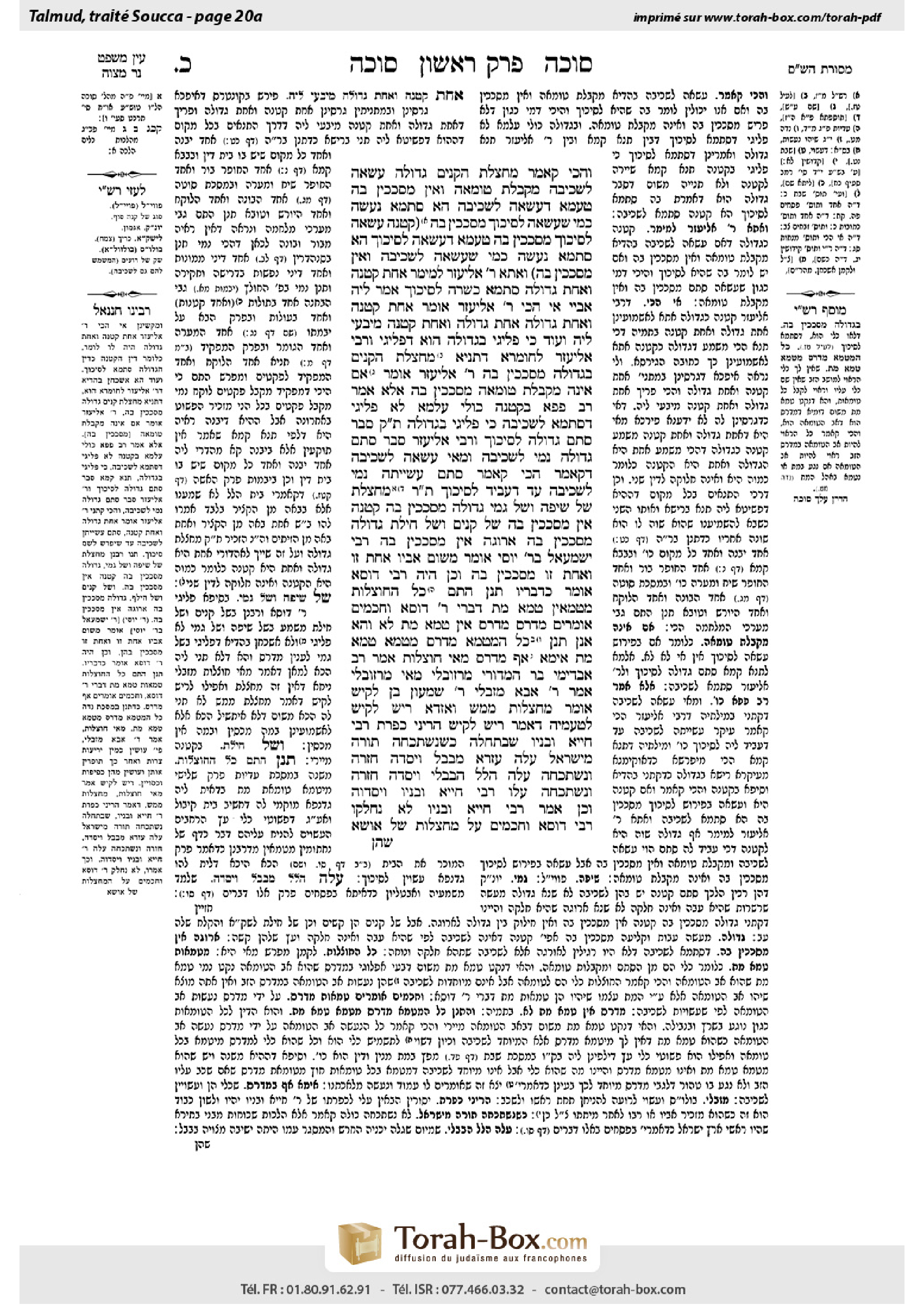
Sukkah 20a: Talmud study for Daf Yomi
Daf Yomi is the daily study of one Talmud folio. Explore 37 tractates with scans, Hebrew text, Sefaria English and AI-generated French translations where annotated.
Passage selection and English or AI-generated French translation are available where the scan has annotations. Daf Study is independent of Torah-Box and Sefaria.
Browse Sukkah · סוכה · All tractatesSukkah 20a text and translations
This page of Sukkah includes the Aramaic text, an English translation and an AI-generated French translation, alongside the scan above.
סוכה כ׳ א · Aramaic and Hebrew text
וְהָכִי קָאָמַר: מַחְצֶלֶת הַקָּנִים גְּדוֹלָה, עֲשָׂאָהּ לִשְׁכִיבָה — מְקַבֶּלֶת טוּמְאָה, וְאֵין מְסַכְּכִין בָּהּ. טַעְמָא דַּעֲשָׂאָהּ לִשְׁכִיבָה, הָא סְתָמָא — נַעֲשָׂה כְּמִי שֶׁעֲשָׂאָהּ לְסִיכּוּךְ, מְסַכְּכִין בָּהּ. (קְטַנָּה, עֲשָׂאָהּ לְסִיכּוּךְ — מְסַכְּכִין בָּהּ. טַעְמָא דַּעֲשָׂאָהּ לְסִיכּוּךְ, הָא סְתָמָא — נַעֲשָׂה כְּמִי שֶׁעֲשָׂאָהּ לִשְׁכִיבָה, וְאֵין מְסַכְּכִין בָּהּ). וַאֲתָא רַבִּי אֱלִיעֶזֶר לְמֵימַר: אַחַת קְטַנָּה וְאַחַת גְּדוֹלָה, סְתָמָא — כְּשֵׁרָה לְסִיכּוּךְ.
אֲמַר לֵיהּ אַבָּיֵי: אִי הָכִי, רַבִּי אֱלִיעֶזֶר אוֹמֵר: אַחַת קְטַנָּה וְאַחַת גְּדוֹלָה, ״אַחַת גְּדוֹלָה וְאַחַת קְטַנָּה״ מִיבְּעֵי לֵיהּ!
וְעוֹד: כִּי פְּלִיגִי, בִּגְדוֹלָה הוּא דִּפְלִיגִי — וְרַבִּי אֱלִיעֶזֶר לְחוּמְרָא. דְּתַנְיָא: מַחְצֶלֶת הַקָּנִים גְּדוֹלָה מְסַכְּכִין בָּהּ. רַבִּי אֱלִיעֶזֶר אוֹמֵר: אִם אֵינָהּ מְקַבֶּלֶת טוּמְאָה — מְסַכְּכִין בָּהּ.
אֶלָּא אָמַר רַב פָּפָּא: בִּקְטַנָּה כּוּלֵּי עָלְמָא לָא פְּלִיגִי דִּסְתָמָא לִשְׁכִיבָה. כִּי פְּלִיגִי בִּגְדוֹלָה, תַּנָּא קַמָּא סָבַר: סְתַם גְּדוֹלָה לְסִיכּוּךְ, וְרַבִּי אֱלִיעֶזֶר סָבַר: סְתַם גְּדוֹלָה נָמֵי לִשְׁכִיבָה.
וּמַאי עֲשָׂאָהּ לִשְׁכִיבָה דְּקָאָמַר — הָכִי קָאָמַר: סְתַם עֲשִׂיָּיתָהּ נָמֵי לִשְׁכִיבָה, עַד דְּעָבֵיד לְסִיכּוּךְ.
תָּנוּ רַבָּנַן: מַחְצֶלֶת שֶׁל שִׁיפָה וְשֶׁל גֶּמִי, גְּדוּלָה — מְסַכְּכִין בָּהּ, קְטַנָּה — אֵין מְסַכְּכִין בָּהּ. שֶׁל קָנִים וְשֶׁל חִילָת, גְּדוֹלָה — מְסַכְּכִין בָּהּ, אֲרוּגָה — אֵין מְסַכְּכִין בָּהּ.
רַבִּי יִשְׁמָעֵאל בְּרַבִּי יוֹסֵי אוֹמֵר מִשּׁוּם אָבִיו: אַחַת זוֹ וְאַחַת זוֹ מְסַכְּכִין בָּהּ. וְכֵן הָיָה רַבִּי דּוֹסָא אוֹמֵר כִּדְבָרָיו.
תְּנַן הָתָם: כׇּל הַחוֹצָלוֹת מְטַמְּאִין טְמֵא מֵת, דִּבְרֵי רַבִּי דּוֹסָא. וַחֲכָמִים אוֹמְרִים: מִדְרָס.
מִדְרָס אִין, טְמֵא מֵת לָא? וְהָא אֲנַן תְּנַן: כׇּל הַמִּטַּמֵּא מִדְרָס — מִטַּמֵּא טְמֵא מֵת. אֵימָא: אַף מִדְרָס.
מַאי חוֹצָלוֹת? אָמַר רַב אַבְדִּימִי בַּר הַמְדּוּרֵי: מַרְזוֹבְלֵי. מַאי מַרְזוֹבְלֵי? אָמַר רַבִּי אַבָּא: מַזְבְּלֵי. רַבִּי שִׁמְעוֹן בֶּן לָקִישׁ אוֹמֵר: מַחְצָלוֹת מַמָּשׁ.
וְאַזְדָּא רֵישׁ לָקִישׁ לְטַעְמֵיהּ. דְּאָמַר רֵישׁ לָקִישׁ: הֲרֵינִי כַּפָּרַת רַבִּי חִיָּיא וּבָנָיו, שֶׁבִּתְחִלָּה כְּשֶׁנִּשְׁתַּכְּחָה תּוֹרָה מִיִּשְׂרָאֵל — עָלָה עֶזְרָא מִבָּבֶל וְיִסְּדָהּ. חָזְרָה וְנִשְׁתַּכְּחָה — עָלָה הִלֵּל הַבַּבְלִי וְיִסְּדָהּ. חָזְרָה וְנִשְׁתַּכְּחָה — עָלוּ רַבִּי חִיָּיא וּבָנָיו וְיִסְּדוּהָ. וְכֵן אָמַר רַבִּי חִיָּיא וּבָנָיו: לֹא נֶחְלְקוּ רַבִּי דּוֹסָא וַחֲכָמִים עַל מַחְצָלוֹת שֶׁל אוּשָׁא
Sukkah 20a · English translation
And this is what the mishna is saying: With regard to a large mat of reeds, if one produced it for the purpose of lying upon it, it is susceptible to ritual impurity, and one may not roof a sukka with it. The reason is that one produced it specifically for the purpose of lying upon it; however, by inference, a mat that one produced without designation becomes as a mat produced for roofing, and one may roof a sukka with it. With regard to a small mat of reeds, if one produced it for roofing, one may roof a sukka with it. The reason is that one produced it specifically for roofing; however, by inference, a mat that one produced without designation becomes as a mat produced for the purpose of lying upon it, and one may not roof a sukka with it. And Rabbi Eliezer comes to say that both a small mat and a large one produced without designation are fit for roofing.
Abaye said to him: If so, if their dispute is only with regard to a small mat, then instead of saying: Rabbi Eliezer says: Both a small mat and a large mat, the mishna needed to say: Both a large mat and a small mat. In a phrase with the format: Both this and that, one typically mentions the more obvious item first. Why then, does Rabbi Eliezer mention the small mat first, if it is with regard to the small mat that they disagree?
And furthermore, there is proof that when they disagree, it is with regard to a large mat, and Rabbi Eliezer’s opinion is a stringency and not a leniency, as it is taught in a baraita: In the case of a reed mat, with a large mat one may roof a sukka. Rabbi Eliezer says: If it is not susceptible to ritual impurity, one may roof his sukka with it. Apparently, Rabbi Eliezer holds that without designation, one may not roof his sukka with a large mat.
Rather, Rav Pappa said: Rava’s proposed resolution is rejected. Rather, with regard to a small mat, everyone agrees that if it was produced without designation, presumably it is for the purpose of lying upon it. When they disagree, is with regard to a large mat: The first tanna holds that a large mat produced without designation is presumably for roofing, and Rabbi Eliezer holds that a large mat produced without designation is also presumably for the purpose of lying upon it.
What, then, is the meaning of: If one produced it for the purpose of lying upon it, that Rabbi Eliezer states? This is what he is saying: Making mats without designation is also for the purpose of lying upon it, until one makes it specifically for roofing.
§ The Sages taught in the Tosefta: In the case of a mat [maḥatzelet] woven of papyrus or bulrushes, if it is a large mat, one may roof a sukka with it, as it is not typically produced for the purpose of lying upon it. If it is a small mat, one may not roof a sukka with it, as it is typically produced for the purpose of lying upon it. However, with regard to a mat produced of ordinary reeds or reeds specifically used for plaiting, if the mat is plaited with a large, coarse weave, one may roof a sukka with it, as it was certainly not produced for the purpose of lying upon it. If it is woven with a small, fine weave, one may not roof the sukka with it, as typically mats of this sort are woven only for the purpose of lying upon them.
Rabbi Yishmael, son of Rabbi Yosei, said in the name of his father: Both with this plaited mat and with that woven mat, one may roof a sukka, as without specific designation otherwise they are not produced for the purpose of lying upon them, and therefore they are ritually pure. And likewise, Rabbi Dosa would say in accordance with his statement.
We learned in a mishna there: All types of ḥotzalot can become ritually impure with impurity imparted by a corpse. Since their legal status is that of a vessel, they become a primary source of ritual impurity. This is the statement of Rabbi Dosa. And the Rabbis say: They become impure with the impurity imparted by treading. If a zav lies or sits on one of the ḥotzalot, they become a primary source of ritual impurity, like a chair or bed of a zav.
The Gemara asks: Impurity imparted by treading, yes; impurity imparted by a corpse, no? But didn’t we learn in a mishna: Any item that becomes ritually impure with impurity imparted by treading also becomes ritually impure with other types of impurity, including impurity imparted by a corpse, although the reverse is not necessarily so. The opinion of the Rabbis is difficult. The Gemara explains: Emend the mishna and say: They become ritually impure even with the impurity imparted by treading. These mats are not merely nondescript vessels, which become primary sources of ritual impurity through exposure to a corpse, they are vessels designated for sitting and lying upon them, and therefore they also become primary sources of ritual impurity if a zav sits or lies upon them.
The Gemara asks about the term used in the mishna: What is the meaning of ḥotzalot? Rav Avdimi bar Hamduri said: They are marzovelei. The Gemara is unfamiliar with the term and asks: What is the meaning of marzovelei? Rabbi Abba said: They are called mezablei in Babylonia. They are leather sacks used by shepherds to feed their animals. Shepherds place them under their heads when lying down. Rabbi Shimon ben Lakish says: Ḥotzalot are a different term for actual mats.
The Gemara notes: And Reish Lakish follows his line of reasoning stated elsewhere, as Reish Lakish said: I am the atonement for Rabbi Ḥiyya and his sons, as initially, when some of the Torah laws were forgotten from the Jewish people in Eretz Yisrael, Ezra ascended from Babylonia and reestablished the forgotten laws. Parts of the Torah were again forgotten in Eretz Yisrael, and Hillel the Babylonian ascended and reestablished the forgotten sections. When parts of the Torah were again forgotten in Eretz Yisrael, Rabbi Ḥiyya and his sons ascended and reestablished the forgotten sections. This expression of deference toward Rabbi Ḥiyya introduces the halakha that Reish Lakish is citing in his name. And so said Rabbi Ḥiyya and his sons: Rabbi Dosa and the Rabbis did not disagree concerning the soft mats of Usha,
Sukkah 20a · Traduction française (IA)
Et voici ce que dit la Michna : une grande natte de roseaux, si on l’a fabriquée pour s’y étendre, est susceptible de contracter l’impureté rituelle, et on ne peut pas l’utiliser pour couvrir une soukka. La raison en est qu’on l’a fabriquée précisément pour s’y étendre ; on peut toutefois en déduire qu’une natte fabriquée sans destination précise est considérée comme ayant été fabriquée pour couvrir, et qu’on peut donc l’utiliser pour couvrir une soukka. Quant à une petite natte de roseaux, si on l’a fabriquée pour couvrir, on peut l’utiliser pour couvrir une soukka. La raison en est qu’on l’a fabriquée précisément pour couvrir ; on peut toutefois en déduire qu’une natte fabriquée sans destination précise est considérée comme ayant été fabriquée pour s’y étendre, et qu’on ne peut donc pas l’utiliser pour couvrir une soukka. Rabbi Eliezer vient enseigner que les nattes, petites comme grandes, fabriquées sans destination précise conviennent pour couvrir.
Abayé lui dit : Si tel est le cas, si leur désaccord ne porte que sur une petite natte, au lieu de dire : « Rabbi Eliezer dit : aussi bien une petite natte qu’une grande », la Michna aurait dû dire : « aussi bien une grande natte qu’une petite ». Dans une formule du type « aussi bien ceci que cela », on mentionne généralement d’abord l’élément le plus évident. Pourquoi Rabbi Eliezer mentionne-t-il donc la petite natte en premier, si c’est au sujet de la petite natte qu’ils sont en désaccord ?
De plus, il est prouvé que leur désaccord porte sur une grande natte, et que l’avis de Rabbi Eliezer est une rigueur, et non une indulgence, comme l’enseigne une baraïta : dans le cas d’une natte de roseaux, on peut couvrir une soukka avec une grande natte. Rabbi Eliezer dit : si elle n’est pas susceptible de contracter l’impureté rituelle, on peut l’utiliser pour couvrir sa soukka. Il apparaît donc que, selon Rabbi Eliezer, sans destination précise, on ne peut pas couvrir sa soukka avec une grande natte.
Rav Pappa dit plutôt : la résolution proposée par Rava est rejetée. Quant à une petite natte, tous s’accordent à dire que, si elle a été fabriquée sans destination précise, elle est présumée avoir été fabriquée pour s’y étendre. Leur désaccord porte sur une grande natte : le premier tanna considère qu’une grande natte fabriquée sans destination précise est présumée destinée à couvrir ; Rabbi Eliezer considère qu’une grande natte fabriquée sans destination précise est, elle aussi, présumée destinée à ce qu’on s’y étende.
Que signifie donc la formule de Rabbi Eliezer : « si on l’a fabriquée pour s’y étendre » ? Voici ce qu’il veut dire : les nattes fabriquées sans destination précise sont également destinées à ce qu’on s’y étende, jusqu’à ce qu’on les fabrique expressément pour couvrir.
§ Les Sages ont enseigné dans la Tossefta : dans le cas d’une natte [maḥatzelet] tressée en papyrus ou en joncs, si elle est grande, on peut l’utiliser pour couvrir une soukka, car elle n’est généralement pas fabriquée pour s’y étendre. Si elle est petite, on ne peut pas l’utiliser pour couvrir une soukka, car elle est généralement fabriquée pour s’y étendre. En revanche, dans le cas d’une natte faite de roseaux ordinaires ou de roseaux spécialement destinés au tressage, si elle est tressée grossièrement, avec de grandes mailles, on peut l’utiliser pour couvrir une soukka, car elle n’a certainement pas été fabriquée pour s’y étendre. Si elle est tressée finement, avec de petites mailles, on ne peut pas l’utiliser pour couvrir la soukka, car les nattes de ce type sont généralement tressées uniquement pour qu’on s’y étende.
Rabbi Yishmael, fils de Rabbi Yosei, dit au nom de son père : on peut couvrir une soukka aussi bien avec cette natte tressée qu’avec cette natte tissée, car, en l’absence de destination précise, elles ne sont pas fabriquées pour qu’on s’y étende et sont donc rituellement pures. Rabbi Dosa s’exprimait de même, conformément à son avis.
Nous avons appris dans une Michna, là-bas : toutes sortes de ḥotzalot peuvent contracter l’impureté rituelle transmise par un cadavre. Puisqu’elles ont le statut d’ustensiles, elles deviennent une source primaire d’impureté rituelle. Telle est la déclaration de Rabbi Dosa. Les Sages disent : elles contractent l’impureté rituelle transmise par le piétinement. Si un zav s’étend sur l’une des ḥotzalot ou s’y assied, celle-ci devient une source primaire d’impureté rituelle, comme un siège ou un lit de zav.
La Guemara demande : elles contractent l’impureté transmise par le piétinement, certes ; mais pas celle transmise par un cadavre ? Pourtant, nous avons appris dans une Michna : tout objet qui contracte l’impureté rituelle transmise par le piétinement contracte également l’impureté rituelle d’autres types, notamment celle transmise par un cadavre, bien que l’inverse ne soit pas nécessairement vrai. L’avis des Sages pose donc une difficulté. La Guemara explique : corrige la Michna et dis : « elles contractent même l’impureté rituelle transmise par le piétinement ». Ces nattes ne sont pas de simples ustensiles sans affectation particulière, qui deviennent des sources primaires d’impureté rituelle au contact d’un cadavre ; ce sont des ustensiles destinés à ce qu’on s’y asseye ou qu’on s’y étende, et elles deviennent donc également des sources primaires d’impureté rituelle si un zav s’assied ou s’étend dessus.
La Guemara s’interroge sur le terme employé dans la Michna : que signifie ḥotzalot ? Rav Avdimi bar Hamdouri dit : ce sont des marzovelei. La Guemara ne connaît pas ce terme et demande : que signifie marzovelei ? Rabbi Abba dit : en Babylonie, on les appelle mezablei. Ce sont des sacs de cuir dont les bergers se servent pour nourrir leurs animaux. Les bergers les placent sous leur tête lorsqu’ils s’allongent. Rabbi Shimon ben Lakish dit : ḥotzalot est un autre terme pour désigner de véritables nattes.
La Guemara relève que Reish Lakish suit le raisonnement qu’il a exposé ailleurs, car Reish Lakish a dit : « Que je sois l’expiation pour Rabbi Ḥiyya et ses fils ! » En effet, au début, lorsque certaines lois de la Torah furent oubliées par le peuple juif en terre d’Israël, Ezra monta de Babylonie et rétablit les lois oubliées. Des parties de la Torah furent de nouveau oubliées en terre d’Israël, et Hillel le Babylonien monta et rétablit les passages oubliés. Lorsque des parties de la Torah furent à nouveau oubliées en terre d’Israël, Rabbi Ḥiyya et ses fils montèrent et rétablirent les passages oubliés. Cette marque de déférence envers Rabbi Ḥiyya introduit la halakha que Reish Lakish cite en son nom. Rabbi Ḥiyya et ses fils ont ainsi dit : Rabbi Dosa et les Sages n’étaient pas en désaccord au sujet des nattes souples d’Ousha,
Traduction française générée par IA à partir de l’édition anglaise de Sefaria. Vérifie toujours un passage avec le texte source.
Text from Sefaria: William Davidson Edition - Vocalized Aramaic (CC BY NC); William Davidson Edition - English (CC BY NC).