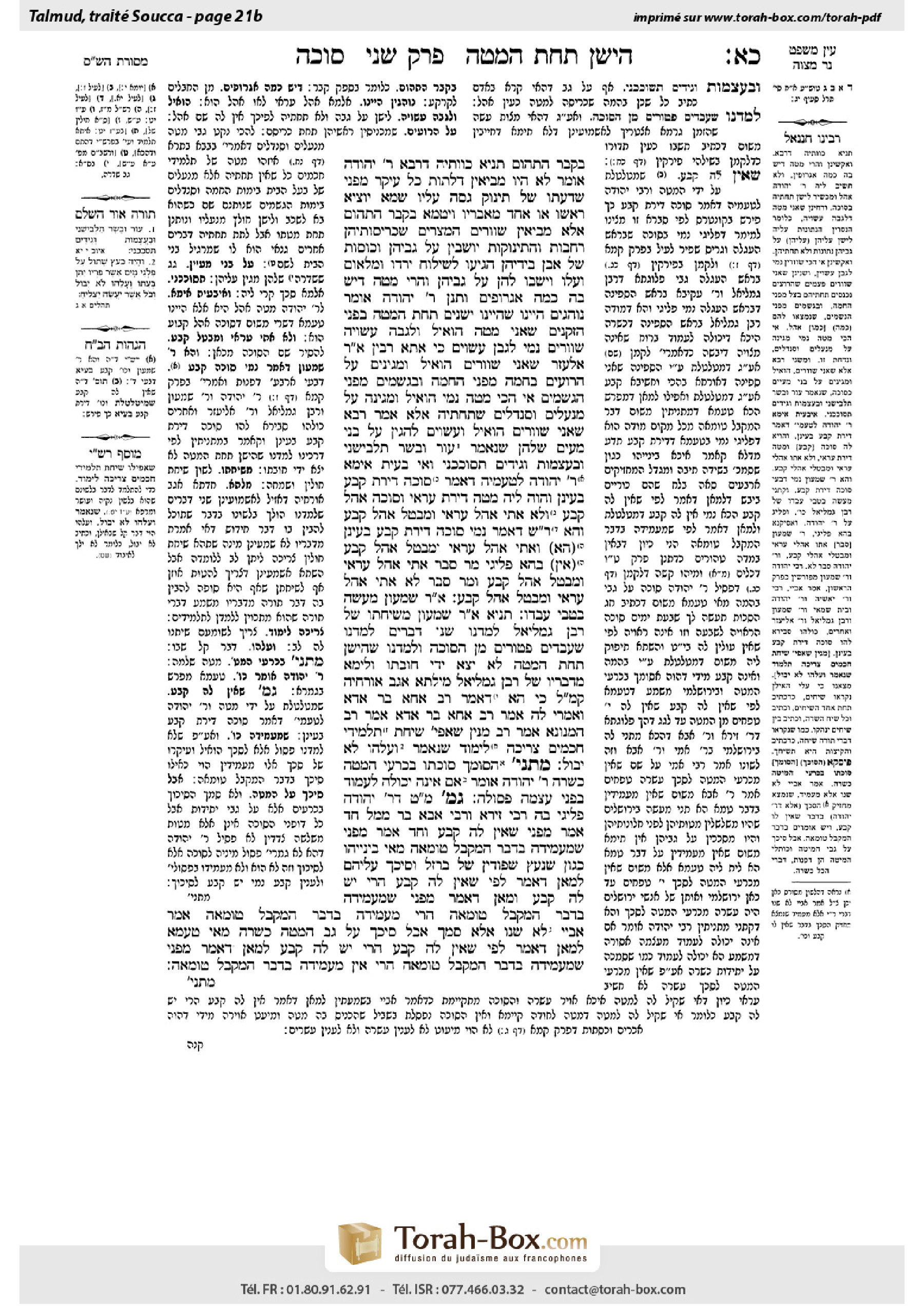
Sukkah 21b: Talmud study for Daf Yomi
Daf Yomi is the daily study of one Talmud folio. Explore 37 tractates with scans, Hebrew text, Sefaria English and AI-generated French translations where annotated.
Passage selection and English or AI-generated French translation are available where the scan has annotations. Daf Study is independent of Torah-Box and Sefaria.
Browse Sukkah · סוכה · All tractatesSukkah 21b text and translations
This page of Sukkah includes the Aramaic text, an English translation and an AI-generated French translation, alongside the scan above.
סוכה כ״א ב · Aramaic and Hebrew text
בְּקֶבֶר הַתְּהוֹם.
תַּנְיָא כְּווֹתֵיהּ דְּרָבָא. רַבִּי יְהוּדָה אוֹמֵר: לֹא הָיוּ מְבִיאִין דְּלָתוֹת כׇּל עִיקָּר, מִפְּנֵי שֶׁדַּעְתּוֹ שֶׁל תִּינוֹק גַּסָּה עָלָיו, שֶׁמָּא יוֹצִיא רֹאשׁוֹ אוֹ אֶחָד מֵאֵבָרָיו וְיִטָּמֵא בְּקֶבֶר הַתְּהוֹם. אֶלָּא מְבִיאִין שְׁוָורִים הַמִּצְרִים שֶׁכְּרֵיסוֹתֵיהֶן רְחָבוֹת, וְהַתִּינוֹקוֹת יוֹשְׁבִין עַל גַּבֵּיהֶן, וְכוֹסוֹת שֶׁל אֶבֶן בִּידֵיהֶן. הִגִּיעוּ לַשִּׁילוֹחַ — יָרְדוּ וּמִלְּאוּם, וְעָלוּ וְיָשְׁבוּ לָהֶן עַל גַּבֵּיהֶן.
וַהֲרֵי מִטָּה, דְּיֵשׁ בָּהּ כַּמָּה אֶגְרוֹפִים, וּתְנַן, רַבִּי יְהוּדָה אוֹמֵר: נוֹהֲגִים הָיִינוּ שֶׁהָיִינוּ יְשֵׁנִים תַּחַת הַמִּטָּה בִּפְנֵי הַזְּקֵנִים! שָׁאנֵי מִטָּה, הוֹאִיל וּלְגַבָּהּ עֲשׂוּיָה. שְׁוָורִים נָמֵי לְגַבָּן עֲשׂוּיִם!
כִּי אֲתָא רָבִין אָמַר רַבִּי אֶלְעָזָר: שָׁאנֵי שְׁוָורִים הוֹאִיל וּמְגִינִּים עַל הָרוֹעִים בַּחַמָּה מִפְּנֵי הַחַמָּה וּבַגְּשָׁמִים מִפְּנֵי הַגְּשָׁמִים. אִי הָכִי, מִטָּה נָמֵי — הוֹאִיל וּמְגִינָּה עַל מִנְעָלִים וְסַנְדָּלִים שֶׁתַּחְתֶּיהָ!
אֶלָּא אָמַר רָבָא: שָׁאנֵי שְׁוָורִים, הוֹאִיל וַעֲשׂוּיִם לְהָגֵין עַל בְּנֵי מֵעַיִם שֶׁלָּהֶן, שֶׁנֶּאֱמַר: ״עוֹר וּבָשָׂר תַּלְבִּישֵׁנִי וּבַעֲצָמוֹת וְגִידִים תְּסוֹכְכֵנִי״.
וְאִי בָּעֵית אֵימָא: רַבִּי יְהוּדָה לְטַעְמֵיהּ, דְּאָמַר: סוּכָּה דִּירַת קֶבַע בָּעֵינַן. וְהָוֵה לֵיהּ מִטָּה דִּירַת עֲרַאי, וְסוּכָּה אֹהֶל קֶבַע — וְלָא אָתֵי אֹהֶל עֲרַאי וּמְבַטֵּל אֹהֶל קֶבַע.
וְהָא רַבִּי שִׁמְעוֹן דְּאָמַר נָמֵי — סוּכָּה דִּירַת קֶבַע בָּעֵינַן, (הָא) וְאָתֵי אֹהֶל עֲרַאי וּמְבַטֵּל אֹהֶל קֶבַע! (אִין) בְּהָא פְּלִיגִי, מָר סָבַר: אָתֵי אֹהֶל עֲרַאי וּמְבַטֵּל אֹהֶל קֶבַע, וּמַר סָבַר: לָא אָתֵי אֹהֶל עֲרַאי וּמְבַטֵּל אֹהֶל קֶבַע.
אָמַר רַבִּי שִׁמְעוֹן: מַעֲשֶׂה בְּטָבִי עַבְדּוֹ. תַּנְיָא, אָמַר רַבִּי שִׁמְעוֹן: מִשִּׂיחָתוֹ שֶׁל רַבָּן גַּמְלִיאֵל לָמַדְנוּ שְׁנֵי דְבָרִים: לָמַדְנוּ שֶׁעֲבָדִים פְּטוּרִים מִן הַסּוּכָּה, וְלָמַדְנוּ שֶׁהַיָּשֵׁן תַּחַת הַמִּטָּה לֹא יָצָא יְדֵי חוֹבָתוֹ.
וְלֵימָא: ״מִדְּבָרָיו שֶׁל רַבָּן גַּמְלִיאֵל״? מִילְּתָא אַגַּב אוֹרְחֵיהּ קָא מַשְׁמַע לַן, כִּי הָא דְּאָמַר רַב אַחָא בַּר אַדָּא, וְאָמְרִי לַהּ אָמַר רַב אַחָא בַּר אַדָּא אָמַר רַב הַמְנוּנָא אָמַר רַב: מִנַּיִן שֶׁאֲפִילּוּ שִׂיחַת תַּלְמִידֵי חֲכָמִים, צְרִיכָה לִימּוּד — שֶׁנֶּאֱמַר: ״וְעָלֵהוּ לֹא יִבּוֹל״.
מַתְנִי׳ הַסּוֹמֵךְ סוּכָּתוֹ בְּכַרְעֵי הַמִּטָּה — כְּשֵׁרָה. רַבִּי יְהוּדָה אוֹמֵר: אִם אֵינָהּ יְכוֹלָה לַעֲמוֹד בִּפְנֵי עַצְמָהּ — פְּסוּלָה.
גְּמָ׳ מַאי טַעְמֵיהּ דְּרַבִּי יְהוּדָה? פְּלִיגִי בַּהּ רַבִּי זֵירָא וְרַבִּי אַבָּא בַּר מֶמֶל. חַד אָמַר: מִפְּנֵי שֶׁאֵין לָהּ קֶבַע. וְחַד אָמַר: מִפְּנֵי שֶׁמַּעֲמִידָהּ בְּדָבָר הַמְקַבֵּל טוּמְאָה.
מַאי בֵּינַיְיהוּ? כְּגוֹן שֶׁנָּעַץ שַׁפּוּדִין שֶׁל בַּרְזֶל וְסִיכֵּךְ עֲלֵיהֶם. לְמַאן דְּאָמַר לְפִי שֶׁאֵין לָהּ קֶבַע — הֲרֵי יֵשׁ לָהּ קֶבַע. וּמַאן דְּאָמַר מִפְּנֵי שֶׁמַּעֲמִידָהּ בְּדָבָר הַמְקַבֵּל טוּמְאָה — הֲרֵי מַעֲמִידָהּ בְּדָבָר הַמְקַבֵּל טוּמְאָה.
אָמַר אַבָּיֵי: לֹא שָׁנוּ אֶלָּא סָמַךְ. אֲבָל סִיכֵּךְ עַל גַּב הַמִּטָּה — כְּשֵׁרָה. מַאי טַעְמָא? לְמַאן דְּאָמַר לְפִי שֶׁאֵין לָהּ קֶבַע — הֲרֵי יֵשׁ לָהּ קֶבַע. לְמַאן דְּאָמַר מִפְּנֵי שֶׁמַּעֲמִידָהּ בְּדָבָר הַמְקַבֵּל טוּמְאָה — הֲרֵי אֵין מַעֲמִידָהּ בְּדָבָר הַמְקַבֵּל טוּמְאָה.
Sukkah 21b · English translation
with impurity imparted by a grave in the depths.
The Gemara comments: It is taught in a baraita in accordance with the opinion of Rava, as Rabbi Yehuda says: They would not bring doors at all, because a child has an exaggerated sense of self-confidence and perhaps he will extend his head or one of his limbs beyond the edge of the door and will become impure with impurity imparted by a grave in the depths. Rather, they would bring Egyptian oxen whose bellies are broad, and the children would sit upon them and they would hold cups of stone in their hands. When they reached the Siloam pool they descended and filled them, and ascended and sat themselves on the backs of the oxen.
The Gemara asks: But with regard to a bed, which measures several fistbreadths, didn’t we learn in the mishna that Rabbi Yehuda says: It was our custom that we would sleep beneath the bed before the Elders? Apparently, despite the fact that a bed measures several handbreadths, its legal status is not that of a tent. The Gemara answers: A bed is different, since it is designed specifically for use upon it; therefore, the status of the space beneath it is not that of a tent. The Gemara asks: Aren’t oxen like those used to transport the children to bring water for the red heifer also designated specifically for use upon them and nevertheless, Rabbi Yehuda deems their spinal column and bellies a tent.
When Ravin came to Babylonia from Eretz Yisrael he said that Rabbi Elazar said: Oxen are different since they protect the shepherds in the sun from the sun, and in the rain from the rain. Shepherds would lie beneath the bellies of the oxen as protection from the elements. The Gemara asks: If so, i.e., if an ox is rendered a tent because it provides protection, even if its primary designation is for use upon it, then the status of a bed too should be that of a tent, since it protects shoes and sandals that are placed beneath it.
Rather, Rava rejected that explanation and said: Oxen are different and their status is that of a tent since their bellies and backs are made to protect their innards, as it is stated: “With skin and flesh You have clothed me, and with bones and sinews You have knitted me together” (Job 10:11). Since flesh and skin are mentioned in the verse as providing shelter, the status of the oxen is that of a tent.
And if you wish, say instead: In this case Rabbi Yehuda conforms to his reasoning, as he stated elsewhere: We require a sukka that is a permanent residence. The bed in a sukka is a temporary residence, and the sukka is a permanent tent; and a temporary tent does not come and negate a permanent tent. The permanent sukka is significant and that significance supersedes any temporary structure within it. Therefore, in Rabbi Yehuda’s opinion, the status of the bed is not that of a tent.
The Gemara asks: But according to Rabbi Shimon, who also stated that we require a sukka that is a permanent residence, nevertheless, a temporary tent comes and negates a permanent tent. The Gemara answers: Yes, and that is the point over which they disagree. One Sage, Rabbi Shimon, holds: A temporary tent comes and negates a permanent tent, and one Sage, Rabbi Yehuda, holds: A temporary tent does not come and negate a permanent tent.
The mishna relates that Rabbi Shimon said, contrary to the opinion of Rabbi Yehuda: There was an incident involving Tavi, the Canaanite slave of Rabban Gamliel who was sleeping beneath the bed, and Rabban Gamliel claimed that Tavi did so because he was a Torah scholar and knew that slaves are exempt from the mitzva of sukka. It is taught in a baraita that Rabbi Shimon said: From the conversation of Rabban Gamliel we learned two matters. We learned that Canaanite slaves are exempt from the mitzva of sukka, and we learned that one who sleeps beneath the bed did not fulfill his obligation.
The Gemara questions the formulation of the baraita. And let Rabbi Shimon say: From the statement of Rabban Gamliel. Why did he use the atypical expression: From the conversation of Rabban Gamliel? The Gemara answers: Through this expression he teaches us another matter in passing, like that which Rabbi Aḥa bar Adda said, and some say that Rabbi Aḥa bar Adda said that Rabbi Hamnuna said that Rav said: From where is it derived that even the conversation of Torah scholars require analysis, even when the intention of the speaker was apparently not to issue a halakhic ruling? It is as it is stated with regard to the righteous: “Which brings forth its fruit in its season and whose leaf does not wither” (Psalms 1:3). This teaches that with regard to a Torah scholar, not only is his primary product, his fruit, significant but even ancillary matters that stem from his conversation, his leaves, are significant.
MISHNA: One who supports his sukka on the legs of the bed, i.e., he leans the sukka roofing on a bed, the sukka is fit. Rabbi Yehuda says: If the sukka cannot stand in and of itself without support of the bed, it is unfit.
GEMARA: The Gemara asks: What is the rationale for the statement of Rabbi Yehuda deeming this sukka unfit? Rabbi Zeira and Rabbi Abba bar Memel disagree with regard to the rationale. One said: It is unfit because it lacks permanence. The sukka is not stable enough, as if the bed is moved the sukka will collapse. And one said: It is unfit because he is supporting the roofing with an object that is susceptible to ritual impurity, as the bedframe is a vessel. Not only the roofing, but that which supports the roofing as well may not be susceptible to ritual impurity.
The Gemara asks: What is the practical difference between them? The Gemara explains: The difference is in a case where one wedged iron skewers into the ground and roofed the sukka upon them. According to the one who said that the reason the sukka is unfit is because it lacks permanence, this sukka has permanence, and it is fit. However, the one who said the reason the sukka is unfit is because he is supporting the roofing with an object that is susceptible to ritual impurity, he is supporting it with an object that is susceptible to ritual impurity, so it is unfit.
Abaye said: The Sages taught this dispute only in a case where one leaned the roofing on the bed. However, if one placed the roofing atop the bed, i.e., he affixed poles to the bed and the roofing is supported by those poles, everyone agrees that the sukka is fit. What is the reason that it is fit? According to the one who said that the sukka is unfit because it lacks permanence, this sukka has permanence as even if the bed is moved, the roofing will move with it and will not collapse. And according to the one who said the sukka is unfit because he supports it with an object that is susceptible to ritual impurity, in this case he is not supporting it with an object that is susceptible to ritual impurity, as the roofing is not supported by the bed.
Sukkah 21b · Traduction française (IA)
avec l’impureté transmise par une tombe située dans les profondeurs.
La Guemara fait remarquer : Une baraïta est enseignée conformément à l’opinion de Rava, comme le dit Rabbi Yehouda : Ils n’apportaient jamais de portes, car un enfant a une confiance en soi excessive et risque de passer la tête ou l’un de ses membres au-delà du bord de la porte et de devenir impur par l’impureté transmise par une tombe située dans les profondeurs. Ils apportaient plutôt des bœufs égyptiens, dont le ventre est large ; les enfants s’asseyaient sur eux et tenaient des coupes de pierre dans leurs mains. Lorsqu’ils arrivaient à la piscine de Siloé, ils descendaient et remplissaient les coupes, puis remontaient et s’installaient sur le dos des bœufs.
La Guemara demande : Mais, à propos d’un lit qui mesure plusieurs téfa’him, n’avons-nous pas appris dans la Michna que Rabbi Yehouda dit : « Nous avions coutume de dormir sous le lit devant les Anciens » ? Il semble donc que, bien qu’un lit mesure plusieurs téfa’him, l’espace qu’il recouvre n’a pas le statut d’une tente. La Guemara répond : Le lit est différent, puisqu’il est spécifiquement destiné à être utilisé par-dessus ; par conséquent, l’espace situé au-dessous n’a pas le statut d’une tente. La Guemara demande : Les bœufs utilisés pour transporter les enfants venus apporter l’eau destinée à la vache rousse ne sont-ils pas eux aussi spécifiquement destinés à être utilisés par-dessus ? Pourtant, Rabbi Yehouda considère leur colonne vertébrale et leur ventre comme une tente.
Lorsque Ravin vint de la Terre d’Israël en Babylonie, il rapporta que Rabbi Elazar avait dit : Les bœufs sont différents, car ils protègent les bergers du soleil quand il fait soleil et de la pluie quand il pleut. Les bergers se couchaient sous le ventre des bœufs pour se protéger des intempéries. La Guemara demande : Dans ce cas, c’est-à-dire si un bœuf acquiert le statut de tente parce qu’il procure un abri, même si sa destination première est d’être utilisé par-dessus, un lit devrait lui aussi avoir le statut de tente, puisqu’il protège les chaussures et les sandales placées dessous.
Rava a plutôt rejeté cette explication et a dit : Les bœufs sont différents et ont le statut de tente, car leur ventre et leur dos sont faits pour protéger leurs entrailles, comme il est dit : « Tu m’as revêtu de peau et de chair, tu m’as tissé d’os et de nerfs » (Job 10,11). Puisque le verset mentionne la chair et la peau comme éléments protecteurs, les bœufs ont le statut de tente.
Et si tu veux, dis plutôt : Dans ce cas, Rabbi Yehouda reste fidèle à son raisonnement, puisqu’il a déclaré ailleurs : « Nous exigeons une soukka qui soit une demeure permanente. » Le lit dans une soukka est une demeure temporaire, tandis que la soukka est une tente permanente ; une tente temporaire ne vient pas annuler une tente permanente. La soukka permanente est importante et cette importance l’emporte sur toute structure temporaire qui s’y trouve. Par conséquent, selon Rabbi Yehouda, le lit n’a pas le statut de tente.
La Guemara demande : Mais, selon Rabbi Shimon, qui a lui aussi déclaré que nous exigeons une soukka qui soit une demeure permanente, une tente temporaire vient néanmoins annuler une tente permanente. La Guemara répond : Oui, et c’est précisément sur ce point qu’ils sont en désaccord. Un Sage, Rabbi Shimon, considère qu’une tente temporaire vient annuler une tente permanente, tandis que l’autre Sage, Rabbi Yehouda, considère qu’une tente temporaire ne vient pas annuler une tente permanente.
La Michna rapporte que Rabbi Shimon dit, contrairement à l’opinion de Rabbi Yehouda : Il y eut un épisode concernant Tavi, l’esclave cananéen de Rabban Gamliel, qui dormait sous le lit. Rabban Gamliel affirma que Tavi agissait ainsi parce qu’il était un érudit de la Torah et savait que les esclaves sont exemptés de la mitsva de soukka. Une baraïta enseigne que Rabbi Shimon dit : « De la conversation de Rabban Gamliel, nous avons appris deux choses. » Nous avons appris que les esclaves cananéens sont exemptés de la mitsva de soukka, et que celui qui dort sous le lit ne s’est pas acquitté de son obligation.
La Guemara remet en question la formulation de la baraïta. Rabbi Shimon n’aurait-il pas dû dire : « De la déclaration de Rabban Gamliel » ? Pourquoi emploie-t-il l’expression inhabituelle : « De la conversation de Rabban Gamliel » ? La Guemara répond : Par cette expression, il nous enseigne incidemment une autre chose, conformément à ce que dit Rabbi Aḥa bar Adda ; certains disent que Rabbi Aḥa bar Adda a dit au nom de Rabbi Hamnuna, qui l’a dit au nom de Rav : D’où apprend-on que même les conversations des érudits de la Torah doivent être examinées, même lorsque le locuteur n’avait apparemment pas l’intention de rendre une décision de halakha ? C’est ce qui est dit à propos des justes : « Il donne son fruit en sa saison, et son feuillage ne se flétrit pas » (Psaumes 1,3). Cela enseigne qu’en ce qui concerne un érudit de la Torah, non seulement son produit principal, son fruit, est important, mais aussi les éléments accessoires issus de sa conversation, ses feuilles.
MICHNA : Celui qui fait reposer sa soukka sur les pieds du lit, c’est-à-dire qui appuie le toit de branchages de la soukka sur un lit, a une soukka valide. Rabbi Yehouda dit : Si la soukka ne peut tenir par elle-même, sans le soutien du lit, elle est invalide.
GUEMARA : La Guemara demande : Quelle est la raison pour laquelle Rabbi Yehouda considère cette soukka comme invalide ? Rabbi Zeira et Rabbi Abba bar Memel sont en désaccord sur la raison. L’un dit : Elle est invalide parce qu’elle manque de permanence. La soukka n’est pas suffisamment stable, car si l’on déplace le lit, elle s’effondre. L’autre dit : Elle est invalide parce que le toit de branchages est soutenu par un objet susceptible de contracter l’impureté rituelle, puisque le cadre du lit est un ustensile. Non seulement le toit de branchages, mais aussi ce qui le soutient ne doit pas être susceptible de contracter l’impureté rituelle.
La Guemara demande : Quelle différence pratique y a-t-il entre eux ? La Guemara explique : La différence concerne le cas où quelqu’un a enfoncé des broches de fer dans le sol et posé le toit de branchages de la soukka dessus. Selon celui qui dit que la soukka est invalide parce qu’elle manque de permanence, cette soukka est permanente et valide. En revanche, selon celui qui dit que la soukka est invalide parce que le toit de branchages est soutenu par un objet susceptible de contracter l’impureté rituelle, elle est invalide, puisqu’il est soutenu par un tel objet.
Abaye dit : Les Sages n’ont enseigné ce désaccord que dans le cas où quelqu’un a appuyé le toit de branchages sur le lit. Toutefois, s’il a posé le toit de branchages au-dessus du lit, c’est-à-dire s’il a fixé des perches au lit et que le toit de branchages est soutenu par ces perches, tous conviennent que la soukka est valide. Pourquoi est-elle valide ? Selon celui qui dit que la soukka est invalide parce qu’elle manque de permanence, cette soukka est permanente, car même si l’on déplace le lit, le toit de branchages se déplacera avec lui et ne s’effondrera pas. Et selon celui qui dit que la soukka est invalide parce qu’elle est soutenue par un objet susceptible de contracter l’impureté rituelle, dans ce cas elle n’est pas soutenue par un objet susceptible de contracter l’impureté rituelle, car le toit de branchages n’est pas soutenu par le lit.
Traduction française générée par IA à partir de l’édition anglaise de Sefaria. Vérifie toujours un passage avec le texte source.
Text from Sefaria: William Davidson Edition - Vocalized Aramaic (CC BY NC); William Davidson Edition - English (CC BY NC).