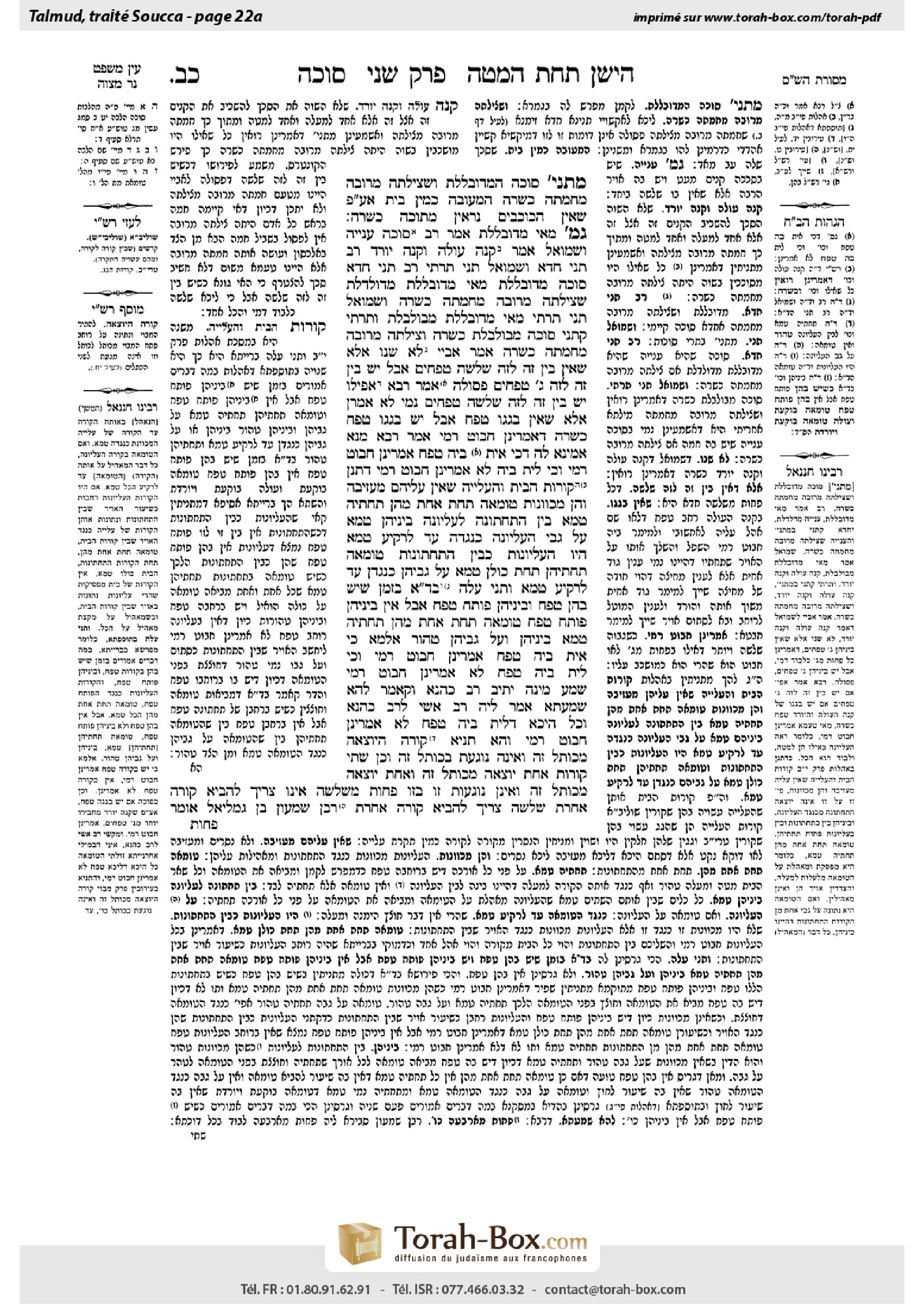
Sukkah 22a: Talmud study for Daf Yomi
Daf Yomi is the daily study of one Talmud folio. Explore 37 tractates with scans, Hebrew text, Sefaria English and AI-generated French translations where annotated.
Passage selection and English or AI-generated French translation are available where the scan has annotations. Daf Study is independent of Torah-Box and Sefaria.
Browse Sukkah · סוכה · All tractatesSukkah 22a text and translations
This page of Sukkah includes the Aramaic text, an English translation and an AI-generated French translation, alongside the scan above.
סוכה כ״ב א · Aramaic and Hebrew text
מַתְנִי׳ סוּכָּה הַמְדוּבְלֶלֶת וְשֶׁצִּילָּתָהּ מְרוּבָּה מֵחַמָּתָהּ — כְּשֵׁרָה. הַמְעוּבָּה כְּמִין בַּיִת, אַף עַל פִּי שֶׁאֵין הַכּוֹכָבִים נִרְאִין מִתּוֹכָהּ — כְּשֵׁרָה.
גְּמָ׳ מַאי מְדוּבְלֶלֶת? אָמַר רַב: סוּכָּה עֲנִיָּיה. וּשְׁמוּאֵל אָמַר: קָנֶה עוֹלֶה וְקָנֶה יוֹרֵד.
רַב תָּנֵי חֲדָא, וּשְׁמוּאֵל תָּנֵי תַּרְתֵּי. רַב תָּנֵי חֲדָא: סוּכָּה מְדוּבְלֶלֶת, מַאי מְדוּבְלֶלֶת — מְדוּלְדֶּלֶת, שֶׁצִּילָּתָהּ מְרוּבָּה מֵחַמָּתָהּ — כְּשֵׁרָה. וּשְׁמוּאֵל תָּנֵי תַּרְתֵּי: מַאי מְדוּבְלֶלֶת — מְבוּלְבֶּלֶת, וְתַרְתֵּי קָתָנֵי: סוּכָּה מְבוּלְבֶּלֶת כְּשֵׁרָה, וְצִילָּתָהּ מְרוּבָּה מֵחַמָּתָהּ — כְּשֵׁרָה.
אָמַר אַבָּיֵי: לֹא שָׁנוּ, אֶלָּא שֶׁאֵין בֵּין זֶה לָזֶה שְׁלֹשָׁה טְפָחִים, אֲבָל יֵשׁ בֵּין זֶה לָזֶה שְׁלֹשָׁה טְפָחִים — פְּסוּלָה. אָמַר רָבָא: אֲפִילּוּ יֵשׁ בֵּין זֶה לָזֶה שְׁלֹשָׁה טְפָחִים נָמֵי לָא אֲמַרַן, אֶלָּא שֶׁאֵין בְּגַגּוֹ טֶפַח, אֲבָל יֵשׁ בְּגַגּוֹ טֶפַח — כְּשֵׁרָה. דְּאָמְרִינַן: חֲבוֹט רְמִי.
אָמַר רָבָא: מְנָא אָמֵינָא לַהּ דְּכִי אִית בֵּיהּ טֶפַח אָמְרִינַן חֲבוֹט רְמִי, וְכִי לֵית בֵּיהּ לָא אָמְרִינַן חֲבוֹט רְמִי? דִּתְנַן: קוֹרוֹת הַבַּיִת וְהָעֲלִיָּיה שֶׁאֵין עֲלֵיהֶם מַעֲזִיבָה, וְהֵן מְכֻוּוֹנוֹת טוּמְאָה תַּחַת אַחַת מֵהֶן — תַּחְתֶּיהָ טָמֵא.
בֵּין הַתַּחְתּוֹנָה לָעֶלְיוֹנָה — בֵּינֵיהֶן טָמֵא, עַל גַּבֵּי הָעֶלְיוֹנָה — כְּנֶגְדָּהּ עַד לָרָקִיעַ טָמֵא. הָיוּ הָעֶלְיוֹנוֹת כְּבֵין הַתַּחְתּוֹנוֹת, טוּמְאָה תַּחְתֵּיהֶן — תַּחַת כּוּלָּן טָמֵא. עַל גַּבֵּיהֶן — כְּנֶגְדָּן עַד לָרָקִיעַ טָמֵא.
וְתָנֵי עֲלַהּ: בַּמֶּה דְּבָרִים אֲמוּרִים — בִּזְמַן שֶׁיֵּשׁ בָּהֶן טֶפַח וּבֵינֵיהֶן פּוֹתֵחַ טֶפַח, אֲבָל אֵין בֵּינֵיהֶן פּוֹתֵחַ טֶפַח, טוּמְאָה תַּחַת אַחַת מֵהֶן — תַּחְתֶּיהָ טָמֵא, בֵּינֵיהֶן וְעַל גַּבֵּיהֶן — טָהוֹר. אַלְמָא כִּי אִית בֵּיהּ טֶפַח, אָמְרִינַן חֲבוֹט רְמִי, וְכִי לֵית בֵּיהּ טֶפַח, לָא אָמְרִינַן חֲבוֹט רְמִי! שְׁמַע מִינַּהּ.
יָתֵיב רַב כָּהֲנָא וְקָאָמַר לְהָא שְׁמַעְתָּא. אֲמַר לֵיהּ רַב אָשֵׁי לְרַב כָּהֲנָא: וְכׇל הֵיכָא דְּלֵית בֵּיהּ טֶפַח לָא אָמְרִינַן חֲבוֹט רְמִי?
וְהָא תַּנְיָא: קוֹרָה הַיּוֹצְאָה מִכּוֹתֶל זֶה וְאֵינָהּ נוֹגַעַת בְּכוֹתֶל זֶה, וְכֵן שְׁתֵּי קוֹרוֹת אַחַת יוֹצְאָה מִכּוֹתֶל זֶה וְאַחַת יוֹצְאָה מִכּוֹתֶל זֶה וְאֵינָן נוֹגְעוֹת זוֹ בָּזוֹ, פָּחוֹת מִשְּׁלֹשָׁה — אֵינוֹ צָרִיךְ לְהָבִיא קוֹרָה אַחֶרֶת, שְׁלֹשָׁה — צָרִיךְ לְהָבִיא קוֹרָה אַחֶרֶת.
רַבָּן שִׁמְעוֹן בֶּן גַּמְלִיאֵל אוֹמֵר:
Sukkah 22a · English translation
MISHNA: A sukka that is meduvlelet and whose shade exceeds its sunlight is fit. A sukka whose roofing is thick like a house of sorts, even though it is so thick that the stars cannot be seen from within it, is fit.
GEMARA: The Gemara asks: What is the meaning of meduvlelet? Rav said: It means an impoverished sukka, i.e., a sukka whose roofing is sparse, although at no point in the roofing is there a gap of three handbreadths. And Shmuel said: It means that the roofing is aligned with one reed ascending and one reed descending. There are two layers of roofing, with each reed on the upper layer situated directly above the space between each reed on the lower level.
The Gemara explains: Rav taught the first clause in the mishna as one halakha, and Shmuel taught that clause as two halakhot. Rav taught one halakha: The halakha of a sukka meduvlelet. And what is a sukka meduvlelet? It is a sparse sukka. Nevertheless, as long as the shade exceeds the sunlight the sukka is fit. And Shmuel taught two halakhot. What is a sukka meduvlelet? It is a disordered sukka. And he teaches two halakhot: A disordered sukka is fit, and one whose shade exceeds its sunlight is fit.
Abaye said: They taught that a sukka with two layers of roofing is fit only in a case where there is not a gap of at least three handbreadths between the top and bottom layers. However, if there is a gap of three handbreadths between them it is unfit. Rava said: Even if there is a gap of three handbreadths between them, we say that the two layers of roofing are not considered joined only in a case where there is not the width of a handbreadth in its upper roof. However, if there is the width of a handbreadth in its upper roof, even if the gap between them is three handbreadths, the sukka is fit, because we say that the principle: Lower and cast down the upper level of the sukka roofing down to the level of the lower sukka roofing, applies here.
Rava said: From where do I learn to say that when there is a handbreadth of width in its roof, we say that the principle lower and cast applies, and when there is not a handbreadth in its roof, we do not say that the principle lower and cast applies? Rava learns this from the halakha of impurity imparted by a corpse, as we learned in a mishna: With regard to the boards of the ceiling of the first floor of the house and of the second story that do not have plaster on them, so that each of the boards is considered a separate entity, and the boards of each are aligned so that the boards of the ceiling of the second story are directly above the boards of the house: If there is a source of ritual impurity imparted by a corpse beneath one of the lower boards, any object that is directly beneath that board is rendered impure by means of a tent over a corpse. However, any object that is above the board or off to the side remains pure.
If the source of impurity is in the airspace of the second story between the lower and upper boards, any object between the two boards is impure; however, any object beneath the lower board or above the upper board or off to the side remains pure. If the source of impurity is atop the upper board, any object aligned with the source of impurity even up to the heavens is impure. However, if the upper boards are spaced between the lower boards, if the source of impurity is beneath any of the boards within the house, any object that is beneath any of the boards is impure, as the legal status of the roof is as though the upper boards were lowered to the level of the lower boards, and the result is one continuous ceiling. If the source of impurity is above them, i.e., above the top boards, any object aligned with the source of impurity even up to the heavens is impure.
And it is taught in the Tosefta elaborating on this mishna: In what case is this statement said? It is only when these boards have the width of a handbreadth, and between them is the space of a handbreadth. However, if the boards are close together and there isn’t even the space of a handbreadth between them, then if the source of impurity is directly beneath one of the boards, only objects in the space beneath it is impure, while an object between the two layers of boards and atop them remains pure. Apparently, when there is a handbreadth in the upper layer, we say lower and cast the upper sukka roofing down to the level of the lower sukka roofing. And when there is not even a handbreadth in the upper layer, we do not say lower and cast the upper sukka roofing down. Indeed, conclude from here that this is the halakha.
The Gemara relates: Rav Kahana sat in the study hall and stated this halakha of Rava, that in a case where the upper sukka roofing is a handbreadth wide, even if the gap between the two layers of roofing is greater than three handbreadths, they are considered attached. Rav Ashi said to Rav Kahana: Is it so that wherever there is not the width of a handbreadth, we do not say lower and cast?
Isn’t it taught in the Tosefta with regard to the halakhot of the merging of alleyways that one of the means of rendering carrying in a closed alleyway permitted on Shabbat is by placing a beam one handbreadth wide over the entrance of the alleyway within twenty cubits but no less than ten handbreadths off the ground? With regard to a cross beam that projects from this wall of an alleyway but does not touch the other opposite wall, and similarly, with regard to two cross beams, one projecting from this wall and one projecting from the other opposite wall, and they do not touch each other, if there is a gap of less than three handbreadths between the beam and the wall, or between the two beams respectively, one need not bring another cross beam to render the alleyway fit for a person to carry within it. This is because they are considered joined based on the principle of lavud. However, if there is a gap of three handbreadths, one must bring another cross beam.
However, Rabban Shimon ben Gamliel, who holds that the principle of lavud applies to a gap of up to four handbreadths wide, says:
Sukkah 22a · Traduction française (IA)
MICHNA : Une soukka meduvlelet, dont l’ombre dépasse la lumière du soleil, est valide. Une soukka dont le toit est épais comme celui d’une maison, même s’il est si épais qu’on ne peut pas voir les étoiles depuis l’intérieur, est valide.
GUEMARA : La Guemara demande : Que signifie meduvlelet ? Rav a dit : Cela désigne une soukka pauvre, c’est-à-dire une soukka dont le toit est clairsemé, bien qu’il n’y ait aucun endroit où l’écart dans le toit atteigne trois palmes. Et Chmouel a dit : Cela signifie que le toit est disposé en alternance, une canne montant et une canne descendant. Il y a deux couches de toit, chaque canne de la couche supérieure se trouvant directement au-dessus de l’espace entre deux cannes de la couche inférieure.
La Guemara explique : Rav a enseigné la première partie de la Michna comme une seule halakha, tandis que Chmouel l’a enseignée comme deux halakhot. Rav a enseigné une seule halakha : celle d’une soukka meduvlelet. Et qu’est-ce qu’une soukka meduvlelet ? C’est une soukka clairsemée. Néanmoins, tant que son ombre dépasse la lumière du soleil, la soukka est valide. Chmouel, lui, a enseigné deux halakhot. Que signifie meduvlelet ? Cela désigne une soukka disposée de façon désordonnée. Et il enseigne deux halakhot : une soukka désordonnée est valide, et une soukka dont l’ombre dépasse la lumière du soleil est valide.
Abayé a dit : Ils ont enseigné qu’une soukka avec deux couches de toit est valide uniquement dans le cas où l’espace entre les couches supérieure et inférieure est inférieur à trois palmes. En revanche, s’il y a entre elles un espace de trois palmes, elle est invalide. Rava a dit : Même s’il y a entre elles un espace de trois palmes, nous disons que les deux couches de toit ne sont pas considérées comme jointes uniquement si le toit supérieur n’a pas une largeur d’une palme. En revanche, si le toit supérieur a une largeur d’une palme, même si l’espace entre les deux couches est de trois palmes, la soukka est valide, car nous appliquons ici le principe suivant : abaisser le niveau supérieur du toit de la soukka jusqu’au niveau du toit inférieur.
Rava a dit : D’où est-ce que je déduis que, lorsqu’il y a une largeur d’une palme dans le toit, nous appliquons le principe d’abaisser, et que, lorsqu’il n’y a pas une palme de largeur dans le toit, nous ne l’appliquons pas ? Rava le déduit de la halakha de l’impureté transmise par un cadavre, comme nous l’avons appris dans une Michna : en ce qui concerne les planches du plafond du rez-de-chaussée d’une maison et celles de l’étage, qui ne sont pas recouvertes de plâtre, de sorte que chaque planche est considérée comme une entité distincte, et dont les planches sont disposées de telle sorte que celles du plafond de l’étage se trouvent directement au-dessus de celles de la maison : si une source d’impureté transmise par un cadavre se trouve sous l’une des planches inférieures, tout objet situé directement sous cette planche devient impur en raison de la tente au-dessus d’un cadavre. En revanche, tout objet situé au-dessus de la planche ou sur le côté reste pur.
Si la source d’impureté se trouve dans l’espace de l’étage, entre les planches inférieures et supérieures, tout objet situé entre les deux planches est impur ; en revanche, tout objet situé sous la planche inférieure, au-dessus de la planche supérieure ou sur le côté reste pur. Si la source d’impureté se trouve sur la planche supérieure, tout objet aligné avec la source d’impureté, jusqu’aux cieux, est impur. Cependant, si les planches supérieures sont espacées et placées entre les planches inférieures, lorsque la source d’impureté se trouve sous l’une des planches de la maison, tout objet situé sous l’une des planches est impur, car le statut du toit est comme si les planches supérieures avaient été abaissées au niveau des planches inférieures, de sorte qu’il en résulte un plafond continu. Si la source d’impureté se trouve au-dessus d’elles, c’est-à-dire au-dessus des planches supérieures, tout objet aligné avec la source d’impureté, jusqu’aux cieux, est impur.
Et il est enseigné dans la Tossefta, qui développe cette Michna : Dans quel cas cette déclaration a-t-elle été faite ? Uniquement lorsque ces planches ont une largeur d’une palme et que l’espace entre elles est d’une palme. En revanche, si les planches sont rapprochées et qu’il n’y a même pas une palme d’espace entre elles, alors, si la source d’impureté se trouve directement sous l’une des planches, seuls les objets situés dans l’espace en dessous sont impurs, tandis qu’un objet situé entre les deux couches de planches ou au-dessus d’elles reste pur. Il semble donc que, lorsque la couche supérieure a une largeur d’une palme, nous disons : abaisser le toit supérieur de la soukka jusqu’au niveau du toit inférieur. Et lorsqu’il n’y a même pas une palme de largeur dans la couche supérieure, nous n’appliquons pas ce principe. En effet, conclus-en que telle est la halakha.
La Guemara rapporte : Rav Kahana était assis à la maison d’étude et énonça cette halakha de Rava : lorsque le toit supérieur de la soukka a une largeur d’une palme, même si l’espace entre les deux couches de toit dépasse trois palmes, elles sont considérées comme jointes. Rav Achi dit à Rav Kahana : Est-il vrai que partout où il n’y a pas une largeur d’une palme, nous n’appliquons pas le principe d’abaisser ?
N’est-il pas enseigné dans la Tossefta, au sujet des halakhot du érouv des ruelles, que l’un des moyens d’autoriser le transport dans une impasse fermée pendant Chabbat consiste à placer une poutre d’une palme de large au-dessus de l’entrée de l’impasse, à moins de vingt coudées de hauteur et à au moins dix palmes du sol ? À propos d’une poutre transversale qui s’avance depuis un mur de l’impasse sans toucher le mur opposé, et, de même, de deux poutres transversales, l’une s’avançant depuis ce mur et l’autre depuis le mur opposé, sans se toucher, s’il y a un espace de moins de trois palmes entre la poutre et le mur, ou entre les deux poutres, respectivement, il n’est pas nécessaire d’apporter une autre poutre transversale pour autoriser le transport dans l’impasse. En effet, elles sont considérées comme jointes selon le principe de lavoud. En revanche, s’il y a un espace de trois palmes, il faut apporter une autre poutre transversale.
Cependant, Rabban Chimon ben Gamliel, qui considère que le principe de lavoud s’applique à un espace pouvant atteindre quatre palmes de largeur, dit :
Traduction française générée par IA à partir de l’édition anglaise de Sefaria. Vérifie toujours un passage avec le texte source.
Text from Sefaria: William Davidson Edition - Vocalized Aramaic (CC BY NC); William Davidson Edition - English (CC BY NC).