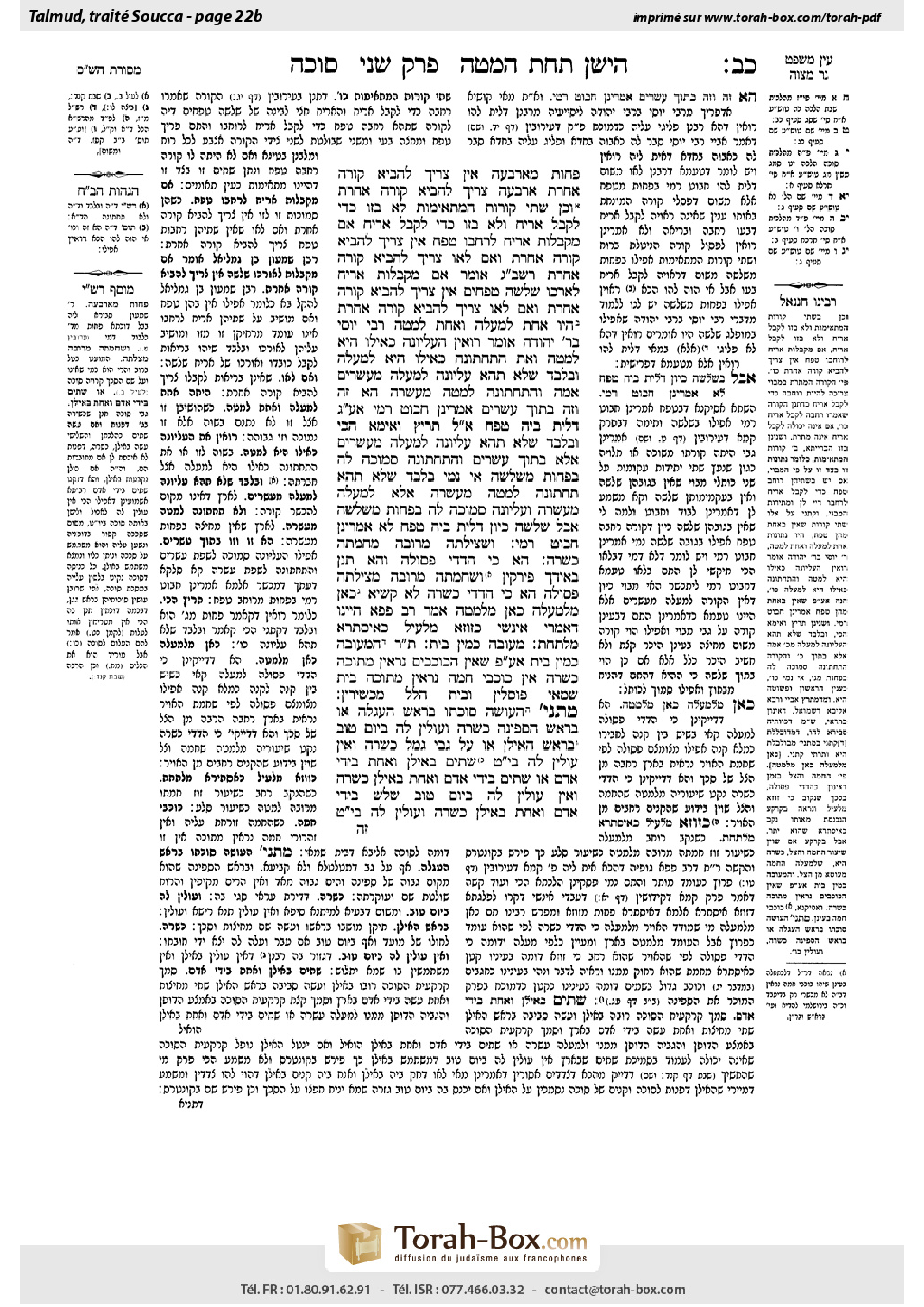
Sukkah 22b: Talmud study for Daf Yomi
Daf Yomi is the daily study of one Talmud folio. Explore 37 tractates with scans, Hebrew text, Sefaria English and AI-generated French translations where annotated.
Passage selection and English or AI-generated French translation are available where the scan has annotations. Daf Study is independent of Torah-Box and Sefaria.
Browse Sukkah · סוכה · All tractatesSukkah 22b text and translations
This page of Sukkah includes the Aramaic text, an English translation and an AI-generated French translation, alongside the scan above.
סוכה כ״ב ב · Aramaic and Hebrew text
פָּחוֹת מֵאַרְבָּעָה — אֵין צָרִיךְ לְהָבִיא קוֹרָה אַחֶרֶת, אַרְבָּעָה — צָרִיךְ לְהָבִיא קוֹרָה אַחֶרֶת.
וְכֵן שְׁתֵּי קוֹרוֹת הַמַּתְאִימוֹת, לֹא בָּזוֹ כְּדֵי לְקַבֵּל אָרִיחַ וְלֹא בָּזוֹ כְּדֵי לְקַבֵּל אָרִיחַ, אִם מְקַבְּלוֹת אָרִיחַ לְרׇחְבּוֹ טֶפַח — אֵין צָרִיךְ לְהָבִיא קוֹרָה אַחֶרֶת, וְאִם לָאו — צָרִיךְ לְהָבִיא קוֹרָה אַחֶרֶת,
רַבָּן שִׁמְעוֹן בֶּן גַּמְלִיאֵל אוֹמֵר: אִם מְקַבְּלוֹת אָרִיחַ לְאׇרְכּוֹ שְׁלֹשָׁה טְפָחִים — אֵין צָרִיךְ לְהָבִיא קוֹרָה אַחֶרֶת. וְאִם לָאו — צָרִיךְ לְהָבִיא קוֹרָה אַחֶרֶת.
הָיוּ אַחַת לְמַעְלָה וְאַחַת לְמַטָּה, רַבִּי יוֹסֵי בְּרַבִּי יְהוּדָה אוֹמֵר: רוֹאִין הָעֶלְיוֹנָה כְּאִילּוּ הִיא לְמַטָּה, וְאֶת הַתַּחְתּוֹנָה כְּאִילּוּ הִיא לְמַעְלָה. וּבִלְבַד שֶׁלֹּא תְּהֵא עֶלְיוֹנָה לְמַעְלָה מֵעֶשְׂרִים אַמָּה, וְהַתַּחְתּוֹנָה לְמַטָּה מֵעֲשָׂרָה. הָא זֶה וְזֶה בְּתוֹךְ עֶשְׂרִים — אָמְרִינַן חֲבוֹט רְמִי אַף עַל גַּב דְּלֵית בֵּיהּ טֶפַח!
אֲמַר לֵיהּ, תָּרֵיץ וְאֵימָא הָכִי: וּבִלְבַד שֶׁלֹּא תְּהֵא עֶלְיוֹנָה לְמַעְלָה מֵעֶשְׂרִים, אֶלָּא בְּתוֹךְ עֶשְׂרִים, וְהַתַּחְתּוֹנָה סְמוּכָה לָהּ בְּפָחוֹת מִשְּׁלֹשָׁה. אִי נָמֵי: בִּלְבַד שֶׁלֹּא תְּהֵא תַּחְתּוֹנָה לְמַטָּה מֵעֲשָׂרָה, אֶלָּא לְמַעְלָה מֵעֲשָׂרָה, וְעֶלְיוֹנָה סְמוּכָה לָהּ בְּפָחוֹת מִשְּׁלֹשָׁה, אֲבָל שְׁלֹשָׁה, כֵּיוָן דְּלֵית בֵּיהּ טֶפַח — לָא אָמְרִינַן חֲבוֹט רְמִי.
וְשֶׁצִּילָּתָהּ מְרוּבָּה מֵחַמָּתָהּ כְּשֵׁרָה. הָא כִּי הֲדָדֵי — פְּסוּלָה. וְהָא תְּנַן בְּאִידַּךְ פִּירְקִין: וְשֶׁחֲמָתָהּ מְרוּבָּה מִצִּילָּתָהּ פְּסוּלָה, הָא כִּי הֲדָדֵי — כְּשֵׁרָה!
לָא קַשְׁיָא: כָּאן מִלְּמַעְלָה, כָּאן מִלְּמַטָּה. אָמַר רַב פָּפָּא, הַיְינוּ דְּאָמְרִי אִינָשֵׁי: כְּזוּזָא מִלְּעֵיל, כְּאִיסְתְּרָא מִלְּתַחַת.
מְעוּבָּה כְּמִין בַּיִת. תָּנוּ רַבָּנַן: הַמְעוּבָּה כְּמִין בַּיִת, אַף עַל פִּי שֶׁאֵין הַכּוֹכָבִים נִרְאִין מִתּוֹכָהּ — כְּשֵׁרָה. אֵין כּוֹכְבֵי חַמָּה נִרְאִין מִתּוֹכָהּ — בֵּית שַׁמַּאי פּוֹסְלִין וּבֵית הִלֵּל מַכְשִׁירִין.
מַתְנִי׳ הָעוֹשֶׂה סוּכָּתוֹ בְּרֹאשׁ הָעֲגָלָה אוֹ בְּרֹאשׁ הַסְּפִינָה — כְּשֵׁרָה, וְעוֹלִין לָהּ בְּיוֹם טוֹב. בְּרֹאשׁ הָאִילָן אוֹ עַל גַּבֵּי גָּמָל — כְּשֵׁרָה, וְאֵין עוֹלִין לָהּ בְּיוֹם טוֹב.
שְׁתַּיִם בָּאִילָן וְאַחַת בִּידֵי אָדָם, אוֹ שְׁתַּיִם בִּידֵי אָדָם וְאַחַת בָּאִילָן — כְּשֵׁרָה, וְאֵין עוֹלִין לָהּ בְּיוֹם טוֹב. שָׁלֹשׁ בִּידֵי אָדָם וְאַחַת בָּאִילָן — כְּשֵׁרָה, וְעוֹלִין לָהּ בְּיוֹם טוֹב.
Sukkah 22b · English translation
If there is a gap of less than four handbreadths, one need not bring another cross beam. However, if there is a gap of four handbreadths, one must bring another cross beam.
And similarly, if two parallel, extremely narrow cross beams are placed alongside each other, even though there is not sufficient width in this beam in order to receive and support a small brick, and there is not sufficient width in that beam in order to receive and support a small brick, if the two beams together can receive a small brick along its handbreadth width, one need not bring another cross beam to render the alleyway fit for one to carry within it. But if not, one is required to bring another cross beam.
Rabban Shimon ben Gamliel says: If the two cross beams can receive a small brick along its length, which is three handbreadths, one need not bring another cross beam, but if not, one must bring another cross beam.
Rabbi Yosei, son of Rabbi Yehuda, says: If these two narrow cross beams are placed at different heights, one above and one below, one considers the upper one as though it were below, and the lower one as though it were above, i.e., close together. If the two together are capable of supporting a small brick, they render the alleyway fit for one to carry within it, although they are not actually close to each other, provided that the upper cross beam is not above twenty cubits off the ground and the lower one is not below ten handbreadths off the ground, between which a cross beam renders an alleyway fit for one to carry within it. By inference, if both this beam and that beam are within twenty cubits, we say that the principle: Lower and cast the upper beam down even though there is not the width of a handbreadth in the upper beam. This is difficult according to Rava’s opinion, as he holds that the principle: Lower and cast, does not apply when the width of the upper crossbeam is less than a handbreadth.
Rav Kahana said to him: Interpret the baraita and say as follows: Provided that the upper beam is not above twenty cubits but rather within twenty cubits and the lower one is adjacent to it, less than three handbreadths from it, as in that case they are joined due to the principle of lavud and not the principle of lower and cast. Alternatively, interpret the baraita as follows: Provided that the lower beam is not below ten handbreadths but rather above ten handbreadths and the upper beam is adjacent to it, less than three handbreadths from it. However, if the distance between the beams is three handbreadths, since there is not the width of one handbreadth in the beam, we do not say: Lower and cast the upper beam, and each beam is considered on its own.
§ The mishna continues: A sukka whose shade exceeds its sunlight is fit. From the formulation of the mishna, it can be inferred that if its shade and sunlight are equal, the sukka is unfit. The Gemara asks: But didn’t we learn in a mishna in another chapter in this tractate: A sukka whose sunlight exceeds its shade is unfit. From the formulation of that mishna it can be inferred that if its sunlight and shade are equal, the sukka is fit. The inferences of the two mishnayot are contradictory.
The Gemara answers: This is not difficult. Here, where the inference was that when the sunlight and shade are equal the sukka is unfit, it is referring to the ratio of shade to sunlight from above, in the sukka roofing itself; and there, where the inference was that when the sunlight and shade are equal the sukka is fit, it is referring to the ratio of shade to sunlight from below, on the sukka floor. The two inferences are not contradictory, as the lower in the sukka one observes the light, the more diffused it is. Therefore, if the shade and the sunlight are equal on the floor of the sukka, clearly, the roofing is sufficiently dense and exceeds the gaps. Rav Pappa said: That is the meaning of the folk saying with regard to light: Like a zuz coin above, like an istera coin below.
The mishna continues: A sukka whose roofing is thick like a type of house is fit. The Sages taught in a baraita: With regard to a sukka whose roofing is thick like a type of house, although it is so dense that the stars are not visible from within it, the sukka is fit. However, if it is so thick that the rays of the sun are also not visible from within it, Beit Shammai deem the sukka unfit and Beit Hillel deem it fit.
MISHNA: In the case of one who establishes his sukka at the top of the wagon or at the top of the ship, although it is portable it is fit, as it is sufficient for a sukka to be a temporary residence. And one may ascend and enter it even on the first Festival day. In the case of one who establishes his sukka at the top of a tree or atop a camel, the sukka is fit, but one may not ascend and enter it on the first Festival day because the Sages prohibit climbing or using trees or animals on the Festival.
If two of the walls of the sukka are in the tree and one is established on the ground by a person, or if two are established on the ground by a person and one is in the tree, the sukka is fit, but one may not ascend and enter it on the first Festival day because it is prohibited to use the tree. However, if three of the walls are established on the ground by a person and one is in the tree, then since it contains the minimum number of walls required, it is fit, and one may enter it on the first Festival day.
Sukkah 22b · Traduction française (IA)
S’il y a un espace de moins de quatre téfaḥim, il n’est pas nécessaire d’ajouter une autre poutre transversale. En revanche, s’il y a un espace de quatre téfaḥim, il faut en ajouter une autre.
De même, si deux poutres transversales parallèles, extrêmement étroites, sont placées côte à côte, bien qu’aucune des deux ne soit assez large pour recevoir et soutenir une petite brique, si elles peuvent ensemble recevoir une petite brique posée sur sa largeur d’un téfaḥ, il n’est pas nécessaire d’ajouter une autre poutre transversale pour rendre l’allée apte à la circulation. Sinon, il faut ajouter une autre poutre transversale.
Rabban Shimon ben Gamliel dit : Si les deux poutres transversales peuvent recevoir une petite brique posée sur sa longueur, qui est de trois téfaḥim, il n’est pas nécessaire d’ajouter une autre poutre transversale ; sinon, il faut en ajouter une.
Rabbi Yosei, fils de Rabbi Yehuda, dit : Si ces deux poutres étroites sont placées à des hauteurs différentes, l’une au-dessus de l’autre, on considère la poutre supérieure comme si elle était en bas et la poutre inférieure comme si elle était en haut, c’est-à-dire comme si elles étaient rapprochées. Si, ensemble, elles peuvent soutenir une petite brique, elles rendent l’allée apte à la circulation, bien qu’elles ne soient pas réellement proches l’une de l’autre, à condition que la poutre supérieure ne soit pas à plus de vingt coudées du sol et que la poutre inférieure ne soit pas à moins de dix téfaḥim du sol ; dans cet intervalle, une poutre transversale rend une allée apte à la circulation. Il en ressort que, si cette poutre et l’autre se trouvent toutes deux à moins de vingt coudées, on applique le principe consistant à abaisser la poutre supérieure, même si celle-ci n’a pas une largeur d’un téfaḥ. Cela pose une difficulté selon l’opinion de Rava, car il soutient que le principe consistant à abaisser la poutre supérieure ne s’applique pas lorsque celle-ci a moins d’un téfaḥ de largeur.
Rav Kahana lui dit : Interprète la baraïta ainsi : à condition que la poutre supérieure ne soit pas à plus de vingt coudées, mais se trouve à moins de vingt coudées, et que la poutre inférieure soit proche d’elle, à moins de trois téfaḥim, car dans ce cas elles sont réunies en vertu du principe de lavoud, et non de celui consistant à abaisser la poutre supérieure. Autre possibilité : interprète la baraïta ainsi : à condition que la poutre inférieure ne soit pas à moins de dix téfaḥim, mais se trouve à plus de dix téfaḥim, et que la poutre supérieure soit proche d’elle, à moins de trois téfaḥim. Toutefois, si la distance entre les poutres est de trois téfaḥim, comme la poutre n’a pas une largeur d’un téfaḥ, on ne dit pas qu’il faut abaisser la poutre supérieure ; chaque poutre est considérée séparément.
§ La Michna poursuit : Une soukka dont l’ombre est plus importante que la lumière est apte. De la formulation de la Michna, on peut déduire que si l’ombre et la lumière sont égales, la soukka est inapte. La Guemara demande : Mais n’avons-nous pas appris dans une Michna d’un autre chapitre de ce traité : Une soukka dont la lumière est plus importante que l’ombre est inapte ? De la formulation de cette Michna, on peut déduire que si la lumière et l’ombre sont égales, la soukka est apte. Les déductions des deux Michnayot se contredisent.
La Guemara répond : Il n’y a pas de difficulté. Ici, où l’on déduit que, lorsque la lumière et l’ombre sont égales, la soukka est inapte, il s’agit du rapport entre l’ombre et la lumière vu d’en haut, au niveau même de la couverture de la soukka ; là, où l’on déduit que, lorsque la lumière et l’ombre sont égales, la soukka est apte, il s’agit du rapport entre l’ombre et la lumière vu d’en bas, sur le sol de la soukka. Les deux déductions ne se contredisent pas, car plus on observe la lumière bas dans la soukka, plus elle est diffuse. Par conséquent, si l’ombre et la lumière sont égales sur le sol de la soukka, cela montre clairement que la couverture est suffisamment dense et que les parties couvertes l’emportent sur les espaces vides. Rav Pappa dit : C’est le sens du dicton populaire au sujet de la lumière : comme une pièce de zouz en haut, comme une pièce d’istera en bas.
La Michna poursuit : Une soukka dont la couverture est épaisse comme celle d’une maison est apte. Les Sages ont enseigné dans une baraïta : Une soukka dont la couverture est épaisse comme celle d’une maison est apte, même si elle est si dense que les étoiles ne sont pas visibles depuis l’intérieur. Toutefois, si elle est si épaisse que les rayons du soleil ne sont pas non plus visibles depuis l’intérieur, Beit Shammaï déclarent la soukka inapte, tandis que Beit Hillel la déclarent apte.
MICHNA : Celui qui installe sa soukka au sommet d’un chariot ou d’un bateau la rend apte, bien qu’elle soit mobile, car il suffit qu’une soukka soit une demeure provisoire. On peut y monter et y entrer même le premier jour de fête. Celui qui installe sa soukka au sommet d’un arbre ou sur un chameau la rend apte, mais on ne peut pas y monter ni y entrer le premier jour de fête, car les Sages interdisent de grimper aux arbres ou de les utiliser, ainsi que d’utiliser des animaux, pendant la fête.
Si deux des parois de la soukka sont dans l’arbre et qu’une personne en établit une sur le sol, ou si une personne en établit deux sur le sol et que la troisième est dans l’arbre, la soukka est apte, mais on ne peut pas y monter ni y entrer le premier jour de fête, car il est interdit d’utiliser l’arbre. En revanche, si une personne établit trois des parois sur le sol et que la quatrième est dans l’arbre, alors, puisqu’elle possède le nombre minimal de parois requis, elle est apte et l’on peut y entrer le premier jour de fête.
Traduction française générée par IA à partir de l’édition anglaise de Sefaria. Vérifie toujours un passage avec le texte source.
Text from Sefaria: William Davidson Edition - Vocalized Aramaic (CC BY NC); William Davidson Edition - English (CC BY NC).