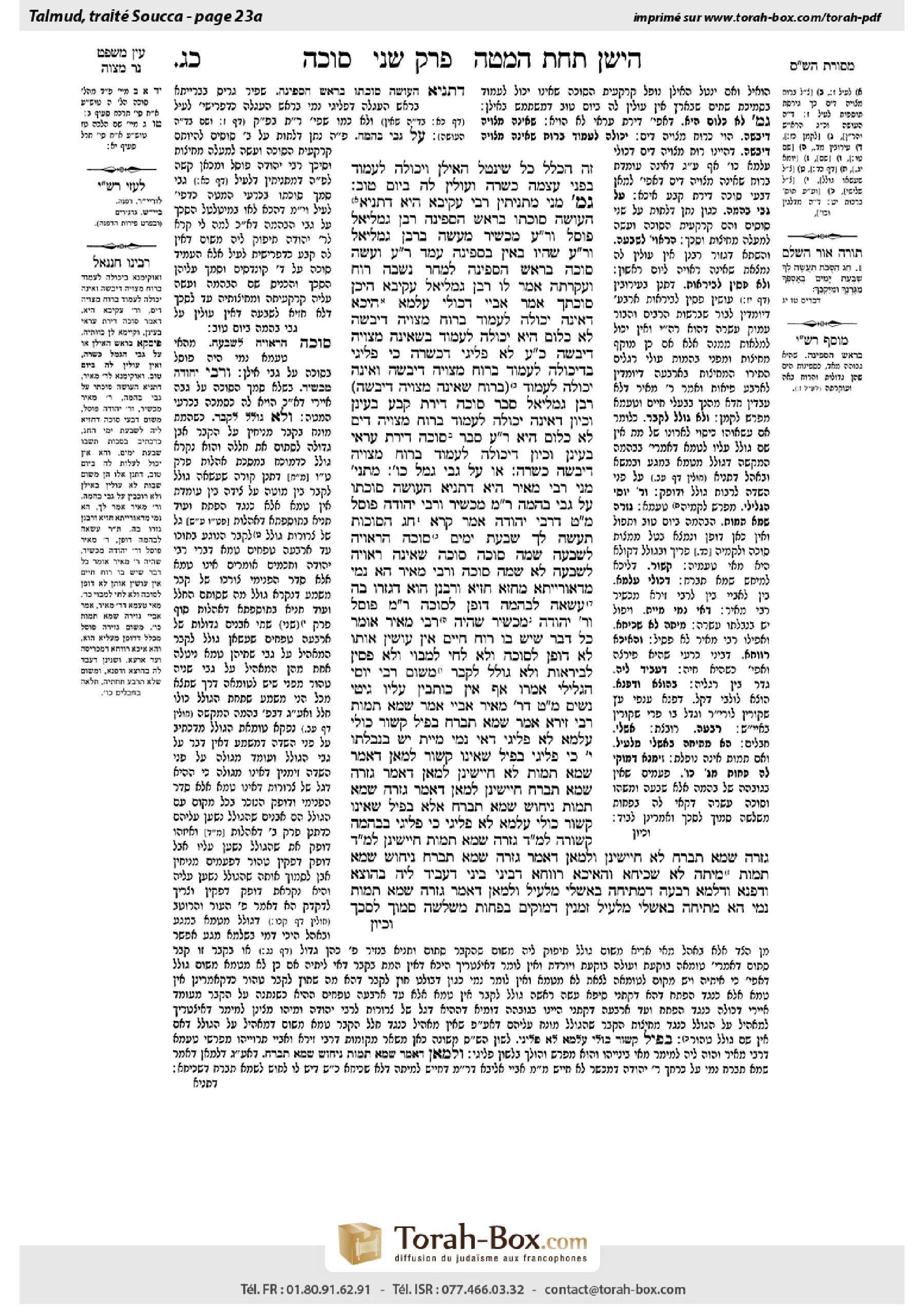
Sukkah 23a: Talmud study for Daf Yomi
Daf Yomi is the daily study of one Talmud folio. Explore 37 tractates with scans, Hebrew text, Sefaria English and AI-generated French translations where annotated.
Passage selection and English or AI-generated French translation are available where the scan has annotations. Daf Study is independent of Torah-Box and Sefaria.
Browse Sukkah · סוכה · All tractatesSukkah 23a text and translations
This page of Sukkah includes the Aramaic text, an English translation and an AI-generated French translation, alongside the scan above.
סוכה כ״ג א · Aramaic and Hebrew text
זֶה הַכְּלָל: כׇּל שֶׁיִּנָּטֵל הָאִילָן וִיכוֹלָה לַעֲמוֹד בִּפְנֵי עַצְמָהּ — כְּשֵׁרָה וְעוֹלִין לָהּ בְּיוֹם טוֹב.
גְּמָ׳ מַנִּי מַתְנִיתִין — רַבִּי עֲקִיבָא הִיא. דְּתַנְיָא: הָעוֹשֶׂה סוּכָּתוֹ בְּרֹאשׁ הַסְּפִינָה — רַבָּן גַּמְלִיאֵל פּוֹסֵל, וְרַבִּי עֲקִיבָא מַכְשִׁיר.
מַעֲשֶׂה בְּרַבָּן גַּמְלִיאֵל וְרַבִּי עֲקִיבָא שֶׁהָיוּ בָּאִין בִּסְפִינָה, עָמַד רַבִּי עֲקִיבָא וְעָשָׂה סוּכָּה בְּרֹאשׁ הַסְּפִינָה. לְמָחָר נָשְׁבָה רוּחַ וַעֲקָרַתָּה. אָמַר לוֹ רַבָּן גַּמְלִיאֵל: עֲקִיבָא! הֵיכָן סוּכָּתְךָ?
אָמַר אַבָּיֵי: דְּכוּלֵּי עָלְמָא, הֵיכָא דְּאֵינָהּ יְכוֹלָה לַעֲמוֹד בְּרוּחַ מְצוּיָה דְּיַבָּשָׁה — לֹא כְּלוּם הִיא. יְכוֹלָה לַעֲמוֹד בְּשֶׁאֵינָהּ מְצוּיָה דְּיַבָּשָׁה, כּוּלֵּי עָלְמָא לָא פְּלִיגִי דִּכְשֵׁרָה. כִּי פְּלִיגִי בְּדִיכוֹלָה לַעֲמוֹד בְּרוּחַ מְצוּיָה דְּיַבָּשָׁה וְאֵינָהּ יְכוֹלָה לַעֲמוֹד (בְּרוּחַ שֶׁאֵינָהּ מְצוּיָה דְּיַבָּשָׁה). רַבָּן גַּמְלִיאֵל סָבַר: סוּכָּה דִּירַת קֶבַע בָּעֵינַן, וְכֵיוָן דְּאֵינָהּ יְכוֹלָה לַעֲמוֹד בְּרוּחַ מְצוּיָה דְּיָם — לֹא כְּלוּם הִיא. רַבִּי עֲקִיבָא סָבַר: סוּכָּה דִּירַת עֲרַאי בָּעֵינַן, וְכֵיוָן דִּיכוֹלָה לַעֲמוֹד בְּרוּחַ מְצוּיָה דְּיַבָּשָׁה — כְּשֵׁרָה.
אוֹ עַל גַּבֵּי גָּמָל כּוּ׳. מַתְנִיתִין מַנִּי — רַבִּי מֵאִיר הִיא. דְּתַנְיָא: הָעוֹשֶׂה סוּכָּתוֹ עַל גַּבֵּי בְּהֵמָה — רַבִּי מֵאִיר מַכְשִׁיר, וְרַבִּי יְהוּדָה פּוֹסֵל. מַאי טַעְמֵיהּ דְּרַבִּי יְהוּדָה? אָמַר קְרָא: ״חַג הַסּוּכּוֹת תַּעֲשֶׂה לְךָ שִׁבְעַת יָמִים״. סוּכָּה הָרְאוּיָה לְשִׁבְעָה — שְׁמָהּ סוּכָּה. סוּכָּה שֶׁאֵינָהּ רְאוּיָה לְשִׁבְעָה — לֹא שְׁמָהּ סוּכָּה.
וְרַבִּי מֵאִיר, הָא נָמֵי — מִדְּאוֹרָיְיתָא מִחְזֵא חַזְיָא, וְרַבָּנַן הוּא דִּגְזַרוּ בַּהּ.
עֲשָׂאָהּ לִבְהֵמָה דּוֹפֶן לְסוּכָּה — רַבִּי מֵאִיר פּוֹסֵל וְרַבִּי יְהוּדָה מַכְשִׁיר. שֶׁהָיָה רַבִּי מֵאִיר אוֹמֵר: כׇּל דָּבָר שֶׁיֵּשׁ בּוֹ רוּחַ חַיִּים, אֵין עוֹשִׂין אוֹתוֹ לֹא דּוֹפֶן לְסוּכָּה, וְלֹא לֶחִי לְמָבוֹי, וְלֹא פַּסִּין לְבֵירָאוֹת, וְלֹא גּוֹלֵל לְקֶבֶר. מִשּׁוּם רַבִּי יוֹסֵי הַגְּלִילִי אָמְרוּ: אַף אֵין כּוֹתְבִין עָלָיו גִּיטֵּי נָשִׁים.
מַאי טַעְמֵיהּ דְּרַבִּי מֵאִיר? אַבָּיֵי אָמַר: שֶׁמָּא תָּמוּת. רַבִּי זֵירָא אָמַר: שֶׁמָּא תִּבְרַח. בְּפִיל קָשׁוּר כּוּלֵּי עָלְמָא לָא פְּלִיגִי, דְּאִי נָמֵי מָיֵית — יֵשׁ בְּנִבְלָתוֹ עֲשָׂרָה. כִּי פְּלִיגִי בְּפִיל שֶׁאֵינוֹ קָשׁוּר. לְמַאן דְּאָמַר שֶׁמָּא תָּמוּת — לָא חָיְישִׁינַן. לְמַאן דְּאָמַר גְּזֵרָה שֶׁמָּא תִּבְרַח — חָיְישִׁינַן.
לְמַאן דְּאָמַר גְּזֵרָה שֶׁמָּא תָּמוּת, נֵיחוּשׁ שֶׁמָּא תִּבְרַח! אֶלָּא: בְּפִיל שֶׁאֵינוֹ קָשׁוּר, כּוּלֵּי עָלְמָא לָא פְלִיגִי. כִּי פְלִיגִי בִּבְהֵמָה קְשׁוּרָה. לְמַאן דְּאָמַר גְּזֵרָה שֶׁמָּא תָּמוּת — חָיְישִׁינַן. וּלְמַאן דְּאָמַר גְּזֵרָה שֶׁמָּא תִּבְרַח — לָא חָיְישִׁינַן.
וּמַאן דְּאָמַר גְּזֵרָה שֶׁמָּא תִּבְרַח, נֵיחוּשׁ שֶׁמָּא תָּמוּת? מִיתָה לָא שְׁכִיחָא. וְהָאִיכָּא רַוְוחָא דְּבֵינֵי בֵּינֵי? דְּעָבֵיד לֵיהּ בְּהוּצָא וְדַפְנָא.
וְדִלְמָא רָבְעָה? דִּמְתִיחָה בְּאַשְׁלֵי מִלְּעֵיל. וּלְמַאן דְּאָמַר גְּזֵרָה שֶׁמָּא תָּמוּת נָמֵי, הָא מְתִיחָה בְּאַשְׁלֵי מִלְּעֵיל! זִמְנִין דְּמוֹקֵים בְּפָחוֹת מִשְּׁלֹשָׁה סָמוּךְ לַסְּכָךְ,
Sukkah 23a · English translation
The mishna summarizes that this is the principle: Any case where, were the tree removed, the sukka would be able to remain standing in and of itself, it is fit, and one may ascend and enter it on the Festival, since the tree is not its primary support.
GEMARA: The Gemara comments: In accordance with whose opinion is the mishna? It is in accordance with the opinion of Rabbi Akiva, as it is taught in a baraita: In the case of one who establishes his sukka at the top of the ship, Rabban Gamliel deems it unfit and Rabbi Akiva deems it fit.
There was an incident involving Rabban Gamliel and Rabbi Akiva, who were coming on a ship. Rabbi Akiva arose and established a sukka at the top of the ship. The next day the wind blew and uprooted it. Rabban Gamliel said to him: Akiva, where is your sukka? It was unfit from the start.
Abaye said: Everyone agrees that in a case where the sukka is unable to withstand a typical land wind, the sukka is of no consequence and it is not even a temporary residence. If it is able to withstand even an atypical land wind, everyone agrees that the sukka is fit. Where they disagree is in a case where the sukka is able to withstand a typical land wind but is unable to withstand an atypical land wind, which is the equivalent of a typical sea wind. Rabban Gamliel holds: In order to fulfill the mitzva of sukka, we require a permanent residence, and since it is not able to withstand an atypical land wind, which is like a typical sea wind, it is of no consequence and is not a sukka at all. Rabbi Akiva holds: In order to fulfill the mitzva of sukka, we require a temporary residence, and since it is able to withstand a typical land wind, it is fit, although it is unable to withstand a typical sea wind.
§ The mishna continues: Or if one establishes his sukka atop a camel, the sukka is fit. The Gemara asks: Who is the tanna of the mishna? It is in accordance with the opinion of Rabbi Meir, as it is taught in a baraita: In the case of one who establishes his sukka atop an animal, Rabbi Meir deems it fit and Rabbi Yehuda deems it unfit. The Gemara asks: What is the rationale for the opinion of Rabbi Yehuda? The Gemara answers that it is as the verse states: “You shall prepare for yourself the festival of Sukkot for seven days” (Deuteronomy 16:13), from which Rabbi Yehuda derives: A sukka that is suitable for seven days is called a sukka, while a sukka that is not suitable for seven days is not called a sukka. It is prohibited to climb upon an animal on the first day of the festival of Sukkot, and therefore a sukka atop an animal is unfit, as it cannot be used all seven days.
And Rabbi Meir, who holds that the sukka is fit, would say: By Torah law, this sukka is also suitable for use on a Festival and on Shabbat, as there is no Torah prohibition against using an animal on those days, and it is the Sages who issued a decree prohibiting it. The fact that it is prohibited by rabbinic decree does not render the sukka unfit.
However, if one utilized his animal as a wall for a sukka and did not establish the entire sukka atop the animal, Rabbi Meir deems it unfit and Rabbi Yehuda deems it fit, as Rabbi Meir would say: With regard to any animate object, one may neither establish it as a wall for the sukka, nor as a side post placed at the entrance to an alleyway to render it permitted to carry in the alleyway on Shabbat, nor as one of the upright boards placed around wells to render the area a private domain and permit one to draw water from the well on Shabbat, nor as the covering for a grave. In the name of Rabbi Yosei HaGelili the Sages said: Nor may one write bills of divorce on it.
The Gemara asks: What is the rationale for the opinion of Rabbi Meir, who rules that an animal is unfit for use as a partition in areas of halakha where a partition is required? Abaye said: It is due to the concern lest the animal die, leaving the sukka without a wall. Rabbi Zeira said: It is due to the concern lest it flee. The Gemara explains the practical halakhic differences between the two opinions. In the case where one established a wall with a tied elephant, everyone agrees that the sukka is fit, as even if it dies and falls, its carcass still has a height of ten handbreadths and is fit for the wall of a sukka. Where they disagree is in the case of an elephant that is not tied. According to the one who said: It is due to the concern lest the animal die, we are not concerned in this case, as the carcass would remain a fit wall. According to the one who said: It is due to a decree lest it flee, we remain concerned.
The Gemara asks: According to the one who said: It is due to a decree lest it die, let us also be concerned lest it flee, as that too is a reasonable concern. Rather, this is the explanation: In the case where one established a wall with an elephant that is not tied, everyone agrees that the sukka is unfit lest it flee. Where they disagree is in the case of a tied animal. According to the one who said: It is due to a decree lest the animal die, we are concerned, as although it cannot flee, it might die, and the carcass of a typical animal is not ten handbreadths high. And according to the one who said: It is due to a decree lest it flee, we are not concerned.
The Gemara asks: And according to the one who said: It is due to a decree lest it flee, let us also be concerned lest it die. The Gemara answers: That is not a concern because death is not common. The Sages do not issue decrees with regard to uncommon circumstances. The Gemara asks: But according to all opinions, isn’t there the space between its legs, which is like a breach in a wall? How can one establish a partition whose breached segment exceeds its standing segment? The Gemara answers: He establishes a partition for it by filling the gaps with hard palm leaves and laurel leaves, sealing the breach.
The Gemara asks further: And even though there is no concern lest the animal die, perhaps it will crouch, leaving a wall that is less than ten handbreadths? The Gemara answers: It is referring to a case where the animal is tied with ropes from above so that it cannot crouch. Based on that explanation, the Gemara asks: And according to the one who said: It is due to a decree lest it die, there is also no concern since it is tied with ropes from above. Even if the animal died, it would remain in place as a fit partition. The Gemara answers: Sometimes the ten-handbreadth wall consists of the animal that is a bit higher than seven handbreadths established adjacent to the roofing, less than three handbreadths away.
Sukkah 23a · Traduction française (IA)
La Michna résume le principe ainsi : dans tout cas où, si l’on retirait l’arbre, la soukka pourrait tenir debout par elle-même, elle est valide, et l’on peut y monter et y entrer pendant la fête, car l’arbre n’en constitue pas le support principal.
GUEMARA : La Guemara fait remarquer : Selon l’opinion de qui la Michna a-t-elle été enseignée ? Selon celle de Rabbi Akiva, comme l’enseigne une baraïta : celui qui installe sa soukka au sommet d’un bateau, Rabban Gamliel la déclare invalide, tandis que Rabbi Akiva la déclare valide.
Un incident impliquant Rabban Gamliel et Rabbi Akiva, qui voyageaient en bateau, eut lieu. Rabbi Akiva se leva et installa une soukka au sommet du bateau. Le lendemain, le vent souffla et l’arracha. Rabban Gamliel lui dit : « Akiva, où est ta soukka ? Elle était invalide dès le départ. »
Abayé dit : Tout le monde convient que si la soukka ne peut pas résister à un vent terrestre ordinaire, elle n’a aucune valeur et ne constitue même pas une résidence temporaire. Si elle peut résister même à un vent terrestre exceptionnel, tout le monde convient qu’elle est valide. Leur désaccord porte sur le cas d’une soukka qui peut résister à un vent terrestre ordinaire, mais pas à un vent terrestre exceptionnel, équivalent à un vent marin ordinaire. Rabban Gamliel estime que, pour accomplir la mitsva de la soukka, il faut une résidence permanente ; puisqu’elle ne peut pas résister à un vent terrestre exceptionnel, comparable à un vent marin ordinaire, elle n’a aucune valeur et ne constitue pas du tout une soukka. Rabbi Akiva estime que, pour accomplir la mitsva de la soukka, il faut une résidence temporaire ; puisqu’elle peut résister à un vent terrestre ordinaire, elle est valide, même si elle ne peut pas résister à un vent marin ordinaire.
§ La Michna poursuit : ou si l’on installe sa soukka sur un chameau, elle est valide. La Guemara demande : De quel tanna la Michna suit-elle l’opinion ? Elle suit celle de Rabbi Meïr, comme l’enseigne une baraïta : celui qui installe sa soukka sur un animal, Rabbi Meïr la déclare valide et Rabbi Yehouda la déclare invalide. La Guemara demande : Quel est le raisonnement de Rabbi Yehouda ? La Guemara répond qu’il se fonde sur ce que dit le verset : « Tu célébreras pour toi la fête de Soukkot pendant sept jours » (Deutéronome 16,13). Rabbi Yehouda en déduit qu’une soukka qui convient pour sept jours est appelée une soukka, tandis qu’une soukka qui ne convient pas pour sept jours n’est pas appelée une soukka. Il est interdit de monter sur un animal le premier jour de la fête de Soukkot ; une soukka installée sur un animal est donc invalide, car on ne peut pas l’utiliser pendant les sept jours.
Et Rabbi Meïr, qui estime que la soukka est valide, dirait : selon la Torah, cette soukka convient également pour être utilisée pendant une fête et pendant Chabbat, car la Torah n’interdit pas d’utiliser un animal ces jours-là ; ce sont les Sages qui ont émis un décret l’interdisant. Le fait que cela soit interdit par décret rabbinique ne rend pas la soukka invalide.
En revanche, si quelqu’un a utilisé son animal comme paroi d’une soukka sans installer toute la soukka sur l’animal, Rabbi Meïr la déclare invalide et Rabbi Yehouda la déclare valide. Rabbi Meïr disait en effet : aucun être vivant ne peut servir de paroi à une soukka, de poteau latéral placé à l’entrée d’une ruelle pour permettre d’y porter pendant Chabbat, de l’une des planches verticales placées autour des puits pour transformer l’espace en domaine privé et permettre d’y puiser de l’eau pendant Chabbat, ni de couverture d’une tombe. Au nom de Rabbi Yosei HaGelili, les Sages ont dit qu’on ne peut pas non plus écrire des actes de divorce sur un être vivant.
La Guemara demande : Quel est le raisonnement de Rabbi Meïr, qui statue qu’un animal ne peut pas servir de séparation dans les domaines de la halakha où une séparation est requise ? Abayé dit : c’est par crainte que l’animal ne meure, laissant la soukka sans paroi. Rabbi Zeïra dit : c’est par crainte qu’il ne s’enfuie. La Guemara explique les différences pratiques entre ces deux avis en matière de halakha. Si quelqu’un a établi une paroi avec un éléphant attaché, tout le monde convient que la soukka est valide, car même s’il meurt et tombe, sa carcasse atteint encore une hauteur de dix palmes et convient comme paroi de soukka. Leur désaccord porte sur le cas d’un éléphant qui n’est pas attaché. Selon celui qui dit que c’est par crainte que l’animal ne meure, il n’y a pas lieu de s’inquiéter dans ce cas, car la carcasse resterait une paroi valide. Selon celui qui dit que c’est par crainte qu’il ne s’enfuie, il y a lieu de s’inquiéter.
La Guemara demande : Selon celui qui dit que c’est par crainte que l’animal ne meure, ne faut-il pas également craindre qu’il ne s’enfuie, puisque cette crainte est elle aussi raisonnable ? Il faut plutôt expliquer ainsi : si quelqu’un a établi une paroi avec un éléphant non attaché, tout le monde convient que la soukka est invalide, par crainte qu’il ne s’enfuie. Leur désaccord porte sur le cas d’un animal attaché. Selon celui qui dit que c’est par crainte que l’animal ne meure, il y a lieu de s’inquiéter : même s’il ne peut pas s’enfuir, il pourrait mourir, et la carcasse d’un animal ordinaire n’atteint pas dix palmes de hauteur. Selon celui qui dit que c’est par crainte qu’il ne s’enfuie, il n’y a pas lieu de s’inquiéter.
La Guemara demande : Et selon celui qui dit que c’est par crainte que l’animal ne s’enfuie, ne faut-il pas également craindre qu’il ne meure ? La Guemara répond : Il n’y a pas lieu de s’en inquiéter, car la mort est rare. Les Sages ne promulguent pas de décrets en prévision de circonstances inhabituelles. La Guemara demande : Mais, selon toutes les opinions, n’y a-t-il pas l’espace entre ses pattes, qui constitue une brèche dans la paroi ? Comment peut-on établir une séparation dont la partie ouverte est plus grande que la partie pleine ? La Guemara répond : on complète la paroi en remplissant les interstices avec des feuilles de palmier rigides et des feuilles de laurier, afin de colmater la brèche.
La Guemara demande encore : Même s’il n’y a pas lieu de craindre que l’animal ne meure, ne risque-t-il pas de s’accroupir, laissant une paroi de moins de dix palmes ? La Guemara répond qu’il s’agit d’un cas où l’animal est attaché par le haut avec des cordes, de sorte qu’il ne peut pas s’accroupir. Sur la base de cette explication, la Guemara demande : Et selon celui qui dit que c’est par crainte qu’il ne meure, il n’y a pas non plus lieu de s’inquiéter, puisqu’il est attaché par le haut avec des cordes. Même si l’animal mourait, il resterait en place comme séparation valide. La Guemara répond que, parfois, la paroi de dix palmes est formée par l’animal, qui mesure un peu plus de sept palmes de hauteur et se trouve placé près de la couverture, à moins de trois palmes de celle-ci.
Traduction française générée par IA à partir de l’édition anglaise de Sefaria. Vérifie toujours un passage avec le texte source.
Text from Sefaria: William Davidson Edition - Vocalized Aramaic (CC BY NC); William Davidson Edition - English (CC BY NC).