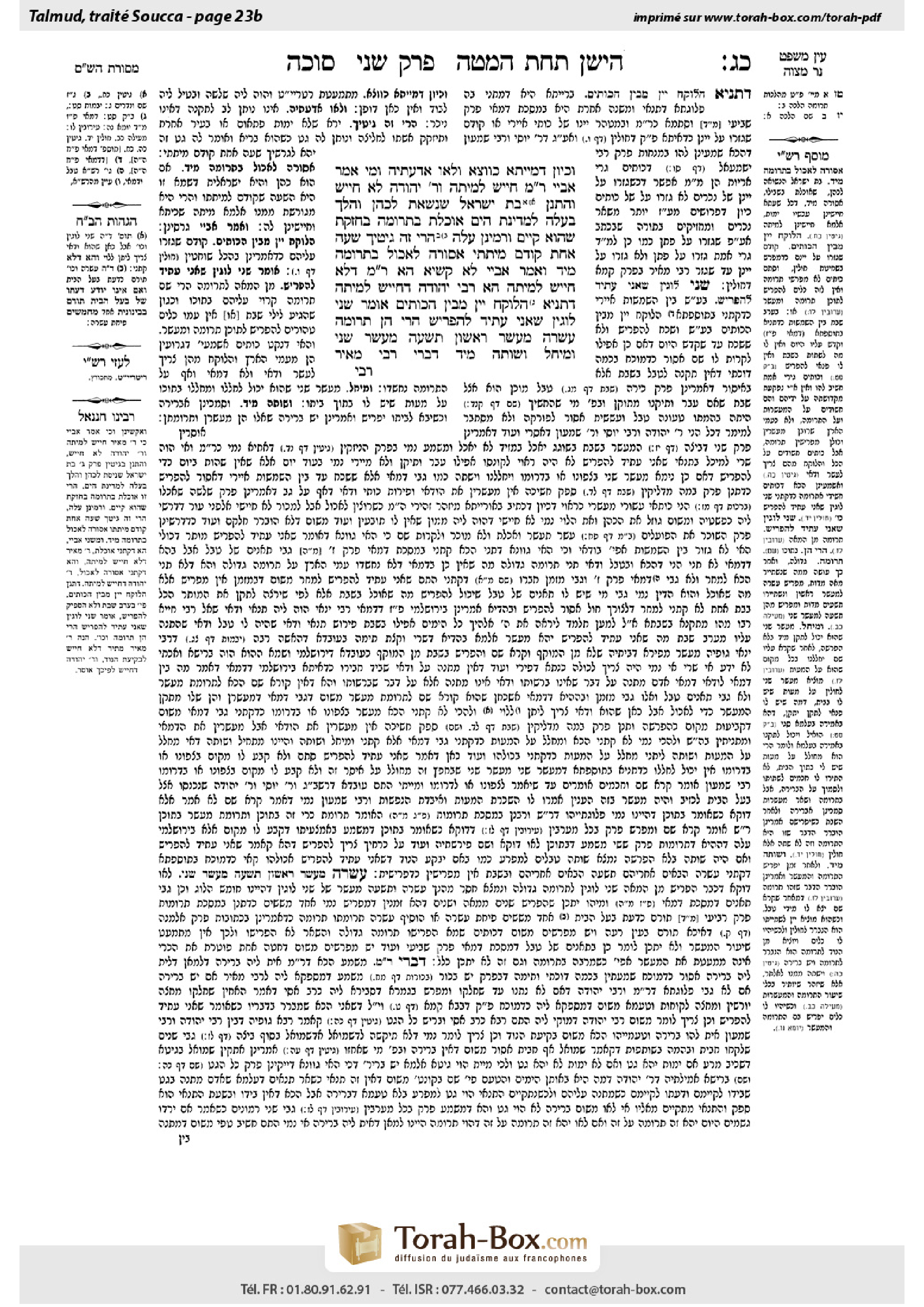
Sukkah 23b: Talmud study for Daf Yomi
Daf Yomi is the daily study of one Talmud folio. Explore 37 tractates with scans, Hebrew text, Sefaria English and AI-generated French translations where annotated.
Passage selection and English or AI-generated French translation are available where the scan has annotations. Daf Study is independent of Torah-Box and Sefaria.
Browse Sukkah · סוכה · All tractatesSukkah 23b text and translations
This page of Sukkah includes the Aramaic text, an English translation and an AI-generated French translation, alongside the scan above.
סוכה כ״ג ב · Aramaic and Hebrew text
וְכֵיוָן דְּמָיְיתָא — כָּוְוצָא וְלָאו אַדַּעְתֵּיהּ.
וּמִי אָמַר אַבָּיֵי רַבִּי מֵאִיר חָיֵישׁ לְמִיתָה וְרַבִּי יְהוּדָה לָא חָיֵישׁ? וְהָתְנַן: בַּת יִשְׂרָאֵל שֶׁנִּשֵּׂאת לְכֹהֵן וְהָלַךְ בַּעְלָהּ לִמְדִינַת הַיָּם — אוֹכֶלֶת בִּתְרוּמָה, בְּחֶזְקַת שֶׁהוּא קַיָּים.
וְרָמֵינַן עֲלַהּ: הֲרֵי זֶה גִּיטִּיךְ שָׁעָה אַחַת קוֹדֶם מִיתָתִי — אֲסוּרָה לֶאֱכוֹל בִּתְרוּמָה מִיָּד!
וְאָמַר אַבָּיֵי, לָא קַשְׁיָא: הָא רַבִּי מֵאִיר דְּלָא חָיֵישׁ לְמִיתָה, הָא רַבִּי יְהוּדָה דְּחָיֵישׁ לְמִיתָה.
דְּתַנְיָא: הַלּוֹקֵחַ יַיִן מִבֵּין הַכּוּתִים, אוֹמֵר: שְׁנֵי לוּגִּין שֶׁאֲנִי עָתִיד לְהַפְרִישׁ הֲרֵי הֵן תְּרוּמָה, עֲשָׂרָה מַעֲשֵׂר רִאשׁוֹן, תִּשְׁעָה מַעֲשֵׂר שֵׁנִי, וּמֵיחֵל וְשׁוֹתֶה מִיָּד, דִּבְרֵי רַבִּי מֵאִיר.
Sukkah 23b · English translation
And once it dies, it contracts to be more than three handbreadths from the roofing, and it does not enter his mind to fix it because it is not noticeable. In that case, the principle of lavud would not apply, and the result would be a wall that is less than the minimum requisite height.
The Gemara asks: And did Abaye actually say that Rabbi Meir is concerned about potential death with regard to the sukka walls and that Rabbi Yehuda is not concerned? Didn’t we learn in a mishna: With regard to the daughter of an Israelite who married a priest and her husband went to a country overseas, she may continue to partake of teruma as the wife of a priest, as the presumptive status of her husband is that he is alive? Apparently, in the absence of evidence to the contrary, the presumption is that one who is alive remains alive.
And we raised a contradiction from a different mishna: If one is leaving his place of residence, and in order to preclude a situation where his wife would have the status of a deserted wife he gives her a conditional bill of divorce and stipulates: This is your bill of divorce that will take effect one hour prior to my death, it is prohibited for her to partake of teruma immediately due to the concern lest he die in the next hour. Apparently, there is concern lest one die at any point.
And Abaye said in resolving the contradiction: This is not difficult. This mishna, where the presumption is that one who is alive remains alive, is in accordance with the opinion of Rabbi Meir, who is not concerned about potential death. That mishna, where there is concern lest one die at any point, is in accordance with the opinion of Rabbi Yehuda, who is concerned about potential death.
The Gemara cites proof that these are the opinions of those tanna’im. As it is taught in a baraita: In the case of one who purchases wine from among the Samaritans and there is reason to suspect that teruma and tithes were not taken, and he is not in a position to separate teruma, he acts as follows. If there are one hundred log of wine in the barrels, he says: Two log that I will separate in the future are teruma, as the mandated average measure of teruma is one-fiftieth; ten log are first tithe; and a tenth of the remainder, which is nine log, are second tithe. And he deconsecrates the second tithe that he will separate in the future, transferring its sanctity to money, and he may drink the wine immediately, relying on the separation that he will perform later. This is the statement of Rabbi Meir.
Sukkah 23b · Traduction française (IA)
Et une fois qu’elle meurt, elle se rétracte et se retrouve à plus de trois téfa’him de la toiture ; il ne lui vient pas à l’esprit de la réparer, car cela ne se remarque pas. Dans ce cas, le principe de lavoud ne s’appliquerait pas, et il en résulterait une paroi d’une hauteur inférieure au minimum requis.
La Guemara demande : Abayé a-t-il réellement dit que Rabbi Meïr tient compte de la possibilité d’un décès concernant les parois de la soukka, tandis que Rabbi Yehouda n’en tient pas compte ? N’avons-nous pas appris dans une Michna : Quant à la fille d’un Israélite qui a épousé un prêtre et dont le mari est parti dans un pays d’outre-mer, elle peut continuer à consommer la terouma en tant qu’épouse d’un prêtre, car on présume que son mari est en vie ? Il apparaît donc qu’en l’absence d’éléments contraires, on présume qu’une personne vivante demeure en vie.
Et nous avons soulevé une contradiction à partir d’une autre Michna : Si un homme quitte son lieu de résidence et, afin d’éviter que sa femme ait le statut d’une femme abandonnée, lui remet un acte de divorce conditionnel en stipulant : « Ceci est ton acte de divorce, qui prendra effet une heure avant ma mort », il lui est interdit de consommer la terouma dès à présent, par crainte qu’il ne meure au cours de l’heure qui suit. Il apparaît donc que l’on craint qu’une personne ne meure à tout moment.
Et Abayé résolut la contradiction ainsi : Il n’y a pas de difficulté. Cette Michna, où l’on présume qu’une personne vivante demeure en vie, est conforme à l’opinion de Rabbi Meïr, qui ne tient pas compte de la possibilité d’un décès. L’autre Michna, où l’on craint qu’une personne ne meure à tout moment, est conforme à l’opinion de Rabbi Yehouda, qui tient compte de cette possibilité.
La Guemara apporte une preuve que telles sont les opinions de ces tannaïm. En effet, il est enseigné dans une baraïta : Dans le cas d’un homme qui achète du vin à des Samaritains, alors qu’il y a lieu de soupçonner que la terouma et les dîmes n’ont pas été prélevées, et qu’il n’est pas en mesure de prélever la terouma, il procède ainsi. S’il y a cent log de vin dans les tonneaux, il dit : « Deux log que je prélèverai ultérieurement sont la terouma », car la mesure moyenne prescrite pour la terouma est d’un cinquantième ; « dix log sont la première dîme, et un dixième du reste, soit neuf log, est la seconde dîme. » Il désacralise ensuite la seconde dîme qu’il prélèvera ultérieurement, en transférant sa sainteté à de l’argent, et peut boire le vin immédiatement, en s’appuyant sur le prélèvement qu’il effectuera plus tard. Telle est la déclaration de Rabbi Meïr.
Traduction française générée par IA à partir de l’édition anglaise de Sefaria. Vérifie toujours un passage avec le texte source.
Text from Sefaria: William Davidson Edition - Vocalized Aramaic (CC BY NC); William Davidson Edition - English (CC BY NC).