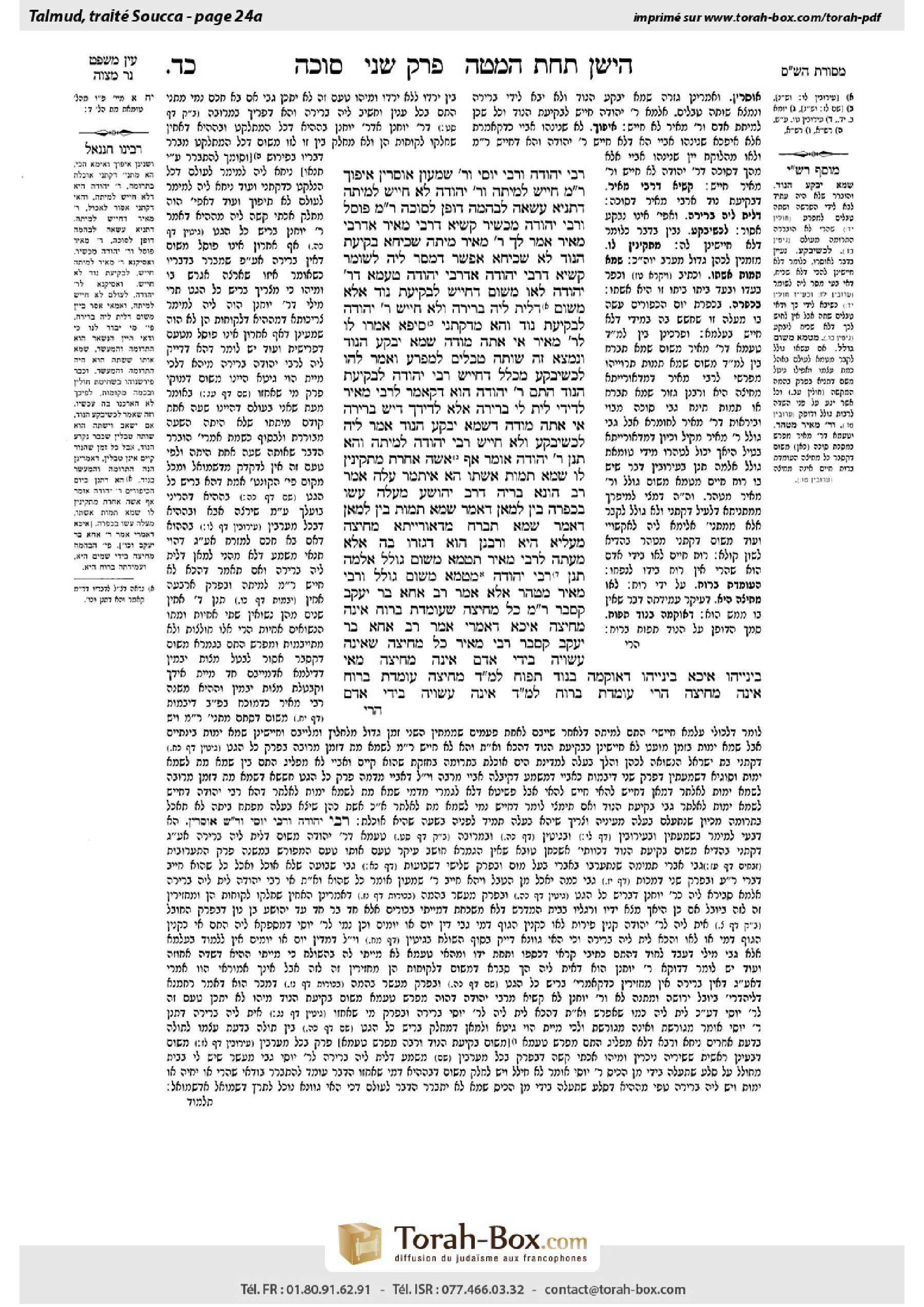
Sukkah 24a: Talmud study for Daf Yomi
Daf Yomi is the daily study of one Talmud folio. Explore 37 tractates with scans, Hebrew text, Sefaria English and AI-generated French translations where annotated.
Passage selection and English or AI-generated French translation are available where the scan has annotations. Daf Study is independent of Torah-Box and Sefaria.
Browse Sukkah · סוכה · All tractatesSukkah 24a text and translations
This page of Sukkah includes the Aramaic text, an English translation and an AI-generated French translation, alongside the scan above.
סוכה כ״ד א · Aramaic and Hebrew text
רַבִּי יְהוּדָה וְרַבִּי יוֹסֵי וְרַבִּי שִׁמְעוֹן אוֹסְרִין!
אֵיפוֹךְ: רַבִּי מֵאִיר חָיֵישׁ לְמִיתָה, וְרַבִּי יְהוּדָה לָא חָיֵישׁ לְמִיתָה, דְּתַנְיָא: עֲשָׂאָהּ לַבְּהֵמָה דּוֹפֶן לַסּוּכָּה — רַבִּי מֵאִיר פּוֹסֵל, וְרַבִּי יְהוּדָה מַכְשִׁיר.
קַשְׁיָא דְּרַבִּי מֵאִיר אַדְּרַבִּי מֵאִיר! אָמַר לָךְ רַבִּי מֵאִיר: מִיתָה שְׁכִיחָא, בְּקִיעַת הַנּוֹד לָא שְׁכִיחָא, אֶפְשָׁר דְּמָסַר לֵיהּ לְשׁוֹמֵר.
קַשְׁיָא דְּרַבִּי יְהוּדָה אַדְּרַבִּי יְהוּדָה!
טַעְמָא דְּרַבִּי יְהוּדָה לָאו מִשּׁוּם דְּחָיֵישׁ לִבְקִיעַת נוֹד, אֶלָּא מִשּׁוּם דְּלֵית לֵיהּ ״בְּרֵירָה״.
וְלָא חָיֵישׁ רַבִּי יְהוּדָה לִבְקִיעַת נוֹד? וְהָא מִדְּקָתָנֵי סֵיפָא: אָמְרוּ לוֹ לְרַבִּי מֵאִיר: אִי אַתָּה מוֹדֶה שֶׁמָּא יִבָּקַע הַנּוֹד וְנִמְצָא זֶה שׁוֹתֶה טְבָלִים לְמַפְרֵעַ? וַאֲמַר לְהוּ: לִכְשֶׁיִּבָּקַע. מִכְּלָל דְּחָיֵישׁ רַבִּי יְהוּדָה לִבְקִיעַת הַנּוֹד!
הָתָם רַבִּי יְהוּדָה הוּא דְּקָאָמַר לְרַבִּי מֵאִיר: לְדִידִי לֵית לִי בְּרֵירָה. אֶלָּא לְדִידָךְ דְּיֵשׁ בְּרֵירָה — אִי אַתָּה מוֹדֶה דְּשֶׁמָּא יִבָּקַע הַנּוֹד? אֲמַר לֵיהּ: לִכְשֶׁיִּבָּקַע.
וְלָא חָיֵישׁ רַבִּי יְהוּדָה לְמִיתָה? וְהָא תְּנַן, רַבִּי יְהוּדָה אוֹמֵר: אַף אִשָּׁה אַחֶרֶת מַתְקִינִין לוֹ, שֶׁמָּא תָּמוּת אִשְׁתּוֹ. הָא אִיתְּמַר עֲלַהּ, אָמַר רַב הוּנָא בְּרֵיהּ דְּרַב יְהוֹשֻׁעַ: מַעֲלָה עָשׂוּ בְּכַפָּרָה.
בֵּין לְמַאן דְּאָמַר שֶׁמָּא תָּמוּת, בֵּין לְמַאן דְּאָמַר שֶׁמָּא תִּבְרַח, מִדְּאוֹרָיְיתָא מְחִיצָה מְעַלְּיָא הִיא, וְרַבָּנַן הוּא דִּגְזַרוּ בָּהּ. אֶלָּא מֵעַתָּה, לְרַבִּי מֵאִיר תְּטַמֵּא מִשּׁוּם גּוֹלֵל? אַלְּמָה תְּנַן: רַבִּי יְהוּדָה מְטַמֵּא מִשּׁוּם גּוֹלֵל, וְרַבִּי מֵאִיר מְטַהֵר?
אֶלָּא אָמַר רַב אַחָא בַּר יַעֲקֹב: קָסָבַר רַבִּי מֵאִיר: כָּל מְחִיצָה שֶׁעוֹמֶדֶת בְּרוּחַ — אֵינָהּ מְחִיצָה. אִיכָּא דְּאָמְרִי, אָמַר רַב אַחָא בַּר יַעֲקֹב: קָסָבַר רַבִּי מֵאִיר כׇּל מְחִיצָה שֶׁאֵינָהּ עֲשׂוּיָה בִּידֵי אָדָם — אֵינָהּ מְחִיצָה.
מַאי בֵּינַיְיהוּ? אִיכָּא בֵּינַיְיהוּ דְּאוֹקְמַהּ בְּנוֹד תָּפוּחַ. לְמַאן דְּאָמַר מְחִיצָה עוֹמֶדֶת בְּרוּחַ אֵינָהּ מְחִיצָה — הֲרֵי עוֹמֶדֶת בְּרוּחַ, לְמַאן דְּאָמַר אֵינָהּ עֲשׂוּיָה בִּידֵי אָדָם —
Sukkah 24a · English translation
Rabbi Yehuda and Rabbi Yosei and Rabbi Shimon prohibit one from doing so due to the concern lest the wineskin burst and the contents spill before he has an opportunity to actually separate the teruma and tithes. In that case, when he drank the wine, retroactively, he is found to have drunk untithed produce. Rabbi Meir is not concerned about potential change in the status quo, and Rabbi Yehuda, who is concerned lest the wineskin burst, would all the more so be concerned about potential death.
The Gemara suggests: Reverse the attribution of the statements according to Abaye. Rabbi Meir is concerned about potential death, and Rabbi Yehuda is not concerned about potential death, as it is taught in a baraita: If one utilized his animal as a wall for the sukka, Rabbi Meir deems it unfit and Rabbi Yehuda deems it fit.
The Gemara asks: This is difficult, as there is a contradiction between the statement of Rabbi Meir with regard to sukka, where he is concerned about potential death, and the other statement of Rabbi Meir with regard to separation of teruma and tithes, where he is not concerned lest the wineskin burst. The Gemara answers: Rabbi Meir could have said to you: Death is common, as every living being will eventually die; however, the bursting of the wineskin is not common because it is possible that he gave the wineskin to a guard for protection so that it does not burst until he has the opportunity to separate the required teruma and tithes.
The Gemara asks: This is difficult, as there is a contradiction between the statement of Rabbi Yehuda with regard to sukka, where he is not concerned about potential death, and the other statement of Rabbi Yehuda with regard to separation of teruma and tithes, where he is concerned lest the wineskin burst.
The Gemara answers: The rationale for the opinion of Rabbi Yehuda with regard to tithes is not due to the fact that he is concerned about the potential bursting of the wineskin; rather, he rules that one may not drink the wine because he is not of the opinion that there is a principle of retroactive clarification. The procedure prescribed by Rabbi Meir is based on a fundamental assumption that when the separation is actually performed, the produce that he separates for teruma and tithes at that point is determined retroactively to have been teruma and tithes from the outset. Rabbi Yehuda does not accept this principle. Therefore, one’s subsequent actions do not retroactively determine the original status of the produce.
The Gemara asks: And is Rabbi Yehuda not concerned about the potential bursting of the wineskin? But isn’t there proof from the fact that it teaches in the latter clause of the baraita that the Sages said to Rabbi Meir with regard to tithes: Do you not concede that perhaps the wineskin will burst, and it will be determined retroactively that he is drinking untithed produce? And Rabbi Meir said to the Sages: That possibility is not a concern. When it actually bursts, I will be concerned. This indicates by inference that Rabbi Yehuda, who disagrees with Rabbi Meir, is concerned about the potential bursting of the wineskin.
The Gemara answers that there, it is Rabbi Yehuda who is saying to Rabbi Meir: For me, I am not of the opinion that there is a principle of retroactive clarification, and therefore one cannot separate teruma and tithes after drinking the wine. However, according to your opinion that there is a principle of retroactive clarification, do you not concede that one may not drink wine before separating teruma and tithes due to the concern lest the wineskin burst? Rabbi Meir said to him: When it actually bursts, I will be concerned.
The Gemara asks further: And is Rabbi Yehuda not concerned about potential death? Didn’t we learn in a mishna in tractate Yoma (2a) that the Sages said with regard to the High Priest prior to Yom Kippur: And they would designate another priest in his stead, and since the High Priest performing the Yom Kippur service must be married, Rabbi Yehuda says: They would even designate another wife for him lest his wife die. Apparently, he is concerned about potential death. The Gemara answers: But wasn’t it stated with regard to that mishna that this designation is unique to Yom Kippur, as Rav Huna, son of Rav Yehoshua, said: They established a higher standard with regard to atonement? Therefore, matters that are not a source of concern in other areas of halakha are significant with regard to Yom Kippur.
§ The Gemara asks: Both according to the one who said that an animal is an unfit partition due to the concern lest it die, and according to the one who said that it is due to the concern lest it flee, apparently it is a full-fledged partition by Torah law, and it is the Sages who issued a decree prohibiting its use lest a problem arise. However, if that is so, according to Rabbi Meir an animal used as a covering for a grave should be impure due to the impurity of the covering of a grave. Why, then, did we learn in a mishna (Eiruvin 15a–b) that Rabbi Yehuda says: Even a living creature imparts ritual impurity due to the impurity of the covering of a grave, but Rabbi Meir deems it pure? If according to Rabbi Meir an animal is unfit for use as a partition only due to the concern lest it die or flee, but essentially it is a fit partition, why does it not become impure when used as a covering of a grave?
Rather, Rav Aḥa bar Ya’akov said, contrary to that which was stated above: Rabbi Meir holds that any partition that stands by means of air, i.e., by intangible means, like an animate being, which stands due to its life force, is not a partition. Some say a different version of that which Rav Aḥa bar Ya’akov said: Rabbi Meir holds that any partition that is not established by a person is not a partition.
The Gemara asks: What is the practical difference between the two versions of Rav Aḥa bar Ya’akov’s statement? The Gemara answers: There is a practical difference between them in the case where one establishes a partition with an inflated wineskin. According to the one who said that a partition that stands by means of air is not a partition, this partition also stands by means of air and is therefore unfit. According to the one who said that if it is not established by a person it is not a partition,
Sukkah 24a · Traduction française (IA)
Rabbi Yehuda, Rabbi Yosei et Rabbi Shimon l’interdisent, par crainte que l’outre n’éclate et que son contenu ne se répande avant qu’il ait eu l’occasion de prélever effectivement la terouma et les dîmes. Dans ce cas, lorsqu’il a bu le vin, il s’avère rétrospectivement qu’il a consommé des produits dont les prélèvements n’avaient pas été effectués. Rabbi Meir ne craint pas une éventuelle modification de la situation, tandis que Rabbi Yehuda, qui craint que l’outre n’éclate, devrait à plus forte raison craindre une éventuelle mort.
La Guemara suggère : selon Abaye, inversons l’attribution des opinions. Rabbi Meir craint une éventuelle mort, tandis que Rabbi Yehuda ne la craint pas, comme l’enseigne une baraïta : si quelqu’un utilise son animal comme paroi de la soukka, Rabbi Meir le déclare impropre, tandis que Rabbi Yehuda le déclare apte.
La Guemara demande : Cela pose une difficulté, car la déclaration de Rabbi Meir au sujet de la soukka, où il craint une éventuelle mort, contredit son autre déclaration au sujet du prélèvement de la terouma et des dîmes, où il ne craint pas que l’outre éclate. La Guemara répond : Rabbi Meir aurait pu te dire : La mort est fréquente, car tout être vivant finira par mourir ; en revanche, l’éclatement de l’outre n’est pas fréquent, puisqu’il est possible qu’il ait confié l’outre à un gardien afin qu’il la protège et l’empêche d’éclater jusqu’à ce qu’il ait l’occasion de prélever la terouma et les dîmes requises.
La Guemara demande : Cela pose une difficulté, car la déclaration de Rabbi Yehuda au sujet de la soukka, où il ne craint pas une éventuelle mort, contredit son autre déclaration au sujet du prélèvement de la terouma et des dîmes, où il craint que l’outre n’éclate.
La Guemara répond : La raison de l’opinion de Rabbi Yehuda au sujet des dîmes n’est pas qu’il craigne que l’outre éclate ; il statue plutôt qu’on ne peut pas boire le vin parce qu’il n’admet pas le principe de la détermination rétroactive. La procédure prescrite par Rabbi Meir repose sur le postulat fondamental que, lorsque le prélèvement est effectivement effectué, les produits qu’il réserve alors à la terouma et aux dîmes sont considérés rétroactivement comme ayant été de la terouma et des dîmes dès le départ. Rabbi Yehuda n’admet pas ce principe. Par conséquent, les actes ultérieurs d’une personne ne déterminent pas rétroactivement le statut initial des produits.
La Guemara demande : Rabbi Yehuda ne craint-il donc pas que l’outre éclate ? Pourtant, n’est-ce pas ce qu’indique la dernière partie de la baraïta, où il est enseigné que les Sages dirent à Rabbi Meir au sujet des dîmes : « Ne reconnais-tu pas qu’il se peut que l’outre éclate et qu’il soit alors établi rétrospectivement qu’il boit des produits dont les prélèvements n’ont pas été effectués ? » Rabbi Meir répondit aux Sages : « Cette éventualité n’est pas à craindre. Quand elle éclatera effectivement, je m’en préoccuperai. » Il ressort implicitement de là que Rabbi Yehuda, qui contredit Rabbi Meir, craint que l’outre n’éclate.
La Guemara répond que, dans ce passage, c’est Rabbi Yehuda qui dit à Rabbi Meir : « Pour ma part, je n’admets pas le principe de la détermination rétroactive ; on ne peut donc pas prélever la terouma et les dîmes après avoir bu le vin. Mais selon ton opinion, puisque tu admets le principe de la détermination rétroactive, ne reconnais-tu pas qu’on ne peut pas boire le vin avant d’avoir prélevé la terouma et les dîmes, par crainte que l’outre n’éclate ? » Rabbi Meir lui répondit : « Quand elle éclatera effectivement, je m’en préoccuperai. »
La Guemara demande encore : Rabbi Yehuda ne craint-il donc pas une éventuelle mort ? N’avons-nous pas appris dans une Michna du traité Yoma (2a) que les Sages disaient au sujet du grand prêtre avant Yom Kippour : « Ils désignaient un autre prêtre à sa place » ; et puisque le grand prêtre qui officie à Yom Kippour doit être marié, Rabbi Yehuda dit : « Ils lui désignaient même une autre épouse, de crainte que sa femme ne meure. » Il apparaît donc qu’il craint une éventuelle mort. La Guemara répond : Mais n’a-t-il pas été dit à propos de cette Michna que cette désignation est propre à Yom Kippour, car Rav Huna, fils de Rav Yehoshua, a dit : « Ils ont établi une exigence plus stricte en matière d’expiation » ? Par conséquent, des éventualités qui ne sont pas à craindre dans les autres domaines de la halakha ont de l’importance pour Yom Kippour.
§ La Guemara demande : Que l’on adopte l’opinion selon laquelle un animal est une cloison impropre par crainte qu’il ne meure, ou celle selon laquelle il l’est par crainte qu’il ne s’enfuie, il semble que, selon la Torah, il constitue bel et bien une cloison et que ce sont les Sages qui ont décrété qu’il était interdit de l’utiliser, de peur qu’un problème ne survienne. Mais, dans ce cas, selon Rabbi Meir, un animal utilisé comme couverture d’une tombe devrait être impur du fait de l’impureté de la couverture d’une tombe. Pourquoi donc avons-nous appris dans une Michna (Eiruvin 15a–b) que Rabbi Yehuda dit : « Même un être vivant transmet l’impureté au titre de la couverture d’une tombe », tandis que Rabbi Meir le déclare pur ? Si, selon Rabbi Meir, un animal ne peut servir de cloison qu’en raison de la crainte qu’il ne meure ou ne s’enfuie, mais qu’en soi il constitue une cloison apte, pourquoi ne devient-il pas impur lorsqu’il sert de couverture à une tombe ?
Rav Aḥa bar Ya’akov dit plutôt, contrairement à ce qui a été énoncé plus haut : Rabbi Meir considère que toute cloison qui tient par l’air, c’est-à-dire grâce à un moyen intangible, comme un être vivant qui tient grâce à sa force vitale, n’est pas une cloison. Certains rapportent une autre version de la déclaration de Rav Aḥa bar Ya’akov : Rabbi Meir considère que toute cloison qui n’a pas été établie par une personne n’est pas une cloison.
La Guemara demande : Quelle différence pratique y a-t-il entre les deux versions de la déclaration de Rav Aḥa bar Ya’akov ? La Guemara répond : Elles diffèrent dans le cas où quelqu’un établit une cloison à l’aide d’une outre gonflée. Selon celui qui dit qu’une cloison qui tient par l’air n’est pas une cloison, cette cloison tient elle aussi par l’air et est donc impropre. Selon celui qui dit que si elle n’a pas été établie par une personne, elle n’est pas une cloison,
Traduction française générée par IA à partir de l’édition anglaise de Sefaria. Vérifie toujours un passage avec le texte source.
Text from Sefaria: William Davidson Edition - Vocalized Aramaic (CC BY NC); William Davidson Edition - English (CC BY NC).