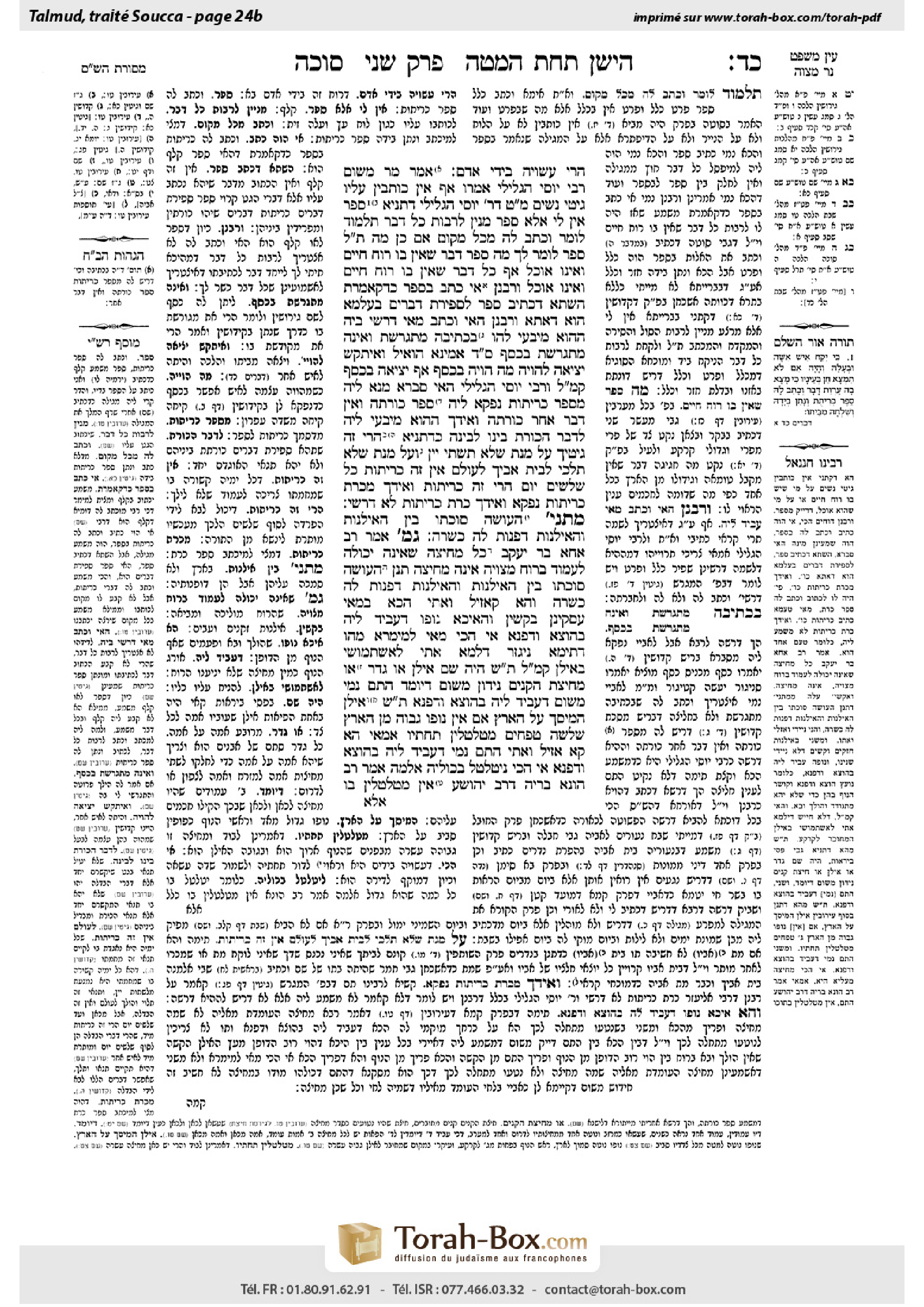
Sukkah 24b: Talmud study for Daf Yomi
Daf Yomi is the daily study of one Talmud folio. Explore 37 tractates with scans, Hebrew text, Sefaria English and AI-generated French translations where annotated.
Passage selection and English or AI-generated French translation are available where the scan has annotations. Daf Study is independent of Torah-Box and Sefaria.
Browse Sukkah · סוכה · All tractatesSukkah 24b text and translations
This page of Sukkah includes the Aramaic text, an English translation and an AI-generated French translation, alongside the scan above.
סוכה כ״ד ב · Aramaic and Hebrew text
הֲרֵי עֲשׂוּיָה בִּידֵי אָדָם.
אָמַר מָר. מִשּׁוּם רַבִּי יוֹסֵי הַגְּלִילִי אָמְרוּ: אַף אֵין כּוֹתְבִין עָלָיו גִּיטֵּי נָשִׁים. מַאי טַעְמֵיהּ דְּרַבִּי יוֹסֵי הַגְּלִילִי? דְּתַנְיָא: ״סֵפֶר״, אֵין לִי אֶלָּא סֵפֶר. מִנַּיִן לְרַבּוֹת כָּל דָּבָר — תַּלְמוּד לוֹמַר: ״וְכָתַב לָהּ״ מִכׇּל מָקוֹם.
אִם כֵּן, מָה תַּלְמוּד לוֹמַר ״סֵפֶר״? לוֹמַר לָךְ: מָה סֵפֶר דָּבָר שֶׁאֵין בּוֹ רוּחַ חַיִּים וְאֵינוֹ אוֹכֶל, אַף כׇּל דָּבָר שֶׁאֵין בּוֹ רוּחַ חַיִּים וְאֵינוֹ אוֹכֶל.
וְרַבָּנַן? אִי כְּתַב ״בְּסֵפֶר״, כִּדְקָאָמְרַתְּ. הַשְׁתָּא דִּכְתִיב ״סֵפֶר״ — לִסְפִירַת דְּבָרִים בְּעָלְמָא הוּא דַּאֲתָא.
וְרַבָּנַן: הַאי ״וְכָתַב״ מַאי דָּרְשִׁי בֵּיהּ? הָהוּא מִיבְּעֵי לְהוּ, בִּכְתִיבָה מִתְגָּרֶשֶׁת וְאֵינָהּ מִתְגָּרֶשֶׁת בְּכֶסֶף. סָלְקָא דַּעְתָּךְ אָמֵינָא: הוֹאִיל וְאִיתַּקַּשׁ יְצִיאָה לַהֲוָיָה, מָה הֲוָיָה בַּכֶּסֶף — אַף יְצִיאָה בְּכֶסֶף, קָא מַשְׁמַע לַן.
וְרַבִּי יוֹסֵי הַגְּלִילִי הַאי סְבָרָא מְנָא לֵיהּ? מִ״סֵּפֶר כְּרִיתוּת״ נָפְקָא לֵיהּ. סֵפֶר כּוֹרְתָהּ, וְאֵין דָּבָר אַחֵר כּוֹרְתָהּ.
וְאִידַּךְ? הַהוּא מִיבְּעֵי לֵיהּ לְדָבָר הַכּוֹרֵת בֵּינוֹ לְבֵינָהּ. כִּדְתַנְיָא: הֲרֵי זֶה גִּיטִּיךְ עַל מְנָת שֶׁלֹּא תִּשְׁתִּי יַיִן, וְעַל מְנָת שֶׁלֹּא תֵּלְכִי לְבֵית אָבִיךְ לְעוֹלָם — אֵין זֶה כְּרִיתוּת, כָּל שְׁלֹשִׁים יוֹם — הֲרֵי זֶה כְּרִיתוּת.
וְאִידָּךְ? מִ״כָּרֵת״ ״כְּרִיתוּת״ נָפְקָא. וְאִידַּךְ? ״כָּרֵת״ ״כְּרִיתוּת״ לָא דָּרְשִׁי.
מַתְנִי׳ הָעוֹשֶׂה סוּכָּתוֹ בֵּין הָאִילָנוֹת וְהָאִילָנוֹת דְּפָנוֹת לָהּ — כְּשֵׁרָה.
גְּמָ׳ אָמַר רַב אַחָא בַּר יַעֲקֹב: כׇּל מְחִיצָה שֶׁאֵינָהּ יְכוֹלָה לַעֲמוֹד בְּרוּחַ מְצוּיָה — אֵינָהּ מְחִיצָה.
תְּנַן: הָעוֹשֶׂה סוּכָּתוֹ בֵּין הָאִילָנוֹת וְהָאִילָנוֹת דְּפָנוֹת לָהּ — כְּשֵׁרָה. וְהָא קָאָזֵיל וְאָתֵי! הָכָא בְּמַאי עָסְקִינַן — בְּקָשִׁין.
וְהָאִיכָּא נוֹפוֹ! דְּעָבֵיד לֵיהּ בְּהוּצָא וְדַפְנָא. אִי הָכִי, מַאי לְמֵימְרָא? מַהוּ דְּתֵימָא: נִיגְזַר דִּלְמָא אָתֵי לְאִשְׁתַּמּוֹשֵׁי בְּאִילָן, קָא מַשְׁמַע לַן.
תָּא שְׁמַע: הָיָה שָׁם אִילָן אוֹ גָּדֵר אוֹ מְחִיצַת הַקָּנִים — נִידּוֹן מִשּׁוּם דְּיוֹמָד! הָתָם נָמֵי, מִשּׁוּם דְּעָבֵיד לֵיהּ בְּהוּצָא וְדַפְנָא.
תָּא שְׁמַע: אִילָן הַמֵּיסֵךְ עַל הָאָרֶץ, אִם אֵין נוֹפוֹ גָּבוֹהַּ מִן הָאָרֶץ שְׁלֹשָׁה טְפָחִים — מְטַלְטְלִין תַּחְתָּיו. אַמַּאי, הָא קָא אָזֵיל וְאָתֵי? הָתָם נָמֵי, דְּעָבֵיד לֵיהּ בְּהוּצָא וְדַפְנָא.
אִי הָכִי, נִיטַּלְטֵל בְּכוּלֵּיהּ! אַלְּמָה אָמַר רַב הוּנָא בְּרֵיהּ דְּרַב יְהוֹשֻׁעַ: אֵין מְטַלְטְלִין בּוֹ
Sukkah 24b · English translation
this partition was established by a person and is therefore fit.
§ The Master said in the baraita that in the name of Rabbi Yosei HaGelili they said: Nor may one write bills of divorce on it. The Gemara asks: What is the rationale for the opinion of Rabbi Yosei HaGelili? It is as it is taught in a baraita with regard to the verse: “When a man takes a wife, and marries her, and it comes to pass if she finds no favor in his eyes, because he has found some unseemly thing in her; that he write her a scroll [sefer] of severance and give it in her hand, and send her out of his house” (Deuteronomy 24:1); from the word scroll, I have derived only that a scroll is fit. From where do I derive to include all objects as fit materials upon which a bill of divorce may be written? The verse states: “That he write her,” in any case, i.e., any surface upon which the formula can be written.
If so, what is the meaning of that which the verse states: Scroll? It is to tell you that a bill of divorce must be written on a surface like a scroll: Just as a scroll is neither alive nor is it food, so too, a bill of divorce may be written on any object that is neither alive nor food. That is why Rabbi Yosei HaGelili invalidates a bill of divorce written on a living being.
The Gemara asks: And how do the Rabbis, who disagree and say that a bill of divorce may be written even on a living creature or on food, interpret the verse? They contend: If the verse had written: That he write for her in the scroll [basefer], it would be as you said, that the bill of divorce may be written only on a scroll. Now that it is written simply: That he write her a sefer, it comes to teach that a mere account of the matters [sefirat devarim] is required. There are no restrictions with regard to the surface on which that account may be written.
The Gemara continues: And what do the Rabbis derive from the phrase: “That he write her”? The Gemara answers: That phrase is required to teach the principle that a woman is divorced only by means of writing, i.e., a bill of divorce, and she is not divorced by means of money. It might have entered your mind to say: Since in the verse, leaving marriage, i.e., divorce, is juxtaposed to becoming married, i.e., betrothal, then just as becoming married is effected with money, so too, leaving marriage may be effected with money. Therefore, the Torah teaches us: “That he write her,” indicating that divorce can be effected only with a written bill of divorce.
The Gemara asks: And Rabbi Yosei HaGelili, from where does he derive this reasoning that a woman cannot be divorced with money? The Gemara answers: He derives it from the phrase: “A scroll of severance,” which teaches that a scroll, i.e., a written document, severs her from her husband, and nothing else severs her from him.
The Gemara continues: And the other tanna, i.e., the Rabbis, requires that verse to teach that a bill of divorce must be a matter that severs all connection between him and her. As it is taught in a baraita: If a man says to his wife: This is your bill of divorce on the condition that you will never drink wine, or on the condition that you will never go to your father’s house, that is not severance; the divorce is not valid. If a bill of divorce imposes a condition upon the woman that permanently binds her to her husband, her relationship with her husband has not been completely severed, which is a prerequisite for divorce. If, however, he imposes a condition for the duration of thirty days, or any other limited period of time, that is severance, and the divorce is valid, as the relationship will be completely terminated at the end of the thirty-day period.
The Gemara continues: And the other tanna, Rabbi Yosei HaGelili, derives that a condition without a termination point invalidates the divorce from the fact that instead of using the term karet, the verse uses the more expanded term keritut. Inasmuch as both terms denote severance, using the longer term teaches two things: Divorce can be effected only by means of writing and not through money, and divorce requires total severance. And the other tanna, the Rabbis, does not derive anything from the expansion of karet to keritut, because the Rabbis do not see this as a significant deviation from the standard language of the verse.
MISHNA: In the case of one who establishes his sukka between the trees, and the trees serve as walls for it, the sukka is fit.
GEMARA: Rav Aḥa bar Ya’akov said: Any partition that is not able to stand in a typical wind, but rather is blown to and fro, is not a partition.
The Gemara asks the following question based on that which we learned in the mishna: In the case of one who establishes his sukka between the trees, and the trees serve as walls for it, the sukka is fit. The Gemara asks: But don’t the trees sway back and forth in the wind? The Gemara answers: With what are we dealing here? The mishna is referring to older trees that are thick and hard and do not sway in the wind.
The Gemara asks: But isn’t there the issue of its foliage, which certainly sways in the wind? If it constitutes part of the wall of the sukka, the sukka should be unfit. The Gemara answers: It is referring to a case where it is a fit wall due to the fact that he established the wall by tying it with hard palm leaves and laurel leaves to tighten it to prevent it from swaying in the wind. And the Gemara says: If it is so that the tree is tied and cannot sway, what purpose is there to state this halakha? It is obvious that it is a fit wall. The Gemara answers: It is lest you say: Let us issue a decree prohibiting its use lest one come to use the tree on Shabbat. Therefore, the mishna teaches us that this is not a concern.
Come and hear a different proof that a partition that is blown to and fro in the wind is a fit partition. The halakha is that double boards positioned in the four corners of an area surrounding a well render the area a private domain in which it is permitted to draw water from the well on Shabbat. If there was a tree there, one cubit thick on each side of one of the corners, or a square stone fence that measures one square cubit, or a partition of reeds, its legal status is assessed like that of a double board positioned at the corners of the area surrounding a well, and serve as a partition for two of the sides. Apparently, a partition that moves in the wind, like the partition of reeds, is considered a full-fledged partition. The Gemara refutes this proof: There, too, it is only considered a full-fledged partition due to the fact that he established the partition by tying it with hard palm leaves and laurel leaves.
The Gemara cites an additional proof. Come and hear that which is taught in a baraita: With regard to a tree whose foliage is broad and its branches reach down and cover the ground, if its foliage is not three handbreadths high off the ground it creates a space similar to a round room; therefore, one may carry beneath it, as it is a full-fledged private domain. Why is the foliage of the tree a fit partition? Doesn’t it sway back and forth in the wind? The Gemara answers: There, too, it is due to the fact that he established the partition by tying it with hard palm leaves and laurel leaves.
The Gemara asks: If so that it is a case where one established the foliage as a complete partition, let him move objects in the entire area beneath the tree, since it is a private domain. Why, then, did Rav Huna, son of Rav Yehoshua, say: One may carry beneath this tree
Sukkah 24b · Traduction française (IA)
Cette cloison a été installée par une personne et est donc valide.
§ Le Maître a dit dans la baraïta qu’ils ont enseigné au nom de Rabbi Yosei HaGelili : On ne peut pas non plus y écrire des actes de divorce. La Guemara demande : Quelle est la raison de l’opinion de Rabbi Yosei HaGelili ? C’est comme il est enseigné dans une baraïta au sujet du verset : « Lorsqu’un homme prend une femme et l’épouse, si elle ne trouve pas grâce à ses yeux, parce qu’il a découvert en elle quelque chose de déshonorant, qu’il lui écrive un acte [sefer] de rupture, le lui remette en main et la renvoie de sa maison » (Deutéronome 24,1). Du mot « acte », j’ai déduit seulement qu’un rouleau convient. D’où déduire qu’il faut inclure tous les objets parmi les supports convenant à l’écriture d’un acte de divorce ? Le verset dit : « Qu’il lui écrive », dans tous les cas, c’est-à-dire sur toute surface sur laquelle la formule peut être écrite.
Si tel est le cas, que signifie le mot « acte » dans le verset ? Il vient t’enseigner qu’un acte de divorce doit être écrit sur un support semblable à un rouleau : de même qu’un rouleau n’est ni vivant ni un aliment, de même un acte de divorce peut être écrit sur tout objet qui n’est ni vivant ni un aliment. C’est pourquoi Rabbi Yosei HaGelili invalide un acte de divorce écrit sur un être vivant.
La Guemara demande : Et comment les Sages, qui ne sont pas d’accord et disent qu’un acte de divorce peut être écrit même sur un être vivant ou sur un aliment, interprètent-ils le verset ? Ils soutiennent : Si le verset avait dit : « Qu’il lui écrive dans le rouleau [basefer] », ce serait comme tu l’as dit, à savoir que l’acte de divorce ne pourrait être écrit que sur un rouleau. Mais puisqu’il est simplement écrit : « Qu’il lui écrive un acte », cela vient enseigner qu’un simple récit des faits [sefirat devarim] est requis. Il n’y a aucune restriction quant au support sur lequel ce récit peut être écrit.
La Guemara poursuit : Et que déduisent les Sages de l’expression « Qu’il lui écrive » ? La Guemara répond : Cette expression est nécessaire pour enseigner le principe selon lequel une femme ne divorce que par écrit, c’est-à-dire au moyen d’un acte de divorce, et non au moyen d’argent. On aurait pu penser : Puisque, dans le verset, la fin du mariage, c’est-à-dire le divorce, est mise en parallèle avec l’entrée dans le mariage, c’est-à-dire les fiançailles, de même que l’entrée dans le mariage s’effectue au moyen d’argent, la fin du mariage peut elle aussi s’effectuer au moyen d’argent. C’est pourquoi la Torah nous enseigne : « Qu’il lui écrive », indiquant que le divorce ne peut s’effectuer qu’au moyen d’un acte de divorce écrit.
La Guemara demande : Et d’où Rabbi Yosei HaGelili déduit-il qu’une femme ne peut pas divorcer contre de l’argent ? La Guemara répond : Il le déduit de l’expression « un acte de rupture », qui enseigne qu’un acte, c’est-à-dire un document écrit, la sépare de son mari, et que rien d’autre ne la sépare de lui.
La Guemara poursuit : Et l’autre tanna, c’est-à-dire les Sages, a besoin de ce verset pour enseigner que l’acte de divorce doit rompre tout lien entre lui et elle. Comme il est enseigné dans une baraïta : Si un homme dit à sa femme : « Voici ton acte de divorce, à condition que tu ne boives jamais de vin », ou « à condition que tu ne te rendes jamais chez ton père », il n’y a pas rupture ; le divorce n’est pas valide. Si un acte de divorce impose à la femme une condition qui la lie définitivement à son mari, sa relation avec lui n’a pas été complètement rompue, ce qui est une condition préalable au divorce. En revanche, s’il impose une condition pour une durée de trente jours, ou pour toute autre période limitée, il y a rupture et le divorce est valide, puisque la relation prendra fin complètement au terme de cette période de trente jours.
La Guemara poursuit : Et l’autre tanna, Rabbi Yosei HaGelili, déduit qu’une condition sans terme final invalide le divorce du fait qu’au lieu du terme karet, le verset emploie le terme plus développé keritut. Puisque les deux termes signifient « rupture », l’emploi du terme le plus long enseigne deux choses : le divorce ne peut s’effectuer qu’au moyen d’un écrit et non au moyen d’argent, et il exige une rupture totale. Et l’autre tanna, les Sages, ne déduit rien du passage de karet à keritut, car ils ne considèrent pas cela comme un écart significatif par rapport à la formulation habituelle du verset.
MICHNA : Dans le cas de celui qui installe sa soukka entre des arbres, lesquels lui servent de parois, la soukka est valide.
GUEMARA : Rav Aḥa bar Ya’akov a dit : Toute cloison qui ne peut résister à un vent ordinaire, mais qui est secouée d’un côté puis de l’autre, n’est pas une cloison.
La Guemara soulève la question suivante à partir de ce que nous avons appris dans la Michna : Celui qui installe sa soukka entre des arbres, lesquels lui servent de parois, a une soukka valide. La Guemara demande : Mais les arbres ne se balancent-ils pas d’un côté puis de l’autre dans le vent ? La Guemara répond : De quoi s’agit-il ici ? La Michna parle d’arbres anciens, épais et robustes, qui ne se balancent pas dans le vent.
La Guemara demande : Mais qu’en est-il de son feuillage, qui se balance certainement dans le vent ? S’il constitue une partie de la paroi de la soukka, celle-ci devrait être invalide. La Guemara répond : Il s’agit d’un cas où la paroi est valide parce qu’il l’a installée en attachant des feuilles de palmier rigides et des feuilles de laurier pour la stabiliser et l’empêcher de se balancer dans le vent. La Guemara demande : Si l’arbre est attaché et ne peut pas se balancer, à quoi bon énoncer cette halakha ? Il est évident que la paroi est valide. La Guemara répond : C’est pour éviter que tu ne dises : « Émettons un décret interdisant son usage, de peur qu’on en vienne à utiliser l’arbre pendant Chabbat. » La Michna nous enseigne donc que ce risque n’est pas à craindre.
Viens et entends une autre preuve qu’une cloison secouée d’un côté puis de l’autre par le vent est une cloison valide. Selon la halakha, des planches jumelées placées aux quatre coins d’une zone entourant un puits font de cette zone un domaine privé, où il est permis de puiser de l’eau du puits pendant Chabbat. S’il s’y trouvait un arbre d’une coudée d’épaisseur de chaque côté de l’un des angles, ou une clôture carrée en pierre d’une coudée de côté, ou une cloison de roseaux, son statut est évalué comme celui d’une planche jumelée placée aux angles de la zone entourant un puits, et ces éléments servent de cloison pour deux des côtés. Il apparaît qu’une cloison qui bouge dans le vent, comme la cloison de roseaux, est considérée comme une cloison à part entière. La Guemara réfute cette preuve : Là aussi, elle n’est considérée comme une cloison à part entière que parce qu’il l’a installée en l’attachant avec des feuilles de palmier rigides et des feuilles de laurier.
La Guemara apporte une preuve supplémentaire. Viens et entends ce qui est enseigné dans une baraïta : Au sujet d’un arbre dont le feuillage est large et dont les branches descendent jusqu’à recouvrir le sol, si son feuillage se trouve à moins de trois palmes du sol, il crée un espace semblable à une pièce circulaire ; on peut donc transporter sous cet arbre, car il constitue un véritable domaine privé. Pourquoi le feuillage de l’arbre constitue-t-il une cloison valide ? Ne se balance-t-il pas d’un côté puis de l’autre dans le vent ? La Guemara répond : Là aussi, c’est parce qu’il a installé la cloison en l’attachant avec des feuilles de palmier rigides et des feuilles de laurier.
La Guemara demande : Si l’on est dans le cas où quelqu’un a aménagé le feuillage en cloison complète, qu’il puisse transporter des objets dans toute la zone sous l’arbre, puisqu’il s’agit d’un domaine privé. Pourquoi Rav Huna, fils de Rav Yehoshua, a-t-il donc dit : « On peut transporter sous cet arbre »
Traduction française générée par IA à partir de l’édition anglaise de Sefaria. Vérifie toujours un passage avec le texte source.
Text from Sefaria: William Davidson Edition - Vocalized Aramaic (CC BY NC); William Davidson Edition - English (CC BY NC).