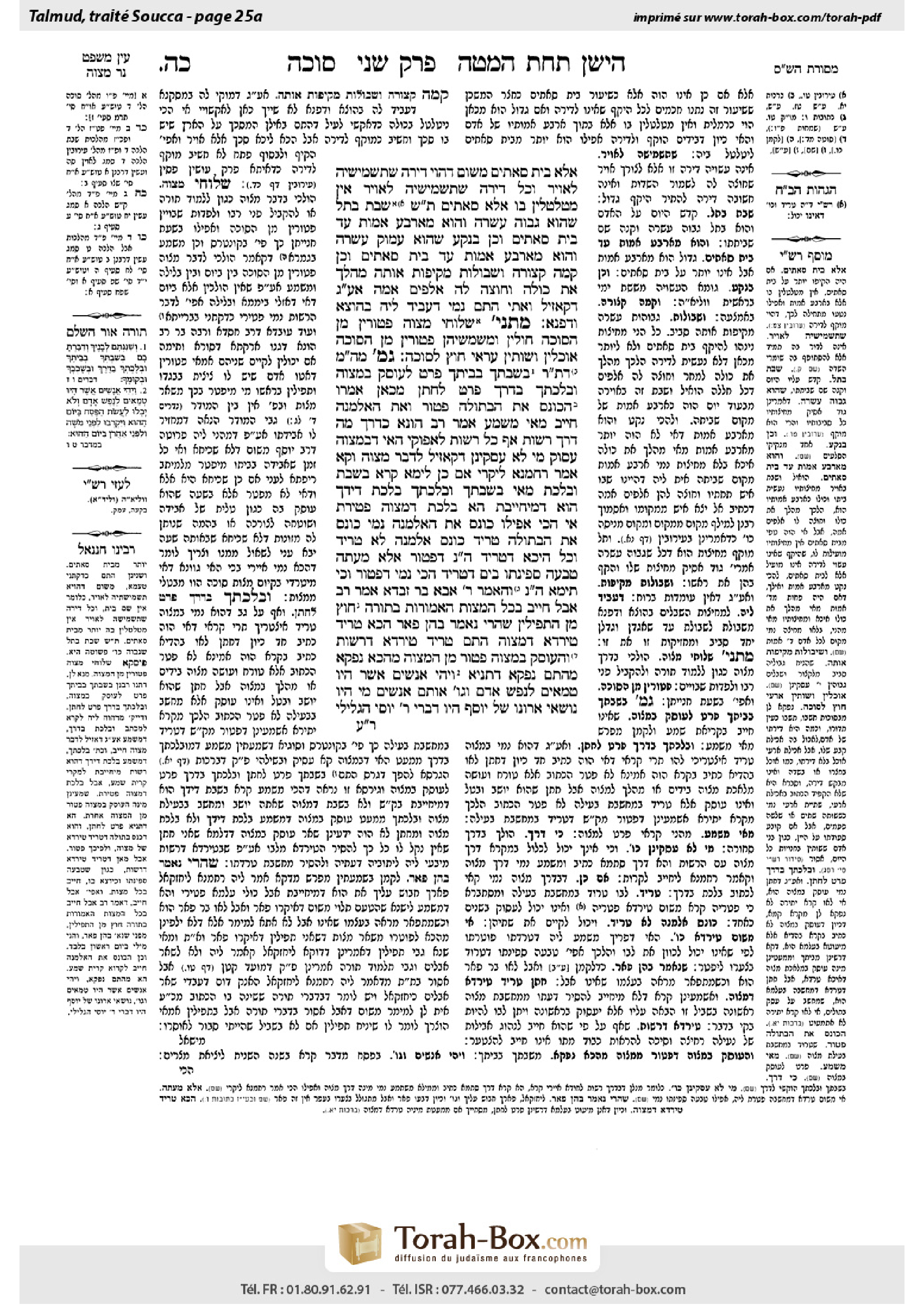
Sukkah 25a: Talmud study for Daf Yomi
Daf Yomi is the daily study of one Talmud folio. Explore 37 tractates with scans, Hebrew text, Sefaria English and AI-generated French translations where annotated.
Passage selection and English or AI-generated French translation are available where the scan has annotations. Daf Study is independent of Torah-Box and Sefaria.
Browse Sukkah · סוכה · All tractatesSukkah 25a text and translations
This page of Sukkah includes the Aramaic text, an English translation and an AI-generated French translation, alongside the scan above.
סוכה כ״ה א · Aramaic and Hebrew text
אֶלָּא בֵּית סָאתַיִם!
מִשּׁוּם דְּהָוֵי דִּירָה שֶׁתַּשְׁמִישֶׁיהָ לַאֲוִיר, וְכׇל דִּירָה שֶׁתַּשְׁמִישֶׁיהָ לַאֲוִיר אֵין מְטַלְטְלִין בּוֹ אֶלָּא סָאתַיִם.
תָּא שְׁמַע: שָׁבַת בְּתֵל שֶׁהוּא גָּבוֹהַּ עֲשָׂרָה, וְהוּא מֵאַרְבַּע אַמּוֹת עַד בֵּית סָאתַיִם, וְכֵן בְּנֶקַע שֶׁהוּא עָמוֹק עֲשָׂרָה, וְהוּא מֵאַרְבַּע אַמּוֹת עַד בֵּית סָאתַיִם, וְכֵן קָמָה קְצוּרָה וְשִׁבּוֹלוֹת מַקִּיפוֹת אוֹתָהּ — מְהַלֵּךְ אֶת כּוּלָּהּ וְחוּצָה לָהּ אַלְפַּיִם אַמָּה. אַף עַל גַּב דְּקָאָזֵיל וְאָתֵי! הָתָם נָמֵי, דְּעָבֵיד לֵיהּ בְּהוּצָא וְדַפְנָא.
מַתְנִי׳ שְׁלוּחֵי מִצְוָה — פְּטוּרִין מִן הַסּוּכָּה. חוֹלִין וּמְשַׁמְּשֵׁיהֶן — פְּטוּרִין מִן הַסּוּכָּה. אוֹכְלִין וְשׁוֹתִין עֲרַאי חוּץ לַסּוּכָּה.
גְּמָ׳ מְנָא הָנֵי מִילֵּי? תָּנוּ רַבָּנַן: ״בְּשִׁבְתְּךָ בְּבֵיתֶךָ״ — פְּרָט לְעוֹסֵק בְּמִצְוָה, ״וּבְלֶכְתְּךָ בַדֶּרֶךְ״ — פְּרָט לְחָתָן. מִכָּאן אָמְרוּ: הַכּוֹנֵס אֶת הַבְּתוּלָה — פָּטוּר, וְאֶת הָאַלְמָנָה — חַיָּיב.
מַאי מַשְׁמַע? אָמַר רַב הוּנָא: כְּדֶרֶךְ. מָה דֶּרֶךְ רְשׁוּת, אַף כֹּל רְשׁוּת, לְאַפּוֹקֵי הַאי דִּבְמִצְוָה עָסוּק.
מִי לָא עָסְקִינַן דְּקָאָזֵיל לִדְבַר מִצְוָה, וְקָא אָמַר רַחֲמָנָא לִיקְרֵי! אִם כֵּן לֵימָא קְרָא ״בְּשֶׁבֶת וּבְלֶכֶת״, מַאי ״בְּשִׁבְתְּךָ״ ״וּבְלֶכְתְּךָ״ — בְּלֶכֶת דִּידָךְ הוּא דְּמִיחַיְּיבַתְּ, הָא בְּלֶכֶת דְּמִצְוָה — פְּטִירַתְּ.
אִי הָכִי, אֲפִילּוּ כּוֹנֵס אֶת הָאַלְמָנָה נָמֵי? כּוֹנֵס אֶת הַבְּתוּלָה טְרִיד, כּוֹנֵס אַלְמָנָה לָא טְרִיד.
וְכׇל הֵיכָא דִּטְרִיד, הָכִי נָמֵי דְּפָטוּר?! אֶלָּא מֵעַתָּה, טָבְעָה סְפִינָתוֹ בַּיָּם — דִּטְרִיד, הָכִי נָמֵי דְּפָטוּר?! וְכִי תֵּימָא הָכִי נָמֵי, וְהָאָמַר רַבִּי אַבָּא בַּר זַבְדָּא אָמַר רַב: אָבֵל חַיָּיב בְּכׇל הַמִּצְוֹת הָאֲמוּרוֹת בַּתּוֹרָה חוּץ מִן הַתְּפִילִּין, שֶׁהֲרֵי נֶאֱמַר בָּהֶן ״פְּאֵר״!
הָכָא טְרִיד טִירְדָּא דְמִצְוָה, הָתָם טְרִיד טִירְדָּא דִרְשׁוּת.
וְהָעוֹסֵק בְּמִצְוָה פָּטוּר מִן הַמִּצְוָה מֵהָכָא נָפְקָא? מֵהָתָם נָפְקָא, דְּתַנְיָא: ״וַיְהִי אֲנָשִׁים אֲשֶׁר הָיוּ טְמֵאִים לְנֶפֶשׁ אָדָם וְגוֹ׳״ — אוֹתָם אֲנָשִׁים מִי הָיוּ? נוֹשְׂאֵי אֲרוֹנוֹ שֶׁל יוֹסֵף הָיוּ, דִּבְרֵי רַבִּי יוֹסֵי הַגְּלִילִי.
Sukkah 25a · English translation
only within an area of two beit se’a, the area necessary to grow two se’a of produce? Two beit se’a was the area of the Tabernacle courtyard; it is also the area within which the Sages permitted one to carry on Shabbat in a case where there are partitions but the area was not originally enclosed for the purpose of residence. If one tied the foliage to prevent its swaying in the wind, he clearly established the partition for residence, and there should be no limits on the area in which he may carry.
The Gemara answers: The reason that it is permitted to carry only if the enclosed area is less than this size is because it is a residence whose uses are for the open air beyond it, i.e., it is used by guards who are watching the fields beyond it rather than as an independent residence. And the halakha with regard to any residence whose uses are for the open air beyond it is that one may carry in it only if its area is no larger than two beit se’a.
Come and hear proof from another source: With regard to one who established his Shabbat residence on a mound that is ten handbreadths high and its area is anywhere from four cubits to two beit se’a; and similarly, with regard to one who established his Shabbat residence in a natural cavity of a rock that is ten handbreadths deep and its area is anywhere from four cubits to two beit se’a; and similarly, with regard to one who established his Shabbat residence in a field of reaped grain, and rows of stalks ten handbreadths high that have not been reaped surround it, serving as a partition enclosing the reaped area, he may walk in the entire enclosed area and outside it an additional two thousand cubits. Apparently, the stalks are a fit partition although they sway back and forth in the wind. The Gemara refutes this proof: There, too, it is a fit partition due to the fact that he established the partition by tying it with hard palm leaves and laurel leaves.
MISHNA: Those on the path to perform a mitzva are exempt from the mitzva of sukka. The ill and their caretakers are exempt from the mitzva of sukka. One may eat and drink in the framework of a casual meal outside the sukka.
GEMARA: The Gemara asks: From where are these matters derived that one who is performing a mitzva is exempt from the mitzva of sukka? The Sages taught in a baraita that it is written in the Torah that one recites Shema at the following times: “When you sit in your house, and when you walk by the way, and when you lie down, and when you rise up” (Deuteronomy 6:7). The Sages interpret: “When you sit in your house,” to the exclusion of one who is engaged in the performance of a mitzva, who is not sitting at home; “and when you walk by the way,” to the exclusion of a groom, who is preoccupied with his mitzva of consummating the marriage and is not walking along the way. The baraita adds that from here the Sages stated: One who marries a virgin is exempt from reciting Shema on his wedding night, and one who marries a widow is obligated.
The Gemara asks: From where may it be inferred in this verse that a groom is exempt from the mitzva of Shema? Rav Huna said: The circumstances when one is obligated to recite Shema are like the circumstances when one walks along the way: Just as the walking by the way described in the verse is voluntary and involves no mitzva, so too, all those obligated to recite Shema are similarly engaged in voluntary activities, to the exclusion of this groom, who is engaged in the performance of a mitzva.
The Gemara asks: The verse does not specify the way along which one is walking. Are we not dealing with one who is walking along the way for a matter of a mitzva, and nevertheless, the Merciful One says to recite Shema? Apparently, one is obligated to do so even if he set out to perform a mitzva. The Gemara answers: If it is so that the intention was to obligate even those who are engaged in performance of a mitzva, let the verse state: When sitting and when walking. What is the meaning of: “When you sit…and when you walk”? It comes to underscore: It is in your walking, undertaken for personal reasons and of one’s own volition, that you are obligated to recite Shema; in walking with the objective of performing a mitzva, you are exempt from reciting Shema.
The Gemara asks: If so, even one who marries a widow should also be exempt, as he too is engaged in the performance of a mitzva. That, however, contradicts the baraita. The Gemara responds that there is a distinction between one marrying a virgin and one marrying a widow. One who marries a virgin is preoccupied by his concern lest he discover that his bride is not a virgin, while one who marries a widow is not preoccupied.
The Gemara asks: And wherever one is preoccupied is he indeed exempt? But if that is so, then one whose ship sank at sea, who is preoccupied, should also be exempt. The Gemara reinforces its question: And if you say that indeed, that is so, didn’t Rabbi Abba bar Zavda say that Rav said: A mourner is obligated in all the mitzvot mentioned in the Torah, including reciting Shema, except for the mitzva to don phylacteries, from which he is exempt, as the term splendor is stated with regard to phylacteries? If a mourner, who is clearly pained and preoccupied, is obligated to recite Shema, then certainly all others who are preoccupied, even one whose ship sank at sea, whose loss was merely monetary (Birkat Hashem), should be obligated. Why, then, is a groom exempted due to his preoccupation and one who lost his property is not?
The Gemara answers: Nevertheless, there is a distinction between the cases. Here, in the case of a groom, he is preoccupied with the preoccupation of a mitzva that he must perform; there, in the case of a ship lost at sea, he is preoccupied with the preoccupation of a voluntary act that he chooses to perform.
§ The Gemara asks: And is the halakhic principle that one who is engaged in a mitzva is exempt from performing another mitzva derived from here? It is derived from there, as it is taught in a baraita that it is written: “There were certain men who were impure by the corpse of a person and they could not observe the Pesaḥ on that day” (Numbers 9:6). Before proceeding with the discussion, the baraita seeks to clarify with regard to those men who became impure: Who were they? The baraita answers: They were the bearers of Joseph’s coffin, which the Jewish people brought with them in the desert. This is the statement of Rabbi Yosei HaGelili.
Sukkah 25a · Traduction française (IA)
uniquement dans une superficie de deux beit séa, soit la superficie nécessaire pour faire pousser deux séa de produits ? Deux beit séa était la superficie de la cour du Tabernacle ; c’est aussi la superficie dans laquelle les Sages ont permis de porter pendant Chabbat lorsqu’il y a des cloisons, mais que la zone n’a pas été initialement clôturée à des fins d’habitation. Si l’on a attaché le feuillage pour l’empêcher de se balancer au vent, on a clairement établi la cloison à des fins d’habitation, et il ne devrait y avoir aucune limite à la superficie dans laquelle on peut porter.
La Guemara répond : Si le port n’est permis que lorsque la zone clôturée est inférieure à cette superficie, c’est parce qu’il s’agit d’un lieu d’habitation dont l’usage est tourné vers l’espace découvert qui l’entoure, c’est-à-dire qu’il est utilisé par des gardes qui surveillent les champs alentour, et non comme lieu d’habitation indépendant. Or, la halakha concernant tout lieu d’habitation dont l’usage est tourné vers l’espace découvert qui l’entoure est qu’on ne peut y porter que si sa superficie ne dépasse pas deux beit séa.
Viens et entends une preuve tirée d’une autre source : celui qui a fixé sa résidence de Chabbat sur un monticule haut de dix palmes et dont la superficie va de quatre coudées à deux beit séa ; de même, celui qui a fixé sa résidence de Chabbat dans une cavité naturelle d’un rocher profonde de dix palmes et dont la superficie va de quatre coudées à deux beit séa ; et de même, celui qui a fixé sa résidence de Chabbat dans un champ de céréales moissonnées, entouré de rangées de tiges hautes de dix palmes qui n’ont pas été moissonnées et qui servent de cloison pour clôturer la zone moissonnée : il peut parcourir toute la zone clôturée, ainsi que deux mille coudées supplémentaires à l’extérieur. Apparemment, les tiges constituent une cloison valable bien qu’elles se balancent au vent. La Guemara réfute cette preuve : là aussi, la cloison est valable parce qu’il l’a établie en l’attachant avec des feuilles de palmier dur et des feuilles de laurier.
Michna : Ceux qui sont en chemin pour accomplir une mitsva sont dispensés de la mitsva de la soukka. Les malades et ceux qui s’occupent d’eux sont dispensés de la mitsva de la soukka. On peut manger et boire en dehors de la soukka dans le cadre d’un repas occasionnel.
Guemara : La Guemara demande : De quoi déduit-on que celui qui accomplit une mitsva est dispensé de la mitsva de la soukka ? Les Sages enseignent dans une baraïta qu’il est écrit dans la Torah que l’on récite le Chéma aux moments suivants : « Quand tu seras assis dans ta maison, quand tu marcheras en chemin, quand tu te coucheras et quand tu te lèveras » (Deutéronome 6:7). Les Sages interprètent : « Quand tu seras assis dans ta maison » exclut celui qui est occupé à accomplir une mitsva, qui n’est pas assis chez lui ; « quand tu marcheras en chemin » exclut le marié, préoccupé par la mitsva de consommer son mariage et qui ne marche pas en chemin. La baraïta ajoute que c’est de là que les Sages ont déduit : celui qui épouse une vierge est dispensé de réciter le Chéma la nuit de ses noces, tandis que celui qui épouse une veuve en est tenu.
La Guemara demande : Comment déduire de ce verset qu’un marié est dispensé de la mitsva du Chéma ? Rav Houna dit : Les circonstances dans lesquelles on est tenu de réciter le Chéma sont semblables à celles où l’on marche en chemin : de même que la marche en chemin décrite dans le verset est volontaire et n’implique aucune mitsva, de même, tous ceux qui sont tenus de réciter le Chéma sont engagés dans des activités volontaires ; cela exclut ce marié, qui accomplit une mitsva.
La Guemara demande : Le verset ne précise pas le motif du déplacement. Ne s’agit-il pas d’une personne qui marche en chemin pour accomplir une mitsva, et pourtant le Miséricordieux lui dit de réciter le Chéma ? Apparemment, on est tenu de le faire même si l’on est parti accomplir une mitsva. La Guemara répond : S’il en était ainsi, et que l’intention était d’obliger même ceux qui accomplissent une mitsva, que le verset dise : « En étant assis et en marchant. » Que signifie : « Quand tu seras assis… et quand tu marcheras » ? Cela souligne que c’est lorsque tu marches pour des raisons personnelles et de ton propre gré que tu es tenu de réciter le Chéma ; lorsque tu marches dans le but d’accomplir une mitsva, tu en es dispensé.
La Guemara demande : Dans ce cas, celui qui épouse une veuve devrait lui aussi être dispensé, puisqu’il accomplit également une mitsva. Cela contredit toutefois la baraïta. La Guemara répond qu’il existe une différence entre celui qui épouse une vierge et celui qui épouse une veuve. Celui qui épouse une vierge est préoccupé à l’idée de découvrir que sa fiancée n’est pas vierge, tandis que celui qui épouse une veuve n’est pas préoccupé.
La Guemara demande : Est-on donc dispensé chaque fois qu’on est préoccupé ? Mais si tel est le cas, celui dont le bateau a sombré en mer, qui est préoccupé, devrait lui aussi être dispensé. La Guemara renforce sa question : Et si tu dis que c’est effectivement le cas, Rabbi Abba bar Zavda n’a-t-il pas dit au nom de Rav : un endeuillé est tenu d’accomplir toutes les mitsvot mentionnées dans la Torah, y compris de réciter le Chéma, à l’exception de la mitsva de mettre les téfilines, dont il est dispensé, car le terme « splendeur » est employé à propos des téfilines ? Si un endeuillé, qui est manifestement affligé et préoccupé, est tenu de réciter le Chéma, alors, à plus forte raison, tous les autres qui sont préoccupés, même celui dont le bateau a sombré en mer et qui n’a subi qu’une perte financière (Birkat Hashem), devraient être tenus de le réciter. Pourquoi, alors, le marié est-il dispensé en raison de sa préoccupation, contrairement à celui qui a perdu ses biens ?
La Guemara répond : Il existe néanmoins une différence entre les cas. Ici, dans le cas du marié, il est préoccupé par l’accomplissement d’une mitsva qui lui incombe ; là, dans le cas du bateau perdu en mer, il est préoccupé par une activité volontaire qu’il choisit d’entreprendre.
§ La Guemara demande : Le principe halakhique selon lequel celui qui accomplit une mitsva est dispensé d’en accomplir une autre est-il déduit de là ? Il est déduit d’un autre passage, comme l’enseigne une baraïta : il est écrit : « Il y avait des hommes qui étaient impurs à cause d’un cadavre humain et qui ne pouvaient pas célébrer Pessa’h ce jour-là » (Nombres 9:6). Avant de poursuivre la discussion, la baraïta cherche à préciser de quels hommes devenus impurs il s’agissait. Elle répond : c’étaient les porteurs du cercueil de Joseph, que le peuple juif avait emporté avec lui dans le désert. Telle est la déclaration de Rabbi Yossi HaGelili.
Traduction française générée par IA à partir de l’édition anglaise de Sefaria. Vérifie toujours un passage avec le texte source.
Text from Sefaria: William Davidson Edition - Vocalized Aramaic (CC BY NC); William Davidson Edition - English (CC BY NC).