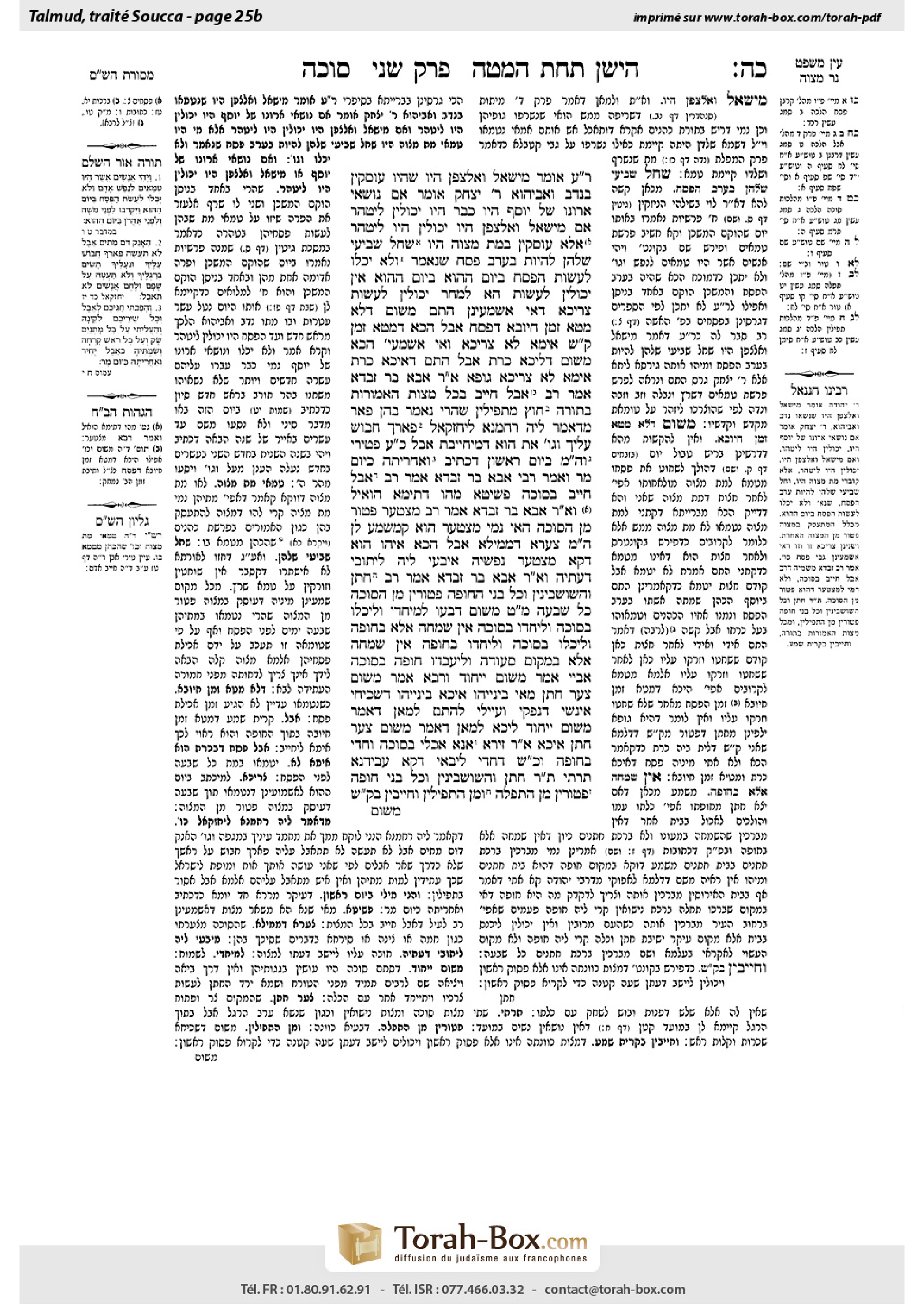
Sukkah 25b: Talmud study for Daf Yomi
Daf Yomi is the daily study of one Talmud folio. Explore 37 tractates with scans, Hebrew text, Sefaria English and AI-generated French translations where annotated.
Passage selection and English or AI-generated French translation are available where the scan has annotations. Daf Study is independent of Torah-Box and Sefaria.
Browse Sukkah · סוכה · All tractatesSukkah 25b text and translations
This page of Sukkah includes the Aramaic text, an English translation and an AI-generated French translation, alongside the scan above.
סוכה כ״ה ב · Aramaic and Hebrew text
רַבִּי עֲקִיבָא אוֹמֵר: מִישָׁאֵל וְאֶלְצָפָן הָיוּ, שֶׁהָיוּ עוֹסְקִין בְּנָדָב וַאֲבִיהוּא. רַבִּי יִצְחָק אוֹמֵר: אִם נוֹשְׂאֵי אֲרוֹנוֹ שֶׁל יוֹסֵף הָיוּ, כְּבָר הָיוּ יְכוֹלִין לִיטָּהֵר. אִם מִישָׁאֵל וְאֶלְצָפָן הָיוּ, יְכוֹלִין הָיוּ לִיטָּהֵר.
אֶלָּא, עוֹסְקִין בְּמֵת מִצְוָה הָיוּ שֶׁחָל שְׁבִיעִי שֶׁלָּהֶן לִהְיוֹת בְּעֶרֶב פֶּסַח, שֶׁנֶּאֱמַר: ״וְלֹא יָכְלוּ לַעֲשׂוֹת הַפֶּסַח בַּיּוֹם הַהוּא״, בְּיוֹם הַהוּא אֵין יְכוֹלִין לַעֲשׂוֹת, הָא לְמָחָר — יְכוֹלִין לַעֲשׂוֹת!
צְרִיכָא, דְּאִי אַשְׁמְעִינַן הָתָם — מִשּׁוּם דְּלָא מְטָא זְמַן חִיּוּבָא דְּפֶסַח, אֲבָל הָכָא, דִּמְטָא זְמַן קְרִיאַת שְׁמַע — אֵימָא לָא, צְרִיכָא. וְאִי אַשְׁמְעִינַן הָכָא — מִשּׁוּם דְּלֵיכָּא כָּרֵת, אֲבָל הָתָם, דְּאִיכָּא כָּרֵת — אֵימָא לָא, צְרִיכָא.
גּוּפָא, אָמַר רַבִּי אַבָּא בַּר זַבְדָּא אָמַר רַב: אָבֵל חַיָּיב בְּכׇל מִצְוֹת הָאֲמוּרוֹת בַּתּוֹרָה חוּץ מִתְּפִילִּין, שֶׁהֲרֵי נֶאֱמַר בָּהֶן ״פְּאֵר״. מִדַּאֲמַר לֵיהּ רַחֲמָנָא לִיחֶזְקֵאל ״פְּאֵרְךָ חֲבוֹשׁ עָלֶיךָ וְגוֹ׳״ — אַתְּ הוּא דְּמִיחַיְּיבַתְּ, אֲבָל כּוּלֵּי עָלְמָא פְּטִירִי.
וְהָנֵי מִילֵּי בְּיוֹם רִאשׁוֹן, דִּכְתִיב: ״וְאַחֲרִיתָהּ כְּיוֹם מָר״.
וְאָמַר רַבִּי אַבָּא בַּר זַבְדָּא אָמַר רַב: אָבֵל חַיָּיב בַּסּוּכָּה. פְּשִׁיטָא? מַהוּ דְּתֵימָא: הוֹאִיל וְאָמַר רַבִּי אַבָּא בַּר זַבְדָּא אָמַר רַב: מִצְטַעֵר פָּטוּר מִן הַסּוּכָּה — הַאי נָמֵי מִצְטַעֵר הוּא, קָמַשְׁמַע לַן: הָנֵי מִילֵּי צַעֲרָא דְמִמֵּילָא, אֲבָל הָכָא, אִיהוּ הוּא דְּקָא מְצַעַר נַפְשֵׁיהּ, אִיבְּעִי לֵיהּ לְיַתּוֹבֵי דַּעְתֵּיהּ.
וְאָמַר רַבִּי אַבָּא בַּר זַבְדָּא אָמַר רַב: חָתָן וְהַשּׁוֹשְׁבִינִין וְכׇל בְּנֵי הַחוּפָּה — פְּטוּרִין מִן הַסּוּכָּה כׇּל שִׁבְעָה. מַאי טַעְמָא? מִשּׁוּם דְּבָעוּ לְמִיחְדֵּי. וְלֵיכְלוּ בַּסּוּכָּה וְלִיחְדּוֹ בַּסּוּכָּה! אֵין שִׂמְחָה אֶלָּא בַּחוּפָּה. וְלֵיכְלוּ בַּסּוּכָּה וְלִיחְדּוֹ בַּחוּפָּה! אֵין שִׂמְחָה אֶלָּא בִּמְקוֹם סְעוּדָה.
וְלֶיעְבְּדוּ חוּפָּה בַּסּוּכָּה? אַבָּיֵי אָמַר: מִשּׁוּם יִיחוּד. וְרָבָא אָמַר: מִשּׁוּם צַעַר חָתָן. מַאי בֵּינַיְיהוּ? אִיכָּא בֵּינַיְיהוּ דִּשְׁכִיחִי אִינָשֵׁי דְּנָפְקִי וְעָיְילִי לְהָתָם. לְמַאן דְּאָמַר מִשּׁוּם יִיחוּד — לֵיכָּא. לְמַאן דְּאָמַר מִשּׁוּם צַעַר חָתָן — אִיכָּא.
אָמַר רַבִּי זֵירָא: אֲנָא אֲכַלִי בַּסּוּכָּה וַחֲדַי בַּחוּפָּה, וְכׇל שֶׁכֵּן דְּחָדֵי לִיבַּאי דְּקָא עָבֵידְנָא תַּרְתֵּי.
תָּנוּ רַבָּנַן: חָתָן וְהַשּׁוֹשְׁבִינִין וְכׇל בְּנֵי חוּפָּה, פְּטוּרִין מִן הַתְּפִלָּה וּמִן הַתְּפִילִּין, וְחַיָּיבִין בִּקְרִיאַת שְׁמַע.
Sukkah 25b · English translation
Rabbi Akiva says: They were Mishael and Elzaphan, who were engaged in carrying the bodies of Nadav and Avihu after they were burned in the Holy of Holies (see Leviticus 10:4). Rabbi Yitzḥak says: These identifications are inaccurate, because if they were the bearers of Joseph’s coffin, they could have already been purified. They were camped at Sinai sufficient time to become purified in time to sacrifice the Paschal lamb. And if they were Mishael and Elzaphan they could have already been purified, as the Tabernacle was erected on the first of Nisan, which was the eighth day of the inauguration, when the sons of Aaron were burned. More than seven days remained until the eve of Passover on the fourteenth of Nisan.
Rather, they were unnamed people who were engaged in tending to a corpse whose burial is a mitzva, i.e., which has no one else available to bury it, and their seventh day of impurity occurred precisely on the eve of Passover, as it is stated: “And they could not observe the Pesaḥ on that day” (Numbers 9:6). The Gemara infers: On that day they could not observe it; on the next day they could observe it. Although they would be purified at nightfall and would then be eligible to partake of the Paschal lamb, at the time of the slaughter and the sprinkling of the blood they were not yet pure. They asked whether the Paschal lamb could be slaughtered on their behalf. Apparently, they were obligated to perform the mitzva of burial of the corpse although it prevented them from fulfilling the mitzva of sacrificing the Paschal lamb, which is a stringent mitzva. This is the source for the principle that one engaged in the performance of a mitzva is exempt from performing another mitzva.
The Gemara answers: Both sources are necessary. As, if it had taught us there, in the case of impurity imparted by a corpse, the conclusion would have been that the exemption from sacrificing the Paschal lamb is due to the fact that the time of the obligation of the Pesaḥ had not yet arrived when they were obligated to bury the corpse, and therefore they proceeded to fulfill the mitzva that they encountered first. However, here, where the time to recite Shema had already arrived during the wedding, say no, that the groom is not exempt; therefore, it is necessary to teach that the groom is exempt. And if it had taught us here, with regard to Shema, the conclusion would have been that the exemption from Shema is due to the fact that it is not a stringent mitzva, as there is no karet administered to one who fails to fulfill it. However, there, with regard to the Paschal lamb, where there is karet administered to one who fails to observe the Pesaḥ, say that one is not exempt from performing it. Therefore, it is necessary to teach both cases.
§ With regard to the matter itself, Rabbi Abba bar Zavda said that Rav said: A mourner is obligated in all the mitzvot mentioned in the Torah except for the mitzva to don phylacteries, from which a mourner is exempt, as the term splendor is stated with regard to phylacteries, and it is not proper for a mourner to adorn himself in this manner. This is derived from the fact that the Merciful One said to Ezekiel: “Sigh in silence; make no mourning for the dead, bind your splendor upon you, and put your shoes upon your feet” (Ezekiel 24:17). Ezekiel was commanded to refrain from mourning for his wife in the manner that others do. God said to Ezekiel: You are obligated to don phylacteries even while mourning; however, everyone else is exempt.
The Gemara comments: This exemption applies only on the first day of mourning, as it is written: “And I will make it as the mourning for an only son, and the end thereof as a bitter day” (Amos 8:10). From this verse it is derived that the primary bitterness of a mourner lasts only one day.
On a similar note, Rabbi Abba bar Zavda said that Rav said: A mourner is obligated in the mitzva of sukka. The Gemara asks: That is obvious; why would he be exempt? The Gemara answers: Lest you say that since Rabbi Abba bar Zavda said that Rav said that one who is suffering due to his presence in the sukka is exempt from the mitzva of sukka, one could have said that this mourner too is one who is suffering and should be exempt as well. Therefore, he teaches us that the mourner is obligated in the mitzva of sukka. These cases are not similar, since this exemption from sukka applies only with regard to suffering that is caused by the sukka itself, e.g., when one is cold or hot or when the roofing has a foul odor. However, here, in the case of a mourner, where he is causing himself to suffer unrelated to his presence in the sukka, he is required to settle himself and fulfill the mitzva.
§ And Rabbi Abba bar Zavda said that Rav said: The groom and the groomsmen and all members of the wedding party who participate in the wedding celebration are exempt from the mitzva of sukka for all seven days of the wedding celebration. The Gemara asks: What is the reason that they are exempt? It is because they wish to rejoice. The Gemara asks: And let them eat in the sukka and rejoice in the sukka. The Gemara answers: The celebration of a wedding is only in the wedding home where the newlyweds reside after the marriage ceremony. The Gemara asks: So let them eat in the sukka like everyone else and rejoice in the wedding home. The Gemara answers: There is joy only in the place where there is a meal. Therefore, since the celebration must be in the home of the newlyweds, the meal must also be there.
The Gemara asks: And let them establish the wedding home in the sukka. Abaye said: This may not be done due to the prohibition against seclusion of the bride with a man other than her husband. As the sukka was often established on a rooftop, if the groom went downstairs at any point, the bride could find herself alone in the sukka with a man. And Rava said: The reason is due to the suffering of the groom. Since the sukka is not enclosed on all sides, he will be unable to enjoy privacy with his bride. The Gemara asks: What is the practical difference between them? The Gemara answers: The practical difference between them is in a case where people regularly enter and leave the sukka. According to the one who said that the reason is due to the prohibition against being alone together, there is no room for concern in that case. However, according to the one who said that the reason is due to the suffering of the groom, there is room for concern in that case as well.
Rabbi Zeira said: I married on the eve of the festival of Sukkot and I ate in the sukka and rejoiced in the wedding home, and all the more so my heart rejoiced as I fulfilled two mitzvot: The mitzva of marriage and the accompanying celebration, and the mitzva of sukka. Nevertheless, he did not require others to do the same.
The Sages taught: The groom and the groomsmen and all the members of the wedding party are exempt from the mitzva of prayer and from the mitzva of phylacteries because they are unable to muster the requisite intent due to the excess of joy and levity; but they are obligated in the mitzva of reciting Shema.
Sukkah 25b · Traduction française (IA)
Rabbi Akiva dit : Il s’agissait de Michaël et d’Eltsafan, qui transportaient les corps de Nadav et d’Avihou après qu’ils eurent été brûlés dans le Saint des Saints (voir Lévitique 10:4). Rabbi Yitzḥak dit : Ces identifications sont inexactes, car s’il s’agissait des porteurs du cercueil de Joseph, ils auraient déjà pu être purifiés. Ils avaient campé au Sinaï assez longtemps pour être purifiés à temps afin d’offrir l’agneau pascal. Et s’il s’agissait de Michaël et d’Eltsafan, ils auraient également déjà pu être purifiés, puisque le Tabernacle fut érigé le premier Nissan, qui était le huitième jour de l’inauguration, jour où les fils d’Aaron furent brûlés. Il restait plus de sept jours jusqu’à la veille de Pessaḥ, le quatorze Nissan.
Il s’agissait plutôt de personnes anonymes qui s’occupaient d’un cadavre dont l’inhumation constitue une mitsva, c’est-à-dire qu’il n’y avait personne d’autre pour l’enterrer, et dont le septième jour d’impureté tombait précisément la veille de Pessaḥ, comme il est dit : « Et ils ne purent célébrer le Pessaḥ ce jour-là » (Nombres 9:6). La Guemara en déduit : Ce jour-là, ils ne purent le célébrer ; le lendemain, ils le pouvaient. Bien qu’ils fussent purifiés à la tombée de la nuit et alors aptes à consommer l’agneau pascal, au moment de l’abattage et de l’aspersion du sang, ils n’étaient pas encore purs. Ils demandèrent si l’agneau pascal pouvait être abattu pour eux. Il apparaît qu’ils étaient tenus d’accomplir la mitsva d’inhumer le cadavre, bien que cela les empêchât d’accomplir la mitsva d’offrir l’agneau pascal, qui est une mitsva rigoureuse. C’est là la source du principe selon lequel celui qui est occupé à accomplir une mitsva est dispensé d’en accomplir une autre.
La Guemara répond : Les deux sources sont nécessaires. En effet, si cela nous avait été enseigné là-bas, dans le cas de l’impureté transmise par un cadavre, on aurait conclu qu’ils étaient dispensés d’offrir l’agneau pascal parce que le moment de l’obligation du Pessaḥ n’était pas encore arrivé lorsqu’ils étaient tenus d’enterrer le cadavre ; ils avaient donc accompli la mitsva qui s’était présentée à eux en premier. Cependant, ici, alors que le moment de réciter le Chéma était déjà arrivé pendant le mariage, on aurait pu dire que le marié n’est pas dispensé ; il est donc nécessaire d’enseigner qu’il l’est. Et si cela nous avait été enseigné ici, à propos du Chéma, on aurait conclu que la dispense du Chéma tient au fait qu’il ne s’agit pas d’une mitsva rigoureuse, car celui qui ne l’accomplit pas n’encourt pas le retranchement. Cependant, là-bas, à propos de l’agneau pascal, celui qui ne célèbre pas le Pessaḥ encourant le retranchement, on aurait pu dire qu’on n’en est pas dispensé. Il est donc nécessaire d’enseigner les deux cas.
§ À propos de ce sujet même, Rabbi Abba bar Zavda a dit au nom de Rav : Une personne en deuil est tenue d’accomplir toutes les mitsvot mentionnées dans la Torah, à l’exception de la mitsva de mettre les tefillin, dont elle est dispensée, car le terme « splendeur » est employé à propos des tefillin, et il ne convient pas qu’une personne en deuil se pare ainsi. Cela se déduit du fait que le Miséricordieux dit à Ézéchiel : « Soupire en silence ; ne fais pas le deuil des morts, attache ta splendeur sur toi et mets tes chaussures à tes pieds » (Ézéchiel 24:17). Ézéchiel reçut l’ordre de ne pas faire le deuil de sa femme comme les autres le font. Dieu dit à Ézéchiel : Tu es tenu de mettre les tefillin même pendant ton deuil ; cependant, tous les autres en sont dispensés.
La Guemara fait remarquer : Cette dispense ne s’applique que le premier jour du deuil, comme il est écrit : « Je le rendrai semblable au deuil pour un fils unique, et sa fin comme un jour amer » (Amos 8:10). On déduit de ce verset que l’amertume principale du deuil ne dure qu’un jour.
Dans le même ordre d’idées, Rabbi Abba bar Zavda a dit au nom de Rav : Une personne en deuil est tenue d’accomplir la mitsva de la soukka. La Guemara demande : Cela va de soi ; pourquoi en serait-elle dispensée ? La Guemara répond : De peur que tu ne dises que, puisque Rabbi Abba bar Zavda a dit au nom de Rav que celui qui souffre du fait de sa présence dans la soukka est dispensé de la mitsva de la soukka, on aurait pu dire que cette personne en deuil souffre elle aussi et devrait également en être dispensée. Il nous enseigne donc que la personne en deuil est tenue d’accomplir la mitsva de la soukka. Ces cas ne sont pas comparables, car cette dispense ne concerne que la souffrance causée par la soukka elle-même, par exemple lorsqu’on a froid ou chaud, ou lorsque la couverture a une odeur nauséabonde. Cependant, ici, dans le cas d’une personne en deuil qui s’inflige une souffrance sans rapport avec sa présence dans la soukka, elle doit se ressaisir et accomplir la mitsva.
§ Rabbi Abba bar Zavda a également dit au nom de Rav : Le marié, les garçons d’honneur et tous les membres de la noce qui participent aux réjouissances sont dispensés de la mitsva de la soukka pendant les sept jours des festivités nuptiales. La Guemara demande : Pourquoi en sont-ils dispensés ? Parce qu’ils souhaitent se réjouir. La Guemara demande : Qu’ils mangent donc dans la soukka et s’y réjouissent. La Guemara répond : Les réjouissances du mariage n’ont lieu que dans la maison nuptiale, où les jeunes mariés résident après la cérémonie. La Guemara demande : Qu’ils mangent donc dans la soukka comme tout le monde et se réjouissent dans la maison nuptiale. La Guemara répond : Il n’y a de réjouissances que là où se prend le repas. Par conséquent, puisque les réjouissances doivent avoir lieu dans la maison des jeunes mariés, le repas doit lui aussi y être pris.
La Guemara demande : Qu’ils installent donc la maison nuptiale dans la soukka. Abayé dit : Cela ne peut se faire en raison de l’interdiction de laisser la mariée seule avec un homme autre que son mari. Comme la soukka était souvent installée sur un toit, si le marié descendait à un moment quelconque, la mariée pouvait se retrouver seule dans la soukka avec un homme. Rava dit : La raison tient à la souffrance du marié. Comme la soukka n’est pas fermée de tous côtés, il ne pourra pas jouir d’intimité avec sa mariée. La Guemara demande : Quelle est la conséquence pratique de leur désaccord ? La Guemara répond : La différence pratique concerne le cas où des gens entrent et sortent régulièrement de la soukka. Selon celui qui dit que la raison tient à l’interdiction de se retrouver seuls ensemble, il n’y a pas lieu de s’inquiéter dans ce cas. Cependant, selon celui qui dit que la raison tient à la souffrance du marié, il y a également lieu de s’inquiéter dans ce cas.
Rabbi Zeira dit : Je me suis marié la veille de la fête de Soukkot, j’ai mangé dans la soukka et me suis réjoui dans la maison nuptiale ; mon cœur s’est d’autant plus réjoui que j’accomplissais deux mitsvot : la mitsva du mariage et des réjouissances qui l’accompagnent, ainsi que la mitsva de la soukka. Il n’a cependant pas exigé des autres qu’ils fassent de même.
Les Sages ont enseigné : Le marié, les garçons d’honneur et tous les membres de la noce sont dispensés de la mitsva de la prière et de celle des tefillin, car l’excès de joie et de légèreté les empêche de se concentrer comme il convient ; mais ils sont tenus d’accomplir la mitsva de réciter le Chéma.
Traduction française générée par IA à partir de l’édition anglaise de Sefaria. Vérifie toujours un passage avec le texte source.
Text from Sefaria: William Davidson Edition - Vocalized Aramaic (CC BY NC); William Davidson Edition - English (CC BY NC).