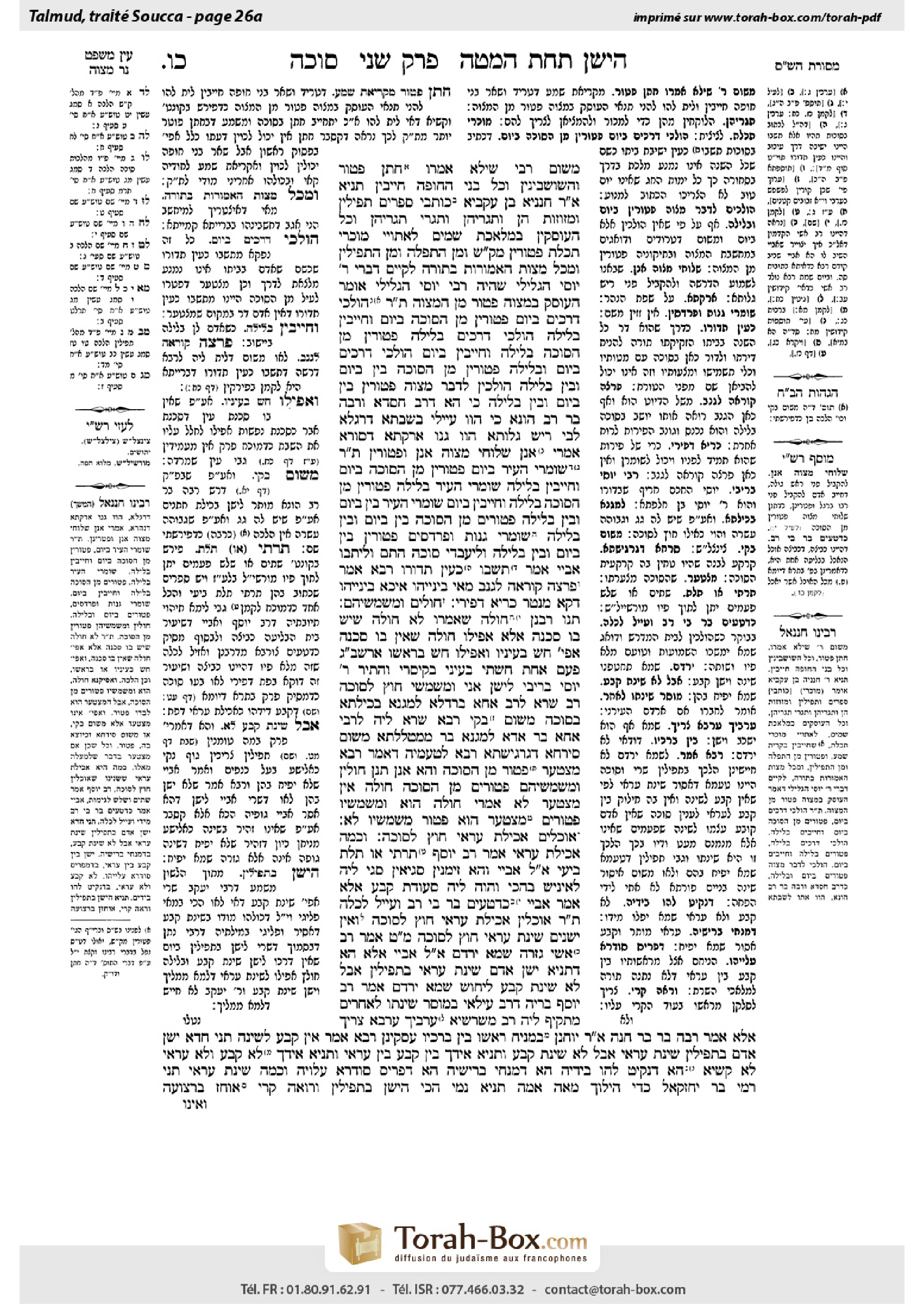
Sukkah 26a: Talmud study for Daf Yomi
Daf Yomi is the daily study of one Talmud folio. Explore 37 tractates with scans, Hebrew text, Sefaria English and AI-generated French translations where annotated.
Passage selection and English or AI-generated French translation are available where the scan has annotations. Daf Study is independent of Torah-Box and Sefaria.
Browse Sukkah · סוכה · All tractatesSukkah 26a text and translations
This page of Sukkah includes the Aramaic text, an English translation and an AI-generated French translation, alongside the scan above.
סוכה כ״ו א · Aramaic and Hebrew text
מִשּׁוּם רַבִּי שֵׁילָא אָמְרוּ: חָתָן פָּטוּר, וְהַשּׁוֹשְׁבִינִין וְכׇל בְּנֵי הַחוּפָּה חַיָּיבִין.
תַּנְיָא, אָמַר רַבִּי חֲנַנְיָא בֶּן עֲקַבְיָא: כּוֹתְבֵי סְפָרִים תְּפִילִּין וּמְזוּזוֹת, הֵן וְתַגָּרֵיהֶן וְתַגָּרֵי תַגָּרֵיהֶן וְכׇל הָעוֹסְקִין בִּמְלֶאכֶת שָׁמַיִם, לְאֵתוֹיֵי מוֹכְרֵי תְכֵלֶת — פְּטוּרִין מִקְּרִיאַת שְׁמַע וּמִן הַתְּפִלָּה וּמִן הַתְּפִילִּין וּמִכׇּל מִצְוֹת הָאֲמוּרוֹת בַּתּוֹרָה, לְקַיֵּים דִּבְרֵי רַבִּי יוֹסֵי הַגְּלִילִי, שֶׁהָיָה רַבִּי יוֹסֵי הַגְּלִילִי אוֹמֵר: הָעוֹסֵק בְּמִצְוָה פָּטוּר מִן הַמִּצְוָה.
תָּנוּ רַבָּנַן: הוֹלְכֵי דְרָכִים בַּיּוֹם — פְּטוּרִין מִן הַסּוּכָּה בַּיּוֹם, וְחַיָּיבִין בַּלַּיְלָה. הוֹלְכֵי דְרָכִים בַּלַּיְלָה — פְּטוּרִין מִן הַסּוּכָּה בַּלַּיְלָה וְחַיָּיבִין בַּיּוֹם. הוֹלְכֵי דְרָכִים בַּיּוֹם וּבַלַּיְלָה — פְּטוּרִין מִן הַסּוּכָּה בֵּין בַּיּוֹם וּבֵין בַּלַּיְלָה. הוֹלְכִין לִדְבַר מִצְוָה — פְּטוּרִין בֵּין בַּיּוֹם וּבֵין בַּלַּיְלָה. כִּי הָא דְּרַב חִסְדָּא וְרַבָּה בַּר רַב הוּנָא כִּי הֲווֹ עָיְילִי בְּשַׁבְּתָא דְרִגְלָא לְבֵי רֵישׁ גָּלוּתָא, הֲווֹ גָּנוּ אַרַקְתָּא דְסוּרָא, אָמְרִי: אֲנַן שְׁלוּחֵי מִצְוָה אֲנַן וּפְטוּרִין.
תָּנוּ רַבָּנַן: שׁוֹמְרֵי הָעִיר בַּיּוֹם — פְּטוּרִין מִן הַסּוּכָּה בַּיּוֹם, וְחַיָּיבִין בַּלַּיְלָה. שׁוֹמְרֵי הָעִיר בַּלַּיְלָה — פְּטוּרִין מִן הַסּוּכָּה בַּלַּיְלָה, וְחַיָּיבִין בַּיּוֹם. שׁוֹמְרֵי הָעִיר בֵּין בַּיּוֹם וּבֵין בַּלַּיְלָה — פְּטוּרִים מִן הַסּוּכָּה בֵּין בַּיּוֹם וּבֵין בַּלַּיְלָה.
שׁוֹמְרֵי גַנּוֹת וּפַרְדֵּסִים — פְּטוּרִין בֵּין בַּיּוֹם וּבֵין בַּלַּיְלָה. וְלִיעְבְּדוּ סוּכָּה הָתָם וְלִיתְּבוּ? אַבָּיֵי אָמַר: ״תֵּשְׁבוּ״ — כְּעֵין תָּדוּרוּ.
רָבָא אָמַר: פִּרְצָה קוֹרְאָה לַגַּנָּב. מַאי בֵּינַיְיהוּ? אִיכָּא בֵּינַיְיהוּ דְּקָא מְנַטַּר כַּרְיָא דְפֵירֵי.
חוֹלִים וּמְשַׁמְּשֵׁיהֶם. תָּנוּ רַבָּנַן: חוֹלֶה שֶׁאָמְרוּ, לֹא חוֹלֶה שֶׁיֵּשׁ בּוֹ סַכָּנָה, אֶלָּא אֲפִילּוּ חוֹלֶה שֶׁאֵין בּוֹ סַכָּנָה. אֲפִילּוּ חָשׁ בְּעֵינָיו, וַאֲפִילּוּ חָשׁ בְּרֹאשׁוֹ. אָמַר רַבָּן שִׁמְעוֹן בֶּן גַּמְלִיאֵל: פַּעַם אַחַת חַשְׁתִּי בְּעֵינֵי בְּקֵיסָרִי, וְהִתִּיר רַבִּי יוֹסֵי בְּרִיבִּי לִישַׁן אֲנִי וּמְשַׁמְּשַׁי חוּץ לַסּוּכָּה.
רַב שְׁרָא לְרַב אַחָא בַּרְדְּלָא לְמִגְנֵא בְּכִילְּתָא בַּסּוּכָּה — מִשּׁוּם בָּקֵי. רָבָא שְׁרָא לֵיהּ לְרַבִּי אַחָא בַּר אַדָּא לְמִגְנֵא בַּר מִמְּטַלַּלְתָּא — מִשּׁוּם סִירְחָא דְגַרְגִּישְׁתָּא.
רָבָא לְטַעְמֵיהּ, דְּאָמַר רָבָא: מִצְטַעֵר — פָּטוּר מִן הַסּוּכָּה. וְהָא אֲנַן תְּנַן: חוֹלִין וּמְשַׁמְּשֵׁיהֶם פְּטוּרִים מִן הַסּוּכָּה. חוֹלֶה אִין, מִצְטַעַר לָא! אָמְרִי: חוֹלֶה — הוּא וּמְשַׁמְּשָׁיו פְּטוּרִים, מִצְטַעֵר — הוּא פָּטוּר, מְשַׁמְּשָׁיו לָא.
אוֹכְלִים אֲכִילַת עֲרַאי חוּץ לַסּוּכָּה. וְכַמָּה אֲכִילַת עֲרַאי? אָמַר רַב יוֹסֵף: תַּרְתֵּי אוֹ תְּלָת בֵּיעֵי. אֲמַר לֵיהּ אַבָּיֵי: וְהָא זִימְנִין סַגִּיאִין סַגִּי לֵיהּ לְאִינִישׁ בְּהָכִי, וְהָוֵה לֵיהּ סְעוּדַת קֶבַע! אֶלָּא אָמַר אַבָּיֵי: כִּדְטָעֵים בַּר בֵּי רַב וְעָיֵיל לְכַלָּה.
תָּנוּ רַבָּנַן: אוֹכְלִין אֲכִילַת עֲרַאי חוּץ לַסּוּכָּה, וְאֵין יְשֵׁנִים שֵׁינַת עֲרַאי חוּץ לַסּוּכָּה. מַאי טַעְמָא? אָמַר רַב אָשֵׁי: גְּזֵרָה שֶׁמָּא יֵרָדֵם.
אֲמַר לֵיהּ אַבָּיֵי, אֶלָּא הָא דְּתַנְיָא: יָשֵׁן אָדָם שֵׁינַת עֲרַאי בִּתְפִילִּין, אֲבָל לֹא שֵׁינַת קֶבַע, לֵיחוּשׁ שֶׁמָּא יֵרָדֵם! אָמַר רַב יוֹסֵף בְּרֵיהּ דְּרַב עִילַּאי: בְּמוֹסֵר שְׁנָתוֹ לַאֲחֵרִים.
מַתְקֵיף לֵיהּ רַב מְשַׁרְשְׁיָא: עָרְבָיךְ עָרְבָא צְרִיךְ! אֶלָּא אָמַר רַבָּה בַּר בַּר חָנָה אָמַר רַבִּי יוֹחָנָן: בְּמַנִּיחַ רֹאשׁוֹ בֵּין בִּרְכָּיו עָסְקִינַן. רָבָא אָמַר: אֵין קֶבַע לַשֵּׁינָה.
תָּנֵי חֲדָא: יָשֵׁן אָדָם בִּתְפִילִּין שֵׁינַת עֲרַאי אֲבָל לֹא שֵׁינַת קֶבַע, וְתַנְיָא אִידַּךְ: בֵּין קֶבַע בֵּין עֲרַאי. וְתַנְיָא אִידַּךְ: לֹא קֶבַע וְלֹא עֲרַאי. לָא קַשְׁיָא: הָא — דְּנָקֵיט לְהוּ בִּידֵיהּ. הָא — דְּמַנְּחִי בְּרֵישֵׁיהּ. הָא — דְּפָרֵיס סוּדָרָא עִלָּוֵיהּ.
וְכַמָּה שֵׁינַת עֲרַאי? תָּנֵי רָמֵי בַּר יְחֶזְקֵאל: כְּדֵי הִילּוּךְ מֵאָה אַמָּה. תַּנְיָא נָמֵי הָכִי: הַיָּשֵׁן בִּתְפִילִּין וְרוֹאֶה קֶרִי — אוֹחֵז בָּרְצוּעָה
Sukkah 26a · English translation
In the name of Rabbi Sheila they said: A groom is exempt from the mitzva of Shema, but the groomsmen and all the members of the wedding party are obligated.
§ It is taught in a baraita: Rabbi Ḥananya ben Akavya said: With regard to scribes of Torah scrolls, phylacteries, and mezuzot, they themselves, and the merchants who sell them, and the merchants who purchase them from the first merchants and sell them to others, and all who are engaged in the labor of Heaven, which comes to include the sellers of the sky-blue dye for ritual fringes, are all exempt from the mitzva of reciting Shema and from prayer and from donning phylacteries and from all mitzvot that are mentioned in the Torah while they are engaged in that labor. This statement comes to fulfill the statement of Rabbi Yosei HaGelili, as Rabbi Yosei HaGelili would say: One who is engaged in a mitzva is exempt from another mitzva.
The Sages taught in a baraita: Travelers who travel during the day are exempt from the mitzva of sukka during the day and are obligated at night. Travelers by night are exempt from the mitzva of sukka at night and obligated during the day. Travelers both during the day and at night are exempt from the mitzva of sukka both during the day and at night. Those who travel for a matter of mitzva are exempt both during the day and at night, because they are preoccupied with the mitzva, even if they are not traveling at night, as in this recurring incident involving Rav Ḥisda and Rabba bar Rav Huna. The Gemara relates: When they would enter the house of the Exilarch on the Shabbat of the Festival to hear his Festival homily, they would sleep on the bank of the Sura River and not in a sukka. They said in explanation: We are ones on the path to perform a mitzva and are exempt from the mitzva of sukka.
The Sages taught in a baraita: Guardians of the city who guard during the day are exempt from the mitzva of sukka during the day and are obligated at night. Guardians of the city at night are exempt from the mitzva of sukka at night and are obligated during the day. Those who guard the city both during the day and at night are exempt from the mitzva of sukka both during the day and at night.
Guardians of gardens and orchards are exempt from sukka both during the day and at night. The Gemara asks: And let them establish a sukka there in the garden and reside there. Why are they exempt from the mitzva of sukka? Abaye said: The reason for the exemption is the verse: “In sukkot shall you reside” (Leviticus 23:42), which the Sages interpreted to mean: Reside as you dwell in your permanent home. Since preparing a sukka that is a fully equipped dwelling in the orchard far from his house would involve considerable exertion, the mitzva does not apply to him.
Rava said: A breach summons the thief. If the guardian builds a sukka, thieves will know where the guardian is located in the field and they will enter the field elsewhere. The exemption of the watchman from the mitzva of sukka prevents that situation. The Gemara asks: What is the practical difference between the two reasons given? The Gemara answers: There is a difference between them in a case where he is guarding a pile of fruit, which can be guarded from inside the sukka; therefore, according to Rava, in that case the guard would be obligated in the mitzva of sukka. However, since the sukka in the orchard is not like a fully equipped home, in Abaye’s opinion he would still be exempt in that case.
§ It is stated in the mishna: The ill and their caretakers are exempt from the mitzva of sukka. The Sages taught in a baraita: The ill person that they said is exempt from sukka is not only an ill person whose condition is critical, but even an ill person whose condition is not critical, and even one who feels pain in his eyes, and even one who feels pain in his head. Rabban Shimon ben Gamliel said: One time I felt pain in my eyes in Caesarea, and the esteemed Rabbi Yosei ben Ḥalafta permitted me and my attendant to sleep outside the sukka.
The Gemara relates a similar tale: Rav permitted Rav Aḥa Bardela to sleep beneath a canopy in the sukka due to the biting flies [baki]. He permitted this although the canopy was more than ten handbreadths high and in sleeping beneath it he did not fulfill his obligation. Rava permitted Rabbi Aḥa bar Adda to sleep outside the sukka due to the foul odor of the earth [gargishta] floor of the sukka.
The Gemara comments: Rava conforms to his line of reasoning, as Rava said: One who suffers in the sukka is exempt from the mitzva of sukka. The Gemara asks: But didn’t we learn in the mishna that the ill and their caretakers are exempt from the mitzva of sukka? By inference, with regard to an ill person, yes, he is exempt; with regard to one who suffers, no, he is not exempt. The Sages say: With regard to an ill person, he and his caretakers are exempt; however, with regard to one who merely suffers in the sukka, he is exempt but his caretakers are not.
§ The mishna continues: One may eat and drink in the framework of a casual meal outside the sukka. The Gemara asks: And how much food is considered a casual meal? Rav Yosef said: It is two or three egg-bulks of bread. Abaye said to him: But often, doesn’t a person suffice with that measure of food, and then its legal status is that of a formal meal? Rather, Abaye said: A casual meal is like the measure that a student of the academy of Rav tastes and then enters the study hall to hear the lecture.
The Sages taught in a baraita: One may eat a casual meal outside the sukka, but one may not take even a brief nap outside the sukka. The Gemara asks: What is the reason for this distinction? After all, sleeping in the sukka is an obligation just as eating in the sukka is an obligation. Rav Ashi said: It is prohibited to nap outside the sukka due to a decree lest he fall into a deep sleep.
Abaye said to him: But with regard to that halakha which is taught in a baraita: A person may take a brief nap while donning phylacteries but substantial sleep is not permitted. Let us be concerned in that case as well lest he fall into a deep sleep. Rav Yosef, son of Rav Illai, said: There is no concern with regard to phylacteries, as it is a case where one assigns responsibility for ensuring that his sleep will not be prolonged to others.
Rav Mesharshiyya strongly objects to Abaye’s statement: Your guarantor, who ensures that you do not sleep too long, requires a guarantor to ensure that he does not do the same. Rather, Rabba bar bar Ḥana said that Rabbi Yoḥanan said: We are dealing with a case where he places his head between his knees, a position that does not lend itself to deep sleep. Rava said: Neither with regard to sukka nor with regard to phylacteries is there concern lest he fall into a deep sleep. Taking a brief nap outside the sukka is prohibited because there is no concept of substantial duration with regard to sleep, i.e., there is no halakhic difference between a brief nap and a longer-lasting sleep. Depending on circumstances, sleep of any duration can be considered substantial and is therefore prohibited outside a sukka.
The Gemara comments that it is taught in one baraita: A person may take a brief nap with phylacteries, but substantial sleep is not permitted. And it was taught in another baraita: Both substantial sleep and a brief nap are permitted. And it was taught in another baraita: Neither substantial sleep nor a brief nap is permitted. The Gemara explains that this is not difficult: This baraita, where it is taught that even a brief nap is prohibited, is in a case where one holds the phylacteries in his hands. It is prohibited to sleep at all lest he drop them. That baraita, where it was taught that a brief nap is permitted, is in a case where the phylacteries are placed on his head. There is no concern during a brief nap lest he break wind or experience a seminal emission. During deep sleep, that is a concern. That third baraita, where it was taught that even substantial sleep is permitted with phylacteries, is in a case where he removes the phylacteries and spreads a cloth over them and sleeps alongside them.
The Gemara asks: And how much is the duration of a brief nap? Rami bar Yeḥezkel taught: It is equivalent to the time required for walking one hundred cubits. The Gemara comments: That is also taught in a baraita: One who sleeps with phylacteries and experiences a seminal emission grips the strap of the phylacteries to remove them
Sukkah 26a · Traduction française (IA)
Au nom de Rabbi Sheila, ils ont dit : Un marié est exempté de la mitsva du Chéma, mais les garçons d’honneur et tous les membres du cortège nuptial en sont tenus.
§ Il est enseigné dans une baraïta : Rabbi Ḥananya ben Akavya a dit : Les scribes de rouleaux de Torah, de téfilines et de mezouzot, les marchands qui les vendent, ceux qui les achètent aux premiers marchands pour les revendre à d’autres, ainsi que tous ceux qui se consacrent à l’œuvre du Ciel — ce qui inclut les vendeurs de teḥélet pour les franges rituelles — sont tous exemptés de la mitsva de réciter le Chéma, de la prière, du port des téfilines et de toutes les mitsvot mentionnées dans la Torah tant qu’ils se consacrent à cette tâche. Cette déclaration vient confirmer celle de Rabbi Yosei HaGelili, qui disait : Celui qui est occupé à accomplir une mitsva est exempté d’une autre mitsva.
Les Sages ont enseigné dans une baraïta : Les voyageurs qui se déplacent pendant la journée sont exemptés de la mitsva de la soukka le jour et en sont tenus la nuit. Ceux qui voyagent la nuit sont exemptés de la mitsva de la soukka la nuit et en sont tenus le jour. Ceux qui voyagent aussi bien le jour que la nuit sont exemptés de la mitsva de la soukka aussi bien le jour que la nuit. Ceux qui voyagent pour accomplir une mitsva en sont exemptés aussi bien le jour que la nuit, car ils sont absorbés par cette mitsva, même s’ils ne voyagent pas la nuit, comme le montre cet épisode récurrent concernant Rav Ḥisda et Rabba bar Rav Huna. La Guemara rapporte : Lorsqu’ils se rendaient chez l’Exilarque, le Chabbat de la fête, pour écouter son enseignement sur la fête, ils dormaient sur la rive du fleuve Soura et non dans une soukka. Ils expliquaient : Nous sommes en route pour accomplir une mitsva et sommes exemptés de la mitsva de la soukka.
Les Sages ont enseigné dans une baraïta : Les gardiens de la ville qui montent la garde le jour sont exemptés de la mitsva de la soukka le jour et en sont tenus la nuit. Les gardiens de la ville qui montent la garde la nuit sont exemptés de la mitsva de la soukka la nuit et en sont tenus le jour. Ceux qui gardent la ville aussi bien le jour que la nuit sont exemptés de la mitsva de la soukka aussi bien le jour que la nuit.
Les gardiens des jardins et des vergers sont exemptés de la soukka aussi bien le jour que la nuit. La Guemara demande : Qu’ils y construisent donc une soukka et y résident ! Pourquoi sont-ils exemptés de la mitsva de la soukka ? Abaye a dit : Cette exemption repose sur le verset : « Vous résiderez dans des soukkot » (Lévitique 23:42), que les Sages ont interprété ainsi : Résidez comme vous habitez votre demeure permanente. Puisque préparer dans le verger, loin de sa maison, une soukka aménagée comme une véritable habitation demanderait un effort considérable, la mitsva ne s’applique pas à lui.
Rava a dit : Une brèche attire le voleur. Si le gardien construit une soukka, les voleurs sauront où il se trouve dans le champ et entreront dans le champ par un autre endroit. L’exemption du gardien de la mitsva de la soukka évite cette situation. La Guemara demande : Quelle est la différence pratique entre les deux raisons avancées ? La Guemara répond : La différence concerne le cas où il garde un tas de fruits, que l’on peut surveiller depuis l’intérieur de la soukka. Selon Rava, dans ce cas, le gardien serait donc tenu d’accomplir la mitsva de la soukka. En revanche, puisque la soukka du verger n’est pas aménagée comme une véritable habitation, selon l’opinion d’Abaye, il resterait exempté dans ce cas.
§ La Michna enseigne : Les malades et ceux qui s’occupent d’eux sont exemptés de la mitsva de la soukka. Les Sages ont enseigné dans une baraïta : Le malade dont on a dit qu’il est exempté de la soukka n’est pas seulement celui dont l’état est critique, mais aussi celui dont l’état ne l’est pas, et même quelqu’un qui a mal aux yeux ou à la tête. Rabban Shimon ben Gamliel a dit : Une fois, j’ai eu mal aux yeux à Césarée, et le vénérable Rabbi Yosei ben Ḥalafta a permis à mon accompagnateur et à moi de dormir hors de la soukka.
La Guemara rapporte un épisode semblable : Rav a permis à Rav Aḥa Bardela de dormir sous un dais dans la soukka à cause des mouches piqueuses [baki]. Il le lui a permis bien que le dais fût à plus de dix palmes de hauteur, de sorte qu’en dormant dessous, il ne s’acquittait pas de son obligation. Rava a permis à Rabbi Aḥa bar Adda de dormir hors de la soukka à cause de la mauvaise odeur du sol en terre [gargishta] de la soukka.
La Guemara fait remarquer : Rava est cohérent avec son raisonnement, car il a dit : Celui qui souffre dans la soukka est exempté de la mitsva de la soukka. La Guemara demande : N’avons-nous pas appris dans la Michna que les malades et ceux qui s’occupent d’eux sont exemptés de la mitsva de la soukka ? On en déduit que le malade, oui, en est exempté ; mais celui qui souffre, non, il n’en est pas exempté. Les Sages répondent : Le malade et ceux qui s’occupent de lui sont exemptés ; en revanche, celui qui souffre simplement dans la soukka en est exempté, mais ceux qui s’occupent de lui ne le sont pas.
§ La Michna poursuit : On peut manger et boire un repas occasionnel hors de la soukka. La Guemara demande : Quelle quantité constitue un repas occasionnel ? Rav Yosef a dit : Deux ou trois volumes d’œuf de pain. Abaye lui a dit : Mais souvent, une personne se contente de cette quantité de nourriture ; dans ce cas, il s’agit alors d’un repas formel. Abaye a plutôt dit : Un repas occasionnel correspond à la quantité que goûte un étudiant de l’académie de Rav avant d’entrer dans la salle d’étude pour écouter le cours.
Les Sages ont enseigné dans une baraïta : On peut prendre un repas occasionnel hors de la soukka, mais on ne peut même pas y faire une courte sieste. La Guemara demande : Quelle est la raison de cette distinction ? Après tout, dormir dans la soukka est une obligation au même titre que manger dans la soukka. Rav Ashi a dit : Il est interdit de faire une sieste hors de la soukka par décret, de crainte que l’on ne tombe dans un sommeil profond.
Abaye lui a dit : Mais concernant cette halakha enseignée dans une baraïta : On peut faire une courte sieste en portant les téfilines, mais un sommeil prolongé n’est pas permis. Ne devrait-on pas aussi craindre, dans ce cas, que l’on tombe dans un sommeil profond ? Rav Yosef, fils de Rav Illai, a dit : Il n’y a pas lieu de s’inquiéter au sujet des téfilines, car c’est un cas où l’on confie à d’autres la responsabilité de veiller à ce que son sommeil ne se prolonge pas.
Rav Mesharshiyya s’oppose vivement à la déclaration d’Abaye : Celui qui se porte garant pour veiller à ce que tu ne dormes pas trop longtemps a lui-même besoin d’un garant pour veiller à ce qu’il ne fasse pas de même. Rabba bar bar Ḥana a plutôt dit au nom de Rabbi Yoḥanan : Il s’agit d’un cas où l’on place la tête entre les genoux, position qui ne favorise pas un sommeil profond. Rava a dit : Ni pour la soukka ni pour les téfilines, il n’y a lieu de craindre que l’on tombe dans un sommeil profond. La courte sieste hors de la soukka est interdite parce qu’il n’existe pas de durée minimale déterminée pour le sommeil, c’est-à-dire qu’il n’y a pas, du point de vue halakhique, de différence entre une courte sieste et un sommeil plus long. Selon les circonstances, un sommeil de n’importe quelle durée peut être considéré comme substantiel et est donc interdit hors de la soukka.
La Guemara fait remarquer qu’une baraïta enseigne : On peut faire une courte sieste avec les téfilines, mais un sommeil prolongé n’est pas permis. Une autre baraïta enseigne : Le sommeil prolongé comme la courte sieste sont permis. Une autre baraïta encore enseigne : Ni le sommeil prolongé ni la courte sieste ne sont permis. La Guemara explique qu’il n’y a pas de contradiction : La baraïta qui enseigne que même une courte sieste est interdite concerne le cas où l’on tient les téfilines dans ses mains. Il est interdit de dormir, même brièvement, de crainte qu’on ne les laisse tomber. La baraïta qui enseigne qu’une courte sieste est permise concerne le cas où les téfilines sont posées sur sa tête. Pendant une courte sieste, on ne craint pas qu’il émette des gaz ou qu’il ait une émission séminale. Pendant un sommeil profond, cette crainte existe. La troisième baraïta, qui enseigne que même un sommeil prolongé est permis avec les téfilines, concerne le cas où il retire les téfilines, les recouvre d’un tissu et dort à côté d’elles.
La Guemara demande : Quelle est la durée d’une courte sieste ? Rami bar Yeḥezkel a enseigné : Elle équivaut au temps nécessaire pour parcourir cent coudées. La Guemara fait remarquer : Cela est également enseigné dans une baraïta : Celui qui dort avec les téfilines et a une émission séminale saisit la lanière des téfilines pour les retirer.
Traduction française générée par IA à partir de l’édition anglaise de Sefaria. Vérifie toujours un passage avec le texte source.
Text from Sefaria: William Davidson Edition - Vocalized Aramaic (CC BY NC); William Davidson Edition - English (CC BY NC).