Sukkah 26b: Talmud study for Daf Yomi
Daf Yomi is the daily study of one Talmud folio. Explore 37 tractates with scans, Hebrew text, Sefaria English and AI-generated French translations where annotated.
Passage selection and English or AI-generated French translation are available where the scan has annotations. Daf Study is independent of Torah-Box and Sefaria.
Browse Sukkah · סוכה · All tractatesSukkah 26b text and translations
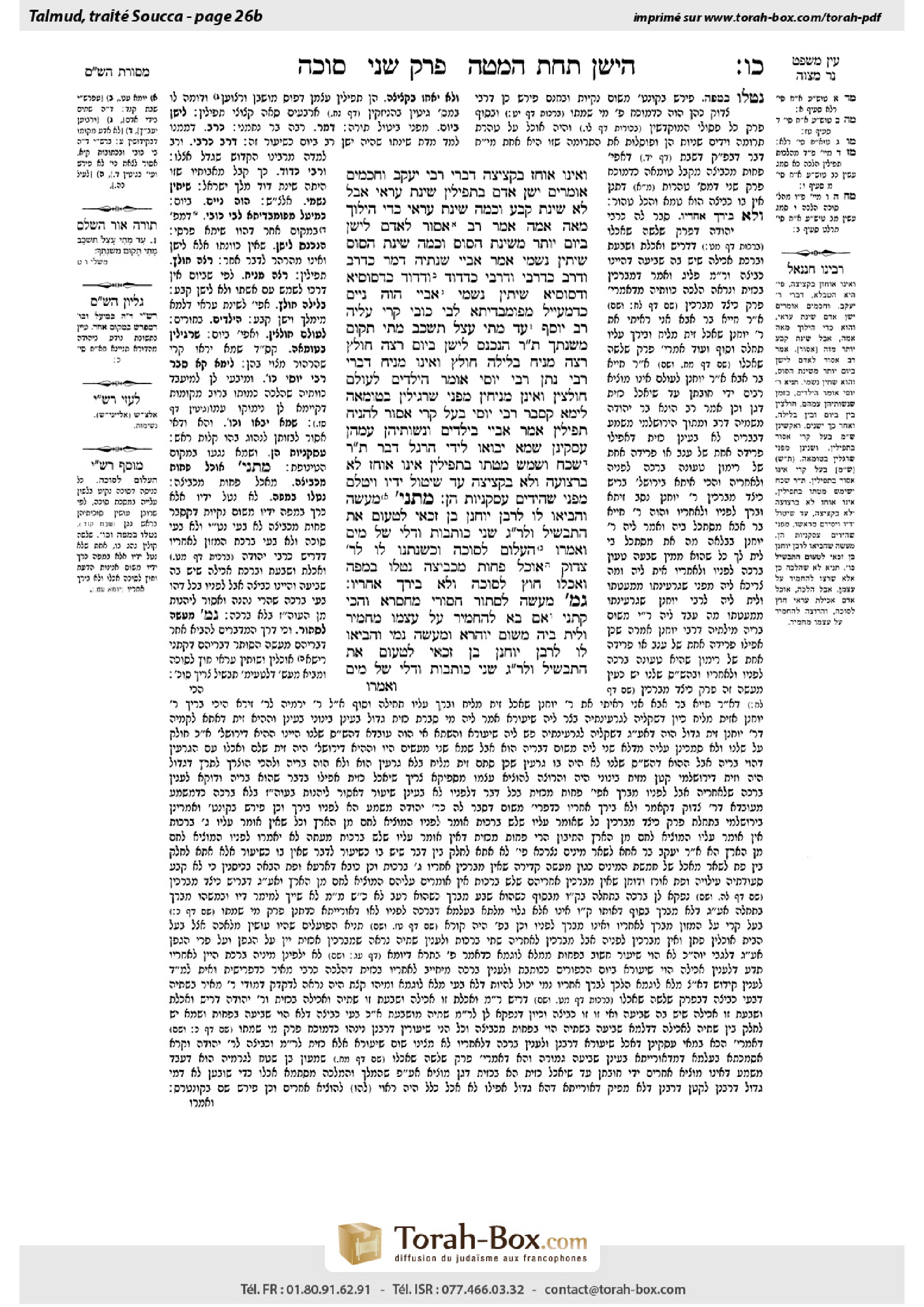
This page of Sukkah includes the Aramaic text, an English translation and an AI-generated French translation, alongside the scan above.
סוכה כ״ו ב · Aramaic and Hebrew text
וְאֵינוֹ אוֹחֵז בַּקְּצִיצָה, דִּבְרֵי רַבִּי יַעֲקֹב. וַחֲכָמִים אוֹמְרִים: יָשֵׁן אָדָם בִּתְפִילִּין שֵׁינַת עֲרַאי, אֲבָל לֹא שֵׁינַת קֶבַע. וְכַמָּה שֵׁינַת עֲרַאי — כְּדֵי הִילּוּךְ מֵאָה אַמָּה.
אָמַר רַב: אָסוּר לָאָדָם לִישַׁן בַּיּוֹם יוֹתֵר מִשֵּׁינַת הַסּוּס. וְכַמָּה שֵׁינַת הַסּוּס — שִׁיתִּין נִשְׁמֵי.
אָמַר אַבָּיֵי: שִׁנְתֵּיהּ דְּמָר כִּדְרַב, וּדְרַב כִּדְרַבִּי, וּדְרַבִּי כִּדְדָוִד, וּדְדָוִד כִּדְסוּסְיָא, וּדְסוּסְיָא שִׁיתִּין נִשְׁמֵי.
אַבָּיֵי הֲוָה נָיֵים כְּדִמְעַיֵּיל מִפּוּמְבְּדִיתָא לְבֵי כוּבֵּי. קָרֵי עֲלֵיהּ רַב יוֹסֵף: ״עַד מָתַי עָצֵל תִּשְׁכָּב מָתַי תָּקוּם מִשְּׁנָתֶךָ״.
תָּנוּ רַבָּנַן: הַנִּכְנָס לִישַׁן בַּיּוֹם, רָצָה — חוֹלֵץ, רָצָה — מַנִּיחַ. בַּלַּיְלָה — חוֹלֵץ וְאֵינוֹ מַנִּיחַ, דִּבְרֵי רַבִּי נָתָן. רַבִּי יוֹסֵי אוֹמֵר: הַיְּלָדִים, לְעוֹלָם חוֹלְצִין וְאֵינָן מַנִּיחִין, מִפְּנֵי שֶׁרְגִילִין בְּטוּמְאָה.
לֵימָא קָסָבַר רַבִּי יוֹסֵי בַּעַל קֶרִי אָסוּר לְהַנִּיחַ תְּפִילִּין? אָמַר אַבָּיֵי: בִּילָדִים וּנְשׁוֹתֵיהֶן עִמָּהֶן עָסְקִינַן, שֶׁמָּא יָבוֹאוּ לִידֵי הֶרְגֵּל דָּבָר.
תָּנוּ רַבָּנַן: שָׁכַח וְשִׁמֵּשׁ מִטָּתוֹ בִּתְפִילִּין — אֵינוֹ אוֹחֵז לֹא בָּרְצוּעָה וְלֹא בַּקְּצִיצָה עַד שֶׁיִּטּוֹל יָדָיו וְיִטְּלֵם, מִפְּנֵי שֶׁהַיָּדַיִם עַסְקָנִיּוֹת הֵן.
מַתְנִי׳ מַעֲשֶׂה וְהֵבִיאוּ לוֹ לְרַבָּן יוֹחָנָן בֶּן זַכַּאי לִטְעוֹם אֶת הַתַּבְשִׁיל, וּלְרַבָּן גַּמְלִיאֵל שְׁנֵי כּוֹתָבוֹת וּדְלִי שֶׁל מַיִם. וְאָמְרוּ: הַעֲלוּם לַסּוּכָּה.
וּכְשֶׁנָּתְנוּ לוֹ לְרַבִּי צָדוֹק אוֹכֶל פָּחוֹת מִכְּבֵיצָה, נְטָלוֹ בַּמַּפָּה, וַאֲכָלוֹ חוּץ לַסּוּכָּה, וְלֹא בֵּירַךְ אַחֲרָיו.
גְּמָ׳ מַעֲשֶׂה לִסְתּוֹר?! חַסּוֹרֵי מְחַסְּרָא וְהָכִי קָתָנֵי: אִם בָּא לְהַחְמִיר עַל עַצְמוֹ — מַחְמִיר, וְלֵית בֵּיהּ מִשּׁוּם יוּהֲרָא. וּמַעֲשֶׂה נָמֵי וְהֵבִיאוּ לוֹ לְרַבָּן יוֹחָנָן בֶּן זַכַּאי לִטְעוֹם אֶת הַתַּבְשִׁיל, וּלְרַבָּן גַּמְלִיאֵל שְׁתֵּי כוֹתָבוֹת וּדְלִי שֶׁל מַיִם,
Sukkah 26b · English translation
and does not grip the box of the phylacteries, which he may not touch while impure. This is the statement of Rabbi Ya’akov. And the Rabbis say: A person may take a brief nap with his phylacteries, but substantial sleep is not permitted, and he will thereby avoid a seminal emission while donning phylacteries. And how long is the duration of a brief nap? It is equivalent to the time required for walking one hundred cubits.
Apropos the duration of a brief nap, the Gemara cites that Rav said: It is prohibited for a person to sleep during the day longer than the duration of the sleep of a horse. One who sleeps for longer is derelict in the study of Torah. And how long is the duration of the sleep of a horse? It is sixty breaths long.
Abaye said: The sleep of the Master, Rabba, is like that of Rav, and that of Rav is like the sleep of Rabbi Yehuda HaNasi. And that of Rabbi Yehuda HaNasi is like that of King David, and that of King David is like that of a horse. And that of a horse is sixty breaths.
The Gemara relates: Abaye would sleep during the day for a period equivalent to the time it takes to enter from Pumbedita to Bei Kuvei. Rav Yosef read the following verse as pertaining to Abaye: “How long will you sleep, sluggard? When will you arise from your sleep?” (Proverbs 6:9). Rav Yosef considered this dereliction in the study of Torah.
The Sages taught in a baraita: With regard to one who enters his bed to sleep during the day, if he wishes, he may remove his phylacteries, and if he wishes, he may leave them in place. One who enters to sleep at night removes his phylacteries and may not leave them in place. This is the statement of Rabbi Natan. Rabbi Yosei says: The young men must always remove them and not leave them in place while sleeping because they are accustomed to impurity, as they are more likely to experience a seminal emission.
The Gemara asks: Let us say that Rabbi Yosei holds that it is prohibited for one who experienced a seminal emission to don phylacteries. Abaye said: This is not so; rather, we are dealing with young men whose wives are with them, and the concern is lest they overlook the fact that they are donning phylacteries and inadvertently come to engage in matters to which they are accustomed, i.e., relations with their wives, which is certainly demeaning to the phylacteries.
The Sages taught in a baraita: If one forgot that he was donning phylacteries and engaged in relations with his phylacteries in place, he may grip neither the strap nor the box until he washes his hands, and only then may he remove the phylacteries. This is because the hands are active and tend to inadvertently touch parts of the body that are unclean.
MISHNA: Apropos eating in the sukka, which is discussed in the previous mishna, this mishna relates: An incident occurred where they brought a cooked dish to Rabban Yoḥanan ben Zakkai for him to taste, and to Rabban Gamliel they brought two dates and a bucket of water. And they each said: Take them up to the sukka and we will eat them there.
In contrast, the mishna relates: And when they gave Rabbi Tzadok less than an egg-bulk of food, he took the food in a cloth for cleanliness; he did not wash his hands because in his opinion, one is not required to wash his hands before eating less than an egg-bulk. And he ate it outside the sukka and did not recite a blessing after eating it. He holds that one is not required to recite a blessing after eating less than an egg-bulk, as it is not satisfying, and it is written: “And you shall eat and be satisfied and bless the Lord your God” (Deuteronomy 8:10). The Gemara will explain the halakhic rationale for each of these actions described.
GEMARA: The Gemara wonders: Is the mishna citing an incident to contradict the halakha cited in the previous mishna that one may eat or drink in the context of a casual meal outside the sukka? The incident involving Rabban Yoḥanan ben Zakkai and Rabban Gamliel indicates that one may eat nothing outside the sukka. The Gemara answers: The mishna is incomplete, as it is lacking a significant element, and it teaches the following: If one seeks to impose a stringency upon himself and eat nothing outside the sukka, he may be stringent, and there is no element of presumptuousness in adopting that stringency. And there was also an incident supporting that ruling: They brought a cooked dish to Rabban Yoḥanan ben Zakkai for him to taste, and to Rabban Gamliel they brought two dates and a bucket of water,
Sukkah 26b · Traduction française (IA)
et ne saisit pas l’étui des téfilines, qu’il ne peut pas toucher lorsqu’il est impur. Telle est la position de Rabbi Ya’akov. Les Sages disent : On peut faire un bref somme avec ses téfilines, mais un sommeil prolongé est interdit ; cela permet d’éviter une émission séminale lorsque l’on porte les téfilines. Quelle est la durée d’un bref somme ? Elle équivaut au temps nécessaire pour parcourir cent coudées.
À propos de la durée d’un bref somme, la Guemara rapporte que Rav a dit : Il est interdit de dormir pendant la journée plus longtemps qu’un cheval. Celui qui dort davantage néglige l’étude de la Torah. Quelle est la durée du sommeil d’un cheval ? Elle est de soixante respirations.
Abayé a dit : Le sommeil de mon maître, Rabba, est comme celui de Rav, et celui de Rav est comme celui de Rabbi Yehouda HaNassi. Celui de Rabbi Yehouda HaNassi est comme celui du roi David, et celui du roi David est comme celui d’un cheval. Le sommeil d’un cheval dure soixante respirations.
La Guemara rapporte : Abayé dormait pendant la journée le temps qu’il fallait pour aller de Poumbedita à Bei Kouvei. Rav Yossef appliquait à Abayé le verset suivant : « Jusqu’à quand, paresseux, resteras-tu couché ? Quand te lèveras-tu de ton sommeil ? » (Proverbes 6,9). Rav Yossef considérait cela comme une négligence de l’étude de la Torah.
Les Sages ont enseigné dans une baraïta : Celui qui se couche pour dormir pendant la journée peut, s’il le souhaite, retirer ses téfilines ou les garder. Celui qui se couche pour dormir la nuit retire ses téfilines et ne peut pas les garder. Telle est la position de Rabbi Natan. Rabbi Yossi dit : Les jeunes hommes doivent toujours les retirer et ne pas les garder pendant leur sommeil, car ils sont sujets à l’impureté, étant plus susceptibles d’avoir une émission séminale.
La Guemara demande : Faut-il en conclure que, selon Rabbi Yossi, il est interdit à celui qui a eu une émission séminale de mettre les téfilines ? Abayé a dit : Ce n’est pas le cas ; il s’agit plutôt de jeunes hommes dont les épouses sont auprès d’eux. On craint qu’ils oublient qu’ils portent les téfilines et se livrent par inadvertance à ce dont ils ont l’habitude, c’est-à-dire à des relations avec leurs épouses, ce qui constitue assurément un manque de respect envers les téfilines.
Les Sages ont enseigné dans une baraïta : Si quelqu’un a oublié qu’il portait les téfilines et a eu des relations alors qu’elles étaient en place, il ne doit saisir ni les lanières ni les boîtiers avant de s’être lavé les mains ; alors seulement peut-il retirer les téfilines. En effet, les mains sont actives et ont tendance à toucher involontairement des parties du corps qui sont impures.
MICHNA : À propos du fait de manger dans la soukka, évoqué dans la Michna précédente, cette Michna rapporte : Un jour, on apporta un plat cuisiné à Rabban Yoḥanan ben Zakkaï pour qu’il y goûte, et l’on apporta à Rabban Gamliel deux dattes et un seau d’eau. Chacun d’eux dit : « Portez-les dans la soukka et nous les mangerons là-bas. »
À l’inverse, la Michna rapporte : Lorsqu’on donna à Rabbi Tsadok une quantité de nourriture inférieure au volume d’un œuf, il la prit dans un linge, par souci de propreté ; il ne se lava pas les mains, car selon lui, il n’est pas nécessaire de se laver les mains avant de manger moins que le volume d’un œuf. Il la mangea hors de la soukka et ne récita pas de bénédiction après l’avoir mangée. Il estimait qu’il n’est pas nécessaire de réciter une bénédiction après avoir mangé moins que le volume d’un œuf, puisque cela ne rassasie pas, et qu’il est écrit : « Tu mangeras, tu seras rassasié et tu béniras le Seigneur ton Dieu » (Deutéronome 8,10). La Guemara expliquera le fondement halakhique de chacun de ces actes rapportés.
GUEMARA : La Guemara s’interroge : La Michna cite-t-elle un épisode qui contredit la halakha énoncée dans la Michna précédente, selon laquelle on peut manger ou boire hors de la soukka dans le cadre d’un repas occasionnel ? L’épisode concernant Rabban Yoḥanan ben Zakkaï et Rabban Gamliel semble indiquer qu’on ne peut rien manger hors de la soukka. La Guemara répond : La Michna est incomplète, car il lui manque un élément important, et elle enseigne ceci : Si quelqu’un souhaite s’imposer une rigueur et ne rien manger hors de la soukka, il peut adopter cette rigueur, et il n’y a aucune présomption d’orgueil à le faire. Un épisode venait également appuyer cette règle : on apporta un plat cuisiné à Rabban Yoḥanan ben Zakkaï pour qu’il y goûte, et l’on apporta à Rabban Gamliel deux dattes et un seau d’eau,
Traduction française générée par IA à partir de l’édition anglaise de Sefaria. Vérifie toujours un passage avec le texte source.
Text from Sefaria: William Davidson Edition - Vocalized Aramaic (CC BY NC); William Davidson Edition - English (CC BY NC).