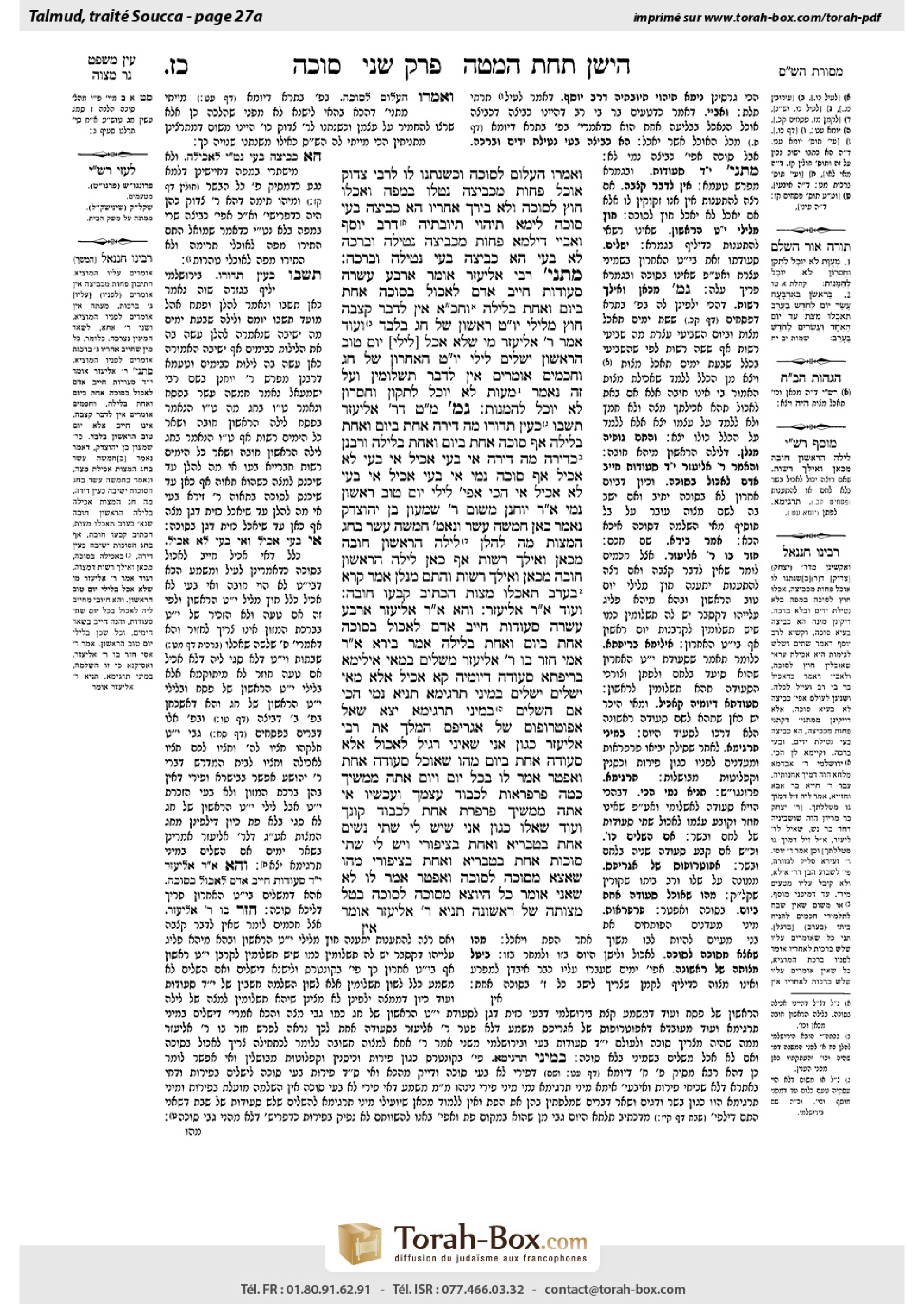
Sukkah 27a: Talmud study for Daf Yomi
Daf Yomi is the daily study of one Talmud folio. Explore 37 tractates with scans, Hebrew text, Sefaria English and AI-generated French translations where annotated.
Passage selection and English or AI-generated French translation are available where the scan has annotations. Daf Study is independent of Torah-Box and Sefaria.
Browse Sukkah · סוכה · All tractatesSukkah 27a text and translations
This page of Sukkah includes the Aramaic text, an English translation and an AI-generated French translation, alongside the scan above.
סוכה כ״ז א · Aramaic and Hebrew text
וְאָמְרוּ: הַעֲלוּם לַסּוּכָּה.
וּכְשֶׁנָּתְנוּ לוֹ לְרַבִּי צָדוֹק אוֹכֶל פָּחוֹת מִכְּבֵיצָה, נְטָלוֹ בְּמַפָּה וַאֲכָלוֹ חוּץ לַסּוּכָּה וְלֹא בֵּירַךְ אַחֲרָיו. הָא כְּבֵיצָה, בָּעֵי סוּכָּה. לֵימָא תֶּיהְוֵי תְּיוּבְתֵּיהּ דְּרַב יוֹסֵף וְאַבָּיֵי! דִּילְמָא פָּחוֹת מִכְּבֵיצָה נְטִילָה וּבְרָכָה לָא בָּעֵי, הָא כְּבֵיצָה בָּעֵי נְטִילָה וּבְרָכָה.
מַתְנִי׳ רַבִּי אֱלִיעֶזֶר אוֹמֵר: אַרְבַּע עֶשְׂרֵה סְעוּדוֹת חַיָּיב אָדָם לֶאֱכוֹל בַּסּוּכָּה, אַחַת בְּיוֹם וְאַחַת בַּלַּיְלָה. וַחֲכָמִים אוֹמְרִים: אֵין לַדָּבָר קִצְבָה, חוּץ מִלֵּילֵי יוֹם טוֹב רִאשׁוֹן שֶׁל חַג בִּלְבַד.
וְעוֹד אָמַר רַבִּי אֱלִיעֶזֶר: מִי שֶׁלֹּא אָכַל [לֵילֵי] יוֹם טוֹב הָרִאשׁוֹן — יַשְׁלִים לֵילֵי יוֹם טוֹב הָאַחֲרוֹן שֶׁל חַג. וַחֲכָמִים אוֹמְרִים: אֵין לַדָּבָר תַּשְׁלוּמִין, וְעַל זֶה נֶאֱמַר: ״מְעֻוָּת לֹא יוּכַל לִתְקוֹן וְחֶסְרוֹן לֹא יוּכַל לְהִמָּנוֹת״.
גְּמָ׳ מַאי טַעְמֵיהּ דְּרַבִּי אֱלִיעֶזֶר? ״תֵּשְׁבוּ״ כְּעֵין תָּדוּרוּ. מָה דִּירָה — אַחַת בַּיּוֹם וְאַחַת בַּלַּיְלָה, אַף סוּכָּה — אַחַת בְּיוֹם וְאַחַת בַּלַּיְלָה.
וְרַבָּנַן? כְּדִירָה. מָה דִּירָה — אִי בָּעֵי אָכֵיל אִי בָּעֵי לָא אָכֵיל, אַף סוּכָּה נָמֵי — אִי בָּעֵי אָכֵיל אִי בָּעֵי לָא אָכֵיל.
אִי הָכִי אֲפִילּוּ לֵילֵי יוֹם טוֹב רִאשׁוֹן נָמֵי!
אָמַר רַבִּי יוֹחָנָן מִשּׁוּם רַבִּי שִׁמְעוֹן בֶּן יְהוֹצָדָק: נֶאֱמַר כָּאן ״חֲמִשָּׁה עָשָׂר״, וְנֶאֱמַר ״חֲמִשָּׁה עָשָׂר״ בְּחַג הַמַּצּוֹת. מָה לְהַלָּן — לַיְלָה הָרִאשׁוֹן חוֹבָה, מִכָּאן וְאֵילָךְ רְשׁוּת, אַף כָּאן — לַיְלָה הָרִאשׁוֹן חוֹבָה, מִכָּאן וְאֵילָךְ רְשׁוּת.
וְהָתָם מְנָלַן? אָמַר קְרָא: ״בָּעֶרֶב תֹּאכְלוּ מַצּוֹת״, הַכָּתוּב קְבָעוֹ חוֹבָה.
וְעוֹד אָמַר רַבִּי אֱלִיעֶזֶר: וְהָא אָמַר רַבִּי אֱלִיעֶזֶר אַרְבַּע עֶשְׂרֵה סְעוּדוֹת חַיָּיב אָדָם לֶאֱכוֹל בַּסּוּכָּה, אַחַת בַּיּוֹם וְאַחַת בַּלַּיְלָה! אָמַר בֵּירָא אָמַר רַבִּי אַמֵּי: חָזַר בּוֹ רַבִּי אֱלִיעֶזֶר.
מַשְׁלִים בְּמַאי? אִילֵימָא בְּרִיפְתָּא, סְעוּדָה דְיוֹמֵיהּ קָא אָכֵיל. אֶלָּא, מַאי יַשְׁלִים — יַשְׁלִים בְּמִינֵי תַרְגִּימָא. תַּנְיָא נָמֵי הָכִי: אִם הִשְׁלִים בְּמִינֵי תַרְגִּימָא — יָצָא.
שָׁאַל אַפּוֹטְרוֹפּוֹס שֶׁל אַגְרִיפַּס הַמֶּלֶךְ אֶת רַבִּי אֱלִיעֶזֶר: כְּגוֹן אֲנִי, שֶׁאֵינִי רָגִיל לֶאֱכוֹל אֶלָּא סְעוּדָה אַחַת בַּיּוֹם, מַהוּ שֶׁאוֹכַל סְעוּדָה אַחַת וְאֶפָּטֵר? אָמַר לוֹ: בְּכׇל יוֹם וְיוֹם אַתָּה מַמְשִׁיךְ כַּמָּה פַּרְפְּרָאוֹת לִכְבוֹד עַצְמְךָ, וְעַכְשָׁיו אִי אַתָּה מַמְשִׁיךְ פַּרְפֶּרֶת אַחַת לִכְבוֹד קוֹנֶךָ?
וְעוֹד שְׁאָלוֹ: כְּגוֹן אֲנִי שֶׁיֵּשׁ לִי שְׁתֵּי נָשִׁים, אַחַת בִּטְבֶרְיָא וְאַחַת בְּצִיפּוֹרִי, וְיֵשׁ לִי שְׁתֵּי סוּכּוֹת אַחַת בִּטְבֶרְיָא וְאַחַת בְּצִיפּוֹרִי, מַהוּ שֶׁאֵצֵא מִסּוּכָּה לְסוּכָּה וְאֶפָּטֵר? אָמַר לוֹ: לֹא! שֶׁאֲנִי אוֹמֵר: כׇּל הַיּוֹצֵא מִסּוּכָּה לְסוּכָּה בִּטֵּל מִצְוָתָהּ שֶׁל רִאשׁוֹנָה.
תַּנְיָא רַבִּי אֱלִיעֶזֶר אוֹמֵר:
Sukkah 27a · English translation
and they each said: Take them up to the sukka.
And when they gave Rabbi Tzadok less than an egg-bulk of food, he took the food in a cloth and he ate it outside the sukka and did not recite a blessing after eating it. The Gemara infers: Had they given him an egg-bulk of food, he would have been required to eat it in a sukka. Let us say that this is a conclusive refutation of the opinion of Rav Yosef and Abaye, who said that one is permitted to eat that measure in the context of a casual meal outside the sukka. The Gemara answers: No proof can be cited from here, because perhaps the reason the mishna emphasizes that Rabbi Tzadok ate less than an egg-bulk of food is that eating less than an egg-bulk does not require washing hands and reciting a blessing after eating it; however, eating an egg-bulk requires washing and reciting a blessing.
MISHNA: Rabbi Eliezer says: A person is obligated to eat fourteen meals in the sukka over the course of the seven days of the festival of Sukkot, one during the day each day and one at night each night. And the Rabbis say: There is no quota for the number of meals, and one may choose whether or not to eat any of the meals except for the meal on the evening of the first Festival day of Sukkot, which one is required to eat in the sukka.
And furthermore, Rabbi Eliezer said: One who did not eat a meal on the evening of the first day of the Festival should compensate with a meal on the evening of the last day of the Festival, on the Eighth Day of Assembly, despite the fact that he will not eat it in the sukka. And the Rabbis say: There is no compensation for this matter, and with regard to similar cases where it is impossible to rectify failure to fulfill a positive mitzva, it is stated: “That which is crooked cannot be made straight; and that which is wanting cannot be numbered” (Ecclesiastes 1:15).
GEMARA: The Gemara asks: What is the rationale for the opinion of Rabbi Eliezer, who mandates eating fourteen meals in the sukka? The Gemara answers that he derives his opinion from the verse: “In sukkot shall you reside” (Leviticus 23:42), which the Sages interpreted to mean: Reside as you dwell in your permanent home. Therefore, just as in one’s dwelling one typically eats one meal during the day and one meal at night, so too, in a sukka one eats one meal during the day and one meal at night.
The Gemara asks: And how do the Rabbis interpret that verse? The Gemara answers: They explain that a sukka is like a permanent dwelling. Just as in one’s dwelling, if one desires to eat, he eats, and if one does not desire to do so, he does not eat, so too, in the sukka, if one desires to eat, he eats, and if one does not desire to do so, he does not eat.
The Gemara asks: If so, then according to the Rabbis, even on the first Festival evening as well one should not be required to eat in the sukka.
Rabbi Yoḥanan said in the name of Rabbi Shimon ben Yehotzadak: There is a verbal analogy between the festivals of Passover and Sukkot. It is stated here, with regard to Sukkot: “On the fifteenth day of this seventh month is the festival of Sukkot for seven days unto the Lord” (Leviticus 23:34). And it is stated: “And on the fifteenth day of the same month is the festival of matzot unto the Lord” (Leviticus 23:6) with regard to the festival of Passover. Just as there, with regard to Passover, on the first night there is an obligation to eat matza and from that point onward it is optional, as from that point onward the only obligation is to refrain from eating leaven, so too here, with regard to Sukkot, on the first night there is an obligation to eat in the sukka and from that point onward it is optional.
The Gemara asks: And there, with regard to Passover, from where do we derive that there is an obligation to eat matza on the first night? The Gemara answers that the verse says: “In the evening you shall eat matzot” (Exodus 12:18). The verse established it as an obligation.
§ The mishna continues: And furthermore, Rabbi Eliezer said that one who did not eat a meal on the evening of the first day of the Festival should compensate with a meal on the evening of the last day of the Festival. The Gemara asks: But didn’t Rabbi Eliezer say that a person is obligated to eat fourteen meals in the sukka, one during the day and one at night? However, the compensatory meal on the evening of the Eighth Day of Assembly is not eaten in the sukka. Beira said that Rabbi Ami said: Rabbi Eliezer retracted his previous statement and agrees with the Rabbis that there is no quota for the meals that one must eat in the sukka, and it is only the meal on the first evening of the Festival that one must eat in the sukka. Their dispute is with regard to compensation if one failed to eat the meal on the first evening.
The Gemara asks: With what will he compensate for his failure to eat the Festival meal? If we say that he compensates with bread, he is thereby eating the festive meal of that Eighth Day of Assembly; how is it obvious that it is compensation for a different meal? Rather, what is the meaning of: He should compensate? It means that he should compensate by adding types of delicacies [targima]. That is taught in a baraita as well: If he compensated by adding types of delicacies, he fulfilled his obligation.
The steward [apotropos] of King Agrippas asked Rabbi Eliezer: For someone like me, who is accustomed to eat only one meal a day, what is the halakha? Is it sufficient that I eat one meal and exempt myself from the obligation to eat any more that day? Rabbi Eliezer said to him: Each day you continue eating and taste various kinds of appetizers in deference to your own desires, and now you do not continue eating even one appetizer in deference to your Maker?
And the steward further asked Rabbi Eliezer: For someone like me, who has two wives, one in Tiberias and one in Tzippori, and has two sukkot, one in Tiberias and one in Tzippori, what is the halakha? Can I depart from one sukka to another sukka and exempt myself from the obligation? In other words, is it permitted to fulfill the mitzva in one sukka for part of Sukkot and in another for the rest of the Festival? Rabbi Eliezer said to him: No, as I say that anyone who departs from one sukka to another sukka has negated the mitzva of the first. The obligation is to reside in the same sukka for all seven days.
It is taught in a baraita that Rabbi Eliezer says:
Sukkah 27a · Traduction française (IA)
et chacun disait : « Portez-les dans la soukka. »
Et lorsqu’on donna à Rabbi Tsadok moins que le volume d’un œuf de nourriture, il prit celle-ci dans un linge, la mangea hors de la soukka et ne récita pas de bénédiction après avoir mangé. La Guemara en déduit que si on lui avait donné le volume d’un œuf de nourriture, il aurait été tenu de la manger dans une soukka. Faut-il donc dire que cela réfute définitivement l’opinion de Rav Yossef et d’Abayé, qui ont dit qu’on peut manger cette quantité dans le cadre d’un repas occasionnel hors de la soukka ? La Guemara répond : on ne peut tirer aucune preuve de là, car la Michna souligne peut-être que Rabbi Tsadok mangea moins que le volume d’un œuf parce que manger moins que ce volume n’exige ni de se laver les mains ni de réciter une bénédiction après avoir mangé ; en revanche, manger le volume d’un œuf exige de se laver les mains et de réciter une bénédiction.
MICHNA : Rabbi Éliézer dit : Une personne est tenue de prendre quatorze repas dans la soukka au cours des sept jours de la fête de Soukkot, un pendant la journée et un pendant la nuit de chaque jour. Les Sages disent : Il n’y a pas de nombre fixe de repas ; chacun peut choisir d’en prendre ou non, à l’exception du repas du soir du premier jour de fête de Soukkot, qu’il est obligatoire de prendre dans la soukka.
En outre, Rabbi Éliézer dit : Celui qui n’a pas pris de repas le soir du premier jour de fête doit compenser en prenant un repas le soir du dernier jour de fête, à Chemini Atséret, bien qu’il ne le prenne pas dans la soukka. Les Sages disent : Il n’y a pas de compensation en cette matière ; et, au sujet de cas analogues où il est impossible de réparer le manquement à une mitsva positive, il est dit : « Ce qui est courbé ne peut être redressé, et ce qui manque ne peut être compté » (Ecclésiaste 1,15).
GUEMARA : La Guemara demande : Quel est le raisonnement de Rabbi Éliézer, qui impose de prendre quatorze repas dans la soukka ? La Guemara répond qu’il déduit son opinion du verset : « Vous demeurerez dans des soukkot » (Lévitique 23,42), que les Sages ont interprété ainsi : demeurez comme vous habitez dans votre résidence permanente. Par conséquent, de même que, chez soi, on prend généralement un repas le jour et un repas la nuit, de même, dans une soukka, on prend un repas le jour et un repas la nuit.
La Guemara demande : Et comment les Sages interprètent-ils ce verset ? La Guemara répond : Ils expliquent que la soukka est comparable à une résidence permanente. De même que, chez soi, si l’on souhaite manger, on mange, et si l’on ne le souhaite pas, on ne mange pas, de même, dans la soukka, si l’on souhaite manger, on mange, et si l’on ne le souhaite pas, on ne mange pas.
La Guemara demande : Dans ce cas, selon les Sages, même le premier soir de fête, on ne devrait pas être tenu de manger dans la soukka.
Rabbi Yo'hanan a dit au nom de Rabbi Chim'on ben Yehotsadak : Il existe une analogie verbale entre les fêtes de Pessa'h et de Soukkot. Il est écrit ici, à propos de Soukkot : « Le quinzième jour de ce septième mois, c’est la fête de Soukkot, pendant sept jours, pour l’Éternel » (Lévitique 23,34). Et il est écrit, à propos de la fête de Pessa'h : « Le quinzième jour de ce même mois, c’est la fête des matsot pour l’Éternel » (Lévitique 23,6). De même que là, à Pessa'h, il est obligatoire de manger de la matsa le premier soir et que, par la suite, cela est facultatif, puisque la seule obligation à partir de ce moment est de s’abstenir de manger du levain, de même ici, à Soukkot, il est obligatoire de manger dans la soukka le premier soir et, par la suite, cela est facultatif.
La Guemara demande : Et là, à Pessa'h, d’où déduisons-nous qu’il est obligatoire de manger de la matsa le premier soir ? La Guemara répond que le verset dit : « Le soir, vous mangerez des matsot » (Exode 12,18). Le verset en fait une obligation.
§ La Michna poursuit : En outre, Rabbi Éliézer a dit que celui qui n’a pas pris de repas le soir du premier jour de fête doit compenser en prenant un repas le soir du dernier jour de fête. La Guemara demande : Mais Rabbi Éliézer n’a-t-il pas dit qu’une personne est tenue de prendre quatorze repas dans la soukka, un pendant la journée et un pendant la nuit ? Or, le repas compensatoire du soir de Chemini Atséret n’est pas pris dans la soukka. Beira a dit au nom de Rabbi Ami : Rabbi Éliézer est revenu sur sa déclaration précédente et convient avec les Sages qu’il n’y a pas de nombre fixe de repas à prendre dans la soukka ; seul le repas du premier soir de fête doit être pris dans la soukka. Leur désaccord porte sur la compensation lorsqu’on a omis de prendre le repas du premier soir.
La Guemara demande : Par quoi compensera-t-il son omission du repas de fête ? Si l’on dit qu’il compense avec du pain, il prend ainsi le repas de fête de Chemini Atséret ; comment peut-on savoir qu’il compense pour un autre repas ? Que signifie donc : « Il doit compenser » ? Cela signifie qu’il doit compenser en ajoutant des sortes de mets délicats [targima]. Une baraïta enseigne également cela : s’il a compensé en ajoutant des sortes de mets délicats, il s’est acquitté de son obligation.
L’intendant [apotropos] du roi Agrippas demanda à Rabbi Éliézer : Pour quelqu’un comme moi, qui a l’habitude de ne prendre qu’un repas par jour, quelle est la halakha ? Me suffit-il de prendre un repas et d’être ainsi dispensé de l’obligation d’en prendre d’autres ce jour-là ? Rabbi Éliézer lui dit : Chaque jour, tu continues à manger et à goûter diverses sortes d’amuse-bouches selon tes propres désirs ; et maintenant, tu ne continuerais pas à manger ne serait-ce qu’un amuse-bouche par égard pour ton Créateur ?
L’intendant demanda encore à Rabbi Éliézer : Pour quelqu’un comme moi, qui a deux épouses, l’une à Tibériade et l’autre à Tsippori, et deux soukkot, l’une à Tibériade et l’autre à Tsippori, quelle est la halakha ? Puis-je quitter une soukka pour une autre et me dispenser ainsi de l’obligation ? Autrement dit, est-il permis d’accomplir la mitsva dans une soukka pendant une partie de Soukkot et dans une autre pendant le reste de la fête ? Rabbi Éliézer lui dit : Non, car je dis que quiconque quitte une soukka pour une autre annule la mitsva de la première. L’obligation est de demeurer dans la même soukka pendant les sept jours.
Il est enseigné dans une baraïta que Rabbi Éliézer dit :
Traduction française générée par IA à partir de l’édition anglaise de Sefaria. Vérifie toujours un passage avec le texte source.
Text from Sefaria: William Davidson Edition - Vocalized Aramaic (CC BY NC); William Davidson Edition - English (CC BY NC).