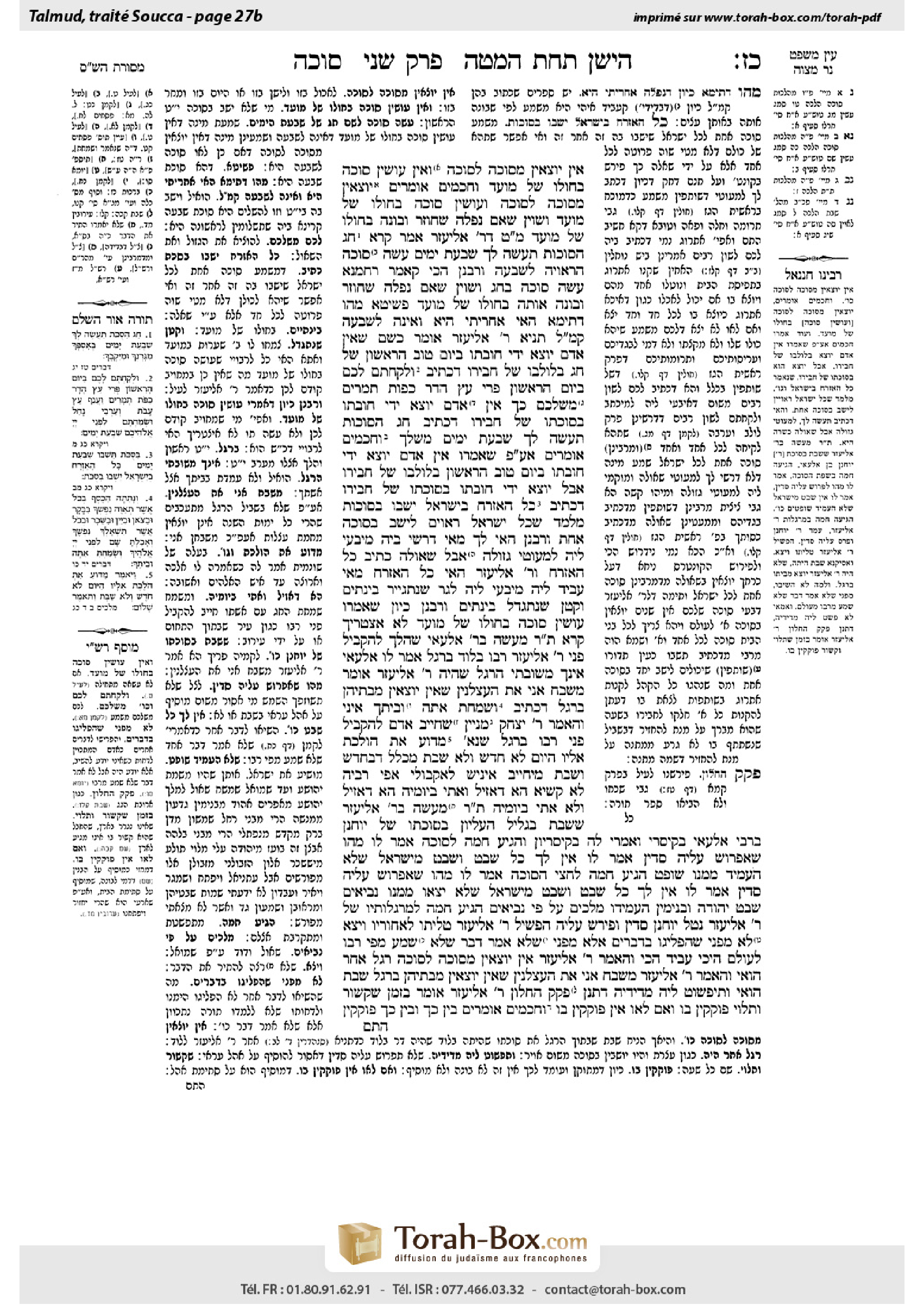
Sukkah 27b: Talmud study for Daf Yomi
Daf Yomi is the daily study of one Talmud folio. Explore 37 tractates with scans, Hebrew text, Sefaria English and AI-generated French translations where annotated.
Passage selection and English or AI-generated French translation are available where the scan has annotations. Daf Study is independent of Torah-Box and Sefaria.
Browse Sukkah · סוכה · All tractatesSukkah 27b text and translations
This page of Sukkah includes the Aramaic text, an English translation and an AI-generated French translation, alongside the scan above.
סוכה כ״ז ב · Aramaic and Hebrew text
אֵין יוֹצְאִין מִסּוּכָּה לְסוּכָּה, וְאֵין עוֹשִׂין סוּכָּה בְּחוּלּוֹ שֶׁל מוֹעֵד. וַחֲכָמִים אוֹמְרִים: יוֹצְאִין מִסּוּכָּה לְסוּכָּה, וְעוֹשִׂין סוּכָּה בְּחוּלּוֹ שֶׁל מוֹעֵד. וְשָׁוִין, שֶׁאִם נָפְלָה, שֶׁחוֹזֵר וּבוֹנָהּ בְּחוּלּוֹ שֶׁל מוֹעֵד.
מַאי טַעְמָא דְּרַבִּי אֱלִיעֶזֶר? אָמַר קְרָא: ״חַג הַסּוּכּוֹת תַּעֲשֶׂה לְךָ שִׁבְעַת יָמִים״, עֲשֵׂה סוּכָּה הָרְאוּיָה לְשִׁבְעָה. וְרַבָּנַן? הָכִי קָאָמַר רַחֲמָנָא: עֲשֵׂה סוּכָּה בֶּחָג.
וְשָׁוִין שֶׁאִם נָפְלָה, שֶׁחוֹזֵר וּבוֹנֶה אוֹתָהּ בְּחוּלּוֹ שֶׁל מוֹעֵד. פְּשִׁיטָא? מַהוּ דְּתֵימָא הַאי אַחֲרִיתִי הִיא וְאֵינָהּ לְשִׁבְעָה, קָא מַשְׁמַע לַן.
תַּנְיָא רַבִּי אֱלִיעֶזֶר אוֹמֵר: כְּשֵׁם שֶׁאֵין אָדָם יוֹצֵא יְדֵי חוֹבָתוֹ בַּיּוֹם טוֹב הָרִאשׁוֹן שֶׁל חַג בְּלוּלָבוֹ שֶׁל חֲבֵירוֹ, דִּכְתִיב: ״וּלְקַחְתֶּם לָכֶם בַּיּוֹם הָרִאשׁוֹן פְּרִי עֵץ הָדָר כַּפּוֹת תְּמָרִים״ — מִשֶּׁלָּכֶם, כָּךְ אֵין אָדָם יוֹצֵא יְדֵי חוֹבָתוֹ בְּסוּכָּתוֹ שֶׁל חֲבֵירוֹ, דִּכְתִיב: ״חַג הַסּוּכּוֹת תַּעֲשֶׂה לְךָ שִׁבְעַת יָמִים״ — מִשֶּׁלְּךָ.
וַחֲכָמִים אוֹמְרִים: אַף עַל פִּי שֶׁאָמְרוּ אֵין אָדָם יוֹצֵא יְדֵי חוֹבָתוֹ בְּיוֹם טוֹב הָרִאשׁוֹן בְּלוּלָבוֹ שֶׁל חֲבֵירוֹ, אֲבָל יוֹצֵא יְדֵי חוֹבָתוֹ בְּסוּכָּתוֹ שֶׁל חֲבֵירוֹ, דִּכְתִיב: ״כׇּל הָאֶזְרָח בְּיִשְׂרָאֵל יֵשְׁבוּ בַּסּוּכּוֹת״, מְלַמֵּד שֶׁכׇּל יִשְׂרָאֵל רְאוּיִם לֵישֵׁב בְּסוּכָּה אַחַת.
וְרַבָּנַן, הַאי ״לְךָ״, מַאי דָּרְשִׁי בֵּיהּ? מִיבְּעֵי לֵיהּ לְמַעוֹטֵי גְּזוּלָה, אֲבָל שְׁאוּלָה כְּתִיב: ״כׇּל הָאֶזְרָח״.
וְרַבִּי אֱלִיעֶזֶר, הַאי ״כׇּל הָאֶזְרָח״ מַאי עָבֵיד לֵיהּ? מִיבְּעֵי לֵיהּ לְגֵר שֶׁנִּתְגַּיֵּיר בֵּינְתַיִם וְקָטָן שֶׁנִּתְגַּדֵּל בֵּינְתַיִם. וְרַבָּנַן? כֵּיוָן שֶׁאָמְרוּ: עוֹשִׂין סוּכָּה בְּחוּלּוֹ שֶׁל מוֹעֵד, לָא אִצְטְרִיךְ קְרָא.
תָּנוּ רַבָּנַן: מַעֲשֶׂה בְּרַבִּי אִלְעַאי שֶׁהָלַךְ לְהַקְבִּיל פְּנֵי רַבִּי אֱלִיעֶזֶר רַבּוֹ בְּלוֹד בָּרֶגֶל. אָמַר לוֹ: אִלְעַאי! אֵינְךָ מִשּׁוֹבְתֵי הָרֶגֶל. שֶׁהָיָה רַבִּי אֱלִיעֶזֶר אוֹמֵר: מְשַׁבֵּחַ אֲנִי אֶת הָעַצְלָנִין, שֶׁאֵין יוֹצְאִין מִבָּתֵּיהֶן בָּרֶגֶל, דִּכְתִיב: ״וְשָׂמַחְתָּ אַתָּה וּבֵיתֶךָ״.
אִינִי?! וְהָאָמַר רַבִּי יִצְחָק: מִנַּיִין שֶׁחַיָּיב לְהַקְבִּיל פְּנֵי רַבּוֹ בָּרֶגֶל, שֶׁנֶּאֱמַר: ״מַדּוּעַ אַתְּ הוֹלֶכֶת אֵלָיו הַיּוֹם לֹא חֹדֶשׁ וְלֹא שַׁבָּת״, מִכְּלָל דִּבְחֹדֶשׁ וְשַׁבָּת מִיחַיַּיב אִינִישׁ לְאַקְבּוֹלֵי אַפֵּי רַבֵּיהּ! לָא קַשְׁיָא: הָא — דְּאָזֵיל וְאָתֵי בְּיוֹמֵיהּ, הָא — דְּאָזֵיל וְלָא אָתֵי בְּיוֹמֵיהּ.
תָּנוּ רַבָּנַן: מַעֲשֶׂה בְּרַבִּי אֱלִיעֶזֶר שֶׁשָּׁבַת בַּגָּלִיל הָעֶלְיוֹן בְּסוּכָּתוֹ שֶׁל יוֹחָנָן בְּרַבִּי אִלְעַאי בְּקֵיסָרִי, וְאָמְרִי לַהּ בְּקֵיסָרְיוֹן, וְהִגִּיעַ חַמָּה לַסּוּכָּה. אָמַר לוֹ: מַהוּ שֶׁאֶפְרוֹשׂ עָלֶיהָ סָדִין? אָמַר לוֹ: אֵין לְךָ כׇּל שֵׁבֶט וְשֵׁבֶט מִיִּשְׂרָאֵל שֶׁלֹּא הֶעֱמִיד מִמֶּנּוּ שׁוֹפֵט.
הִגִּיעַ חַמָּה לַחֲצִי הַסּוּכָּה, אָמַר לוֹ: מַהוּ שֶׁאֶפְרוֹשׂ עָלֶיהָ סָדִין? אָמַר לוֹ: אֵין לְךָ כׇּל שֵׁבֶט וְשֵׁבֶט מִיִּשְׂרָאֵל שֶׁלֹּא יָצְאוּ מִמֶּנּוּ נְבִיאִים. שֵׁבֶט יְהוּדָה וּבִנְיָמִין הֶעֱמִידוּ מְלָכִים עַל פִּי נְבִיאִים. הִגִּיעַ חַמָּה לְמַרְגְּלוֹתָיו שֶׁל רַבִּי אֱלִיעֶזֶר, נָטַל יוֹחָנָן סָדִין וּפֵירַשׂ עָלֶיהָ, הִפְשִׁיל רַבִּי אֱלִיעֶזֶר טַלִּיתוֹ לַאֲחוֹרָיו וְיָצָא. לֹא מִפְּנֵי שֶׁהִפְלִיגוֹ בִּדְבָרִים, אֶלָּא מִפְּנֵי שֶׁלֹּא אָמַר דָּבָר שֶׁלֹּא שָׁמַע מִפִּי רַבּוֹ לְעוֹלָם.
הֵיכִי עָבֵיד הָכִי? וְהָאָמַר רַבִּי אֱלִיעֶזֶר: אֵין יוֹצְאִין מִסּוּכָּה לְסוּכָּה! רֶגֶל אַחֵר הֲוַאי.
וְהָאָמַר רַבִּי אֱלִיעֶזֶר: מְשַׁבֵּחַ אֲנִי אֶת הָעַצְלָנִין שֶׁאֵין יוֹצְאִין מִבָּתֵּיהֶן בָּרֶגֶל! שַׁבָּת הֲוַאי.
וְתִיפְשׁוֹט לֵיהּ מִדִּידֵיהּ דִּתְנַן: פְּקַק הַחַלּוֹן, רַבִּי אֱלִיעֶזֶר אוֹמֵר: בִּזְמַן שֶׁקָּשׁוּר וְתָלוּי — פּוֹקְקִין בּוֹ, וְאִם לָאו — אֵין פּוֹקְקִין בּוֹ. וַחֲכָמִים אוֹמְרִים: בֵּין כָּךְ וּבֵין כָּךְ פּוֹקְקִין.
Sukkah 27b · English translation
One may not depart from one sukka to another sukka; he must reside in the same sukka for the entire Festival. And one may not establish a sukka during the intermediate days of the Festival if he failed to do so before the Festival. And the Rabbis say: One may depart from one sukka to another sukka, and one may establish a sukka on the intermediate days of the Festival. And they all, even Rabbi Eliezer, agree that if a sukka that one constructed before the Festival collapsed, he may rebuild it during the intermediate days of the Festival.
The Gemara asks: What is the rationale for the opinion of Rabbi Eliezer that it is prohibited to move from one sukka to another during the Festival? The Gemara explains it is as the verse says: “You shall prepare for yourself the festival of Sukkot for seven days” (Deuteronomy 16:13); this is interpreted to mean: Establish a sukka that is suitable for seven days. It is considered a sukka suitable for the mitzva only if it is established for seven days. The Gemara asks: And how do the Rabbis interpret this verse? The Gemara answers: In their opinion, this is what the Merciful One is saying: If one did not establish a sukka on the eve of the Festival, he should establish a sukka during the Festival. The obligation to establish a sukka is in effect all seven days of the Festival.
It is taught in the baraita: And they agree that if a sukka that one constructed before the Festival collapsed, he may rebuild it during the intermediate days of the Festival. The Gemara asks: That is obvious; why would it be prohibited? The Gemara answers: Lest you say that according to Rabbi Eliezer this rebuilt sukka is considered a different one and is not a sukka established for seven days, therefore, the baraita teaches us that Rabbi Eliezer agrees that it is considered to be the same sukka.
It is taught in another baraita that Rabbi Eliezer says: Just as a person does not fulfill his obligation on the first day of the Festival with the lulav of another, as it is written: “And you shall take for yourselves on the first day the fruit of a beautiful tree, branches of a date palm” (Leviticus 23:40), and the Sages derive from the phrase: Shall take for yourselves, that it must be taken from your own and not from that of someone else, so too, a person does not fulfill his obligation with the sukka of another, as it is written: “You shall prepare for yourself the festival of Sukkot for seven days” (Deuteronomy 16:13), and the Sages derive from the term “for yourself” that it must be taken from your own.
And the Rabbis say: Although they said that a person does not fulfill his obligation on the first day of the Festival with the lulav of another, he fulfills his obligation with the sukka of another, as it is written: “All the homeborn in Israel shall reside in sukkot” (Leviticus 23:42). This teaches that all of the Jewish people are fit to reside in one sukka. If the value of one sukka were divided among all the Jewish people, no individual would have a peruta stake in it; therefore, no individual could be considered even a part-owner of the sukka. The only way the entire Jewish people could fulfill the mitzva in one sukka is by residing in a communal sukka that does not belong to any of them. Apparently, there is no obligation to reside specifically in one’s own sukka.
The Gemara asks: And the Rabbis, who do not derive that one is obligated to reside in his own sukka, what do they derive from this term “for yourself”? The Gemara answers: They require that term to exclude a stolen sukka. One does not fulfill his obligation with a stolen sukka. However, with regard to a borrowed sukka, it is written: “All the homeborn,” to teach that every Jew can fulfill the mitzva in a sukka borrowed from the community.
The Gemara asks: And Rabbi Eliezer, what does he do with this term: “All the homeborn”? The Gemara answers: He requires that term to derive that a convert who converted in the interim, during Sukkot, and a minor who reached majority in the interim, whose obligation began during the Festival, are obligated to fulfill the mitzva of residing in a sukka. The Gemara asks: And according to the Rabbis, from where are these halakhot derived? The Gemara answers: Once the Sages said that one may establish a sukka during the intermediate days of the Festival, an additional verse is not necessary to derive the obligation of the convert and the minor who reached majority.
§ The Sages taught: There was an incident involving Rabbi Elai, who went on Sukkot eve to greet his teacher Rabbi Eliezer in Lod on the first day of the Festival. He said to him: Elai, you are not among those who stay home on the Festival and therefore you have not fulfilled the mitzva of the Festival, as Rabbi Eliezer would say: I praise the lazy, who, although they act no differently than they do the entire year, are praiseworthy because they do not leave their houses on the Festival, as it is written: “You shall rejoice, you and your household” (Deuteronomy 14:26). The term “your household” is interpreted as referring to one’s wife. One who is not home cannot rejoice with his wife.
The Gemara asks: Is that so? Didn’t Rabbi Yitzḥak say: From where is it derived that one is obligated to greet his teacher on the Festival? It is as it is stated that the husband of the Shunamite woman asked his wife: “Why are you going to him today? It is neither the New Moon nor Shabbat” (II Kings 4:23). This proves by inference that on the New Moon and Shabbat a person is obligated to greet his teacher. The Gemara answers that this is not difficult: This statement of Rabbi Yitzḥak that one is obligated to go and greet his teacher is referring to a case where he goes and returns on the same day and can rejoice with his wife at night; and this statement of Rabbi Eliezer that one should stay home is referring to a case where he goes and does not return on the same day and cannot rejoice with his wife at night.
§ The Sages taught: There was an incident involving Rabbi Eliezer, who stayed in the Upper Galilee in the sukka of Yoḥanan, son of Rabbi Elai, in Caesarea; and some say that it did not occur in Caesarea but in Caesarion. And the sun reached a point over the roofing of the sukka, rendering it uncomfortable to remain in the sukka. Rabbi Yoḥanan said to him: What is the halakha; may I spread a sheet over the roofing? Is it permitted, since it is only adding to a temporary tent or is it prohibited? Rabbi Eliezer evaded the question and said to him: There is no tribe of Israel from which a judge did not emerge.
In the meantime, the sun reached directly over the midpoint of the roofing of the sukka. Once again, Rabbi Yoḥanan said to him: What is the halakha; may I spread a sheet over it? Rabbi Eliezer again evaded the question and said to him: There is no tribe of Israel from which prophets did not emerge. And the tribes of Judah and Benjamin were unique because they established kings according to prophets, as Saul and David were anointed by the prophet Samuel. At that point, the light of the sun reached the feet of Rabbi Eliezer. Yoḥanan took a sheet and spread it over the sukka. Rabbi Eliezer slung his cloak over his shoulder behind him and emerged from the sukka because he did not want to permit doing so. The Gemara comments: Rabbi Eliezer conducted himself in that manner not because he was seeking to avoid answering by diverting his attention with his words, but because Rabbi Eliezer never said a matter that he did not hear from his teacher.
The Gemara asks: How did Rabbi Eliezer do so? How did he stay in a sukka in the Upper Galilee on the festival of Sukkot? Didn’t Rabbi Eliezer himself say: One may not depart from one sukka to another sukka? The Gemara answers: The incident was on a different Festival and not the festival of Sukkot, and they were in the sukka merely for the fresh air.
The Gemara asks from a different perspective: But didn’t Rabbi Eliezer say: I praise the lazy, who do not leave their houses on the Festival? That apparently applies to all Festivals. The Gemara answers: The incident did not take place on a Festival at all. It was on Shabbat, and Rabbi Yoḥanan’s question was with regard to the prohibited labor of building on Shabbat.
The Gemara asks: If so, resolve the matter and conclude that it is not permitted from his own opinion, as we learned in a mishna: With regard to a window shutter on Shabbat, Rabbi Eliezer says: When it is tied to and hanging from the window, i.e., it is not touching the ground, one may shutter the window with it, because that is not considered building; and if not, i.e., if it is touching the ground, one may not shutter the window with it. And the Rabbis say: Both in this case and in that case one may shutter with it. From the fact that if it is not hanging from the window, Rabbi Eliezer prohibits shuttering the window, he also prohibits adding to a temporary tent.
Sukkah 27b · Traduction française (IA)
On ne peut pas passer d’une soukka à une autre : il faut séjourner dans la même soukka pendant toute la fête. On ne peut pas non plus construire une soukka pendant les jours intermédiaires de la fête si l’on ne l’a pas fait avant la fête. Les Sages disent : On peut passer d’une soukka à une autre et en construire une pendant les jours intermédiaires de la fête. Tous, même Rabbi Eliezer, conviennent que si une soukka construite avant la fête s’est effondrée, on peut la reconstruire pendant les jours intermédiaires de la fête.
La Guemara demande : Quel est le fondement de l’opinion de Rabbi Eliezer, selon laquelle il est interdit de passer d’une soukka à une autre pendant la fête ? La Guemara explique qu’elle découle du verset : « Tu célébreras pour toi la fête de Soukkot pendant sept jours » (Deutéronome 16, 13). On l’interprète ainsi : construis pour toi une soukka qui convienne pour sept jours. Une soukka n’est considérée comme convenant à la mitsva que si elle est établie pour sept jours. La Guemara demande : Et comment les Sages interprètent-ils ce verset ? La Guemara répond : Selon eux, le Miséricordieux dit ceci : si quelqu’un n’a pas établi de soukka la veille de la fête, qu’il en établisse une pendant la fête. L’obligation d’établir une soukka s’applique pendant les sept jours de la fête.
Il est enseigné dans une baraïta : Et ils conviennent que si une soukka construite avant la fête s’est effondrée, on peut la reconstruire pendant les jours intermédiaires de la fête. La Guemara demande : Cela va de soi ; pourquoi serait-ce interdit ? La Guemara répond : De peur que tu ne dises que, selon Rabbi Eliezer, cette soukka reconstruite est considérée comme une autre soukka et n’est donc pas une soukka établie pour sept jours, la baraïta nous enseigne que Rabbi Eliezer convient qu’elle est considérée comme la même soukka.
Il est enseigné dans une autre baraïta que Rabbi Eliezer dit : De même qu’une personne ne s’acquitte pas de son obligation le premier jour de la fête avec le loulav d’autrui, comme il est écrit : « Vous prendrez, le premier jour, le fruit d’un bel arbre, des rameaux de palmier » (Lévitique 23, 40), et que les Sages déduisent de l’expression « vous prendrez pour vous » qu’il faut le prendre parmi ce qui vous appartient, et non parmi les biens d’autrui, de même une personne ne s’acquitte pas de son obligation avec la soukka d’autrui, comme il est écrit : « Tu célébreras pour toi la fête de Soukkot pendant sept jours » (Deutéronome 16, 13). Les Sages déduisent de l’expression « pour toi » que la soukka doit lui appartenir.
Les Sages disent : Bien qu’ils aient enseigné qu’une personne ne s’acquitte pas de son obligation le premier jour de la fête avec le loulav d’autrui, elle s’acquitte de son obligation avec la soukka d’autrui, comme il est écrit : « Tous les autochtones d’Israël séjourneront dans des soukkot » (Lévitique 23, 42). Cela enseigne que tout le peuple juif peut séjourner dans une seule soukka. Si la valeur d’une soukka était répartie entre tous les Juifs, aucun individu n’en détiendrait même une part valant une perouta ; aucun ne pourrait donc être considéré comme copropriétaire, même en partie, de la soukka. Le seul moyen pour que tout le peuple juif accomplisse la mitsva dans une seule soukka est de séjourner dans une soukka commune qui n’appartient à aucun d’eux. Il apparaît donc qu’il n’est pas obligatoire de séjourner spécifiquement dans sa propre soukka.
La Guemara demande : Et les Sages, qui ne déduisent pas de cette expression qu’on est obligé de séjourner dans sa propre soukka, que déduisent-ils de l’expression « pour toi » ? La Guemara répond : Ils ont besoin de cette expression pour exclure une soukka volée. On ne s’acquitte pas de son obligation dans une soukka volée. En revanche, à propos d’une soukka empruntée, il est écrit : « Tous les autochtones », pour enseigner que chaque Juif peut accomplir la mitsva dans une soukka empruntée à la collectivité.
La Guemara demande : Et Rabbi Eliezer, que fait-il de l’expression « tous les autochtones » ? La Guemara répond : Il a besoin de cette expression pour déduire qu’un converti qui s’est converti en cours de fête, pendant Soukkot, et qu’un mineur qui a atteint sa majorité en cours de fête, dont l’obligation commence alors, sont tenus d’accomplir la mitsva de séjourner dans une soukka. La Guemara demande : Et selon les Sages, d’où déduit-on ces halakhot ? La Guemara répond : Dès lors que les Sages ont dit qu’on peut établir une soukka pendant les jours intermédiaires de la fête, il n’est pas nécessaire de disposer d’un verset supplémentaire pour déduire l’obligation du converti et du mineur qui a atteint sa majorité.
§ Les Sages ont enseigné : Un incident s’est produit avec Rabbi Ilaï, qui, la veille de Soukkot, alla saluer son maître Rabbi Eliezer à Lod, le premier jour de la fête. Celui-ci lui dit : « Ilaï, tu ne fais pas partie de ceux qui restent chez eux pendant la fête ; tu n’as donc pas accompli la mitsva de la fête. » Rabbi Eliezer disait en effet : « Je loue les paresseux qui, bien qu’ils n’agissent pas autrement que le reste de l’année, sont dignes d’éloges parce qu’ils ne quittent pas leur maison pendant la fête », comme il est écrit : « Tu te réjouiras, toi et ta maisonnée » (Deutéronome 14, 26). L’expression « ta maisonnée » s’interprète comme désignant son épouse. Celui qui n’est pas chez lui ne peut pas se réjouir avec son épouse.
La Guemara demande : Est-ce bien le cas ? Rabbi Yitzḥak n’a-t-il pas dit : D’où déduit-on qu’on est tenu d’aller saluer son maître pendant la fête ? Cela ressort de ce que le mari de la Sunamite demanda à son épouse : « Pourquoi vas-tu chez lui aujourd’hui ? Ce n’est ni la nouvelle lune ni le Chabbat » (II Rois 4, 23). On en déduit que, à la nouvelle lune et le Chabbat, une personne est tenue d’aller saluer son maître. La Guemara répond que ce n’est pas difficile : la déclaration de Rabbi Yitzḥak, selon laquelle on est tenu d’aller saluer son maître, concerne le cas où l’on part et revient le même jour, et où l’on peut se réjouir avec son épouse le soir ; la déclaration de Rabbi Eliezer, selon laquelle il faut rester chez soi, concerne le cas où l’on part sans revenir le même jour, et où l’on ne peut pas se réjouir avec son épouse le soir.
§ Les Sages ont enseigné : Un incident s’est produit avec Rabbi Eliezer, qui séjourna en Haute-Galilée dans la soukka de Yoḥanan, fils de Rabbi Ilaï, à Césarée ; certains disent que cela ne se passa pas à Césarée, mais à Césarion. Le soleil parvint au-dessus du toit de la soukka, rendant le séjour dans la soukka inconfortable. Rabbi Yoḥanan lui demanda : « Quelle est la halakha ? Puis-je étendre une toile au-dessus du toit ? Est-ce permis, puisqu’il ne s’agit que d’ajouter à une tente temporaire, ou est-ce interdit ? » Rabbi Eliezer éluda la question et lui dit : « Il n’y a pas de tribu d’Israël dont ne soit issu un juge. »
Entre-temps, le soleil atteignit directement le milieu du toit de la soukka. Rabbi Yoḥanan lui demanda de nouveau : « Quelle est la halakha ? Puis-je étendre une toile par-dessus ? » Rabbi Eliezer éluda encore la question et lui dit : « Il n’y a pas de tribu d’Israël dont ne soient issus des prophètes. » Les tribus de Juda et de Benjamin étaient uniques, car elles établirent des rois selon les prophéties : Saül et David furent oints par le prophète Samuel. À ce moment-là, la lumière du soleil atteignit les pieds de Rabbi Eliezer. Yoḥanan prit une toile et l’étendit sur la soukka. Rabbi Eliezer jeta son manteau sur son épaule, derrière lui, et sortit de la soukka, car il ne voulait pas permettre cette action. La Guemara commente : Rabbi Eliezer n’agit pas ainsi pour éviter de répondre en détournant l’attention par ses paroles, mais parce qu’il n’a jamais énoncé une chose qu’il n’avait pas entendue de son maître.
La Guemara demande : Comment Rabbi Eliezer a-t-il pu faire cela ? Comment a-t-il pu séjourner dans une soukka en Haute-Galilée pendant la fête de Soukkot ? Rabbi Eliezer lui-même n’a-t-il pas dit : On ne peut pas passer d’une soukka à une autre ? La Guemara répond : L’incident s’est produit lors d’une autre fête, et non pendant la fête de Soukkot ; ils se trouvaient dans la soukka uniquement pour profiter de l’air frais.
La Guemara pose une question sous un autre angle : Mais Rabbi Eliezer n’a-t-il pas dit : « Je loue les paresseux qui ne quittent pas leur maison pendant la fête » ? Cela semble s’appliquer à toutes les fêtes. La Guemara répond : L’incident ne s’est pas du tout produit un jour de fête. C’était Chabbat, et la question de Rabbi Yoḥanan portait sur le travail interdit de construire pendant Chabbat.
La Guemara demande : Si c’est ainsi, tranchez la question et concluez que, selon sa propre opinion, cela n’est pas permis, car nous avons appris dans une Michna : À propos d’un volet de fenêtre pendant Chabbat, Rabbi Eliezer dit : S’il est attaché à la fenêtre et suspendu, c’est-à-dire s’il ne touche pas le sol, on peut fermer la fenêtre avec, car cela n’est pas considéré comme construire ; sinon, c’est-à-dire s’il touche le sol, on ne peut pas fermer la fenêtre avec. Les Sages disent : Dans les deux cas, on peut fermer la fenêtre avec. Puisque Rabbi Eliezer interdit de fermer la fenêtre lorsque le volet n’est pas suspendu à celle-ci, il interdit également d’ajouter à une tente temporaire.
Traduction française générée par IA à partir de l’édition anglaise de Sefaria. Vérifie toujours un passage avec le texte source.
Text from Sefaria: William Davidson Edition - Vocalized Aramaic (CC BY NC); William Davidson Edition - English (CC BY NC).