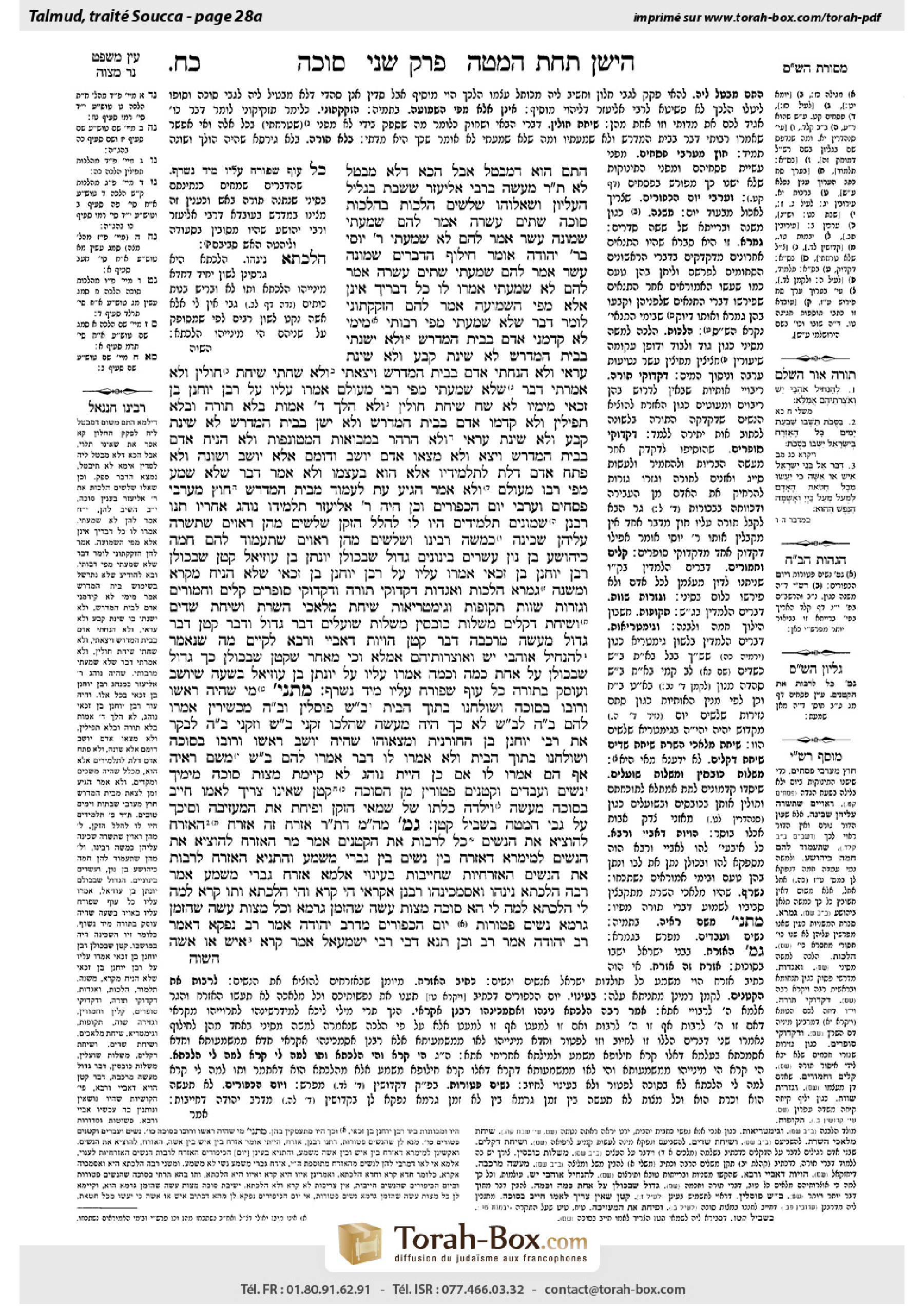
Sukkah 28a: Talmud study for Daf Yomi
Daf Yomi is the daily study of one Talmud folio. Explore 37 tractates with scans, Hebrew text, Sefaria English and AI-generated French translations where annotated.
Passage selection and English or AI-generated French translation are available where the scan has annotations. Daf Study is independent of Torah-Box and Sefaria.
Browse Sukkah · סוכה · All tractatesSukkah 28a text and translations
This page of Sukkah includes the Aramaic text, an English translation and an AI-generated French translation, alongside the scan above.
סוכה כ״ח א · Aramaic and Hebrew text
הָתָם הוּא דִּמְבַטֵּל, אֲבָל הָכָא דְּלָא מְבַטֵּל — לָא.
תָּנוּ רַבָּנַן: מַעֲשֶׂה בְּרַבִּי אֱלִיעֶזֶר שֶׁשָּׁבַת בַּגָּלִיל הָעֶלְיוֹן, וּשְׁאָלוּהוּ שְׁלֹשִׁים הֲלָכוֹת בְּהִלְכוֹת סוּכָּה, שְׁתֵּים עֶשְׂרֵה אָמַר לָהֶם: שָׁמַעְתִּי, שְׁמוֹנֶה עֶשְׂרֵה אָמַר לָהֶם: לֹא שָׁמַעְתִּי. רַבִּי יוֹסֵי בְּרַבִּי יְהוּדָה אוֹמֵר, חִילּוּף הַדְּבָרִים: שְׁמוֹנֶה עֶשְׂרֵה אָמַר לָהֶם: שָׁמַעְתִּי, שְׁתֵּים עֶשְׂרֵה אָמַר לָהֶם: לֹא שָׁמַעְתִּי.
אָמְרוּ לוֹ: כׇּל דְּבָרֶיךָ אֵינָן אֶלָּא מִפִּי הַשְּׁמוּעָה! אָמַר לָהֶם: הִזְקַקְתּוּנִי לוֹמַר דָּבָר שֶׁלֹּא שָׁמַעְתִּי מִפִּי רַבּוֹתַי. מִיָּמַי לֹא קְדָמַנִי אָדָם בְּבֵית הַמִּדְרָשׁ, וְלֹא יָשַׁנְתִּי בְּבֵית הַמִּדְרָשׁ לֹא שֵׁינַת קֶבַע וְלֹא שֵׁינַת עֲרַאי, וְלֹא הִנַּחְתִּי אָדָם בְּבֵית הַמִּדְרָשׁ וְיָצָאתִי, וְלֹא שַׂחְתִּי שִׂיחַת חוּלִּין, וְלֹא אָמַרְתִּי דָּבָר שֶׁלֹּא שָׁמַעְתִּי מִפִּי רַבִּי מֵעוֹלָם.
אָמְרוּ עָלָיו עַל רַבָּן יוֹחָנָן בֶּן זַכַּאי: מִיָּמָיו לֹא שָׂח שִׂיחַת חוּלִּין, וְלֹא הָלַךְ אַרְבַּע אַמּוֹת בְּלָא תּוֹרָה וּבְלֹא תְּפִילִּין, וְלֹא קְדָמוֹ אָדָם בְּבֵית הַמִּדְרָשׁ, וְלֹא יָשַׁן בְּבֵית הַמִּדְרָשׁ לֹא שֵׁינַת קֶבַע וְלֹא שֵׁינַת עֲרַאי, וְלֹא הִרְהֵר בִּמְבוֹאוֹת הַמְטוּנָּפוֹת, וְלֹא הִנִּיחַ אָדָם בְּבֵית הַמִּדְרָשׁ וְיָצָא, וְלֹא מְצָאוֹ אָדָם יוֹשֵׁב וְדוֹמֵם אֶלָּא יוֹשֵׁב וְשׁוֹנֶה, וְלֹא פָּתַח אָדָם דֶּלֶת לְתַלְמִידָיו, אֶלָּא הוּא בְּעַצְמוֹ, וְלֹא אָמַר דָּבָר שֶׁלֹּא שָׁמַע מִפִּי רַבּוֹ מֵעוֹלָם, וְלֹא אָמַר: הִגִּיעַ עֵת לַעֲמוֹד מִבֵּית הַמִּדְרָשׁ, חוּץ מֵעַרְבֵי פְסָחִים, וְעַרְבֵי יוֹם הַכִּפּוּרִים. וְכֵן הָיָה רַבִּי אֱלִיעֶזֶר תַּלְמִידוֹ נוֹהֵג אַחֲרָיו.
תָּנוּ רַבָּנַן: שְׁמוֹנִים תַּלְמִידִים הָיוּ לוֹ לְהִלֵּל הַזָּקֵן. שְׁלֹשִׁים מֵהֶן רְאוּיִם שֶׁתִּשְׁרֶה עֲלֵיהֶן שְׁכִינָה כְּמֹשֶׁה רַבֵּינוּ, וּשְׁלֹשִׁים מֵהֶן רְאוּיִם שֶׁתַּעֲמוֹד לָהֶם חַמָּה כִּיהוֹשֻׁעַ בִּן נוּן. עֶשְׂרִים בֵּינוֹנִים. גָּדוֹל שֶׁבְּכוּלָּן — יוֹנָתָן בֶּן עוּזִּיאֵל, קָטָן שֶׁבְּכוּלָּן — רַבָּן יוֹחָנָן בֶּן זַכַּאי.
אָמְרוּ עָלָיו עַל רַבָּן יוֹחָנָן בֶּן זַכַּאי שֶׁלֹּא הִנִּיחַ מִקְרָא וּמִשְׁנָה, גְּמָרָא הֲלָכוֹת וְאַגָּדוֹת; דִּקְדּוּקֵי תוֹרָה וְדִקְִדּוּקֵי סוֹפְרִים; קַלִּים וַחֲמוּרִים וּגְזֵרוֹת שָׁווֹת; תְּקוּפוֹת וְגִימַטְרִיָּאוֹת; שִׂיחַת מַלְאֲכֵי הַשָּׁרֵת וְשִׂיחַת שֵׁדִים וְשִׂיחַת דְּקָלִים; מִשְׁלוֹת כּוֹבְסִין, מִשְׁלוֹת שׁוּעָלִים; דָּבָר גָּדוֹל וְדָבָר קָטָן.
דָּבָר גָּדוֹל — מַעֲשֵׂה מֶרְכָּבָה. דָּבָר קָטָן — הֲוָיוֹת דְּאַבָּיֵי וְרָבָא. לְקַיֵּים מַה שֶּׁנֶּאֱמַר: ״לְהַנְחִיל אוֹהֲבַי יֵשׁ וְאוֹצְרוֹתֵיהֶם אֲמַלֵּא״. וְכִי מֵאַחַר שֶׁקָּטָן שֶׁבְּכוּלָּן כָּךְ, גָּדוֹל שֶׁבְּכוּלָּן עַל אַחַת כַּמָּה וְכַמָּה. אָמְרוּ עָלָיו עַל יוֹנָתָן בֶּן עוּזִּיאֵל, בְּשָׁעָה שֶׁיּוֹשֵׁב וְעוֹסֵק בַּתּוֹרָה — כׇּל עוֹף שֶׁפּוֹרֵחַ עָלָיו מִיָּד נִשְׂרָף.
מַתְנִי׳ מִי שֶׁהָיָה רֹאשׁוֹ וְרוּבּוֹ בַּסּוּכָּה וְשׁוּלְחָנוֹ בְּתוֹךְ הַבַּיִת — בֵּית שַׁמַּאי פּוֹסְלִין וּבֵית הִלֵּל מַכְשִׁירִין. אָמְרוּ לָהֶם בֵּית הִלֵּל לְבֵית שַׁמַּאי: לֹא כָּךְ הָיָה מַעֲשֶׂה שֶׁהָלְכוּ זִקְנֵי בֵּית שַׁמַּאי וְזִקְנֵי בֵּית הִלֵּל לְבַקֵּר אֶת רַבִּי יוֹחָנָן בֶּן הַחוֹרָנִית, וּמְצָאוּהוּ שֶׁהָיָה יוֹשֵׁב רֹאשׁוֹ וְרוּבּוֹ בַּסּוּכָּה וְשׁוּלְחָנוֹ בְּתוֹךְ הַבַּיִת, וְלֹא אָמְרוּ לוֹ דָּבָר. אָמְרוּ לָהֶם בֵּית שַׁמַּאי: מִשָּׁם רְאָיָה?! אַף הֵם אָמְרוּ לוֹ: אִם כֵּן הָיִיתָ נוֹהֵג, לֹא קִיַּימְתָּ מִצְוַת סוּכָּה מִיָּמֶיךָ.
נָשִׁים וַעֲבָדִים וּקְטַנִּים פְּטוּרִין מִן הַסּוּכָּה. קָטָן שֶׁאֵינוֹ צָרִיךְ לְאִמּוֹ — חַיָּיב בְּסוּכָּה. מַעֲשֶׂה וְיָלְדָה כַּלָּתוֹ שֶׁל שַׁמַּאי הַזָּקֵן, וּפִיחֵת אֶת הַמַּעֲזִיבָה וְסִיכֵּךְ עַל גַּבֵּי הַמִּטָּה בִּשְׁבִיל קָטָן.
גְּמָ׳ מְנָא הָנֵי מִילֵּי? דְּתָנוּ רַבָּנַן: ״אֶזְרָח״ — זֶה אֶזְרָח, ״הָאֶזְרָח״ — לְהוֹצִיא אֶת הַנָּשִׁים, ״כׇּל״ — לְרַבּוֹת אֶת הַקְּטַנִּים.
אָמַר מָר: ״הָאֶזְרָח״ — לְהוֹצִיא אֶת הַנָּשִׁים. לְמֵימְרָא דְּ״אֶזְרָח״, בֵּין נָשִׁים בֵּין גַּבְרֵי מַשְׁמַע? וְהָתַנְיָא: ״הָאֶזְרָח״ — לְרַבּוֹת אֶת הַנָּשִׁים הָאֶזְרָחִיּוֹת, שֶׁחַיָּיבוֹת בְּעִינּוּי. אַלְמָא ״אֶזְרָח״ — גַּבְרֵי מַשְׁמַע! אָמַר רַבָּה: הִלְכְתָא נִינְהוּ וְאַסְמְכִינְהוּ רַבָּנַן אַקְּרָאֵי.
הֵי קְרָא וְהֵי הִלְכְתָא? וְתוּ: קְרָא לְמָה לִי, הִלְכְתָא לְמָה לִי? הָא סוּכָּה מִצְוַת עֲשֵׂה שֶׁהַזְּמַן גְּרָמָא, וְכׇל מִצְוַת עֲשֵׂה שֶׁהַזְּמַן גְּרָמָא נָשִׁים פְּטוּרוֹת.
יוֹם הַכִּפּוּרִים, מִדְּרַב יְהוּדָה אָמַר רַב נָפְקָא. דְּאָמַר רַב יְהוּדָה אָמַר רַב, וְכֵן תָּנָא דְּבֵי רַבִּי יִשְׁמָעֵאל אָמַר קְרָא: ״אִישׁ אוֹ אִשָּׁה״,
Sukkah 28a · English translation
The Gemara answers: There is a difference between the case of the shutter and the case of the sheet. There, in the case of the shutter, where he negates it by shuttering the window, it is considered part of the building and it is therefore prohibited. However, here, in the case of the sheet, where he does not negate it, as he plans on removing it, no, it is not necessarily prohibited.
The Gemara relates a similar incident. The Sages taught: There was an incident involving Rabbi Eliezer, who stayed in the Upper Galilee, and the people there asked him thirty halakhot in the halakhot of sukka. In response to twelve, he said to them: I heard an answer from my teachers, and he related what he heard. In response to the other eighteen, he said to them: I did not hear an answer. Rabbi Yosei, son of Rabbi Yehuda, says: It was the reverse of these matters. In response to eighteen he said to them: I heard an answer; in response to the other twelve he said to them: I did not hear an answer.
They said to him: Are all the matters that you know only from what you heard? Don’t you say any matters on your own? He said to them: Now you forced me to say a matter that I did not hear from my teachers, as I must describe my character traits and the manner in which I conduct myself. In all my days, no person ever preceded me into the study hall, as I am always first to arrive; and I never slept in the study hall, neither substantial sleep nor a brief nap; and I never left anyone in the study hall and exited, as I was always last to leave; and I never engaged in idle conversation; rather, I discussed only necessary matters or matters of Torah; and I never said anything that I did not hear from my teacher. That is why he did not answer those questions that his teacher did not address.
Apropos the character traits of Rabbi Eliezer, the Gemara cites character traits of his teacher. The Sages said about Rabban Yoḥanan ben Zakkai, the teacher of Rabbi Eliezer: In all his days he never engaged in idle conversation; and he never walked four cubits without engaging in Torah study and without donning phylacteries; and no person ever preceded him into the study hall; and he never slept in the study hall, neither substantial sleep nor a brief nap; and he never contemplated matters of Torah in alleyways filthy with human excrement, as doing so is a display of contempt for the Torah; and he never left anyone in the study hall and exited; and no person ever found him sitting and silent, i.e., inactive; rather, he was always sitting and studying; and only he opened the door for his students, disregarding his own eminent standing; and he never said anything that he did not hear from his teacher; and he never said to his students that the time has arrived to arise and leave the study hall except on Passover eves, when they were obligated to sacrifice the Paschal lamb, and Yom Kippur eves, when there is a mitzva to eat and drink abundantly. And Rabbi Eliezer, his student, accustomed himself to model his conduct after his example.
The Gemara continues to praise the Sages. The Sages taught: Hillel the Elder had eighty students. Thirty of them were sufficiently worthy that the Divine Presence should rest upon them as it did upon Moses our teacher, and thirty of them were sufficiently worthy that the sun should stand still for them as it did for Joshua bin Nun, and twenty were on an intermediate level between the other two. The greatest of all the students was Yonatan ben Uzziel, and the youngest of them was Rabban Yoḥanan ben Zakkai.
The Gemara relates: The Sages said about Rabban Yoḥanan ben Zakkai that he did not neglect Bible; Mishna; Gemara; halakhot and aggadot; minutiae of the Torah and minutiae of the scribes; the hermeneutical principles of the Torah with regard to a fortiori inferences and verbal analogies; the calculation of the calendrical seasons; and numerology [gimmatreyaot]. In addition, he did not neglect esoteric matters, including the conversation of ministering angels; the conversation of demons, and the conversation of palm trees; parables of launderers, which are folk tales that can be used to explain the Torah; parables of foxes; and more generally, a great matter and a small matter.
The Gemara elaborates: A great matter is referring to the secrets of the Design of the Divine Chariot, the conduct of the transcendent universe. A small matter is, for example, halakhot that were ultimately formulated in the framework of the disputes of Abaye and Rava. He did not neglect any of these disciplines so as to fulfill that which is stated: “That I may cause those that love me to inherit substance and that I may fill their treasuries” (Proverbs 8:21), as Rabban Yoḥanan was filled with the disciplines of Torah and wisdom. And if the youngest of them was so prolific, the greatest of them was all the more so prolific. The Gemara relates that the Sages said of Yonatan ben Uzziel, the greatest of Hillel’s students, that when he sat and was engaged in Torah study, the sanctity that he generated was so intense that any bird that flew over him was immediately incinerated.
MISHNA: In the case of one whose head and most of his body were in the sukka and his table was in the house, Beit Shammai deem it unfit, and Beit Hillel deem it fit. Beit Hillel said to Beit Shammai: And wasn’t there an incident where the Elders of Beit Shammai and the Elders of Beit Hillel went to visit Rabbi Yoḥanan ben HaḤoranit and they found him such that he was sitting with his head and most of his body in the sukka and his table in the house, and they said nothing to him? Even Beit Shammai did not object. Beit Shammai said to them: Is there proof from there? That is not what happened; rather, they said to him: If you were accustomed to act in this manner, you have never fulfilled the mitzva of sukka in your life.
The mishna continues: Women, slaves, and minors are exempt from the mitzva of sukka. A minor who does not need his mother any longer is obligated in the mitzva. There was an incident where the daughter-in-law of Shammai the Elder gave birth just before Sukkot, and Shammai removed the coat of plaster from the roof, leaving the beams, and roofed with the beams over the bed for the newborn minor.
GEMARA: With regard to the halakha that women, slaves, and minors are exempt from the mitzva of sukka, the Gemara asks: From where are these matters derived? The Gemara answers that it is as the Sages taught in a baraita that it is stated: “All the homeborn in Israel shall reside in sukkot” (Leviticus 23:42). Had the verse stated only: Homeborn, it would have been derived that any homeborn member of the Jewish people is obligated to observe this mitzva. However, the term with the addition of the definite article: “The homeborn,” indicates that only certain homeborn members are obligated, i.e., men, to the exclusion of the women. The word “all” in the phrase: “All the homeborn,” comes to include the minors capable of performing this mitzva.
§ The Gemara analyzes the baraita. The Master said: “The homeborn” is to the exclusion of women. Is that to say that the term homeborn without the definite article indicates both men and women? Isn’t it taught in a baraita with regard to Yom Kippur that it is stated: “And it shall be a statute forever unto you: In the seventh month, on the tenth day of the month, you shall afflict your souls and shall do no manner of work, the homeborn, or the stranger that sojourns among you” (Leviticus 16:29). And the term “the homeborn” in that verse comes to include homeborn women, who are obligated in the mitzva of affliction on Yom Kippur. In that case, the definite article comes to include women. Therefore, apparently, the term homeborn, without the definite article, indicates only men. Rabba said: They are each a halakha transmitted to Moses from Sinai, and the Sages merely supported them with verses as a mnemonic device. Therefore, it is not surprising that the derivations are contradictory.
The Gemara asks: Which of them is derived from the verse and which is a halakha transmitted to Moses from Sinai and merely supported by a verse? And furthermore, why do I need the verse and why do I need the halakha? Isn’t sukka a positive, time-bound mitzva, and the principle is that women are exempt from all positive, time-bound mitzvot? There is no need for a special derivation to exempt women from the mitzva of sukka.
And there is no need for a derivation with regard to their obligation to fast on Yom Kippur, as that can be derived from that which Rav Yehuda said that Rav said, as Rav Yehuda said that Rav said, and it was likewise taught in the school of Rabbi Yishmael: The verse says: “When a man or woman shall commit any sin that a person commits, to commit a trespass against the Lord, and that soul be guilty” (Numbers 5:6).
Sukkah 28a · Traduction française (IA)
La Guemara répond : il y a une différence entre le cas du volet et celui de la toile. Dans le cas du volet, puisqu’il obture la fenêtre de façon permanente, il est considéré comme faisant partie du bâtiment et est donc interdit. En revanche, ici, dans le cas de la toile, puisqu’il ne la fixe pas et qu’il a l’intention de l’enlever, elle n’est pas nécessairement interdite.
La Guemara rapporte un incident semblable. Les Sages ont enseigné : Rabbi Eliezer séjourna en Haute-Galilée, et les habitants de la région lui posèrent trente questions de halakha concernant la soukka. À douze d’entre elles, il leur répondit : « J’ai entendu une réponse de mes maîtres », puis il leur rapporta ce qu’il avait entendu. Aux dix-huit autres, il leur dit : « Je n’ai pas entendu de réponse. » Rabbi Yossei, fils de Rabbi Yehouda, dit : c’était l’inverse. À dix-huit questions, il leur répondit : « J’ai entendu une réponse » ; aux douze autres, il leur dit : « Je n’ai pas entendu de réponse. »
Ils lui dirent : « Tout ce que tu sais, tu ne le sais que parce que tu l’as entendu ? Ne dis-tu donc rien de toi-même ? » Il leur répondit : « À présent, vous m’obligez à dire quelque chose que je n’ai pas entendu de mes maîtres, car je dois décrire mes traits de caractère et ma manière de me conduire. De toute ma vie, personne ne m’a jamais précédé à la maison d’étude, car j’arrive toujours le premier ; je n’y ai jamais dormi, ni profondément ni même d’un bref somme ; je n’ai jamais laissé quelqu’un dans la maison d’étude en sortant, car j’en partais toujours le dernier ; je ne me suis jamais livré à des conversations futiles, mais je ne parlais que de sujets nécessaires ou de Torah ; et je n’ai jamais dit quoi que ce soit que je n’aie entendu de mon maître. » C’est pourquoi il ne répondit pas aux questions auxquelles son maître n’avait pas répondu.
À propos des traits de caractère de Rabbi Eliezer, la Guemara cite ceux de son maître. Les Sages ont dit au sujet de Rabban Yoḥanan ben Zakkaï, le maître de Rabbi Eliezer : de toute sa vie, il ne s’est jamais livré à des conversations futiles ; il n’a jamais parcouru quatre coudées sans étudier la Torah et sans porter les téfilines ; personne ne l’a jamais précédé à la maison d’étude ; il n’y a jamais dormi, ni profondément ni même d’un bref somme ; il n’a jamais médité sur des sujets de Torah dans des ruelles souillées d’excréments humains, car cela témoigne du mépris de la Torah ; il n’a jamais laissé quelqu’un dans la maison d’étude en sortant ; personne ne l’a jamais trouvé assis et silencieux, c’est-à-dire inactif, mais il était toujours assis et en train d’étudier ; lui seul ouvrait la porte à ses élèves, sans tenir compte de son éminent statut ; il n’a jamais dit quoi que ce soit qu’il n’ait entendu de son maître ; et il n’a jamais dit à ses élèves qu’il était temps de se lever et de quitter la maison d’étude, sauf les veilles de Pessaḥ, lorsqu’ils étaient tenus d’offrir l’agneau pascal, et les veilles de Yom Kippour, où il y a une mitsva de manger et de boire abondamment. Rabbi Eliezer, son élève, prit l’habitude de suivre son exemple dans sa conduite.
La Guemara poursuit l’éloge des Sages. Les Sages ont enseigné : Hillel l’Ancien avait quatre-vingts élèves. Trente d’entre eux étaient suffisamment dignes pour que la Présence divine repose sur eux comme elle l’avait fait sur Moïse notre maître ; trente étaient suffisamment dignes pour que le soleil s’arrête pour eux comme il l’avait fait pour Josué fils de Noun ; et vingt se situaient à un niveau intermédiaire entre les deux autres groupes. Le plus grand de tous les élèves était Yonatan ben Ouziel, et le plus jeune était Rabban Yoḥanan ben Zakkaï.
La Guemara rapporte : les Sages ont dit au sujet de Rabban Yoḥanan ben Zakkaï qu’il ne négligeait aucun domaine : la Bible, la Michna, la Guemara, les halakhot et les aggadot, les détails minutieux de la Torah et ceux des scribes, les principes herméneutiques de la Torah concernant les raisonnements a fortiori et les analogies verbales, le calcul des saisons calendaires et la numérologie [gimmatreyaot]. En outre, il ne négligeait pas les matières ésotériques, notamment les conversations des anges préposés au service, celles des démons et celles des palmiers ; les paraboles de blanchisseurs, qui sont des récits populaires pouvant servir à expliquer la Torah ; les paraboles de renards ; et, plus généralement, les sujets importants comme les sujets mineurs.
La Guemara précise : un sujet important désigne les secrets de la Configuration du Char divin, c’est-à-dire le fonctionnement de l’univers transcendant. Un sujet mineur désigne, par exemple, les halakhot qui furent finalement formulées dans le cadre des controverses d’Abayé et de Rava. Il ne négligeait aucune de ces disciplines, afin d’accomplir ce qui est dit : « Pour faire hériter des biens à ceux qui m’aiment et remplir leurs trésors » (Proverbes 8:21), car Rabban Yoḥanan était rempli des disciplines de la Torah et de la sagesse. Et si le plus jeune d’entre eux était si érudit, le plus grand l’était à plus forte raison. La Guemara rapporte que les Sages ont dit de Yonatan ben Ouziel, le plus grand des élèves de Hillel, que lorsqu’il s’asseyait pour étudier la Torah, la sainteté qu’il suscitait était si intense que tout oiseau qui passait au-dessus de lui était aussitôt consumé.
MICHNA : Dans le cas d’une personne dont la tête et la majeure partie du corps se trouvent dans la soukka, mais dont la table est dans la maison, Beit Chammaï déclarent la soukka invalide, tandis que Beit Hillel la déclarent valide. Beit Hillel dirent à Beit Chammaï : « N’est-il pas arrivé que les Anciens de Beit Chammaï et les Anciens de Beit Hillel rendent visite à Rabbi Yoḥanan ben Haḥoranit et le trouvent assis, la tête et la majeure partie du corps dans la soukka, tandis que sa table était dans la maison, sans rien lui dire ? » Même Beit Chammaï ne s’y opposèrent pas. Beit Chammaï leur dirent : « Peut-on tirer une preuve de là ? Ce n’est pas ce qui s’est passé. Ils lui ont plutôt dit : “Si tu avais l’habitude d’agir ainsi, tu n’as jamais accompli la mitsva de la soukka de toute ta vie.” »
La Michna poursuit : les femmes, les esclaves et les mineurs sont dispensés de la mitsva de la soukka. Un mineur qui n’a plus besoin de sa mère est astreint à cette mitsva. Un incident eut lieu : la belle-fille de Chammaï l’Ancien accoucha peu avant Soukkot, et Chammaï retira le revêtement de plâtre du toit, en laissant les poutres, puis couvrit de poutres le lit où se trouvait le nouveau-né, qui était mineur.
GUEMARA : À propos de la halakha selon laquelle les femmes, les esclaves et les mineurs sont dispensés de la mitsva de la soukka, la Guemara demande : d’où déduit-on ces règles ? La Guemara répond qu’elles viennent de ce que les Sages ont enseigné dans une baraïta : il est écrit « Tous les membres de souche en Israël résideront dans des soukkot » (Lévitique 23:42). Si le verset avait uniquement dit « membres de souche », on aurait déduit que tout membre de souche du peuple juif est tenu d’accomplir cette mitsva. Cependant, la forme avec l’article défini, « les membres de souche », indique que seuls certains membres de souche y sont astreints, à savoir les hommes, à l’exclusion des femmes. Le mot « tous » dans l’expression « tous les membres de souche » vient inclure les mineurs capables d’accomplir cette mitsva.
§ La Guemara analyse la baraïta. Le maître a dit : « Les membres de souche » exclut les femmes. Cela signifie-t-il que le terme « membre de souche », sans article défini, désigne à la fois les hommes et les femmes ? N’est-il pas enseigné dans une baraïta, à propos de Yom Kippour, qu’il est écrit : « Ce sera pour vous une loi perpétuelle : au septième mois, le dixième jour du mois, vous vous affligerez et ne ferez aucun travail, ni les membres de souche ni l’étranger qui séjourne parmi vous » (Lévitique 16:29). L’expression « les membres de souche » dans ce verset vient inclure les femmes de souche, qui sont tenues d’accomplir la mitsva d’affliction à Yom Kippour. Dans ce cas, l’article défini vient inclure les femmes. Il semble donc que le terme « membre de souche », sans article défini, ne désigne que les hommes. Rabba dit : chacune de ces règles est une halakha transmise à Moïse au Sinaï, et les Sages les ont simplement étayées par des versets servant de moyen mnémotechnique. Il n’est donc pas étonnant que les déductions se contredisent.
La Guemara demande : laquelle de ces règles est déduite du verset, et laquelle est une halakha transmise à Moïse au Sinaï et simplement étayée par un verset ? En outre, pourquoi faut-il le verset et pourquoi faut-il la halakha ? La soukka n’est-elle pas une mitsva positive liée au temps, et le principe n’est-il pas que les femmes sont dispensées de toutes les mitsvot positives liées au temps ? Il n’est donc pas nécessaire d’avoir une déduction particulière pour dispenser les femmes de la mitsva de la soukka.
Il n’est pas non plus nécessaire d’avoir une déduction concernant leur obligation de jeûner à Yom Kippour, car on peut la déduire de ce que Rav Yehouda a dit au nom de Rav, comme cela a également été enseigné dans l’école de Rabbi Yichmaël : le verset dit : « Lorsqu’un homme ou une femme commettra l’un des péchés que les êtres humains commettent, en commettant une infidélité envers l’Éternel, cette personne sera coupable » (Nombres 5:6).
Traduction française générée par IA à partir de l’édition anglaise de Sefaria. Vérifie toujours un passage avec le texte source.
Text from Sefaria: William Davidson Edition - Vocalized Aramaic (CC BY NC); William Davidson Edition - English (CC BY NC).