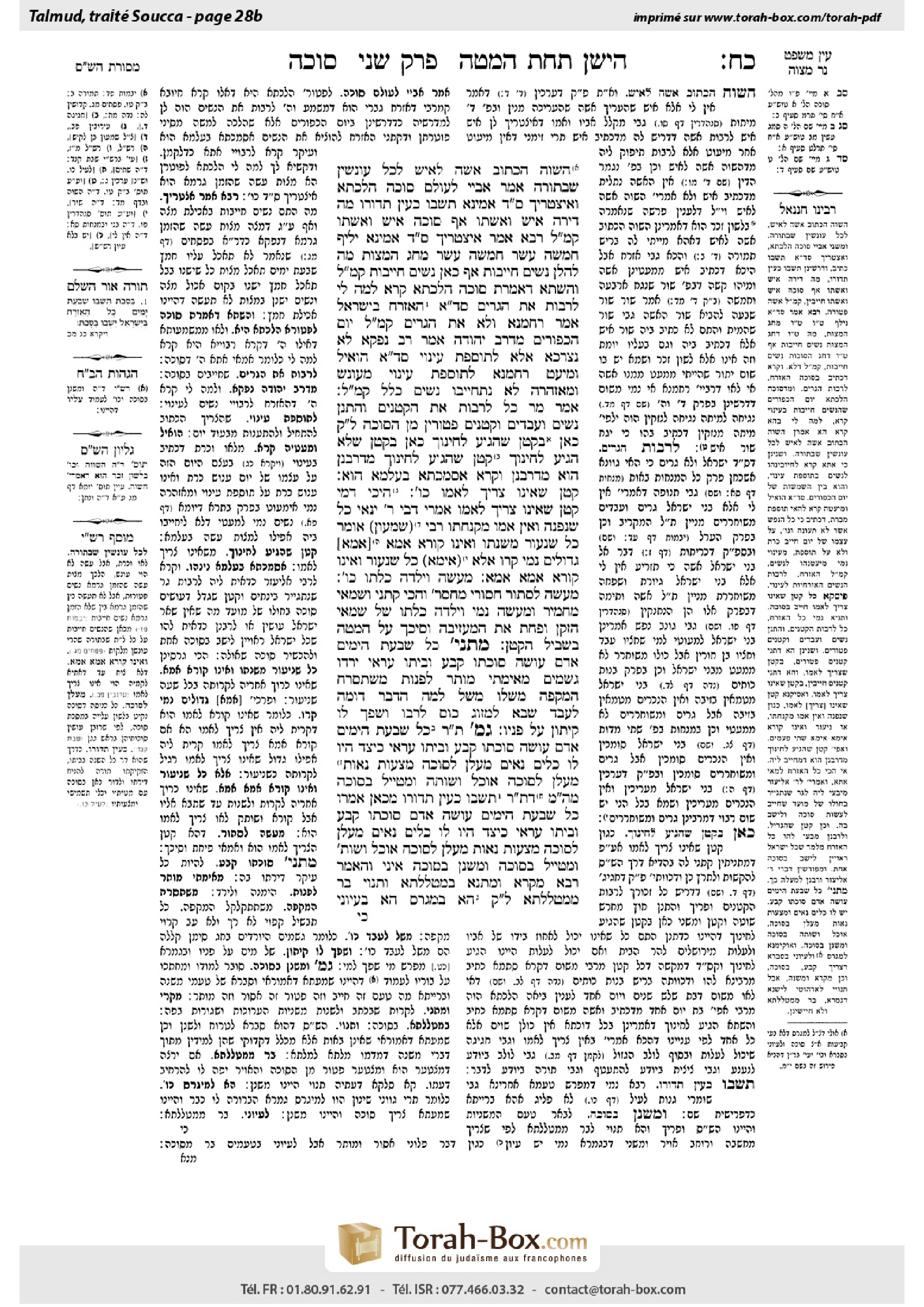
Sukkah 28b: Talmud study for Daf Yomi
Daf Yomi is the daily study of one Talmud folio. Explore 37 tractates with scans, Hebrew text, Sefaria English and AI-generated French translations where annotated.
Passage selection and English or AI-generated French translation are available where the scan has annotations. Daf Study is independent of Torah-Box and Sefaria.
Browse Sukkah · סוכה · All tractatesSukkah 28b text and translations
This page of Sukkah includes the Aramaic text, an English translation and an AI-generated French translation, alongside the scan above.
סוכה כ״ח ב · Aramaic and Hebrew text
הִשְׁוָה הַכָּתוּב אִשָּׁה לְאִישׁ לְכׇל עוֹנָשִׁין שֶׁבַּתּוֹרָה. אָמַר אַבָּיֵי: לְעוֹלָם סוּכָּה הִלְכְתָא, וְאִיצְטְרִיךְ. סָלְקָא דַּעְתָּךְ אָמֵינָא ״תֵּשְׁבוּ״ — כְּעֵין תָּדוּרוּ, מָה דִּירָה — אִישׁ וְאִשְׁתּוֹ, אַף סוּכָּה — אִישׁ וְאִשְׁתּוֹ, קָא מַשְׁמַע לַן.
רָבָא אָמַר: אִיצְטְרִיךְ, סָלְקָא דַּעְתָּךְ אָמֵינָא יָלֵיף ״חֲמִשָּׁה עָשָׂר״ ״חֲמִשָּׁה עָשָׂר״ מֵחַג הַמַּצּוֹת. מָה לְהַלָּן — נָשִׁים חַיָּיבוֹת, אַף כָּאן — נָשִׁים חַיָּיבוֹת. קָא מַשְׁמַע לַן.
וְהַשְׁתָּא דְּאָמְרַתְּ סוּכָּה הִלְכְתָא, קָרָא לְמָה לִי? לְרַבּוֹת אֶת הַגֵּרִים. סָלְקָא דַּעְתָּךְ אָמֵינָא: ״הָאֶזְרָח בְּיִשְׂרָאֵל״ אָמַר רַחֲמָנָא — וְלֹא אֶת הַגֵּרִים, קָא מַשְׁמַע לַן.
יוֹם הַכִּפּוּרִים מִדְּרַב יְהוּדָה אָמַר רַב נָפְקָא. לֹא נִצְרְכָא אֶלָּא לְתוֹסֶפֶת עִינּוּי. סָלְקָא דַּעְתָּךְ אָמֵינָא: הוֹאִיל וּמִיעֵט רַחֲמָנָא לְתוֹסֶפֶת עִינּוּי מֵעוֹנֶשׁ וּמֵאַזְהָרָה, לֹא נִתְחַיְּיבוּ נָשִׁים כְּלָל, קָא מַשְׁמַע לַן.
אָמַר מָר: ״כׇּל״ לְרַבּוֹת אֶת הַקְּטַנִּים. וְהָתְנַן: נָשִׁים וַעֲבָדִים וּקְטַנִּים פְּטוּרִין מִן הַסּוּכָּה! לָא קַשְׁיָא כָּאן — בְּקָטָן שֶׁהִגִּיעַ לְחִינּוּךְ, כָּאן — בְּקָטָן שֶׁלֹּא הִגִּיעַ לְחִינּוּךְ. קָטָן שֶׁהִגִּיעַ לְחִינּוּךְ מִדְּרַבָּנַן הוּא! מִדְּרַבָּנַן, וּקְרָא — אַסְמַכְתָּא בְּעָלְמָא הוּא.
קָטָן שֶׁאֵינוֹ צָרִיךְ לְאִמּוֹ כּוּ׳. הֵיכִי דָּמֵי קָטָן שֶׁאֵינוֹ צָרִיךְ לְאִמּוֹ? אָמְרִי דְּבֵי רַבִּי יַנַּאי: כֹּל שֶׁנִּפְנֶה וְאֵין אִמּוֹ מְקַנַּחְתּוֹ. רַבִּי (שִׁמְעוֹן) אוֹמֵר: כׇּל שֶׁנֵּעוֹר מִשְּׁנָתוֹ וְאֵינוֹ קוֹרֵא ״אִמָּא, [אִמָּא]!״ גְּדוֹלִים נָמֵי קָרוּ? אֶלָּא: (אֵימָא) כָּל שֶׁנֵּעוֹר וְאֵינוֹ קוֹרֵא: ״אִמָּא, אִמָּא!״.
מַעֲשֶׂה וְיָלְדָה כַּלָּתוֹ כּוּ׳. מַעֲשֶׂה לִסְתּוֹר? חַסּוֹרֵי מְחַסְּרָא וְהָכִי קָתָנֵי: וְשַׁמַּאי מַחְמִיר, וּמַעֲשֶׂה נָמֵי וְיָלְדָה כַּלָּתוֹ שֶׁל שַׁמַּאי הַזָּקֵן, וּפִחֵת אֶת הַמַּעֲזִיבָה וְסִיכֵּךְ עַל הַמִּטָּה בִּשְׁבִיל הַקָּטָן.
מַתְנִי׳ כׇּל שִׁבְעַת הַיָּמִים אָדָם עוֹשֶׂה סוּכָּתוֹ קֶבַע, וּבֵיתוֹ עֲרַאי. יָרְדוּ גְּשָׁמִים, מֵאֵימָתַי מוּתָּר לְפַנּוֹת — מִשֶּׁתִּסְרַח הַמִּקְפָּה. מָשְׁלוּ מָשָׁל לְמָה הַדָּבָר דּוֹמֶה — לְעֶבֶד שֶׁבָּא לִמְזוֹג כּוֹס לְרַבּוֹ, וְשָׁפַךְ לוֹ קִיתוֹן עַל פָּנָיו.
גְּמָ׳ תָּנוּ רַבָּנַן: כׇּל שִׁבְעַת הַיָּמִים אָדָם עוֹשֶׂה סוּכָּתוֹ קֶבַע וּבֵיתוֹ עֲרַאי, כֵּיצַד? הָיוּ לוֹ כֵּלִים נָאִים מַעֲלָן לַסּוּכָּה, מַצָּעוֹת נָאוֹת — מַעֲלָן לַסּוּכָּה, אוֹכֵל וְשׁוֹתֶה וּמְטַיֵּיל בַּסּוּכָּה. מְנָא הָנֵי מִילֵּי? דְּתָנוּ רַבָּנַן: ״תֵּשְׁבוּ״ — כְּעֵין תָּדוּרוּ, מִכָּאן אָמְרוּ: כׇּל שִׁבְעַת הַיָּמִים עוֹשֶׂה אָדָם סוּכָּתוֹ קֶבַע וּבֵיתוֹ עֲרַאי. כֵּיצַד? הָיוּ לוֹ כֵּלִים נָאִים — מַעֲלָן לַסּוּכָּה, מַצָּעוֹת נָאוֹת — מַעֲלָן לַסּוּכָּה, אוֹכֵל וְשׁוֹתֶה וּמְטַיֵּיל בַּסּוּכָּה וּמְשַׁנֵּן בַּסּוּכָּה.
אִינִי?! וְהָאָמַר רָבָא: מִקְרָא וּמִתְנֵא בִּמְטַלַּלְתָּא, וְתַנּוֹיֵי בַּר מִמְּטַלַּלְתָּא! לָא קַשְׁיָא: הָא — בְּמִגְרַס, הָא — בְּעַיּוֹנֵי.
Sukkah 28b · English translation
The verse equated a woman to a man with regard to all punishments and prohibitions in the Torah. The mitzvot of Yom Kippur include prohibitions, as well as the punishment of karet. Why, then, was this additional derivation necessary? Abaye said: Actually, sukka is a halakha transmitted to Moses from Sinai. Nevertheless, it was necessary to teach that a woman is exempt from the mitzva of sukka, as it might enter your mind to say: “Shall you reside” (Leviticus 23:42) indicates that you reside in the sukka as you dwell; just as dwelling is typically performed by a man and his wife, so too, the mitzva of sukka is performed by both a man and his wife. Therefore, it teaches us that women are exempt.
Rava said a different reason: A halakha transmitted to Moses from Sinai was necessary to teach that a woman is exempt from the mitzva of sukka, as it might enter your mind to say: Derive a verbal analogy with regard to Sukkot, about which it is written: “On the fifteenth day of this seventh month is the festival of Sukkot” (Leviticus 23:34), from Passover, about which it is written: “And on the fifteenth day of the same month is the festival of matzot” (Leviticus 23:6). Just as there, women are obligated to eat matza on Passover even though it is a time-bound mitzva, so too here, with regard to the mitzva of sukka, women are obligated. Therefore, the halakha transmitted to Moses from Sinai teaches us that they are exempt.
The Gemara asks: And now that you said that women’s exemption from the mitzva of sukka is a halakha transmitted to Moses from Sinai, why do I need the definite article stated in the verse in the term “the homeborn”? The Gemara answers: This verse comes to include converts, as it might enter your mind to say that the Merciful One says: “The homeborn in Israel,” indicating that only homeborn Jews are included and not the converts. Therefore, the verse teaches us that converts are also obligated.
The Gemara asks: The obligation of women to fast on Yom Kippur is derived from the statement that Rav Yehuda said that Rav said. In that case, why do I need the definite article in the term: The homeborn? The Gemara answers: That phrase was needed only to include women in the extension of the period of affliction on Yom Kippur eve, as it might enter your mind to say: Since the Merciful One excludes one who violates the obligation to afflict himself during the extension of the period of affliction from the punishment of karet and from the Torah prohibition, women should not be obligated to observe that period at all. Their obligation to observe Yom Kippur is based on the principle: The verse equated a woman to a man with regard to all punishments and prohibitions in the Torah. Since there is neither punishment nor Torah prohibition during that period, women should be exempt. Therefore, the verse teaches us that since they are obligated to observe Yom Kippur, they are obligated to observe the extension of Yom Kippur as well.
The Master said in the baraita: “All the homeborn” comes to include the minors capable of performing this mitzva. The Gemara asks: Didn’t we learn in the mishna: Women and slaves and minors are exempt from the mitzva of sukka? The Gemara answers: This is not difficult. Here, in the baraita where it is taught that minors are included, it is referring to a minor who reached the age of training, whose parents are commanded to train him in the performance of mitzvot and to accustom him to fulfill them. Here, in the mishna where it stated that the minor is exempt, it is referring to a minor who did not yet reach the age of training. The Gemara asks: The obligation of a minor who reached the age of training to perform mitzvot is by rabbinic law, and therefore it is not derived from a verse. The Gemara answers: Indeed, the obligation of the minor is by rabbinic law as part of his training, and the verse is a mere support alluding to that obligation.
The mishna continues: A minor who does not need his mother any longer is obligated in the mitzva of sukka. The Gemara asks: What are the circumstances of a minor who does not need his mother? In the school of Rabbi Yannai they said: This is referring to any child who defecates and his mother does not need to wipe him. Rabbi Shimon says: It is any child who awakens from his sleep and does not call: Mother, mother. The Gemara asks: Older children also call for their mother when they arise; what, then, is the criterion? The Gemara answers: Rather, say that any child who awakens and does not call: Mother, mother, repeatedly until his mother comes is characterized as one who does not need his mother. An older child will cry once. However, if his mother does not come, he will tend to himself.
The mishna relates: There was an incident where the daughter-in-law of Shammai the Elder gave birth and he removed part of the roof so the baby would be in a sukka. The Gemara asks: Does the mishna cite an incident to contradict the preceding halakha that minors that are not independent are exempt from the mitzva of sukka? The Gemara answers: The mishna is incomplete, and it teaches the following: And Shammai is stringent even with very small children; and there was also an incident and the daughter-in-law of Shammai the Elder gave birth and Shammai removed the coat of plaster from the roof and left the beams and roofed with the beams over the bed for the newborn minor.
MISHNA: All seven days of Sukkot, a person renders his sukka his permanent residence and his house his temporary residence. If rain fell, from when is it permitted to vacate the sukka? It is permitted from the point that it is raining so hard that the congealed dish will spoil. The Sages told a parable: To what is this matter comparable? It is comparable to a servant who comes to pour wine for his master, and he pours a jug [kiton] of water in his face to show him that his presence is not desired. So too, in the sukka, rain is an indication that the Holy One, Blessed be He, does not want the person to fulfill the mitzva of sukka.
GEMARA: The Sages taught: All seven days of Sukkot, a person renders his sukka his permanent residence and his house his temporary residence. How so? If he has beautiful vessels, he takes them up to the sukka, which was typically built on the roof. If he has beautiful bedding, he takes it up to the sukka. He eats and drinks and relaxes in the sukka. The Gemara asks: From where are these matters derived? The Gemara explains that it is as the Sages taught: “In sukkot shall you reside” (Leviticus 23:42), and they interpreted: Reside as you dwell in your permanent home. From here they said: All seven days, a person renders his sukka his permanent residence and his house his temporary residence. How so? If he has beautiful vessels, he takes them up to the sukka; if he has beautiful bedding, he takes it up to the sukka; he eats and drinks and relaxes in the sukka and studies Torah in the sukka.
With regard to studying Torah in the sukka, the Gemara asks: Is that so? Didn’t Rava say: Studying Bible and studying Mishna are undertaken in the sukka; however, analyzing the Mishna must be undertaken outside the sukka. This indicates that one should not analyze Torah in the sukka. The Gemara answers: It is not difficult. This baraita, where it was taught that one studies in the sukka, is with regard to extensive study, i.e., broad study and memorization. That statement of Rava that one should study outside the sukka is with regard to intensive study; such study requires an environment where one can concentrate properly in order to engage in analysis of the Mishna.
Sukkah 28b · Traduction française (IA)
Le verset a assimilé la femme à l’homme en ce qui concerne toutes les sanctions et toutes les interdictions de la Torah. Les mitsvot de Yom Kippour comprennent des interdictions ainsi que la sanction du karet. Pourquoi, dès lors, cette déduction supplémentaire était-elle nécessaire ? Abaye dit : En réalité, la soukka relève d’une halakha transmise à Moïse au Sinaï. Il fallait néanmoins enseigner que la femme est exemptée de la mitsva de la soukka, car on aurait pu penser que l’expression « vous résiderez » (Lévitique 23:42) signifie que l’on réside dans la soukka comme on habite chez soi ; de même que l’on habite généralement avec son épouse, la mitsva de la soukka serait elle aussi accomplie par l’homme et son épouse. Le verset nous enseigne donc que les femmes en sont exemptées.
Rava donne une autre raison : une halakha transmise à Moïse au Sinaï était nécessaire pour enseigner que la femme est exemptée de la mitsva de la soukka, car on aurait pu penser qu’il fallait établir une analogie verbale entre Soukkot, au sujet desquelles il est écrit : « Le quinzième jour de ce septième mois est la fête de Soukkot » (Lévitique 23:34), et Pessa’h, au sujet duquel il est écrit : « Et le quinzième jour de ce mois est la fête des matsot » (Lévitique 23:6). De même que, dans ce dernier cas, les femmes ont l’obligation de manger de la matsa à Pessa’h, bien qu’il s’agisse d’une mitsva liée au temps, de même, ici, en ce qui concerne la mitsva de la soukka, les femmes seraient obligées. La halakha transmise à Moïse au Sinaï nous enseigne donc qu’elles en sont exemptées.
La Guemara demande : Maintenant que tu as dit que l’exemption des femmes de la mitsva de la soukka relève d’une halakha transmise à Moïse au Sinaï, pourquoi le verset emploie-t-il l’article défini dans l’expression « l’indigène » ? La Guemara répond : Ce verset vient inclure les convertis, car on aurait pu penser que le Miséricordieux dit : « L’indigène en Israël », indiquant que seuls les Juifs nés en Israël sont concernés, et non les convertis. Le verset nous enseigne donc que les convertis sont eux aussi obligés.
La Guemara demande : L’obligation des femmes de jeûner à Yom Kippour est déduite de ce que Rav Yehouda a dit au nom de Rav. Dans ce cas, pourquoi l’article défini est-il nécessaire dans l’expression « l’indigène » ? La Guemara répond : Cette expression était nécessaire uniquement pour inclure les femmes dans la prolongation de la période d’affliction, à la veille de Yom Kippour. En effet, on aurait pu penser que, puisque le Miséricordieux exclut de la sanction du karet et de l’interdiction de la Torah celui qui ne respecte pas l’obligation de s’affliger pendant cette période prolongée, les femmes ne devraient pas être tenues de l’observer. Leur obligation d’observer Yom Kippour repose sur le principe selon lequel le verset a assimilé la femme à l’homme en ce qui concerne toutes les sanctions et toutes les interdictions de la Torah. Puisqu’il n’y a ni sanction ni interdiction de la Torah pendant cette période, les femmes devraient en être exemptées. Le verset nous enseigne donc que, puisqu’elles sont tenues d’observer Yom Kippour, elles sont également tenues d’observer la période prolongée de Yom Kippour.
Le Maître a dit dans la baraïta : « Tous les indigènes » vient inclure les mineurs capables d’accomplir cette mitsva. La Guemara demande : N’avons-nous pas appris dans la Michna : « Les femmes, les esclaves et les mineurs sont exemptés de la mitsva de la soukka » ? La Guemara répond : Il n’y a pas de difficulté. Ici, dans la baraïta où il est enseigné que les mineurs sont inclus, il s’agit d’un mineur qui a atteint l’âge de l’éducation, dont les parents ont l’obligation de l’éduquer à l’accomplissement des mitsvot et de l’habituer à les observer. Là, dans la Michna qui indique que le mineur est exempté, il s’agit d’un mineur qui n’a pas encore atteint l’âge de l’éducation. La Guemara demande : L’obligation d’accomplir les mitsvot pour un mineur qui a atteint l’âge de l’éducation relève de la loi rabbinique et ne peut donc pas être déduite d’un verset. La Guemara répond : En effet, l’obligation du mineur relève de la loi rabbinique dans le cadre de son éducation, et le verset n’est qu’un appui qui fait allusion à cette obligation.
La Michna poursuit : Un mineur qui n’a plus besoin de sa mère est tenu d’accomplir la mitsva de la soukka. La Guemara demande : Dans quelles circonstances un mineur n’a-t-il plus besoin de sa mère ? À l’école de Rabbi Yannai, on dit : Il s’agit de tout enfant qui fait ses besoins et que sa mère n’a pas besoin d’essuyer. Rabbi Chimon dit : Il s’agit de tout enfant qui se réveille et n’appelle pas : « Maman, maman. » La Guemara demande : Les enfants plus âgés appellent eux aussi leur mère lorsqu’ils se réveillent ; quel est donc le critère ? La Guemara répond : Il faut plutôt dire qu’un enfant qui se réveille et n’appelle pas « Maman, maman » à plusieurs reprises, jusqu’à ce que sa mère vienne, est considéré comme n’ayant plus besoin de sa mère. Un enfant plus âgé pleurera une fois. Toutefois, si sa mère ne vient pas, il s’occupera de lui-même.
La Michna rapporte : Il est arrivé que la belle-fille de Chammaï l’Ancien accouche et que celui-ci retire une partie du toit afin que le bébé se trouve dans une soukka. La Guemara demande : La Michna rapporte-t-elle un incident qui contredit la halakha précédente, selon laquelle les mineurs qui ne sont pas autonomes sont exemptés de la mitsva de la soukka ? La Guemara répond : La Michna est incomplète et enseigne ceci : Chammaï est même strict à l’égard des très jeunes enfants. Il est également arrivé que la belle-fille de Chammaï l’Ancien accouche et que Chammaï retire l’enduit du toit, en laissant les poutres, puis couvre le lit de poutres pour le nouveau-né.
MICHNA : Pendant les sept jours de Soukkot, on fait de sa soukka sa résidence permanente et de sa maison sa résidence temporaire. S’il pleut, à partir de quel moment est-il permis de quitter la soukka ? Cela est permis dès qu’il pleut si fort que le plat en sauce se gâte. Les Sages ont proposé une parabole : À quoi cette situation ressemble-t-elle ? À un serviteur qui vient verser du vin à son maître, et celui-ci lui verse une cruche [kiton] d’eau au visage pour lui montrer que sa présence n’est pas souhaitée. De même, dans la soukka, la pluie indique que le Saint, béni soit-Il, ne veut pas que la personne accomplisse la mitsva de la soukka.
GUEMARA : Les Sages ont enseigné : Pendant les sept jours de Soukkot, on fait de sa soukka sa résidence permanente et de sa maison sa résidence temporaire. Comment cela ? S’il possède de beaux ustensiles, il les monte dans la soukka, qui était généralement construite sur le toit. S’il possède une belle literie, il la monte dans la soukka. Il mange, boit et se détend dans la soukka. La Guemara demande : D’où ces principes sont-ils déduits ? La Guemara explique que c’est ce que les Sages ont enseigné : « Vous résiderez dans des soukkot » (Lévitique 23:42), et ils l’ont interprété ainsi : Résidez comme vous habitez dans votre demeure permanente. De là, ils ont dit : Pendant les sept jours, on fait de sa soukka sa résidence permanente et de sa maison sa résidence temporaire. Comment cela ? S’il possède de beaux ustensiles, il les monte dans la soukka ; s’il possède une belle literie, il la monte dans la soukka ; il mange, boit et se détend dans la soukka, et il étudie la Torah dans la soukka.
Au sujet de l’étude de la Torah dans la soukka, la Guemara demande : Est-ce vraiment le cas ? Rava n’a-t-il pas dit que l’on étudie la Bible et la Michna dans la soukka, mais que l’analyse de la Michna doit se faire en dehors de la soukka ? Cela indique qu’on ne doit pas analyser la Torah dans la soukka. La Guemara répond : Il n’y a pas de difficulté. Cette baraïta, qui enseigne que l’on étudie dans la soukka, concerne une étude étendue, c’est-à-dire une étude générale et la mémorisation. La déclaration de Rava, selon laquelle on doit étudier en dehors de la soukka, concerne une étude approfondie ; celle-ci exige un environnement où l’on peut se concentrer convenablement afin d’analyser la Michna.
Traduction française générée par IA à partir de l’édition anglaise de Sefaria. Vérifie toujours un passage avec le texte source.
Text from Sefaria: William Davidson Edition - Vocalized Aramaic (CC BY NC); William Davidson Edition - English (CC BY NC).