Sukkah 29a: Talmud study for Daf Yomi
Daf Yomi is the daily study of one Talmud folio. Explore 37 tractates with scans, Hebrew text, Sefaria English and AI-generated French translations where annotated.
Passage selection and English or AI-generated French translation are available where the scan has annotations. Daf Study is independent of Torah-Box and Sefaria.
Browse Sukkah · סוכה · All tractatesSukkah 29a text and translations
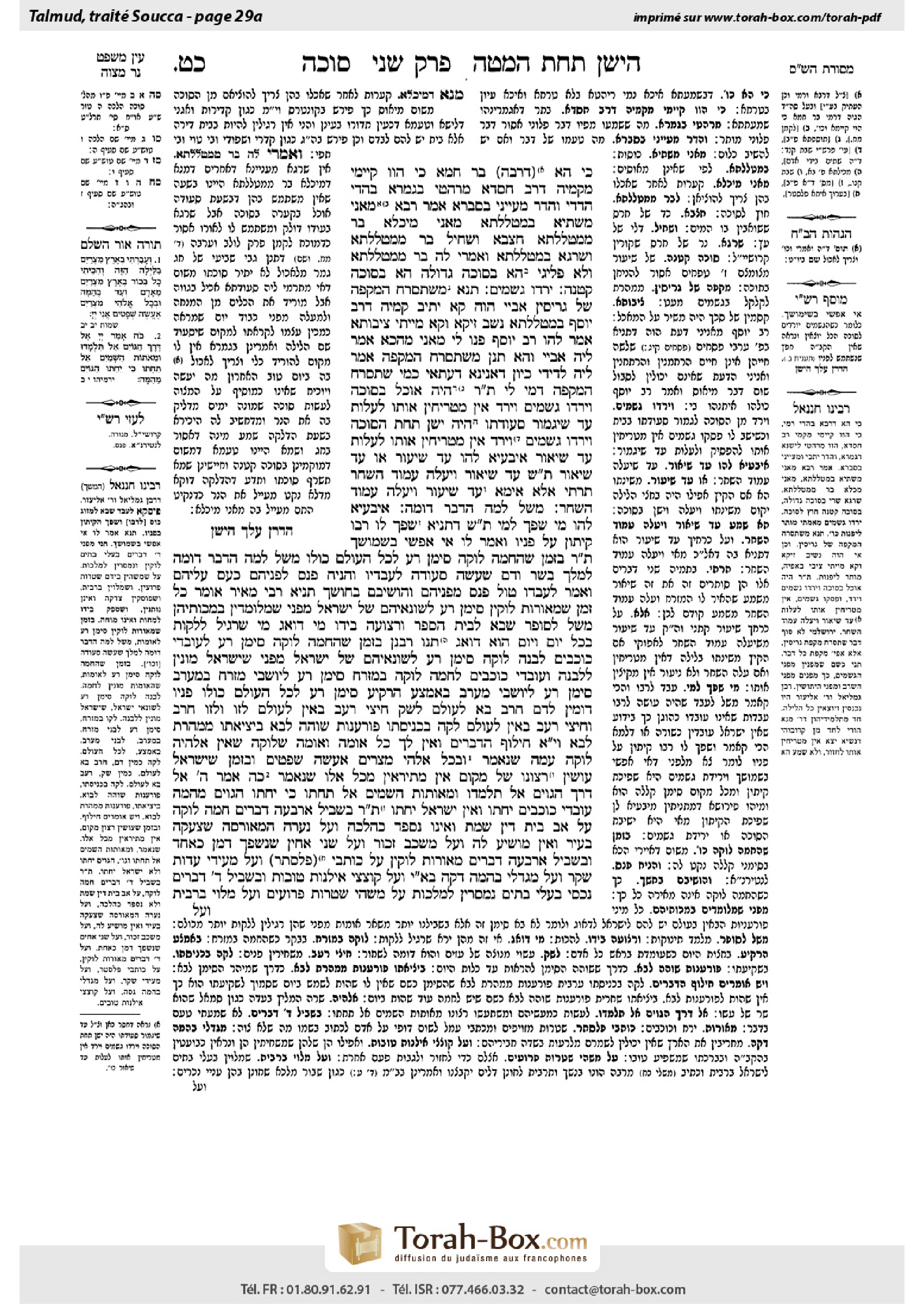
This page of Sukkah includes the Aramaic text, an English translation and an AI-generated French translation, alongside the scan above.
סוכה כ״ט א · Aramaic and Hebrew text
כִּי הָא (דְּרַבָּה) בַּר חָמָא כִּי הֲווֹ קָיְימִי מִקַּמֵּיהּ דְּרַב חִסְדָּא מַרְהֲטִי בִּגְמָרָא בַּהֲדֵי הֲדָדֵי, וַהֲדַר מְעַיְּינִי בִּסְבָרָא.
אָמַר רָבָא: מָאנֵי מִשְׁתְּיָא — בִּמְטַלַּלְתָּא, מָאנֵי מֵיכְלָא — בַּר מִמְּטַלַּלְתָּא. חַצְבָּא וְשָׁחֵיל — בַּר מִמְּטַלַּלְתָּא, וּשְׁרָגָא — בִּמְטַלַּלְתָּא. וְאָמְרִי לַהּ: בַּר מִמְּטַלַּלְתָּא. וְלָא פְּלִיגִי: הָא — בְּסוּכָּה גְּדוֹלָה, הָא — בְּסוּכָּה קְטַנָּה.
יָרְדוּ גְּשָׁמִים. תָּנָא: מִשֶּׁתִּסְרַח הַמִּקְפָּה שֶׁל גְּרִיסִין.
אַבָּיֵי הֲוָה קָא יָתֵיב קַמֵּיהּ דְּרַב יוֹסֵף בִּמְטַלַּלְתָּא, נְשַׁב זִיקָא וְקָא מַיְיתֵי צִיבְוָתָא. אֲמַר לְהוּ רַב יוֹסֵף: פַּנּוּ לִי מָאנַי מֵהָכָא. אֲמַר לֵיהּ אַבָּיֵי, וְהָא תְּנַן: מִשֶּׁתִּסְרַח הַמִּקְפָּה! אֲמַר לֵיהּ: לְדִידִי, כֵּיוָן דַּאֲנִינָא דַּעְתַּאי — כְּמִי שֶׁתִּסְרַח הַמִּקְפָּה דָּמֵי לִי.
תָּנוּ רַבָּנַן: הָיָה אוֹכֵל בַּסּוּכָּה וְיָרְדוּ גְּשָׁמִים וְיָרַד — אֵין מַטְרִיחִין אוֹתוֹ לַעֲלוֹת עַד שֶׁיִּגְמוֹר סְעוּדָּתוֹ. הָיָה יָשֵׁן תַּחַת הַסּוּכָּה וְיָרְדוּ גְּשָׁמִים וְיָרַד — אֵין מַטְרִיחִין אוֹתוֹ לַעֲלוֹת עַד שֶׁיֵּאוֹר.
אִיבַּעְיָא לְהוּ: עַד שֶׁיֵּעוֹר אוֹ עַד שֶׁיֵּאוֹר? תָּא שְׁמַע: עַד שֶׁיֵּאוֹר וְיַעֲלֶה עַמּוּד הַשַּׁחַר. תַּרְתֵּי?! אֶלָּא אֵימָא: עַד שֶׁיֵּעוֹר וְיַעֲלֶה עַמּוּד הַשַּׁחַר.
מָשָׁל לְמָה הַדָּבָר דּוֹמֶה. אִיבַּעְיָא לְהוּ: מִי שָׁפַךְ לְמִי? תָּא שְׁמַע דְּתַנְיָא: שָׁפַךְ לוֹ רַבּוֹ קִיתוֹן עַל פָּנָיו, וְאָמַר לוֹ: אִי אֶפְשִׁי בְּשִׁמּוּשֶׁךָ.
תָּנוּ רַבָּנַן: בִּזְמַן שֶׁהַחַמָּה לוֹקָה — סִימָן רַע לְכׇל הָעוֹלָם כּוּלּוֹ. מָשָׁל לְמָה הַדָּבָר דּוֹמֶה? לְמֶלֶךְ בָּשָׂר וָדָם שֶׁעָשָׂה סְעוּדָּה לַעֲבָדָיו וְהִנִּיחַ פָּנָס לִפְנֵיהֶם, כָּעַס עֲלֵיהֶם וְאָמַר לְעַבְדּוֹ: טוֹל פָּנָס מִפְּנֵיהֶם וְהוֹשִׁיבֵם בַּחוֹשֶׁךְ.
תַּנְיָא רַבִּי מֵאִיר אוֹמֵר: כׇּל זְמַן שֶׁמְּאוֹרוֹת לוֹקִין — סִימָן רַע לְשׂוֹנְאֵיהֶם שֶׁל יִשְׂרָאֵל, מִפְּנֵי שֶׁמְּלוּמָּדִין בְּמַכּוֹתֵיהֶן. מָשָׁל לְסוֹפֵר שֶׁבָּא לְבֵית הַסֵּפֶר וּרְצוּעָה בְּיָדוֹ, מִי דּוֹאֵג — מִי שֶׁרָגִיל לִלְקוֹת בְּכׇל יוֹם וָיוֹם הוּא דּוֹאֵג.
תָּנוּ רַבָּנַן: בִּזְמַן שֶׁהַחַמָּה לוֹקָה — סִימָן רַע לַגּוֹיִם. לְבָנָה לוֹקָה — סִימָן רַע לְשׂוֹנְאֵיהֶם שֶׁל יִשְׂרָאֵל. מִפְּנֵי שֶׁיִּשְׂרָאֵל מוֹנִין לַלְּבָנָה, וְגוֹיִם לַחַמָּה. לוֹקָה בַּמִּזְרָח — סִימָן רַע לְיוֹשְׁבֵי מִזְרָח. בַּמַּעֲרָב — סִימָן רַע לְיוֹשְׁבֵי מַעֲרָב. בְּאֶמְצַע הָרָקִיעַ — סִימָן רַע לְכׇל הָעוֹלָם כּוּלּוֹ.
פָּנָיו דּוֹמִין לְדָם — חֶרֶב בָּא לָעוֹלָם. לְשַׂק — חִיצֵּי רָעָב בָּאִין לָעוֹלָם. לָזוֹ וְלָזוֹ — חֶרֶב וְחִיצֵּי רָעָב בָּאִין לָעוֹלָם. לָקָה בִּכְנִיסָתוֹ — פּוּרְעָנוּת שׁוֹהָה לָבֹא. בִּיצִיאָתוֹ — מְמַהֶרֶת לָבֹא. וְיֵשׁ אוֹמְרִים חִילּוּף הַדְּבָרִים.
וְאֵין לְךָ כׇּל אוּמָּה וְאוּמָּהּ שֶׁלּוֹקָה, שֶׁאֵין אֱלֹהֶיהָ לוֹקֶה עִמָּהּ, שֶׁנֶּאֱמַר: ״וּבְכׇל אֱלֹהֵי מִצְרַיִם אֶעֱשֶׂה שְׁפָטִים״. וּבִזְמַן שֶׁיִּשְׂרָאֵל עוֹשִׂין רְצוֹנוֹ שֶׁל מָקוֹם אֵין מִתְיָרְאִין מִכׇּל אֵלּוּ, שֶׁנֶּאֱמַר: ״כֹּה אָמַר ה׳ אֶל דֶּרֶךְ הַגּוֹיִם אַל תִּלְמָדוּ וּמֵאוֹתוֹת הַשָּׁמַיִם אַל תֵּחָתּוּ כִּי יֵחַתּוּ הַגּוֹיִם מֵהֵמָּה״ — גּוֹיִם יֵחַתּוּ, וְאֵין יִשְׂרָאֵל יֵחַתּוּ.
תָּנוּ רַבָּנַן: בִּשְׁבִיל אַרְבָּעָה דְּבָרִים חַמָּה לוֹקָה: עַל אָב בֵּית דִּין שֶׁמֵּת וְאֵינוֹ נִסְפָּד כַּהֲלָכָה, וְעַל נַעֲרָה הַמְאוֹרָסָה שֶׁצָּעֲקָה בָּעִיר וְאֵין מוֹשִׁיעַ לָהּ, וְעַל מִשְׁכַּב זְכוּר, וְעַל שְׁנֵי אַחִין שֶׁנִּשְׁפַּךְ דָּמָן כְּאֶחָד.
וּבִשְׁבִיל אַרְבָּעָה דְּבָרִים מְאוֹרוֹת לוֹקִין: עַל כּוֹתְבֵי פְלַסְתֵּר, וְעַל מְעִידֵי עֵדוּת שֶׁקֶר, וְעַל מְגַדְּלֵי בְּהֵמָה דַּקָּה בְּאֶרֶץ יִשְׂרָאֵל, וְעַל קוֹצְצֵי אִילָנוֹת טוֹבוֹת.
וּבִשְׁבִיל אַרְבָּעָה דְּבָרִים נִכְסֵי בַּעֲלֵי בָתִּים נִמְסָרִין לַמַּלְכוּת: עַל מַשְׁהֵי שְׁטָרוֹת פְּרוּעִים, וְעַל מַלְוֵי בְּרִבִּית,
Sukkah 29a · English translation
As in that situation involving Rava and Rami bar Ḥama, when they would stand before Rav Ḥisda, after he taught them a halakha they would quickly review the tradition that they heard from him together and only then analyze the rationale of the tradition that they had received. Apparently, in the study of Mishna and the amoraic commentary on the Mishna there is a distinction between extensive and intensive study.
With regard to residence in the sukka, Rava said: Drinking vessels such as cups, which are usually clean, remain in the sukka. Eating vessels are taken out of the sukka after use. An earthenware jug and a wicker basket [shaḥil ] that are used for drawing water are taken outside the sukka. And a lamp remains inside the sukka, and some say it is taken outside the sukka. The Gemara comments: And they do not disagree. Rather, this opinion, that a lamp remains inside the sukka, is referring to a large sukka, where the lamp and its odor do not disturb those residing in the sukka. And that opinion, that the lamp is taken outside the sukka, is referring to a small sukka, where the lamp’s odor is offensive.
§ The mishna stated: If rain fell, it is permitted to leave the sukka from the point that it is raining so hard that the congealed dish will spoil. It was taught in the Tosefta: The measure is from when a congealed dish of pounded grain, a dish ruined by even slight rainfall, will spoil.
Abaye was sitting before Rav Yosef in the sukka. The wind blew and brought with it splinters from the roofing, and they fell onto the food. Rav Yosef said to him: Vacate my vessels from here, and I will eat in the house. Abaye said to him: Didn’t we learn in the mishna that one remains in the sukka until the congealed dish will spoil? That is not yet the case. He said to him: For me, since I am delicate, this situation is as if the congealed dish will spoil.
The Sages taught: If one was eating in the sukka, and rain fell, and he descended from the sukka on the roof to eat in his house, one does not burden him to ascend back to the sukka once the rain ceases until after he finishes his meal. Similarly, if one was sleeping under the roofing of the sukka, and rain fell, and he descended to sleep in the house, one does not burden him to ascend back to the sukka once the rain ceases; rather, he may sleep in the house until it becomes light.
A dilemma was raised before the Sages: Is the correct reading of the baraita: Until one awakens [sheyeor], spelled with an ayin, and once he awakens he returns to the sukka even in the middle of the night? Or is the correct reading: Until it becomes light [sheyeor], spelled with an alef, and he need not return to the sukka until morning? Come and hear a proof that will resolve the matter from a related baraita: One need not return to the sukka until it becomes light [sheyeor], spelled with an alef, and dawn arrives. The Gemara asks: Why did the baraita repeat the arrival of light two times (Ritva)? Rather, say instead: Until he awakens [sheyeor], spelled with an ayin, and the dawn arrives. Both of the readings are accurate, as until one awakens and it becomes light he may remain in the house.
§ The mishna continues: The Sages told a parable: To what is this matter comparable? It is comparable to a servant who comes to pour wine for his master, and he pours a jug of water in his face. A dilemma was raised before the Sages: Who poured the water in whose face? Come and hear a proof, as it is taught explicitly in a baraita: His master poured a jug of water on his face and said to him: I do not want your service.
Apropos the fact that rain on Sukkot is an indication of divine rebuke, the Gemara cites several related topics. The Sages taught: When the sun is eclipsed it is a bad omen for the entire world. The Gemara tells a parable. To what is this matter comparable? It is comparable to a king of flesh and blood who prepared a feast for his servants and placed a lantern [panas] before them to illuminate the hall. He became angry at them and said to his servant: Take the lantern from before them and seat them in darkness.
It is taught in a baraita that Rabbi Meir says: When the heavenly lights, i.e., the sun and the moon, are eclipsed, it is a bad omen for the enemies of the Jewish people, which is a euphemism for the Jewish people, because they are experienced in their beatings. Based on past experience, they assume that any calamity that afflicts the world is directed at them. The Gemara suggests a parable: This is similar to a teacher who comes to the school with a strap in his hand. Who worries? The child who is accustomed to be beaten each and every day is the one who worries.
The Sages taught in another baraita: When the sun is eclipsed, it is a bad omen for the other nations. When the moon is eclipsed, it is a bad omen for the enemies of the Jewish people. This is due to the fact that the Jewish people calculate their calendar primarily based on the moon, and the other nations calculate based on the sun. When the sun is eclipsed in the east, it is a bad omen for the residents of the lands of the east. When it is eclipsed in the west, it is a bad omen for the residents of the lands of the west. When it is eclipsed in the middle of the sky, it is a bad omen for the entire world.
If, during an eclipse, the visage of the sun is red like blood, it is an omen that sword, i.e., war, is coming to the world. If the sun is black like sackcloth made of dark goat hair, it is an omen that arrows of hunger are coming to the world, because hunger darkens people’s faces. When it is similar both to this, to blood, and to that, to sackcloth, it is a sign that both sword and arrows of hunger are coming to the world. If it was eclipsed upon its entry, soon after rising, it is an omen that calamity is tarrying to come. If the sun is eclipsed upon its departure at the end of the day, it is an omen that calamity is hastening to come. And some say the matters are reversed: An eclipse in the early morning is an omen that calamity is hastening, while an eclipse in the late afternoon is an omen that calamity is tarrying.
The Sages said: There is no nation that is afflicted whose god is not afflicted with it, as it is stated: “And against all the gods of Egypt I will mete out judgment; I am God” (Exodus 12:12). The Gemara adds: When the Jewish people perform God’s will, they need not fear any of these omens, as it is stated: “Thus says the Lord: Learn not the way of the nations, and be not dismayed at the signs of Heaven; for the nations are dismayed at them” (Jeremiah 10:2). The nations will be dismayed, but the Jewish people will not be dismayed, provided they do not follow the ways of the nations.
The Sages taught that on account of four matters the sun is eclipsed: On account of a president of the court who dies and is not eulogized appropriately, and the eclipse is a type of eulogy by Heaven; on account of a betrothed young woman who screamed in the city that she was being raped and there was no one to rescue her; on account of homosexuality; and on account of two brothers whose blood was spilled as one.
And on account of four matters the heavenly lights are eclipsed: On account of forgers of a fraudulent document [pelaster] that is intended to discredit others; on account of testifiers of false testimony; on account of raisers of small domesticated animals in Eretz Yisrael in a settled area; and on account of choppers of good, fruit-producing trees.
And on account of four matters the property of homeowners is delivered to the monarchy as punishment: On account of those keepers of paid promissory notes, who keep these documents instead of tearing them or returning them to the borrowers, as that would allow the lender to collect money with the note a second time; and on account of lenders with interest;
Sukkah 29a · Traduction française (IA)
Comme dans l’épisode de Rava et de Rami bar Ḥama : lorsqu’ils se tenaient devant Rav Ḥisda, après que celui-ci leur avait enseigné une halakha, ils révisaient rapidement ensemble la tradition qu’ils avaient entendue de lui, et ce n’est qu’ensuite qu’ils en analysaient le raisonnement. Il apparaît donc que, dans l’étude de la Michna et du commentaire amoraïque sur la Michna, il existe une distinction entre l’étude extensive et l’étude approfondie.
Concernant le séjour dans la soukka, Rava a dit : les récipients à boire, tels que les coupes, qui sont généralement propres, restent dans la soukka. Les ustensiles servant à manger sont sortis de la soukka après usage. Une cruche en terre cuite et un panier d’osier [shaḥil] servant à puiser de l’eau sont sortis de la soukka. Une lampe reste dans la soukka ; certains disent qu’elle doit en être sortie. La Guemara commente : ils ne sont pas en désaccord. L’avis selon lequel la lampe reste dans la soukka concerne une grande soukka, où la lampe et son odeur ne dérangent pas ceux qui y séjournent. L’avis selon lequel la lampe est sortie de la soukka concerne une petite soukka, où son odeur est désagréable.
§ La Michna a enseigné : s’il a plu, il est permis de quitter la soukka à partir du moment où la pluie est assez forte pour gâter le plat de gruau. Il a été enseigné dans la Tosefta : la mesure est le moment où un plat de céréales pilées, que même une faible pluie suffit à gâter, serait abîmé.
Abayé était assis devant Rav Yossef dans la soukka. Le vent souffla, emportant des copeaux de la couverture végétale, qui tombèrent sur la nourriture. Rav Yossef lui dit : « Sors mes ustensiles d’ici, et je mangerai dans la maison. » Abayé lui dit : « N’avons-nous pas appris dans la Michna qu’on reste dans la soukka jusqu’à ce que le plat de gruau soit gâté ? Ce n’est pas encore le cas. » Il lui répondit : « Pour moi, comme je suis délicat, cette situation équivaut au moment où le plat de gruau serait gâté. »
Les Sages ont enseigné : si quelqu’un mangeait dans la soukka, qu’il s’est mis à pleuvoir et qu’il est descendu du toit de la soukka pour manger dans sa maison, on ne l’oblige pas à remonter dans la soukka lorsque la pluie cesse avant qu’il ait terminé son repas. De même, si quelqu’un dormait sous la couverture végétale de la soukka, qu’il s’est mis à pleuvoir et qu’il est descendu dormir dans la maison, on ne l’oblige pas à remonter dans la soukka lorsque la pluie cesse ; il peut dormir dans la maison jusqu’à ce qu’il fasse jour.
Une question fut posée aux Sages : faut-il lire dans la baraïta « jusqu’à ce qu’il se réveille » [sheyeor], écrit avec un ayin, de sorte qu’une fois réveillé, il retourne dans la soukka même au milieu de la nuit ? Ou faut-il lire « jusqu’à ce qu’il fasse jour » [sheyeor], écrit avec un alef, et il n’a pas besoin de retourner dans la soukka avant le matin ? Viens et entends une preuve qui tranchera la question, tirée d’une baraïta apparentée : il n’a pas besoin de retourner dans la soukka jusqu’à ce qu’il fasse jour [sheyeor], écrit avec un alef, et que l’aube arrive. La Guemara demande : pourquoi la baraïta mentionne-t-elle deux fois l’arrivée du jour (Ritva) ? Il faut plutôt dire : jusqu’à ce qu’il se réveille [sheyeor], écrit avec un ayin, et que l’aube arrive. Les deux lectures sont exactes : tant qu’il ne s’est pas réveillé et qu’il ne fait pas jour, il peut rester dans la maison.
§ La Michna poursuit : Les Sages ont proposé une parabole : à quoi cette situation est-elle comparable ? À un serviteur qui vient verser du vin à son maître, mais lui verse une cruche d’eau au visage. Une question fut posée aux Sages : qui a versé l’eau au visage de qui ? Viens et entends une preuve, car cela est explicitement enseigné dans une baraïta : son maître lui a versé une cruche d’eau au visage et lui a dit : « Je ne veux pas de ton service. »
À propos du fait que la pluie à Soukkot indique une réprimande divine, la Guemara cite plusieurs sujets connexes. Les Sages ont enseigné : une éclipse de soleil est un mauvais présage pour le monde entier. La Guemara propose une parabole : à quoi cette situation est-elle comparable ? À un roi de chair et de sang qui prépare un festin pour ses serviteurs et place devant eux une lanterne [panas] pour éclairer la salle. Il se met en colère contre eux et dit à son serviteur : « Retire la lanterne de devant eux et fais-les asseoir dans l’obscurité. »
Il est enseigné dans une baraïta que Rabbi Meïr dit : lorsque les luminaires célestes, c’est-à-dire le soleil et la lune, sont éclipsés, c’est un mauvais présage pour les ennemis du peuple juif — expression euphémique désignant le peuple juif — car celui-ci est habitué aux coups. Fort de son expérience passée, il suppose que toute calamité qui frappe le monde le vise. La Guemara propose une parabole : cela ressemble à un maître qui arrive à l’école avec une lanière à la main. Qui s’inquiète ? L’enfant habitué à être battu chaque jour est celui qui s’inquiète.
Les Sages ont enseigné dans une autre baraïta : lorsqu’une éclipse de soleil se produit, c’est un mauvais présage pour les autres nations ; lorsqu’une éclipse de lune se produit, c’est un mauvais présage pour les ennemis du peuple juif. Cela tient au fait que le peuple juif établit son calendrier principalement en fonction de la lune, tandis que les autres nations l’établissent en fonction du soleil. Lorsque le soleil est éclipsé à l’est, c’est un mauvais présage pour les habitants des pays de l’est. Lorsqu’il est éclipsé à l’ouest, c’est un mauvais présage pour les habitants des pays de l’ouest. Lorsqu’il est éclipsé au milieu du ciel, c’est un mauvais présage pour le monde entier.
Si, pendant une éclipse, le disque du soleil est rouge comme le sang, c’est le présage que l’épée, c’est-à-dire la guerre, va s’abattre sur le monde. Si le soleil est noir comme un cilice fait de poil de chèvre sombre, c’est le présage que des flèches de famine vont s’abattre sur le monde, car la famine assombrit le visage des gens. S’il ressemble à la fois au sang et au cilice, c’est le signe que l’épée et les flèches de famine vont toutes deux s’abattre sur le monde. Si le soleil est éclipsé à son entrée, peu après son lever, c’est le présage que la calamité tarde à venir. S’il est éclipsé à son départ, à la fin de la journée, c’est le présage que la calamité va bientôt arriver. Certains disent que les choses sont inversées : une éclipse tôt le matin est le présage d’une calamité imminente, tandis qu’une éclipse en fin d’après-midi indique que la calamité tarde à venir.
Les Sages ont dit : aucune nation n’est frappée sans que sa divinité ne le soit avec elle, ainsi qu’il est dit : « J’exercerai des jugements contre tous les dieux de l’Égypte ; je suis l’Éternel » (Exode 12,12). La Guemara ajoute : lorsque le peuple juif accomplit la volonté de Dieu, il n’a pas à craindre ces présages, ainsi qu’il est dit : « Ainsi parle l’Éternel : N’apprenez pas la voie des nations et ne soyez pas terrifiés par les signes du ciel, car les nations en sont terrifiées » (Jérémie 10,2). Les nations en seront terrifiées, mais le peuple juif ne le sera pas, à condition qu’il ne suive pas les voies des nations.
Les Sages ont enseigné que le soleil est éclipsé à cause de quatre choses : à cause de la mort d’un président du tribunal qui n’est pas convenablement pleuré, l’éclipse tenant lieu d’oraison funèbre céleste ; à cause d’une jeune femme fiancée qui a crié dans la ville qu’elle était violée, sans que personne vienne la secourir ; à cause des relations homosexuelles ; et à cause de deux frères dont le sang a été versé ensemble.
Et les luminaires célestes sont éclipsés à cause de quatre choses : à cause des faussaires d’un document frauduleux [pelaster] destiné à discréditer autrui ; à cause de ceux qui portent un faux témoignage ; à cause de ceux qui élèvent de petits animaux domestiques en terre d’Israël dans une zone habitée ; et à cause de ceux qui abattent de bons arbres fruitiers.
Et les biens des propriétaires sont livrés au pouvoir royal à titre de punition à cause de quatre choses : à cause de ceux qui conservent des billets à ordre acquittés au lieu de les déchirer ou de les rendre aux emprunteurs, ce qui permettrait au prêteur de recouvrer une seconde fois la somme au moyen du billet ; et à cause des prêteurs à intérêt ;
Traduction française générée par IA à partir de l’édition anglaise de Sefaria. Vérifie toujours un passage avec le texte source.
Text from Sefaria: William Davidson Edition - Vocalized Aramaic (CC BY NC); William Davidson Edition - English (CC BY NC).