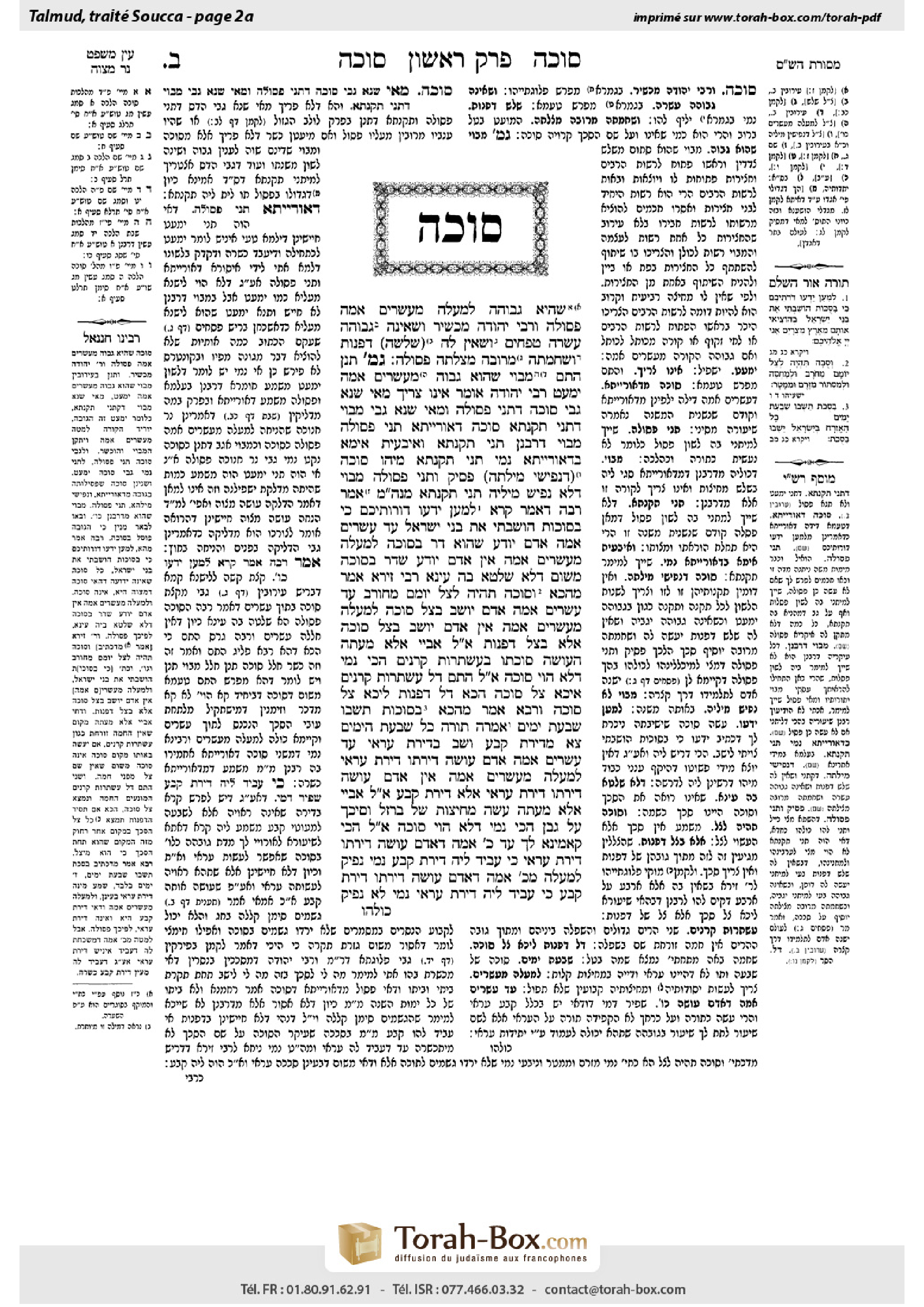
Sukkah 2a: Talmud study for Daf Yomi
Daf Yomi is the daily study of one Talmud folio. Explore 37 tractates with scans, Hebrew text, Sefaria English and AI-generated French translations where annotated.
Passage selection and English or AI-generated French translation are available where the scan has annotations. Daf Study is independent of Torah-Box and Sefaria.
Browse Sukkah · סוכה · All tractatesSukkah 2a text and translations
This page of Sukkah includes the Aramaic text, an English translation and an AI-generated French translation, alongside the scan above.
סוכה ב׳ א · Aramaic and Hebrew text
סוּכָּה שֶׁהִיא גְּבוֹהָה לְמַעְלָה מֵעֶשְׂרִים אַמָּה — פְּסוּלָה. וְרַבִּי יְהוּדָה מַכְשִׁיר.
וְשֶׁאֵינָהּ גְּבוֹהָה עֲשָׂרָה טְפָחִים, וְשֶׁאֵין לָהּ (שְׁלֹשָׁה) דְּפָנוֹת, וְשֶׁחֲמָתָהּ מְרוּבָּה מְצִלָּתָהּ — פְּסוּלָה.
גְּמָ׳ תְּנַן הָתָם: מָבוֹי שֶׁהוּא גָּבוֹהַּ מֵעֶשְׂרִים אַמָּה — יְמַעֵט. רַבִּי יְהוּדָה אוֹמֵר: אֵינוֹ צָרִיךְ.
מַאי שְׁנָא גַּבֵּי סוּכָּה דְּתָנֵי פְּסוּלָה, וּמַאי שְׁנָא גַּבֵּי מָבוֹי דְּתָנֵי תַּקַּנְתָּא?
סוּכָּה דְּאוֹרָיְיתָא, תָּנֵי פְּסוּלָה. מָבוֹי דְּרַבָּנַן, תָּנֵי תַּקַּנְתָּא.
וְאִיבָּעֵית אֵימָא: בִּדְאוֹרָיְיתָא נָמֵי תָּנֵי תַּקַּנְתָּא, מִיהוּ סוּכָּה דִּנְפִישִׁי מִילָּתַהּ — פָּסֵיק וְתָנֵי פְּסוּלָה, מָבוֹי דְּלָא נְפִישׁ מִילֵּיהּ — תָּנֵי תַּקַּנְתָּא.
מְנָא הָנֵי מִילֵּי?
אָמַר רַבָּה, דְּאָמַר קְרָא: ״לְמַעַן יֵדְעוּ דוֹרוֹתֵיכֶם כִּי בַסּוּכּוֹת הוֹשַׁבְתִּי אֶת בְּנֵי יִשְׂרָאֵל״, עַד עֶשְׂרִים אַמָּה, אָדָם יוֹדֵעַ שֶׁהוּא דָּר בַּסּוּכָּה, לְמַעְלָה מֵעֶשְׂרִים אַמָּה — אֵין אָדָם יוֹדֵעַ שֶׁדָּר בַּסּוּכָּה, מִשּׁוּם דְּלָא שָׁלְטָא בַּהּ עֵינָא.
רַבִּי זֵירָא אָמַר מֵהָכָא: ״וְסוּכָּה תִּהְיֶה לְצֵל יוֹמָם מֵחוֹרֶב״, עַד עֶשְׂרִים אַמָּה אָדָם יוֹשֵׁב בְּצֵל סוּכָּה, לְמַעְלָה מֵעֶשְׂרִים אַמָּה — אֵין אָדָם יוֹשֵׁב בְּצֵל סוּכָּה אֶלָּא בְּצֵל דְּפָנוֹת.
אֲמַר לֵיהּ אַבָּיֵי: אֶלָּא מֵעַתָּה, הָעוֹשֶׂה סוּכָּתוֹ בְּעַשְׁתְּרוֹת קַרְנַיִם, הָכִי נָמֵי דְּלָא הָוֵי סוּכָּה?
אֲמַר לֵיהּ: הָתָם, דַּל עַשְׁתְּרוֹת קַרְנַיִם — אִיכָּא צֵל סוּכָּה. הָכָא, דַּל דְּפָנוֹת — לֵיכָּא צֵל סוּכָּה.
וְרָבָא אָמַר, מֵהָכָא: ״בַּסּוּכּוֹת תֵּשְׁבוּ שִׁבְעַת יָמִים״. אָמְרָה תּוֹרָה: כׇּל שִׁבְעַת הַיָּמִים צֵא מִדִּירַת קֶבַע וְשֵׁב בְּדִירַת עֲרַאי. עַד עֶשְׂרִים אַמָּה אָדָם עוֹשֶׂה דִּירָתוֹ דִּירַת עֲרַאי, לְמַעְלָה מֵעֶשְׂרִים אַמָּה — אֵין אָדָם עוֹשֶׂה דִּירָתוֹ דִּירַת עֲרַאי אֶלָּא דִּירַת קֶבַע.
אֲמַר לֵיהּ אַבָּיֵי: אֶלָּא מֵעַתָּה, עָשָׂה מְחִיצוֹת שֶׁל בַּרְזֶל וְסִיכֵּךְ עַל גַּבָּן, הָכִי נָמֵי דְּלָא הָוֵי סוּכָּה?
אֲמַר לֵיהּ, הָכִי קָאָמֵינָא לָךְ: עַד עֶשְׂרִים אַמָּה דְּאָדָם עוֹשֶׂה דִּירָתוֹ דִּירַת עֲרַאי, כִּי עָבֵיד לֵיהּ דִּירַת קֶבַע, נָמֵי נָפֵיק. לְמַעְלָה מֵעֶשְׂרִים אַמָּה, דְּאָדָם עוֹשֶׂה דִּירָתוֹ דִּירַת קֶבַע, כִּי עָבֵיד לֵיהּ דִּירַת עֲרַאי, נָמֵי לָא נָפֵיק.
Sukkah 2a · English translation
MISHNA: A sukka, i.e., its roofing, which is the main and most crucial element of the mitzva, that is more than twenty cubits high is unfit. Rabbi Yehuda deems it fit.
Similarly, a sukka that is not even ten handbreadths high, and one that does not have three walls, and one whose sunlight that passes through its roofing is greater than its shade are unfit.
GEMARA: We learned a similar halakha in a mishna there, in tractate Eiruvin (2a): In the case of an alleyway that is higher than twenty cubits, i.e., the beam that was placed across the end of an alleyway that opens into a public domain in order to permit carrying within the alleyway on Shabbat is higher than twenty cubits, one must diminish the height of the beam in order to permit carrying within the alleyway. Rabbi Yehuda says he need not do so, and although the beam lies higher than twenty cubits, the alleyway is qualified to permit carrying within.
Given the seeming similarity between the two cases, that of the sukka and that of the alleyway, the Gemara asks: What is different with regard to a sukka where the mishna teaches that it is unfit, and what is different with regard to an alleyway where the mishna teaches the method of rectification, that one must diminish the height of the cross beam? Why was a solution not suggested in the case of a sukka?
The Gemara answers: With regard to sukka, since it is a mitzva by Torah law, the mishna teaches that it is unfit, as, if it is not constructed in the proper manner, no mitzva is fulfilled. However, with regard to an alleyway, where the entire prohibition of carrying is only by rabbinic law, the mishna teaches the method of rectification, as the cross beam comes only to rectify a rabbinic prohibition but does not involve a mitzva by Torah law.
The Gemara suggests an alternative explanation: And if you wish, say instead that even with regard to matters prohibited by Torah law, it would have been appropriate for the mishna to teach a method of rectification. However, with regard to sukka, whose matters are numerous, it categorically teaches that it is unfit. Merely diminishing the height of a sukka is insufficient to render it fit; the sukka must also satisfy requirements governing its size, its walls, and its roofing. Teaching the remedy for each disqualification would have required lengthy elaboration. With regard to an alleyway, however, whose matters are not numerous, the mishna teaches the method of rectification. Once the height is diminished, it is permitted to carry in the alleyway.
§ After clarifying its formulation, the Gemara addresses the halakha in the mishna and asks: From where are these matters, i.e., the halakha that a sukka may not exceed a height of twenty cubits, derived?
Rabba said that it is derived as the verse states: “So that your future generations will know that I caused the children of Israel to reside in sukkot when I took them out of the land of Egypt” (Leviticus 23:43). In a sukka up to twenty cubits high, even without a concerted effort, a person is aware that he is residing in a sukka. His eye catches sight of the roofing, evoking the sukka and its associated mitzvot. However, in a sukka that is more than twenty cubits high, a person is not aware that he is residing in a sukka because his eye does not involuntarily catch sight of the roof, as at that height, without a concerted effort one would not notice the roofing.
Rabbi Zeira said that it is derived from here: The verse states: “And there shall be a sukka for shade in the daytime from the heat, and for refuge and cover from storm and from rain” (Isaiah 4:6). In a sukka up to twenty cubits high, a person is sitting in the shade of the sukka, i.e., the shade of the roofing; in a sukka that is more than twenty cubits high, a person is not sitting in the shade of the roofing of the sukka but rather in the shade of the walls of the sukka, as their considerable height provides constant shade, rendering the shade of the roofing irrelevant.
Abaye said to him: But if it is so that one is required to sit in the shade of the roofing of the sukka, then in the case of one who makes his sukka in Ashterot Karnayim, which is located between two mountains that prevent sunlight from reaching there, so too, it is not a fit sukka, since he is not sitting in the shade of the roofing.
Rabbi Zeira said to him: The two cases are not comparable; there, if one theoretically removes the Ashterot Karnayim mountains that obstruct the sunlight, there is still the shade of the roofing of the sukka. In that case, the sukka is properly constructed and there are only external factors that affect the sunlight. However, here, in the case of a sukka that is more than twenty cubits high, if one theoretically removes the walls of the sukka, there is no shade provided by the roofing of the sukka, since throughout the day sunlight will enter the sukka beneath the roofing from where the walls used to be.
Rava said that the halakha is derived from here: “In sukkot shall you reside seven days” (Leviticus 23:42). The Torah said: For the entire seven days, emerge from the permanent residence in which you reside year round and reside in a temporary residence, the sukka. In constructing a sukka up to twenty cubits high, a person can render his residence a temporary residence, as up to that height one can construct a structure that is not sturdy; however, in constructing a sukka above twenty cubits high, one cannot render his residence a temporary residence; rather, he must construct a sturdy permanent residence, which is unfit for use as a sukka.
Abaye said to him: But if that is so, then if he constructed a sukka with steel partitions and placed roofing over them, so too, there, say that it would not be a fit sukka, as any sukka constructed as a permanent residence would be unfit. However, there is no opinion that deems a sukka of that sort unfit.
Rava said to him in response that this is what I am saying to you: In a case where one constructs a sukka up to twenty cubits high, a height that a person typically constructs a temporary residence, when he constructs a structure of that height that is sturdy like a permanent residence, he also fulfills his obligation. However, in a case where one constructs a sukka more than twenty cubits high, a height that a person typically constructs a permanent residence, even when he constructs it in a less sturdy fashion like a temporary residence, he does not fulfill his obligation.
Sukkah 2a · Traduction française (IA)
MICHNA : Une soukka dont le toit — élément principal et essentiel de la mitsva — dépasse vingt coudées est invalide. Rabbi Yehouda la juge valide.
De même, est invalide une soukka qui ne mesure même pas dix palmes de haut, qui n’a pas trois parois ou dont le toit laisse passer plus de lumière du soleil que d’ombre.
GUEMARA : Nous avons appris une halakha similaire dans une Michna du traité Erouvin (2a) : dans le cas d’une ruelle dont la poutre transversale, placée à l’entrée de la ruelle qui débouche sur le domaine public afin d’y permettre le transport d’objets pendant Chabbat, se trouve à plus de vingt coudées de hauteur, il faut abaisser la poutre pour permettre le transport dans la ruelle. Rabbi Yehouda dit qu’il n’est pas nécessaire de le faire ; bien que la poutre soit à plus de vingt coudées, la ruelle remplit les conditions permettant d’y transporter des objets.
Étant donné la ressemblance apparente entre les deux cas, celui de la soukka et celui de la ruelle, la Guemara demande : Quelle différence y a-t-il entre la soukka, au sujet de laquelle la Michna enseigne qu’elle est invalide, et la ruelle, au sujet de laquelle la Michna enseigne comment remédier au problème, à savoir en abaissant la poutre transversale ? Pourquoi ne propose-t-on pas de solution dans le cas de la soukka ?
La Guemara répond : En ce qui concerne la soukka, puisque c’est une mitsva prescrite par la Torah, la Michna enseigne qu’elle est invalide, car si elle n’est pas construite comme il convient, aucune mitsva n’est accomplie. En revanche, en ce qui concerne la ruelle, où l’interdiction de transporter des objets relève uniquement de la loi rabbinique, la Michna enseigne comment remédier au problème : la poutre transversale ne sert qu’à remédier à une interdiction rabbinique et n’implique pas une mitsva prescrite par la Torah.
La Guemara propose une autre explication : ou bien, si tu veux, dis plutôt que même pour les choses interdites par la Torah, il aurait convenu que la Michna enseigne comment remédier au problème. Cependant, pour la soukka, dont les règles sont nombreuses, elle enseigne de façon catégorique qu’elle est invalide. Se contenter d’en abaisser la hauteur ne suffit pas à la rendre valide ; la soukka doit également satisfaire aux exigences concernant ses dimensions, ses parois et son toit. Exposer le remède pour chaque motif d’invalidité aurait nécessité de longs développements. En revanche, pour la ruelle, dont les règles sont peu nombreuses, la Michna enseigne comment remédier au problème. Une fois la poutre abaissée, le transport dans la ruelle est permis.
§ Après avoir clarifié la formulation de la Michna, la Guemara aborde la halakha qu’elle enseigne et demande : De quoi déduit-on ces règles, c’est-à-dire la halakha selon laquelle une soukka ne peut pas dépasser vingt coudées de hauteur ?
Rabba dit qu’on le déduit du verset : « Afin que vos générations futures sachent que j’ai fait résider les enfants d’Israël dans des soukkot lorsque je les ai fait sortir du pays d’Égypte » (Lévitique 23:43). Dans une soukka qui ne dépasse pas vingt coudées de hauteur, une personne sait qu’elle réside dans une soukka, même sans y prêter particulièrement attention. Son regard aperçoit le toit, ce qui lui rappelle la soukka et les mitsvot qui s’y rapportent. En revanche, dans une soukka qui dépasse vingt coudées, une personne ne sait pas qu’elle réside dans une soukka, car son regard ne se pose pas spontanément sur le toit : à cette hauteur, on ne le remarque pas sans y prêter une attention particulière.
Rabbi Zeïra dit qu’on le déduit d’ici : le verset dit : « Il y aura une soukka pour faire de l’ombre pendant le jour contre la chaleur, et pour servir de refuge et d’abri contre l’orage et la pluie » (Isaïe 4:6). Dans une soukka qui ne dépasse pas vingt coudées de hauteur, une personne est assise à l’ombre de la soukka, c’est-à-dire à l’ombre du toit. Dans une soukka qui dépasse vingt coudées, elle n’est pas assise à l’ombre du toit de la soukka, mais plutôt à l’ombre de ses parois, dont la grande hauteur procure une ombre constante, rendant sans pertinence l’ombre du toit.
Abayé lui dit : Mais s’il en est ainsi, si l’on doit s’asseoir à l’ombre du toit de la soukka, alors, dans le cas de quelqu’un qui construit sa soukka à Ashterot Karnayim, située entre deux montagnes qui empêchent la lumière du soleil d’y parvenir, elle aussi devrait être invalide, puisqu’il ne s’assied pas à l’ombre du toit.
Rabbi Zeïra lui dit : Les deux cas ne sont pas comparables. Là-bas, si l’on supprimait théoriquement les montagnes d’Ashterot Karnayim qui font obstacle à la lumière du soleil, l’ombre du toit de la soukka subsisterait. Dans ce cas, la soukka est construite comme il convient ; seuls des facteurs extérieurs influent sur la lumière du soleil. Ici, en revanche, dans le cas d’une soukka qui dépasse vingt coudées, si l’on supprimait théoriquement ses parois, le toit ne ferait pas d’ombre, car, tout au long de la journée, la lumière du soleil pénétrerait dans la soukka par les endroits où se trouvaient les parois.
Rava dit qu’on déduit la halakha d’ici : « Vous résiderez dans des soukkot pendant sept jours » (Lévitique 23:42). La Torah a dit : pendant les sept jours entiers, quittez la résidence permanente où vous résidez toute l’année et résidez dans une résidence temporaire, la soukka. En construisant une soukka qui ne dépasse pas vingt coudées de hauteur, une personne peut faire de sa résidence une résidence temporaire, car, jusqu’à cette hauteur, on peut construire une structure qui n’est pas solide. En revanche, en construisant une soukka de plus de vingt coudées de hauteur, on ne peut pas faire de sa résidence une résidence temporaire ; il faut plutôt construire une résidence permanente solide, qui ne convient pas à l’usage d’une soukka.
Abayé lui dit : Mais s’il en est ainsi, si quelqu’un a construit une soukka avec des parois en acier et posé un toit au-dessus, il faudrait dire là aussi qu’elle n’est pas valide, puisque toute soukka construite comme une résidence permanente serait invalide. Or, personne ne soutient qu’une soukka de ce type est invalide.
Rava lui répondit : Voici ce que je te dis. Lorsqu’on construit une soukka qui ne dépasse pas vingt coudées, hauteur à laquelle on construit généralement une résidence temporaire, même si l’on construit à cette hauteur une structure solide comme une résidence permanente, on s’acquitte de son obligation. En revanche, lorsqu’on construit une soukka qui dépasse vingt coudées, hauteur à laquelle on construit généralement une résidence permanente, même si on la construit de façon moins solide, comme une résidence temporaire, on ne s’acquitte pas de son obligation.
Traduction française générée par IA à partir de l’édition anglaise de Sefaria. Vérifie toujours un passage avec le texte source.
Text from Sefaria: William Davidson Edition - Vocalized Aramaic (CC BY NC); William Davidson Edition - English (CC BY NC).