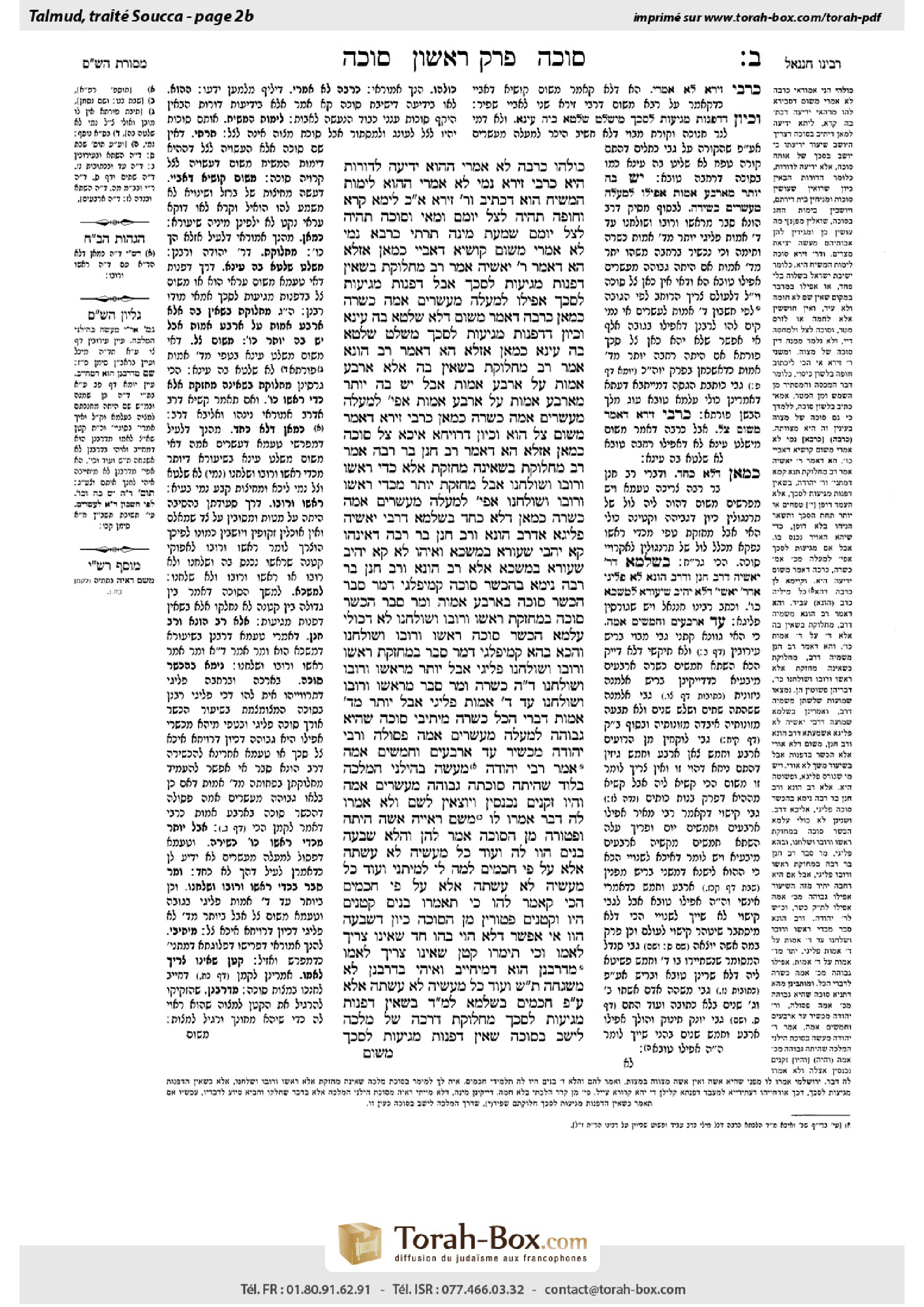
Sukkah 2b: Talmud study for Daf Yomi
Daf Yomi is the daily study of one Talmud folio. Explore 37 tractates with scans, Hebrew text, Sefaria English and AI-generated French translations where annotated.
Passage selection and English or AI-generated French translation are available where the scan has annotations. Daf Study is independent of Torah-Box and Sefaria.
Browse Sukkah · סוכה · All tractatesSukkah 2b text and translations
This page of Sukkah includes the Aramaic text, an English translation and an AI-generated French translation, alongside the scan above.
סוכה ב׳ ב · Aramaic and Hebrew text
כּוּלְּהוּ כְּרַבָּה לָא אָמְרִי, הָהוּא יְדִיעָה לְדוֹרוֹת הִיא.
כְּרַבִּי זֵירָא נָמֵי לָא אָמְרִי, הָהוּא לִימוֹת הַמָּשִׁיחַ הוּא דִּכְתִיב.
וְרַבִּי זֵירָא — אִם כֵּן לֵימָא קְרָא: ״וְחוּפָּה תִּהְיֶה לְצֵל יוֹמָם״, וּמַאי ״וְסוּכָּה תִּהְיֶה לְצֵל יוֹמָם״ — שָׁמְעַתְּ מִינַּהּ תַּרְתֵּי.
כְּרָבָא נָמֵי לָא אָמְרִי, מִשּׁוּם קוּשְׁיָא דְאַבָּיֵי.
כְּמַאן אָזְלָא הָא דְּאָמַר רַבִּי יֹאשִׁיָּה אָמַר רַב: מַחְלוֹקֶת בְּשֶׁאֵין דְּפָנוֹת מַגִּיעוֹת לַסְּכָךְ, אֲבָל דְּפָנוֹת מַגִּיעוֹת לַסְּכָךְ — אֲפִילּוּ לְמַעְלָה מֵעֶשְׂרִים אַמָּה כְּשֵׁרָה. כְּמַאן?
כְּרַבָּה, דְּאָמַר מִשּׁוּם דְּלָא שָׁלְטָא בַּהּ עֵינָא, וְכֵיוָן דִּדְפָנוֹת מַגִּיעוֹת לַסְּכָךְ, מִשְׁלָט שָׁלְטָא בַּהּ עֵינָא.
כְּמַאן אָזְלָא הָא דְּאָמַר רַב הוּנָא אָמַר רַב: מַחְלוֹקֶת בְּשֶׁאֵין בָּהּ אֶלָּא אַרְבַּע אַמּוֹת עַל אַרְבַּע אַמּוֹת, אֲבָל יֵשׁ בָּהּ יוֹתֵר מֵאַרְבַּע אַמּוֹת עַל אַרְבַּע אַמּוֹת — אֲפִילּוּ לְמַעְלָה מֵעֶשְׂרִים אַמָּה כְּשֵׁרָה. כְּמַאן?
כְּרַבִּי זֵירָא, דְּאָמַר: מִשּׁוּם צֵל הוּא, וְכֵיוָן דִּרְוִיחָא — אִיכָּא צֵל סוּכָּה.
כְּמַאן אָזְלָא הָא דְּאָמַר רַב חָנָן בַּר רַבָּה אָמַר רַב: מַחְלוֹקֶת בְּשֶׁאֵינָהּ מַחְזֶקֶת אֶלָּא כְּדֵי רֹאשׁוֹ וְרוּבּוֹ וְשׁוּלְחָנוֹ, אֲבָל מַחְזֶקֶת יוֹתֵר מִכְּדֵי רֹאשׁוֹ וְרוּבּוֹ וְשׁוּלְחָנוֹ — אֲפִילּוּ לְמַעְלָה מֵעֶשְׂרִים אַמָּה כְּשֵׁרָה. כְּמַאן — דְּלָא כְּחַד.
בִּשְׁלָמָא דְּרַבִּי יֹאשִׁיָּה פְּלִיגָא אַדְּרַב הוּנָא וְרַב חָנָן בַּר רַבָּה, דְּאִינְהוּ קָא יָהֲבִי שִׁעוּרָא בִּמְשָׁכָא, וְאִיהוּ לָא קָא יָהֵיב שִׁעוּרָא בִּמְשָׁכָא.
אֶלָּא רַב הוּנָא וְרַב חָנָן בַּר רַבָּה, נֵימָא בְּהֶכְשֵׁר סוּכָּה קָמִיפַּלְגִי, דְּמָר סָבַר הֶכְשֵׁר סוּכָּה בְּאַרְבַּע אַמּוֹת, וּמָר סָבַר הֶכְשֵׁר סוּכָּה בְּמַחְזֶקֶת רֹאשׁוֹ וְרוּבּוֹ וְשׁוּלְחָנוֹ?
לָא, דְּכוּלֵּי עָלְמָא הֶכְשֵׁר סוּכָּה רֹאשׁוֹ וְרוּבּוֹ וְשׁוּלְחָנוֹ. וְהָכָא בְּהָא קָמִיפַּלְגִי: דְּמָר סָבַר בְּמַחְזֶקֶת רֹאשׁוֹ וְרוּבּוֹ וְשׁוּלְחָנוֹ פְּלִיגִי, אֲבָל יוֹתֵר מֵרֹאשׁוֹ וְרוּבּוֹ וְשׁוּלְחָנוֹ — דִּבְרֵי הַכֹּל כְּשֵׁרָה,
וּמָר סָבַר מֵרֹאשׁוֹ וְרוּבּוֹ וְשׁוּלְחָנוֹ עַד אַרְבַּע אַמּוֹת פְּלִיגִי, אֲבָל יוֹתֵר מֵאַרְבַּע אַמּוֹת — דִּבְרֵי הַכֹּל כְּשֵׁרָה.
מֵיתִיבִי: סוּכָּה שֶׁהִיא גְּבוֹהָה לְמַעְלָה מֵעֶשְׂרִים אַמָּה — פְּסוּלָה, וְרַבִּי יְהוּדָה מַכְשִׁיר עַד אַרְבָּעִים וַחֲמִשִּׁים אַמָּה.
אָמַר רַבִּי יְהוּדָה: מַעֲשֶׂה בְּהֵילֶנִי הַמַּלְכָּה בְּלוֹד שֶׁהָיְתָה סוּכָּתָהּ גְּבוֹהָה מֵעֶשְׂרִים אַמָּה, וְהָיוּ זְקֵנִים נִכְנָסִין וְיוֹצְאִין לְשָׁם וְלֹא אָמְרוּ לָהּ דָּבָר. אָמְרוּ לוֹ: מִשָּׁם רְאָיָיה? אִשָּׁה הָיְתָה וּפְטוּרָה מִן הַסּוּכָּה. אָמַר לָהֶן: וַהֲלֹא שִׁבְעָה בָּנִים הֲווֹ לָהּ, וְעוֹד: כׇּל מַעֲשֶׂיהָ לֹא עָשְׂתָה אֶלָּא עַל פִּי חֲכָמִים.
לְמָה לִי לְמִיתְנֵי ״וְעוֹד כׇּל מַעֲשֶׂיהָ לֹא עָשְׂתָה אֶלָּא עַל פִּי חֲכָמִים״?
הָכִי קָאָמַר לְהוּ: כִּי תֹּאמְרוּ בָּנִים קְטַנִּים הָיוּ, וּקְטַנִּים פְּטוּרִין מִן הַסּוּכָּה — כֵּיוָן דְּשִׁבְעָה הֲווֹ, אִי אֶפְשָׁר דְּלָא הָוֵי בְּהוּ חַד שֶׁאֵינוֹ צָרִיךְ לְאִמּוֹ.
וְכִי תֵּימְרוּ קָטָן שֶׁאֵינוֹ צָרִיךְ לְאִמּוֹ מִדְּרַבָּנַן הוּא דְּמִיחַיַּיב, וְאִיהִי בִּדְרַבָּנַן לָא מַשְׁגְּחָה, תָּא שְׁמַע: וְעוֹד, כׇּל מַעֲשֶׂיהָ לֹא עָשְׂתָה אֶלָּא עַל פִּי חֲכָמִים.
בִּשְׁלָמָא לְמַאן דְּאָמַר בְּשֶׁאֵין דְּפָנוֹת מַגִּיעוֹת לַסְּכָךְ מַחְלוֹקֶת, דַּרְכָּהּ שֶׁל מַלְכָּה לֵישֵׁב בְּסוּכָּה שֶׁאֵין דְּפָנוֹת מַגִּיעוֹת לַסְּכָךְ,
Sukkah 2b · English translation
The Gemara explains why each of the Sages cited his own source and did not accept the sources cited by the others. All of them, Rabbi Zeira and Rava, did not say that the fact that a sukka more than twenty cubits high is unfit is derived from the verse: “So that your future generations will know that I caused the children of Israel to reside in sukkot when I took them out of the land of Egypt” (Leviticus 23:43), as did Rabba, because in their opinion that verse does not mandate one to be aware that he is sitting in a sukka; rather, it mandates knowledge for future generations of the exodus from Egypt.
Similarly, they, Rabba and Rava, also did not say that it is derived from the verse: “And there shall be a sukka for shade in the daytime from the heat” (Isaiah 4:6), as did Rabbi Zeira, because in their opinion it is with regard to the messianic era that this verse is written. It means that God will be a shield and a shelter for the Jewish people; it is not referring to the structure of a sukka.
The Gemara asks: And Rabbi Zeira, how would he respond to this objection? The Gemara answers that Rabbi Zeira could say: If it is so that the verse is merely a metaphor, let the verse say: And there shall be a canopy for shade in the daytime from the heat, which is the term used in the previous verse. And what is the meaning of: “And there shall be a sukka for shade in the daytime from the heat”? Learn from it two matters: One is the plain meaning of the verse, that God will be a canopy of glory for the Jewish people, and the second is that the essence of a sukka is to have the roofing provide shade.
They, Rabba and Rabbi Zeira, also did not say that it is derived from the verse: “In sukkot shall you reside seven days” (Leviticus 23:42), as did Rava, due to the difficulty raised by Abaye with regard to a sukka with steel partitions. Since there is a weakness in each of the sources, it is understandable why the other Sages did not accept it.
§ The Gemara asks: In accordance with whose opinion is that which Rabbi Yoshiya said that Rav said: The dispute between Rabbi Yehuda and the Rabbis with regard to the fitness of a sukka more than twenty cubits high is specifically in a case where the walls of the sukka do not reach up to the roofing; however, in a case where the walls of the sukka reach up to the roofing, the Rabbis concede that even if the roofing is more than twenty cubits high, it is fit. In accordance with whose opinion is it?
It is in accordance with the opinion of Rabba, who says that the reason that a sukka that high is unfit is because the eye does not automatically catch sight of the roofing. And since the walls of the sukka reach the roofing, the eye catches sight of the roofing, as the person will follow the walls all the way up to the roofing despite their considerable height. However, if the roofing is not contiguous with the top of the walls, a person does not notice it without a concerted effort.
The Gemara asks: In accordance with whose opinion is that which Rav Huna said that Rav said: The dispute between Rabbi Yehuda and the Rabbis with regard to the fitness of a sukka more than twenty cubits high is specifically in a case where there is not an area of four cubits by four cubits in the sukka; however, in a case where there is an area of more than four cubits by four cubits in the sukka, the Rabbis concede that even if the roofing is more than twenty cubits high, it is fit. In accordance with whose opinion is it?
It is in accordance with the opinion of Rabbi Zeira, who says that a sukka that high is unfit due to the shade that is provided by the walls and not by the roofing; and since the sukka in this case is spacious and has a large area, there is shade from the roofing of the sukka and not only from the walls.
The Gemara asks: In accordance with whose opinion is that which Rav Ḥanan bar Rabba said that Rav said: The dispute between Rabbi Yehuda and the Rabbis with regard to the fitness of a sukka more than twenty cubits high is specifically in a case where the sukka is only large enough to hold one’s head, most of his body, and his table, as, if the sukka were smaller, it would not qualify as a sukka; however, in a case where it is sufficiently large to hold more than one’s head, most of his body, and his table, even if it is more than twenty cubits high, it is fit. In accordance with whose opinion is it? It is not in accordance with the opinion of any one of them. This statement cannot be explained according to any of the rationales for the fact that a sukka more than twenty cubits high is unfit.
With regard to the three aforementioned halakhot, the Gemara notes: Granted, the statement of Rabbi Yoshiya differs from the statements of Rav Huna and Rav Ḥanan bar Rabba, as they are providing the measure of the extent of the sukka while he is not providing a measure. In Rabbi Yoshiya’s opinion, the halakha is based on whether the top of the walls reach the roofing, which indicates a fundamentally different understanding of the issue of a sukka more than twenty cubits high.
However, in terms of Rav Huna and Rav Ḥanan bar Rabba, let us say that it is with regard to the minimum size required for fitness of a sukka that they disagree; as one Sage, Rav Huna, holds: The minimum size required for fitness of a sukka is four by four cubits, and the other Sage, Rav Ḥanan bar Rabba, holds: The minimum size required for fitness of a sukka is one that holds one’s head, and most of his body, and his table.
The Gemara rejects this suggestion: No, there is no need to explain their dispute that way, as it could be explained that everyone, i.e., Rav Huna and Rav Ḥanan bar Rabba, agrees that the minimum size required for fitness of a sukka is one that holds one’s head, and most of his body, and his table. And here, it is with regard to this that they disagree: One Sage, Rav Ḥanan bar Rabba, holds that Rabbi Yehuda and the Rabbis disagree only with regard to a sukka more than twenty cubits high in a case where it holds the person’s head, and most of his body, and his table. However, in a case where it is larger than one that holds one’s head, and most of his body, and his table, everyone agrees that the sukka is fit regardless of its height.
And one Sage, Rav Huna, holds that it is with regard to a sukka that ranges in size from one that holds one’s head, and most of his body, and his table up to one that is four by four cubits that they disagree; however, if the sukka is more than four by four cubits, everyone agrees that it is fit.
The Gemara raises an objection from a baraita: A sukka that is more than twenty cubits high is unfit. Rabbi Yehuda deems a sukka fit even if it is up to forty or fifty cubits high.
Rabbi Yehuda said: There was an incident involving Queen Helene in Lod where her sukka was more than twenty cubits high, and the Elders were entering and exiting the sukka and did not say anything to her about the sukka not being fit.
The Rabbis said to him: Is there proof from there? She was, after all, a woman and therefore exempt from the mitzva of sukka. Consequently, the fact that her sukka was not fit did not warrant a comment from the Elders.
Rabbi Yehuda said to them in response: Didn’t she have seven sons and therefore require a fit sukka? And furthermore, she performed all of her actions only in accordance with the directives of the Sages.
Before analyzing the objection being raised from the baraita, the Gemara seeks to understand its content. Why do I need Rabbi Yehuda to teach: And furthermore, she performed all of her actions only in accordance with the directives of the Sages? His first contention was sufficient.
The Gemara answers that this is what Rabbi Yehuda is saying to them: If you say that Helene’s sons were minor sons and minors are exempt from the mitzva of sukka, and that is why the Elders said nothing; since they were seven sons, then it is not possible that there was not at least one among them who no longer needed his mother to look after him. The halakha is that a minor who no longer needs his mother has reached the age of training and is required to fulfill the mitzva of sukka by rabbinic law. Even if she gave birth to them in consecutive years, the oldest would be seven years old, and at that age a child does not need his mother to constantly look after him.
And if you say that a child who no longer needs his mother is obligated in the mitzva of sukka only by rabbinic law, and Queen Helene did not observe rabbinic law, come and hear that which Rabbi Yehuda said: And furthermore, she performed all of her actions only in accordance with the directives of the Sages.
The Gemara explores the statements of the amora’im who quoted Rav in light of this baraita. Granted, according to the one, Rabbi Yoshiya, who said that it is specifically in a case where the walls of the sukka do not reach up to the roofing that there is a dispute between Rabbi Yehuda and the Rabbis, the baraita can be explained as dealing with a sukka of that type, as it is customary for a queen to reside in a sukka in which the walls do not reach up to the roofing,
Sukkah 2b · Traduction française (IA)
La Guemara explique pourquoi chacun des Sages a cité sa propre source et n’a pas accepté celles citées par les autres. Ni Rabbi Zeira ni Rava n’ont affirmé que l’inaptitude d’une soukka de plus de vingt coudées se déduit du verset : « Afin que vos générations futures sachent que j’ai fait résider les enfants d’Israël dans des soukkot lorsque je les ai fait sortir du pays d’Égypte » (Lévitique 23, 43), comme l’a fait Rabba, car, selon eux, ce verset n’impose pas de savoir que l’on est assis dans une soukka ; il impose plutôt aux générations futures de connaître la sortie d’Égypte.
De même, ni Rabba ni Rava n’ont affirmé que cela se déduit du verset : « Il y aura une soukka pour ombrager le jour contre la chaleur » (Isaïe 4, 6), comme l’a fait Rabbi Zeira, car, selon eux, ce verset concerne l’ère messianique. Il signifie que Dieu sera un bouclier et un abri pour le peuple juif ; il ne se rapporte pas à la structure d’une soukka.
La Guemara demande : Et que répondrait Rabbi Zeira à cette objection ? La Guemara répond que Rabbi Zeira pourrait dire : S’il en est ainsi, et que le verset n’est qu’une métaphore, qu’il dise : « Il y aura un dais pour ombrager le jour contre la chaleur », expression employée dans le verset précédent. Que signifie donc : « Il y aura une soukka pour ombrager le jour contre la chaleur » ? On en déduit deux choses : d’abord, le sens simple du verset, à savoir que Dieu sera un dais de gloire pour le peuple juif ; ensuite, que l’essence d’une soukka est que son toit fournisse de l’ombre.
Ni Rabba ni Rabbi Zeira n’ont affirmé que cela se déduit du verset : « Vous résiderez dans des soukkot pendant sept jours » (Lévitique 23, 42), comme l’a fait Rava, en raison de la difficulté soulevée par Abaye à propos d’une soukka dont les parois sont en acier. Puisque chacune des sources présente une faiblesse, on comprend pourquoi les autres Sages ne l’ont pas acceptée.
§ La Guemara demande : Selon l’opinion de qui faut-il comprendre ce que Rabbi Yoshiya a dit au nom de Rav : le désaccord entre Rabbi Yehouda et les Rabbins quant à l’aptitude d’une soukka de plus de vingt coudées concerne précisément le cas où les parois de la soukka n’atteignent pas le toit ; toutefois, lorsque les parois de la soukka atteignent le toit, les Rabbins reconnaissent qu’elle est apte, même si le toit se trouve à plus de vingt coudées de hauteur ? Selon l’opinion de qui est-ce ?
C’est conforme à l’opinion de Rabba, qui affirme qu’une soukka de cette hauteur est inapte parce que l’œil ne repère pas spontanément le toit. Puisque les parois de la soukka atteignent le toit, l’œil le repère, car la personne suit les parois jusqu’au toit malgré leur grande hauteur. En revanche, si le toit n’est pas dans le prolongement du sommet des parois, la personne ne le remarque pas sans un effort particulier.
La Guemara demande : Selon l’opinion de qui faut-il comprendre ce que Rav Houna a dit au nom de Rav : le désaccord entre Rabbi Yehouda et les Rabbins quant à l’aptitude d’une soukka de plus de vingt coudées concerne précisément le cas où la soukka ne mesure pas quatre coudées sur quatre ; toutefois, lorsque sa superficie dépasse quatre coudées sur quatre, les Rabbins reconnaissent qu’elle est apte, même si le toit se trouve à plus de vingt coudées de hauteur ? Selon l’opinion de qui est-ce ?
C’est conforme à l’opinion de Rabbi Zeira, qui affirme qu’une soukka de cette hauteur est inapte parce que l’ombre est produite par les parois et non par le toit. Puisque la soukka en question est spacieuse et de grande superficie, elle est ombragée par son toit, et pas seulement par ses parois.
La Guemara demande : Selon l’opinion de qui faut-il comprendre ce que Rav Ḥanan bar Rabba a dit au nom de Rav : le désaccord entre Rabbi Yehouda et les Rabbins quant à l’aptitude d’une soukka de plus de vingt coudées concerne précisément le cas où la soukka est juste assez grande pour contenir la tête d’une personne, la majeure partie de son corps et sa table, car, si elle était plus petite, elle ne serait pas considérée comme une soukka ; toutefois, si elle est assez grande pour contenir davantage que la tête d’une personne, la majeure partie de son corps et sa table, elle est apte même si elle dépasse vingt coudées. Selon l’opinion de qui est-ce ? Ce n’est conforme à l’opinion d’aucun d’entre eux. Cette déclaration ne peut s’expliquer par aucun des motifs avancés pour justifier l’inaptitude d’une soukka de plus de vingt coudées.
Au sujet des trois halakhot mentionnées précédemment, la Guemara relève : Il est compréhensible que la déclaration de Rabbi Yoshiya diffère de celles de Rav Houna et de Rav Ḥanan bar Rabba, puisqu’eux précisent les dimensions de la soukka, tandis que lui ne donne aucune mesure. Selon Rabbi Yoshiya, la halakha dépend de la question de savoir si le sommet des parois atteint le toit, ce qui traduit une conception fondamentalement différente de la question d’une soukka de plus de vingt coudées.
Toutefois, pour ce qui est de Rav Houna et de Rav Ḥanan bar Rabba, ne pourrait-on pas dire que leur désaccord porte sur la taille minimale requise pour qu’une soukka soit apte ? En effet, l’un des Sages, Rav Houna, estime que la taille minimale requise pour qu’une soukka soit apte est de quatre coudées sur quatre, tandis que l’autre Sage, Rav Ḥanan bar Rabba, estime qu’elle doit être assez grande pour contenir la tête d’une personne, la majeure partie de son corps et sa table.
La Guemara rejette cette proposition : Non, il n’est pas nécessaire d’expliquer leur désaccord de cette manière, car on peut dire que tous, c’est-à-dire Rav Houna et Rav Ḥanan bar Rabba, conviennent que la taille minimale requise pour qu’une soukka soit apte est celle qui permet d’y tenir la tête d’une personne, la majeure partie de son corps et sa table. Leur désaccord porte plutôt sur le point suivant : Rav Ḥanan bar Rabba estime que Rabbi Yehouda et les Rabbins ne sont en désaccord qu’à propos d’une soukka de plus de vingt coudées qui contient juste la tête de la personne, la majeure partie de son corps et sa table. En revanche, si elle est plus grande que ce qui est nécessaire pour contenir sa tête, la majeure partie de son corps et sa table, tous conviennent que la soukka est apte, quelle que soit sa hauteur.
L’autre Sage, Rav Houna, estime que leur désaccord porte sur une soukka dont les dimensions vont de celles qui permettent de contenir la tête d’une personne, la majeure partie de son corps et sa table, jusqu’à quatre coudées sur quatre ; en revanche, si la soukka dépasse quatre coudées sur quatre, tous conviennent qu’elle est apte.
La Guemara soulève une objection à partir d’une baraïta : une soukka de plus de vingt coudées est inapte. Rabbi Yehouda déclare qu’une soukka est apte même si elle atteint quarante ou cinquante coudées de hauteur.
Rabbi Yehouda dit : Il arriva que la reine Hélène, à Lod, eut une soukka de plus de vingt coudées, et les Anciens entraient et sortaient de la soukka sans rien lui dire au sujet de son inaptitude. Les Rabbins lui dirent : Est-ce une preuve ? Après tout, elle était une femme et était donc dispensée de la mitsva de soukka. Par conséquent, le fait que sa soukka soit inapte ne justifiait aucun commentaire des Anciens. Rabbi Yehouda leur répondit : N’avait-elle pas sept fils et n’avait-elle donc pas besoin d’une soukka apte ? De plus, elle n’accomplissait tous ses actes qu’en suivant les directives des Sages.
Avant d’analyser l’objection soulevée à partir de la baraïta, la Guemara cherche à en comprendre le contenu. Pourquoi Rabbi Yehouda ajoute-t-il : « De plus, elle n’accomplissait tous ses actes qu’en suivant les directives des Sages » ? Son premier argument suffisait.
La Guemara répond que voici ce que Rabbi Yehouda leur dit : Si vous prétendez que les fils d’Hélène étaient des enfants mineurs, et que les mineurs sont dispensés de la mitsva de soukka, raison pour laquelle les Anciens n’ont rien dit, alors, puisqu’elle avait sept fils, il est impossible qu’il n’y en ait pas eu au moins un qui n’ait plus eu besoin que sa mère s’occupe de lui. Selon la halakha, un mineur qui n’a plus besoin de sa mère a atteint l’âge de l’éducation et doit accomplir la mitsva de soukka en vertu du droit rabbinique. Même si elle les avait mis au monde au cours d’années consécutives, l’aîné aurait eu sept ans ; or, à cet âge, un enfant n’a pas besoin que sa mère s’occupe constamment de lui.
Et si vous dites qu’un enfant qui n’a plus besoin de sa mère n’est tenu d’accomplir la mitsva de soukka qu’en vertu du droit rabbinique, et que la reine Hélène ne suivait pas les prescriptions rabbiniques, venez entendre ce qu’a dit Rabbi Yehouda : « De plus, elle n’accomplissait tous ses actes qu’en suivant les directives des Sages. »
La Guemara examine les déclarations des amoraïm qui ont rapporté les propos de Rav à la lumière de cette baraïta. Il est compréhensible que, selon l’un d’eux, Rabbi Yoshiya, qui a dit que le désaccord entre Rabbi Yehouda et les Rabbins concerne précisément le cas où les parois de la soukka n’atteignent pas le toit, on puisse expliquer que la baraïta traite d’une soukka de ce type, car il est courant qu’une reine réside dans une soukka dont les parois n’atteignent pas le toit,
Traduction française générée par IA à partir de l’édition anglaise de Sefaria. Vérifie toujours un passage avec le texte source.
Text from Sefaria: William Davidson Edition - Vocalized Aramaic (CC BY NC); William Davidson Edition - English (CC BY NC).