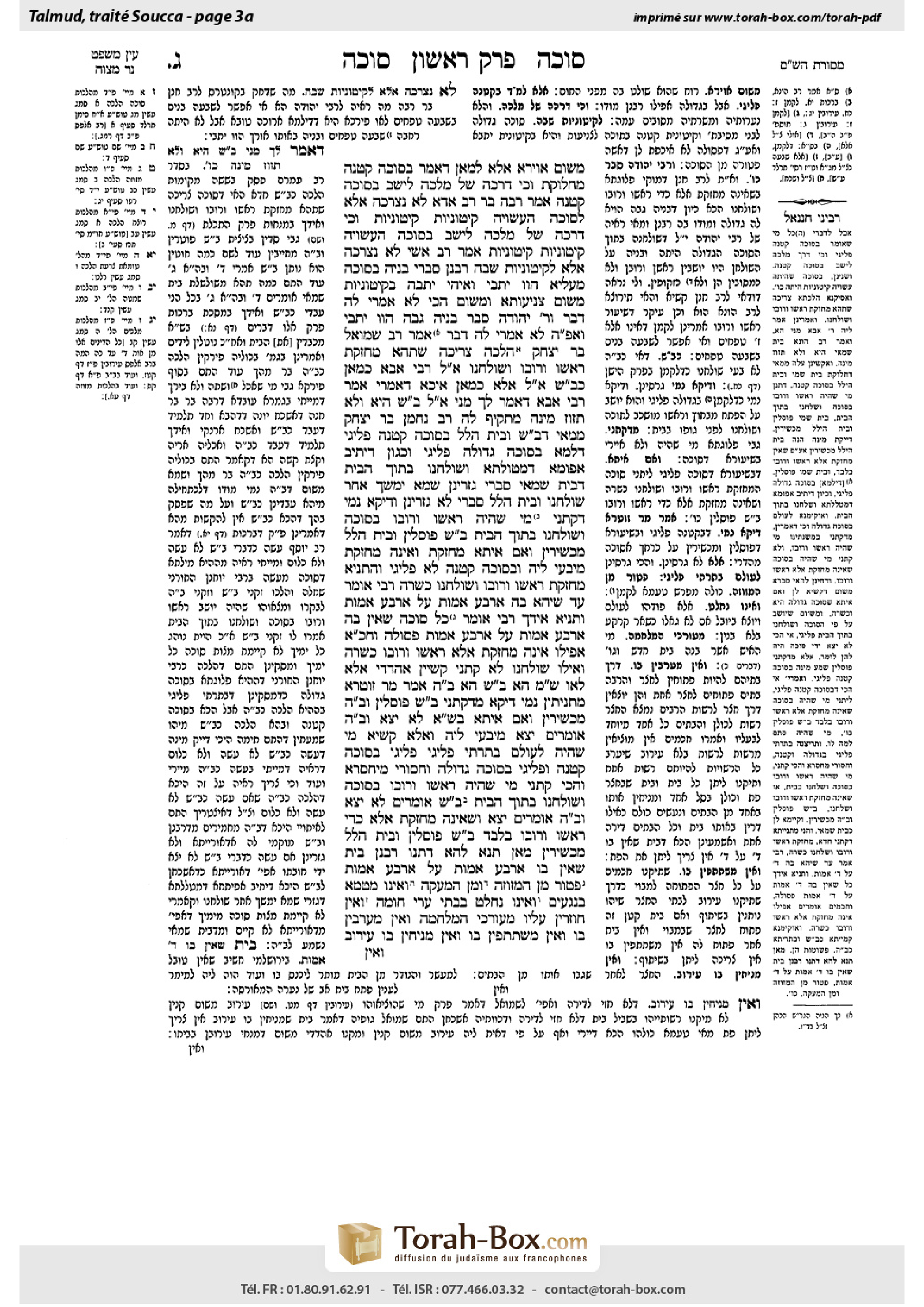
Sukkah 3a: Talmud study for Daf Yomi
Daf Yomi is the daily study of one Talmud folio. Explore 37 tractates with scans, Hebrew text, Sefaria English and AI-generated French translations where annotated.
Passage selection and English or AI-generated French translation are available where the scan has annotations. Daf Study is independent of Torah-Box and Sefaria.
Browse Sukkah · סוכה · All tractatesSukkah 3a text and translations
This page of Sukkah includes the Aramaic text, an English translation and an AI-generated French translation, alongside the scan above.
סוכה ג׳ א · Aramaic and Hebrew text
מִשּׁוּם אַוֵּירָא. אֶלָּא לְמַאן דְּאָמַר בְּסוּכָּה קְטַנָּה מַחְלוֹקֶת, וְכִי דַּרְכָּהּ שֶׁל מַלְכָּה לֵישֵׁב בְּסוּכָּה קְטַנָּה? אָמַר רַבָּה בַּר רַב אַדָּא: לֹא נִצְרְכָה אֶלָּא סוּכָּה הָעֲשׂוּיָה קִיטוֹנִיּוֹת קִיטוֹנִיּוֹת.
וְכִי דַּרְכָּהּ שֶׁל מַלְכָּה לֵישֵׁב בְּסוּכָּה הָעֲשׂוּיָה קִיטוֹנִיּוֹת קִיטוֹנִיּוֹת? אָמַר רַב אָשֵׁי: לֹא נִצְרְכָה אֶלָּא לְקִיטוֹנִיּוֹת שֶׁבָּהּ.
רַבָּנַן סָבְרִי: בָּנֶיהָ בְּסוּכָּה מְעַלְּיָא הֲווֹ יָתְבִי, וְאִיהִי יָתְבָה בְּקִיטוֹנִיּוֹת מִשּׁוּם צְנִיעוּתָא, וּמִשּׁוּם הָכִי לָא אָמְרִי לַהּ דָּבָר. וְרַבִּי יְהוּדָה סָבַר: בָּנֶיהָ גַּבָּהּ הֲווֹ יָתְבִי, וַאֲפִילּוּ הָכִי לָא אָמְרִי לַהּ דָּבָר.
אָמַר רַב שְׁמוּאֵל בַּר יִצְחָק: הֲלָכָה, צְרִיכָה שֶׁתְּהֵא מַחְזֶקֶת רֹאשׁוֹ וְרוּבּוֹ וְשׁוּלְחָנוֹ. אֲמַר לֵיהּ רַבִּי אַבָּא: כְּמַאן, כְּבֵית שַׁמַּאי? אֲמַר לֵיהּ: אֶלָּא כְּמַאן?!
אִיכָּא דְּאָמְרִי, אָמַר רַבִּי אַבָּא: דַּאֲמַר לָךְ מַנִּי? אֲמַר לֵיהּ: בֵּית שַׁמַּאי הִיא, וְלָא תְּזוּז מִינַּהּ.
מַתְקֵיף לַהּ רַב נַחְמָן בַּר יִצְחָק: מִמַּאי דְּבֵית שַׁמַּאי וּבֵית הִלֵּל בְּסוּכָּה קְטַנָּה פְּלִיגִי? דִּלְמָא בְּסוּכָּה גְּדוֹלָה פְּלִיגִי, וּכְגוֹן דְּיָתֵיב אַפּוּמָּא דִּמְטוּלְּתָא וְשׁוּלְחָנוֹ בְּתוֹךְ הַבַּיִת. דְּבֵית שַׁמַּאי סָבְרִי: גָּזְרִינַן שֶׁמָּא יִמָּשֵׁךְ אַחַר שׁוּלְחָנוֹ, וּבֵית הִלֵּל סָבְרִי: לָא גָּזְרִינַן.
וְדַיְקָא נָמֵי, דְּקָתָנֵי: מִי שֶׁהָיָה רֹאשׁוֹ וְרוּבּוֹ בַּסּוּכָּה וְשׁוּלְחָנוֹ בְּתוֹךְ הַבַּיִת, בֵּית שַׁמַּאי פּוֹסְלִין וּבֵית הִלֵּל מַכְשִׁירִין. וְאִם אִיתָא, מַחְזֶקֶת וְאֵינָהּ מַחְזֶקֶת מִיבְּעֵי לֵיהּ.
וּבְסוּכָּה קְטַנָּה לָא פְּלִיגִי? וְהָתַנְיָא: מַחְזֶקֶת רֹאשׁוֹ וְרוּבּוֹ וְשׁוּלְחָנוֹ — כְּשֵׁרָה. רַבִּי אוֹמֵר: עַד שֶׁיְּהֵא בָּהּ אַרְבַּע אַמּוֹת עַל אַרְבַּע אַמּוֹת.
וְתַנְיָא אִידַּךְ, רַבִּי אוֹמֵר: כׇּל סוּכָּה שֶׁאֵין בָּהּ אַרְבַּע אַמּוֹת עַל אַרְבַּע אַמּוֹת — פְּסוּלָה. וַחֲכָמִים אוֹמְרִים: אֲפִילּוּ אֵינָהּ מַחְזֶקֶת אֶלָּא רֹאשׁוֹ וְרוּבּוֹ — כְּשֵׁרָה. וְאִילּוּ שׁוּלְחָנוֹ לָא קָתָנֵי. קַשְׁיָין אַהֲדָדֵי. אֶלָּא לָאו, שְׁמַע מִינַּהּ: הָא בֵּית שַׁמַּאי, הָא בֵּית הִלֵּל.
אָמַר מָר זוּטְרָא: מַתְנִיתִין נָמֵי דַּיְקָא, מִדְּקָתָנֵי: ״בֵּית שַׁמַּאי פּוֹסְלִין, וּבֵית הִלֵּל מַכְשִׁירִין״, וְאִם אִיתָא, ״בֵּית שַׁמַּאי אוֹמְרִים לֹא יָצָא, וּבֵית הִלֵּל אוֹמְרִים יָצָא״ מִיבְּעֵי לֵיהּ.
וְאֶלָּא קַשְׁיָא ״מִי שֶׁהָיָה״!
לְעוֹלָם בְּתַרְתֵּי פְּלִיגִי: פְּלִיגִי בְּסוּכָּה קְטַנָּה, וּפְלִיגִי בְּסוּכָּה גְּדוֹלָה. וְחַסּוֹרֵי מִיחַסְּרָא וְהָכִי קָתָנֵי: מִי שֶׁהָיָה רֹאשׁוֹ וְרוּבּוֹ בַּסּוּכָּה וְשׁוּלְחָנוֹ בְּתוֹךְ הַבַּיִת, בֵּית שַׁמַּאי אוֹמְרִים: לֹא יָצָא, וּבֵית הִלֵּל אוֹמְרִים: יָצָא. וְשֶׁאֵינָהּ מַחְזֶקֶת אֶלָּא כְּדֵי רֹאשׁוֹ וְרוּבּוֹ בִּלְבַד, בֵּית שַׁמַּאי פּוֹסְלִין, וּבֵית הִלֵּל מַכְשִׁירִין.
מַאן תְּנָא לְהָא דְּתָנוּ רַבָּנַן: בַּיִת שֶׁאֵין בּוֹ אַרְבַּע אַמּוֹת עַל אַרְבַּע אַמּוֹת — פָּטוּר מִן הַמְּזוּזָה, וּמִן הַמַּעֲקֶה, וְאֵינוֹ מִטַּמֵּא בִּנְגָעִים, וְאֵינוֹ נֶחְלָט בְּבָתֵּי עָרֵי חוֹמָה,
וְאֵין חוֹזְרִין עָלָיו מֵעוֹרְכֵי הַמִּלְחָמָה, וְאֵין מְעָרְבִין בּוֹ, וְאֵין מִשְׁתַּתְּפִין בּוֹ, וְאֵין מַנִּיחִין בּוֹ עֵירוּב,
Sukkah 3a · English translation
due to the fresh air that circulates through the openings in the wall. However, according to the one who said that it is specifically in the case of a small sukka that there is a dispute between Rabbi Yehuda and the Rabbis, in which case the baraita is referring to a case where Queen Helene resided in a small sukka, is it customary for a queen to reside in a small sukka whose area is less than four cubits squared? Rabba bar Rav Adda said: This ruling is necessary only in the case of a sukka that is constructed with several small rooms [kitoniyyot]. The sukka was large, but it was subdivided into many small rooms, each of which was smaller than four square cubits.
Again, the Gemara asks: Is it then customary for a queen to reside in a sukka constructed with several small rooms without leaving a large room in which she could assemble her family and servants? Rav Ashi said: This ruling is necessary only with regard to the compartments in the sukka. It was indeed a large sukka with a large central room; however, there were many small rooms adjacent to the main room. It is with regard to this type of sukka that there is a tannaitic dispute.
The Rabbis hold: Her sons were residing in a full-fledged sukka with a large central room, which everyone agrees was fit. However, she often resided in the small rooms due to modesty, to avoid being in the public eye. And for that reason the Elders did not say anything to her, as even if the small rooms were too small relative to the height of the sukka, there was no problem since her sons did not sit in them. And Rabbi Yehuda holds: Her sons would occasionally reside with her in the small room, and even so, the Elders did not say anything to her, indicating that a sukka more than twenty cubits high is fit even in a small sukka. Now that the Tosefta can be explained according to all the statements cited by the amora’im in the name of Rav, no proof can be cited with regard to the essence of the dispute between Rabbi Yehuda and the Rabbis with regard to a small sukka more than twenty cubits high.
§ Rav Shmuel bar Yitzḥak said: The halakha is that one’s sukka must be large enough to hold his head, and most of his body, and his table. Rabbi Abba said to him, astonished: In accordance with whose opinion did you rule? Was it in accordance with the opinion of Beit Shammai? This is the subject of a dispute between Beit Shammai and Beit Hillel, and according to Beit Hillel it is sufficient for the sukka to be large enough to hold one’s head and most of his body; it need not be large enough to hold his table as well. The halakhic ruling that you issued is in accordance with the opinion of Beit Shammai, despite the fact that in disputes between Beit Shammai and Beit Hillel, the halakha is in accordance with the opinion of Beit Hillel. Rav Shmuel bar Yitzḥak said to him: Rather, in accordance with whose opinion should I rule? Yes, my ruling is in accordance with the opinion of Beit Shammai because in this case that is the halakha.
Some say that the exchange between the amora’im was slightly different. Rabbi Abba said: Who stated that opinion to you? Rav Shmuel bar Yitzḥak said to him: It was Beit Shammai, and nevertheless do not budge from it, as that is the established halakha. Based on either version of the exchange, there is a dispute between Beit Shammai and Beit Hillel with regard to the minimum measure of a small sukka.
Rav Naḥman bar Yitzḥak strongly objects to this assumption: From where do you conclude that Beit Shammai and Beit Hillel disagree with regard to the minimum measure of a small sukka? Perhaps it is with regard to a large sukka that they disagree, and in a case where one is sitting at the entrance of the sukka and his table is inside the house. As Beit Shammai hold that we issue a decree to prohibit one from sitting that way lest he be drawn after his table while eating, to the extent that his head and most of his body will be inside the house and not inside the sukka. And Beit Hillel hold that we do not issue that decree.
And the language of the mishna is also precise, as it teaches: In the case of one whose head and most of his body were in the sukka and his table was in the house, Beit Shammai deem it unfit and Beit Hillel deem it fit. And if it is so that the dispute is with regard to the minimum measure of the sukka, the formulation of the mishna is missing the essential point. The distinction between a sukka that holds and a sukka that does not hold his head and most of his body is what the mishna needed to say. Since the mishna does not make that distinction, apparently the dispute is not with regard to the minimum measure of a sukka.
The Gemara questions this conclusion: And in the case of a small sukka do Beit Shammai and Beit Hillel not disagree? But isn’t it taught in another baraita: A sukka that holds his head, and most of his body, and his table is fit. Rabbi Yehuda HaNasi says: It is unfit until it measures at least four cubits by four cubits.
And it is taught in yet another baraita that Rabbi Yehuda HaNasi says: Any sukka that does not have an area of at least four cubits by four cubits is unfit. And the Rabbis say: Even if it holds only his head and most of his body, it is fit. However, the term: His table, is not taught in this baraita. If so, these two tannaitic sources contradict each other, as each attributes a different opinion to the Rabbis. Rather, must one not conclude from it that this baraita, in which: His table, is taught, is in accordance with the opinion of Beit Shammai, while that baraita, in which: His table, is not taught, is in accordance with the opinion of Beit Hillel? Apparently, they do dispute the minimum measure of a small sukka.
Mar Zutra said: And the language of the mishna is also precise, and it indicates that Beit Shammai and Beit Hillel indeed dispute the minimum measure of a small sukka from the fact that it teaches: Beit Shammai deem it unfit and Beit Hillel deem it fit. And if it is so that the dispute is with regard to the conduct of one sitting at the entrance of a large sukka, then Beit Shammai say: He did not fulfill his obligation, and Beit Hillel say: He fulfilled his obligation, is what the mishna needed to say. However, the terms fit and unfit indicate that the dispute is with regard to the halakhic status of the sukka itself, not the individual’s behavior.
The Gemara asks: But if that is so, the formulation of the mishna: One whose head and most of his body were in the sukka, is difficult, as it indicates that the dispute is with regard to where in the sukka he was sitting. The mishna does not say: A sukka that holds his head and most of his body, which would indicate that the dispute is with regard to the minimum measure of the sukka.
The Gemara answers: Actually, they disagree with regard to two issues; they disagree with regard to the minimum measure of a small sukka, and they disagree with regard to where one may sit in a large sukka. And the mishna is incomplete and this is what it is teaching: One whose head and most of his body were in the sukka and his table was in the house, Beit Shammai say that he did not fulfill his obligation and Beit Hillel say that he fulfilled his obligation. And with regard to a sukka that holds only his head and most of his body, Beit Shammai deem it unfit and Beit Hillel deem it fit. In this way, the dispute in the mishna is understood as relating to the measure of a small sukka and the manner in which one fulfills his obligation in a large sukka.
§ Apropos the above discussion, the Gemara asks: Who is the tanna who taught that which the Sages taught: The halakhic status of a house in which there is not an area of four cubits by four cubits is not that of a house? Therefore, halakhot in the Torah or the mishna that are relevant to a house do not apply to a house that size. Consequently, it is exempt from the mitzva of placing a mezuza on its doorpost; and it is exempt from the obligation of establishing a parapet around its roof; and it does not become ritually impure with leprosy of the house. And its sale is not rendered final in the same manner as the sale of houses within walled cities. The owner of a house in a walled city who sells his house has the option to buy it back from the purchaser within one year of the sale. If he fails to do so, the sale is rendered final and the house does not return to the original owner during the Jubilee Year (see Leviticus 25:29–31).
And one does not return from the ranks of soldiers waging war for a house that size, as would one who built a house with an area greater than four by four cubits (see Deuteronomy 20:5). And one need not join the houses in the courtyards for a house with that area. If there is more than one house in a courtyard, it is prohibited by rabbinic law to carry in that courtyard unless the residents of each of the houses contribute food that is placed in one of the houses, thereby rendering them joint-owners of the courtyard. The resident of a house with an area of less than four by four cubits need not participate in this joining of courtyards. And one need not merge the courtyards that open into an alleyway for a courtyard in which the area of its only house is less than four by four cubits. In this case, too, the resident of that courtyard need not participate in the merging of alleyways. And one does not place the food collected for the aforementioned joining [eiruv] of courtyards in this house but rather in a house with an area of at least four by four cubits.
Sukkah 3a · Traduction française (IA)
en raison de l’air frais qui circule par les ouvertures du mur. Toutefois, selon celui qui dit que le désaccord entre Rabbi Yehuda et les Rabbins concerne précisément une petite soukka, auquel cas la baraïta parle d’une situation où la reine Hélène résidait dans une petite soukka, est-il habituel qu’une reine réside dans une soukka dont la superficie est inférieure à quatre coudées carrées ? Rabba bar Rav Adda a dit : Cette décision est nécessaire uniquement dans le cas d’une soukka construite avec plusieurs petites pièces [kitoniyyot]. La soukka était grande, mais elle était subdivisée en nombreuses petites pièces, chacune ayant une superficie inférieure à quatre coudées carrées.
De nouveau, la Guemara demande : Est-il donc habituel qu’une reine réside dans une soukka composée de plusieurs petites pièces sans qu’il y ait une grande pièce où elle puisse réunir sa famille et ses serviteurs ? Rav Ashi a dit : Cette décision est nécessaire uniquement à propos des compartiments de la soukka. Il s’agissait bien d’une grande soukka dotée d’une grande pièce centrale ; toutefois, de nombreuses petites pièces jouxtaient la pièce principale. C’est à propos de ce type de soukka qu’il existe un désaccord entre les tannaïm.
Les Rabbins soutiennent que ses fils résidaient dans une soukka en bonne et due forme, dotée d’une grande pièce centrale, dont tous convenaient qu’elle était valide. Cependant, elle résidait souvent dans les petites pièces par pudeur, afin de ne pas être exposée aux regards du public. C’est pourquoi les Anciens ne lui firent aucune remarque : même si les petites pièces étaient trop petites par rapport à la hauteur de la soukka, il n’y avait pas de problème, puisque ses fils ne s’y asseyaient pas. Rabbi Yehuda, quant à lui, soutient que ses fils résidaient parfois avec elle dans la petite pièce ; malgré cela, les Anciens ne lui firent aucune remarque, ce qui indique qu’une soukka de plus de vingt coudées de haut est valide même s’il s’agit d’une petite soukka. À présent que la Tossefta peut s’expliquer conformément à toutes les interprétations citées par les amoraïm au nom de Rav, on ne peut en tirer aucune preuve quant à la nature du désaccord entre Rabbi Yehuda et les Rabbins au sujet d’une petite soukka de plus de vingt coudées de haut.
§ Rav Shmuel bar Yitzḥak a dit : La halakha est qu’une soukka doit être assez grande pour contenir la tête, la majeure partie du corps et la table de celui qui y réside. Rabbi Abba lui dit, étonné : Selon l’avis de qui as-tu statué ? Selon l’avis de Beit Shammaï ? Le sujet fait l’objet d’un désaccord entre Beit Shammaï et Beit Hillel ; selon Beit Hillel, il suffit que la soukka soit assez grande pour contenir la tête et la majeure partie du corps de celui qui y réside ; il n’est pas nécessaire qu’elle puisse aussi contenir sa table. La décision halakhique que tu as rendue est conforme à l’avis de Beit Shammaï, alors que, dans les désaccords entre Beit Shammaï et Beit Hillel, la halakha suit l’avis de Beit Hillel. Rav Shmuel bar Yitzḥak lui dit : Mais selon l’avis de qui devrais-je donc statuer ? Oui, ma décision suit l’avis de Beit Shammaï, car, dans ce cas, telle est la halakha.
Certains rapportent que l’échange entre les amoraïm était légèrement différent. Rabbi Abba a dit : Qui t’a énoncé cet avis ? Rav Shmuel bar Yitzḥak lui répondit : C’est Beit Shammaï ; néanmoins, ne t’en écarte pas, car telle est la halakha établie. Quelle que soit la version de cet échange, il existe un désaccord entre Beit Shammaï et Beit Hillel concernant la mesure minimale d’une petite soukka.
Rav Naḥman bar Yitzḥak s’oppose fermement à cette hypothèse : D’où concluez-vous que Beit Shammaï et Beit Hillel sont en désaccord sur la mesure minimale d’une petite soukka ? Peut-être sont-ils en désaccord à propos d’une grande soukka, dans le cas où quelqu’un est assis à l’entrée de la soukka et où sa table se trouve à l’intérieur de la maison. Beit Shammaï soutiennent que l’on décrète qu’il est interdit de s’asseoir ainsi, de crainte qu’en mangeant il ne soit attiré vers sa table, au point que sa tête et la majeure partie de son corps se trouvent à l’intérieur de la maison et non dans la soukka. Beit Hillel, eux, soutiennent que l’on ne décrète pas cela.
La formulation de la Michna est également précise, car elle enseigne : Dans le cas de quelqu’un dont la tête et la majeure partie du corps se trouvaient dans la soukka tandis que sa table était dans la maison, Beit Shammaï déclarent la soukka invalide et Beit Hillel la déclarent valide. Or, si le désaccord portait sur la mesure minimale de la soukka, la formulation de la Michna passerait à côté de l’essentiel. La Michna aurait dû distinguer entre une soukka assez grande pour contenir la tête et la majeure partie de son corps et une soukka trop petite pour les contenir. Puisque la Michna n’établit pas cette distinction, il semble que le désaccord ne porte pas sur la mesure minimale d’une soukka.
La Guemara met en doute cette conclusion : Beit Shammaï et Beit Hillel ne sont-ils donc pas en désaccord au sujet d’une petite soukka ? N’est-il pas enseigné dans une autre baraïta : Une soukka assez grande pour contenir sa tête, la majeure partie de son corps et sa table est valide. Rabbi Yehuda HaNassi dit : Elle est invalide tant qu’elle ne mesure pas au moins quatre coudées sur quatre.
Et une autre baraïta enseigne que Rabbi Yehuda HaNassi dit : Toute soukka dont la superficie n’atteint pas quatre coudées sur quatre est invalide. Les Rabbins disent : Même si elle ne peut contenir que sa tête et la majeure partie de son corps, elle est valide. Toutefois, les mots « sa table » ne figurent pas dans cette baraïta. Ces deux sources tannaitiques se contredisent donc, puisque chacune attribue un avis différent aux Rabbins. Ne faut-il pas plutôt en conclure que cette baraïta, où figurent les mots « sa table », suit l’avis de Beit Shammaï, tandis que l’autre baraïta, où ces mots ne figurent pas, suit l’avis de Beit Hillel ? Il semble donc qu’ils soient bien en désaccord sur la mesure minimale d’une petite soukka.
Mar Zutra a dit : La formulation de la Michna est également précise et indique que Beit Shammaï et Beit Hillel sont effectivement en désaccord sur la mesure minimale d’une petite soukka, puisqu’elle enseigne : Beit Shammaï déclarent la soukka invalide et Beit Hillel la déclarent valide. Or, si leur désaccord portait sur la conduite de quelqu’un assis à l’entrée d’une grande soukka, la Michna aurait dû dire : Beit Shammaï disent qu’il ne s’est pas acquitté de son obligation, et Beit Hillel disent qu’il s’en est acquitté. Cependant, les termes « valide » et « invalide » indiquent que le désaccord concerne le statut halakhique de la soukka elle-même, et non le comportement de la personne.
La Guemara demande : Mais si c’est ainsi, la formulation de la Michna — « quelqu’un dont la tête et la majeure partie du corps se trouvaient dans la soukka » — pose difficulté, puisqu’elle indique que le désaccord porte sur l’endroit où il était assis dans la soukka. La Michna ne dit pas : « une soukka assez grande pour contenir sa tête et la majeure partie de son corps », formulation qui indiquerait que le désaccord concerne la mesure minimale de la soukka.
La Guemara répond : En réalité, ils sont en désaccord sur deux sujets : ils sont en désaccord sur la mesure minimale d’une petite soukka, et ils sont en désaccord sur l’endroit où l’on peut s’asseoir dans une grande soukka. La Michna est incomplète, et voici ce qu’elle enseigne : Quelqu’un dont la tête et la majeure partie du corps se trouvaient dans la soukka tandis que sa table était dans la maison : Beit Shammaï disent qu’il ne s’est pas acquitté de son obligation, et Beit Hillel disent qu’il s’en est acquitté. Quant à une soukka assez grande pour contenir uniquement sa tête et la majeure partie de son corps, Beit Shammaï la déclarent invalide et Beit Hillel la déclarent valide. De cette manière, le désaccord de la Michna porte à la fois sur la mesure d’une petite soukka et sur la manière de s’acquitter de son obligation dans une grande soukka.
§ À propos de la discussion précédente, la Guemara demande : Quel est le tanna qui a enseigné ce que les Sages ont enseigné : Une maison dont la superficie est inférieure à quatre coudées sur quatre n’a pas le statut de maison ? Par conséquent, les halakhot de la Torah ou de la Michna qui concernent une maison ne s’appliquent pas à une maison de cette taille. Elle est donc exemptée de la mitsva de poser une mezouza sur son montant ; elle est exemptée de l’obligation d’établir un parapet autour de son toit ; et elle ne devient pas rituellement impure par la lèpre des maisons. Sa vente n’est pas non plus soumise aux mêmes règles que la vente des maisons situées dans des villes fortifiées. Le propriétaire d’une maison située dans une ville fortifiée qui la vend peut la racheter à l’acquéreur dans l’année qui suit la vente. S’il ne le fait pas, la vente devient définitive et la maison ne revient pas à son propriétaire initial lors de l’année du Jubilé (voir Lévitique 25,29-31).
Et l’on ne revient pas des rangs des soldats partis faire la guerre en raison d’une maison de cette taille, contrairement à celui qui a construit une maison dont la superficie dépasse quatre coudées sur quatre (voir Deutéronome 20,5). De plus, on n’a pas besoin de faire participer les maisons d’une cour à un érouv pour une maison de cette superficie. S’il y a plusieurs maisons dans une cour, la halakha rabbinique interdit d’y transporter des objets, à moins que les habitants de chacune des maisons ne contribuent de la nourriture, déposée dans l’une des maisons, ce qui les rend copropriétaires de la cour. L’habitant d’une maison dont la superficie est inférieure à quatre coudées sur quatre n’a pas à participer à cet érouv de cour. De même, il n’est pas nécessaire de réunir les cours qui donnent sur une ruelle pour une cour dont l’unique maison a une superficie inférieure à quatre coudées sur quatre. Dans ce cas également, l’habitant de cette cour n’a pas à participer à l’érouv des ruelles. Enfin, on ne dépose pas dans cette maison la nourriture recueillie pour l’érouv précité des cours [eiruv], mais dans une maison dont la superficie est d’au moins quatre coudées sur quatre.
Traduction française générée par IA à partir de l’édition anglaise de Sefaria. Vérifie toujours un passage avec le texte source.
Text from Sefaria: William Davidson Edition - Vocalized Aramaic (CC BY NC); William Davidson Edition - English (CC BY NC).