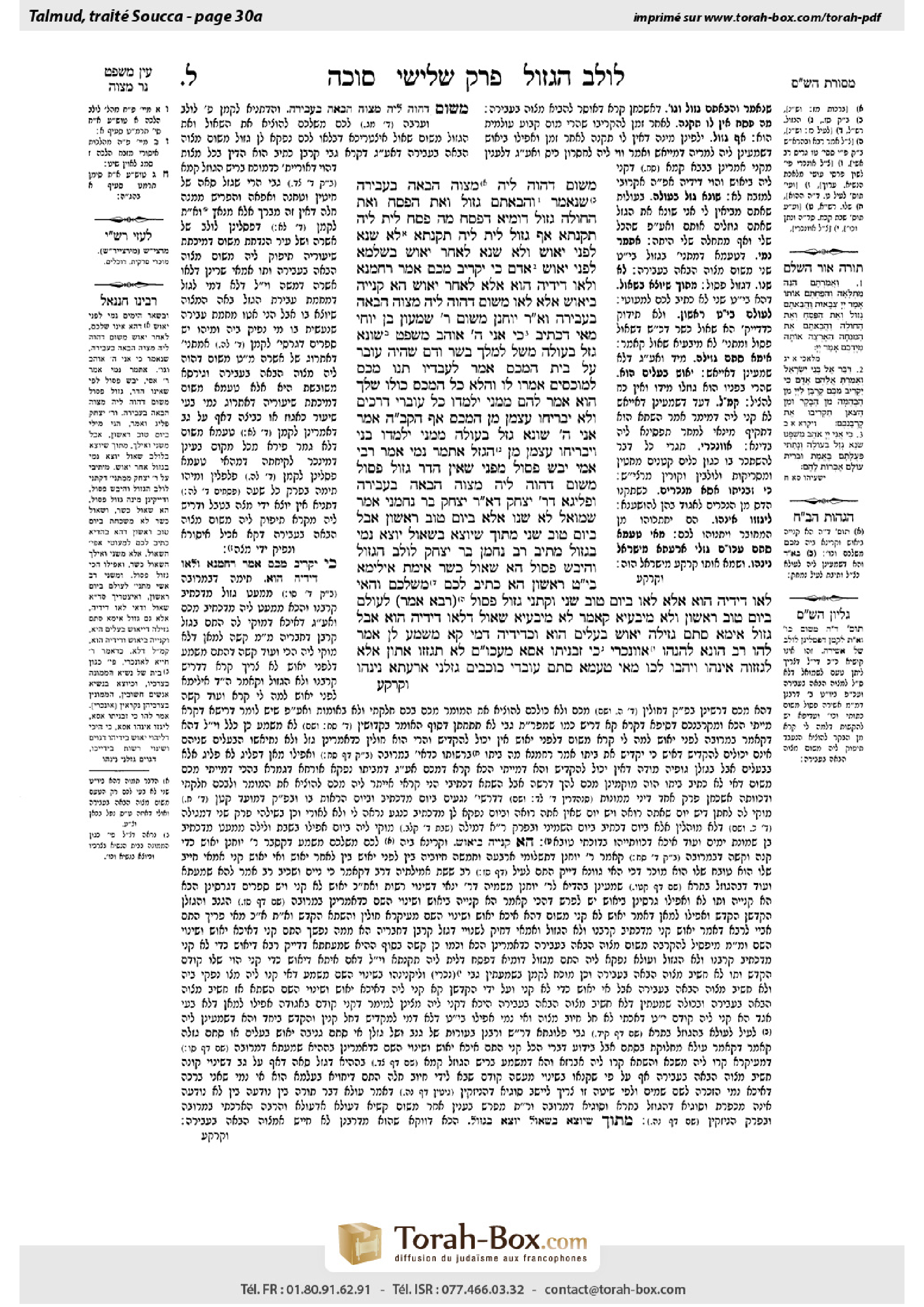
Sukkah 30a: Talmud study for Daf Yomi
Daf Yomi is the daily study of one Talmud folio. Explore 37 tractates with scans, Hebrew text, Sefaria English and AI-generated French translations where annotated.
Passage selection and English or AI-generated French translation are available where the scan has annotations. Daf Study is independent of Torah-Box and Sefaria.
Browse Sukkah · סוכה · All tractatesSukkah 30a text and translations
This page of Sukkah includes the Aramaic text, an English translation and an AI-generated French translation, alongside the scan above.
סוכה ל׳ א · Aramaic and Hebrew text
מִשּׁוּם דְּהָוֵה לֵיהּ מִצְוָה הַבָּאָה בַּעֲבֵירָה, שֶׁנֶּאֱמַר: ״וַהֲבֵאתֶם גָּזוּל וְאֶת הַפִּסֵּחַ וְאֶת הַחוֹלֶה״. גָּזוּל דּוּמְיָא דְּפִסֵּחַ, מָה פִּסֵּחַ לֵית לֵיהּ תַּקַּנְתָּא — אַף גָּזוּל לֵית לֵיהּ תַּקַּנְתָּא, לָא שְׁנָא לִפְנֵי יֵאוּשׁ וְלָא שְׁנָא לְאַחַר יֵאוּשׁ.
בִּשְׁלָמָא לִפְנֵי יֵאוּשׁ — ״אָדָם כִּי יַקְרִיב מִכֶּם״ אָמַר רַחֲמָנָא, וְלָאו דִּידֵיהּ הוּא. אֶלָּא לְאַחַר יֵאוּשׁ — הָא קַנְיֵיהּ בְּיֵאוּשׁ! אֶלָּא לָאו, מִשּׁוּם דְּהָוֵה לֵיהּ מִצְוָה הַבָּאָה בַּעֲבֵירָה.
וְאָמַר רַבִּי יוֹחָנָן מִשּׁוּם רַבִּי שִׁמְעוֹן בֶּן יוֹחַי: מַאי דִּכְתִיב: ״כִּי אֲנִי ה׳ אוֹהֵב מִשְׁפָּט שׂוֹנֵא גָזֵל בְּעוֹלָה״ — מָשָׁל לְמֶלֶךְ בָּשָׂר וָדָם שֶׁהָיָה עוֹבֵר עַל בֵּית הַמֶּכֶס, אָמַר לַעֲבָדָיו: תְּנוּ מֶכֶס לַמּוֹכְסִים. אָמְרוּ לוֹ: וַהֲלֹא כׇּל הַמֶּכֶס כּוּלּוֹ שֶׁלְּךָ הוּא? אָמַר לָהֶם: מִמֶּנִּי יִלְמְדוּ כׇּל עוֹבְרֵי דְּרָכִים וְלֹא יַבְרִיחוּ עַצְמָן מִן הַמֶּכֶס. אַף הַקָּדוֹשׁ בָּרוּךְ הוּא אָמַר: ״אֲנִי ה׳ שׂוֹנֵא גָזֵל בְּעוֹלָה״, מִמֶּנִּי יִלְמְדוּ בָּנַי וְיַבְרִיחוּ עַצְמָן מִן הַגָּזֵל.
אִתְּמַר נָמֵי, אָמַר רַבִּי אַמֵּי: יָבֵשׁ פָּסוּל מִפְּנֵי שֶׁאֵין הָדָר, גָּזוּל פָּסוּל מִשּׁוּם דְּהָוֵה לֵיהּ מִצְוָה הַבָּאָה בַּעֲבֵירָה.
וּפְלִיגָא דְּרַבִּי יִצְחָק. דְּאָמַר רַבִּי יִצְחָק בַּר נַחְמָנִי אָמַר שְׁמוּאֵל: לֹא שָׁנוּ, אֶלָּא בְּיוֹם טוֹב רִאשׁוֹן, אֲבָל בְּיוֹם טוֹב שֵׁנִי, מִתּוֹךְ שֶׁיּוֹצֵא בְּשָׁאוּל — יוֹצֵא נָמֵי בְּגָזוּל.
מֵתִיב רַב נַחְמָן בַּר יִצְחָק: לוּלָב הַגָּזוּל וְהַיָּבֵשׁ — פָּסוּל, הָא שָׁאוּל — כָּשֵׁר. אֵימַת? אִילֵּימָא בְּיוֹם טוֹב רִאשׁוֹן, הָא כְּתִיב: ״לָכֶם״ — מִשֶּׁלָּכֶם, וְהַאי לָאו דִּידֵיהּ הוּא. אֶלָּא לָאו, בְּיוֹם טוֹב שֵׁנִי, וְקָתָנֵי גָּזוּל — פָּסוּל!
(רָבָא אָמַר:) לְעוֹלָם בְּיוֹם טוֹב רִאשׁוֹן, וְלָא מִיבַּעְיָא קָאָמַר: לָא מִיבַּעְיָא שָׁאוּל דְּלָאו דִּידֵיהּ הוּא, אֲבָל גָּזוּל, אֵימָא: סְתַם גְּזֵילָה יֵאוּשׁ בְּעָלִים הוּא, וּכְדִידֵיהּ דָּמֵי, קָא מַשְׁמַע לַן.
אֲמַר לְהוּ רַב הוּנָא לְהָנְהוּ אֲוַונְכָּרֵי: כִּי זָבְנִיתוּ אָסָא מִגּוֹיִם — לָא תִּגְזְזוּ אַתּוּן, אֶלָּא לִגְזְזוּהּ אִינְהוּ וְיָהֲבוּ לְכוּ. מַאי טַעְמָא — סְתָם גּוֹיִם גַּזְלָנֵי אַרְעָתָא נִינְהוּ
Sukkah 30a · English translation
It is unfit because it is a mitzva that comes to be fulfilled by means of a transgression, which renders the mitzva unfulfilled, as it is stated: “And you have brought that which was stolen and the lame, and the sick; that is how you bring the offering; should I accept this of your hand? says the Lord” (Malachi 1:13). Based on the juxtaposition in the verse, it is derived that the legal status of a stolen animal is equivalent to that of a lame animal. Just as a lame animal, because it is blemished, has no remedy and is unfit for use, so too, a stolen animal has no remedy. There is no difference before the owners reach a state of despair of recovering the stolen animal, and there is no difference after despair. In both cases there is no remedy.
The Gemara elaborates: Granted, before the despair of the owner, the robber may not sacrifice the animal because the animal does not belong to him. The Merciful One says: “When a person sacrifices from yours an offering” (Leviticus 1:2). The term “from yours” indicates that the animal must belong to the one sacrificing it, and this stolen animal is not his. However, after the despair of the owner, didn’t the robber acquire the animal with the despair? Once the owner despairs, the animal belongs to the robber, despite the fact that he incurs a debt that he must repay the owner. Since the animal is legally his, why is it prohibited for the robber to sacrifice it as an offering? Rather, is it not because the offering is a mitzva that comes by means of a transgression? Since the animal came into his possession by means of a transgression, it is unfit for use in fulfilling a mitzva.
And Rabbi Yoḥanan said in the name of Rabbi Shimon ben Yoḥai: What is the meaning of that which is written: “For I the Lord love justice, I hate robbery in a burnt-offering” (Isaiah 61:8)? The Gemara cites a parable of a flesh-and-blood king who was passing by a customs house. He said to his servants: Pay the levy to the taxmen. They said to him: Doesn’t all the tax in its entirety belong to you? If the taxes will ultimately reach the royal treasury, what is the point of paying the levy? He said to them: From my conduct, all travelers will learn and will not evade payment of the tax. So too, the Holy One, Blessed be He, said: “I the Lord... hate robbery in a burnt-offering.” Although the whole world is His and the acquisitions of man have no impact upon Him, God says: From My conduct, My children will learn and distance themselves from robbery, even from robbery unrelated to the needs of offerings.
It was also stated: Rabbi Ami said: A dry lulav is unfit because it does not meet the criterion of beauty, and a stolen lulav is unfit because it is a mitzva that comes by means of a transgression.
The Gemara notes: And Rabbi Ami disagrees with the opinion of Rabbi Yitzḥak, as Rabbi Yitzhak bar Naḥmani said that Shmuel said: The Sages taught that the halakha that a stolen lulav is unfit applies only with regard to the first day of the festival of Sukkot. However, beginning on the second day of the Festival, there is no longer a Torah requirement to use a lulav from one’s own property. Since one fulfills his obligation with a borrowed lulav, one fulfills his obligation with a stolen one as well.
Rabbi Naḥman bar Yitzḥak raises an objection from the mishna: A lulav that was stolen or that is completely dry is unfit. By inference, one concludes that a borrowed lulav is fit for use. The Gemara asks: When does this halakha apply? If you say that it applies only on the first day of the Festival, isn’t it written: “And you shall take for yourselves on the first day,” indicating that the four species must be taken from your own property, and this borrowed lulav is not his? Clearly, the mishna is not referring to the first day. Rather, is it not that the mishna is referring to the second day of the Festival, and the mishna teaches that a stolen lulav is unfit on this day too, contrary to Shmuel’s opinion?
Rava said: Actually, the mishna can be explained as referring to the first day of the Festival, and the tanna is stating the halakha employing the didactic style: It was not necessary. It was not necessary to state that one does not fulfill his obligation with a borrowed lulav, as it is not his. However, with regard to a stolen lulav, say: Barring extraordinary circumstances, standard robbery is a case that leads to despair of the owners, and despite the fact that a stolen lulav was acquired by means of a transgression, its legal status is like the robber’s own property. Therefore, the mishna teaches us that this is not so. One does not fulfill his obligation with a stolen lulav. The mishna is not a refutation of Shmuel’s opinion.
§ Apropos the unfitness of four species acquired through robbery, the Gemara relates: Rav Huna said to the merchants [avankarei] selling the four species: When you purchase myrtle branches from gentiles, don’t you cut them off the tree? Rather, let the gentiles cut them and give them to you. What is the reason for this advice? It is because typical gentiles are land robbers,
Sukkah 30a · Traduction française (IA)
Il est impropre, car c’est une mitsva dont l’accomplissement passe par une transgression, ce qui empêche d’accomplir la mitsva, comme il est dit : « Vous avez apporté ce qui a été volé, ainsi que l’animal boiteux et le malade ; c’est ainsi que vous présentez l’offrande ! Puis-je l’accepter de votre main ? dit le Seigneur » (Malachie 1,13). En s’appuyant sur le rapprochement établi dans le verset, on déduit que le statut juridique d’un animal volé équivaut à celui d’un animal boiteux. De même qu’un animal boiteux, parce qu’il est atteint d’un défaut, ne peut être réparé et est impropre à l’usage, de même un animal volé ne peut être rendu apte. Il n’y a de différence ni avant que les propriétaires ne désespèrent de récupérer l’animal volé, ni après qu’ils ont désespéré. Dans les deux cas, il n’existe aucun moyen de le rendre apte.
La Guemara développe : certes, avant que le propriétaire ne désespère de récupérer l’animal, le voleur ne peut pas l’offrir, car il ne lui appartient pas. Le Miséricordieux dit : « Lorsqu’un homme offrira une offrande provenant de ce qui lui appartient » (Lévitique 1,2). L’expression « de ce qui lui appartient » indique que l’animal doit appartenir à celui qui l’offre, or cet animal volé ne lui appartient pas. Cependant, après que le propriétaire a désespéré, le voleur n’a-t-il pas acquis l’animal grâce à ce désespoir ? Une fois que le propriétaire a désespéré, l’animal appartient au voleur, bien que celui-ci reste redevable envers le propriétaire et doive le rembourser. Puisque l’animal lui appartient juridiquement, pourquoi est-il interdit au voleur de l’offrir en sacrifice ? N’est-ce pas plutôt parce que cette offrande est une mitsva dont l’accomplissement passe par une transgression ? Puisque l’animal est entré en sa possession par une transgression, il est impropre à l’accomplissement d’une mitsva.
Et Rabbi Yoḥanan a dit au nom de Rabbi Shimon ben Yoḥai : Que signifie ce qui est écrit : « Car moi, le Seigneur, j’aime la justice, je hais le vol dans l’holocauste » (Isaïe 61,8) ? La Guemara rapporte la parabole d’un roi de chair et de sang qui passait devant un poste de douane. Il dit à ses serviteurs : « Payez le droit de douane aux percepteurs. » Ils lui dirent : « Toute la taxe ne vous appartient-elle pas ? Si les impôts finissent par parvenir au trésor royal, à quoi bon payer le droit de douane ? » Il leur dit : « Par mon comportement, tous les voyageurs apprendront à ne pas chercher à éluder le paiement de la taxe. » De même, le Saint, béni soit-Il, dit : « Moi, le Seigneur… je hais le vol dans l’holocauste. » Bien que le monde entier Lui appartienne et que les acquisitions de l’homme n’aient aucune incidence sur Lui, Dieu dit : « Par mon comportement, mes enfants apprendront à s’éloigner du vol, même lorsqu’il n’a aucun rapport avec les offrandes. »
Il a également été enseigné : Rabbi Ami a dit : un loulav sec est impropre, car il ne satisfait pas au critère de beauté ; un loulav volé est impropre, car c’est une mitsva dont l’accomplissement passe par une transgression.
La Guemara relève que Rabbi Ami est en désaccord avec l’opinion de Rabbi Yitzḥak, car Rabbi Yitzḥak bar Naḥmani a dit au nom de Shmuel : Les Sages ont enseigné que la halakha selon laquelle un loulav volé est impropre ne s’applique qu’au premier jour de la fête de Soukkot. En revanche, à partir du deuxième jour de la fête, la Torah n’exige plus que l’on utilise un loulav provenant de ses propres biens. Puisqu’on s’acquitte de son obligation avec un loulav emprunté, on s’en acquitte également avec un loulav volé.
Rabbi Naḥman bar Yitzḥak soulève une objection à partir de la Michna : un loulav qui a été volé ou qui est complètement sec est impropre. On en déduit qu’un loulav emprunté est apte à l’usage. La Guemara demande : quand cette halakha s’applique-t-elle ? Si vous dites qu’elle ne s’applique qu’au premier jour de la fête, n’est-il pas écrit : « Vous prendrez pour vous le premier jour », ce qui indique que les quatre espèces doivent être prises parmi vos propres biens, alors que ce loulav emprunté ne lui appartient pas ? Il est donc clair que la Michna ne parle pas du premier jour. Ne parle-t-elle pas plutôt du deuxième jour de la fête, enseignant ainsi qu’un loulav volé est également impropre ce jour-là, contrairement à l’opinion de Shmuel ?
Rava a dit : En réalité, la Michna peut être comprise comme parlant du premier jour de la fête, et le tanna énonce la halakha selon le procédé didactique appelé « il n’était pas nécessaire ». Il n’était pas nécessaire de préciser qu’on ne s’acquitte pas de son obligation avec un loulav emprunté, puisqu’il ne lui appartient pas. En revanche, à propos d’un loulav volé, on aurait pu dire : sauf circonstances exceptionnelles, un vol ordinaire est un cas où les propriétaires en viennent à désespérer de récupérer leur bien ; ainsi, bien qu’un loulav volé ait été acquis par une transgression, son statut juridique est celui d’un bien appartenant au voleur. La Michna nous enseigne donc que ce n’est pas le cas : on ne s’acquitte pas de son obligation avec un loulav volé. La Michna ne réfute pas l’opinion de Shmuel.
§ À propos de l’inaptitude des quatre espèces acquises par le vol, la Guemara rapporte : Rav Huna dit aux marchands [avankarei] qui vendent les quatre espèces : « Lorsque vous achetez des branches de myrte à des non-Juifs, ne les coupez-vous pas vous-mêmes de l’arbre ? Laissez plutôt les non-Juifs les couper et vous les donner. » Quelle est la raison de ce conseil ? C’est que les non-Juifs s’approprient généralement les terres par le vol,
Traduction française générée par IA à partir de l’édition anglaise de Sefaria. Vérifie toujours un passage avec le texte source.
Text from Sefaria: William Davidson Edition - Vocalized Aramaic (CC BY NC); William Davidson Edition - English (CC BY NC).