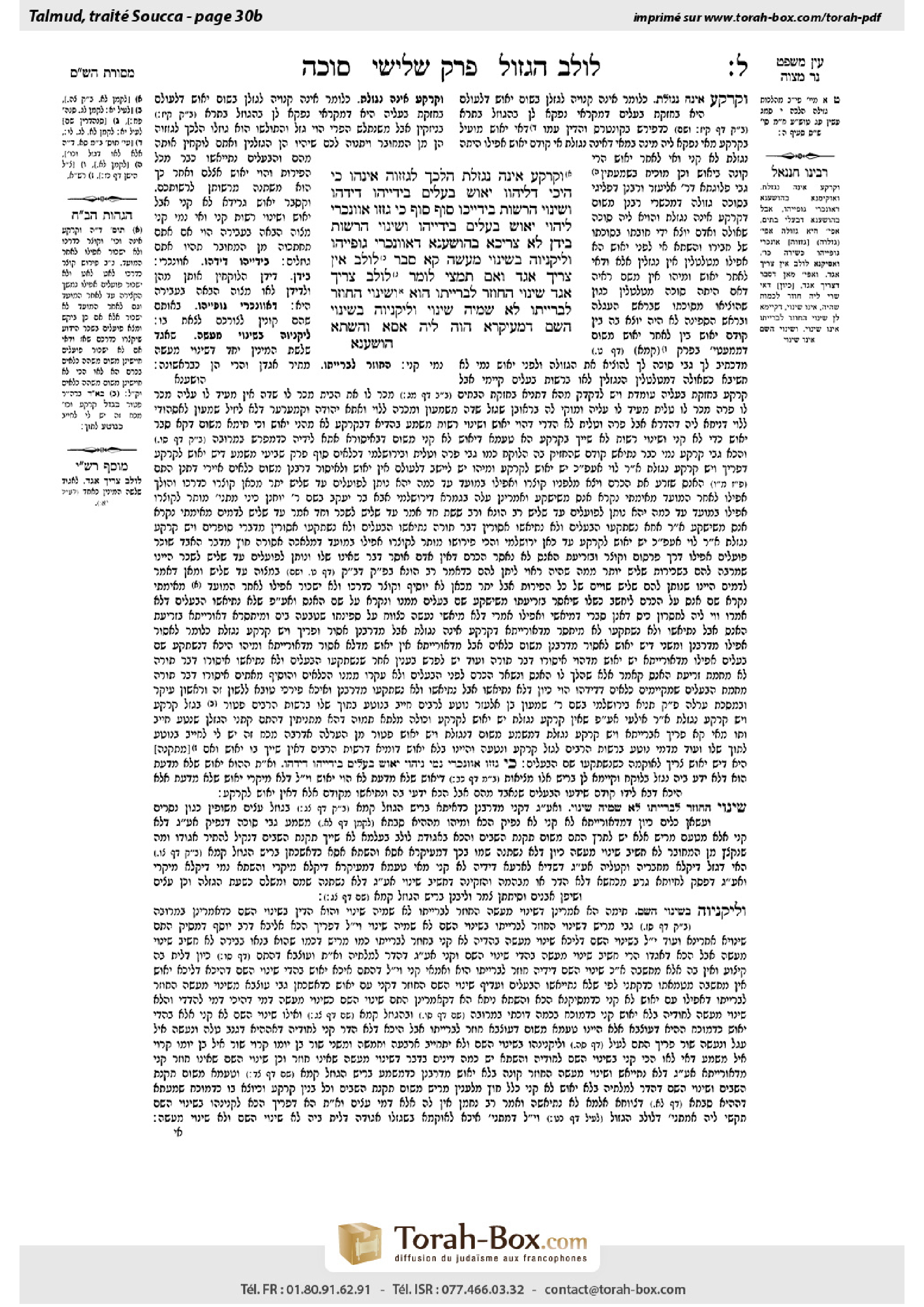
Sukkah 30b: Talmud study for Daf Yomi
Daf Yomi is the daily study of one Talmud folio. Explore 37 tractates with scans, Hebrew text, Sefaria English and AI-generated French translations where annotated.
Passage selection and English or AI-generated French translation are available where the scan has annotations. Daf Study is independent of Torah-Box and Sefaria.
Browse Sukkah · סוכה · All tractatesSukkah 30b text and translations
This page of Sukkah includes the Aramaic text, an English translation and an AI-generated French translation, alongside the scan above.
סוכה ל׳ ב · Aramaic and Hebrew text
וְקַרְקַע אֵינָהּ נִגְזֶלֶת. הִלְכָּךְ לִגְזְזוּהּ אִינְהוּ, כִּי הֵיכִי דְּלִיהְווֹ יֵאוּשׁ בְּעָלִים בִּידַיְיהוּ דִּידְהוּ וְשִׁינּוּי הָרְשׁוּת בִּידַיְיכוּ.
סוֹף סוֹף כִּי גָזְזוּ אֲוַונְכָּרֵי, לֶיהֱוֵי יֵאוּשׁ בְּעָלִים בִּידַיְיהוּ וְשִׁינּוּי הָרְשׁוּת בִּידַן! לָא צְרִיכָא, בְּהוֹשַׁעְנָא דַּאֲוַונְכָּרֵי גּוּפַיְיהוּ.
וְלִיקְנְיוּהּ בְּשִׁינּוּי מַעֲשֶׂה! קָא סָבַר לוּלָב אֵין צָרִיךְ אֶגֶד.
וְאִם תִּמְצֵי לוֹמַר לוּלָב צָרִיךְ אֶגֶד, שִׁינּוּי הַחוֹזֵר לִבְרִיָּיתוֹ הוּא, וְשִׁינּוּי הַחוֹזֵר לִבְרִיָּיתוֹ — לָא שְׁמֵיהּ שִׁינּוּי.
וְלִיקְנְיוּהּ בְּשִׁינּוּי הַשֵּׁם, דְּמֵעִיקָּרָא הֲוָה לֵיהּ אַסָּא וְהַשְׁתָּא
Sukkah 30b · English translation
and land is not stolen. When one seizes land, the land remains the property of its original owner, even if that owner has despaired. In this case, there is concern that these myrtle branches were stolen from Jews. Therefore, let the gentiles cut the myrtle branches, so that the despair of the owners will be when the myrtle branches are still in the hands of the gentiles and the change of possession will be accomplished through their purchase and transfer into your hands. The combination of owner’s despair and change of possession will render the myrtle branches the property of the merchants, and it will not be a mitzva fulfilled by means of a transgression.
The Gemara asks: Ultimately, even when the merchants cut the myrtle branches, let it be a case of despair in their hands, and the change of possession is accomplished through the purchase and transfer of the myrtle branches into the hands of the buyers. Why did Rav Huna advise them to have the gentiles cut the myrtle branches? The same result is achieved through their sale. The Gemara answers: No, it is necessary for Rav Huna to advise the merchants to allow the gentiles to cut the myrtle branches only with regard to the myrtle branches of the merchants themselves, which will not undergo another change of possession. The only way to ensure that the merchants are fulfilling the mitzva with myrtle branches that belong to them is to have the gentiles cut them and have the change of possession accomplished through the purchase from the gentiles.
The Gemara asks: And let them acquire the myrtle branches with a physical change accomplished by the action of binding them with the lulav and the willow branch. Just as despair followed by a change in possession effects acquisition, despair followed by a physical change effects acquisition for the one who implements that change. In that case, too, the myrtle branches no longer belong to the original owner. The Gemara answers that Rav Huna holds: A lulav does not require binding. There is no mitzva to bind the four species together. One need only hold them unbound in his hand; therefore, the myrtle branches undergo no action that effects physical change.
And even if you want to say that a lulav requires binding, and therefore the myrtle branches undergo a physical change, it is a change after which the object reverts to its original state. Binding the species effects no change in the myrtle branches themselves. Once the binding is removed, the myrtle branches are restored to their original state. And the principle is: A change after which the object reverts to its original state is not considered a change. It is of no significance with regard to effecting acquisition.
The Gemara asks: And let the merchants acquire a myrtle branch with a change of name that it underwent, as initially it was called a myrtle branch, and now that it is designated for use in fulfilling the mitzva,
Sukkah 30b · Traduction française (IA)
et la terre ne peut pas être volée. Lorsqu’on s’empare d’un terrain, celui-ci reste la propriété de son propriétaire initial, même si ce dernier a désespéré d’en recouvrer la possession. En l’occurrence, on peut craindre que ces branches de myrte aient été volées à des Juifs. Il faut donc laisser les non-Juifs couper les branches de myrte, afin que les propriétaires désespèrent d’en recouvrer la possession alors que les branches sont encore entre les mains des non-Juifs, et que le changement de possession s’accomplisse par leur achat, suivi de leur transfert entre vos mains. La combinaison du désespoir des propriétaires et du changement de possession fera des branches de myrte la propriété des marchands, et la mitsva ne sera pas accomplie au moyen d’une transgression.
La Guemara demande : en définitive, même lorsque les marchands coupent les branches de myrte, celles-ci peuvent faire l’objet d’un désespoir de la part de leurs propriétaires alors qu’elles sont entre les mains des marchands, puis le changement de possession s’accomplit par l’achat et le transfert des branches de myrte entre les mains des acheteurs. Pourquoi Rav Houna leur a-t-il conseillé de laisser les non-Juifs couper les branches de myrte ? Le même résultat est obtenu par leur vente. La Guemara répond : non, Rav Houna doit conseiller aux marchands de laisser les non-Juifs couper les branches de myrte uniquement lorsqu’il s’agit des branches de myrte des marchands eux-mêmes, qui ne feront pas l’objet d’un autre changement de possession. La seule manière de garantir que les marchands accomplissent la mitsva avec des branches de myrte qui leur appartiennent est de laisser les non-Juifs les couper et de faire en sorte que le changement de possession s’accomplisse par l’achat auprès des non-Juifs.
La Guemara demande : qu’ils acquièrent les branches de myrte grâce à la transformation matérielle résultant de leur liaison au loulav et à la branche de saule. De même que le désespoir suivi d’un changement de possession entraîne l’acquisition, le désespoir suivi d’une transformation matérielle entraîne l’acquisition par celui qui effectue cette transformation. Dans ce cas également, les branches de myrte n’appartiennent plus à leur propriétaire initial. La Guemara répond que Rav Houna considère que le loulav n’a pas besoin d’être lié. Il n’y a pas de mitsva consistant à lier ensemble les quatre espèces. Il suffit de les tenir dans la main sans les lier ; les branches de myrte ne subissent donc aucune action entraînant une transformation matérielle.
Et même si l’on veut dire que le loulav doit être lié, et que les branches de myrte subissent donc une transformation matérielle, il s’agit d’une transformation après laquelle l’objet retrouve son état initial. Lier les espèces ne modifie pas les branches de myrte elles-mêmes. Une fois le lien défait, elles retrouvent leur état initial. Or, le principe est le suivant : une transformation après laquelle l’objet retrouve son état initial n’est pas considérée comme une transformation. Elle n’a aucune incidence sur l’acquisition.
La Guemara demande : que les marchands acquièrent une branche de myrte grâce au changement de nom qu’elle a subi : au départ, elle était appelée « branche de myrte », et maintenant, puisqu’elle est destinée à servir à l’accomplissement de la mitsva,
Traduction française générée par IA à partir de l’édition anglaise de Sefaria. Vérifie toujours un passage avec le texte source.
Text from Sefaria: William Davidson Edition - Vocalized Aramaic (CC BY NC); William Davidson Edition - English (CC BY NC).