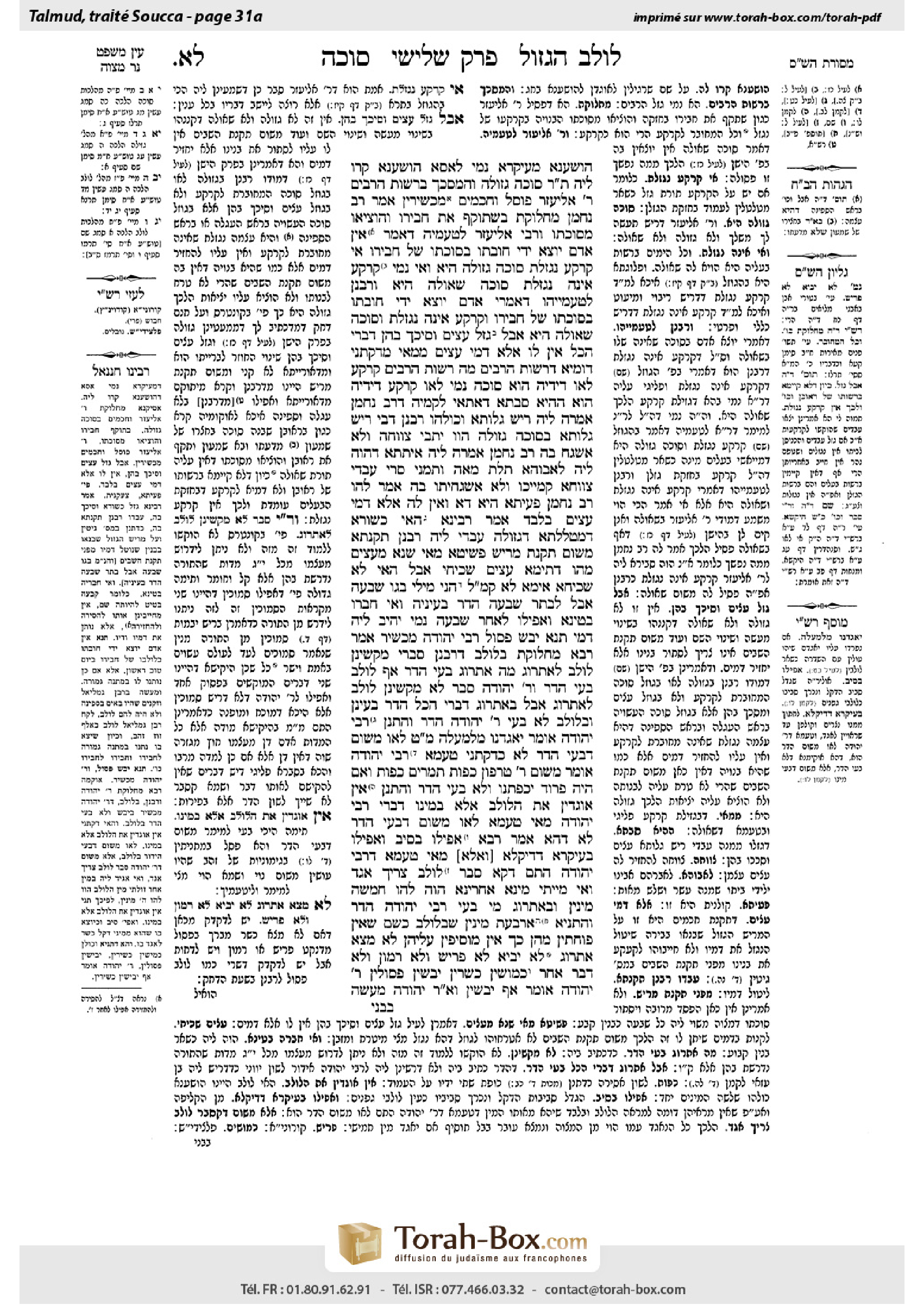
Sukkah 31a: Talmud study for Daf Yomi
Daf Yomi is the daily study of one Talmud folio. Explore 37 tractates with scans, Hebrew text, Sefaria English and AI-generated French translations where annotated.
Passage selection and English or AI-generated French translation are available where the scan has annotations. Daf Study is independent of Torah-Box and Sefaria.
Browse Sukkah · סוכה · All tractatesSukkah 31a text and translations
This page of Sukkah includes the Aramaic text, an English translation and an AI-generated French translation, alongside the scan above.
סוכה ל״א א · Aramaic and Hebrew text
הוֹשַׁעְנָא! מֵעִיקָּרָא, נָמֵי לְאַסָּא ״הוֹשַׁעְנָא״ קָרוּ לֵיהּ.
תָּנוּ רַבָּנַן: סוּכָּה גְּזוּלָה, וְהַמְסַכֵּךְ בִּרְשׁוּת הָרַבִּים — רַבִּי אֱלִיעֶזֶר פּוֹסֵל, וַחֲכָמִים מַכְשִׁירִין.
אָמַר רַב נַחְמָן: מַחְלוֹקֶת בְּשֶׁתּוֹקֵף אֶת חֲבֵירוֹ וְהוֹצִיאוֹ מִסּוּכָּתוֹ. וְרַבִּי אֱלִיעֶזֶר לְטַעְמֵיהּ דְּאָמַר: אֵין אָדָם יוֹצֵא יְדֵי חוֹבָתוֹ בְּסוּכָּתוֹ שֶׁל חֲבֵירוֹ. אִי קַרְקַע נִגְזֶלֶת — סוּכָּה גְּזוּלָה הִיא. וְאִי נָמֵי קַרְקַע אֵינָהּ נִגְזֶלֶת — סוּכָּה שְׁאוּלָה הִיא.
וְרַבָּנַן לְטַעְמַיְיהוּ, דְּאָמְרִי: אָדָם יוֹצֵא יְדֵי חוֹבָתוֹ בְּסוּכָּתוֹ שֶׁל חֲבֵירוֹ, וְקַרְקַע אֵינָהּ נִגְזֶלֶת, וְסוּכָּה שְׁאוּלָה הִיא.
אֲבָל גָּזַל עֵצִים וְסִיכֵּךְ בָּהֶן — דִּבְרֵי הַכֹּל אֵין לוֹ אֶלָּא דְּמֵי עֵצִים.
מִמַּאי?
מִדְּקָתָנֵי: דּוּמְיָא דִּרְשׁוּת הָרַבִּים. מָה רְשׁוּת הָרַבִּים — קַרְקַע לָאו דִּידֵיהּ הוּא, סוּכָּה נָמֵי — לָאו קַרְקַע דִּידֵיהּ הוּא.
הָהִיא סָבְתָּא דַּאֲתַאי לְקַמֵּיהּ דְּרַב נַחְמָן, אֲמַרָה לֵיהּ: רֵישׁ גָּלוּתָא וְכוּלְּהוּ רַבָּנַן דְּבֵי רֵישׁ גָּלוּתָא בְּסוּכָּה גְּזוּלָה הֲווֹ יָתְבִי. צָוְוחָה וְלָא אַשְׁגַּח בָּהּ רַב נַחְמָן. אֲמַרָה לֵיהּ: אִיתְּתָא דַּהֲוָה לֵיהּ לַאֲבוּהָא תְּלָת מְאָה וְתַמְנֵי סְרֵי עַבְדֵי צָוְוחָא קַמַּיְיכוּ וְלָא אַשְׁגְּחִיתוּ בַּהּ?! אֲמַר לְהוּ רַב נַחְמָן: פָּעִיתָא הִיא דָּא, וְאֵין לָהּ אֶלָּא דְּמֵי עֵצִים בִּלְבַד.
אָמַר רָבִינָא: הַאי כְּשׁוּרָא דִמְטַלַּלְתָּא דִּגְזוּלָה, עָבְדִי לַיהּ רַבָּנַן תַּקַּנְתָּא, מִשּׁוּם תַּקָּנַת מָרִישׁ.
פְּשִׁיטָא, מַאי שְׁנָא מֵעֵצִים? מַהוּ דְּתֵימָא עֵצִים שְׁכִיחִי, אֲבָל הַאי לָא שְׁכִיחָא — אֵימָא לָא, קָא מַשְׁמַע לַן.
הָנֵי מִילֵּי בְּגוֹ שִׁבְעָה, אֲבָל לְבָתַר שִׁבְעָה — הָדַר בְּעֵינֵיהּ. וְאִי חִבְּרוֹ בְּטִינָא, וַאֲפִילּוּ לְאַחַר שִׁבְעָה נָמֵי יָהֵיב לֵיהּ דְּמֵי.
תָּנָא: יָבֵשׁ — פָּסוּל, רַבִּי יְהוּדָה מַכְשִׁיר. אָמַר רָבָא: מַחֲלוֹקֶת בְּלוּלָב, דְּרַבָּנַן סָבְרִי: מַקְּשִׁינַן לוּלָב לְאֶתְרוֹג, מָה אֶתְרוֹג בָּעֵי ״הָדָר״ — אַף לוּלָב בָּעֵי ״הָדָר״. וְרַבִּי יְהוּדָה סָבַר: לָא מַקְּשִׁינַן לוּלָב לְאֶתְרוֹג. אֲבָל בְּאֶתְרוֹג — דִּבְרֵי הַכֹּל הָדָר בָּעֵינַן.
וּבְלוּלָב לָא בָּעֵי רַבִּי יְהוּדָה ״הָדָר״? וְהָתְנַן, רַבִּי יְהוּדָה אוֹמֵר: יַאַגְדֶנּוּ מִלְמַעְלָה. מַאי טַעְמָא — לָאו מִשּׁוּם דְּבָעֵי ״הָדָר״?
לָא, כִּדְקָתָנֵי טַעְמָא: רַבִּי יְהוּדָה אוֹמֵר מִשּׁוּם רַבִּי טַרְפוֹן: ״כַּפּוֹת תְּמָרִים״ — כְּפוֹת, וְאִם הָיָה פָּרוּד יִכְפְּתֶנּוּ.
וְלָא בָּעֵי ״הָדָר״? וְהָתְנַן: אֵין אוֹגְדִין אֶת הַלּוּלָב אֶלָּא בְּמִינוֹ, דִּבְרֵי רַבִּי יְהוּדָה. מַאי טַעְמָא, לָאו מִשּׁוּם דְּבָעֵי ״הָדָר״?
לָא, דְּהָא אָמַר רָבָא: אֲפִילּוּ בְּסִיב, וַאֲפִילּוּ בְּעִיקָּרָא דְּדִיקְלָא. [וְאֶלָּא] מַאי טַעְמָא דְּרַבִּי יְהוּדָה הָתָם? דְּקָא סָבַר לוּלָב צָרִיךְ אֶגֶד, וְאִי מַיְיתֵי מִינָא אַחֲרִינָא — הָוֵה לְהוּ חֲמִשָּׁה מִינִין.
וּבְאֶתְרוֹג מִי בָּעֵי רַבִּי יְהוּדָה הָדָר? וְהָתַנְיָא: אַרְבַּעַת מִינִין שֶׁבַּלּוּלָב, כְּשֵׁם שֶׁאֵין פּוֹחֲתִין מֵהֶן כָּךְ אֵין מוֹסִיפִין עֲלֵיהֶן. לֹא מָצָא אֶתְרוֹג — לֹא יָבִיא לֹא פָּרִישׁ וְלֹא רִמּוֹן וְלֹא דָּבָר אַחֵר. כְּמוּשִׁין — כְּשֵׁרִין, יְבֵשִׁין — פְּסוּלִין. רַבִּי יְהוּדָה אוֹמֵר: אַף יְבֵשִׁין.
וְאָמַר רַבִּי יְהוּדָה: מַעֲשֶׂה
Sukkah 31a · English translation
it is called hoshana, which is a term used to describe the four species. The Gemara answers: This is not a full-fledged change of name, as occasionally it also happens that they initially refer to a myrtle branch as a hoshana while it is attached to the tree.
§ The Sages taught: With regard to a stolen sukka and with regard to one who roofs a sukka in the public domain, which is tantamount to robbing land from the public, Rabbi Eliezer deems these sukkot unfit for use in fulfillment of the mitzva, and the Rabbis deem them fit.
Rav Naḥman said: This dispute is limited to a case where one assaults another and forcibly evicts him from his sukka, and takes his place in the sukka. In that case, Rabbi Eliezer deems the sukka unfit. And Rabbi Eliezer conforms to his own reasoning, as he said: A person does not fulfill his obligation with the sukka of another. Therefore, in any event, he does not fulfill his obligation with it. If land can be stolen and acquired by the robber, the sukka from which he evicted the owner is a stolen sukka. And if indeed land cannot be stolen, nevertheless, the robber does not fulfill his obligation according to Rabbi Eliezer, as it is a borrowed sukka.
And the Rabbis conform to their reasoning, as they said: A person fulfills his obligation with the sukka of another. And since land cannot be stolen and the sukka is merely a borrowed sukka and not a stolen one, the robber fulfills his obligation, despite the fact that he committed a reprehensible act.
However, if one stole wood and roofed a sukka with it, everyone agrees, as Rabbi Eliezer concedes, that the original owner of the wood has rights only to the monetary value of the wood. The wood itself belongs to the robber, so it is not a stolen sukka.
The Gemara asks: From where does Rav Naḥman draw the conclusion that the dispute is with regard to a stolen sukka and not with regard to a sukka established with stolen building materials?
The Gemara answers: From the fact that the halakha of a stolen sukka is juxtaposed in the baraita to the halakha of a sukka established in the public domain, the baraita teaches that the legal status of the stolen sukka is similar to the legal status of a sukka established in the public domain. Just as one does not fulfill his obligation with a sukka in the public domain because the land is not his, with regard to the stolen sukka too, one does not fulfill his obligation because the land is not his, not because the building materials were stolen.
The Gemara relates: There was a certain old woman who came before Rav Naḥman. She said to him: The Exilarch and all the Sages in his house have been sitting in a stolen sukka. She claimed that the Exilarch’s servants stole her wood and used it to build the sukka. She screamed, but Rav Naḥman did not pay attention to her. She said to him: A woman whose father, Abraham, our forefather, had three hundred and eighteen slaves screams before you, and you do not pay attention to her? She claimed that she should be treated with deference due to her lineage as a Jew. Rav Naḥman said to the Sages: This woman is a screamer, and she has rights only to the monetary value of the wood. However, the sukka itself was already acquired by the Exilarch.
Ravina said: With regard to the stolen large beam of a sukka, the Sages instituted an ordinance that the robber need not return it intact, due to the general ordinance of a beam. By the letter of the law, one who stole a beam and incorporated it in the construction of a new house is required to dismantle the house and return the beam. The Sages instituted an ordinance requiring the robber to repay the monetary value of the beam instead. They instituted this ordinance to facilitate the repentance of the robber, who would be less likely to repent if doing so entailed destruction of the house.
The Gemara asks: This is obvious. In what way is the beam different from other wood used in establishing the sukka? The Gemara answers: Lest you say: Wood is common, and therefore the owners are more likely to despair of recovering the wood and will suffice with receiving monetary restitution and replacing the wood, but, with regard to this large beam, which is not common, say that there is no despair, and the robber is required to return the actual beam, therefore, Ravina teaches us that the ordinance applies even to this beam, and the robber is required to return only its monetary value.
The Gemara notes: This halakha that the robber need not dismantle the sukka and return the beam applies only within the seven days of the Festival. However, after the seven days, the beam returns to the owner intact. And if the robber attached it with mortar and it is affixed permanently to the sukka, then even after the seven days of the Festival, the ordinance remains in effect, and the robber gives the original owner the monetary value of the beam.
§ It was taught in the Tosefta: A dry lulav is unfit. Rabbi Yehuda deems it fit. Rava said: The dispute is specifically with regard to a lulav, as the Rabbis hold: We liken the lulav to the etrog, based on their juxtaposition in the verse. Just as the etrog requires beauty, so too, the lulav requires beauty. And Rabbi Yehuda holds: We do not liken the lulav to the etrog. However, with regard to an etrog, everyone agrees that we require beauty [hadar] as the verse states: “Fruit of a beautiful tree” (Leviticus 23:40) and a dry etrog does not meet that criterion.
The Gemara asks: And with regard to a lulav, does Rabbi Yehuda really not require beauty? But didn’t we learn in the mishna that Rabbi Yehuda says: With regard to a lulav whose leaves have spread out, one should bind the lulav from the top. What is the reason to do so? Is it not because he requires beauty in the case of lulav?
The Gemara rejects this: No, as the reason is taught: Rabbi Yehuda says in the name of Rabbi Tarfon that the same verse states: “Branches [kappot] of a date palm.” The Sages interpret the term to mean bound [kafut], indicating that if the leaves of the lulav were spread, one should bind it.
The Gemara asks: And does Rabbi Yehuda not require beauty with regard to the lulav? But didn’t we learn in a mishna: One binds the lulav only with its own species, this is the statement of Rabbi Yehuda? What is the reason that Rabbi Yehuda requires the binding to be from its own species? Is it not due to the fact that he requires beauty with regard to the lulav?
The Gemara answers: No, that is not the reason, as Rava said: According to Rabbi Yehuda, one may bind the lulav even with fiber that grows around the trunk of the date palm and even with the root of the date palm, even though these do not meet the criterion of beauty. The Gemara asks: Rather, what is the rationale for the opinion of Rabbi Yehuda there, that a lulav must be bound with its own species? The Gemara answers: It is because he holds that a lulav requires binding, and if one brought another species to bind it, they are five species instead of four, violating the prohibition against adding to the mitzvot of the Torah.
The Gemara asks: And with regard to an etrog, does Rabbi Yehuda require beauty? But isn’t it taught in a baraita: With regard to the four species of the lulav, just as one may not diminish from their number, so too, one may not add to their number. If one did not find an etrog, he should not bring a quince, a pomegranate, or any other item instead. If the species are slightly dried, they are fit. If they are completely dry, they are unfit. Rabbi Yehuda says: Even dry etrogim are fit.
And Rabbi Yehuda said: There was an incident
Sukkah 31a · Traduction française (IA)
il est appelé hoshana, terme qui désigne les quatre espèces. La Guemara répond : ce n’est pas un véritable changement de nom, car il arrive aussi que l’on appelle hoshana une branche de myrte encore attachée à l’arbre.
§ Les Sages ont enseigné : Une soukka volée et une soukka construite dans le domaine public — ce qui équivaut à s’emparer d’un terrain appartenant au public — sont déclarées inaptes à l’accomplissement de la mitsva par Rabbi Eliezer, tandis que les Sages les déclarent aptes.
Rav Naḥman a dit : Cette controverse porte sur le cas où quelqu’un agresse une autre personne, la chasse de force de sa soukka et prend sa place dans celle-ci. Dans ce cas, Rabbi Eliezer déclare la soukka inapte. Rabbi Eliezer reste fidèle à sa propre opinion, car il a dit : On ne s’acquitte pas de son obligation avec la soukka d’autrui. Par conséquent, quoi qu’il en soit, le voleur ne s’en acquitte pas. Si un terrain peut être volé et acquis par le voleur, la soukka dont il a expulsé le propriétaire est une soukka volée. Et même si un terrain ne peut pas être volé, le voleur ne s’acquitte néanmoins pas de son obligation selon Rabbi Eliezer, puisqu’il s’agit d’une soukka empruntée.
Les Sages, eux, restent fidèles à leur opinion, car ils ont dit : On s’acquitte de son obligation avec la soukka d’autrui. Puisque le terrain ne peut pas être volé et que la soukka est simplement empruntée, et non volée, le voleur s’acquitte de son obligation, malgré le caractère répréhensible de son acte.
Cependant, si quelqu’un vole du bois et s’en sert pour couvrir une soukka, tous sont d’accord — comme Rabbi Eliezer le reconnaît — que le propriétaire initial du bois n’a de droits qu’à sa valeur monétaire. Le bois lui-même appartient au voleur ; il ne s’agit donc pas d’une soukka volée.
La Guemara demande : De quoi Rav Naḥman déduit-il que la controverse porte sur une soukka volée et non sur une soukka construite avec des matériaux volés ?
La Guemara répond : Le fait que, dans la baraïta, la halakha relative à une soukka volée soit juxtaposée à celle d’une soukka construite dans le domaine public enseigne que le statut de la soukka volée est semblable à celui d’une soukka construite dans le domaine public. De même qu’on ne s’acquitte pas de son obligation avec une soukka située dans le domaine public parce que le terrain ne nous appartient pas, de même, pour la soukka volée, on ne s’acquitte pas de son obligation parce que le terrain ne nous appartient pas, et non parce que les matériaux de construction ont été volés.
La Guemara rapporte : Une vieille femme se présenta devant Rav Naḥman. Elle lui dit : « L’Exilarque et tous les Sages de sa maison sont installés dans une soukka volée. » Elle affirma que les serviteurs de l’Exilarque lui avaient volé son bois et l’avaient utilisé pour construire la soukka. Elle cria, mais Rav Naḥman ne lui prêta pas attention. Elle lui dit : « Une femme dont le père, Abraham notre ancêtre, avait trois cent dix-huit esclaves crie devant toi, et tu ne lui prêtes pas attention ? » Elle revendiquait des égards en raison de ses origines juives. Rav Naḥman dit aux Sages : « Cette femme est une braillarde, et elle n’a droit qu’à la valeur monétaire du bois. La soukka elle-même a toutefois déjà été acquise par l’Exilarque. »
Ravina a dit : Concernant la grosse poutre volée d’une soukka, les Sages ont institué une mesure dispensant le voleur de la restituer intacte, conformément à la règle générale relative à une poutre. Selon la stricte loi, celui qui a volé une poutre et l’a intégrée à la construction d’une maison neuve doit démolir la maison et restituer la poutre. Les Sages ont institué une mesure imposant au voleur de rembourser plutôt la valeur monétaire de la poutre. Ils ont instauré cette mesure afin de faciliter le repentir du voleur, qui serait moins enclin à se repentir si cela impliquait la destruction de la maison.
La Guemara demande : Cela va de soi. En quoi cette poutre diffère-t-elle des autres pièces de bois utilisées pour construire la soukka ? La Guemara répond : De peur que tu ne dises : le bois est courant, et ses propriétaires sont donc plus susceptibles de renoncer à le récupérer et de se contenter d’une indemnisation monétaire pour en remplacer le bois ; mais, concernant cette grosse poutre, qui est rare, on pourrait dire qu’ils ne renoncent pas à la récupérer et que le voleur doit restituer la poutre elle-même. Ravina nous enseigne donc que la mesure s’applique même à cette poutre et que le voleur n’est tenu d’en restituer que la valeur monétaire.
La Guemara précise : Cette halakha, selon laquelle le voleur n’a pas à démolir la soukka pour restituer la poutre, ne s’applique que pendant les sept jours de la fête. Après ces sept jours, la poutre revient intacte à son propriétaire. Mais si le voleur l’a fixée avec du mortier, de sorte qu’elle est attachée de façon permanente à la soukka, alors, même après les sept jours de la fête, la mesure reste en vigueur et le voleur verse au propriétaire initial la valeur monétaire de la poutre.
§ Il a été enseigné dans la Tossefta : Un loulav sec est inapte. Rabbi Yehouda le déclare apte. Rava a dit : La controverse porte précisément sur le loulav, car les Sages établissent une analogie entre le loulav et l’étrog en raison de leur juxtaposition dans le verset. De même que l’étrog doit être beau, le loulav doit lui aussi être beau. Rabbi Yehouda, quant à lui, n’établit pas d’analogie entre le loulav et l’étrog. Toutefois, concernant l’étrog, tous sont d’accord qu’il doit être beau [hadar], comme le dit le verset : « Le fruit d’un bel arbre » (Lévitique 23, 40), et un étrog sec ne répond pas à ce critère.
La Guemara demande : Et concernant le loulav, Rabbi Yehouda n’exige-t-il vraiment pas qu’il soit beau ? N’avons-nous pas appris dans la Michna que Rabbi Yehouda dit : Lorsqu’un loulav a les feuilles déployées, on doit le lier à son sommet ? Pourquoi faut-il le faire ? N’est-ce pas parce qu’il exige que le loulav soit beau ?
La Guemara rejette cette interprétation : Non, car la raison est enseignée ainsi : Rabbi Yehouda dit au nom de Rabbi Tarfon que le même verset dit : « Rameaux [kappot] d’un palmier dattier. » Les Sages interprètent le terme comme signifiant « liés » [kafut], ce qui indique que, si les feuilles du loulav sont déployées, on doit le lier.
La Guemara demande : Et Rabbi Yehouda n’exige-t-il pas que le loulav soit beau ? N’avons-nous pas appris dans une Michna : « On ne lie le loulav qu’avec des éléments de sa propre espèce » ; telle est l’opinion de Rabbi Yehouda. Pourquoi Rabbi Yehouda exige-t-il que le lien soit fait avec des éléments de sa propre espèce ? N’est-ce pas parce qu’il exige que le loulav soit beau ?
La Guemara répond : Non, ce n’est pas la raison, car Rava a dit : Selon Rabbi Yehouda, on peut lier le loulav même avec la fibre qui pousse autour du tronc du palmier dattier, et même avec la racine du palmier dattier, bien que ces éléments ne répondent pas au critère de beauté. La Guemara demande : Quelle est donc la raison de l’opinion de Rabbi Yehouda selon laquelle le loulav doit être lié avec des éléments de sa propre espèce ? La Guemara répond : C’est parce qu’il considère que le loulav doit être lié et que, si l’on utilise une autre espèce pour le lier, on en a cinq au lieu de quatre, ce qui enfreint l’interdiction d’ajouter aux mitsvot de la Torah.
La Guemara demande : Et concernant l’étrog, Rabbi Yehouda exige-t-il qu’il soit beau ? N’est-il pas enseigné dans une baraïta : « Pour les quatre espèces du loulav, de même qu’on ne peut pas en réduire le nombre, on ne peut pas non plus en augmenter le nombre. Si l’on n’a pas trouvé d’étrog, on ne doit pas apporter à sa place un coing, une grenade ni aucun autre fruit. Si les espèces sont légèrement desséchées, elles sont aptes ; si elles sont complètement desséchées, elles sont inaptes. » Rabbi Yehouda dit : « Même les étrogim secs sont aptes. »
Et Rabbi Yehouda dit : « Il y eut un incident
Traduction française générée par IA à partir de l’édition anglaise de Sefaria. Vérifie toujours un passage avec le texte source.
Text from Sefaria: William Davidson Edition - Vocalized Aramaic (CC BY NC); William Davidson Edition - English (CC BY NC).