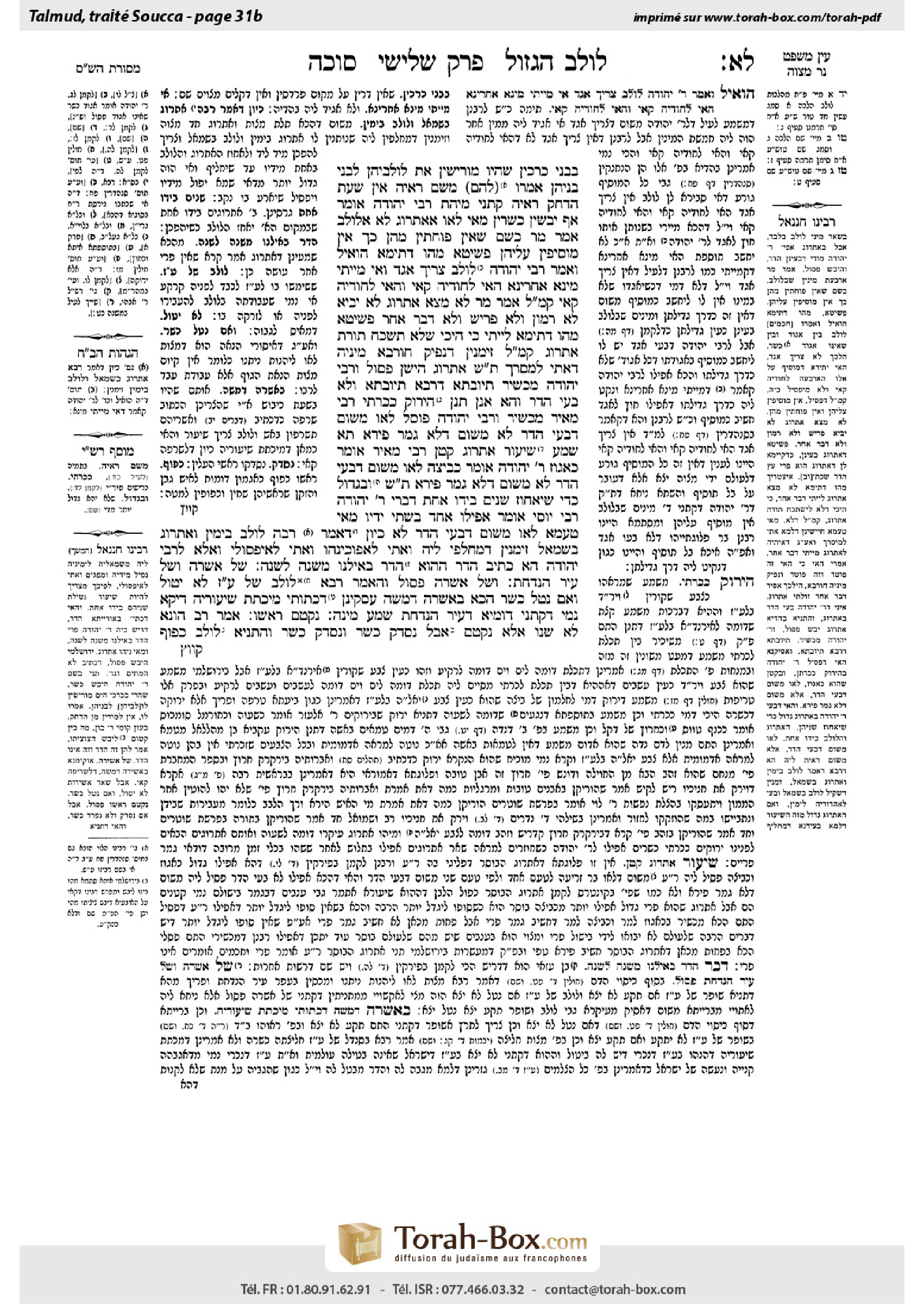
Sukkah 31b: Talmud study for Daf Yomi
Daf Yomi is the daily study of one Talmud folio. Explore 37 tractates with scans, Hebrew text, Sefaria English and AI-generated French translations where annotated.
Passage selection and English or AI-generated French translation are available where the scan has annotations. Daf Study is independent of Torah-Box and Sefaria.
Browse Sukkah · סוכה · All tractatesSukkah 31b text and translations
This page of Sukkah includes the Aramaic text, an English translation and an AI-generated French translation, alongside the scan above.
סוכה ל״א ב · Aramaic and Hebrew text
בִּבְנֵי כְרַכִּין, שֶׁהָיוּ מוֹרִישִׁין אֶת לוּלְבֵיהֶן לִבְנֵי בְנֵיהֶן! אָמְרוּ (לָהֶם): מִשָּׁם רְאָיָה? אֵין שְׁעַת הַדְּחָק רְאָיָה.
קָתָנֵי מִיהַת, רַבִּי יְהוּדָה אוֹמֵר: אַף יְבֵשִׁין כְּשֵׁרִין, מַאי לָאו, אַאֶתְרוֹג! לָא, אַלּוּלָב.
אָמַר מָר: כְּשֵׁם שֶׁאֵין פּוֹחֲתִין מֵהֶן, כָּךְ אֵין מוֹסִיפִין עֲלֵיהֶן. פְּשִׁיטָא? מַהוּ דְּתֵימָא: הוֹאִיל וְאָמַר רַבִּי יְהוּדָה לוּלָב צָרִיךְ אֶגֶד, וְאִי מַיְיתֵי מִינָא אַחֲרִינָא, הַאי לְחוֹדֵיהּ קָאֵי וְהַאי לְחוֹדֵיהּ קָאֵי, קָא מַשְׁמַע לַן.
אָמַר מָר: לֹא מָצָא אֶתְרוֹג — לֹא יָבִיא לֹא רִמּוֹן וְלֹא פָּרִישׁ וְלֹא דָּבָר אַחֵר. פְּשִׁיטָא! מַהוּ דְּתֵימָא: לַיְיתֵי, כִּי הֵיכִי שֶׁלֹּא תִּשָּׁכַח תּוֹרַת אֶתְרוֹג, קָא מַשְׁמַע לַן, זִימְנִין דְּנָפֵיק חוּרְבָּא מִינֵּיהּ, דְּאָתֵי לְמִסְרַךְ.
תָּא שְׁמַע: אֶתְרוֹג הַיָּשָׁן — פָּסוּל, וְרַבִּי יְהוּדָה מַכְשִׁיר. תְּיוּבְתָּא דְרָבָא, תְּיוּבְתָּא.
וְלָא בָּעֵי הָדָר? וְהָא אֲנַן תְּנַן: הַיָּרוֹק כְּכַרָּתֵי — רַבִּי מֵאִיר מַכְשִׁיר וְרַבִּי יְהוּדָה פּוֹסֵל. לָאו מִשּׁוּם דְּבָעֵי הָדָר? לָא, מִשּׁוּם דְּלָא גְּמַר פֵּירָא.
תָּא שְׁמַע: שִׁיעוּר אֶתְרוֹג קָטָן, רַבִּי מֵאִיר אוֹמֵר: כֶּאֱגוֹז, רַבִּי יְהוּדָה אוֹמֵר: כְּבֵיצָה. לָאו מִשּׁוּם דְּבָעֵי הָדָר? לָא, מִשּׁוּם דְּלָא גְּמַר פֵּירָא.
תָּא שְׁמַע: וּבְגָדוֹל כְּדֵי שֶׁיֶּאֱחוֹז שְׁנַיִם בְּיָדוֹ אַחַת, דִּבְרֵי רַבִּי יְהוּדָה. רַבִּי יוֹסֵי אוֹמֵר: אֲפִילּוּ אֶחָד בִּשְׁתֵּי יָדָיו. מַאי טַעְמָא, לָאו מִשּׁוּם דְּבָעֵי הָדָר? לָא, כֵּיוָן דְּאָמַר רַבָּה: לוּלָב בְּיָמִין וְאֶתְרוֹג בִּשְׂמֹאל, זִימְנִין דְּמִחַלְּפִי לֵיהּ וְאָתֵי לְאַפּוּכִינְהוּ וְאָתֵי לְאִיפְּסוֹלֵי.
וְאֶלָּא לְרַבִּי יְהוּדָה, הָא כְּתִיב ״הָדָר״?
הַהוּא הַדָּר בְּאִילָנוֹ מִשָּׁנָה לְשָׁנָה.
שֶׁל אֲשֵׁרָה וְשֶׁל עִיר הַנִּדַּחַת. וְשֶׁל אֲשֵׁרָה — פָּסוּל? וְהָאָמַר רָבָא: לוּלָב שֶׁל עֲבוֹדָה זָרָה — לֹא יִטּוֹל, וְאִם נָטַל — כָּשֵׁר.
הָכָא בַּאֲשֵׁרָה דְמֹשֶׁה עָסְקִינַן, דְּכַתּוֹתֵי מְיכַתַּת שִׁיעוּרֵיהּ.
דַּיְקָא נָמֵי, דְּקָתָנֵי: דּוּמְיָא דְּעִיר הַנִּדַּחַת. שְׁמַע מִינַּהּ.
נִקְטַם רֹאשׁוֹ. אָמַר רַב הוּנָא: לֹא שָׁנוּ אֶלָּא נִקְטַם, אֲבָל נִסְדַּק — כָּשֵׁר.
וְנִסְדַּק כָּשֵׁר? וְהָתַנְיָא: לוּלָב כָּפוּף,
Sukkah 31b · English translation
involving city dwellers who lived in an area distant from the region where the four species grow, who would bequeath their lulavim to their grandchildren, even though they were completely dry. The Sages said to him: Is there proof from there that species that are dry remain fit for use? Actions taken in exigent circumstances are not proof. In typical circumstances, it would be prohibited to use those species.
In any event, the Tosefta teaches that Rabbi Yehuda says: Even dry species are fit for use in fulfilling the mitzva. What, is it not referring to an etrog as well, indicating that in his opinion an etrog does not require beauty? No, he was stating only that a dry lulav is fit for use.
The Master stated in the baraita cited above: Just as one may not diminish from their number, so too, one may not add to their number. The Gemara asks: That is obvious. Why would it be permitted to add an additional species? The Gemara answers: Lest you say: Since Rabbi Yehuda said that a lulav requires a binding, and that requirement is a fundamental component of the mitzva, and if you bring another additional species, this species stands alone and that species stands alone, i.e., because the additional species is not bound with the others, its presence is insignificant, and causes no problem, therefore, Rabbi Yehuda teaches us that this is not the case. In fact, one may not bring an additional species.
The Master stated in the baraita cited above: If one cannot find an etrog, he may not bring a pomegranate, a quince, or anything else instead. The Gemara wonders: This is obvious. The Gemara answers: Lest you say: He should bring these fruits so that the halakhic category of the etrog will not be forgotten, therefore, Rabbi Yehuda teaches us that it is in fact prohibited because on occasion, damage will result from this practice. Some may come to be drawn to this practice and use these species even when etrogim are available.
The Gemara proposes: Come and hear another proof that, with regard to an etrog, Rabbi Yehuda does not require beauty: An old etrog is unfit. Rabbi Yehuda deems it fit. This is a conclusive refutation of the opinion of Rava, who holds that everyone agrees that an etrog requires beauty. The Gemara concludes: It is, indeed, a conclusive refutation of Rava’s opinion.
The Gemara asks: And does Rabbi Yehuda not require beauty in an etrog? But didn’t we learn in a mishna: With regard to an etrog that is leek green, Rabbi Meir deems it fit and Rabbi Yehuda deems it unfit? The Gemara asks: Is it not due to the fact that Rabbi Yehuda requires beauty in an etrog? The Gemara answers: No, it is due to the fact that in the case of a green etrog the fruit did not ripen, and it is inappropriate to fulfill the mitzva with an unripe fruit.
The Gemara cites an additional proof. Come and hear: What is the minimum measure of a small etrog? Rabbi Meir says: It may be no smaller than a walnut-bulk. Rabbi Yehuda says: It may be no smaller than an egg-bulk. The Gemara asks: Is it not due to the fact that Rabbi Yehuda requires beauty in an etrog? The Gemara answers: No, it is due to the fact that in that case of an etrog smaller than an egg-bulk, the fruit did not ripen.
Come and hear an additional proof: And in a large etrog, the maximum measure is so that one could hold two in his one hand; this is the statement of Rabbi Yehuda. Rabbi Yosei says: It is fit even if it is so large that he can hold only one in his two hands. The Gemara asks: What is the rationale for the opinion of Rabbi Yehuda? Is it not due to the fact that Rabbi Yehuda requires beauty in an etrog? The Gemara answers: No, the rationale is as Rabba said: One holds the lulav in the right hand and the etrog in the left. Sometimes, when one is handed the four species, they will exchange them for him, placing the three species in his left hand and the etrog in his right, and then he will come to switch them and place each in the appropriate hand. However, if the etrog is too large, he will be unable to hold the etrog and the lulav together, and he will come to render the etrog unfit, as it is apt to fall.
The Gemara asks: However, even according to Rabbi Yehuda, isn’t it written: The fruit of a beautiful [hadar] tree? How, then, can he rule that an etrog does not require beauty?
The Gemara answers that Rabbi Yehuda holds: That verse means that one should take a fruit that dwells [hadar] in its tree from year to year. It remains on the tree and does not wither and fall at the end of the season as do most fruits. That is characteristic of the etrog.
§ The mishna continues: The lulav of a tree worshipped as idolatry [asheira] and a lulav from a city whose residents were incited to idolatry, which must be burned along with all the city’s property, are unfit. And is a lulav of an asheira unfit? But didn’t Rava say with regard to a lulav of idolatry: One should not take it to fulfill the mitzva ab initio; however, if he took it, it is fit and he fulfills his obligation after the fact? Apparently, a lulav from an asheira is fit.
The Gemara explains: Here, in the mishna, we are dealing with the asheira of Moses, depicted in the Torah. The mishna is not referring to a tree planted in deference to idolatry, but rather to a tree that was itself worshipped as an idol. There is an obligation to burn idolatry and destroy it. Therefore, legally, the latter tree is considered as if it were already burned. The requisite measure of the lulav was crushed, and it is therefore unfit for use in fulfilling the mitzva. Rava’s ruling does not apply to an asheira of that kind.
The Gemara notes: The formulation of the mishna is also precise and indicates that the reference is to an asheira of Moses, as the juxtaposition of the halakha of an asheira to the halakha of a city whose residents were incited to idolatry teaches that the legal status of the asheira is similar to that of a city whose residents were incited to idolatry, in which all the property must be burned. In both cases, the lulav is considered already burned and lacking the requisite measure. The Gemara concludes: Indeed, learn from here that this is the reason that the lulav is unfit.
The mishna continues: If the top of the lulav was severed it is unfit. Rav Huna said: They taught that it is unfit only when it was completely severed; however, if the top merely split, the lulav is fit.
The Gemara asks: And is a split lulav fit? But isn’t it taught in a baraita: A lulav that is bent at the top,
Sukkah 31b · Traduction française (IA)
Il s’agissait d’habitants des villes vivant loin de la région où poussent les quatre espèces, qui léguaient leurs lulavim à leurs petits-enfants, même s’ils étaient complètement secs. Les Sages lui dirent : Cela prouve-t-il que les espèces sèches restent aptes à l’usage ? Les actes accomplis dans des circonstances exceptionnelles ne constituent pas une preuve. Dans des circonstances ordinaires, il serait interdit d’utiliser ces espèces.
Quoi qu’il en soit, la Tosefta enseigne que Rabbi Yehuda dit : Même les espèces sèches sont aptes à l’usage pour accomplir la mitsva. Ne s’agit-il pas aussi d’un etrog, ce qui indiquerait qu’à son avis, l’etrog n’a pas besoin d’être beau ? Non, il disait seulement qu’un lulav sec est apte à l’usage.
Le Maître a enseigné dans la baraïta citée plus haut : De même qu’on ne peut pas diminuer leur nombre, on ne peut pas non plus l’augmenter. La Guemara demande : Cela va de soi. Pourquoi serait-il permis d’ajouter une espèce supplémentaire ? La Guemara répond : De peur que tu ne dises : puisque Rabbi Yehuda a dit qu’un lulav doit être lié, et que cette exigence est un élément fondamental de la mitsva, si l’on apporte une espèce supplémentaire, celle-ci reste à part et les autres espèces restent à part, c’est-à-dire que, puisque l’espèce supplémentaire n’est pas liée aux autres, sa présence est insignifiante et ne pose aucun problème. Rabbi Yehuda nous enseigne donc que ce n’est pas le cas. En réalité, on ne peut pas apporter d’espèce supplémentaire.
Le Maître a enseigné dans la baraïta citée plus haut : Si quelqu’un ne trouve pas d’etrog, il ne peut pas apporter une grenade, un coing ou quoi que ce soit d’autre à la place. La Guemara s’étonne : Cela va de soi. La Guemara répond : De peur que tu ne dises qu’il devrait apporter ces fruits afin que la catégorie halakhique de l’etrog ne tombe pas dans l’oubli, Rabbi Yehuda nous enseigne que cela est en fait interdit, car cette pratique peut parfois entraîner des conséquences néfastes. Certains pourraient être incités à suivre cette pratique et à utiliser ces espèces même lorsque des etrogim sont disponibles.
La Guemara propose : Voici une autre preuve que, concernant l’etrog, Rabbi Yehuda n’exige pas qu’il soit beau : un etrog ancien est inapte, mais Rabbi Yehuda le considère apte. Cela réfute définitivement l’avis de Rava, selon lequel tous reconnaissent que l’etrog doit être beau. La Guemara conclut : En effet, cela réfute définitivement l’avis de Rava.
La Guemara demande : Rabbi Yehuda n’exige-t-il donc pas que l’etrog soit beau ? N’avons-nous pas appris dans une Michna : Pour un etrog vert poireau, Rabbi Meir le considère apte et Rabbi Yehuda le considère inapte ? La Guemara demande : N’est-ce pas parce que Rabbi Yehuda exige que l’etrog soit beau ? La Guemara répond : Non, c’est parce que, dans le cas d’un etrog vert, le fruit n’a pas mûri ; il ne convient pas d’accomplir la mitsva avec un fruit immature.
Voici une autre preuve. Quelle est la mesure minimale d’un petit etrog ? Rabbi Meir dit : Il ne doit pas être plus petit qu’une noix. Rabbi Yehuda dit : Il ne doit pas être plus petit qu’un œuf. La Guemara demande : N’est-ce pas parce que Rabbi Yehuda exige que l’etrog soit beau ? La Guemara répond : Non, c’est parce que, dans le cas d’un etrog plus petit qu’un œuf, le fruit n’a pas mûri.
Voici une autre preuve : pour un grand etrog, la mesure maximale est telle qu’on puisse en tenir deux dans une seule main ; telle est l’opinion de Rabbi Yehuda. Rabbi Yosei dit : Il est apte même s’il est si grand qu’on ne peut en tenir qu’un seul à deux mains. La Guemara demande : Quelle est la raison de l’avis de Rabbi Yehuda ? N’est-ce pas parce que Rabbi Yehuda exige que l’etrog soit beau ? La Guemara répond : Non, la raison est celle qu’a donnée Rabba : on tient le lulav dans la main droite et l’etrog dans la main gauche. Parfois, lorsqu’on remet les quatre espèces à quelqu’un, on les échange pour lui, en plaçant les trois espèces dans sa main gauche et l’etrog dans sa main droite ; il viendra alors à les intervertir pour placer chacune dans la main qui convient. Toutefois, si l’etrog est trop grand, il ne pourra pas tenir l’etrog et le lulav ensemble et risque alors de rendre l’etrog inapte, car celui-ci pourrait tomber.
La Guemara demande : Pourtant, même selon Rabbi Yehuda, n’est-il pas écrit : « Le fruit d’un bel [hadar] arbre » ? Comment peut-il donc statuer qu’un etrog n’a pas besoin d’être beau ?
La Guemara répond que Rabbi Yehuda comprend ce verset ainsi : il signifie qu’il faut prendre un fruit qui demeure [hadar] sur son arbre d’une année à l’autre. Il reste sur l’arbre et ne se dessèche pas pour tomber à la fin de la saison, comme le font la plupart des fruits. C’est là une caractéristique de l’etrog.
§ La Michna poursuit : Le lulav d’un arbre adoré comme une idole [asheira] et le lulav provenant d’une ville dont les habitants ont été incités à l’idolâtrie, ville qui doit être brûlée avec tous ses biens, sont inaptes. Mais le lulav d’une asheira est-il inapte ? Rava n’a-t-il pas dit, au sujet d’un lulav issu de l’idolâtrie : On ne doit pas le prendre pour accomplir la mitsva a priori ; toutefois, si on l’a pris, il est apte et l’on s’est acquitté de son obligation a posteriori ? Il semble donc qu’un lulav provenant d’une asheira soit apte.
La Guemara explique : Ici, dans la Michna, il s’agit de l’asheira de Moïse, décrite dans la Torah. La Michna ne parle pas d’un arbre planté en hommage à l’idolâtrie, mais plutôt d’un arbre qui était lui-même adoré comme une idole. Il y a obligation de brûler les idoles et de les détruire. Par conséquent, juridiquement, cet arbre est considéré comme s’il avait déjà été brûlé. La mesure requise du lulav a été réduite en cendres ; il est donc inapte à l’usage pour accomplir la mitsva. La décision de Rava ne s’applique pas à une asheira de ce type.
La Guemara relève que la formulation de la Michna est également précise et indique qu’il s’agit d’une asheira de Moïse : le rapprochement de la halakha relative à une asheira avec celle d’une ville dont les habitants ont été incités à l’idolâtrie enseigne que le statut juridique de l’asheira est semblable à celui d’une telle ville, dont tous les biens doivent être brûlés. Dans les deux cas, le lulav est considéré comme déjà brûlé et privé de la mesure requise. La Guemara conclut : En effet, déduis de là que c’est pour cette raison que le lulav est inapte.
La Michna poursuit : Si le sommet du lulav a été coupé, il est inapte. Rav Huna dit : Ils ont enseigné qu’il est inapte uniquement lorsqu’il a été complètement coupé ; toutefois, si le sommet s’est seulement fendu, le lulav est apte.
La Guemara demande : Un lulav fendu est-il donc apte ? N’est-il pas enseigné dans une baraïta : Un lulav dont le sommet est courbé,
Traduction française générée par IA à partir de l’édition anglaise de Sefaria. Vérifie toujours un passage avec le texte source.
Text from Sefaria: William Davidson Edition - Vocalized Aramaic (CC BY NC); William Davidson Edition - English (CC BY NC).