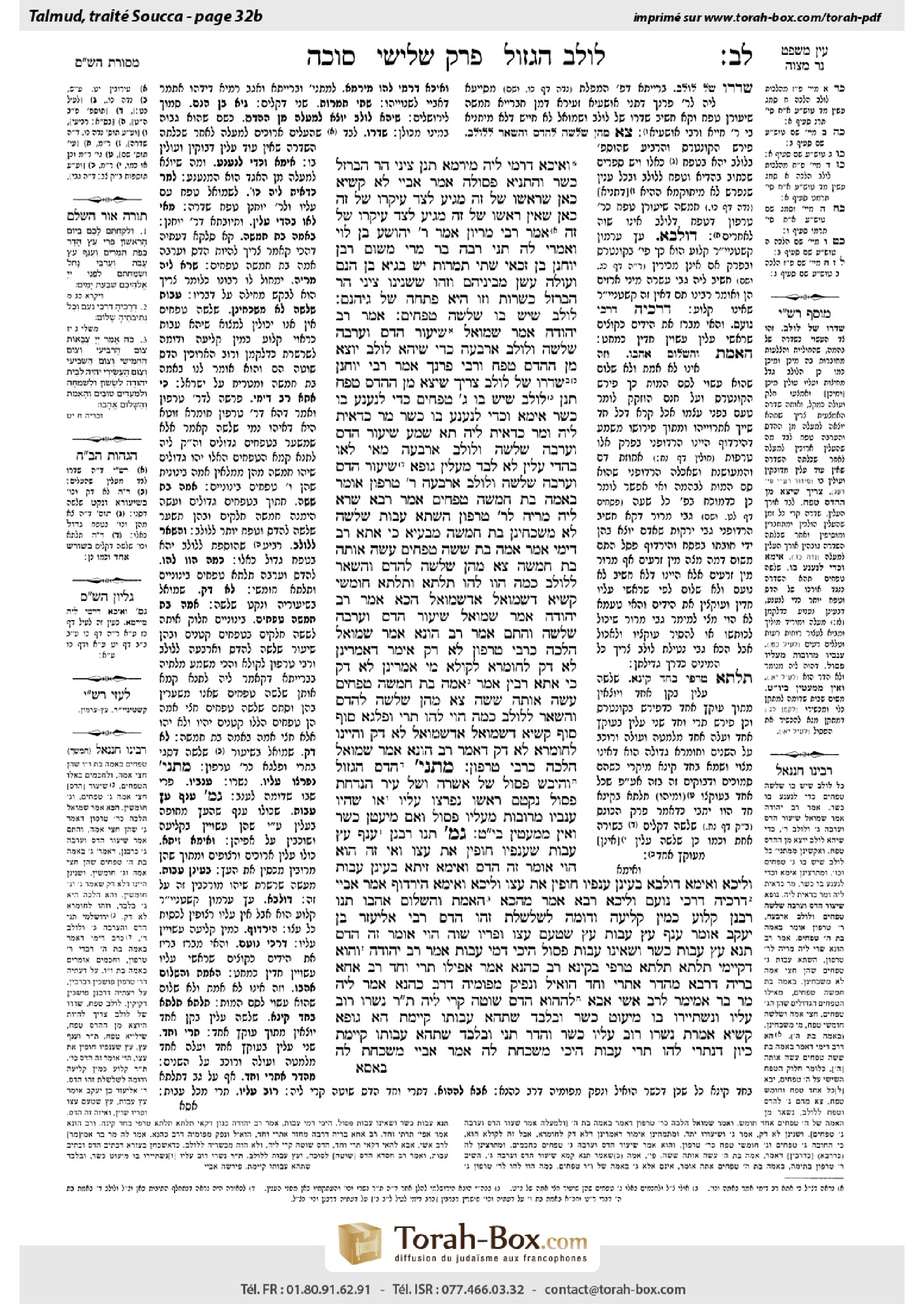
Sukkah 32b: Talmud study for Daf Yomi
Daf Yomi is the daily study of one Talmud folio. Explore 37 tractates with scans, Hebrew text, Sefaria English and AI-generated French translations where annotated.
Passage selection and English or AI-generated French translation are available where the scan has annotations. Daf Study is independent of Torah-Box and Sefaria.
Browse Sukkah · סוכה · All tractatesSukkah 32b text and translations
This page of Sukkah includes the Aramaic text, an English translation and an AI-generated French translation, alongside the scan above.
סוכה ל״ב ב · Aramaic and Hebrew text
וְאִיכָּא דְּרָמֵי לַיהּ מִירְמֵא: תְּנַן צִינֵּי הַר הַבַּרְזֶל — כָּשֵׁר, וְהָתַנְיָא: פְּסוּלָה! אָמַר אַבָּיֵי, לָא קַשְׁיָא: כָּאן — שֶׁרֹאשׁוֹ שֶׁל זֶה מַגִּיעַ לְצַד עִיקָּרוֹ שֶׁל זֶה, כָּאן — שֶׁאֵין רֹאשׁוֹ שֶׁל זֶה מַגִּיעַ לְצַד עִיקָּרוֹ שֶׁל זֶה.
אָמַר רַבִּי מָרִיּוֹן אָמַר רַבִּי יְהוֹשֻׁעַ בֶּן לֵוִי, וְאָמְרִי לַהּ תָּנֵי רַבָּה בַּר מָרִי מִשּׁוּם רַבָּן יוֹחָנָן בֶּן זַכַּאי: שְׁתֵּי תְמָרוֹת יֵשׁ בְּגֵיא בֶּן הִנֹּם, וְעוֹלֶה עָשָׁן מִבֵּינֵיהֶם. וְזֶהוּ שֶׁשָּׁנִינוּ: צִינֵּי הַר הַבַּרְזֶל כְּשֵׁרוֹת, וְזוֹ הִיא פִּתְחָהּ שֶׁל גֵּיהִנָּם.
לוּלָב שֶׁיֵּשׁ בּוֹ שְׁלֹשָׁה טְפָחִים. אָמַר רַב יְהוּדָה אָמַר שְׁמוּאֵל: שִׁיעוּר הֲדַס וַעֲרָבָה — שְׁלֹשָׁה, וְלוּלָב — אַרְבָּעָה, כְּדֵי שֶׁיְּהֵא לוּלָב יוֹצֵא מִן הַהֲדַס טֶפַח.
וְרַבִּי פַּרְנָךְ אָמַר רַבִּי יוֹחָנָן: שִׁדְרוֹ שֶׁל לוּלָב צָרִיךְ שֶׁיֵּצֵא מִן הַהֲדַס טֶפַח.
תְּנַן: לוּלָב שֶׁיֵּשׁ בּוֹ שְׁלֹשָׁה טְפָחִים כְּדֵי לְנַעְנֵעַ בּוֹ כָּשֵׁר. אֵימָא: וּכְדֵי לְנַעְנֵעַ בּוֹ, כָּשֵׁר. מָר כִּדְאִית לֵיהּ, וּמַר כִּדְאִית לֵיהּ.
תָּא שְׁמַע: שִׁיעוּר הֲדַס וַעֲרָבָה — שְׁלֹשָׁה, וְלוּלָב — אַרְבָּעָה. מַאי לָאו בַּהֲדֵי עָלִין! לָא, לְבַד מֵעָלִין.
גּוּפָא: שִׁיעוּר הֲדַס וַעֲרָבָה — שְׁלֹשָׁה, וְלוּלָב — אַרְבָּעָה. רַבִּי טַרְפוֹן אוֹמֵר: בְּאַמָּה בַּת חֲמִשָּׁה טְפָחִים.
אָמַר רָבָא: שְׁרָא לֵיהּ מָרֵיהּ לְרַבִּי טַרְפוֹן. הַשְׁתָּא עָבוֹת שְׁלֹשָׁה לָא מַשְׁכְּחִינַן, בַּת חֲמִשָּׁה מִבַּעְיָא!
כִּי אֲתָא רַב דִּימִי, אָמַר: אַמָּה בַּת שִׁשָּׁה טְפָחִים עֲשֵׂה אוֹתָהּ בַּת חֲמִשָּׁה, צֵא מֵהֶן שְׁלֹשָׁה לַהֲדַס, וְהַשְּׁאָר לַלּוּלָב. כַּמָּה הָווּ לְהוּ — תְּלָתָא וּתְלָתָא חוּמְשֵׁי.
קַשְׁיָא דִּשְׁמוּאֵל אַדִּשְׁמוּאֵל: הָכָא אָמַר רַב יְהוּדָה אָמַר שְׁמוּאֵל: שִׁיעוּר הֲדַס וַעֲרָבָה — שְׁלֹשָׁה, וְהָתָם אָמַר רַב הוּנָא אָמַר שְׁמוּאֵל: הֲלָכָה כְּרַבִּי טַרְפוֹן! לָא דַּק. אֵימַר דְּאָמְרִינַן לָא דַּק לְחוּמְרָא, לְקוּלָּא מִי אָמְרִינַן לָא דַּק?!
כִּי אֲתָא רָבִין, אָמַר: אַמָּה בַּת חֲמִשָּׁה טְפָחִים עֲשֵׂה אוֹתָהּ שִׁשָּׁה. צֵא מֵהֶן שְׁלֹשָׁה לַהֲדַס, וְהַשְּׁאָר לַלּוּלָב. כַּמָּה הָוֵי לְהוּ — תְּרֵי וּפַלְגָא.
סוֹף סוֹף קַשְׁיָא דִּשְׁמוּאֵל אַדִּשְׁמוּאֵל! לָא דַּק, וְהַיְינוּ לְחוּמְרָא לָא דַּק. דְּאָמַר רַב הוּנָא אָמַר שְׁמוּאֵל: הֲלָכָה כְּרַבִּי טַרְפוֹן.
מַתְנִי׳ הֲדַס הַגָּזוּל וְהַיָּבֵשׁ — פָּסוּל. שֶׁל אֲשֵׁרָה וְשֶׁל עִיר הַנִּדַּחַת — פָּסוּל. נִקְטַם רֹאשׁוֹ, נִפְרְצוּ עָלָיו, אוֹ שֶׁהָיוּ עֲנָבָיו מְרוּבּוֹת מֵעָלָיו — פָּסוּל. וְאִם מִיעֲטָן — כָּשֵׁר, וְאֵין מְמַעֲטִין בְּיוֹם טוֹב.
גְּמָ׳ תָּנוּ רַבָּנַן: ״עֲנַף עֵץ עָבוֹת״ — שֶׁעֲנָפָיו חוֹפִין אֶת עֵצוֹ. וְאֵי זֶה הוּא? הֱוֵי אוֹמֵר זֶה הֲדַס. וְאֵימָא זֵיתָא! בָּעֵינַן ״עָבוֹת״, וְלֵיכָּא.
וְאֵימָא דּוּלְבָּא! בָּעֵינַן עֲנָפָיו חוֹפִין אֶת עֵצוֹ, וְלֵיכָּא.
וְאֵימָא הִירְדּוּף! אָמַר אַבָּיֵי: ״דְּרָכֶיהָ דַרְכֵי נוֹעַם״, וְלֵיכָּא. רָבָא אָמַר, מֵהָכָא: ״הָאֱמֶת וְהַשָּׁלוֹם אֱהָבוּ״.
תָּנוּ רַבָּנַן: קָלוּעַ כְּמִין קְלִיעָה וְדוֹמֶה לְשַׁלְשֶׁלֶת, זֶהוּ הֲדַס. רַבִּי אֱלִיעֶזֶר בֶּן יַעֲקֹב אוֹמֵר: ״עֲנַף עֵץ עָבוֹת״ — עֵץ שֶׁטַּעַם עֵצוֹ וּפִרְיוֹ שָׁוֶה, הֱוֵי אוֹמֵר זֶה הֲדַס.
תָּנָא: עֵץ עָבוֹת — כָּשֵׁר, וְשֶׁאֵינוֹ עָבוֹת — פָּסוּל.
הֵיכִי דָּמֵי עָבוֹת? אָמַר רַב יְהוּדָה: וְהוּא דְּקָיְימִי תְּלָתָא תְּלָתָא טַרְפֵי בְּקִינָּא. רַב כָּהֲנָא אָמַר: אֲפִילּוּ תְּרֵי וְחַד. רַב אַחָא בְּרֵיהּ דְּרָבָא מְהַדַּר אַתְּרֵי וְחַד, הוֹאִיל וּנְפַיק מִפּוּמֵּיהּ דְּרַב כָּהֲנָא. אֲמַר לֵיהּ מָר בַּר אַמֵּימָר לְרַב אָשֵׁי: אַבָּא לְהָהוּא — הֲדַס שׁוֹטֶה קָרֵי לֵיהּ.
תָּנוּ רַבָּנַן: נָשְׁרוּ רוֹב עָלָיו וְנִשְׁתַּיְּירוּ בּוֹ מִיעוּט — כָּשֵׁר, וּבִלְבַד שֶׁתְּהֵא עֲבוֹתוֹ קַיֶּימֶת.
הָא גוּפָא קַשְׁיָא: אָמְרַתְּ נָשְׁרוּ רוֹב עָלָיו כָּשֵׁר, וַהֲדַר תָּנֵי וּבִלְבַד שֶׁתְּהֵא עֲבוֹתוֹ קַיֶּימֶת. כֵּיוָן דְּנָתְרִי לְהוּ תְּרֵי, עָבוֹת הֵיכִי מַשְׁכַּחַתְּ לַהּ?
אָמַר אַבָּיֵי: מַשְׁכַּחַתְּ לַהּ
Sukkah 32b · English translation
And others raise it as a contradiction. We learned in the mishna: A lulav from the palms of the Iron Mountain is fit. But isn’t it taught in a baraita: It is unfit? Abaye said: This is not difficult: Here, in the mishna, where the lulav is fit, it is referring to a case where the top of this leaf reaches the base of that next leaf, whereas, there, in the baraita, where the lulav is unfit, it is referring to a case where the top of this leaf does not reach the base of that next leaf.
The Gemara describes the location of these lulavim. Rabbi Maryon said that Rabbi Yehoshua ben Levi said, and some say that Rabba bar Mari taught this baraita in the name of Rabban Yoḥanan ben Zakkai: There are two date palms in the valley of ben Hinnom, and smoke arises from between them. And this is the place about which we learned in the mishna: A lulav from the palms of the Iron Mountain is fit. And that site is the entrance of Gehenna.
The mishna continues: A lulav that has three handbreadths in length, sufficient to enable one to wave with it, is fit for use in fulfilling the mitzva. Rav Yehuda said that Shmuel said: The minimum measure of a myrtle branch and a willow branch is three handbreadths. And the minimum measure of a lulav is four handbreadths. The difference between the measures is so that the lulav will extend at least one handbreadth from the myrtle branch.
And Rabbi Parnakh said that Rabbi Yoḥanan said: The spine of the lulav, and not merely its leaves, must be at least four handbreadths long, so that it will extend from the myrtle branch at least one handbreadth.
The Gemara asks: Didn’t we learn in the mishna: A lulav that has three handbreadths in length, sufficient to enable one to wave with it, is fit for use in fulfilling the mitzva? That indicates that a lulav three handbreadths long is fit. The Gemara answers: Emend the language of the mishna and say: A lulav that has three handbreadths and an additional handbreadth that is sufficient to enable one to wave with it is fit. This emendation is understood by each amora according to his opinion. It is understood by this Sage, Shmuel, as per his opinion that only one additional handbreadth is required including the leaves; and it is understood by this Sage, Rabbi Yoḥanan, as per his opinion that the additional handbreadth must be in the length of the spine of the lulav, and the leaves are not taken into consideration.
The Gemara cites proof from a baraita. Come and hear: The minimum measure of a myrtle branch and of a willow branch is three handbreadths, and that of a lulav is four handbreadths. What, is it not that this measure is calculated with the leaves, in accordance with the opinion of Shmuel? The Gemara rejects this proof: No, it can be understood that the measure is calculated without the leaves.
Apropos the baraita cited above, the Gemara discusses the matter itself. The minimum measure of a myrtle branch and of a willow branch is three handbreadths, and that of a lulav is four handbreadths. Rabbi Tarfon says: With a cubit of five handbreadths. The preliminary understanding of Rabbi Tarfon’s opinion is that the minimum measure of a myrtle branch is five handbreadths, not three.
Rava said: May his Master, the Holy One, Blessed be He, forgive Rabbi Tarfon for this extreme stringency. Now, we do not find even a dense-leaved myrtle branch three handbreadths long; is it necessary to say that finding one five handbreadths long is nearly impossible?
When Rav Dimi came from Eretz Yisrael to Babylonia, he said that this is the correct understanding of the statement of Rabbi Tarfon: Take a cubit of six handbreadths, and render it a cubit of five handbreadths. Rabbi Tarfon is saying that for the purpose of measuring the myrtle branch, willow branch, and lulav, the standard six-handbreadth cubit is divided into five handbreadths, each slightly larger than the standard handbreadth. Take three of these large handbreadths for the myrtle branch, and three of these handbreadths plus the extra handbreadth for the lulav. The Gemara calculates: How many standard handbreadths are there in the minimum measure of a myrtle branch or willow branch? There are three and three-fifths standard handbreadths.
However, on that basis, there is a difficulty, as one statement of Shmuel contradicts another statement of Shmuel. Here, Rabbi Yehuda said that Shmuel said: The minimum measure of the myrtle branch and of the willow branch is three handbreadths, and there, Rav Huna said that Shmuel said: The halakha is in accordance with the opinion of Rabbi Tarfon, who requires a larger handbreadth. There is a discrepancy of three-fifths of a handbreadth between the measures. The Gemara answers: When Shmuel said that the measure is three handbreadths, he was not precise and merely approximated the measure. The Gemara asks: Say that we say: He was not precise when the approximation leads to stringency, but when it leads to leniency, do we say: He was not precise? That would result in using an unfit myrtle branch in performing a mitzva.
When Rabin came from Eretz Yisrael to Babylonia, he said that this is the correct understanding of the statement of Rabbi Tarfon: Take a cubit of five handbreadths, and render it a cubit of six handbreadths. Rabbi Tarfon said that for the purpose of measuring the myrtle branch, willow branch, and lulav, a five-handbreadth cubit is divided into six handbreadths, each slightly smaller than the standard handbreadth. Take three of these smaller handbreadths for the myrtle branch, and three of these handbreadths plus the extra handbreadth for the lulav. The Gemara calculates: How many standard handbreadths are there in the minimum measure of a myrtle branch or willow branch? There are two and a half standard handbreadths.
The Gemara asks: Ultimately, there remains a difficulty, as one statement of Shmuel contradicts another statement of Shmuel. In one statement he said the minimum measure of a myrtle branch is two and a half handbreadths, and in another he said that the measure is three handbreadths. The Gemara answers: When Shmuel said that the measure is three handbreadths, he was not precise and merely approximated the measure. And this is a case of: He was not precise, where the approximation leads to a stringency, as Rav Huna said that Shmuel said: The halakha is in accordance with the opinion of Rabbi Tarfon. Shmuel holds that the actual measure required is two and a half handbreadths, and he rounded it off to three, which is a more stringent measure.
MISHNA: A myrtle branch that was stolen or that is completely dry is unfit. A myrtle branch of a tree worshipped as idolatry [asheira] or a myrtle branch from a city whose residents were incited to idolatry is unfit. If the top of the myrtle branch was severed, if the leaves were severed completely, or if its berries were more numerous than its leaves, it is unfit. If one diminished their number by plucking berries so that they no longer outnumbered the leaves, the myrtle branch is fit. But one may not diminish the number on the Festival itself.
GEMARA: The Sages taught: It is written: “Boughs of a dense-leaved tree” (Leviticus 23:40); this is referring to a tree whose leaves obscure its tree. And which tree is that? You must say it is the myrtle tree. The Gemara suggests: And say it is the olive tree, whose leaves obscure the tree. The Gemara answers: We require a “dense-leaved” tree, whose leaves are in a chain-like configuration, and that is not the case with an olive tree.
The Gemara suggests: And say it is the Oriental plane tree, whose leaves are in a braid-like configuration. The Gemara answers: We require a tree whose leaves obscure its tree, and that is not the case with an Oriental plane tree.
The Gemara suggests: And say the verse is referring to oleander, which has both characteristics. Abaye said: It is written with regard to the Torah: “Its ways are ways of pleasantness” (Proverbs 3:17), and that is not the case with the oleander tree, because it is a poisonous plant and its sharp, thorn-like leaves pierce the hand of one holding it. Rava said: The unfitness of the oleander is derived from here: “Love truth and peace” (Zechariah 8:19), and poisonous plants that pierce are antithetical to peace.
The Sages taught: Plaited like a braid and chain-like; that is characteristic of the myrtle branch used in the fulfillment of the mitzva. Rabbi Eliezer ben Ya’akov says another characteristic. It is written: “Boughs of a dense-leaved tree,” indicating a tree that the taste of its branches and the taste of its fruit are alike. You must say this is the myrtle branch.
A Sage taught in the Tosefta: A dense-leaved branch is fit, and one that is not dense-leaved is unfit, even though it is a myrtle branch.
The Gemara asks: What are the circumstances of “dense-leaved tree”? Rav Yehuda said: And it is a configuration where three leaves emerge from each base. Rav Kahana said: Even two leaves emerging from one base and one leaf that covers the other two emerging from a lower base is called thick. Rav Aḥa, son of Rava, would purposely seek a myrtle branch configured with two leaves emerging from one base and one emerging from a lower base, since this statement emerged from the mouth of Rav Kahana. Mar bar Ameimar said to Rav Ashi: My father called a myrtle branch with that configuration a wild myrtle branch.
The Sages taught: If most of its leaves fell and only a minority of the leaves remained, the myrtle branch is fit, provided that its dense-leaved nature remains intact.
The Gemara wonders: This matter itself is difficult, as there is an internal contradiction in this baraita. On the one hand, you said: If most of its leaves fell it is fit, and then the baraita taught: Provided that its dense-leaved nature remains intact. Once two of every three leaves fell, how can you find a branch whose dense-leaved nature is intact?
Abaye said: You can find it
Sukkah 32b · Traduction française (IA)
D’autres soulèvent une contradiction. Nous avons appris dans la Michna : Un loulav provenant des palmiers du mont de Fer est apte. Mais n’est-il pas enseigné dans une baraïta qu’il est inapte ? Abayé dit : Il n’y a pas de difficulté. Ici, dans la Michna, où le loulav est apte, il s’agit d’un cas où le sommet de cette feuille atteint la base de la feuille suivante ; tandis que là, dans la baraïta, où le loulav est inapte, il s’agit d’un cas où le sommet de cette feuille n’atteint pas la base de la feuille suivante.
La Guemara précise où se trouvent ces loulavim. Rabbi Maryon dit au nom de Rabbi Yehoshua ben Levi — certains disent que Rabba bar Mari enseignait cette baraïta au nom de Rabban Yoḥanan ben Zakkaï : « Il y a deux palmiers dans la vallée de Ben Hinnom, et de la fumée s’élève entre eux. » C’est l’endroit auquel nous avons fait allusion dans la Michna en disant qu’un loulav provenant des palmiers du mont de Fer est apte. Et ce lieu est l’entrée de la Géhenne.
La Michna poursuit : Un loulav qui mesure trois téfaḥim, longueur suffisante pour pouvoir l’agiter, est apte à accomplir la mitsva. Rav Yehouda dit au nom de Chmouel : La mesure minimale d’une branche de myrte et d’une branche de saule est de trois téfaḥim, tandis que celle d’un loulav est de quatre téfaḥim. Cette différence de mesure permet au loulav de dépasser la branche de myrte d’au moins un téfaḥ.
Et Rabbi Parnakh dit au nom de Rabbi Yoḥanan : La tige du loulav, et pas seulement ses feuilles, doit mesurer au moins quatre téfaḥim, afin qu’elle dépasse la branche de myrte d’au moins un téfaḥ.
La Guemara demande : N’avons-nous pas appris dans la Michna qu’un loulav qui mesure trois téfaḥim, longueur suffisante pour pouvoir l’agiter, est apte à accomplir la mitsva ? Cela indique qu’un loulav de trois téfaḥim est apte. La Guemara répond : Corrige le texte de la Michna et lis : « Un loulav qui mesure trois téfaḥim, plus un téfaḥ supplémentaire suffisant pour pouvoir l’agiter, est apte. » Chacun des amoraïm comprend cette correction selon son opinion. Ce Sage, Chmouel, la comprend conformément à son opinion : un seul téfaḥ supplémentaire est nécessaire, feuilles comprises ; tandis que cet autre Sage, Rabbi Yoḥanan, la comprend conformément à son opinion : le téfaḥ supplémentaire doit correspondre à la longueur de la tige du loulav, sans tenir compte des feuilles.
La Guemara apporte une preuve d’une baraïta. Viens et écoute : La mesure minimale d’une branche de myrte et d’une branche de saule est de trois téfaḥim, et celle d’un loulav est de quatre téfaḥim. N’est-ce pas que cette mesure est calculée feuilles comprises, conformément à l’opinion de Chmouel ? La Guemara rejette cette preuve : Non, on peut comprendre que la mesure est calculée sans les feuilles.
À propos de la baraïta citée plus haut, la Guemara examine le sujet lui-même. La mesure minimale d’une branche de myrte et d’une branche de saule est de trois téfaḥim, et celle d’un loulav est de quatre téfaḥim. Rabbi Tarfon dit : selon une coudée de cinq téfaḥim. On comprend d’abord l’opinion de Rabbi Tarfon ainsi : la mesure minimale d’une branche de myrte est de cinq téfaḥim, et non de trois.
Rava dit : « Que son Maître, le Saint, béni soit-Il, pardonne à Rabbi Tarfon cette rigueur extrême ! À présent, nous ne trouvons même pas de branche de myrte touffue de trois téfaḥim ; faut-il dire qu’il est presque impossible d’en trouver une de cinq téfaḥim ? »
Lorsque Rav Dimi vint de la terre d’Israël en Babylonie, il dit que voici la juste compréhension de la déclaration de Rabbi Tarfon : « Prends une coudée de six téfaḥim et fais-en une coudée de cinq téfaḥim. » Rabbi Tarfon dit que, pour mesurer la branche de myrte, la branche de saule et le loulav, la coudée ordinaire de six téfaḥim est divisée en cinq téfaḥim, chacun légèrement plus grand qu’un téfaḥ ordinaire. Prends trois de ces grands téfaḥim pour la branche de myrte, et trois de ces téfaḥim plus le téfaḥ supplémentaire pour le loulav. La Guemara calcule : Combien de téfaḥim ordinaires compte la mesure minimale d’une branche de myrte ou de saule ? Elle en compte trois et trois cinquièmes.
Cependant, selon cette explication, une difficulté se pose, car une déclaration de Chmouel contredit une autre déclaration de Chmouel. Ici, Rabbi Yehouda dit au nom de Chmouel que la mesure minimale d’une branche de myrte et d’une branche de saule est de trois téfaḥim ; et là, Rav Houna dit au nom de Chmouel que la halakha suit l’opinion de Rabbi Tarfon, qui exige un téfaḥ plus grand. Il y a un écart de trois cinquièmes de téfaḥ entre les mesures. La Guemara répond : Lorsque Chmouel a dit que la mesure est de trois téfaḥim, il n’a pas été précis et a simplement donné une mesure approximative. La Guemara demande : Admettons-nous qu’il n’a pas été précis lorsque l’approximation entraîne une rigueur ; mais lorsqu’elle entraîne une indulgence, admettons-nous qu’il n’a pas été précis ? Cela conduirait à utiliser une branche de myrte inapte pour accomplir une mitsva.
Lorsque Ravin vint de la terre d’Israël en Babylonie, il dit que voici la juste compréhension de la déclaration de Rabbi Tarfon : « Prends une coudée de cinq téfaḥim et fais-en une coudée de six téfaḥim. » Rabbi Tarfon dit que, pour mesurer la branche de myrte, la branche de saule et le loulav, une coudée de cinq téfaḥim est divisée en six téfaḥim, chacun légèrement plus petit qu’un téfaḥ ordinaire. Prends trois de ces petits téfaḥim pour la branche de myrte, et trois de ces téfaḥim plus le téfaḥ supplémentaire pour le loulav. La Guemara calcule : Combien de téfaḥim ordinaires compte la mesure minimale d’une branche de myrte ou de saule ? Elle en compte deux et demi.
La Guemara demande : En définitive, une difficulté subsiste, car une déclaration de Chmouel contredit une autre déclaration de Chmouel. Dans une déclaration, il dit que la mesure minimale d’une branche de myrte est de deux téfaḥim et demi, et dans une autre, il dit que la mesure est de trois téfaḥim. La Guemara répond : Lorsque Chmouel a dit que la mesure est de trois téfaḥim, il n’a pas été précis et a simplement donné une mesure approximative. Il s’agit ici d’un cas où il n’a pas été précis, car l’approximation entraîne une rigueur : Rav Houna dit en effet au nom de Chmouel que la halakha suit l’opinion de Rabbi Tarfon. Chmouel estime que la mesure effectivement requise est de deux téfaḥim et demi, et il l’a arrondie à trois, ce qui est une mesure plus rigoureuse.
MICHNA : Une branche de myrte qui a été volée ou qui est entièrement sèche est inapte. Une branche de myrte provenant d’un arbre adoré comme une idole [asheira] ou d’une ville dont les habitants ont été incités à l’idolâtrie est inapte. Si le sommet de la branche de myrte a été coupé, si ses feuilles ont été entièrement arrachées, ou si ses baies sont plus nombreuses que ses feuilles, elle est inapte. Si l’on a réduit leur nombre en cueillant des baies, de sorte qu’elles ne soient plus plus nombreuses que les feuilles, la branche de myrte est apte. Mais on ne peut pas en réduire le nombre le jour de la fête.
GUEMARA : Les Sages ont enseigné : Il est écrit : « des rameaux d’un arbre touffu » (Lévitique 23:40) ; cela désigne un arbre dont les feuilles cachent le bois. Et de quel arbre s’agit-il ? Tu dois dire qu’il s’agit du myrte. La Guemara suggère : Dis plutôt qu’il s’agit de l’olivier, dont les feuilles cachent le bois. La Guemara répond : Nous avons besoin d’un arbre touffu dont les feuilles sont disposées en chaîne, ce qui n’est pas le cas de l’olivier.
La Guemara suggère : Dis plutôt qu’il s’agit du platane d’Orient, dont les feuilles sont disposées en tresse. La Guemara répond : Nous avons besoin d’un arbre dont les feuilles cachent le bois, ce qui n’est pas le cas du platane d’Orient.
La Guemara suggère : Dis plutôt que le verset parle du laurier-rose, qui possède ces deux caractéristiques. Abayé dit : Il est écrit au sujet de la Torah : « Ses voies sont des voies agréables » (Proverbes 3:17), ce qui n’est pas le cas du laurier-rose, car c’est une plante toxique et ses feuilles acérées, semblables à des épines, transpercent la main de celui qui la tient. Rava dit : L’inaptitude du laurier-rose se déduit d’ici : « Aimez la vérité et la paix » (Zacharie 8:19), et les plantes toxiques qui transpercent sont contraires à la paix.
Les Sages ont enseigné : Des feuilles disposées en tresse et en chaîne : telle est la caractéristique de la branche de myrte utilisée pour accomplir la mitsva. Rabbi Eliezer ben Ya’akov donne une autre caractéristique. Il est écrit : « des rameaux d’un arbre touffu », ce qui indique un arbre dont le goût des branches et celui des fruits sont identiques. Tu dois dire qu’il s’agit de la branche de myrte.
Un Sage enseigna dans la Tossefta : Une branche touffue est apte, et une branche qui n’est pas touffue est inapte, même s’il s’agit d’une branche de myrte.
La Guemara demande : En quoi consiste la configuration d’un « arbre touffu » ? Rav Yehouda dit : Il s’agit d’une configuration où trois feuilles sortent de chaque base. Rav Kahana dit : Même lorsque deux feuilles sortent d’une base et qu’une feuille, issue d’une base inférieure, couvre les deux autres, cela est considéré comme touffu. Rav Aḥa, fils de Rava, cherchait délibérément une branche de myrte où deux feuilles sortent d’une base et une autre d’une base inférieure, puisque cette déclaration venait de Rav Kahana. Mar bar Ameimar dit à Rav Achi : Mon père appelait une branche de myrte présentant cette configuration un myrte sauvage.
Les Sages ont enseigné : Si la plupart de ses feuilles sont tombées et qu’il n’en reste qu’une minorité, la branche de myrte est apte, à condition qu’elle conserve son caractère touffu.
La Guemara s’étonne : Cette baraïta elle-même pose problème, car elle contient une contradiction interne. D’un côté, tu as dit : « Si la plupart de ses feuilles sont tombées, elle est apte » ; puis la baraïta enseigne : « à condition qu’elle conserve son caractère touffu ». Mais si deux feuilles sur trois sont tombées, comment peut-on trouver une branche qui ait conservé son caractère touffu ?
Abayé dit : On peut trouver un tel cas.
Traduction française générée par IA à partir de l’édition anglaise de Sefaria. Vérifie toujours un passage avec le texte source.
Text from Sefaria: William Davidson Edition - Vocalized Aramaic (CC BY NC); William Davidson Edition - English (CC BY NC).