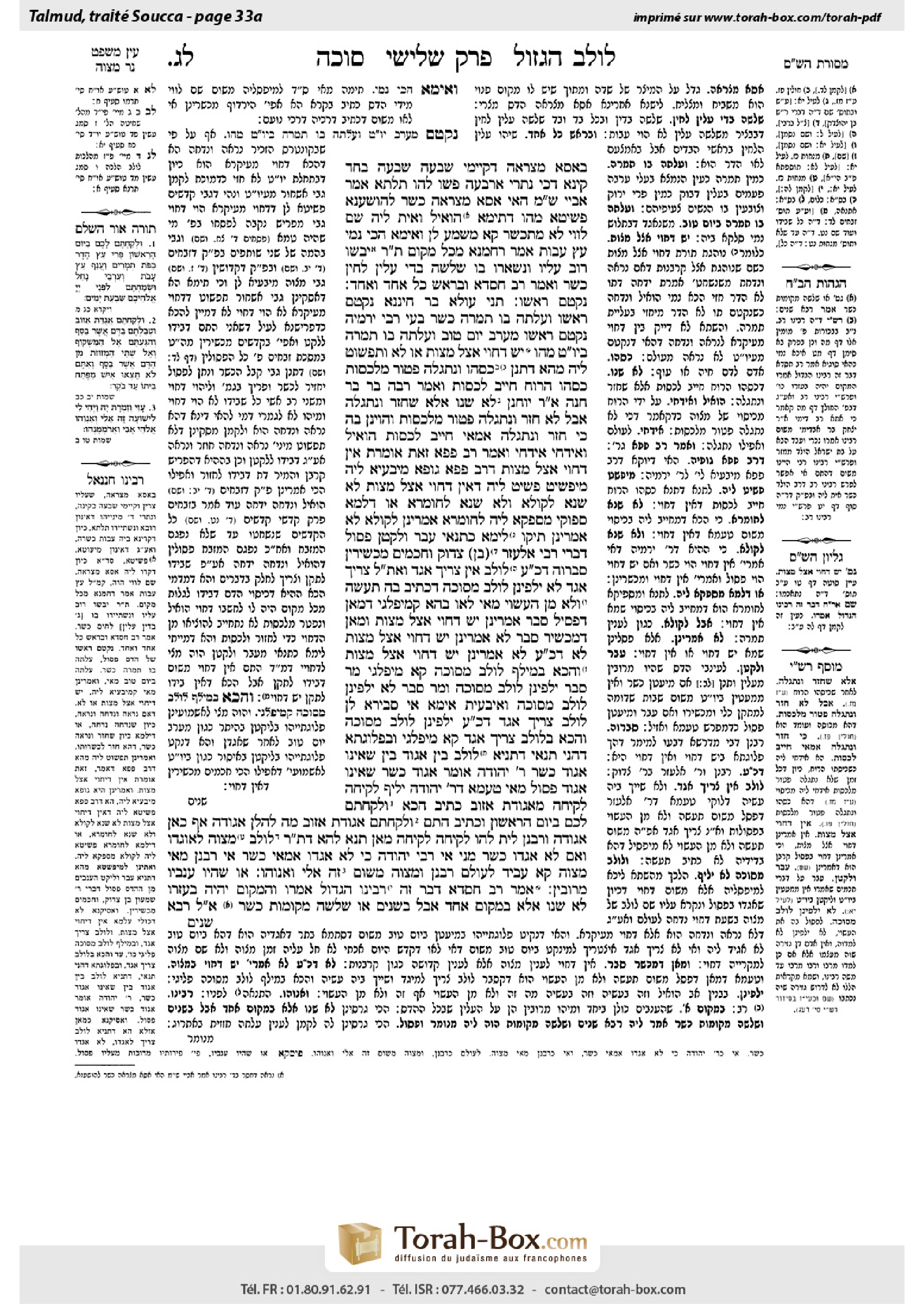
Sukkah 33a: Talmud study for Daf Yomi
Daf Yomi is the daily study of one Talmud folio. Explore 37 tractates with scans, Hebrew text, Sefaria English and AI-generated French translations where annotated.
Passage selection and English or AI-generated French translation are available where the scan has annotations. Daf Study is independent of Torah-Box and Sefaria.
Browse Sukkah · סוכה · All tractatesSukkah 33a text and translations
This page of Sukkah includes the Aramaic text, an English translation and an AI-generated French translation, alongside the scan above.
סוכה ל״ג א · Aramaic and Hebrew text
בְּאַסָּא מִצְרָאָה דְּקָיְימִי שִׁבְעָה שִׁבְעָה בְּחַד קִינָּא, דְּכִי נָתְרִי אַרְבְּעָה, פָּשׁוּ לְהוּ תְּלָתָא. אָמַר אַבָּיֵי: שְׁמַע מִינַּהּ הַאי אַסָּא מִצְרָאָה כָּשַׁר לְהוֹשַׁעְנָא.
פְּשִׁיטָא! מַהוּ דְּתֵימָא הוֹאִיל וְאִית לֵיהּ שֵׁם לְוַוי, לָא מִתַּכְשַׁר — קָא מַשְׁמַע לַן. וְאֵימָא הָכִי נָמֵי! ״עֵץ עָבוֹת״ אָמַר רַחֲמָנָא, מִכׇּל מָקוֹם.
תָּנוּ רַבָּנַן: יָבְשׁוּ רוֹב עָלָיו וְנִשְׁאֲרוּ בּוֹ שְׁלֹשָׁה בַּדֵּי עָלִין לַחִין כָּשֵׁר. וְאָמַר רַב חִסְדָּא: וּבְרֹאשׁ כׇּל אֶחָד וְאֶחָד.
נִקְטַם רֹאשׁוֹ. תָּנֵי עוּלָּא בַּר חִינָּנָא: נִקְטַם רֹאשׁוֹ וְעָלְתָה בּוֹ תְּמָרָה — כָּשֵׁר.
בָּעֵי רַבִּי יִרְמְיָה: נִקְטַם רֹאשׁוֹ מֵעֶרֶב יוֹם טוֹב וְעָלְתָה בּוֹ תְּמָרָה בְּיוֹם טוֹב, מַהוּ? יֵשׁ דִּחוּי אֵצֶל מִצְוֹת, אוֹ לֹא?
וְתִפְשׁוֹט לֵיהּ מֵהָא דִּתְנַן: כִּסָּהוּ וְנִתְגַּלָּה — פָּטוּר מִלְּכַסּוֹת. כִּסָּהוּ הָרוּחַ — חַיָּיב לְכַסּוֹת. וְאָמַר רַבָּה בַּר בַּר חָנָה אָמַר רַבִּי יוֹחָנָן: לֹא שָׁנוּ אֶלָּא שֶׁחָזַר וְנִתְגַּלָּה, אֲבָל לֹא חָזַר וְנִתְגַּלָּה — פָּטוּר מִלְּכַסּוֹת.
וְהָוֵינַן בָּהּ: כִּי חָזַר וְנִתְגַּלָּה אַמַּאי חַיָּיב לְכַסּוֹת? הוֹאִיל וְאִידְּחִי אִידְּחִי!
וְאָמַר רַב פָּפָּא: זֹאת אוֹמֶרֶת אֵין דִּחוּי אֵצֶל מִצְוֹת.
דְּרַב פָּפָּא גּוּפָא מִיבַּעְיָא לֵיהּ: מִיפְשָׁיט פְּשִׁיט לֵיהּ דְּאֵין דִּחוּי אֵצֶל מִצְוֹת — לָא שְׁנָא לְקוּלָּא וְלָא שְׁנָא לְחוּמְרָא, אוֹ דִלְמָא סַפּוֹקֵי מְסַפְּקָא לֵיהּ — לְחוּמְרָא אָמְרִינַן, לְקוּלָּא לָא אָמְרִינַן. תֵּיקוּ.
לֵימָא כְּתַנָּאֵי: עָבַר וְלִקְּטָן — פָּסוּל, דִּבְרֵי רַבִּי אֶלְעָזָר (בֶּן) צָדוֹק, וַחֲכָמִים מַכְשִׁירִין. סַבְרוּהָ דְּכוּלֵּי עָלְמָא, לוּלָב אֵין צָרִיךְ אֶגֶד. וְאִם תִּמְצֵי לוֹמַר צָרִיךְ אֶגֶד, לָא יָלְפִינַן לוּלָב מִסּוּכָּה דִּכְתִיב בָּהּ: ״תַּעֲשֶׂה״ — וְלֹא מִן הֶעָשׂוּי.
מַאי לָאו בְּהָא קָמִיפַּלְגִי, דְּמַאן דְּפָסֵיל סָבַר: אָמְרִינַן יֵשׁ דִּחוּי אֵצֶל מִצְוֹת, וּמַאן דְּמַכְשַׁיר סָבַר: לָא אָמְרִינַן יֵשׁ דִּחוּי אֵצֶל מִצְוֹת?
לָא, דְּכוּלֵּי עָלְמָא לָא אָמְרִינַן יֵשׁ דִּחוּי אֵצֶל מִצְוֹת, וְהָכָא בְּמֵילַף לוּלָב מִסּוּכָּה קָא מִיפַּלְגִי. מָר סָבַר: יָלְפִינַן לוּלָב מִסּוּכָּה, וּמַר סָבַר: לָא יָלְפִינַן לוּלָב מִסּוּכָּה.
וְאִיבָּעֵית אֵימָא: אִי סְבִירָא לַן לוּלָב צָרִיךְ אֶגֶד, דְּכוּלֵּי עָלְמָא יָלְפִינַן לוּלָב מִסּוּכָּה, וְהָכָא בְּלוּלָב צָרִיךְ אֶגֶד קָא מִיפַּלְגִי, וּבִפְלוּגְתָּא דְּהָנֵי תַּנָּאֵי, דְּתַנְיָא: לוּלָב, בֵּין אָגוּד, בֵּין שֶׁאֵינוֹ אָגוּד — כָּשֵׁר, רַבִּי יְהוּדָה אוֹמֵר: אָגוּד — כָּשֵׁר, שֶׁאֵינוֹ אָגוּד — פָּסוּל.
מַאי טַעְמָא דְּרַבִּי יְהוּדָה? יָלֵיף ״לְקִיחָה״ ״לְקִיחָה״ מֵאֲגוּדַּת אֵזוֹב. כְּתִיב הָכָא: ״וּלְקַחְתֶּם לָכֶם בַּיּוֹם הָרִאשׁוֹן״, וּכְתִיב הָתָם: ״וּלְקַחְתֶּם אֲגוּדַּת אֵזוֹב״. מָה לְהַלָּן — אֲגוּדָּה, אַף כָּאן — אֲגוּדָּה. וְרַבָּנַן לֵית לְהוּ ״לְקִיחָה״ ״לְקִיחָה״.
מַאן תְּנָא לְהָא דְּתָנוּ רַבָּנַן: לוּלָב מִצְוָה לְאוֹגְדוֹ, וְאִם לֹא אֲגָדוֹ כָּשֵׁר. מַנִּי? אִי רַבִּי יְהוּדָה, כִּי לֹא אֲגָדוֹ אַמַּאי כָּשֵׁר? אִי רַבָּנַן, מַאי מִצְוָה קָא עָבֵיד? לְעוֹלָם רַבָּנַן, וּמִצְוָה מִשּׁוּם ״זֶה אֵלִי וְאַנְוֵהוּ״.
אוֹ שֶׁהָיוּ עֲנָבָיו מְרוּבִּין. אָמַר רַב חִסְדָּא: דָּבָר זֶה, רַבֵּינוּ הַגָּדוֹל אֲמָרוֹ, וְהַמָּקוֹם יִהְיֶה בְּעֶזְרוֹ: לֹא שָׁנוּ אֶלָּא בְּמָקוֹם אֶחָד, אֲבָל בִּשְׁנַיִם אוֹ שְׁלֹשָׁה מְקוֹמוֹת — כָּשֵׁר.
אֲמַר לֵיהּ רָבָא:
Sukkah 33a · English translation
in an Egyptian myrtle branch, which has seven leaves emerging from each and every base, as even when four leaves, the majority, fall, three remain, and its dense-leaved nature remains intact. Abaye said: Learn from it that the Sages hold that this Egyptian myrtle branch is fit for use as a hoshana in the mitzva of the four species.
The Gemara asks: This is obvious. It is a myrtle branch. Why would it be unfit? The Gemara answers: Lest you say that since its name is accompanied by a modifier, i.e., it is not called simply a myrtle branch but an Egyptian myrtle branch, it is unfit. Therefore, Abaye teaches us that it is fit for use. The Gemara asks: And say it is indeed so, that since its name is accompanied by a modifier it is unfit. The Gemara answers: It is fit, as “dense-leaved tree” is stated by the Merciful One. As the Torah did not mandate the use of a specific species but rather listed an identifying characteristic, a tree with that characteristic is fit in any case, and the modifier is irrelevant.
The Sages taught: If most of its leaves dried and three branches of moist leaves remained on it, it is fit. Rav Ḥisda said: And that is the ruling only if the moist leaves are at the top of each and every one of the branches. However, if the moist leaves are elsewhere on the branch, it is unfit.
§ The mishna continues: If the top of the myrtle branch was severed, it is unfit. Ulla bar Ḥinnana taught: If the top of the myrtle branch was severed, but a gallnut-like berry grew in that place, it is fit, as the berry fills the void and the top of the branch no longer appears severed.
Rabbi Yirmeya raised a dilemma: If the top was severed on the Festival eve, and the berry grew in that place on the Festival, what is the halakha? This dilemma is tied to a more fundamental, wide-ranging dilemma: Is there disqualification with regard to mitzvot or not? Because this myrtle branch was unfit when the Festival began, is the halakha that it is permanently disqualified and cannot be rendered fit? Or perhaps the halakha is that there is no disqualification with regard to mitzvot. Once the growth of the berry neutralizes the cause for the disqualification, the myrtle branch is again fit for use.
The Gemara asks: And resolve this dilemma from that which we learned in a mishna: With regard to one who slaughtered a non-domesticated animal or a bird and is obligated to cover the blood, if he covered the blood and it was then uncovered, he is exempt from the obligation to cover it a second time. However, if the wind blew dust and covered the blood and no person was involved, he is obligated to cover it. Rabba bar bar Ḥana said that Rabbi Yoḥanan said: They taught that he is obligated to cover the blood after the wind covered it only if the blood was then exposed. However, if it was not then exposed, he is exempt from the obligation to cover it.
And we discussed this issue and asked: When it was then exposed, why is he obligated to cover it a second time? Since it was disqualified, it should remain disqualified. When the wind covered the blood, he was exempt from covering the blood. If so, even if the blood is subsequently uncovered, he should remain exempt. Why then, is he obligated to cover the blood in that case?
And Rav Pappa said: That is to say that there is no disqualification with regard to mitzvot. Once the cause of the exemption from the obligation is neutralized, one is once again obligated to fulfill the mitzva. Although there is disqualification with regard to offerings, that is not the case with regard to mitzvot. If so, Rabbi Yirmeya’s dilemma is resolved.
The Gemara answers: It is with regard to Rav Pappa’s resolution itself that Rabbi Yirmeya raised the dilemma. Is it obvious to Rav Pappa, based on the discussion with regard to the blood, that there is no disqualification with regard to mitzvot; and there is no difference whether that ruling leads to leniency, as in the case of a myrtle branch whose top was severed and a berry grew in its place, rendering it fit, and there is no difference whether that ruling leads to stringency, as in the case of the blood, where one is obligated to cover it anew? Or, perhaps the tanna was uncertain, and therefore, when that ruling leads to stringency, we say that there is no disqualification with regard to mitzvot, and one must perform the mitzva. However, when that ruling leads to leniency, we do not say that there is no disqualification with regard to mitzvot. The Gemara concludes: The dilemma stands unresolved.
The Gemara suggests: Let us say that this matter of disqualification with regard to mitzvot is dependent upon a dispute of tanna’im, as a similar topic was taught in a baraita: If one transgressed and picked the berries that render the myrtle branch unfit on the Festival, it remains unfit; this is the statement of Rabbi Elazar, son of Rabbi Tzadok. The Sages deem it fit. The Gemara explains: Everyone, both tanna’im, agree that a lulav does not require binding. And even if you say that a lulav requires binding, nevertheless, we do not derive the halakhot of lulav from the halakhot of sukka. With regard to sukka it is written: Prepare it, from which it is derived, and not from that which is already prepared. The sukka must be established by means of an action, not one that was established by itself.
What, is it not that Rabbi Elazar, son of Rabbi Tzadok, and the Rabbis are disagreeing about the following? The one who deems the myrtle branch unfit, Rabbi Elazar, holds: We say there is disqualification with regard to mitzvot. Since this myrtle branch was unfit when the Festival began because the berries outnumbered the leaves, reducing the number of berries will not render it fit. And the one who deems the myrtle branch fit, the Rabbis, holds: We do not say there is disqualification with regard to mitzvot. Even though this myrtle branch was unfit when the Festival began, once the cause of the disqualification is neutralized, the myrtle branch is rendered fit for use in the performance of the mitzva.
The Gemara rejects this suggestion. No, one could say that everyone agrees that we do not say there is disqualification with regard to mitzvot. And here, it is with regard to deriving lulav from sukka that they disagree. One Sage, Rabbi Elazar, son of Rabbi Tzadok, holds: We derive lulav from sukka. Just as a sukka must be rendered fit through building and not by means of an action taken after it was built, so too, a lulav must be rendered fit through binding and not by an action taken after it was bound. Since this myrtle branch was not rendered fit through binding but rather through the removal of the berries after it was bound, it is unfit. And one Sage, i.e., the Rabbis, holds: We do not derive lulav from sukka. Therefore, even if the lulav was rendered fit from that which is already prepared, it is fit.
And if you wish, say instead: If we hold that lulav requires binding, everyone agrees that we derive the halakhot of lulav from the halakhot of sukka. And here, it is with regard to whether or not a lulav requires binding that they disagree, and they disagree in the dispute of these tanna’im, as it was taught in a baraita: A lulav, whether it is bound with the myrtle and willow and whether it is not bound, is fit. Rabbi Yehuda says: If it is bound it is fit; if it is not bound it is unfit.
The Gemara asks: What is the rationale for the opinion of Rabbi Yehuda? From where does he derive this requirement by Torah law? The Gemara answers: He derives the term taking written with regard to the four species from the term taking written with regard to the bundle of hyssop by means of a verbal analogy. It is written here, in the context of the four species: “And you shall take for yourselves on the first day the fruit of a beautiful tree, branches of a date palm and boughs of a dense-leaved tree, and willows of the brook” (Leviticus 23:40). and it is written there, in the context of the sacrifice of the Paschal lamb in Egypt: “Take a bundle of hyssop” (Exodus 12:22), Just as there, with regard to the Paschal lamb, the mitzva to take the hyssop is specifically in a bundle, so too here, the mitzva to take the four species is specifically in a bundle. And the Rabbis hold: We do not derive the term taking from the term taking by means of the verbal analogy.
On a related note, the Gemara asks: Who is the tanna who taught in the baraita: There is a mitzva to bind the myrtle and the willow with the lulav, and if he did not bind it, it is fit? Whose opinion is it? If the baraita is in accordance with the opinion of Rabbi Yehuda, when he did not bind it, why is it fit? If it is in accordance with the opinion of the Rabbis, what mitzva did he perform? The Gemara answers: Actually, it is in accordance with the opinion of the Rabbis. And the reason that there is a mitzva to bind them is due to the fact that it is stated: “This is my God and I will glorify Him [ve’anvehu]” (Exodus 15:2), which they interpreted to mean: Beautify yourself [hitna’e] before Him in the performance of the mitzvot. The Rabbis agree that although failure to bind the three species does not render the lulav unfit for the mitzva, the performance of the mitzva is more beautiful when the lulav is bound.
§ The mishna continues: Or if its berries were more numerous than its leaves, it is unfit. Rav Ḥisda said: This statement was stated by our great rabbi, Rav, and may the Omnipresent come to his assistance. The Sages taught this halakha only if the berries were concentrated in one place. However, if they were distributed in two or three places throughout the branch, it is fit.
Rava said to Rav Ḥisda:
Sukkah 33a · Traduction française (IA)
dans une branche de myrte d’Égypte, dont chaque nœud porte sept feuilles, car même si quatre feuilles, soit la majorité, tombent, il en reste trois et son caractère touffu demeure intact. Abayé dit : Apprends-en que, selon les Sages, cette branche de myrte d’Égypte est apte à servir de hoshana pour la mitsva des quatre espèces.
La Guemara demande : Cela va de soi. C’est une branche de myrte. Pourquoi serait-elle inapte ? La Guemara répond : De peur que tu ne dises que, puisque son nom est accompagné d’un qualificatif — elle n’est pas appelée simplement « branche de myrte », mais « branche de myrte d’Égypte » —, elle est inapte. Abayé nous enseigne donc qu’elle est apte. La Guemara demande : Et pourquoi ne pas dire que c’est effectivement le cas, et que, puisque son nom est accompagné d’un qualificatif, elle est inapte ? La Guemara répond : Elle est apte, car le Tout-Puissant a mentionné un « arbre touffu ». Puisque la Torah n’a pas imposé une espèce particulière, mais a indiqué une caractéristique permettant de l’identifier, tout arbre présentant cette caractéristique est apte, et le qualificatif est sans importance.
Les Sages ont enseigné : Si la plupart de ses feuilles ont séché et que trois branches portant des feuilles humides sont restées, elle est apte. Rav Ḥisda dit : Cela n’est valable que si les feuilles humides se trouvent au sommet de chacune des branches. Mais si elles se trouvent ailleurs sur la branche, celle-ci est inapte.
§ La Michna poursuit : Si la cime de la branche de myrte a été coupée, elle est inapte. Oula bar Ḥinnana enseigna : Si la cime de la branche de myrte a été coupée, mais qu’une baie semblable à une noix de galle a poussé à cet endroit, elle est apte, car la baie comble le vide et la cime de la branche ne paraît plus coupée.
Rabbi Yirmeya souleva un dilemme : Si la cime a été coupée la veille de la fête et qu’une baie a poussé à cet endroit pendant la fête, quelle est la halakha ? Ce dilemme est lié à un dilemme plus fondamental et de vaste portée : y a-t-il invalidation en matière de mitsvot ou non ? Comme cette branche de myrte était inapte au début de la fête, la halakha est-elle qu’elle est définitivement invalidée et ne peut plus être rendue apte ? Ou peut-être la halakha est-elle qu’il n’y a pas d’invalidation en matière de mitsvot. Dès que la pousse de la baie neutralise la cause de l’invalidation, la branche de myrte redevient apte à l’usage.
La Guemara demande : Et résolvons ce dilemme à partir de ce que nous avons appris dans une Michna : Celui qui a abattu un animal sauvage ou un oiseau et est tenu d’en couvrir le sang, s’il l’a couvert puis que le sang a été découvert, il est dispensé de le couvrir une seconde fois. Mais si le vent a soufflé de la poussière qui a recouvert le sang, sans intervention humaine, il est tenu de le couvrir. Rabba bar bar Ḥana dit au nom de Rabbi Yoḥanan : Ils ont enseigné qu’il est tenu de couvrir le sang après que le vent l’a recouvert uniquement si le sang a ensuite été découvert. Mais s’il n’a pas été découvert, il est dispensé de l’obligation de le couvrir.
Et nous avons examiné cette question et demandé : Lorsqu’il a ensuite été découvert, pourquoi est-il tenu de le couvrir une seconde fois ? Puisqu’il a été invalidé, il devrait le rester. Lorsque le vent a recouvert le sang, il était dispensé de l’obligation de le couvrir. Dès lors, même si le sang est ensuite découvert, il devrait rester dispensé. Pourquoi donc est-il tenu de couvrir le sang dans ce cas ?
Et Rav Pappa dit : Cela signifie qu’il n’y a pas d’invalidation en matière de mitsvot. Dès que la cause de l’exemption de l’obligation est neutralisée, on est de nouveau tenu d’accomplir la mitsva. Il y a certes invalidation en matière d’offrandes, mais ce n’est pas le cas pour les mitsvot. Le dilemme de Rabbi Yirmeya est donc résolu.
La Guemara répond : C’est précisément au sujet de la résolution de Rav Pappa que Rabbi Yirmeya a soulevé son dilemme. Est-il évident pour Rav Pappa, d’après la discussion sur le sang, qu’il n’y a pas d’invalidation en matière de mitsvot, que cette règle mène à la rigueur, comme dans le cas du sang, où l’on est tenu de le couvrir à nouveau, ou qu’elle mène à la clémence, comme dans le cas d’une branche de myrte dont la cime a été coupée et à la place de laquelle une baie a poussé, la rendant apte ? Ou peut-être le tanna était-il dans le doute et, lorsque cette règle mène à la rigueur, dit-on qu’il n’y a pas d’invalidation en matière de mitsvot et qu’il faut accomplir la mitsva ; mais, lorsqu’elle mène à la clémence, ne dit-on pas qu’il n’y a pas d’invalidation en matière de mitsvot ? La Guemara conclut : Le dilemme reste sans solution.
La Guemara propose : Peut-on dire que cette question de l’invalidation en matière de mitsvot dépend d’un désaccord entre tannaïm, puisqu’un sujet similaire a été enseigné dans une baraïta : Si quelqu’un a transgressé l’interdit et cueilli, pendant la fête, les baies qui rendent la branche de myrte inapte, celle-ci reste inapte ; telle est l’opinion de Rabbi Elazar, fils de Rabbi Tsadok. Les Sages la déclarent apte. La Guemara explique : Les deux tannaïm conviennent qu’un loulav n’a pas besoin d’être lié. Et même si tu dis qu’un loulav doit être lié, nous ne déduisons néanmoins pas les halakhot du loulav de celles de la soukka. Au sujet de la soukka, il est écrit : « Prépare-la » ; on en déduit qu’elle ne doit pas être déjà préparée. La soukka doit être érigée par une action, et non se constituer d’elle-même.
N’est-ce pas que Rabbi Elazar, fils de Rabbi Tsadok, et les Rabbins sont en désaccord sur le point suivant ? Celui qui déclare la branche de myrte inapte, Rabbi Elazar, estime qu’il y a invalidation en matière de mitsvot. Puisque cette branche de myrte était inapte au début de la fête, parce que les baies étaient plus nombreuses que les feuilles, réduire le nombre de baies ne la rendra pas apte. Et celui qui déclare la branche de myrte apte, les Rabbins, estime qu’il n’y a pas d’invalidation en matière de mitsvot. Même si cette branche de myrte était inapte au début de la fête, dès que la cause de son invalidation est neutralisée, elle devient apte à l’accomplissement de la mitsva.
La Guemara rejette cette proposition. Non, on peut dire que tous conviennent qu’il n’y a pas d’invalidation en matière de mitsvot. Ici, ils sont en désaccord sur la question de savoir si l’on déduit les règles du loulav de celles de la soukka. Un Sage, Rabbi Elazar, fils de Rabbi Tsadok, estime que l’on déduit les règles du loulav de celles de la soukka. De même qu’une soukka doit être rendue apte par sa construction, et non par une action effectuée après sa construction, de même un loulav doit être rendu apte par le fait de le lier, et non par une action effectuée après qu’il a été lié. Puisque cette branche de myrte n’a pas été rendue apte par le fait de la lier, mais par le retrait des baies après qu’elle a été liée, elle est inapte. L’autre Sage, c’est-à-dire les Rabbins, estime que l’on ne déduit pas les règles du loulav de celles de la soukka. Par conséquent, même si le loulav a été rendu apte à partir de ce qui était déjà préparé, il est apte.
Et si tu le souhaites, dis plutôt : si nous considérons que le loulav doit être lié, tous conviennent que nous déduisons les règles du loulav de celles de la soukka. Ici, ils sont en désaccord sur la question de savoir si le loulav doit être lié ou non ; leur désaccord relève de la controverse entre ces tannaïm, comme cela a été enseigné dans une baraïta : Un loulav, qu’il soit lié ou non avec le myrte et le saule, est apte. Rabbi Yehouda dit : S’il est lié, il est apte ; s’il n’est pas lié, il est inapte.
La Guemara demande : Quel est le raisonnement de Rabbi Yehouda ? D’où déduit-il cette exigence de la Torah ? La Guemara répond : Il déduit, par une analogie verbale, le terme « prendre », employé au sujet des quatre espèces, du terme « prendre », employé au sujet du bouquet d’hysope. Il est écrit ici, au sujet des quatre espèces : « Vous prendrez le premier jour le fruit d’un bel arbre, des branches de palmier, des rameaux d’un arbre touffu et des saules du torrent » (Lévitique 23, 40). Et il est écrit là, au sujet du sacrifice de l’agneau pascal en Égypte : « Prenez un bouquet d’hysope » (Exode 12, 22). De même que là, pour l’agneau pascal, la mitsva de prendre l’hysope consiste précisément à prendre un bouquet, de même ici, la mitsva de prendre les quatre espèces consiste précisément à les prendre en bouquet. Et les Rabbins estiment que l’on ne déduit pas le terme « prendre » d’un autre terme « prendre » par analogie verbale.
À ce propos, la Guemara demande : Quel est le tanna qui a enseigné dans la baraïta : Il y a une mitsva de lier le myrte et le saule au loulav, et si on ne les a pas liés, il est apte ? De qui est cette opinion ? Si la baraïta suit l’opinion de Rabbi Yehouda, pourquoi est-il apte lorsqu’on ne les a pas liés ? Si elle suit l’opinion des Rabbins, quelle mitsva a-t-on accomplie ? La Guemara répond : En réalité, elle suit l’opinion des Rabbins. La raison pour laquelle il y a une mitsva de les lier est qu’il est dit : « C’est mon Dieu et je le glorifierai [ve’anvehu] » (Exode 15, 2), ce qu’ils ont interprété ainsi : « Embellis-toi [hitna’e] devant Lui » dans l’accomplissement des mitsvot. Les Rabbins conviennent que, même si le fait de ne pas lier les trois espèces ne rend pas le loulav inapte à la mitsva, l’accomplissement de la mitsva est plus beau lorsque le loulav est lié.
§ La Michna poursuit : Ou si ses baies sont plus nombreuses que ses feuilles, elle est inapte. Rav Ḥisda dit : Cette règle a été énoncée par notre grand maître, Rav — que le Tout-Puissant lui vienne en aide. Les Sages ont enseigné cette halakha uniquement si les baies sont regroupées en un seul endroit. Mais si elles sont réparties en deux ou trois endroits sur la branche, celle-ci est apte.
Rava dit à Rav Ḥisda :
Traduction française générée par IA à partir de l’édition anglaise de Sefaria. Vérifie toujours un passage avec le texte source.
Text from Sefaria: William Davidson Edition - Vocalized Aramaic (CC BY NC); William Davidson Edition - English (CC BY NC).