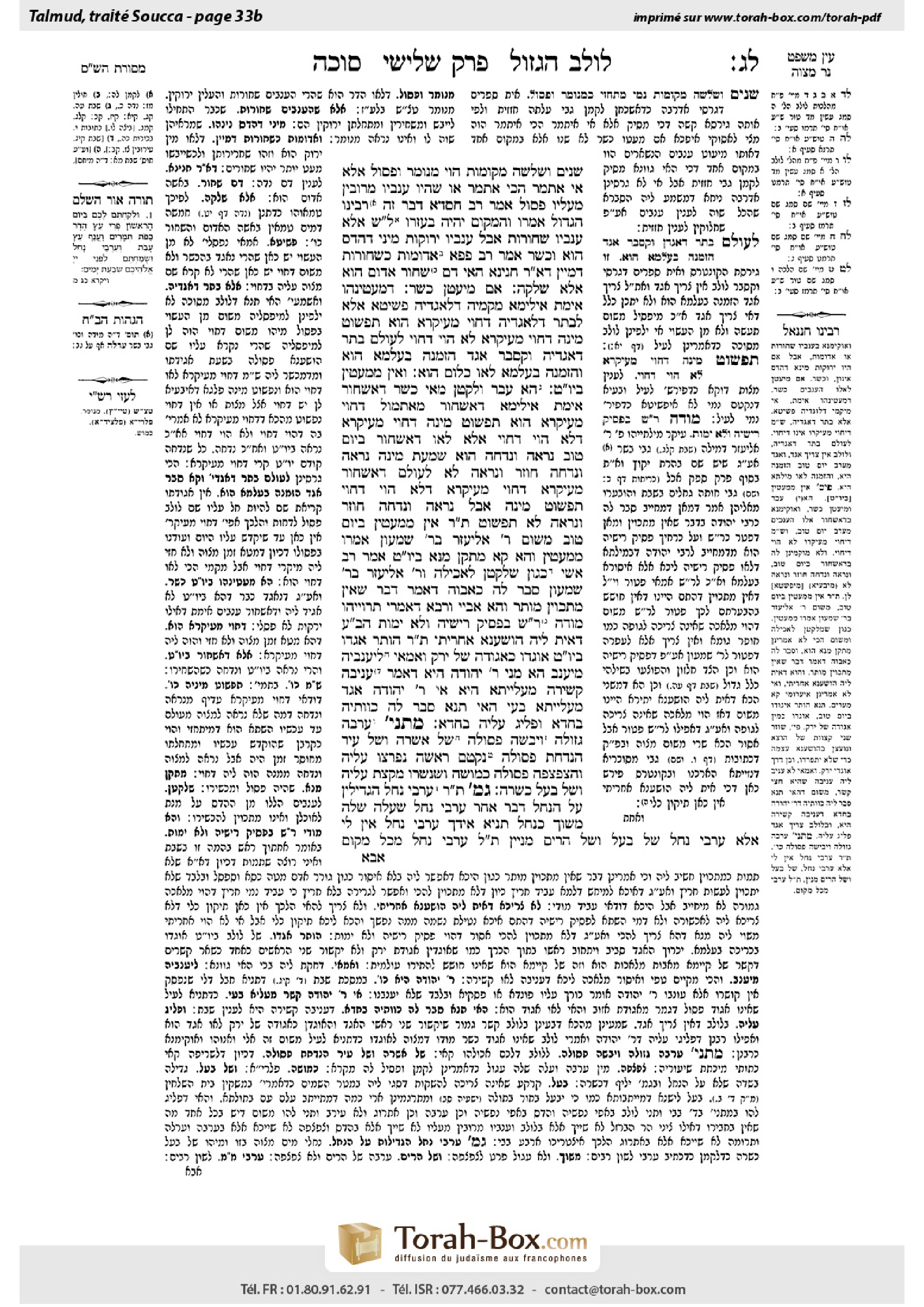
Sukkah 33b: Talmud study for Daf Yomi
Daf Yomi is the daily study of one Talmud folio. Explore 37 tractates with scans, Hebrew text, Sefaria English and AI-generated French translations where annotated.
Passage selection and English or AI-generated French translation are available where the scan has annotations. Daf Study is independent of Torah-Box and Sefaria.
Browse Sukkah · סוכה · All tractatesSukkah 33b text and translations
This page of Sukkah includes the Aramaic text, an English translation and an AI-generated French translation, alongside the scan above.
סוכה ל״ג ב · Aramaic and Hebrew text
שְׁנַיִם וּשְׁלֹשָׁה מְקוֹמוֹת הָוֵי מְנוּמָּר, וּפְסוּל.
אֶלָּא, אִי אִתְּמַר הָכִי אִתְּמַר: אוֹ שֶׁהָיוּ עֲנָבָיו מְרוּבִּין מֵעָלָיו — פָּסוּל. אָמַר רַב חִסְדָּא: דָּבָר זֶה רַבֵּינוּ הַגָּדוֹל אֲמָרוֹ, וְהַמָּקוֹם יִהְיֶה בְּעֶזְרוֹ: לֹא שָׁנוּ אֶלָּא עֲנָבָיו שְׁחוֹרוֹת. אֲבָל עֲנָבָיו יְרוּקּוֹת — מִינֵי דַהֲדַס הוּא, וְכָשֵׁר.
אָמַר רַב פָּפָּא: אֲדוּמּוֹת כִּשְׁחוֹרוֹת דָּמְיָין, דְּאָמַר רַבִּי חֲנִינָא: הַאי דָּם שָׁחוֹר — אָדוֹם הוּא, אֶלָּא שֶׁלָּקָה.
אִם מִיעֲטָן — כָּשֵׁר. דְּמַעֲטִינְהוּ אֵימַת? אִילֵּימָא מִקַּמֵּיה דְּלֹאגְדֵיהּ — פְּשִׁיטָא! אֶלָּא לְבָתַר דְּלֹאגְדֵיהּ — דָּחוּי מֵעִיקָּרָא הוּא! תִּפְשׁוֹט מִינַּהּ: דָּחוּי מֵעִיקָּרָא — לָא הָוֵי דָּחוּי!
לְעוֹלָם בָּתַר דְּאַגְדֵּיהּ, וְקָסָבַר: אֶגֶד הַזְמָנָה בְּעָלְמָא הוּא, וְהַזְמָנָה בְּעָלְמָא — לָאו כְּלוּם הוּא.
וְאֵין מְמַעֲטִין בְּיוֹם טוֹב. הָא עָבַר וְלִקְּטָן מַאי? כָּשֵׁר. דְּאַשְׁחוּר אֵימַת? אִילֵּימָא דְּאַשְׁחוּר מֵאֶתְמוֹל — דָּחוּי מֵעִיקָּרָא הוּא. תִּפְשׁוֹט מִינַּהּ דָּחוּי מֵעִיקָּרָא דְּלָא הָוֵי דָּחוּי!
אֶלָּא לָאו, דְּאַשְׁחוּר בְּיוֹם טוֹב, נִרְאֶה וְנִדְחֶה הוּא. שָׁמְעַתְּ מִינַּהּ: נִרְאֶה וְנִדְחֶה — חוֹזֵר וְנִרְאֶה!
לָא, לְעוֹלָם דְּאַשְׁחוּר מֵעִיקָּרָא, דָּחוּי מֵעִיקָּרָא דְּלָא הָוֵי דָּחוּי תִּפְשׁוֹט מִינַּהּ, אֲבָל נִרְאֶה וְנִדְחֶה חוֹזֵר וְנִרְאֶה, לָא תִּפְשׁוֹט.
תָּנוּ רַבָּנַן: אֵין מְמַעֲטִין בְּיוֹם טוֹב. מִשּׁוּם רַבִּי אֱלִיעֶזֶר בְּרַבִּי שִׁמְעוֹן אָמְרוּ: מְמַעֲטִין. וְהָא קָא מְתַקֵּן מָנָא בְּיוֹם טוֹב!
אָמַר רַב אָשֵׁי: כְּגוֹן שֶׁלִּקְּטָן לַאֲכִילָה. וְרַבִּי אֱלִיעֶזֶר בְּרַבִּי שִׁמְעוֹן סָבַר לַהּ כַּאֲבוּהּ, דְּאָמַר: דָּבָר שֶׁאֵין מִתְכַּוֵּין — מוּתָּר.
וְהָא אַבָּיֵי וְרָבָא דְּאָמְרִי תַּרְוַיְיהוּ: מוֹדֶה רַבִּי שִׁמְעוֹן בִּ״פְסִיק רֵישֵׁיהּ וְלָא יְמוּת״!
הָכָא בְּמַאי עָסְקִינַן — דְּאִית לֵיהּ הוֹשַׁעְנָא אַחֲרִיתִי.
תָּנוּ רַבָּנַן: הוּתַּר אַגְדּוֹ בְּיוֹם טוֹב — אוֹגְדוֹ כַּאֲגוּדָּה שֶׁל יָרָק. וְאַמַּאי? לִיעְנְבֵיהּ מִיעְנָב! הָא מַנִּי רַבִּי יְהוּדָה הִיא, דְּאָמַר: עֲנִיבָה — קְשִׁירָה מְעַלַּיְיתָא הִיא.
אִי רַבִּי יְהוּדָה, אֶגֶד מְעַלַּיְיתָא בָּעֵי! הַאי תַּנָּא סָבַר לַהּ כְּווֹתֵיהּ בַּחֲדָא, וּפְלִיג עֲלֵיהּ בַּחֲדָא.
מַתְנִי׳ עֲרָבָה גְּזוּלָה וִיבֵשָׁה — פְּסוּלָה. שֶׁל אֲשֵׁרָה וְשֶׁל עִיר הַנִּדַּחַת — פְּסוּלָה. נִקְטַם רֹאשָׁהּ, נִפְרְצוּ עָלֶיהָ, וְהַצַּפְצָפָה — פְּסוּלָה. כְּמוּשָׁה, וְשֶׁנָּשְׁרוּ מִקְצָת עָלֶיהָ, וְשֶׁל בַּעַל — כְּשֵׁרָה.
גְּמָ׳ תָּנוּ רַבָּנַן: ״עַרְבֵי נַחַל״ — הַגְּדֵילִין עַל הַנַּחַל. דָּבָר אַחֵר: ״עַרְבֵי נַחַל״, שֶׁעָלֶה שֶׁלָּהּ מָשׁוּךְ כְּנַחַל.
תַּנְיָא אִידַּךְ: ״עַרְבֵי נַחַל״, אֵין לִי אֶלָּא עַרְבֵי נַחַל. שֶׁל בַּעַל וְשֶׁל הָרִים מִנַּיִין — תַּלְמוּד לוֹמַר: ״עַרְבֵי נַחַל״ מִכׇּל מָקוֹם.
Sukkah 33b · English translation
If the berries are distributed in two or three places, the myrtle branch is speckled with different colors in different places. It lacks beauty and is certainly unfit.
Rather, emend the text: If this statement was stated, it was stated as follows: Or, if its berries were more numerous than its leaves, it is unfit. Rav Ḥisda said: This statement was stated by our great rabbi, Rav, and may the Omnipresent come to his assistance: The Sages taught this halakha only with regard to ripe, black berries, since they stand in stark contrast to the green leaves of the branch, which then appears speckled. However, if its berries are green, they are considered of the same type as the myrtle branch, as they are the same color. Consequently, the branch does not appear speckled, and therefore it is fit.
Rav Pappa said: The legal status of red berries is like that of black ones, as Rabbi Ḥanina said: In the case of menstrual blood, this black blood is actually red blood, except that it deteriorated. Red and black are considered two shades of the same color.
§ The mishna continues: If he diminished their number, it is fit. The Gemara asks: This is a case where he diminished their number when? If you say that he did so before he bound the lulav, it is obvious that it is fit. When he performs the mitzva with it, the leaves outnumber the berries. Rather, it must be that he diminished their number after he bound the lulav with the other species. If so, it is a case of disqualification from the outset, as it was unfit at the time that it was bound. Resolve from here the dilemma that was raised and conclude that disqualification from the outset is not permanent disqualification.
The Gemara rejects this suggestion: Actually, it is a case where he diminished the number of berries after he bound it. And that Sage holds that binding does not render the three bound species a lulav used for a mitzva. Rather, it is mere designation of the species for the mitzva, and mere designation is not anything of significance. The fact that the berries outnumbered the leaves at the time that it was bound is not disqualification from the outset, as binding is a stage prior to the outset.
§ The mishna continues: But one may not diminish the number on the Festival itself. The Gemara asks: But if one violated the prohibition and picked them, what is the halakha? The myrtle branch is fit, as the mishna prohibited doing so ab initio but did not deem it unfit. The Gemara clarifies: This is a case that the berries turned black when? If you say that they were black from yesterday, the Festival eve, the myrtle is disqualified from the outset, as it is unfit at the start of the Festival. If so, resolve from here that disqualification from the outset is not permanent disqualification, as the mishna says that if one picked the berries, the myrtle branch is fit.
Rather, is it not that they turned black on the Festival itself and he picked them that day. That then is a case where the myrtle branch was fit and then disqualified, as at the start of the Festival the berries were green and only later turned black, rendering the myrtle branch unfit. Conclude from it that an item that was fit and then disqualified can then be rendered fit again, thereby resolving an unresolved dilemma.
The Gemara rejects that conclusion. No, actually, it is a case where the berries turned black from the outset, prior to the Festival. Resolve from it that an item disqualified from the outset is not permanently disqualified. However, do not resolve the dilemma concerning whether an item that was fit and then disqualified can then be rendered fit, as no clear proof can be adduced from here.
The Sages taught: One may not diminish the number of berries on the Festival to render the myrtle branch fit. In the name of Rabbi Eliezer, son of Rabbi Shimon, they said: One may diminish their number. The Gemara asks: But isn’t he preparing a vessel on a Festival, as he renders an unfit myrtle branch fit for use in fulfilling the mitzva?
Rav Ashi said: It is a case where he picked them for the purpose of eating them, as it is permitted to pick berries from a branch unattached to the ground, and preparing the myrtle branch for use is permitted because he did not intend to do so. And Rabbi Eliezer, son of Rabbi Shimon, holds in accordance with the opinion of his father, who said: An unintentional act, i.e., a permitted action from which a prohibited labor inadvertently ensues, is permitted on Shabbat or on a Festival. Here too, one’s intention is to eat the berries. Although the myrtle branch is prepared for use in the process, picking the berries is permitted because that was not his intention.
The Gemara challenges: But didn’t Abaye and Rava both say that Rabbi Shimon concedes in the case of: Cut off its head and will it not die? Even Rabbi Shimon, who says that an unintentional act is permitted, said so only in cases where the prohibited result is possible but not guaranteed. However, when a prohibited result is inevitable, just as death inevitably ensues from decapitation, the act is prohibited. In the case of picking berries off of a myrtle branch for food, one cannot claim that he did not intend for the prohibited result of preparing the myrtle branch for use to ensue. In this case, the myrtle branch will inevitably be rendered fit; how is this permitted?
The Gemara answers: With what are we dealing here? It is with a case where he has another fit myrtle branch. Therefore, one is not considered to be preparing a vessel. Since the ultimate objective is to render the lulav and the accompanying species, which constitute the vessel in question, fit, and those species are already fit, picking the berries from the myrtle branch is not inevitable preparation of a vessel. Therefore, if one ate the berries, and the myrtle branch is thereby rendered fit, it is fit for use in the mitzva.
§ The Sages taught: If the binding of the lulav was untied on the Festival, one may bind it again. One may not bind it with a sophisticated knot as before, but with a knot like the one used in a binding of vegetables, by merely winding the string around the species. The Gemara asks: But why merely wind it? Let him tie a bow, which is permitted on Shabbat or a Festival, as he is not tying an actual knot. The Gemara answers: Whose opinion is it in this baraita? It is the opinion of Rabbi Yehuda, who says that a bow is a full-fledged knot, and therefore it is prohibited to tie one on the Festival.
The Gemara answers: If the baraita is in accordance with the opinion of Rabbi Yehuda, since he holds that a lulav requires binding, as he derived from the Paschal lamb, he requires the binding to be a full-fledged binding. How, then, can winding the string like the binding of vegetables suffice in fulfillment of the mitzva? The Gemara answers: This tanna of the baraita holds in accordance with his opinion in one matter, i.e., that a bow is a full-fledged knot, and disagrees with him in one matter, as the tanna holds that binding the species is merely to enhance the beauty of the mitzva, but it is not a Torah requirement.
MISHNA: A willow branch that was stolen or is completely dry is unfit. One from a tree worshipped as idolatry [asheira] or from a city whose residents were incited to idolatry is unfit. If the top was severed, or its leaves were severed, or if it is the tzaftzafa, a species similar to, but not actually a willow, it is unfit. However, a willow branch that is slightly dried, and one that a minority of its leaves fell, and a branch from a willow that does not grow by the river, but instead is from a non-irrigated field, is fit.
GEMARA: The Sages taught: “Willows of the brook” (Leviticus 23:40) means willows that grow by the brook. Alternatively, “willows of the brook” is an allusion to the tree in question. It is a tree whose leaf is elongated like a brook.
It was taught in another baraita: From “willows of the brook,” I have derived only actual willows of the brook that grow on the banks of the brook. With regard to willows of the non-irrigated field and willows of the mountains, from where do I derive that they are fit as well? The verse states: “Willows of the brook,” in the plural, teaching that the branches of willows are fit in any case.
Sukkah 33b · Traduction française (IA)
Si les baies sont réparties en deux ou trois endroits, la branche de myrte présente des taches de différentes couleurs à différents endroits. Elle manque de beauté et est donc certainement impropre.
Il faut plutôt corriger le texte ainsi : si cette déclaration a été formulée, elle l’a été de la manière suivante : ou bien, si ses baies sont plus nombreuses que ses feuilles, elle est impropre. Rav Ḥisda dit : Cette déclaration a été formulée par notre grand maître, Rav — que le Tout-Puissant lui vienne en aide ! Les Sages n’ont enseigné cette halakha qu’à propos de baies mûres et noires, car elles contrastent fortement avec les feuilles vertes de la branche, qui paraît alors tachetée. En revanche, si ses baies sont vertes, elles sont considérées comme étant de même nature que la branche de myrte, puisqu’elles sont de la même couleur. Par conséquent, la branche ne paraît pas tachetée et est donc apte.
Rav Pappa dit : Le statut des baies rouges est le même que celui des baies noires, car Rabbi Ḥanina a dit : Dans le cas du sang menstruel, le sang noir est en réalité du sang rouge qui s’est simplement détérioré. Le rouge et le noir sont considérés comme deux nuances d’une même couleur.
§ La Michna poursuit : S’il en a diminué le nombre, elle est apte. La Guemara demande : À quel moment a-t-il diminué leur nombre ? Si tu dis qu’il l’a fait avant d’attacher le loulav, il est évident qu’elle est apte. Lorsqu’il accomplit la mitsva avec elle, les feuilles sont plus nombreuses que les baies. Il faut donc plutôt dire qu’il en a diminué le nombre après avoir attaché le loulav avec les autres espèces. Si tel est le cas, il s’agit d’une invalidation dès le départ, puisqu’elle était impropre au moment où il l’a attachée. Il faut en conclure que la difficulté soulevée est résolue : une invalidation dès le départ n’est pas une invalidation permanente.
La Guemara rejette cette proposition : en réalité, il s’agit d’un cas où il a diminué le nombre de baies après l’avoir attaché. Ce tanna considère que l’attachement ne transforme pas les trois espèces liées en un loulav destiné à l’accomplissement de la mitsva. Il ne s’agit que de désigner les espèces pour la mitsva, et une simple désignation n’a pas de valeur particulière. Le fait que les baies aient été plus nombreuses que les feuilles au moment de l’attachement ne constitue pas une invalidation dès le départ, car l’attachement est une étape antérieure au commencement proprement dit.
§ La Michna poursuit : Mais on ne peut pas en diminuer le nombre pendant la fête. La Guemara demande : Mais si quelqu’un a enfreint l’interdiction et les a cueillies, quelle est la halakha ? La branche de myrte est apte, car la Michna interdit de le faire a priori, mais ne la déclare pas impropre. La Guemara précise : À quel moment les baies sont-elles devenues noires ? Si tu dis qu’elles étaient déjà noires la veille, à la veille de la fête, le myrte est invalidé dès le départ, puisqu’il est impropre au début de la fête. Il faut alors en conclure qu’une invalidation dès le départ n’est pas une invalidation permanente, puisque la Michna dit que si l’on a cueilli les baies, la branche de myrte est apte.
Ne s’agit-il pas plutôt d’un cas où elles sont devenues noires pendant la fête et où il les a cueillies ce jour-là ? Ce serait alors un cas où la branche de myrte était apte, puis a été invalidée : au début de la fête, les baies étaient vertes et ce n’est que plus tard qu’elles sont devenues noires, rendant la branche de myrte impropre. Il faut en conclure qu’un objet qui était apte, puis a été invalidé, peut redevenir apte, ce qui résout une difficulté restée sans réponse.
La Guemara rejette cette conclusion. Non, en réalité, il s’agit d’un cas où les baies étaient devenues noires dès le départ, avant la fête. Il faut en conclure qu’un objet invalidé dès le départ n’est pas invalidé de manière permanente. Toutefois, ne résous pas la difficulté concernant la possibilité pour un objet qui était apte, puis a été invalidé, de redevenir apte, car aucun élément de preuve concluant ne peut être tiré d’ici.
Les Sages ont enseigné : On ne peut pas diminuer le nombre de baies pendant la fête pour rendre la branche de myrte apte. Au nom de Rabbi Eliezer, fils de Rabbi Shimon, ils ont dit : On peut en diminuer le nombre. La Guemara demande : Mais n’est-il pas en train de préparer un ustensile pendant la fête, puisqu’il rend apte à l’usage, pour l’accomplissement de la mitsva, une branche de myrte qui était impropre ?
Rav Ashi dit : Il s’agit d’un cas où il les a cueillies pour les manger. Il est permis de cueillir des baies sur une branche détachée du sol, et il est permis de rendre la branche de myrte apte à l’usage, puisqu’il n’en avait pas l’intention. Rabbi Eliezer, fils de Rabbi Shimon, suit l’opinion de son père, qui a dit : Un acte involontaire, c’est-à-dire une action permise dont découle par inadvertance un travail interdit, est permis le Chabbat ou pendant une fête. Ici aussi, la personne a l’intention de manger les baies. Bien que la branche de myrte soit rendue apte à l’usage au cours de l’opération, il est permis de cueillir les baies, car ce n’était pas son intention.
La Guemara objecte : Mais Abaye et Rava n’ont-ils pas tous deux dit que Rabbi Shimon reconnaît le principe dans le cas de : « Coupe-lui la tête, et ne mourra-t-il pas ? » Même Rabbi Shimon, qui dit qu’un acte involontaire est permis, ne l’a dit que dans les cas où le résultat interdit est possible, mais pas certain. En revanche, lorsqu’un résultat interdit est inévitable, tout comme la mort découle inévitablement de la décapitation, l’acte est interdit. Lorsqu’on cueille des baies d’une branche de myrte pour les manger, on ne peut pas prétendre que l’on n’avait pas l’intention de produire le résultat interdit, à savoir rendre la branche de myrte apte à l’usage. Dans ce cas, la branche de myrte sera nécessairement rendue apte ; comment cela peut-il être permis ?
La Guemara répond : De quel cas s’agit-il ici ? D’un cas où il possède une autre branche de myrte apte. Par conséquent, on ne considère pas qu’il prépare un ustensile. Puisque l’objectif final est de rendre aptes le loulav et les espèces qui l’accompagnent, qui constituent l’ustensile en question, et que ces espèces sont déjà aptes, cueillir les baies de la branche de myrte ne constitue pas une préparation inévitable d’un ustensile. Par conséquent, s’il mange les baies et que la branche de myrte est ainsi rendue apte, elle convient à l’accomplissement de la mitsva.
§ Les Sages ont enseigné : Si le lien du loulav s’est défait pendant la fête, on peut le rattacher. On ne peut pas le renouer avec un nœud élaboré comme auparavant, mais avec un nœud semblable à celui utilisé pour attacher des légumes, en enroulant simplement la ficelle autour des espèces. La Guemara demande : Mais pourquoi se contenter de l’enrouler ? Qu’il fasse un nœud en boucle, ce qui est permis le Chabbat ou pendant une fête, puisqu’il ne fait pas un véritable nœud. La Guemara répond : De qui est l’avis de cette baraïta ? C’est celui de Rabbi Yehuda, qui dit qu’un nœud en boucle est un véritable nœud ; il est donc interdit d’en faire un pendant la fête.
La Guemara répond : Si la baraïta suit l’opinion de Rabbi Yehuda, puisqu’il considère que le loulav doit être attaché — comme il l’a déduit de l’agneau pascal —, il exige que l’attachement soit un véritable lien. Comment, dès lors, le simple enroulement de la ficelle, comme pour attacher des légumes, peut-il suffire à l’accomplissement de la mitsva ? La Guemara répond : Ce tanna de la baraïta suit son opinion sur un point, à savoir qu’un nœud en boucle est un véritable nœud, mais il est en désaccord avec lui sur un autre point : il considère que l’attachement des espèces ne vise qu’à embellir la mitsva et ne constitue pas une exigence de la Torah.
MICHNA : Une branche de saule qui a été volée ou qui est entièrement desséchée est impropre. Une branche provenant d’un arbre voué à l’idolâtrie [asheira] ou d’une ville dont les habitants ont été incités à l’idolâtrie est impropre. Si son sommet a été coupé, si ses feuilles ont été coupées, ou s’il s’agit du tzaftzafa, une espèce semblable au saule, mais qui n’est pas véritablement un saule, elle est impropre. Cependant, une branche de saule légèrement desséchée, une branche dont une minorité des feuilles est tombée, ainsi qu’une branche de saule qui ne pousse pas au bord d’un cours d’eau mais dans un champ non irrigué, sont aptes.
GUEMARA : Les Sages ont enseigné : « Les saules du torrent » (Lévitique 23,40) désigne les saules qui poussent au bord du torrent. Autrement, « les saules du torrent » fait allusion à l’arbre en question : c’est un arbre dont la feuille est allongée comme un torrent.
Il a été enseigné dans une autre baraïta : De l’expression « les saules du torrent », j’ai seulement déduit que sont aptes les véritables saules du torrent, qui poussent sur les rives du torrent. D’où déduis-je que les saules des champs non irrigués et ceux des montagnes sont également aptes ? Le verset dit « les saules du torrent », au pluriel, pour enseigner que les branches de saule sont aptes dans tous les cas.
Traduction française générée par IA à partir de l’édition anglaise de Sefaria. Vérifie toujours un passage avec le texte source.
Text from Sefaria: William Davidson Edition - Vocalized Aramaic (CC BY NC); William Davidson Edition - English (CC BY NC).