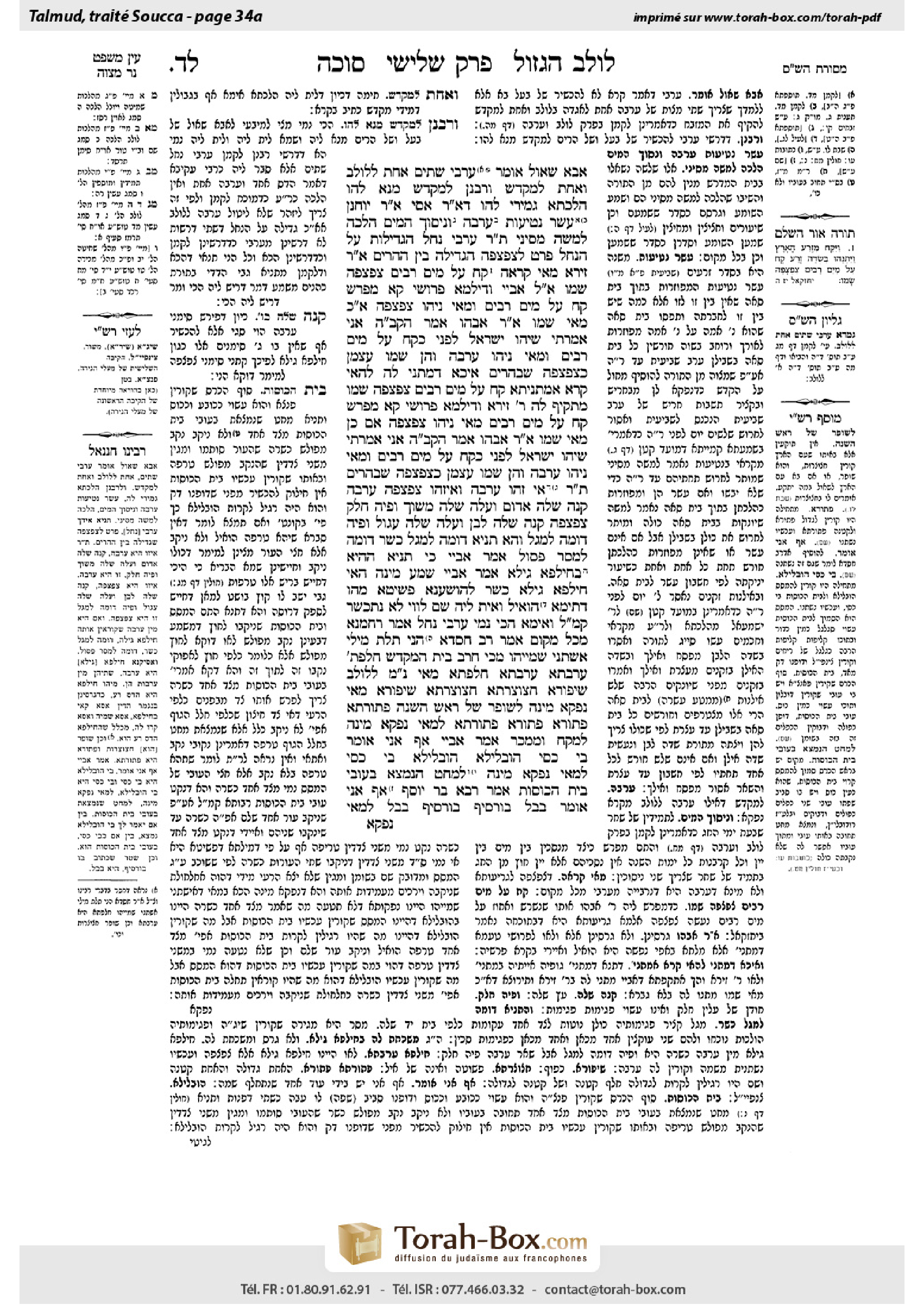
Sukkah 34a: Talmud study for Daf Yomi
Daf Yomi is the daily study of one Talmud folio. Explore 37 tractates with scans, Hebrew text, Sefaria English and AI-generated French translations where annotated.
Passage selection and English or AI-generated French translation are available where the scan has annotations. Daf Study is independent of Torah-Box and Sefaria.
Browse Sukkah · סוכה · All tractatesSukkah 34a text and translations
This page of Sukkah includes the Aramaic text, an English translation and an AI-generated French translation, alongside the scan above.
סוכה ל״ד א · Aramaic and Hebrew text
אַבָּא שָׁאוּל אוֹמֵר: ״עַרְבֵי״ — שְׁתַּיִם. אַחַת לַלּוּלָב, וְאַחַת לַמִּקְדָּשׁ.
וְרַבָּנַן, לַמִּקְדָּשׁ מְנָא לְהוּ? הִלְכְתָא גְּמִירִי לְהוּ. דְּאָמַר רַבִּי אַסִּי אָמַר רַבִּי יוֹחָנָן: עֶשֶׂר נְטִיעוֹת, עֲרָבָה וְנִיסּוּךְ הַמַּיִם — הֲלָכָה לְמֹשֶׁה מִסִּינַי.
תָּנוּ רַבָּנַן: ״עַרְבֵי נַחַל״ — הַגְּדֵילוֹת עַל הַנַּחַל, פְּרָט לְצַפְצָפָה הַגְּדֵילָה בֵּין הֶהָרִים. אָמַר רַבִּי זֵירָא, מַאי קְרָאָה: ״קָח עַל מַיִם רַבִּים צַפְצָפָה שָׂמוֹ״.
אֲמַר לֵיהּ אַבָּיֵי: וְדִילְמָא פָּרוֹשֵׁי קָא מְפָרֵשׁ — ״קָח עַל מַיִם רַבִּים״, וּמַאי נִיהוּ — צַפְצָפָה! אִם כֵּן, מַאי ״שָׂמוֹ״? אָמַר רַבִּי אֲבָהוּ: אָמַר הַקָּדוֹשׁ בָּרוּךְ הוּא: אֲנִי אָמַרְתִּי שֶׁיְּהוּ יִשְׂרָאֵל לְפָנַי כְּ״קָח עַל מַיִם רַבִּים״, וּמַאי נִיהוּ — עֲרָבָה, וְהֵן שָׂמוּ עַצְמָן כְּצַפְצָפָה שֶׁבֶּהָרִים.
אִיכָּא דְּמַתְנֵי לַהּ לְהַאי קְרָא אַמַּתְנִיתָא: ״קָח עַל מַיִם רַבִּים צַפְצָפָה שָׂמוֹ״. מַתְקֵיף לַהּ רַבִּי זֵירָא: וְדִילְמָא פָּרוֹשֵׁי קָא מְפָרֵשׁ ״קָח עַל מַיִם רַבִּים״, מַאי נִיהוּ — צַפְצָפָה! אִם כֵּן — מַאי ״שָׂמוֹ״? אָמַר רַבִּי אֲבָהוּ: אָמַר הַקָּדוֹשׁ בָּרוּךְ הוּא: אֲנִי אָמַרְתִּי שֶׁיְּהוּ יִשְׂרָאֵל לְפָנַי כְּ״קָח עַל מַיִם רַבִּים״, וּמַאי נִיהוּ — עֲרָבָה, וְהֵן שָׂמוּ עַצְמָן כְּצַפְצָפָה שֶׁבֶּהָרִים.
תָּנוּ רַבָּנַן: אֵי זֶהוּ עֲרָבָה וְאֵיזֶהוּ צַפְצָפָה? עֲרָבָה, קָנֶה שֶׁלָּהּ אָדוֹם, וְעָלֶה שֶׁלָּהּ מָשׁוּךְ וּפִיהָ חָלָק. צַפְצָפָה, קָנֶה שֶׁלָּהּ לָבָן, וְעָלֶה שֶׁלָּהּ עָגוֹל וּפִיהָ דּוֹמֶה לְמַגָּל. וְהָא תַּנְיָא: דּוֹמֶה לְמַגָּל כָּשֵׁר, דּוֹמֶה לְמַסָּר — פָּסוּל! אֲמַר אַבָּיֵי: כִּי תַּנְיָא הָהִיא, בְּחִילְפָא גִּילָא.
אָמַר אַבָּיֵי: שְׁמַע מִינַּהּ הַאי חִילְפָא גִּילָא — כָּשֵׁר לְהוֹשַׁעְנָא. פְּשִׁיטָא! מַהוּ דְּתֵימָא: הוֹאִיל וְאִית לֵיהּ שֵׁם לְוַוי לָא נִתַּכְשַׁר, קָא מַשְׁמַע לַן.
וְאֵימָא הָכִי נָמֵי! ״עַרְבֵי נַחַל״ אָמַר רַחֲמָנָא, מִכׇּל מָקוֹם.
אָמַר רַב חִסְדָּא: הָנֵי תְּלָת מִילֵּי אִשְׁתַּנִּי שְׁמַיְיהוּ מִכִּי חֲרַב בֵּית הַמִּקְדָּשׁ: חֲלַפְתָּא — עֲרַבְתָּא, עֲרַבְתָּא — חֲלַפְתָּא. מַאי נָפְקָא מִינַּהּ? לְלוּלָב.
שִׁיפּוּרָא — חֲצוֹצַרְתָּא, חֲצוֹצַרְתָּא — שִׁיפּוּרָא. מַאי נָפְקָא מִינַּהּ? לְשׁוֹפָר שֶׁל רֹאשׁ הַשָּׁנָה.
פָּתוּרְתָּא — פָּתוּרָא, פָּתוּרָא — פָּתוּרְתָּא. לְמַאי נָפְקָא מִינַּהּ? לְמִקָּח וּמִמְכָּר.
אָמַר אַבָּיֵי, אַף אֲנִי אוֹמֵר: בֵּי כָסֵי — הוּבְלִילָא, הוּבְלִילָא — בֵּי כָסֵי.
לְמַאי נָפְקָא מִינַּהּ? לְמַחַט הַנִּמְצָא בְּעוֹבִי בֵּית הַכּוֹסוֹת.
אָמַר רָבָא בַּר יוֹסֵף, אַף אֲנִי אוֹמֵר: בָּבֶל — בּוֹרְסִיף, בּוֹרְסִיף — בָּבֶל. לְמַאי
Sukkah 34a · English translation
Abba Shaul says: “Willows” in the plural teaches that there are two mitzvot that involve use of the willow branch. One is the willow branch for the lulav, and one is the willow branch taken for the Temple, with which the people would circle the altar on Sukkot.
And the Rabbis, who do not interpret the verse that way, from where do they derive the mitzva of the willow branch for the Temple? It is a halakha transmitted to Moses from Sinai that they learned through tradition and not from a verse, as Rabbi Asi said that Rabbi Yoḥanan said: There are three halakhot for which the Sages unsuccessfully sought a Torah source. The first is the halakha of ten saplings. There is a mitzva by Torah law to extend the sanctity of the Sabbatical Year and to begin refraining from plowing thirty days before the Sabbatical Year begins. However, one may plow around individual saplings to sustain them. In a field that is one beit se’a, fifty by fifty cubits, in which there are ten evenly spaced saplings, it is permitted to plow the entire field until the onset of the Sabbatical Year to sustain the saplings. The second halakha is the mitzva of the willow branch in the Temple. And the third halakha is the mitzva of the water libation on the altar, which accompanies the daily offerings each day of Sukkot, together with the daily wine libation. No Torah source was found for these halakhot, as each is a halakha transmitted to Moses from Sinai.
The Sages taught an additional baraita: “Willows of the brook” is referring to those that grow by the river, which comes to exclude a tzaftzafa, which grows among the mountains and not near a brook. Rabbi Zeira said: What is the verse from which the fact that the tzaftzafa is unfit is derived? It is derived from the reprimand that is written: “He placed it by great waters, and set it as a tzaftzafa” (Ezekiel 17:5). The Jewish people were planted like a willow on great waters, but ultimately became like a tzaftzafa. Apparently, a tzaftzafa does not grow on great waters.
Abaye said to Rabbi Zeira: And perhaps the second part of the verse is merely explaining the first part, and it means: He placed it by great waters, and what is it that He placed there? It is a tzaftzafa. Rabbi Zeira answered: If so, and that is the meaning of the verse, what is the meaning of the term “set it”? Rather, the verse means that the willow branch was transformed into a tzaftzafa. That is how Rabbi Abbahu explained the verse, as Rabbi Abbahu said that the Holy One, Blessed be He, said: I said that the Jewish people should be before Me as a plant placed by great waters, and what is that plant? It is a willow. And they set themselves as a tzaftzafa of the mountains.
Some taught this verse as the conclusion of the baraita and Rabbi Zeira raised the objection, and the response to his objection is unattributed: He placed it by great waters, and set it as a tzaftzafa. Rabbi Zeira strongly objects: And perhaps the second part of the verse is merely explaining the first part, and it means: He placed it by great waters, and what is it that He placed there? It is a tzaftzafa. The Gemara rejects this suggestion: If so, and that is the meaning of the verse, what is the meaning of the term “set it”? Rabbi Abbahu said that the Holy One, Blessed be He, said: I said that the Jewish people should be before Me as a plant placed by great waters, and what is that plant? It is a willow. And they set themselves as a tzaftzafa of the mountains.
Apropos the defining characteristics of the willow branch, in contrast to similar species that are unfit, the Sages taught: What is a willow and what is a tzaftzafa? With regard to a willow branch, its stem is red, and its leaf is elongated, and the edge of its leaf is smooth. With regard to a tzaftzafa, its stem is white, its leaf is round, and the edge of its leaf is serrated like a sickle. The Gemara objects: But isn’t it taught in a baraita: If the edge of its leaf is serrated like a sickle it is fit, but if it is serrated like a saw, whose teeth are uneven in both size and sequence, it is unfit? Abaye said: When that baraita was taught, it was referring to a particular type of willow called ḥilfa gila, whose leaves are serrated. However, all other types of willow branches have leaves with a smooth edge.
Abaye said: Conclude from it that this ḥilfa gila is fit for use in the hoshana of the four species. The Gemara wonders: That is obvious. The Gemara answers: Lest you say that since its name is accompanied by a modifier, as it is called ḥilfa gila, it should not be fit. Therefore, Abaye teaches us that it is fit.
The Gemara asks: And say it is indeed so, that since its name is accompanied by a modifier it is unfit. The Gemara answers: The Merciful One states: “Willows of the brook,” in the plural, teaching that the branches of willows are fit in any case.
Apropos the branches of the willow and the tzaftzafa, the Gemara cites what Rav Ḥisda said: These three objects’ names changed since the Temple was destroyed. That which was called willow was called in later generations ḥalfata, which is another name for tzaftzafa, and that which was called ḥalfata was called willow. The Gemara asks: What is the practical halakhic difference that emerges from the name change? The Gemara answers: It is with regard to the mitzva of taking the lulav, as one of the species bound with the lulav is a willow branch, which is now called tzaftzafa.
In addition, that which was called trumpet was called shofar in later generations, and that which was called shofar was called trumpet in later generations. The Gemara asks: What is the practical halakhic difference whether a shofar is called shofar or trumpet? The Gemara answers: It is significant with regard to the halakhot of shofar of Rosh HaShana. On Rosh HaShana, one fulfills his obligation only by sounding a shofar. If one comes today and asks what instrument he should use to sound the requisite blasts, he should be told to use a trumpet.
Also, that which was called petorata, originally meaning a small table, was called in later generations petora, and that which was called petora, originally meaning a large table, was called petorata in later generations. The Gemara asks: What is the practical halakhic difference that emerges from the change of name? The Gemara answers: It is with regard to the laws of buying and selling. One who orders a petora should know that he ordered a small table and not a large one.
Abaye said: I too shall speak of changes in the meaning of terms in this generation. That which was called huvlila, the first compartment of the stomach of animals that chew their cud, is, in recent generations, called bei kasei, the name of the second compartment of the animal’s stomach. Similarly, that which was once called bei kasei is called huvlila in recent generations.
What is the practical halakhic difference that emerges from this change of names? It is with regard to a needle that is found in the thick wall of the second compartment of the stomach. In the halakhot of tereifot, it is prohibited to eat animals with a life expectancy of less than a year. It was established that if a needle punctures the wall of the second compartment of the stomach from only one side, the animal is kosher. If the needle penetrates the wall in a manner visible from both sides, the animal assumes the halakhic status of a tereifa. In the first stomach, even if the needle penetrated only one side of the wall, the animal assumes the halakhic status of a tereifa. Therefore, it is crucial to distinguish between the first and the second compartments of the stomach.
Rava bar Yosef said: I too shall speak of changes in the meaning of terms in this generation. The city that in biblical times was called Babylon was called Bursif in later generations, and Bursif was called Babylon in later generations. The Gemara asks: What is
Sukkah 34a · Traduction française (IA)
Abba Shaul dit : « Saules », au pluriel, enseigne qu’il existe deux mitsvot qui impliquent l’usage d’une branche de saule. L’une est la branche de saule du loulav, et l’autre est la branche de saule prise pour le Temple, avec laquelle le peuple faisait le tour de l’autel à Souccot.
Et les Sages, qui n’interprètent pas le verset de cette manière, d’où tirent-ils la mitsva de la branche de saule au Temple ? Ils la tiennent d’une halakha transmise à Moïse au Sinaï, apprise par tradition et non à partir d’un verset. En effet, Rabbi Assi a dit au nom de Rabbi Yoḥanan : Il existe trois halakhot pour lesquelles les Sages ont cherché en vain une source dans la Torah. La première est la halakha des dix jeunes arbres. Selon la Torah, il faut étendre la sainteté de l’année sabbatique et commencer à s’abstenir de labourer trente jours avant son début. Toutefois, on peut labourer autour de jeunes arbres isolés afin de les préserver. Dans un champ d’un beit séa, soit cinquante coudées sur cinquante, où se trouvent dix jeunes arbres régulièrement espacés, il est permis de labourer tout le champ jusqu’au début de l’année sabbatique afin de préserver ces arbres. La deuxième halakha est la mitsva de la branche de saule au Temple. La troisième est la mitsva de la libation d’eau sur l’autel, qui accompagne chaque jour de Souccot les sacrifices quotidiens, ainsi que la libation quotidienne de vin. Aucune source dans la Torah n’a été trouvée pour ces halakhot, car chacune est une halakha transmise à Moïse au Sinaï.
Les Sages ont enseigné dans une autre baraïta : « Saules du ruisseau » désigne les saules qui poussent près d’un cours d’eau ; cela exclut le tzaftzafa, qui pousse dans les montagnes et non près d’un ruisseau. Rabbi Zeira dit : De quel verset déduit-on que le tzaftzafa est impropre ? On le déduit du reproche formulé dans ce qui est écrit : « Il le plaça près de grandes eaux et en fit un tzaftzafa » (Ézéchiel 17, 5). Le peuple juif fut planté comme un saule près de grandes eaux, mais finit par devenir comme un tzaftzafa. Il apparaît donc qu’un tzaftzafa ne pousse pas près de grandes eaux.
Abayé dit à Rabbi Zeira : Peut-être la seconde partie du verset ne fait-elle qu’expliquer la première, et le sens est-il : « Il le plaça près de grandes eaux » ; et qu’y plaça-t-Il ? Un tzaftzafa. Rabbi Zeira répondit : Si tel était le sens du verset, que signifie alors le terme « en fit » ? Le verset signifie plutôt que le saule fut transformé en tzaftzafa. C’est ainsi que Rabbi Abbahou expliqua le verset, car Rabbi Abbahou dit que le Saint, béni soit-Il, a dit : « J’ai dit que le peuple juif devait être devant Moi comme une plante placée près de grandes eaux. Et quelle est cette plante ? Un saule. Mais ils se sont faits eux-mêmes tzaftzafa des montagnes. »
Certains ont enseigné ce verset comme conclusion de la baraïta, et Rabbi Zeira a soulevé l’objection ; la réponse à son objection n’est attribuée à personne : « Il le plaça près de grandes eaux et en fit un tzaftzafa. » Rabbi Zeira objecte avec force : Peut-être la seconde partie du verset ne fait-elle qu’expliquer la première, et le sens est-il : « Il le plaça près de grandes eaux » ; et qu’y plaça-t-Il ? Un tzaftzafa. La Guemara rejette cette proposition : Si tel était le sens du verset, que signifie alors le terme « en fit » ? Rabbi Abbahou dit que le Saint, béni soit-Il, a dit : « J’ai dit que le peuple juif devait être devant Moi comme une plante placée près de grandes eaux. Et quelle est cette plante ? Un saule. Mais ils se sont faits eux-mêmes tzaftzafa des montagnes. »
À propos des caractéristiques qui distinguent le saule des espèces similaires impropres, les Sages ont enseigné : Qu’est-ce qu’un saule et qu’est-ce qu’un tzaftzafa ? Le saule a une tige rouge, une feuille allongée et un bord lisse. Le tzaftzafa a une tige blanche, une feuille ronde et un bord dentelé comme une faucille. La Guemara objecte : Mais n’est-il pas enseigné dans une baraïta que, si le bord de la feuille est dentelé comme une faucille, elle est propre à l’usage, tandis que s’il est dentelé comme une scie, dont les dents sont irrégulières par leur taille et leur disposition, elle est impropre ? Abayé dit : Cette baraïta fait référence à une variété particulière de saule appelée ḥilfa gila, dont les feuilles sont dentelées. Toutes les autres variétés de saule ont cependant des feuilles au bord lisse.
Abayé dit : On peut en conclure que ce ḥilfa gila convient pour la hoshaana des quatre espèces. La Guemara s’étonne : Cela va de soi. La Guemara répond : On aurait pu dire que, puisque son nom comporte un qualificatif — on l’appelle ḥilfa gila —, il est impropre. Abayé nous enseigne donc qu’il convient.
La Guemara demande : Ne pourrait-on pas effectivement dire que, puisque son nom comporte un qualificatif, il est impropre ? La Guemara répond : Le Miséricordieux dit « saules du ruisseau », au pluriel, enseignant que les branches de saule conviennent dans tous les cas.
À propos des branches de saule et du tzaftzafa, la Guemara rapporte ce que Rav Ḥisda a dit : Les noms de ces trois objets ont changé depuis la destruction du Temple. Ce qui était appelé saule fut appelé ḥalfata dans les générations suivantes, autre nom du tzaftzafa ; et ce qui était appelé ḥalfata fut appelé saule. La Guemara demande : Quelle différence pratique sur le plan de la halakha découle de ce changement de nom ? La Guemara répond : Cela concerne la mitsva de prendre le loulav, car l’une des espèces liées au loulav est une branche de saule, appelée désormais tzaftzafa.
De même, ce qui était appelé ḥaṣoṣera fut appelé shofar dans les générations suivantes, et ce qui était appelé shofar fut appelé ḥaṣoṣera. La Guemara demande : Quelle différence pratique y a-t-il, sur le plan de la halakha, entre le fait d’appeler un shofar shofar ou ḥaṣoṣera ? La Guemara répond : Cela a de l’importance pour les halakhot du shofar de Roch Hachana. À Roch Hachana, on ne s’acquitte de son obligation qu’en sonnant du shofar. Si quelqu’un vient aujourd’hui demander quel instrument il doit utiliser pour produire les sonneries requises, on doit lui dire d’utiliser une ḥaṣoṣera.
De même, ce qui était appelé petorata, terme désignant à l’origine une petite table, fut appelé petora dans les générations suivantes ; et ce qui était appelé petora, terme désignant à l’origine une grande table, fut appelé petorata dans les générations suivantes. La Guemara demande : Quelle différence pratique sur le plan de la halakha découle de ce changement de nom ? La Guemara répond : Cela concerne les lois des achats et des ventes. Celui qui commande une petora doit savoir qu’il a commandé une petite table et non une grande.
Abayé dit : Moi aussi, je parlerai des changements de sens des termes à notre époque. Ce qui était appelé huvlila, le premier compartiment de l’estomac des animaux ruminants, s’appelle, dans les générations récentes, bei kasei, nom du deuxième compartiment de l’estomac de l’animal. De même, ce qui était autrefois appelé bei kasei s’appelle huvlila dans les générations récentes.
Quelle différence pratique sur le plan de la halakha découle de ce changement de nom ? Cela concerne une aiguille trouvée dans la paroi épaisse du deuxième compartiment de l’estomac. Selon les halakhot des tereifot, il est interdit de consommer les animaux dont l’espérance de vie est inférieure à un an. Il a été établi que si une aiguille ne perce la paroi du deuxième compartiment de l’estomac que d’un seul côté, l’animal est cachère. Si l’aiguille traverse la paroi de sorte qu’elle est visible des deux côtés, l’animal acquiert le statut halakhique de tereifa. Dans le premier compartiment de l’estomac, même si l’aiguille ne pénètre qu’un seul côté de la paroi, l’animal acquiert le statut halakhique de tereifa. Il est donc essentiel de distinguer le premier et le deuxième compartiment de l’estomac.
Rava bar Yosef dit : Moi aussi, je parlerai des changements de sens des termes à notre époque. La ville appelée Babylone à l’époque biblique fut appelée Bursif dans les générations suivantes, et Bursif fut appelée Babylone dans les générations suivantes. La Guemara demande : Quelle est
Traduction française générée par IA à partir de l’édition anglaise de Sefaria. Vérifie toujours un passage avec le texte source.
Text from Sefaria: William Davidson Edition - Vocalized Aramaic (CC BY NC); William Davidson Edition - English (CC BY NC).