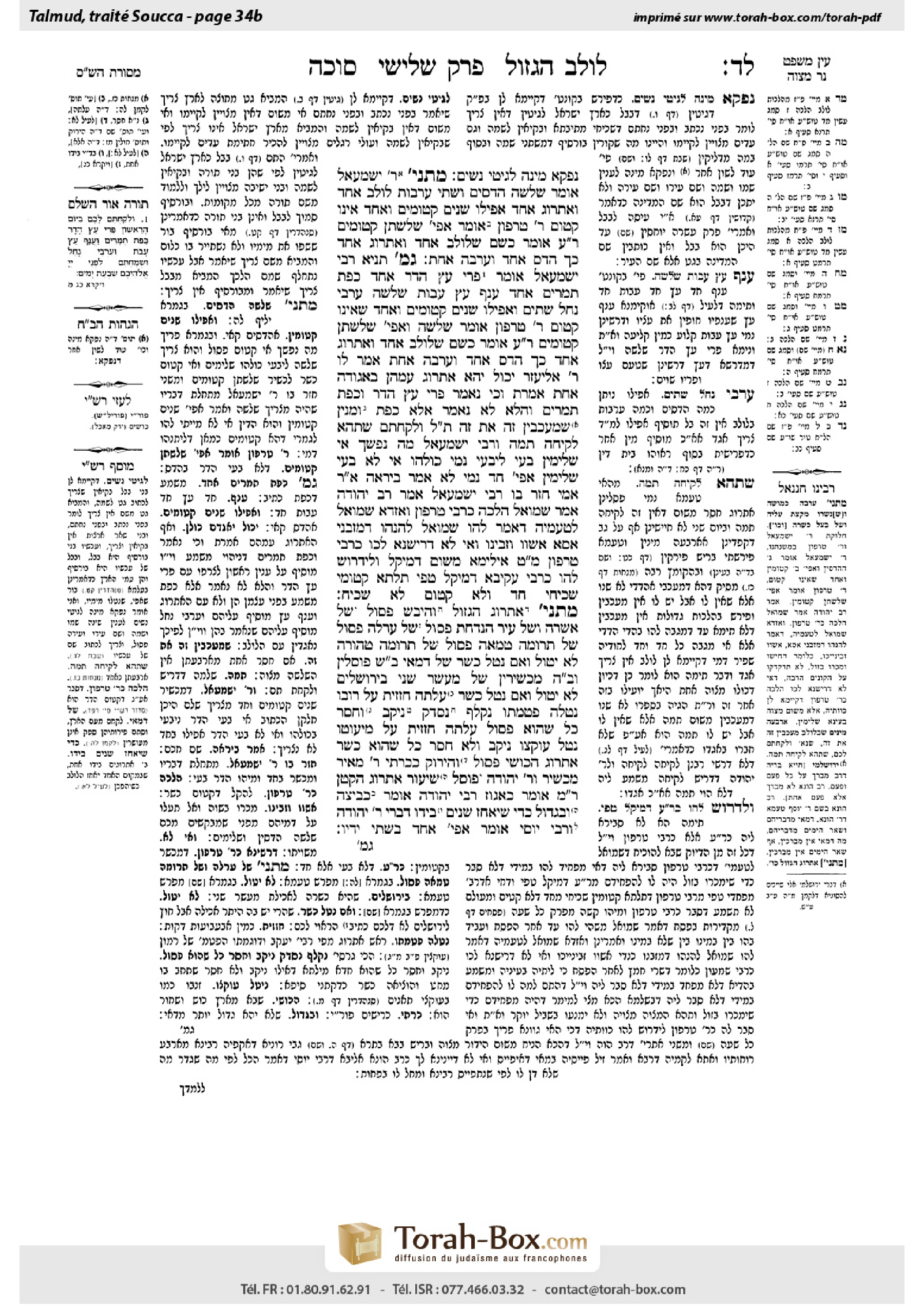
Sukkah 34b: Talmud study for Daf Yomi
Daf Yomi is the daily study of one Talmud folio. Explore 37 tractates with scans, Hebrew text, Sefaria English and AI-generated French translations where annotated.
Passage selection and English or AI-generated French translation are available where the scan has annotations. Daf Study is independent of Torah-Box and Sefaria.
Browse Sukkah · סוכה · All tractatesSukkah 34b text and translations
This page of Sukkah includes the Aramaic text, an English translation and an AI-generated French translation, alongside the scan above.
סוכה ל״ד ב · Aramaic and Hebrew text
נָפְקָא מִינַּהּ? לְגִיטֵּי נָשִׁים.
מַתְנִי׳ רַבִּי יִשְׁמָעֵאל אוֹמֵר: שְׁלֹשָׁה הֲדַסִּים וּשְׁתֵּי עֲרָבוֹת, לוּלָב אֶחָד, וְאֶתְרוֹג אֶחָד. אֲפִילּוּ שְׁנַיִם קְטוּמִים, וְאֶחָד אֵינוֹ קָטוּם. רַבִּי טַרְפוֹן אוֹמֵר: אֲפִילּוּ שְׁלָשְׁתָּן קְטוּמִים. רַבִּי עֲקִיבָא אוֹמֵר: כְּשֵׁם שֶׁלּוּלָב אֶחָד וְאֶתְרוֹג אֶחָד — כָּךְ הֲדַס אֶחָד וַעֲרָבָה אַחַת.
גְּמָ׳ תַּנְיָא, רַבִּי יִשְׁמָעֵאל אוֹמֵר: ״פְּרִי עֵץ הָדָר״ — אֶחָד. ״כַּפֹּת תְּמָרִים״ — אֶחָד. ״עֲנַף עֵץ עָבוֹת״ — שְׁלֹשָׁה. ״עַרְבֵי נַחַל״ — שְׁתַּיִם. וַאֲפִילּוּ שְׁנַיִם קְטוּמִים, וְאֶחָד שֶׁאֵינוֹ קָטוּם. רַבִּי טַרְפוֹן אוֹמֵר: שְׁלֹשָׁה, וַאֲפִילּוּ שְׁלָשְׁתָּן קְטוּמִים. רַבִּי עֲקִיבָא אוֹמֵר: כְּשֵׁם שֶׁלּוּלָב אֶחָד וְאֶתְרוֹג אֶחָד, כָּךְ הֲדַס אֶחָד וַעֲרָבָה אַחַת.
אָמַר לוֹ רַבִּי אֱלִיעֶזֶר: יָכוֹל יְהֵא אֶתְרוֹג עִמָּהֶן בַּאֲגוּדָּה אַחַת? אָמַרְתָּ, וְכִי נֶאֱמַר ״פְּרִי עֵץ הָדָר וְכַפֹּת תְּמָרִים״? וַהֲלֹא לֹא נֶאֱמַר אֶלָּא ״כַּפֹּת״! וּמִנַּיִן שֶׁמְּעַכְּבִין זֶה אֶת זֶה? תַּלְמוּד לוֹמַר: ״וּלְקַחְתֶּם״ — שֶׁתְּהֵא לְקִיחָה תַּמָּה.
וְרַבִּי יִשְׁמָעֵאל, מָה נַפְשָׁךְ? אִי שְׁלֵימִין בָּעֵי — לִיבְעֵי נָמֵי כּוּלְּהוּ, אִי לָא בָּעֵי שְׁלֵימִין — אֲפִילּוּ חַד נָמֵי לָא! אָמַר בִּירָאָה אָמַר רַבִּי אַמֵּי: חָזַר בּוֹ רַבִּי יִשְׁמָעֵאל.
אָמַר רַב יְהוּדָה אָמַר שְׁמוּאֵל: הֲלָכָה כְּרַבִּי טַרְפוֹן. וְאַזְדָּא שְׁמוּאֵל לְטַעְמֵיהּ, דַּאֲמַר לְהוּ שְׁמוּאֵל לְהָנְהוּ דִּמְזַבְּנֵי אַסָּא: אַשְׁווֹ וְזַבִּינוּ, וְאִי לָא — דָּרֵישְׁנָא לְכוּ כְּרַבִּי טַרְפוֹן.
מַאי טַעְמָא? אִילֵּימָא מִשּׁוּם דְּמֵיקֵל — וְלִידְרוֹשׁ לְהוּ כְּרַבִּי עֲקִיבָא דְּמֵיקֵל טְפֵי! תְּלָתָא קְטִימִי שְׁכִיחִי, חַד וְלָא קְטִים לָא שְׁכִיחַ.
מַתְנִי׳ אֶתְרוֹג הַגָּזוּל וְהַיָּבֵשׁ — פָּסוּל. שֶׁל אֲשֵׁרָה וְשֶׁל עִיר הַנִּדַּחַת — פָּסוּל. שֶׁל עׇרְלָה — פָּסוּל. שֶׁל תְּרוּמָה טְמֵאָה — פָּסוּל. שֶׁל תְּרוּמָה טְהוֹרָה לֹא יִטּוֹל, וְאִם נָטַל — כָּשֵׁר. שֶׁל דְּמַאי — בֵּית שַׁמַּאי פּוֹסְלִין, וּבֵית הִלֵּל מַכְשִׁירִין. שֶׁל מַעֲשֵׂר שֵׁנִי בִּירוּשָׁלַיִם — לֹא יִטּוֹל, וְאִם נָטַל — כָּשֵׁר.
עָלְתָה חֲזָזִית עַל רוּבּוֹ, נִטְּלָה פִּטְמָתוֹ, נִקְלַף, נִסְדַּק, נִיקַּב וְחָסַר כׇּל שֶׁהוּא — פָּסוּל. עָלְתָה חֲזָזִית עַל מִיעוּטוֹ, נִטַּל עוּקְצוֹ, נִיקַּב וְלֹא חָסַר כׇּל שֶׁהוּא — כָּשֵׁר. אֶתְרוֹג הַכּוּשִׁי — פָּסוּל, וְהַיָּרוֹק כְּכַרָּתֵי — רַבִּי מֵאִיר מַכְשִׁיר וְרַבִּי יְהוּדָה פּוֹסֵל. שִׁיעוּר אֶתְרוֹג הַקָּטָן, רַבִּי מֵאִיר אוֹמֵר: כֶּאֱגוֹז, רַבִּי יְהוּדָה אוֹמֵר כְּבֵיצָה. וּבַגָּדוֹל — כְּדֵי שֶׁיֹּאחַז שְׁנַיִם בְּיָדוֹ. דִּבְרֵי רַבִּי יְהוּדָה, וְרַבִּי יוֹסֵי אוֹמֵר: אֲפִילּוּ אֶחָד בִּשְׁתֵּי יָדָיו.
Sukkah 34b · English translation
the practical halakhic difference that emerges from this change of names? It is in the area of women’s bills of divorce. With regard to bills of divorce, special care is devoted to ensuring that the name of the place where the bill is written is not altered. Therefore, it is important to be aware that Babylon underwent a name change in later generations.
MISHNA: Rabbi Yishmael says: The mitzva of the four species is to take three myrtle branches, and two willow branches, one lulav, and one etrog. With regard to the myrtle branches, even if the tops of two are severed and the top of one is not severed, it is fit. Rabbi Tarfon says: Even if the tops of all three are severed, it is fit. Rabbi Akiva says with regard to the number of each of the species: Just as there is one lulav and one etrog, so too there is one myrtle branch and one willow branch.
GEMARA: It was taught in a baraita that Rabbi Yishmael says: “The fruit of a beautiful tree” (Leviticus 23:40); that is one etrog. “Branches of a date palm”; that is one lulav. Based on tradition, kappot is written without the letter vav. Although the word is vocalized in the plural, the lack of the vav indicates that only one is required. “Boughs of a dense-leaved tree”; these are three, as the verse is referring to a branch with several stems. “Willows of the brook”; these are two, as it is plural. Even if the tops of two are severed and the top of one is not severed, it is fit. Rabbi Tarfon says: Even if the tops of all three are severed, it is fit. Rabbi Akiva says: Just as there is one lulav and one etrog, so too, there is one myrtle branch and one willow branch.
Rabbi Eliezer said to him that the species cannot be equated. I might have thought that the etrog should be bound with the other species in one bundle. However, you could say in response: Does it say: The fruit of a beautiful tree and branches of a date palm, with the conjunction joining them? Doesn’t it say only “branches of a date palm,” without a conjunction? That indicates that the etrog is taken separately from the other three species, which are joined in the verse by conjunctions: Branches of a date palm, and boughs of a dense-leaved tree, and willows of the brook, are taken together. And from where is it derived that failure to take each of the species prevents fulfillment of the mitzva with the others? The verse states: “And you shall take [ulkaḥtem],” from which it is derived based on the etymological similarity that it shall be a complete taking [lekiḥa tamma] consisting of all the species.
The Gemara asks: And according to Rabbi Yishmael, who deems the lulav fit even if the tops of two of the myrtle branches were severed, whichever way you look at it, his statement is problematic. If he requires whole myrtle branches, and those whose tops are severed do not fill the criterion of beauty, let him require all of them to be whole. And if he does not require whole myrtle branches, even one branch should not be required to be whole either, as Rabbi Tarfon said. The Sage Bira’a said that Rabbi Ami said: Rabbi Yishmael retracted his statement. He concedes that, fundamentally, only one myrtle branch is required, and that branch must be whole.
Rav Yehuda said that Shmuel said: The halakha is in accordance with the opinion of Rabbi Tarfon. And Shmuel conforms to his line of reasoning, as Shmuel said to those who were selling myrtle branches: Equate the price that you demand for myrtle branches to their value and sell your myrtle branches. And if you do not do so and overcharge, I will teach the halakha in public for you in accordance with the opinion of Rabbi Tarfon, who allows the use of myrtle branches whose tops are severed.
The Gemara asks: What is the reason that Shmuel said that to them? If you say it is because Rabbi Tarfon is lenient in his ruling, let him say to them that he will teach the halakha in public for them in accordance with the opinion of Rabbi Akiva, who is even more lenient in his ruling, as he requires only one myrtle branch. The Gemara answers: That is not the case, as three myrtle branches whose tops are severed are common, but one complete myrtle branch whose top is not severed is not common. In practical terms, Rabbi Tarfon’s ruling is the more lenient.
MISHNA: An etrog that was stolen or is completely dry is unfit. One from a tree worshipped as idolatry [asheira] or from a city whose residents were incited to idolatry is unfit. An etrog that is fruit that grew on a tree during the three years after it was planted [orla] is unfit, because it is prohibited to eat and derive benefit from it. An etrog of impure teruma is unfit. With regard to an etrog of pure teruma, one may not take it ab initio, and if one took it, it is fit, and he fulfilled his obligation after the fact. With regard to an etrog of demai, which is produce acquired from an am ha’aretz, who does not reliably tithe his produce, Beit Shammai deem it unfit, and Beit Hillel deem it fit. With regard to an etrog of second tithe in Jerusalem, one may not take it ab initio; and if he took it, it is fit.
If boil-like blemishes arose on the majority of the etrog; if its pestle-like protuberance on the upper, blossom end was removed; if the etrog was peeled, split, or pierced and is missing any amount, it is unfit. However, if boil-like blemishes arose only on its minority; if its stem, which connects it to the tree, was removed; or it was pierced but is not missing any amount, it is fit. A Cushite etrog, which is black like a Cushite, is unfit. And with regard to an etrog that is leek green, Rabbi Meir deems it fit and Rabbi Yehuda deems it unfit. What is the minimum measure of a small etrog? Rabbi Meir says: It may be no smaller than a walnut-bulk. Rabbi Yehuda says: It may be no smaller than an egg-bulk. And in a large etrog, the maximum measure is so that one could hold two in his one hand; this is the statement of Rabbi Yehuda. Rabbi Yosei says: It is fit even if it is so large that he can hold only one in his two hands.
Sukkah 34b · Traduction française (IA)
Quelle différence pratique en halakha découle de ce changement de nom ? Elle concerne les actes de divorce des femmes. Pour les actes de divorce, on veille tout particulièrement à ce que le nom du lieu où l’acte est rédigé ne soit pas modifié. Il importe donc de savoir que la Babylonie a changé de nom au cours des générations ultérieures.
MICHNA : Rabbi Yishmael dit : La mitsva des quatre espèces consiste à prendre trois branches de myrte, deux branches de saule, un loulav et un etrog. Quant aux branches de myrte, même si les sommets de deux d’entre elles sont coupés et que celui de la troisième ne l’est pas, elles sont aptes. Rabbi Tarfon dit : Même si les sommets des trois sont coupés, elles sont aptes. Rabbi Akiva dit, au sujet du nombre de spécimens de chaque espèce : De même qu’il y a un loulav et un etrog, il y a aussi une branche de myrte et une branche de saule.
GUEMARA : Il a été enseigné dans une baraïta que Rabbi Yishmael dit : « Le fruit d’un bel arbre » (Lévitique 23:40), c’est un etrog. « Des branches de palmier », c’est un loulav. Selon la tradition, le mot kappot est écrit sans la lettre vav. Bien que le mot soit vocalisé au pluriel, l’absence du vav indique qu’un seul est requis. « Des rameaux d’un arbre touffu », il s’agit de trois, car le verset parle d’une branche comportant plusieurs tiges. « Des saules du torrent », il s’agit de deux, car le terme est au pluriel. Même si les sommets de deux d’entre elles sont coupés et que celui de la troisième ne l’est pas, elles sont aptes. Rabbi Tarfon dit : Même si les sommets des trois sont coupés, elles sont aptes. Rabbi Akiva dit : De même qu’il y a un loulav et un etrog, il y a aussi une branche de myrte et une branche de saule.
Rabbi Eliezer lui dit qu’on ne peut pas assimiler les espèces. J’aurais pu penser que l’etrog doit être lié aux autres espèces en un seul bouquet. Mais on peut répondre : Est-il écrit « le fruit d’un bel arbre et des branches de palmier », avec une conjonction qui les relie ? N’est-il pas écrit seulement « des branches de palmier », sans conjonction ? Cela indique que l’etrog est pris séparément des trois autres espèces, que les conjonctions du verset relient entre elles : « des branches de palmier, des rameaux d’un arbre touffu et des saules du torrent » sont prises ensemble. Et d’où déduit-on que l’absence de l’une des espèces empêche d’accomplir la mitsva avec les autres ? Le verset dit : « Et vous prendrez [ulkaḥtem] » ; la similitude étymologique permet d’en déduire qu’il faut une prise complète [lekiḥa tamma], composée de toutes les espèces.
La Guemara demande : Selon Rabbi Yishmael, qui juge le loulav apte même si les sommets de deux branches de myrte sont coupés, son propos pose problème, quel que soit l’angle sous lequel on l’examine. S’il exige des branches de myrte intactes et que celles dont les sommets sont coupés ne satisfont pas au critère de beauté, qu’il exige que toutes soient intactes. Et s’il n’exige pas des branches de myrte intactes, il ne devrait pas non plus être nécessaire qu’une seule branche soit intacte, comme l’a dit Rabbi Tarfon. Le Sage Bira’a a dit au nom de Rabbi Ami : Rabbi Yishmael est revenu sur sa déclaration. Il reconnaît qu’en principe une seule branche de myrte est requise et que cette branche doit être intacte.
Rav Yehouda a dit au nom de Shmouel : La halakha suit l’opinion de Rabbi Tarfon. Et Shmouel agit conformément à son raisonnement, car il dit à ceux qui vendent des branches de myrte : Fixez un prix correspondant à leur valeur et vendez vos branches de myrte. Si vous ne le faites pas et que vous les vendez trop cher, j’enseignerai publiquement la halakha en accord avec l’opinion de Rabbi Tarfon, qui permet d’utiliser des branches de myrte dont les sommets sont coupés.
La Guemara demande : Pourquoi Shmouel leur a-t-il dit cela ? Si vous dites que c’est parce que Rabbi Tarfon est indulgent dans sa décision, qu’il leur dise qu’il enseignera publiquement la halakha en accord avec l’opinion de Rabbi Akiva, qui est encore plus indulgent, puisqu’il n’exige qu’une seule branche de myrte. La Guemara répond : Ce n’est pas le cas, car il est courant de trouver trois branches de myrte dont les sommets sont coupés, tandis qu’une branche de myrte intacte, dont le sommet n’est pas coupé, est rare. En pratique, la décision de Rabbi Tarfon est donc la plus indulgente.
MICHNA : Un etrog volé ou complètement desséché est inapte. Un etrog provenant d’un arbre adoré comme une idole [asheira], ou d’une ville dont les habitants ont été incités à l’idolâtrie, est inapte. Un etrog provenant d’un arbre durant les trois années suivant sa plantation [orla] est inapte, car il est interdit d’en manger et d’en tirer profit. Un etrog de terouma impure est inapte. Quant à un etrog de terouma pure, on ne doit pas le prendre a priori ; si on l’a pris, il est apte et l’on s’est acquitté de son obligation après coup. Pour un etrog de demaï, c’est-à-dire un produit acheté à un am haaretz, qui ne prélève pas ses dîmes de manière fiable, Beit Shammaï le juge inapte et Beit Hillel le juge apte. Quant à un etrog de seconde dîme à Jérusalem, on ne doit pas le prendre a priori ; si on l’a pris, il est apte.
Si des taches semblables à des furoncles apparaissent sur la majeure partie de l’etrog ; si sa protubérance en forme de pilon, à l’extrémité supérieure où se trouvait la fleur, a été retirée ; si l’etrog a été pelé, fendu ou percé et qu’il en manque, même une quantité infime, il est inapte. En revanche, si des taches semblables à des furoncles apparaissent seulement sur une partie minoritaire de l’etrog ; si sa tige, qui le relie à l’arbre, a été retirée ; ou s’il a été percé sans qu’il en manque quoi que ce soit, il est apte. Un etrog kouchite, noir comme un Kouchite, est inapte. Quant à un etrog vert comme un poireau, Rabbi Meïr le juge apte et Rabbi Yehouda le juge inapte. Quelle est la taille minimale d’un petit etrog ? Rabbi Meïr dit : Il ne doit pas être plus petit qu’un volume de noix. Rabbi Yehouda dit : Il ne doit pas être plus petit qu’un volume d’œuf. Pour un grand etrog, la taille maximale est telle qu’on puisse en tenir deux dans une main ; telle est la déclaration de Rabbi Yehouda. Rabbi Yossi dit : Il est apte même s’il est si grand qu’on ne peut en tenir qu’un seul dans ses deux mains.
Traduction française générée par IA à partir de l’édition anglaise de Sefaria. Vérifie toujours un passage avec le texte source.
Text from Sefaria: William Davidson Edition - Vocalized Aramaic (CC BY NC); William Davidson Edition - English (CC BY NC).