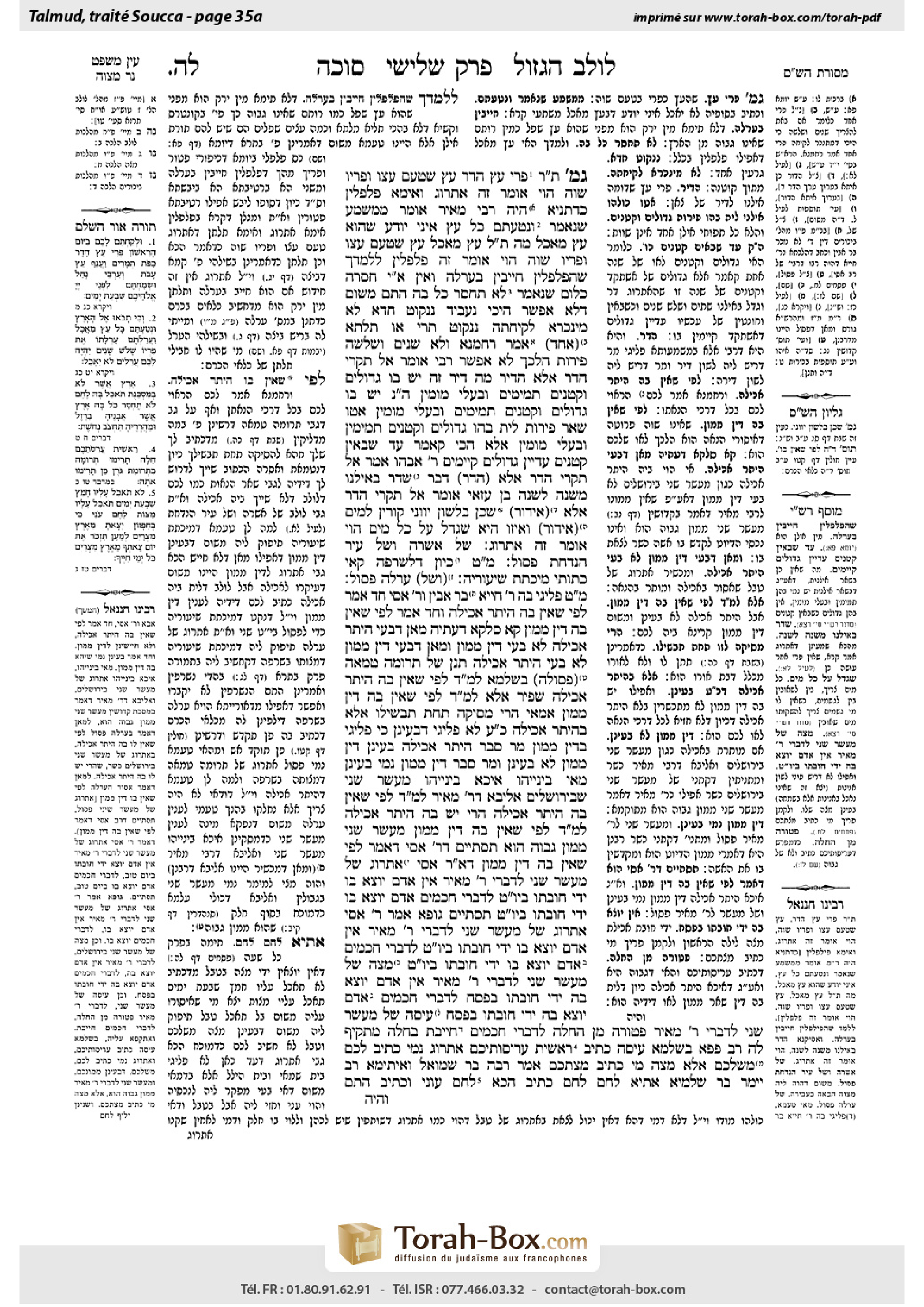
Sukkah 35a: Talmud study for Daf Yomi
Daf Yomi is the daily study of one Talmud folio. Explore 37 tractates with scans, Hebrew text, Sefaria English and AI-generated French translations where annotated.
Passage selection and English or AI-generated French translation are available where the scan has annotations. Daf Study is independent of Torah-Box and Sefaria.
Browse Sukkah · סוכה · All tractatesSukkah 35a text and translations
This page of Sukkah includes the Aramaic text, an English translation and an AI-generated French translation, alongside the scan above.
סוכה ל״ה א · Aramaic and Hebrew text
גְּמָ׳ תָּנוּ רַבָּנַן: ״פְּרִי עֵץ הָדָר״, עֵץ שֶׁטַּעַם עֵצוֹ וּפִרְיוֹ שָׁוֶה — הֱוֵי אוֹמֵר זֶה אֶתְרוֹג.
וְאֵימָא פִּלְפְּלִין; כִּדְתַנְיָא, הָיָה רַבִּי מֵאִיר אוֹמֵר: מִמַּשְׁמַע שֶׁנֶּאֱמַר ״וּנְטַעְתֶּם כׇּל עֵץ״, אֵינִי יוֹדֵעַ שֶׁהוּא עֵץ מַאֲכָל? מָה תַּלְמוּד לוֹמַר ״עֵץ מַאֲכָל״, עֵץ שֶׁטַּעַם עֵצוֹ וּפִרְיוֹ שָׁוֶה — הֱוֵי אוֹמֵר זֶה פִּלְפְּלִין. לְלַמֶּדְךָ שֶׁהַפִּלְפְּלִין חַיָּיבִין בְּעׇרְלָה. וְאֵין אֶרֶץ יִשְׂרָאֵל חֲסֵרָה כְּלוּם, שֶׁנֶּאֱמַר: ״לֹא תֶחְסַר כֹּל בָּהּ״.
הָתָם מִשּׁוּם דְּלָא אֶפְשָׁר, הֵיכִי נַעֲבֵיד? נִנְקוֹט חֲדָא — לָא מִינַּכְרָא לְקִיחָתַהּ. נִנְקוֹט תְּרֵי אוֹ תְּלָתָא — (אֶחָד) אָמַר רַחֲמָנָא, וְלֹא שְׁנַיִם וּשְׁלֹשָׁה פֵּירוֹת, הִלְכָּךְ לָא אֶפְשָׁר.
רַבִּי אוֹמֵר: אַל תִּקְרֵי ״הָדָר״, אֶלָּא ״הַדִּיר״. מָה דִּיר זֶה יֵשׁ בּוֹ גְּדוֹלִים וּקְטַנִּים, תְּמִימִים וּבַעֲלֵי מוּמִין — הָכִי נָמֵי יֵשׁ בּוֹ גְּדוֹלִים וּקְטַנִּים, תְּמִימִים וּבַעֲלֵי מוּמִין. אַטּוּ שְׁאָר פֵּירוֹת לֵית בְּהוּ גְּדוֹלִים וּקְטַנִּים, תְּמִימִין וּבַעֲלֵי מוּמִין?! אֶלָּא הָכִי קָאָמַר: עַד שֶׁבָּאִין קְטַנִּים, עֲדַיִין גְּדוֹלִים קַיָּימִים.
רַבִּי אֲבָהוּ אָמַר: אַל תִּקְרֵי ״הָדָר״, אֶלָּא ״הַדָּר״ — דָּבָר שֶׁדָּר בְּאִילָנוֹ מִשָּׁנָה לְשָׁנָה. בֶּן עַזַּאי אוֹמֵר: אַל תִּקְרֵי ״הָדָר״, אֶלָּא ״אִידוֹר״, שֶׁכֵּן בְּלָשׁוֹן יְווֹנִי קוֹרִין לְמַיִם אִידוֹר, וְאֵיזוֹ הִיא שֶׁגָּדֵל עַל כׇּל מַיִם — הֱוֵי אוֹמֵר זֶה אֶתְרוֹג.
שֶׁל אֲשֵׁרָה וְשֶׁל עִיר הַנִּדַּחַת — פָּסוּל. מַאי טַעְמָא? כֵּיוָן דְּלִשְׂרֵפָה קָאֵי — כַּתּוֹתֵי מְיכַתַּת שִׁיעוּרֵיהּ.
וְשֶׁל עׇרְלָה פָּסוּל. מַאי טַעְמָא? פְּלִיגִי בַּהּ רַבִּי חִיָּיא בַּר אָבִין וְרַבִּי אַסִּי. חַד אָמַר: לְפִי שֶׁאֵין בָּהּ הֶיתֵּר אֲכִילָה, וְחַד אָמַר: לְפִי שֶׁאֵין בָּהּ דִּין מָמוֹן.
קָא סָלְקָא דַּעְתֵּיהּ מַאן דְּבָעֵי הֶיתֵּר אֲכִילָה לָא בָּעֵי דִּין מָמוֹן, וּמַאן דְּבָעֵי דִּין מָמוֹן לָא בָּעֵי הֶיתֵּר אֲכִילָה. תְּנַן: שֶׁל תְּרוּמָה טְמֵאָה — פְּסוּלָה, בִּשְׁלָמָא לְמַאן דְּאָמַר לְפִי שֶׁאֵין בָּהּ הֶיתֵּר אֲכִילָה — שַׁפִּיר. אֶלָּא לְמַאן דְּאָמַר לְפִי שֶׁאֵין בָּהּ דִּין מָמוֹן — אַמַּאי? הֲרֵי מַסִּיקָהּ תַּחַת תַּבְשִׁילוֹ!
אֶלָּא: בְּהֶיתֵּר אֲכִילָה כּוּלֵּי עָלְמָא לָא פְּלִיגִי דְּבָעֵינַן, כִּי פְּלִיגִי בְּדִין מָמוֹן. מָר סָבַר: הֶיתֵּר אֲכִילָה בָּעֵינַן, דִּין מָמוֹן לָא בָּעֵינַן, וּמָר סָבַר: דִּין מָמוֹן נָמֵי בָּעֵינַן. מַאי בֵּינַיְיהוּ?
אִיכָּא בֵּינַיְיהוּ מַעֲשֵׂר שֵׁנִי שֶׁבִּירוּשָׁלַיִם. אַלִּיבָּא דְּרַבִּי מֵאִיר, לְמַאן דְּאָמַר לְפִי שֶׁאֵין בָּהּ הֶיתֵּר אֲכִילָה — הֲרֵי יֵשׁ בָּהּ הֶיתֵּר אֲכִילָה, לְמַאן דְּאָמַר לְפִי שֶׁאֵין בָּהּ דִּין מָמוֹן — מַעֲשֵׂר שֵׁנִי מָמוֹן גָּבוֹהַּ הוּא.
תִּסְתַּיַּים דְּרַבִּי אַסִּי דְּאָמַר לְפִי שֶׁאֵין בָּהּ דִּין מָמוֹן. דְּאָמַר רַבִּי אַסִּי: אֶתְרוֹג שֶׁל מַעֲשֵׂר שֵׁנִי, לְדִבְרֵי רַבִּי מֵאִיר — אֵין אָדָם יוֹצֵא בּוֹ יְדֵי חוֹבָתוֹ בְּיוֹם טוֹב, לְדִבְרֵי חֲכָמִים — אָדָם יוֹצֵא בּוֹ יְדֵי חוֹבָתוֹ בְּיוֹם טוֹב. תִּסְתַּיַּים.
גּוּפָא. אָמַר רַבִּי אַסִּי: אֶתְרוֹג שֶׁל מַעֲשֵׂר שֵׁנִי, לְדִבְרֵי רַבִּי מֵאִיר — אֵין אָדָם יוֹצֵא בּוֹ יְדֵי חוֹבָתוֹ בְּיוֹם טוֹב. לְדִבְרֵי חֲכָמִים — אָדָם יוֹצֵא בּוֹ יְדֵי חוֹבָתוֹ בְּיוֹם טוֹב. מַצָּה שֶׁל מַעֲשֵׂר שֵׁנִי, דִּבְרֵי רַבִּי מֵאִיר — אֵין אָדָם יוֹצֵא בָּהּ יְדֵי חוֹבָתוֹ בַּפֶּסַח, לְדִבְרֵי חֲכָמִים — אָדָם יוֹצֵא בָּהּ יְדֵי חוֹבָתוֹ בַּפֶּסַח. עִיסָּה שֶׁל מַעֲשֵׂר שֵׁנִי, לְדִבְרֵי רַבִּי מֵאִיר — פְּטוּרָה מִן הַחַלָּה, לְדִבְרֵי חֲכָמִים — חַיֶּיבֶת בַּחַלָּה.
מַתְקֵיף לַהּ רַב פָּפָּא: בִּשְׁלָמָא עִיסָּה, כְּתִיב: ״רֵאשִׁית עֲרִיסוֹתֵיכֶם״. אֶתְרוֹג נָמֵי — כְּתִיב: ״לָכֶם״, מִשֶּׁלָּכֶם. אֶלָּא מַצָּה, מִי כְּתִיב ״מַצַּתְכֶם״? אָמַר רַבָּה בַּר שְׁמוּאֵל, וְאִיתֵּימָא רַב יֵימַר בַּר שֶׁלֶמְיָא: אָתְיָא ״לֶחֶם״ ״לֶחֶם״. כְּתִיב הָכָא ״לֶחֶם עוֹנִי״, וּכְתִיב הָתָם
Sukkah 35a · English translation
GEMARA: The Sages taught that the verse states: “Fruit of a beautiful tree,” meaning, a tree that the taste of its tree trunk and the taste of its fruit are alike. What tree is that? You must say it is the etrog tree.
The Gemara asks: And say that it is referring to the pepper tree, since the taste of its trunk and the taste of its fruit are alike, as it was taught in a baraita with regard to the verse: “When you enter the land and plant any tree for food you shall regard its fruit as orla” (Leviticus 19:23). Rabbi Meir would say that by inference from that which is stated “and plant any tree,” don’t I know that it is referring to a tree that produces food? Rather, for what purpose does the verse state: “Any tree for food”? It is to include a tree that the taste of its tree trunk and the taste of its fruit are alike. And which tree is this? You must say this is the pepper tree. This comes to teach you that the peppers, and even its trunk, are edible, and therefore the tree is obligated in the prohibition of orla. And Eretz Yisrael lacks nothing, as it is stated: “A land where you shall eat bread without scarceness, you shall lack nothing” (Deuteronomy 8:9). From where, then, is it derived that the Torah commands the taking of an etrog as one of the four species? Perhaps the verse is referring to peppers.
The Gemara answers: There, with regard to the four species, it is clear that the Torah is not referring to peppers, due to the fact that it is not possible to utilize peppers for this purpose. How shall we proceed? If we take one pepper, its taking is not noticeable due to its small size. If we take two or three peppers, the Torah said one fruit and not two or three fruits. Therefore, it is impossible. The verse “the fruit of a beautiful tree” cannot be referring to peppers.
Rabbi Yehuda HaNasi says: Do not read the verse as it is written, hadar, meaning beautiful, but rather read it hadir, meaning the sheep pen. And it means, just as in this pen there are large and small sheep, unblemished and blemished sheep, so too, this tree has large and small fruits, flawless and blemished fruits. The Gemara wonders: Is that to say that among other fruits there are not large and small fruits, flawless and blemished fruits? How does this description identify the etrog specifically? Rather, this is what Rabbi Yehuda HaNasi is saying: Just as in a pen, there are both large and small sheep together, so too, on an etrog tree, when the small ones come into being, the large ones still exist on the tree, which is not the case with other fruit trees.
Rabbi Abbahu said: Do not read it hadar, but rather read it haddar, meaning one that dwells, referring to an item that dwells on its tree from year to year. Ben Azzai says: Do not read it hadar, but rather read it idur, as in the Greek language one calls water idur. And which is the fruit that grows on the basis of all water sources, and not exclusively through irrigation or rainwater? You must say it is an etrog.
The mishna continues: An etrog from a tree worshipped as idolatry or from a city whose residents were incited to idolatry is unfit. The Gemara asks: What is the reason? The Gemara answers: Since the etrog is fated for burning, its requisite measure was crushed. Although it has not yet been burned, its legal status is that of ashes.
The mishna continues: An etrog of orla is unfit. The Gemara asks: What is the reason? Rabbi Ḥiyya bar Avin and Rabbi Asi disagree about this matter. One said: It is unfit because there is no permission to eat orla. Anything that may not be eaten is not one’s property, and it is therefore unfit for use in this mitzva. And one said: It is unfit because it has no monetary value. Since it is prohibited to benefit from orla, it has no value, and one cannot own an item that has no value. Therefore, it does not fulfill the requirement of taking an etrog from one’s own property.
The Gemara asserts that it may enter one’s mind to say: The one who requires permission to eat the etrog to render it fit does not require that it have monetary value, and the one who requires that it have monetary value does not require permission to eat it. On that basis, the Gemara raises a difficulty from what we learned in the mishna: An etrog of impure teruma is unfit. Granted, according to the one who says that an etrog of orla is unfit because there is no permission to eat it, it works out well that an etrog of impure teruma is unfit, as it too may not be eaten. However, according to the one who says that it is unfit because it has no monetary value, why is the etrog of impure teruma unfit? Although eating it is prohibited, a priest burns it as fuel under his cooked food. Since one may benefit from it, impure teruma has monetary value.
Rather, contrary to the previous assumption, with regard to permission to eat it, everyone agrees that we require that it be permitted to eat the etrog. When they disagree is with regard to monetary value. One Sage holds: We require permission to eat it, but we do not require that it have monetary value. And one Sage holds: We also require that it have monetary value. The Gemara asks: If so, according to this understanding, what is the practical halakhic difference between them?
There is a practical difference between them with regard to the halakha of an etrog of second tithe in Jerusalem, and according to the opinion of Rabbi Meir, who holds that the legal status of second-tithe produce in Jerusalem is that of consecrated property. Although its owner has the right to eat it, just as he may eat from offerings that he sacrifices, it is the property of God, and he has no monetary rights to the produce. According to the one who said: An etrog of orla is unfit because there is no permission to eat it, there is permission to eat second tithe; therefore, according to Rabbi Meir, a second-tithe etrog in Jerusalem is fit for use in fulfilling the mitzva. And according to the one who said: An etrog of orla is unfit because it has no monetary value, second tithe in Jerusalem is consecrated property of God and has no monetary value to its owner. Therefore, according to Rabbi Meir, it is not fit for use in fulfilling the mitzva.
In an attempt to attribute the opinions to the amora’im, the Gemara suggests: Conclude that Rabbi Asi is the one who said that the reason is because there is no monetary value, as Rabbi Asi said: With an etrog of second tithe, according to the statement of Rabbi Meir, a person does not fulfill his obligation with it on the Festival. According to the Rabbis, a person fulfills his obligation with it on the Festival. That is precisely the manner in which the dispute with regard to the need for the etrog to have monetary value is presented above. The Gemara determines: Indeed, conclude that Rabbi Asi is the one who holds that the etrog must have monetary value as well.
§ With regard to the matter itself, Rabbi Asi said: With an etrog of second tithe, according to the statement of Rabbi Meir, a person does not fulfill his obligation with it on the Festival. According to the Rabbis, a person fulfills his obligation with it on the Festival. With matza of second tithe, according to Rabbi Meir, a person does not fulfill his obligation with it on Passover because it is not his. According to the Rabbis, a person fulfills his obligation with it on Passover. Similarly, according to Rabbi Meir, dough of second tithe is exempt from the obligation of separating ḥalla. According to the Rabbis, it is subject to the obligation of separating ḥalla. In all of these cases, the dispute is whether second tithe is the property of the owner or the property of God.
Rav Pappa strongly objects to this: Granted, with regard to dough, it is written: “The first of your dough, ḥalla you shall offer as a gift” (Numbers 15:20). “Your dough” indicates that one is obligated to separate ḥalla only from dough that belongs to him and not consecrated dough. With regard to the etrog too it is written: “And you shall take for yourselves,” indicating that it must be from your own property. However, with regard to matza, why does he not fulfill his obligation with second tithe? Is it written: Your matza? Rabba bar Shmuel said, and some say it was Rav Yeimar bar Shelamya who said: This is derived by means of a verbal analogy between bread written with regard to matza and bread written with regard to ḥalla. It is written here, with regard to matza: “Bread of affliction” (Deuteronomy 16:3), and it is written there, with regard to ḥalla:
Sukkah 35a · Traduction française (IA)
GUEMARA : Les Sages ont enseigné que le verset dit : « Le fruit d’un bel arbre », c’est-à-dire un arbre dont le goût du bois et celui du fruit sont identiques. Quel est cet arbre ? Il faut dire que c’est le cédratier.
La Guemara demande : Ne pourrait-on pas dire qu’il s’agit du poivrier, puisque le goût de son bois et celui de son fruit sont identiques, comme cela a été enseigné dans une baraïta à propos du verset : « Quand vous entrerez dans le pays et que vous y planterez tout arbre fruitier, vous considérerez son fruit comme orla » (Lévitique 19, 23) ? Rabbi Meïr disait : À partir de ce qui est écrit, « et que vous y planterez tout arbre », ne sais-je pas qu’il s’agit d’un arbre qui produit des fruits comestibles ? À quoi sert donc l’expression « tout arbre fruitier » ? Elle vient inclure un arbre dont le goût du bois et celui du fruit sont identiques. Et quel est cet arbre ? Il faut dire que c’est le poivrier. Cela vient t’apprendre que les poivres, et même le bois de l’arbre, sont comestibles ; l’arbre est donc soumis à l’interdiction d’orla. Or, la terre d’Israël ne manque de rien, comme il est dit : « Un pays où tu mangeras du pain sans pénurie, où tu ne manqueras de rien » (Deutéronome 8, 9). D’où déduit-on alors que la Torah ordonne de prendre un cédrat comme l’une des quatre espèces ? Peut-être le verset parle-t-il de poivres.
La Guemara répond : Dans le cas des quatre espèces, il est clair que la Torah ne parle pas de poivres, car il est impossible de les utiliser à cette fin. Comment procéder ? Si l’on en prend un seul, sa prise ne se remarque pas, étant donné sa petite taille. Si l’on en prend deux ou trois, la Torah parle d’un fruit, et non de deux ou trois fruits. C’est donc impossible. Le verset « le fruit d’un bel arbre » ne peut pas désigner les poivres.
Rabbi Yehouda HaNassi dit : Ne lis pas le verset tel qu’il est écrit, hadar, qui signifie « beau », mais lis plutôt hadir, qui signifie « bergerie ». Cela veut dire que, de même que dans cette bergerie il y a des moutons grands et petits, sans défaut et avec des défauts, de même cet arbre porte des fruits grands et petits, parfaits et imparfaits. La Guemara s’interroge : Cela signifie-t-il que les autres fruits n’existent pas en grandes et petites tailles, parfaits et imparfaits ? Comment cette description permet-elle d’identifier spécifiquement le cédrat ? Rabbi Yehouda HaNassi veut plutôt dire ceci : de même que dans une bergerie se trouvent ensemble des moutons grands et petits, de même, sur un cédratier, lorsque les petits fruits apparaissent, les grands sont encore présents sur l’arbre, ce qui n’est pas le cas des autres arbres fruitiers.
Rabbi Abbahou dit : Ne lis pas hadar, mais plutôt haddar, c’est-à-dire « celui qui demeure », en référence à un fruit qui demeure sur son arbre d’une année à l’autre. Ben Azzai dit : Ne lis pas hadar, mais plutôt idour, car en grec, on appelle l’eau idour. Et quel est le fruit qui pousse grâce à toutes les sources d’eau, et pas seulement grâce à l’irrigation ou à l’eau de pluie ? Il faut dire que c’est le cédrat.
La Michna poursuit : Un cédrat provenant d’un arbre adoré comme une idole ou d’une ville dont les habitants ont été incités à l’idolâtrie est impropre. La Guemara demande : Pourquoi ? La Guemara répond : Puisque le cédrat est destiné à être brûlé, la mesure requise est considérée comme réduite en cendres. Bien qu’il n’ait pas encore été brûlé, son statut juridique est celui de la cendre.
La Michna poursuit : Un cédrat d’orla est impropre. La Guemara demande : Pourquoi ? Rabbi Ḥiyya bar Avin et Rabbi Asi sont en désaccord sur cette question. L’un dit : Il est impropre parce que la consommation de l’orla n’est pas autorisée. Tout ce qu’il est interdit de consommer ne nous appartient pas et ne peut donc pas être utilisé pour cette mitsva. L’autre dit : Il est impropre parce qu’il n’a aucune valeur monétaire. Puisqu’il est interdit de tirer profit de l’orla, celle-ci n’a aucune valeur, et on ne peut posséder un objet sans valeur. Le cédrat ne satisfait donc pas à l’exigence de prendre un cédrat qui nous appartient.
La Guemara avance qu’on pourrait penser ceci : celui qui exige que la consommation du cédrat soit autorisée pour qu’il soit apte n’exige pas qu’il ait une valeur monétaire ; et celui qui exige qu’il ait une valeur monétaire n’exige pas que sa consommation soit autorisée. Sur cette base, la Guemara soulève une difficulté à partir de ce que nous avons appris dans la Michna : Un cédrat de terouma impure est impropre. Il est logique que, selon celui qui dit qu’un cédrat d’orla est impropre parce que sa consommation n’est pas autorisée, un cédrat de terouma impure soit également impropre, puisqu’il ne peut lui aussi être consommé. Mais, selon celui qui dit qu’il est impropre parce qu’il n’a aucune valeur monétaire, pourquoi le cédrat de terouma impure est-il impropre ? Bien qu’il soit interdit de le consommer, un prêtre le brûle comme combustible sous son plat en train de cuire. Puisqu’on peut en tirer profit, la terouma impure a une valeur monétaire.
Il faut plutôt dire, contrairement à l’hypothèse précédente, qu’en ce qui concerne l’autorisation de le consommer, tous sont d’accord qu’il faut que la consommation du cédrat soit autorisée. Leur désaccord porte sur sa valeur monétaire. Un Sage estime qu’il faut que sa consommation soit autorisée, mais qu’il n’est pas nécessaire qu’il ait une valeur monétaire. L’autre estime qu’il faut également qu’il ait une valeur monétaire. La Guemara demande : Si tel est le cas, selon cette interprétation, quelle différence pratique en matière de halakha y a-t-il entre eux ?
Il y a entre eux une différence pratique concernant la halakha d’un cédrat de seconde dîme à Jérusalem, selon l’opinion de Rabbi Meïr, qui estime que les produits de la seconde dîme à Jérusalem ont le statut de biens consacrés. Bien que leur propriétaire ait le droit de les consommer, tout comme il peut manger les offrandes qu’il présente, ils appartiennent à Dieu et leur propriétaire n’a aucun droit de propriété monétaire sur eux. Selon celui qui dit qu’un cédrat d’orla est impropre parce que sa consommation n’est pas autorisée, la consommation des produits de la seconde dîme est autorisée ; par conséquent, selon Rabbi Meïr, un cédrat de seconde dîme à Jérusalem convient pour accomplir la mitsva. Et selon celui qui dit qu’un cédrat d’orla est impropre parce qu’il n’a aucune valeur monétaire, les produits de la seconde dîme à Jérusalem sont des biens consacrés appartenant à Dieu et n’ont aucune valeur monétaire pour leur propriétaire. Par conséquent, selon Rabbi Meïr, ils ne conviennent pas pour accomplir la mitsva.
Pour tenter d’attribuer ces opinions aux amoraïm, la Guemara propose : Conclus que Rabbi Asi est celui qui dit que la raison est l’absence de valeur monétaire, car Rabbi Asi a dit : Avec un cédrat de seconde dîme, selon l’opinion de Rabbi Meïr, on ne s’acquitte pas de son obligation pendant la fête. Selon les Rabbins, on s’acquitte de son obligation pendant la fête. C’est précisément ainsi qu’a été présenté plus haut le désaccord concernant la nécessité que le cédrat ait une valeur monétaire. La Guemara conclut : En effet, conclus que Rabbi Asi estime que le cédrat doit également avoir une valeur monétaire.
§ À propos de cette question elle-même, Rabbi Asi a dit : Avec un cédrat de seconde dîme, selon l’opinion de Rabbi Meïr, on ne s’acquitte pas de son obligation pendant la fête. Selon les Rabbins, on s’acquitte de son obligation pendant la fête. Avec une matsa de seconde dîme, selon Rabbi Meïr, on ne s’acquitte pas de son obligation à Pessa’h, car elle ne lui appartient pas. Selon les Rabbins, on s’acquitte de son obligation à Pessa’h. De même, selon Rabbi Meïr, une pâte de seconde dîme est exemptée de l’obligation de prélever la ḥalla. Selon les Rabbins, elle est soumise à l’obligation de prélever la ḥalla. Dans tous ces cas, le désaccord porte sur la question de savoir si la seconde dîme appartient à son propriétaire ou à Dieu.
Rav Pappa s’oppose vivement à cela : Il est logique qu’en ce qui concerne la pâte, il soit écrit : « Le premier de votre pâte, vous en offrirez la ḥalla » (Nombres 15, 20). L’expression « votre pâte » indique que l’on n’est tenu de prélever la ḥalla que sur une pâte qui nous appartient, et non sur une pâte consacrée. Pour le cédrat aussi, il est écrit : « Vous prendrez pour vous », ce qui indique qu’il doit provenir de vos propres biens. Mais pour la matsa, pourquoi ne s’acquitte-t-on pas de son obligation avec de la seconde dîme ? Est-il écrit : « Votre matsa » ? Rabba bar Shmuel a dit, et certains disent que c’est Rav Yeimar bar Shelamya qui l’a dit : Cela se déduit par une analogie verbale entre le mot « pain », écrit à propos de la matsa, et le mot « pain », écrit à propos de la ḥalla. Ici, à propos de la matsa, il est écrit : « Pain de misère » (Deutéronome 16, 3), et là, à propos de la ḥalla, il est écrit :
Traduction française générée par IA à partir de l’édition anglaise de Sefaria. Vérifie toujours un passage avec le texte source.
Text from Sefaria: William Davidson Edition - Vocalized Aramaic (CC BY NC); William Davidson Edition - English (CC BY NC).