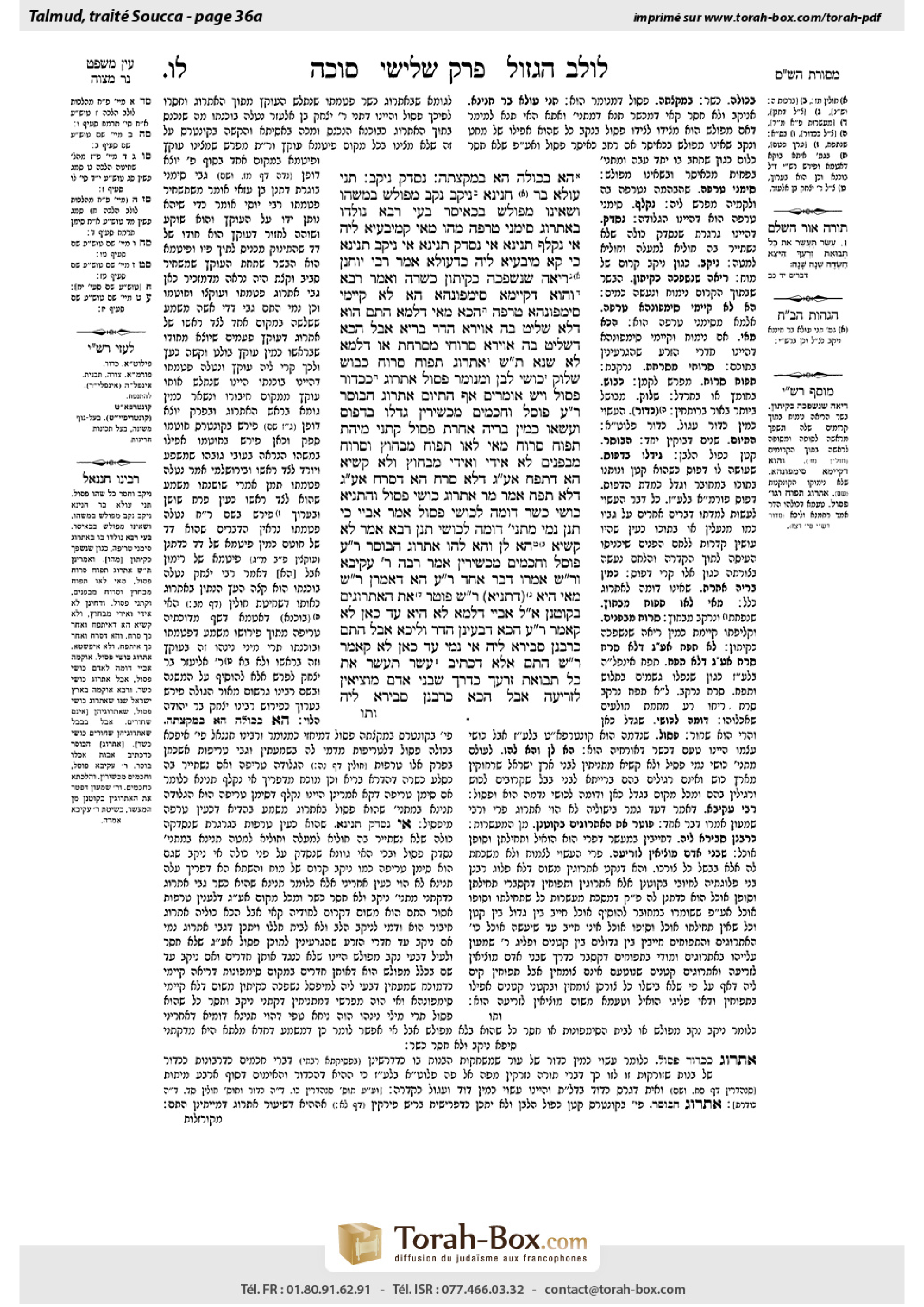
Sukkah 36a: Talmud study for Daf Yomi
Daf Yomi is the daily study of one Talmud folio. Explore 37 tractates with scans, Hebrew text, Sefaria English and AI-generated French translations where annotated.
Passage selection and English or AI-generated French translation are available where the scan has annotations. Daf Study is independent of Torah-Box and Sefaria.
Browse Sukkah · סוכה · All tractatesSukkah 36a text and translations
This page of Sukkah includes the Aramaic text, an English translation and an AI-generated French translation, alongside the scan above.
סוכה ל״ו א · Aramaic and Hebrew text
הָא בְּכוּלַּהּ, הָא בְּמִקְצָתַהּ.
נִסְדַּק, נִיקַּב. תָּנֵי עוּלָּא בַּר חֲנִינָא: נִיקַּב נֶקֶב מְפוּלָּשׁ — בְּמַשֶּׁהוּ, וְשֶׁאֵינוֹ מְפוּלָּשׁ — בִּכְאִיסָּר.
בָּעֵי רָבָא: נוֹלְדוּ בָּאֶתְרוֹג סִימָנֵי טְרֵפָה, מַהוּ? מַאי קָמִיבַּעְיָא לֵיהּ? אִי נִקְלַף — תְּנֵינָא! אִי נִסְדַּק — תְּנֵינָא! אִי נִיקַּב — תְּנֵינָא!
כִּי קָא מִיבַּעְיָא לֵיהּ כִּדְעוּלָּא אָמַר רַבִּי יוֹחָנָן: רֵיאָה שֶׁנִּשְׁפְּכָה כְּקִיתוֹן — כְּשֵׁרָה. וְאָמַר רָבָא: וְהוּא דְּקָיְימִי סִימְפּוֹנַהָא. הָא לָא קָיְימִי סִימְפּוֹנַהָא — טְרֵפָה. הָכָא מַאי? דִּלְמָא הָתָם הוּא דְּלָא שָׁלֵיט בַּהּ אַוֵּירָא, הֲדַר בָּרְיָא, אֲבָל הָכָא דְּשָׁלֵיט בַּהּ אַוֵּירָא — סָרוֹחֵי מַסְרְחָא, אוֹ דִלְמָא לָא שְׁנָא?
תָּא שְׁמַע: אֶתְרוֹג תָּפוּחַ סָרוּחַ, כָּבוּשׁ, שָׁלוּק, כּוּשִׁי, לָבָן, וּמְנוּמָּר — פָּסוּל. אֶתְרוֹג כְּכַדּוּר — פָּסוּל, וְיֵשׁ אוֹמְרִים: אַף הַתְּיוֹם. אֶתְרוֹג הַבּוֹסֶר — רַבִּי עֲקִיבָא פּוֹסֵל, וַחֲכָמִים מַכְשִׁירִין. גִּדְּלוֹ בִּדְפוּס וַעֲשָׂאוֹ כְּמִין בְּרִיָּה אַחֶרֶת — פָּסוּל.
קָתָנֵי מִיהַת תָּפוּחַ סָרוּחַ, מַאי לָאו: תָּפוּחַ מִבַּחוּץ, וְסָרוּחַ מִבִּפְנִים! לָא, אִידִי וְאִידִי מִבַּחוּץ, וְלָא קַשְׁיָא: הָא דִּתְפַח אַף עַל גַּב דְּלָא סְרַח, הָא דִּסְרַח אַף עַל גַּב דְּלָא תְּפַח.
אָמַר מָר: אֶתְרוֹג כּוּשִׁי — פָּסוּל. וְהָתַנְיָא: כּוּשִׁי כָּשֵׁר, דּוֹמֶה לְכוּשִׁי — פָּסוּל! אֲמַר אַבָּיֵי: כִּי תְּנַן נָמֵי מַתְנִיתִין, דּוֹמֶה לְכוּשִׁי תְּנַן. רָבָא אָמַר: לָא קַשְׁיָא הָא לַן, וְהָא לְהוּ.
אֶתְרוֹג הַבּוֹסֶר — רַבִּי עֲקִיבָא פּוֹסֵל וַחֲכָמִים מַכְשִׁירִין. אָמַר רַבָּה: רַבִּי עֲקִיבָא וְרַבִּי שִׁמְעוֹן אָמְרוּ דָּבָר אֶחָד. רַבִּי עֲקִיבָא — הָא דַּאֲמַרַן. רַבִּי שִׁמְעוֹן מַאי הִיא — (דְּתַנְיָא:) רַבִּי שִׁמְעוֹן פּוֹטֵר אֶת הָאֶתְרוֹגִים בְּקוֹטְנָן.
אֲמַר לֵיהּ אַבָּיֵי: דִּלְמָא לָא הִיא, עַד כָּאן לָא קָאָמַר רַבִּי עֲקִיבָא הָכָא, דְּבָעֵינַן ״הָדָר״ וְלֵיכָּא, אֲבָל הָתָם — כְּרַבָּנַן סְבִירָא לֵיהּ.
אִי נָמֵי, עַד כָּאן לָא קָאָמַר רַבִּי שִׁמְעוֹן הָתָם, אֶלָּא דִּכְתִיב: ״עַשֵּׂר תְּעַשֵּׂר אֵת כׇּל תְּבוּאַת זַרְעֶךָ״, כְּדֶרֶךְ שֶׁבְּנֵי אָדָם מוֹצִיאִין לִזְרִיעָה. אֲבָל הָכָא, כְּרַבָּנַן סְבִירָא לֵיהּ.
Sukkah 36a · English translation
this mishna, where it states that if the etrog was peeled it is unfit, is in a case where all of it was peeled. That statement of Rava that if it was peeled it is fit is in a case where only part of it was peeled.
The mishna continues discussing the halakha of an etrog that was split or pierced. Ulla bar Ḥanina taught: An etrog that was pierced with a hole that completely goes through its body is unfit with any size hole. If the hole does not completely go through the etrog, it is unfit only with a hole the size of an issar coin.
Rava raised a dilemma: If signs of a tereifa developed in the etrog, what is its halakhic status? The Gemara clarifies: What is the dilemma that he is raising? There are similarities between the halakhot of the etrog in the mishna and some of the halakhot of a tereifa, a bird or animal with a condition that will lead to its death within a year. If it is the case where the etrog was peeled, we already learned that case. If it is the case where the etrog was split, we learned that case as well. And if it is the case where the etrog was pierced, we learned that too. After ruling out those defects, the question remains: With regard to what is Rava’s dilemma?
The Gemara answers: When he raises the dilemma, it is with regard to a case like that which Ulla said that Rabbi Yoḥanan said: A lung whose contents can be poured like a pitcher, i.e., whose tissue dissolved to the point of liquefaction, is not a sign of tereifa, and the animal is kosher. And Rava said: And that is the halakha only where the bronchia are intact. However, if the bronchia are not intact, it is a sign of tereifa. The dilemma here is with regard to a comparable situation in an etrog, i.e., an etrog that liquefied from within: What is its halakhic status? Perhaps it is there, in the case of the lung, where the air does not affect it since it is completely enclosed in the body, that the lungs can recover, and that is why it is not a tereifa. However, here, in the case of the etrog, where the air affects it, it inevitably decays and spoils and therefore it is a tereifa. Or, perhaps the case of the etrog is no different.
The Gemara answers: Come and hear a resolution to this dilemma based on that which was taught in a baraita. An etrog that is tafuaḥ, saruaḥ, pickled, boiled, a black Cushite etrog, a white etrog, or a speckled etrog is unfit. An etrog shaped like a ball is unfit, and some say even a twin, conjoined, etrog is unfit. With regard to an etrog that is unripe, Rabbi Akiva deems it unfit, and the Rabbis deem it fit. If he grew the etrog in a mold and shaped it to appear like a different entity, and it is no longer shaped like an etrog, it is unfit.
In any event, it teaches that an etrog that is tafuaḥ or saruaḥ is unfit. What, is it not that tafuaḥ means that it decayed on the outside and saruaḥ means that it decayed on the inside? The Gemara rejects this explanation: No, both this and that are referring to decay on the outside. And this apparent redundancy is not difficult, as this case, tafuaḥ, is where it swelled even though it did not decay, and that case, saruaḥ, is where it decayed even though it did not swell.
The Master said in the baraita cited above: A Cushite etrog is unfit. The Gemara asks: But isn’t it taught in a different baraita: A Cushite etrog is fit, but an etrog that is similar to a Cushite etrog is unfit. Abaye said: When we learned this halakha in the mishna that it is unfit, too, we learned it not in reference to an actual Cushite etrog, but rather in reference to one that is similar to a Cushite etrog. Rava said: Actually, the mishna is referring to a Cushite etrog, and nevertheless, it is not difficult; this, the halakha that it is unfit, is for us in Babylonia because our etrogim are typically light, and the dark Cushite etrogim are conspicuously different. And that, the halakha that it is fit, is for them in Eretz Yisrael, whose etrogim are typically dark. In Eretz Yisrael the dark Cushite etrog is not conspicuously different, and it is therefore fit.
It was also taught in the baraita: With regard to an unripe etrog, Rabbi Akiva deems it unfit, and the Rabbis deem it fit. Rabba said: Rabbi Akiva and Rabbi Shimon said one and the same statement. The Gemara elaborates: The statement of Rabbi Akiva is that which we said; an unripe etrog is unfit. Rabbi Shimon, what is his statement? It is as it is taught in a baraita: Rabbi Shimon exempts etrogim from the requirement to be tithed while in their small state. Apparently, Rabbi Shimon, too, holds that an unripe etrog is not a fruit.
Abaye said to Rabba: Perhaps that is not the case and they do not share the same opinion. Rabbi Akiva stated his opinion only here, with regard to an unripe etrog, as we require beauty [hadar] in an etrog and there is none in the case of an unripe etrog due to its color or small size; however, there, with regard to tithes, perhaps he holds in accordance with the opinion of the Rabbis that one is obligated to tithe even a half-ripe etrog.
Alternatively, Rabbi Shimon stated his opinion only there with regard to the exemption of an unripe etrog from tithes, as it is written: “You shall surely tithe all the produce of your planting, which is brought forth in the field year by year” (Deuteronomy 14:22). From that verse it is derived that the obligation to tithe applies only to produce that has developed to the point where it is typical for people to take it out to the field for sowing; one is not obligated to tithe unripe fruit that is not suitable for planting. However, perhaps here he holds in accordance with the opinion of the Rabbis, who disagree with Rabbi Akiva and would deem an unripe etrog fit.
Sukkah 36a · Traduction française (IA)
Cette Michna, qui enseigne qu’un etrog pelé est impropre, concerne le cas où il a été entièrement pelé. La déclaration de Rava, selon laquelle un etrog pelé est apte, concerne le cas où seule une partie de sa peau a été enlevée.
La Michna poursuit en examinant la halakha d’un etrog fendu ou percé. Oulla bar Ḥanina enseigna : Un etrog percé d’un trou qui le traverse de part en part est impropre, quelle que soit la taille du trou. Si le trou ne traverse pas entièrement l’etrog, celui-ci n’est impropre que si le trou a la taille d’une pièce d’issar.
Rava souleva un dilemme : Si des signes de tereifa apparaissent dans l’etrog, quel est son statut halakhique ? La Guemara précise : Quel est le dilemme qu’il soulève ? Les halakhot de l’etrog dans la Michna présentent des similitudes avec certaines halakhot de la tereifa, un oiseau ou un animal atteint d’une affection qui entraînera sa mort dans l’année. S’il s’agit du cas où l’etrog a été pelé, nous avons déjà appris ce cas. S’il s’agit du cas où l’etrog a été fendu, nous avons également appris ce cas. Et s’il s’agit du cas où l’etrog a été percé, nous l’avons aussi appris. Ces défauts écartés, la question demeure : sur quoi porte le dilemme de Rava ?
La Guemara répond : Il soulève son dilemme à propos d’un cas comparable à celui qu’Oulla a rapporté au nom de Rabbi Yoḥanan : un poumon dont le contenu peut être versé comme celui d’une cruche, c’est-à-dire dont les tissus se sont dissous au point de devenir liquides, ne constitue pas un signe de tereifa, et l’animal est cachère. Rava a dit : Cela n’est valable que lorsque les bronches sont intactes. En revanche, si elles ne le sont pas, c’est un signe de tereifa. Le dilemme porte ici sur une situation comparable dans le cas d’un etrog, c’est-à-dire un etrog qui s’est liquéfié de l’intérieur : quel est son statut halakhique ? Peut-être est-ce dans le cas du poumon, où l’air ne l’affecte pas puisqu’il est entièrement enfermé dans le corps, que le poumon peut se rétablir, et que c’est pourquoi il ne s’agit pas d’une tereifa. Mais ici, dans le cas de l’etrog, où l’air l’affecte, il se décompose et s’abîme nécessairement, et constitue donc une tereifa. Ou peut-être le cas de l’etrog ne diffère-t-il pas.
La Guemara répond : Voyons si l’on peut résoudre ce dilemme à partir de ce qui a été enseigné dans une baraïta. Un etrog qui est tafuaḥ, saruaḥ, mariné, bouilli, un etrog koushi noir, un etrog blanc ou un etrog tacheté est impropre. Un etrog en forme de boule est impropre, et certains disent qu’un etrog double, soudé, est lui aussi impropre. Quant à un etrog immature, Rabbi Akiva le déclare impropre, tandis que les Sages le déclarent apte. Si quelqu’un a fait pousser l’etrog dans un moule et lui a donné l’apparence d’un autre objet, de sorte qu’il n’a plus la forme d’un etrog, il est impropre.
Quoi qu’il en soit, la baraïta enseigne qu’un etrog tafuaḥ ou saruaḥ est impropre. Cela ne signifie-t-il pas que tafuaḥ désigne un etrog qui s’est décomposé à l’extérieur et saruaḥ un etrog qui s’est décomposé à l’intérieur ? La Guemara rejette cette explication : Non, les deux termes se rapportent à une décomposition extérieure. Cette apparente redondance ne pose pas de difficulté, car le cas de tafuaḥ désigne un etrog qui a enflé sans se décomposer, tandis que celui de saruaḥ désigne un etrog qui s’est décomposé sans enfler.
Le maître a dit dans la baraïta citée plus haut : Un etrog koushi est impropre. La Guemara demande : Mais n’est-il pas enseigné dans une autre baraïta : Un etrog koushi est apte, tandis qu’un etrog qui ressemble à un etrog koushi est impropre ? Abayé dit : Lorsque nous avons appris dans la Michna cette halakha selon laquelle il est impropre, nous l’avons également comprise non pas comme faisant référence à un véritable etrog koushi, mais à un etrog qui lui ressemble. Rava dit : En réalité, la Michna parle bien d’un etrog koushi ; pourtant, il n’y a pas de difficulté : ceci, la halakha selon laquelle il est impropre, vaut pour nous en Babylonie, car nos etrogim sont généralement clairs et les etrogim koushi, foncés, se distinguent nettement. Cela, la halakha selon laquelle il est apte, vaut pour eux en terre d’Israël, où les etrogim sont généralement foncés. En terre d’Israël, l’etrog koushi foncé ne se distingue pas nettement et est donc apte.
La baraïta enseignait également : À propos d’un etrog immature, Rabbi Akiva le déclare impropre, tandis que les Sages le déclarent apte. Rabba dit : Rabbi Akiva et Rabbi Shimon ont exprimé une seule et même opinion. La Guemara développe : L’opinion de Rabbi Akiva est celle que nous venons de citer : un etrog immature est impropre. Quelle est l’opinion de Rabbi Shimon ? Elle est rapportée dans une baraïta : Rabbi Shimon exempte les etrogim de l’obligation de la dîme tant qu’ils sont petits. Il apparaît donc que Rabbi Shimon aussi considère qu’un etrog immature n’est pas un fruit.
Abayé dit à Rabba : Peut-être n’en est-il pas ainsi et ne partagent-ils pas la même opinion. Rabbi Akiva n’a exprimé son opinion qu’ici, à propos d’un etrog immature, car nous exigeons qu’un etrog soit beau [hadar], or un etrog immature ne l’est pas, en raison de sa couleur ou de sa petite taille. Mais là, à propos des dîmes, peut-être est-il d’accord avec les Sages : on est tenu de prélever la dîme même sur un etrog à moitié mûr.
Ou bien Rabbi Shimon n’a exprimé son opinion que là, à propos de l’exemption de la dîme pour un etrog immature, car il est écrit : « Tu prélèveras sûrement la dîme de toute la production de tes semailles, que le champ produit année après année » (Deutéronome 14:22). On déduit de ce verset que l’obligation de prélever la dîme ne s’applique qu’aux produits qui ont atteint le stade où il est habituel que les gens les emportent au champ pour les semer ; on n’est pas tenu de prélever la dîme sur des fruits immatures qui ne conviennent pas à la plantation. Mais peut-être Rabbi Shimon est-il ici d’accord avec les Sages, qui sont en désaccord avec Rabbi Akiva et déclareraient apte un etrog immature.
Traduction française générée par IA à partir de l’édition anglaise de Sefaria. Vérifie toujours un passage avec le texte source.
Text from Sefaria: William Davidson Edition - Vocalized Aramaic (CC BY NC); William Davidson Edition - English (CC BY NC).