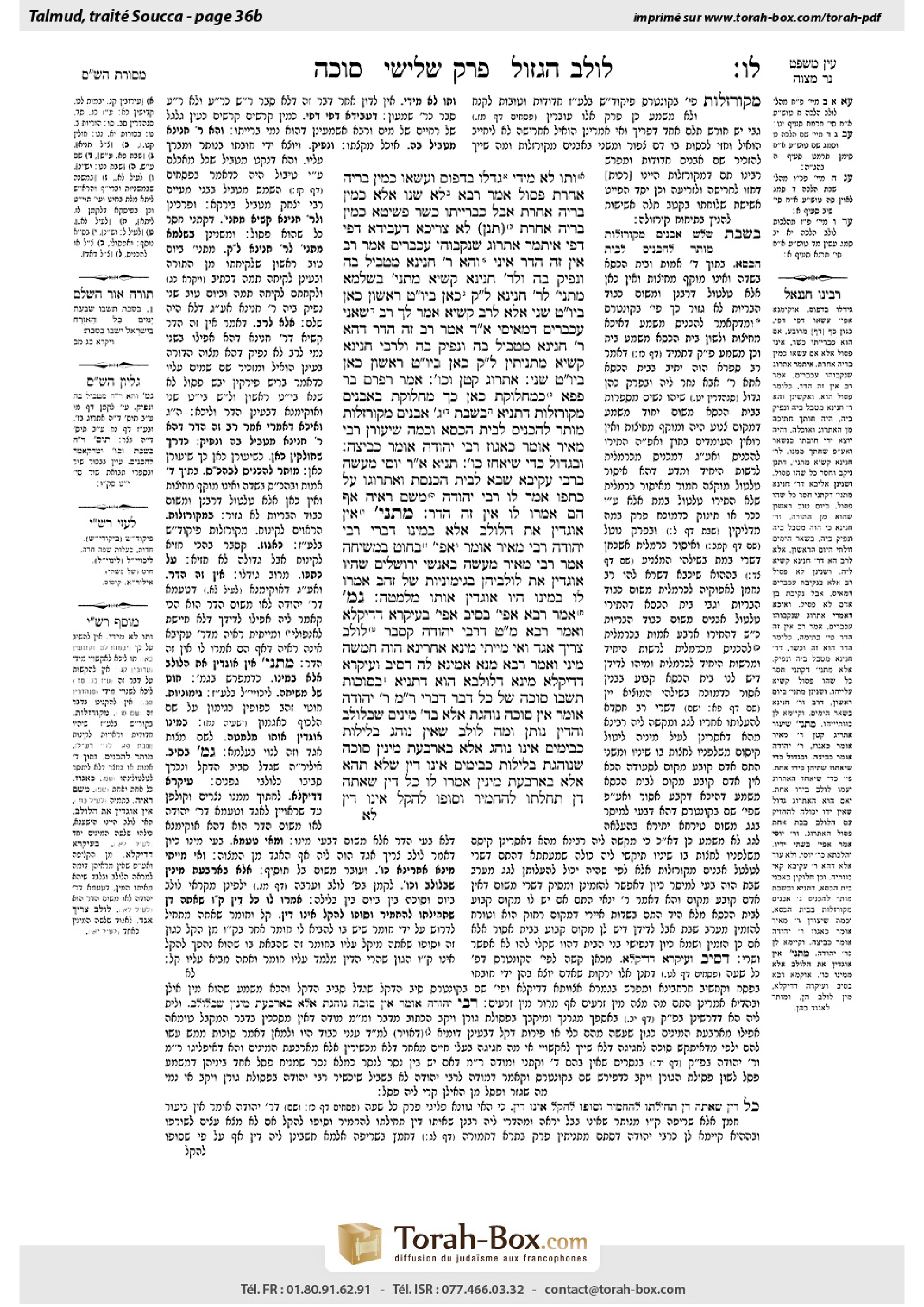
Sukkah 36b: Talmud study for Daf Yomi
Daf Yomi is the daily study of one Talmud folio. Explore 37 tractates with scans, Hebrew text, Sefaria English and AI-generated French translations where annotated.
Passage selection and English or AI-generated French translation are available where the scan has annotations. Daf Study is independent of Torah-Box and Sefaria.
Browse Sukkah · סוכה · All tractatesSukkah 36b text and translations
This page of Sukkah includes the Aramaic text, an English translation and an AI-generated French translation, alongside the scan above.
סוכה ל״ו ב · Aramaic and Hebrew text
וְתוּ לָא מִידֵּי.
גִּדְּלוֹ בִּדְפוּס וַעֲשָׂאוֹ כְּמִין בְּרִיָּה אַחֶרֶת — פָּסוּל. אָמַר רָבָא: לֹא שָׁנוּ אֶלָּא כְּמִין בְּרִיָּה אַחֶרֶת, אֲבָל כִּבְרִיָּיתוֹ — כָּשֵׁר. פְּשִׁיטָא! כְּמִין בְּרִיָּה אַחֶרֶת (תְּנַן)! לָא צְרִיכָא, דַּעֲבִידָא דַּפֵּי דַּפֵּי.
אִיתְּמַר אֶתְרוֹג שֶׁנְּקָבוּהוּ עַכְבָּרִים, אָמַר רַב: אֵין זֶה הָדָר. אִינִי? וְהָא רַבִּי חֲנִינָא מְטַבֵּיל בֵּהּ וְנָפֵיק בֵּהּ! וּלְרַבִּי חֲנִינָא קַשְׁיָא מַתְנִיתִין!
בִּשְׁלָמָא מַתְנִיתִין לְרַבִּי חֲנִינָא לָא קַשְׁיָא: כָּאן בְּיוֹם טוֹב רִאשׁוֹן, כָּאן בְּיוֹם טוֹב שֵׁנִי. אֶלָּא לְרַב קַשְׁיָא! אָמַר לְךָ רַב: שָׁאנֵי עַכְבָּרִים דִּמְאִיסִי.
אִיכָּא דְּאָמְרִי, אָמַר רַב: זֶה הָדָר, דְּהָא רַבִּי חֲנִינָא מְטַבֵּיל בֵּהּ וְנָפֵיק בֵּהּ. וּלְרַבִּי חֲנִינָא קַשְׁיָא מַתְנִיתִין! לָא קַשְׁיָא: כָּאן בְּיוֹם טוֹב רִאשׁוֹן, כָּאן בְּיוֹם טוֹב שֵׁנִי.
אֶתְרוֹג קָטָן וְכוּ׳. אָמַר רַפְרָם בַּר פָּפָּא: כְּמַחְלוֹקֶת כָּאן, כָּךְ מַחְלוֹקֶת בַּאֲבָנִים מְקוּרְזָלוֹת. דְּתַנְיָא: בְּשַׁבָּת שָׁלֹשׁ אֲבָנִים מְקוּרְזָלוֹת מוּתָּר לְהַכְנִיס לְבֵית הַכִּסֵּא, וְכַמָּה שִׁיעוּרָן? רַבִּי מֵאִיר אוֹמֵר: כֶּאֱגוֹז, רַבִּי יְהוּדָה אוֹמֵר: כְּבֵיצָה.
וּבַגָּדוֹל כְּדֵי שֶׁיֹּאחַז כּוּ׳. תַּנְיָא, אָמַר רַבִּי יוֹסֵי: מַעֲשֶׂה בְּרַבִּי עֲקִיבָא שֶׁבָּא לְבֵית הַכְּנֶסֶת וְאֶתְרוֹגוֹ עַל כְּתֵפוֹ! אָמַר לוֹ רַבִּי יְהוּדָה: מִשָּׁם רְאָיָה? אַף הֵם אָמְרוּ לוֹ: אֵין זֶה הָדָר.
מַתְנִי׳ אֵין אוֹגְדִין אֶת הַלּוּלָב אֶלָּא בְּמִינוֹ, דִּבְרֵי רַבִּי יְהוּדָה. רַבִּי מֵאִיר אוֹמֵר: אֲפִילּוּ (בְּחוּט) בִּמְשִׁיחָה. אָמַר רַבִּי מֵאִיר: מַעֲשֶׂה בְּאַנְשֵׁי יְרוּשָׁלַיִם שֶׁהָיוּ אוֹגְדִין אֶת לוּלְבֵיהֶן בְּגִימוֹנִיּוֹת שֶׁל זָהָב. אָמְרוּ לוֹ: בְּמִינוֹ הָיוּ אוֹגְדִין אוֹתוֹ מִלְּמַטָּה.
גְּמָ׳ אָמַר רָבָא: אֲפִילּוּ בְּסִיב, אֲפִילּוּ בְּעִיקָּרָא דְּדִיקְלָא. וְאָמַר רָבָא: מַאי טַעְמֵיהּ דְּרַבִּי יְהוּדָה, קָסָבַר: לוּלָב צָרִיךְ אֶגֶד, וְאִי מַיְיתֵי מִינָא אַחֲרִינָא — הָוֵה חַמְשָׁה מִינֵי.
וְאָמַר רָבָא: מְנָא אָמֵינָא לַהּ דְּסִיב וְעִיקָּרָא דְּדִיקְלָא מִינָא דְלוּלַבָּא הוּא — דְּתַנְיָא: ״בַּסּוּכּוֹת תֵּשְׁבוּ״, סוּכָּה שֶׁל כׇּל דָּבָר, דִּבְרֵי רַבִּי מֵאִיר. רַבִּי יְהוּדָה אוֹמֵר: אֵין סוּכָּה נוֹהֶגֶת אֶלָּא בְּאַרְבָּעָה מִינִים שֶׁבַּלּוּלָב. וְהַדִּין נוֹתֵן: וּמָה לוּלָב שֶׁאֵין נוֹהֵג בַּלֵּילוֹת כְּבַיָּמִים, אֵינוֹ נוֹהֵג אֶלָּא בְּאַרְבַּעַת מִינִין, סוּכָּה שֶׁנּוֹהֶגֶת בַּלֵּילוֹת כְּבַיָּמִים — אֵינוֹ דִּין שֶׁלֹּא תְּהֵא אֶלָּא בְּאַרְבַּעַת מִינִין!
אָמְרוּ לוֹ: כׇּל דִּין שֶׁאַתָּה דָּן תְּחִלָּתוֹ לְהַחְמִיר וְסוֹפוֹ לְהָקֵל — אֵינוֹ דִּין.
Sukkah 36b · English translation
The Gemara notes: And there is nothing more to discuss here. Clearly, the opinions of Rabbi Akiva and Rabbi Shimon do not necessarily coincide.
The baraita continues: If he grew the etrog in a mold and shaped it to appear like a different species, it is unfit. Rava said: The Sages taught that it is unfit only if he shaped it to appear like a different species; however, if he shaped the etrog so it still appears like its own species, it is fit. The Gemara asks: That is obvious; the phrase: Like a different species, is explicitly taught in the baraita. If it shaped like its own species, it is fit. The Gemara answers: No, Rava’s statement is necessary to deem fit an etrog that is shaped into the shape of many planks, i.e., pieces of wood attached to each other. Although its shape is not precisely that of a regular etrog, it sufficiently resembles a regular etrog and is fit.
§ It was stated that the amora’im disagree with regard to an etrog that mice pierced. Rav said: That is not beautiful. Is that so? But wouldn’t Rabbi Ḥanina dip his etrog, eat part of it, and fulfill his obligation with what remained of it? The Gemara asks: And for Rabbi Ḥanina, the mishna is difficult, as it states that an incomplete etrog is unfit.
The Gemara explains: Granted, for Rabbi Ḥanina, the mishna is not difficult, as it can be explained that here, when the mishna prohibits one from using an incomplete etrog, it is referring to performing the mitzva on the first day of the festival of Sukkot, when a complete taking of the species is required; and there, when Rabbi Ḥanina’s conduct leads to the conclusion that an incomplete etrog is fit, it is referring to performing the mitzva on the second day of the Festival or thereafter. However, according to Rav, who said an etrog that was pierced by mice is unfit, Rabbi Ḥanina’s conduct is difficult, as the requirement of beauty applies on all seven days. The Gemara answers: This is not difficult, as Rav could have said to you: Mice are different, as they are repulsive. When mice pierce an etrog, what remains is antithetical to beauty. When a person bites an etrog, what remains can still be considered beautiful.
§ Some say this exchange differently. Rav said with regard to an etrog that mice pierced: That is beautiful, as Rabbi Ḥanina would dip his etrog, eat part of it, and fulfill his obligation with what remained of it, indicating that an incomplete etrog is fit. The Gemara asks: And for Rabbi Ḥanina, the mishna is difficult, as it states that an incomplete etrog is unfit. The Gemara answers: The mishna is not difficult; here, it is referring to performing the mitzva on the first day of the festival of Sukkot; there, it is referring to performing the mitzva on the second day of the Festival or thereafter.
A dispute between Rabbi Meir and Rabbi Yehuda is cited in a mishna with regard to the minimum measure of a small etrog. Rafram bar Pappa said: Like the dispute here, so is the dispute with regard to the matter of rounded stones, as it was taught in a baraita: On Shabbat three rounded stones may be taken into the bathroom in order to clean oneself with them. Although generally one may not move stones on Shabbat because they are set aside from use, the Sages permitted doing so in the interest of human dignity. However, they disagreed, with regard to the size of these stones. And what is their measure? Rabbi Meir says: A walnut-bulk; Rabbi Yehuda says: An egg-bulk. Clearly the rationales for these disputes are different; however, since the respective measures are identical, the analogy can serve as a mnemonic.
The mishna continues: And in a large etrog, the maximum measure is so that one could hold two in his one hand; this is the statement of Rabbi Yehuda. Rabbi Yosei says: It is fit even if it is so large that he can hold only one in his two hands. It is taught in a baraita that Rabbi Yosei said: There was an incident involving Rabbi Akiva, who came to the synagogue, and his etrog was so large that he carried it on his shoulder. Apparently, one can fulfill his obligation with a large etrog. Rabbi Yehuda said to him: Is there proof from there? In that case, too, the Sages said to him: That is not beauty.
MISHNA: One may bind the lulav only with its own species; i.e., one of the four species taken with the lulav. This is the statement of Rabbi Yehuda. Rabbi Meir says: One may do so even with a string or with a cord. Rabbi Meir said: There was an incident involving the men of Jerusalem who would bind their lulavim with gold rings. The Sages said to him: They would bind it with its own species beneath the rings, which serve a merely decorative purpose and not a halakhic one.
GEMARA: Rava said: One may bind the lulav even with fibers that grow around the trunk of the date palm, and even with a piece of the trunk of the date palm. And Rava said: What is the rationale for the opinion of Rabbi Yehuda? He holds that a lulav requires binding, and if one brings another species to bind the lulav, there will be five species and he will violate the prohibition against adding to the mitzvot.
And Rava further said: From where do I say this halakha that fibers and the trunk of the date palm are the species of the lulav? It is as it is taught in a baraita that it is written: “You shall reside in sukkot for seven days” (Leviticus 23:42), which means a sukka of any material, as the Torah was not particular about the material to be used for the roofing; any species may be used as long as it grew from the ground and it is not susceptible to impurity. This is the statement of Rabbi Meir. Rabbi Yehuda says: The mitzva of sukka is practiced only with the four species of the lulav as roofing. And, he claims, logic dictates that it is so, as it is derived by means of an a fortiori inference: Just as the mitzva of lulav, which is not practiced at night as it is during the day, is practiced only with the four species, with regard to the mitzva of sukka, which is practiced at night as it is during the day, is it not right that its roofing should be only from the four species?
The Rabbis said to him: That is not an a fortiori inference, as any a fortiori inference that you infer initially to be stringent, but ultimately it is to be lenient, is not a legitimate a fortiori inference. If ultimately the stringency leads to a leniency, the entire basis of the inference is undermined.
Sukkah 36b · Traduction française (IA)
La Guemara fait remarquer : Il n’y a rien de plus à discuter ici. De toute évidence, les avis de Rabbi Akiva et de Rabbi Shimon ne coïncident pas nécessairement.
La baraïta poursuit : Si l’on a fait pousser l’étrog dans un moule et qu’on lui a donné la forme d’une autre espèce, il est impropre. Rava dit : Les Sages ont enseigné qu’il est impropre uniquement si on lui a donné la forme d’une autre espèce ; en revanche, si on l’a façonné de manière qu’il ressemble toujours à un étrog, il est apte. La Guemara demande : Cela va de soi ; l’expression « comme une autre espèce » figure explicitement dans la baraïta. S’il a la forme de sa propre espèce, il est apte. La Guemara répond : Non, la déclaration de Rava est nécessaire pour déclarer apte un étrog façonné de manière à ressembler à plusieurs planches, c’est-à-dire à des morceaux de bois attachés les uns aux autres. Bien que sa forme ne soit pas exactement celle d’un étrog ordinaire, il lui ressemble suffisamment pour être apte.
§ Il a été rapporté que les amoraïm sont en désaccord au sujet d’un étrog que des souris ont percé. Rav dit : Il n’est pas beau. En est-il ainsi ? Rabbi Ḥanina ne trempait-il pas son étrog, n’en mangeait-il pas une partie, puis ne s’acquittait-il pas de son obligation avec ce qui en restait ? La Guemara demande : La Michna pose donc une difficulté pour Rabbi Ḥanina, puisqu’elle enseigne qu’un étrog incomplet est impropre.
La Guemara explique : Pour Rabbi Ḥanina, la Michna ne pose pas de difficulté, car on peut expliquer qu’ici, lorsque la Michna interdit d’utiliser un étrog incomplet, elle parle de l’accomplissement de la mitsva le premier jour de la fête de Soukkot, où l’on doit prendre les quatre espèces dans leur intégralité ; tandis que là, lorsque la conduite de Rabbi Ḥanina permet de conclure qu’un étrog incomplet est apte, il s’agit de l’accomplissement de la mitsva à partir du deuxième jour de la fête. Cependant, selon Rav, qui a dit qu’un étrog percé par des souris est impropre, la conduite de Rabbi Ḥanina pose une difficulté, car l’exigence de beauté s’applique pendant les sept jours. La Guemara répond : Il n’y a pas de difficulté, car Rav aurait pu te dire : Les souris sont différentes, car elles sont répugnantes. Quand des souris percent un étrog, ce qui en reste est contraire à la beauté. Quand une personne mord dans un étrog, ce qui en reste peut encore être considéré comme beau.
§ Certains rapportent cet échange différemment. Au sujet d’un étrog percé par des souris, Rav dit : Il est beau, car Rabbi Ḥanina trempait son étrog, en mangeait une partie, puis s’acquittait de son obligation avec ce qui en restait, ce qui indique qu’un étrog incomplet est apte. La Guemara demande : La Michna pose donc une difficulté pour Rabbi Ḥanina, puisqu’elle enseigne qu’un étrog incomplet est impropre. La Guemara répond : La Michna ne pose pas de difficulté ; ici, il s’agit de l’accomplissement de la mitsva le premier jour de la fête de Soukkot ; là, il s’agit de son accomplissement à partir du deuxième jour de la fête.
Une Michna cite un désaccord entre Rabbi Meïr et Rabbi Yehouda au sujet de la mesure minimale d’un petit étrog. Rafram bar Pappa dit : Le désaccord ici est analogue à celui concernant les pierres arrondies, comme il est enseigné dans une baraïta : Le Chabbat, on peut emporter trois pierres arrondies aux toilettes afin de se nettoyer avec. Bien qu’en général, on ne puisse pas déplacer des pierres le Chabbat, car elles sont mises à l’écart de tout usage, les Sages l’ont permis par égard pour la dignité humaine. Cependant, ils sont en désaccord au sujet de la taille de ces pierres. Quelle est leur mesure ? Rabbi Meïr dit : le volume d’une noix ; Rabbi Yehouda dit : le volume d’un œuf. De toute évidence, les raisons de ces désaccords sont différentes ; toutefois, puisque les mesures respectives sont identiques, l’analogie peut servir de moyen mnémotechnique.
La Michna poursuit : Pour un grand étrog, la mesure maximale est telle qu’on puisse en tenir deux dans une seule main ; telle est la déclaration de Rabbi Yehouda. Rabbi Yossi dit : Il est apte même s’il est si grand qu’on ne peut en tenir qu’un seul à deux mains. Une baraïta enseigne que Rabbi Yossi dit : Il est arrivé que Rabbi Akiva se rende à la synagogue avec un étrog si grand qu’il le portait sur son épaule. Il apparaît donc qu’on peut s’acquitter de son obligation avec un grand étrog. Rabbi Yehouda lui dit : Peut-on en tirer une preuve ? Dans ce cas aussi, les Sages lui ont dit : Ce n’est pas beau.
MICHNA : On ne peut lier le loulav qu’avec une espèce qui lui est propre, c’est-à-dire l’une des quatre espèces prises avec le loulav. Telle est la déclaration de Rabbi Yehouda. Rabbi Meïr dit : On peut même le faire avec une ficelle ou une corde. Rabbi Meïr dit : Il est arrivé que les hommes de Jérusalem lient leurs loulavim avec des anneaux d’or. Les Sages lui dirent : Ils le liaient avec une espèce qui lui est propre sous les anneaux, lesquels n’avaient qu’une fonction décorative et non une fonction halakhique.
GUEMARA : Rava dit : On peut lier le loulav même avec les fibres qui poussent autour du tronc du palmier-dattier, et même avec un morceau de son tronc. Rava dit également : Quelle est la raison de l’avis de Rabbi Yehouda ? Il estime que le loulav doit être lié et que, si l’on utilise une autre espèce pour le lier, il y aura cinq espèces et l’on transgressera l’interdiction d’ajouter aux mitsvot.
Rava dit également : D’où déduis-je cette halakha selon laquelle les fibres et le tronc du palmier-dattier sont de l’espèce du loulav ? De ce qui est enseigné dans une baraïta : Il est écrit : « Vous demeurerez dans des soukkot pendant sept jours » (Lévitique 23:42), ce qui signifie qu’une soukka peut être faite de n’importe quel matériau, car la Torah n’a pas imposé de matériau particulier pour la couverture ; toute espèce peut être utilisée, à condition qu’elle pousse du sol et ne soit pas susceptible d’impureté. Telle est la déclaration de Rabbi Meïr. Rabbi Yehouda dit : La mitsva de la soukka ne peut être accomplie qu’avec les quatre espèces du loulav pour couverture. Selon lui, la logique l’impose, car il le déduit au moyen d’un raisonnement a fortiori : de même que la mitsva du loulav, qui ne s’accomplit pas la nuit comme elle s’accomplit le jour, ne se pratique qu’avec les quatre espèces, n’est-il pas d’autant plus juste que la couverture de la soukka, dont la mitsva s’accomplit la nuit comme le jour, soit faite uniquement avec ces quatre espèces ?
Les Sages lui dirent : Ce n’est pas un raisonnement a fortiori, car un raisonnement a fortiori que l’on établit d’abord pour conclure à une rigueur, mais qui aboutit finalement à une indulgence, n’est pas valable. Si, en fin de compte, la rigueur conduit à une indulgence, le fondement même du raisonnement s’en trouve sapé.
Traduction française générée par IA à partir de l’édition anglaise de Sefaria. Vérifie toujours un passage avec le texte source.
Text from Sefaria: William Davidson Edition - Vocalized Aramaic (CC BY NC); William Davidson Edition - English (CC BY NC).