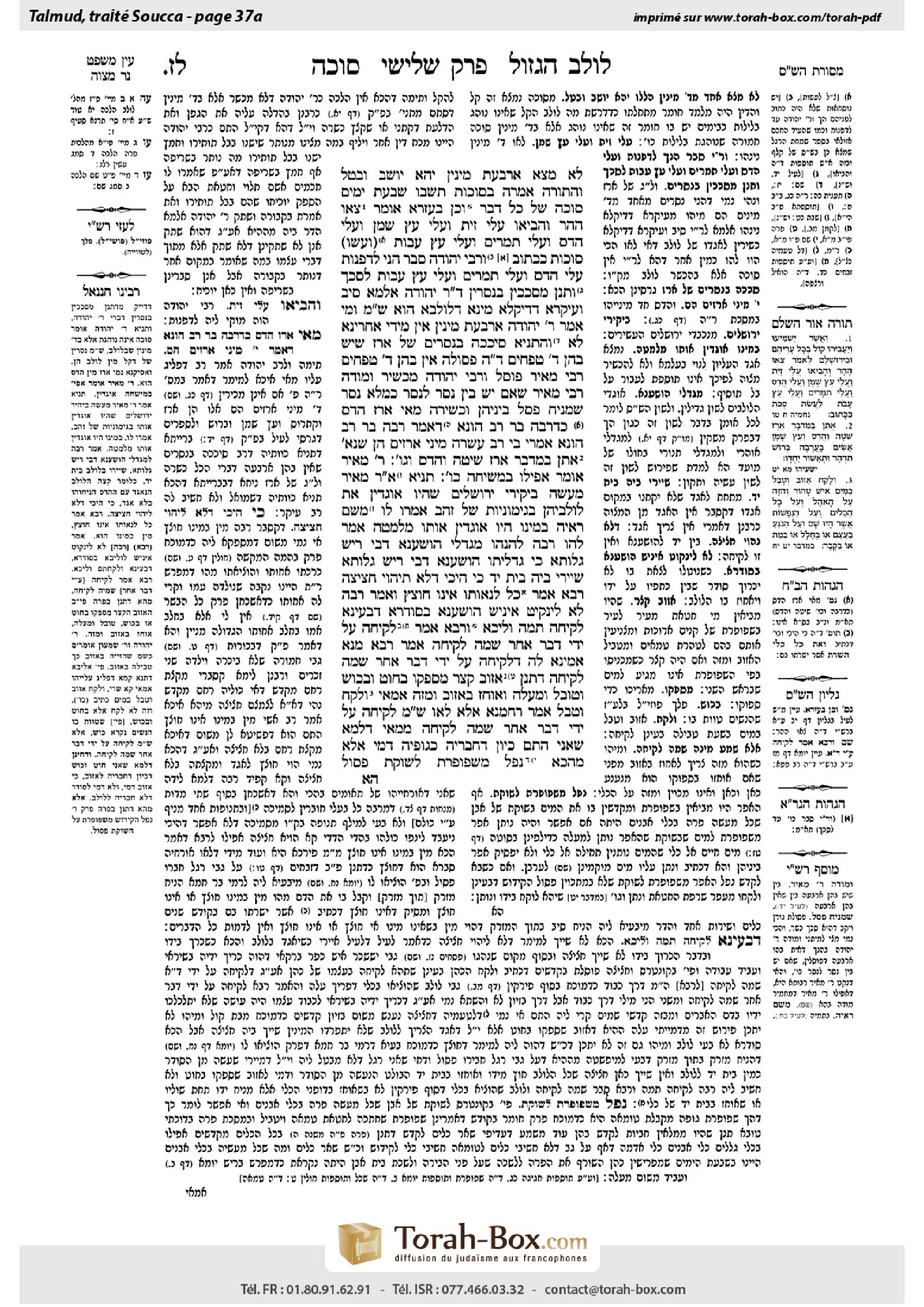
Sukkah 37a: Talmud study for Daf Yomi
Daf Yomi is the daily study of one Talmud folio. Explore 37 tractates with scans, Hebrew text, Sefaria English and AI-generated French translations where annotated.
Passage selection and English or AI-generated French translation are available where the scan has annotations. Daf Study is independent of Torah-Box and Sefaria.
Browse Sukkah · סוכה · All tractatesSukkah 37a text and translations
This page of Sukkah includes the Aramaic text, an English translation and an AI-generated French translation, alongside the scan above.
סוכה ל״ז א · Aramaic and Hebrew text
לֹא מָצָא אַרְבַּעַת מִינִין יְהֵא יוֹשֵׁב וּבָטֵל, וְהַתּוֹרָה אָמְרָה: ״בַּסּוּכּוֹת תֵּשְׁבוּ שִׁבְעַת יָמִים״ — סוּכָּה שֶׁל כׇּל דָּבָר. וְכֵן בְּעֶזְרָא אוֹמֵר: ״צְאוּ הָהָר וְהָבִיאוּ עֲלֵי זַיִת וַעֲלֵי עֵץ שֶׁמֶן וַעֲלֵי הֲדַס וַעֲלֵי תְמָרִים וַעֲלֵי עֵץ עָבוֹת (וַעֲשׂוּ) סוּכּוֹת כַּכָּתוּב״!
וְרַבִּי יְהוּדָה סָבַר: הָנֵי — לִדְפָנוֹת, עֲלֵי הֲדַס וַעֲלֵי תְמָרִים וַעֲלֵי עֵץ עָבוֹת — לִסְכָךְ. וּתְנַן: מְסַכְּכִין בִּנְסָרִין, דִּבְרֵי רַבִּי יְהוּדָה. אַלְמָא סִיב וְעִיקָּרָא דְּדִיקְלָא מִינָא דְלוּלַבָּא הוּא, שְׁמַע מִינַּהּ.
וּמִי אָמַר רַבִּי יְהוּדָה אַרְבַּעַת מִינִין — אִין, מִידֵּי אַחֲרִינָא — לָא? וְהָתַנְיָא: סִיכְּכָהּ בִּנְסָרִים שֶׁל אֶרֶז שֶׁיֵּשׁ בָּהֶן אַרְבָּעָה טְפָחִים — דִּבְרֵי הַכֹּל פְּסוּלָה. אֵין בָּהֶן אַרְבָּעָה טְפָחִים — רַבִּי מֵאִיר פּוֹסֵל, וְרַבִּי יְהוּדָה מַכְשִׁיר. וּמוֹדֶה רַבִּי מֵאִיר שֶׁאִם יֵשׁ בֵּין נֶסֶר לְנֶסֶר כִּמְלֹא נֶסֶר — שֶׁמַּנִּיחַ פְּסָל בֵּינֵיהֶן, וּכְשֵׁירָה!
מַאי ״אֶרֶז״ — הֲדַס, כִּדְרַבָּה בַּר רַב הוּנָא. דְּאָמַר רַבָּה בַּר רַב הוּנָא, אָמְרִי בֵּי רַב: עֲשָׂרָה מִינֵי אֲרָזִים הֵן, שֶׁנֶּאֱמַר: ״אֶתֵּן בַּמִּדְבָּר אֶרֶז שִׁיטָּה וַהֲדַס וְגוֹ׳״.
רַבִּי מֵאִיר אוֹמֵר אֲפִילּוּ בִּמְשִׁיחָה כּוּ׳. תַּנְיָא אָמַר רַבִּי מֵאִיר: מַעֲשֶׂה בְּיַקִּירֵי יְרוּשָׁלַיִם שֶׁהָיוּ אוֹגְדִין אֶת לוּלְבֵיהֶן בְּגִימוֹנִיּוֹת שֶׁל זָהָב. אָמְרוּ לוֹ: מִשָּׁם רְאָיָה?! בְּמִינוֹ הָיוּ אוֹגְדִין אוֹתוֹ מִלְּמַטָּה.
אֲמַר לְהוּ רַבָּה לְהָנְהוּ מְגַדְּלֵי הוֹשַׁעְנָא דְּבֵי רֵישׁ גָּלוּתָא: כִּי גָּדְלִיתוּ הוֹשַׁעְנָא דְּבֵי רֵישׁ גָּלוּתָא, שַׁיִּירוּ בֵּיהּ בֵּית יָד — כִּי הֵיכִי דְּלָא תֶּיהְוֵי חֲצִיצָה.
רָבָא אָמַר: כׇּל לְנָאוֹתוֹ — אֵינוֹ חוֹצֵץ. וְאָמַר רַבָּה: לָא לִינְקוֹט אִינִישׁ הוֹשַׁעְנָא בְּסוּדָרָא, דְּבָעֵינָא לְקִיחָה תַּמָּה וְלֵיכָּא. וְרָבָא אָמַר: לְקִיחָה עַל יְדֵי דָּבָר אַחֵר — שְׁמָהּ לְקִיחָה.
אָמַר רָבָא: מְנָא אָמֵינָא לַהּ דִּלְקִיחָה עַל יְדֵי דָּבָר אַחֵר שְׁמָהּ לְקִיחָה, דִּתְנַן: אֵזוֹב קָצָר — מְסַפְּקוֹ בְּחוּט וּבְכוּשׁ, וְטוֹבֵל וּמַעֲלֶה וְאוֹחֵז בָּאֵזוֹב וּמַזֶּה. אַמַּאי — ״וְלָקַח״ ״וְטָבַל״ אָמַר רַחֲמָנָא! אֶלָּא לָאו, שְׁמַע מִינַּהּ: לְקִיחָה עַל יְדֵי דָּבָר אַחֵר — שְׁמָהּ לְקִיחָה.
מִמַּאי? דִּלְמָא שָׁאנֵי הָתָם, כֵּיוָן דְּחַבְּרֵיהּ — כְּגוּפֵיהּ דָּמֵי. אֶלָּא מֵהָכָא: נָפַל מִשְּׁפוֹפֶרֶת לַשּׁוֹקֶת — פָּסוּל.
Sukkah 37a · English translation
According to your reasoning, if one did not find any of the four species to roof his sukka, he will sit idly and fail to fulfill the mitzva of sukka; and the Torah states: “You shall reside in sukkot for seven days” (Leviticus 23:42), meaning a sukka of any material. Likewise, in the book of Ezra, which can refer also to the book of Nehemiah, it says: “Go forth unto the mount, and fetch olive branches, and pine branches, and myrtle branches, and palm branches, and branches of a dense-leaved tree, to make sukkot, as it is written” (Nehemiah 8:15). Apparently, a sukka may be constructed even with materials other than the four species.
And Rabbi Yehuda holds: These olive branches and pine branches mentioned in the verse were for the walls of the sukka, which need not be built from the four species. Myrtle branches, palm branches, and branches of a dense-leaved tree, i.e., again myrtle, all of which are among the four species, were for the roofing. Rabbi Yehuda holds that one may roof the sukka only with the four species. And we learned in a mishna: One may roof the sukka with boards; this is the statement of Rabbi Yehuda. As boards can be produced from one of the four species only if the trunk of the date palm is considered a lulav, apparently, fibers and the trunk of the date palm are the species of the lulav. The Gemara determines: Indeed, conclude from it that this is so.
The Gemara wonders: And did Rabbi Yehuda say with regard to the materials fit for roofing a sukka that the four species, yes, they are fit, but other materials, no, they are not fit? But isn’t it taught in a baraita: If one roofed the sukka with cedar [erez] boards that have four handbreadths in their width, everyone agrees that it is unfit. If they do not have four handbreadths in their width, Rabbi Meir deems it unfit and Rabbi Yehuda deems it fit. And Rabbi Meir concedes that if there is between one board and another board a gap the complete width of a board, then one places fit roofing from the waste of the threshing floor and the winepress between the boards and the sukka is fit. Apparently, Rabbi Yehuda permits one to roof the sukka with cedar wood, which is not one of the four species.
The Gemara responds: What is the erez to which the mishna refers? It is in fact a myrtle tree, in accordance with that which Rabba bar Rav Huna said, as Rabba bar Rav Huna said that they say in the school of Rav: There are ten types of erez, as it is stated: “I will place in the wilderness the cedar [erez], the acacia-tree, the myrtle, and pine tree; I will set in the plain the juniper, the box-tree, and the cypress all together” (Isaiah 41:19). All the trees listed in this verse are types of cedar, and the myrtle is one of them.
§ The mishna continues: Rabbi Meir says: One may tie the lulav even with a cord. It is taught in the Tosefta that Rabbi Meir said: There was an incident involving the prominent residents of Jerusalem who would bind their lulavim with gold rings. The Sages said to him: Is there proof from there? They would bind it with its own species beneath the rings, which serve a merely decorative purpose and not a halakhic one.
Rabba said to those who would bind the four species [hoshana] of the house of the Exilarch: When you bind the four species of the house of the Exilarch, leave room for a handgrip on it where there is neither binding nor decoration so that there will not be an interposition between the lulav and the hand of the person taking it.
Rava said: That is unnecessary, as any addition whose purpose is to beautify does not interpose. And Rabba said: Let a person not take the four species with a cloth [sudara] around his hand, since I require a complete taking, and there is none in this case due to the interposition between his hand and the lulav. And Rava said: That is not a problem, as taking by means of another object is considered taking.
Rava said: From where do I say that taking by means of another object is considered taking? It is as we learned in a mishna: One undergoing purification from impurity imparted by a corpse must be sprinkled with purification water with the ashes of the red heifer. If the hyssop used to sprinkle the water was short and did not reach the water in the receptacle, one renders it sufficiently long by attaching a string or a spindle, and then he dips the hyssop into the water, removes it, grasps the hyssop, and sprinkles the water on the one undergoing purification. And why may he do so? Doesn’t the Merciful One say in the Torah: “And a ritually pure person shall take hyssop, and dip it in the water, and sprinkle it” (Numbers 19:18), indicating that one must take the hyssop while dipping it? Rather, may one not conclude from this that taking by means of another object is considered taking?
This proof is rejected: From where can that be proven? Perhaps it is different there; since he attached the string to the hyssop, its legal status is like that of the hyssop itself. However, the legal status of the cloth is not like that of the lulav, since it is not attached to the lulav. Rather, the fact that taking by means of another object is considered taking can be learned from here: If the ashes of the red heifer fell from the tube in which they were held into the trough in which the spring water was located, the water is unfit, since taking the ashes and placing them in the water must be performed intentionally.
Sukkah 37a · Traduction française (IA)
Selon ton raisonnement, si quelqu’un ne trouve aucune des quatre espèces pour couvrir sa soukka, il restera inactif et ne s’acquittera pas de la mitsva de la soukka. Or la Torah dit : « Vous demeurerez dans des soukkot pendant sept jours » (Lévitique 23:42), c’est-à-dire dans une soukka faite de n’importe quel matériau. De même, dans le livre d’Ezra, qui peut également désigner le livre de Néhémie, il est dit : « Allez à la montagne et rapportez des branches d’olivier, des branches de pin, des branches de myrte, des branches de palmier et des branches d’arbre touffu, afin de faire des soukkot, comme il est écrit » (Néhémie 8:15). Il semble donc qu’on puisse construire une soukka avec des matériaux autres que les quatre espèces.
Et Rabbi Yehouda considère que les branches d’olivier et de pin mentionnées dans le verset servaient aux parois de la soukka, qui n’ont pas besoin d’être faites à partir des quatre espèces. Les branches de myrte, de palmier et d’arbre touffu, c’est-à-dire, de nouveau, des branches de myrte, toutes comprises parmi les quatre espèces, servaient à la couverture. Rabbi Yehouda considère qu’on ne peut couvrir la soukka qu’avec les quatre espèces. Or nous avons appris dans une Michna : « On peut couvrir la soukka avec des planches » ; telle est l’opinion de Rabbi Yehouda. Comme on ne peut fabriquer des planches à partir de l’une des quatre espèces que si le tronc du palmier-dattier est considéré comme un lulav, il semble que les fibres et le tronc du palmier-dattier appartiennent à l’espèce du lulav. La Guemara conclut : en effet, déduis-en que c’est bien le cas.
La Guemara s’étonne : Rabbi Yehouda a-t-il donc dit, au sujet des matériaux aptes à couvrir une soukka, que les quatre espèces conviennent, mais pas les autres matériaux ? Pourtant, n’est-il pas enseigné dans une baraïta : si quelqu’un a couvert la soukka avec des planches de cèdre [erez] larges de quatre palmes, tous conviennent qu’elle est invalide. Si elles font moins de quatre palmes de large, Rabbi Meïr la juge invalide et Rabbi Yehouda la juge valide. Et Rabbi Meïr reconnaît que, s’il y a entre deux planches un espace égal à la largeur d’une planche, on place entre elles un matériau de couverture valide, provenant des déchets de l’aire de battage et du pressoir, et la soukka est valide. Il semble donc que Rabbi Yehouda autorise à couvrir la soukka avec du bois de cèdre, qui ne fait pas partie des quatre espèces.
La Guemara répond : quel est l’erez auquel la Michna fait référence ? Il s’agit en fait d’un myrte, conformément à ce que Rabba bar Rav Houna a dit. En effet, Rabba bar Rav Houna a dit qu’on enseigne à l’école de Rav : il existe dix sortes d’erez, comme il est dit : « Je mettrai dans le désert le cèdre [erez], l’acacia, le myrte et le pin ; dans la plaine, je placerai ensemble le genévrier, le buis et le cyprès » (Isaïe 41:19). Tous les arbres énumérés dans ce verset sont des sortes de cèdre, et le myrte en fait partie.
§ La Michna poursuit : Rabbi Meïr dit : « On peut attacher le lulav même avec une corde. » Il est enseigné dans la Tossefta que Rabbi Meïr a dit : « Il est arrivé que les notables de Jérusalem attachent leurs lulavim avec des anneaux d’or. » Les Sages lui dirent : « Peut-on en tirer une preuve ? Ils attachaient le lulav avec une espèce qui lui est propre, sous les anneaux, lesquels n’avaient qu’une fonction décorative et non halakhique. »
Rabba dit à ceux qui attachaient les quatre espèces [hoshana] de la maison de l’Exilarque : « Lorsque vous attachez les quatre espèces de la maison de l’Exilarque, laissez une partie servant de poignée, sans attache ni ornement, afin qu’il n’y ait pas d’interposition entre le lulav et la main de la personne qui le prend. »
Rava dit : « Cela n’est pas nécessaire, car tout ajout destiné à embellir ne constitue pas une interposition. » Et Rabba dit : « Qu’on ne prenne pas les quatre espèces avec un tissu [sudara] autour de la main, car j’exige une prise complète, ce qui n’est pas le cas ici en raison de l’interposition entre la main et le lulav. » Et Rava dit : « Cela ne pose pas problème, car prendre au moyen d’un autre objet est considéré comme une prise. »
Rava dit : « De quoi déduis-je que prendre au moyen d’un autre objet est considéré comme une prise ? » De ce que nous avons appris dans une Michna : une personne en cours de purification de l’impureté transmise par un mort doit être aspergée d’eau de purification mêlée aux cendres de la vache rousse. Si l’hysope utilisée pour l’aspersion est trop courte et n’atteint pas l’eau dans le récipient, on la rallonge suffisamment en y attachant un fil ou un fuseau ; puis on plonge l’hysope dans l’eau, on la retire, on saisit l’hysope et on asperge d’eau la personne en cours de purification. Pourquoi peut-on faire ainsi ? Le Miséricordieux ne dit-il pas dans la Torah : « Un homme rituellement pur prendra de l’hysope, la trempera dans l’eau et aspergera » (Nombres 19:18), ce qui indique qu’il faut tenir l’hysope au moment de la tremper ? Ne faut-il pas en conclure que prendre au moyen d’un autre objet est considéré comme une prise ?
Cette preuve est rejetée : d’où peut-on le démontrer ? Peut-être que ce cas est différent : puisque le fil a été attaché à l’hysope, il a le même statut juridique que l’hysope elle-même. En revanche, le tissu n’a pas le même statut juridique que le lulav, puisqu’il n’y est pas attaché. On peut plutôt apprendre d’ici que prendre au moyen d’un autre objet est considéré comme une prise : si les cendres de la vache rousse tombent du tube qui les contient dans l’auge où se trouve l’eau de source, l’eau est invalide, car la prise des cendres et leur dépôt dans l’eau doivent être effectués intentionnellement.
Traduction française générée par IA à partir de l’édition anglaise de Sefaria. Vérifie toujours un passage avec le texte source.
Text from Sefaria: William Davidson Edition - Vocalized Aramaic (CC BY NC); William Davidson Edition - English (CC BY NC).