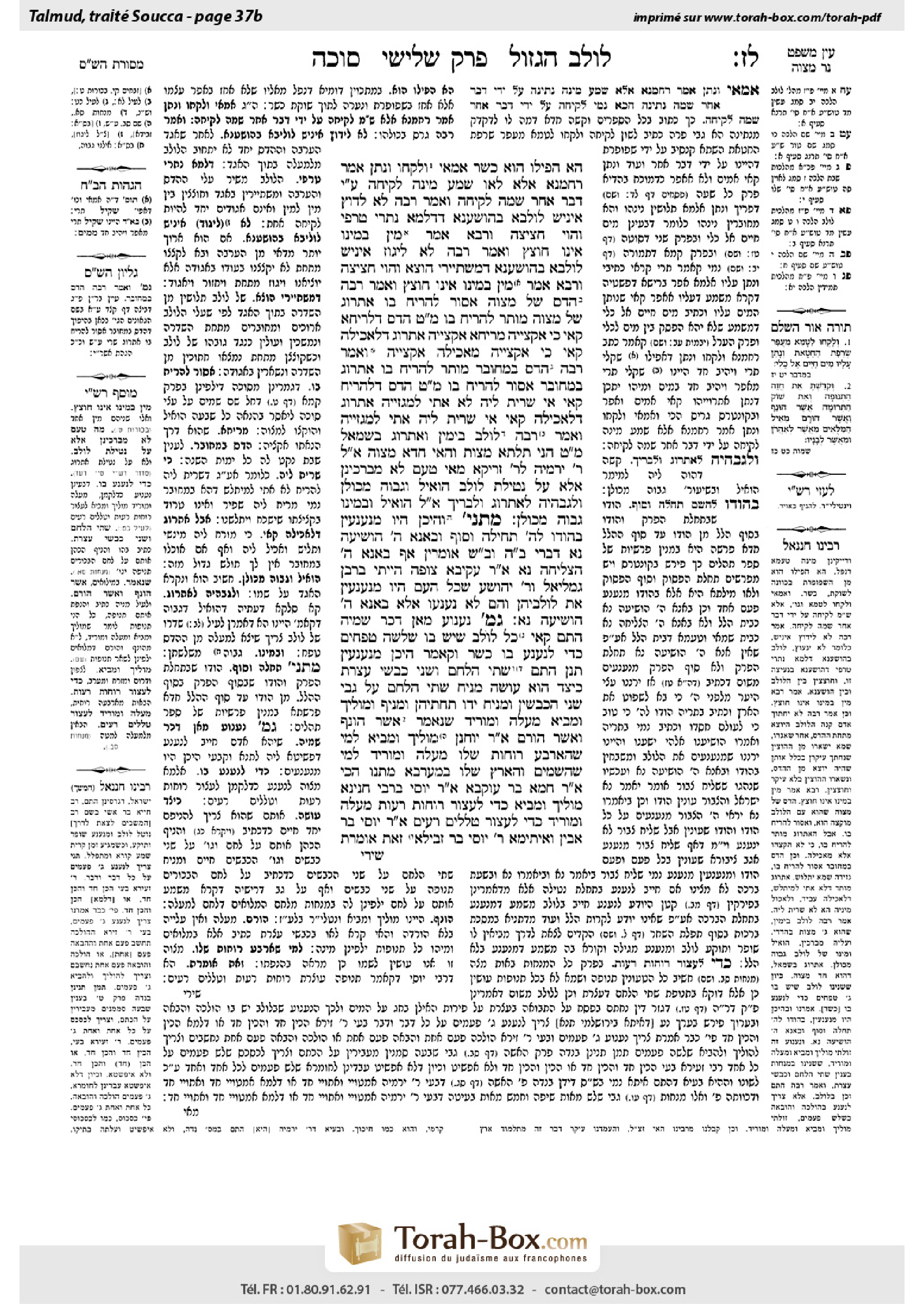
Sukkah 37b: Talmud study for Daf Yomi
Daf Yomi is the daily study of one Talmud folio. Explore 37 tractates with scans, Hebrew text, Sefaria English and AI-generated French translations where annotated.
Passage selection and English or AI-generated French translation are available where the scan has annotations. Daf Study is independent of Torah-Box and Sefaria.
Browse Sukkah · סוכה · All tractatesSukkah 37b text and translations
This page of Sukkah includes the Aramaic text, an English translation and an AI-generated French translation, alongside the scan above.
סוכה ל״ז ב · Aramaic and Hebrew text
הָא הִפִּילוֹ הוּא — כָּשֵׁר. אַמַּאי? ״וְלָקְחוּ״ ״וְנָתַן״ אָמַר רַחֲמָנָא! אֶלָּא לָאו, שְׁמַע מִינַּהּ: לְקִיחָה עַל יְדֵי דָּבָר אַחֵר — שְׁמָהּ לְקִיחָה.
וְאָמַר רַבָּה: לָא לִדוּץ אִינִישׁ לוּלַבָּא בְּהוֹשַׁעְנָא, דְּדִלְמָא נָתְרִי טַרְפֵי וְהָוֵי חֲצִיצָה. וְרָבָא אָמַר: מִין בְּמִינוֹ אֵינוֹ חוֹצֵץ.
וְאָמַר רַבָּה: לָא לִיגּוֹז אִינִישׁ לוּלַבָּא בְּהוֹשַׁעְנָא, דְּמִשְׁתַּיְּירִי הוּצֵא וְהָוֵי חֲצִיצָה. וְרָבָא אָמַר: מִין בְּמִינוֹ אֵינוֹ חוֹצֵץ.
וְאָמַר רַבָּה: הֲדַס שֶׁל מִצְוָה — אָסוּר לְהָרִיחַ בּוֹ, אֶתְרוֹג שֶׁל מִצְוָה — מוּתָּר לְהָרִיחַ בּוֹ. מַאי טַעְמָא? הֲדַס דִּלְרֵיחָא קָאֵי, כִּי אַקְצְיֵיה — מֵרֵיחָא אַקְצְיֵיה. אֶתְרוֹג דְּלַאֲכִילָה קָאֵי כִּי אַקְצְיֵיה — מֵאֲכִילָה אַקְצְיֵיה.
וְאָמַר רַבָּה: הֲדַס בִּמְחוּבָּר — מוּתָּר לְהָרִיחַ בּוֹ, אֶתְרוֹג בִּמְחוּבָּר — אָסוּר לְהָרִיחַ בּוֹ. מַאי טַעְמָא? הֲדַס דִּלְהָרִיחַ קָאֵי, אִי שָׁרֵית לֵיהּ — לָא אָתֵי לְמִגְזְיֵיהּ. אֶתְרוֹג, דְּלַאֲכִילָה קָאֵי, אִי שָׁרֵית לֵיהּ — אָתֵי לְמִגְזְיֵיהּ.
וְאָמַר רַבָּה: לוּלָב — בְּיָמִין, וְאֶתְרוֹג — בִּשְׂמֹאל. מַאי טַעְמָא? הָנֵי תְּלָתָא מִצְוֹת, וְהַאי חֲדָא מִצְוָה. אֲמַר לֵיהּ רַבִּי יִרְמְיָה לְרַבִּי זְרִיקָא: מַאי טַעַם לָא מְבָרְכִינַן אֶלָּא ״עַל נְטִילַת לוּלָב״ — הוֹאִיל וְגָבוֹהַּ מִכּוּלָּן. וְלַגְבְּהֵיהּ לְאֶתְרוֹג וּלְבָרֵיךְ! אֲמַר לֵיהּ: הוֹאִיל וּבְמִינוֹ גָּבוֹהַּ מִכּוּלָּן.
מַתְנִי׳ וְהֵיכָן הָיוּ מְנַעַנְעִין? בְּ״הוֹדוּ לַה׳״ תְּחִילָּה וָסוֹף, וּבְ״אָנָּא ה׳ הוֹשִׁיעָה נָּא״ — דִּבְרֵי בֵּית הִלֵּל. וּבֵית שַׁמַּאי אוֹמְרִין: אַף בְּ״אָנָּא ה׳ הַצְלִיחָה נָּא״. אָמַר רַבִּי עֲקִיבָא: צוֹפֶה הָיִיתִי בְּרַבָּן גַּמְלִיאֵל וְרַבִּי יְהוֹשֻׁעַ, שֶׁכׇּל הָעָם הָיוּ מְנַעְנְעִין אֶת לוּלְבֵיהֶן, וְהֵם לֹא נַעְנָעוֹ אֶלָּא בְּ״אָנָּא ה׳ הוֹשִׁיעָה נָּא״.
גְּמָ׳ נִעְנוּעַ מַאן דְּכַר שְׁמֵיהּ? הָתָם קָאֵי: כׇּל לוּלָב שֶׁיֵּשׁ בּוֹ שְׁלֹשָׁה טְפָחִים כְּדֵי לְנַעְנֵעַ בּוֹ — כָּשֵׁר, וְקָאָמַר: הֵיכָן מְנַעְנְעִין.
תְּנַן הָתָם: שְׁתֵּי הַלֶּחֶם וּשְׁנֵי כִּבְשֵׂי עֲצֶרֶת כֵּיצַד הוּא עוֹשֶׂה? מַנִּיחַ שְׁתֵּי הַלֶּחֶם עַל גַּבֵּי שְׁנֵי הַכְּבָשִׂין, וּמַנִּיחַ יָדוֹ תַּחְתֵּיהֶן, וּמֵנִיף וּמוֹלִיךְ וּמֵבִיא, מַעֲלֶה וּמוֹרִיד. שֶׁנֶּאֱמַר: ״אֲשֶׁר הוּנַף וַאֲשֶׁר הוּרָם״.
אָמַר רַבִּי יוֹחָנָן: מוֹלִיךְ וּמֵבִיא לְמִי שֶׁהָאַרְבַּע רוּחוֹת שֶׁלּוֹ, מַעֲלֶה וּמוֹרִיד לְמִי שֶׁהַשָּׁמַיִם וְהָאָרֶץ שֶׁלּוֹ. בְּמַעְרְבָא מַתְנוּ הָכִי: אָמַר רַבִּי חָמָא בַּר עוּקְבָא אָמַר רַבִּי יוֹסֵי בְּרַבִּי חֲנִינָא: מוֹלִיךְ וּמֵבִיא כְּדֵי לַעֲצוֹר רוּחוֹת רָעוֹת, מַעֲלֶה וּמוֹרִיד כְּדֵי לַעֲצוֹר טְלָלִים רָעִים. אָמַר רַבִּי יוֹסֵי בַּר אָבִין וְאִיתֵּימָא רַבִּי יוֹסֵי בַּר זְבִידָא: זֹאת אוֹמֶרֶת
Sukkah 37b · English translation
By inference, if he spilled the ashes intentionally from the tube into the water, it is fit. Why? Doesn’t the Merciful One say in the Torah: “And for the impure they shall take of the ashes of the burning of the purification from sin, and he places running water upon them in a vessel” (Numbers 19:17). Apparently, one must mix the water and the ashes intentionally. Rather, may one not conclude from it that taking by means of another object is considered taking?
And Rabba said with regard to the lulav: After binding the myrtle branches and willow branches, let a person not insert the lulav into the binding of the four species, as perhaps as a result the leaves will fall from the branches and the leaves will constitute an interposition between the various species. And Rava said: An object of one species does not interpose before an object of the same species.
And Rabba said: Let a person not cut the lulav in order to shorten it while it is in the binding of the four species, as perhaps as a result leaves will become detached and will constitute an interposition between the various species. And Rava said: An object of one species does not interpose before an object of the same species.
§ And Rabba said: It is prohibited to smell the myrtle branch used in fulfillment of the mitzva. However, it is permitted to smell the etrog used in fulfillment of the mitzva. The Gemara asks: What is the reason for the distinction between them? The Gemara answers: With regard to a myrtle branch, which exists primarily for its fragrance, when he sets it aside exclusively for the mitzva, he sets it aside from enjoying its fragrance. With regard to an etrog, on the other hand, which exists primarily for eating, when he sets it aside exclusively for the mitzva, he sets it aside from eating. However, he never intended to prohibit this ancillary pleasure.
And Rabba said: With regard to a myrtle branch, while it is attached to the tree, it is permitted to smell it on Shabbat. With regard to an etrog, while it is attached to the tree, it is prohibited to smell it. The Gemara explains: What is the reason for the difference between them? With regard to a myrtle branch, which exists primarily to smell it, if you permit him to smell it, he will not come to cut it. Once he has smelled it, he has no further use for it. With regard to an etrog, which exists primarily for eating, one may not smell it because if you permit him to do so, the concern is that he will come to cut it from the tree to eat it.
§ And Rabba said: One takes the lulav bound with the other two species in the right hand and the etrog in the left. The Gemara explains: What is the reason for that arrangement? These species constitute three mitzvot, and this etrog is only one mitzva. One accords deference to the greater number of mitzvot by taking the three species in the right hand. Rabbi Yirmeya said to Rabbi Zerika: What is the reason that we recite the blessing only with the formula: About taking the lulav, with no mention of the other species? Rabbi Zerika said to him: Since it is highest of them all and the most conspicuous, the other species are subsumed under it. Rabbi Yirmeya asks: And if that is the only reason, let him lift the etrog higher than the lulav and recite the blessing mentioning it. Rabbi Zerika said to him that he meant: Since the tree of its species is the tallest of them all, it is the most prominent, and therefore it is appropriate for the formula of the blessing to emphasize the lulav.
MISHNA: And where in the recitation of hallel would they wave the lulav? They would do so at the verse: “Thank the Lord, for He is good” (Psalms 118:1, 29) that appears at both the beginning and the end of the psalm, and at the verse: “Lord, please save us” (Psalms 118:25); this is the statement of Beit Hillel. And Beit Shammai say: They would wave the lulav even at the verse: “Lord, please grant us success” (Psalms 118:25). Rabbi Akiva said: I was observing Rabban Gamliel and Rabbi Yehoshua and saw that all the people were waving their lulavim, and the two of them waved their lulav only at: “Lord, please save us,” indicating that this is the halakha.
GEMARA: The Gemara asks about the premise of the mishna. With regard to waving, who mentioned it? As no previous mention was made of waving the lulav, it is a non sequitur when the tanna begins discussion of the details of the custom. The Gemara answers: The tanna is basing himself on the mishna there (29b), which states: Any lulav that has three handbreadths in length, sufficient to enable one to wave with it, is fit for use in fulfilling the mitzva. As the custom of waving the lulav was already established there, here the tanna is saying: Where would they wave the lulav?
We learned in a mishna there (Menaḥot 61a): With regard to the two loaves and the two lambs offered on the festival of Shavuot, how does he perform their waving before the altar? He places the two loaves atop the two lambs, and places his hand beneath them, and waves to and fro to each side, and he raises and lowers them, as it is stated: “Which is waved and which is lifted” (Exodus 29:27), indicating that there is waving to the sides as well as raising and lowering.
Rabbi Yoḥanan said: He moves them to and fro to dedicate them to He Whom the four directions are His. He raises and lowers them to He Whom the heavens and earth are His. In the West, Eretz Yisrael, they taught it as follows. Rabbi Ḥama bar Ukva said that Rabbi Yosei, son of Rabbi Ḥanina, said: He moves them to and fro in order to request a halt to harmful winds, storms and tempests that come from all directions; he raises and lowers them in order to halt harmful dews and rains that come from above. Rabbi Yosei bar Avin said, and some say that it was Rabbi Yosei bar Zevila who said: That is to say,
Sukkah 37b · Traduction française (IA)
On peut en déduire que, s’il a intentionnellement versé les cendres du tube dans l’eau, celle-ci est apte. Pourquoi ? Le Miséricordieux ne dit-il pas dans la Torah : « Pour l’impur, ils prendront des cendres provenant de la combustion du sacrifice expiatoire, et il y versera de l’eau vive dans un récipient » (Nombres 19,17) ? Il semble donc qu’il faille mélanger intentionnellement l’eau et les cendres. Ne peut-on pas plutôt en conclure que prendre au moyen d’un autre objet est considéré comme prendre ?
Et Rabba a dit au sujet du loulav : après avoir lié les branches de myrte et les branches de saule, qu’on n’insère pas le loulav dans le faisceau des quatre espèces, car les feuilles pourraient tomber des branches et faire écran entre les différentes espèces. Et Rava a dit : un objet d’une espèce ne fait pas écran devant un objet de la même espèce.
Et Rabba a dit : qu’on ne coupe pas le loulav pour le raccourcir alors qu’il se trouve dans le faisceau des quatre espèces, car des feuilles pourraient alors se détacher et faire écran entre les différentes espèces. Et Rava a dit : un objet d’une espèce ne fait pas écran devant un objet de la même espèce.
§ Et Rabba a dit : il est interdit de sentir la branche de myrte utilisée pour accomplir la mitsva. En revanche, il est permis de sentir l’étrog utilisé pour accomplir la mitsva. La Guemara demande : quelle est la raison de cette distinction ? La Guemara répond : la branche de myrte existe principalement pour son parfum ; lorsqu’on la réserve exclusivement à la mitsva, on renonce à jouir de son parfum. L’étrog, en revanche, existe principalement pour être mangé ; lorsqu’on le réserve exclusivement à la mitsva, on renonce à le manger. Toutefois, on n’a jamais eu l’intention d’interdire ce plaisir accessoire.
Et Rabba a dit : tant que la branche de myrte est attachée à l’arbre, il est permis de la sentir pendant Chabbat. Quant à l’étrog, tant qu’il est attaché à l’arbre, il est interdit de le sentir. La Guemara explique : quelle est la raison de cette différence ? La branche de myrte existe principalement pour son parfum ; si l’on permet de la sentir, on ne craindra pas qu’on vienne la couper. Une fois qu’on l’a sentie, on n’en a plus besoin. L’étrog, qui existe principalement pour être mangé, ne peut pas être senti, car si on le permettait, on craindrait que la personne ne le cueille pour le manger.
§ Et Rabba a dit : on prend le loulav, lié aux deux autres espèces, dans la main droite, et l’étrog dans la main gauche. La Guemara explique : quelle est la raison de cette disposition ? Ces espèces constituent trois mitsvot, tandis que cet étrog n’est qu’une seule mitsva. On accorde la préséance au plus grand nombre de mitsvot en prenant les trois espèces dans la main droite. Rabbi Yirmeya dit à Rabbi Zerika : pourquoi ne récite-t-on la bénédiction qu’avec la formule « sur la prise du loulav », sans mentionner les autres espèces ? Rabbi Zerika lui répondit : puisqu’il est le plus haut de tous et le plus visible, les autres espèces sont comprises sous son nom. Rabbi Yirmeya demande : si telle est la seule raison, qu’on élève l’étrog plus haut que le loulav et qu’on récite la bénédiction en le mentionnant. Rabbi Zerika lui répondit qu’il voulait dire ceci : puisque l’arbre de son espèce est le plus grand de tous, le loulav est le plus remarquable ; il convient donc que la formule de la bénédiction mette le loulav en avant.
Michna : À quels versets de la récitation du Hallel agitait-on le loulav ? On le faisait aux versets « Rendez grâce à l’Éternel, car Il est bon » (Psaumes 118,1 et 29), qui apparaissent au début et à la fin du psaume, et au verset « Éternel, de grâce, sauve-nous » (Psaumes 118,25). Telle est la déclaration de Beit Hillel. Beit Shammaï dit : on agitait le loulav également au verset « Éternel, de grâce, accorde-nous la réussite » (Psaumes 118,25). Rabbi Akiva a dit : j’observais Rabban Gamliel et Rabbi Yehoshua, et j’ai vu que tout le monde agitait son loulav, tandis que tous deux ne l’agitaient qu’au verset « Éternel, de grâce, sauve-nous », ce qui indique que telle est la halakha.
Guemara : La Guemara interroge le présupposé de la Michna. Qui a parlé d’agitation ? Puisqu’il n’a pas été question auparavant d’agiter le loulav, le tanna en vient sans transition à discuter des détails de cette coutume. La Guemara répond : le tanna se fonde sur la Michna là-bas (29b), qui enseigne : tout loulav long de trois palmes, longueur suffisante pour qu’on puisse l’agiter, est apte à accomplir la mitsva. Puisque la coutume d’agiter le loulav a déjà été établie là-bas, le tanna dit ici : à quels moments agitait-on le loulav ?
Nous avons appris dans une Michna là-bas (Menaḥot 61a) : au sujet des deux pains et des deux agneaux offerts lors de la fête de Chavouot, comment les agitait-on devant l’autel ? On plaçait les deux pains sur les deux agneaux, puis on plaçait sa main au-dessous d’eux et on les agitait d’avant en arrière, de part et d’autre ; on les élevait et on les abaissait, comme il est dit : « qui est agité et qui est élevé » (Exode 29,27), ce qui indique qu’on les agitait de part et d’autre, ainsi qu’en les élevant et en les abaissant.
Rabbi Yoḥanan a dit : on les déplace d’avant en arrière, de part et d’autre, pour les consacrer à Celui à qui appartiennent les quatre directions. On les élève et on les abaisse pour les consacrer à Celui à qui appartiennent les cieux et la terre. En Occident, c’est-à-dire en Eretz Israël, on l’enseignait ainsi : Rabbi Ḥama bar Ukva a dit au nom de Rabbi Yosei, fils de Rabbi Ḥanina : on les déplace d’avant en arrière, de part et d’autre, pour demander que cessent les vents nuisibles, les tempêtes et les bourrasques qui viennent de toutes les directions ; on les élève et on les abaisse pour demander que cessent les rosées et les pluies nuisibles qui viennent d’en haut. Rabbi Yosei bar Avin a dit, et certains disent que c’est Rabbi Yosei bar Zevila qui l’a dit : cela signifie que,
Traduction française générée par IA à partir de l’édition anglaise de Sefaria. Vérifie toujours un passage avec le texte source.
Text from Sefaria: William Davidson Edition - Vocalized Aramaic (CC BY NC); William Davidson Edition - English (CC BY NC).