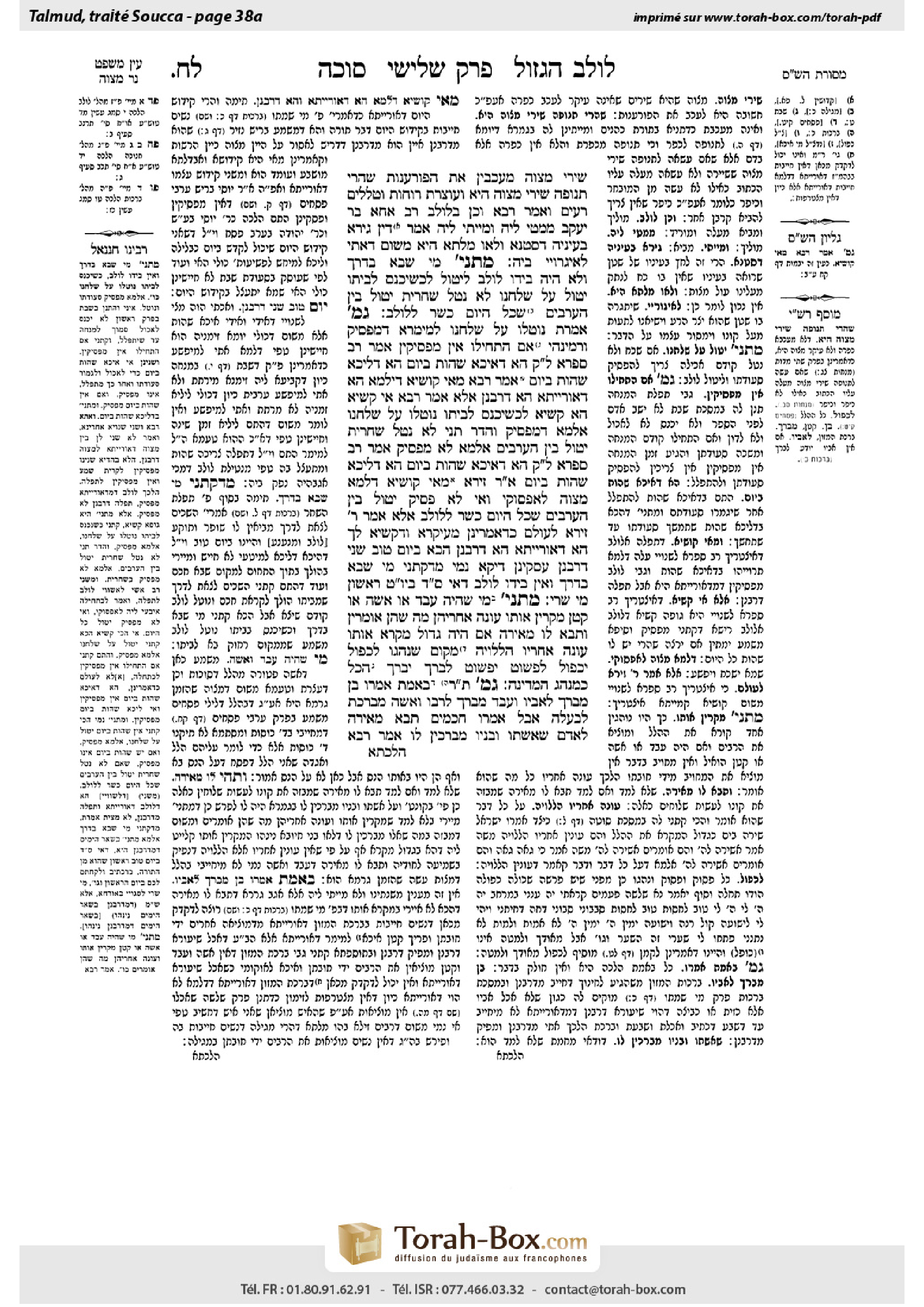
Sukkah 38a: Talmud study for Daf Yomi
Daf Yomi is the daily study of one Talmud folio. Explore 37 tractates with scans, Hebrew text, Sefaria English and AI-generated French translations where annotated.
Passage selection and English or AI-generated French translation are available where the scan has annotations. Daf Study is independent of Torah-Box and Sefaria.
Browse Sukkah · סוכה · All tractatesSukkah 38a text and translations
This page of Sukkah includes the Aramaic text, an English translation and an AI-generated French translation, alongside the scan above.
סוכה ל״ח א · Aramaic and Hebrew text
שְׁיָרֵי מִצְוָה מְעַכְּבִין אֶת הַפּוּרְעָנוּת. שֶׁהֲרֵי תְּנוּפָה שְׁיָרֵי מִצְוָה הִיא — וְעוֹצֶרֶת רוּחוֹת וּטְלָלִים רָעִים. וְאָמַר רָבָא: וְכֵן בְּלוּלָב. רַב אַחָא בַּר יַעֲקֹב מַמְטֵי לֵיהּ וּמַיְיתֵי לֵיהּ, אֲמַר: דֵּין גִּירָא בְּעֵינֵיהּ דְּסִטְנָא. וְלָאו מִלְּתָא הִיא, מִשּׁוּם דְּאָתֵי לְאִיגָּרוֹיֵי בֵּיהּ.
מַתְנִי׳ מִי שֶׁבָּא בַּדֶּרֶךְ וְלֹא הָיָה בְּיָדוֹ לוּלָב לִיטּוֹל — לִכְשֶׁיִּכָּנֵס לְבֵיתוֹ, יִטּוֹל עַל שֻׁלְחָנוֹ. לֹא נָטַל שַׁחֲרִית — יִטּוֹל בֵּין הָעַרְבַּיִם, שֶׁכׇּל הַיּוֹם כָּשֵׁר לְלוּלָב.
גְּמָ׳ אָמְרַתְּ, נוֹטְלוֹ עַל שֻׁלְחָנוֹ; לְמֵימְרָא דְּמַפְסֵיק? וּרְמִינְהִי: אִם הִתְחִילוּ — אֵין מַפְסִיקִין! אָמַר רַב סָפְרָא: לָא קַשְׁיָא, הָא — דְּאִיכָּא שְׁהוּת בַּיּוֹם, הָא — דְּלֵיכָּא שְׁהוּת בַּיּוֹם.
אָמַר רָבָא: מַאי קוּשְׁיָא? דִּילְמָא הָא דְּאוֹרָיְיתָא, הָא דְּרַבָּנַן. אֶלָּא אָמַר רָבָא: אִי קַשְׁיָא — הָא קַשְׁיָא: לִכְשֶׁיִּכָּנֵס לְבֵיתוֹ — נוֹטְלוֹ עַל שֻׁלְחָנוֹ, אַלְמָא דְּמַפְסֵיק, וַהֲדַר תָּנֵי: לֹא נָטַל שַׁחֲרִית — יִטּוֹל בֵּין הָעַרְבַּיִם. אַלְמָא לָא מַפְסֵיק!
אָמַר רַב סָפְרָא: לָא קַשְׁיָא, הָא — דְּאִיכָּא שְׁהוּת בַּיּוֹם, הָא — דְּלֵיכָּא שְׁהוּת בַּיּוֹם.
אָמַר רַבִּי זֵירָא: מַאי קוּשְׁיָא? דִּלְמָא: מִצְוָה לְאַפְסוֹקֵי, וְאִי לָא פְּסַיק — יִטּוֹל בֵּין הָעַרְבַּיִם, שֶׁכׇּל הַיּוֹם כָּשֵׁר לְלוּלָב. אֶלָּא אָמַר רַבִּי זֵירָא: לְעוֹלָם כִּדְאָמְרִינַן מֵעִיקָּרָא, וּדְקַשְׁיָא לָךְ הָא דְּאוֹרָיְיתָא הָא דְּרַבָּנַן — הָכָא בְּיוֹם טוֹב שֵׁנִי דְּרַבָּנַן עָסְקִינַן.
דַּיְקָא נָמֵי, מִדְּקָתָנֵי: מִי שֶׁבָּא בַּדֶּרֶךְ וְאֵין בְּיָדוֹ לוּלָב. דְּאִי סָלְקָא דַעְתָּךְ בְּיוֹם טוֹב רִאשׁוֹן — מִי שְׁרֵי?!
מַתְנִי׳ מִי שֶׁהָיָה עֶבֶד אוֹ אִשָּׁה אוֹ קָטָן מַקְרִין אוֹתוֹ — עוֹנֶה אַחֲרֵיהֶן מַה שֶּׁהֵן אוֹמְרִין, וְתָבֹא לוֹ מְאֵירָה. אִם הָיָה גָּדוֹל מַקְרֶא אוֹתוֹ, עוֹנֶה אַחֲרָיו ״הַלְלוּיָהּ״. מָקוֹם שֶׁנָּהֲגוּ לִכְפּוֹל — יִכְפּוֹל, לִפְשׁוֹט — יִפְשׁוֹט, לְבָרֵךְ — יְבָרֵךְ, הַכֹּל כְּמִנְהַג הַמְּדִינָה.
גְּמָ׳ תָּנוּ רַבָּנַן: בֶּאֱמֶת אָמְרוּ בֵּן מְבָרֵךְ לְאָבִיו. וְעֶבֶד מְבָרֵךְ לְרַבּוֹ, וְאִשָּׁה מְבָרֶכֶת לְבַעְלָהּ, אֲבָל אָמְרוּ חֲכָמִים: תָּבֹא מְאֵירָה לְאָדָם שֶׁאִשְׁתּוֹ וּבָנָיו מְבָרְכִין לוֹ.
אָמַר רָבָא:
Sukkah 38a · English translation
non-essential aspects of a mitzva avert calamity, as waving is a non-essential aspect of the mitzva, since even if one failed to wave the loaves he fulfilled his obligation, and nevertheless it halts harmful winds and dews. And Rava said: And likewise one should conduct himself the same way with a lulav, i.e., one should wave it to and fro and raise and lower it for the same reasons. When Rav Aḥa bar Ya’akov would move the lulav to and fro, he would say: This is an arrow in the eye of Satan, as despite his best efforts, the Jewish people continue to joyously fulfill mitzvot. The Gemara notes: That is not a proper manner of conduct, as it will induce Satan to come to incite him to sin. Gloating due to his victory over the evil inclination will lead Satan to redouble his efforts to corrupt him.
MISHNA: With regard to one who was coming along the way and did not have a lulav in his hand to take and fulfill the mitzva while traveling, when he enters his house to eat, he should take the lulav at his table. He interrupts his meal to fulfill the mitzva of lulav. If he did not take the lulav in the morning, he should take it in the afternoon, as the entire day is suited for fulfilling the mitzva of lulav.
GEMARA: The Gemara analyzes the mishna. On one hand, you said that if he did not take the lulav before the meal then he takes it at his table. That is to say that if remembers that he did not yet take the lulav, he interrupts his meal, takes the lulav, and then continues his meal. And the Gemara raises a contradiction from a mishna (Shabbat 9b): One may not begin to eat before he recites the afternoon prayer; however, if they started a meal, they need not interrupt the meal in order to pray. Rav Safra said: This is not difficult, as that mishna, where one need not interrupt his meal, is referring to a case where there is opportunity to pray later in the day; this mishna, where one must interrupt his meal, is referring to a case where there is no opportunity to take the lulav later in the day. In that case, one must fulfill the mitzva immediately.
Rava said: What is the difficulty? The two cases are different, and there is no contradiction at all. Perhaps this mitzva of lulav is a mitzva by Torah law, and therefore one must interrupt his meal to take the lulav, while that mitzva to recite the afternoon prayer is a mitzva by rabbinic law, and therefore one need not interrupt his meal to pray. Rather, Rava said: If there is a difficulty, i.e., a contradiction, this is the difficulty: In the first clause in the mishna it says that when he enters his house to eat, he should take the lulav at his table. Apparently, one must interrupt his meal. And then in the latter clause of the mishna it is taught: If he did not take the lulav in the morning, he should take it in the afternoon. Apparently, he need not interrupt his meal.
Resolving the contradiction, Rav Safra said: This is not difficult. This clause, where one need not interrupt his meal, is referring to a case where there is opportunity to take the lulav later in the day; that clause, where one must interrupt his meal, is referring to a case where there is no opportunity to take the lulav later in the day.
Rabbi Zeira said: What is the difficulty? There is no contradiction, as perhaps the mishna is teaching that there is a mitzva to interrupt one’s meal and take the lulav; but if he did not interrupt his meal he should take it in the afternoon, as the entire day is suited for fulfilling the mitzva of lulav. Rather, Rabbi Zeira said: Actually, the contradiction is as we said initially, between the ruling with regard to lulav and the ruling with regard to the afternoon prayer. And as to that which you found difficult, i.e., there is no contradiction at all, as this mitzva of lulav is a mitzva by Torah law and that mitzva to recite the afternoon prayer is a mitzva by rabbinic law, that is not difficult; as here, in the case of lulav, we are dealing with the second day of the Festival and beyond, during the intermediate days, when the mitzva of lulav is by rabbinic law. The contradiction is therefore between the rulings pertaining to two mitzvot by rabbinic law.
The language of the mishna is also precise and indicates that it is dealing with the intermediate days of the Festival from the fact that it teaches: One who was coming along the way and does not have a lulav in his hand. As, if it enters your mind to say that the mishna is referring to the first day of the Festival, is it permitted to travel a long distance on that day? Rather, it is referring to the intermediate days.
MISHNA: With regard to one for whom a Canaanite slave, a woman, or a minor was reciting hallel, he repeats after them what they are saying word for word. The mishna notes: And may a curse come to him for being so ignorant that he needs them to recite it for him. If an adult male was reciting hallel on his behalf, he need not repeat each word, as the adult male can fulfill the obligation to recite hallel on his behalf. Rather, he simply answers: Halleluya, to each phrase that is recited. In a place where they were accustomed to repeat certain verses, he, too, should repeat them. If the custom is to recite them plainly, without repetition, he should recite them plainly. In a place where the custom is to recite a blessing when reciting hallel, he should recite a blessing. Everything is in accordance with the local custom in these matters.
GEMARA: The Sages taught: Actually, they said that a son may recite a blessing on behalf of his father, and a slave may recite a blessing on behalf of his master, and a woman may recite a blessing on behalf of her husband, but the Sages said: May a curse come to a man who, due to his ignorance, requires his wife and children to recite a blessing on his behalf.
Rava said:
Sukkah 38a · Traduction française (IA)
Les aspects non indispensables d’une mitsva écartent les calamités. Ainsi, l’agitation est un aspect non indispensable de la mitsva, puisque même si l’on n’agitait pas les pains, on s’acquitterait de son obligation ; pourtant, elle arrête les vents nuisibles et les rosées. Rava dit également qu’il faut agir de la même manière avec le loulav, c’est-à-dire l’agiter d’avant en arrière, puis le lever et l’abaisser, pour les mêmes raisons. Lorsque Rav Aḥa bar Ya’akov agitait le loulav d’avant en arrière, il disait : « C’est une flèche dans l’œil de Satan », car, malgré tous ses efforts, le peuple juif continue d’accomplir les mitsvot avec joie. La Guemara fait remarquer que ce n’est pas une conduite convenable, car cela incitera Satan à venir le pousser à pécher. Se réjouir de sa victoire sur le penchant au mal conduira Satan à redoubler d’efforts pour le pervertir.
MICHNA : Celui qui était en chemin et n’avait pas de loulav en main pour accomplir la mitsva pendant son trajet, lorsqu’il entre chez lui pour manger, prend le loulav à sa table. Il interrompt son repas pour accomplir la mitsva du loulav. S’il n’a pas pris le loulav le matin, il le prend l’après-midi, car toute la journée convient à l’accomplissement de la mitsva du loulav.
GUEMARA : La Guemara analyse la Michna. D’un côté, tu as dit que s’il n’a pas pris le loulav avant le repas, il le prend à sa table. Cela signifie que, s’il se souvient qu’il n’a pas encore pris le loulav, il interrompt son repas, prend le loulav, puis reprend son repas. La Guemara soulève une contradiction à partir d’une Michna (Chabbat 9b) : On ne peut pas commencer à manger avant d’avoir récité la prière de l’après-midi ; toutefois, si l’on a commencé un repas, il n’est pas nécessaire de l’interrompre pour prier. Rav Safra dit : Ce n’est pas difficile, car cette Michna, selon laquelle il n’est pas nécessaire d’interrompre son repas, concerne un cas où l’on peut prier plus tard dans la journée ; la Michna dont il est question ici, selon laquelle il faut interrompre son repas, concerne un cas où l’on ne peut pas prendre le loulav plus tard dans la journée. Dans ce cas, il faut accomplir la mitsva immédiatement.
Rava dit : Quelle est la difficulté ? Les deux cas sont différents et ne présentent aucune contradiction. Peut-être la mitsva du loulav est-elle une mitsva imposée par la Torah, et faut-il donc interrompre son repas pour prendre le loulav, tandis que la mitsva de réciter la prière de l’après-midi est d’origine rabbinique ; il n’est donc pas nécessaire d’interrompre son repas pour prier. Rava dit plutôt : S’il y a une difficulté, c’est-à-dire une contradiction, la voici : dans la première partie de la Michna, il est dit que lorsqu’il entre chez lui pour manger, il doit prendre le loulav à sa table. Il semble donc qu’il faille interrompre son repas. Puis, dans la dernière partie de la Michna, il est enseigné : S’il n’a pas pris le loulav le matin, il le prend l’après-midi. Il semble donc qu’il ne soit pas nécessaire d’interrompre son repas.
Pour résoudre la contradiction, Rav Safra dit : Ce n’est pas difficile. Cette partie, selon laquelle il n’est pas nécessaire d’interrompre son repas, concerne un cas où l’on peut prendre le loulav plus tard dans la journée ; l’autre partie, selon laquelle il faut interrompre son repas, concerne un cas où l’on ne peut pas prendre le loulav plus tard dans la journée.
Rabbi Zeira dit : Quelle est la difficulté ? Il n’y a pas de contradiction, car peut-être la Michna enseigne-t-elle qu’il y a une mitsva d’interrompre son repas pour prendre le loulav ; mais s’il n’a pas interrompu son repas, il le prend l’après-midi, puisque toute la journée convient à l’accomplissement de la mitsva du loulav. Rabbi Zeira dit plutôt : En réalité, la contradiction est celle que nous avons évoquée au départ, entre la règle relative au loulav et celle qui concerne la prière de l’après-midi. Quant à l’objection selon laquelle il n’y aurait en fait aucune contradiction, puisque la mitsva du loulav est imposée par la Torah tandis que celle de réciter la prière de l’après-midi est d’origine rabbinique, elle ne tient pas : ici, dans le cas du loulav, nous parlons du deuxième jour de la fête et des jours suivants, pendant les jours intermédiaires, où la mitsva du loulav est d’origine rabbinique. La contradiction porte donc sur les règles relatives à deux mitsvot d’origine rabbinique.
La formulation de la Michna est également précise et indique qu’elle traite des jours intermédiaires de la fête, puisqu’elle enseigne : « Celui qui était en chemin et n’a pas de loulav en main. » En effet, si l’on envisage que la Michna parle du premier jour de la fête, serait-il permis de parcourir une longue distance ce jour-là ? Elle parle donc des jours intermédiaires.
MICHNA : Si un esclave cananéen, une femme ou un mineur récite le Hallel pour quelqu’un, celui-ci répète après eux, mot pour mot, ce qu’ils disent. La Michna ajoute : Qu’une malédiction s’abatte sur lui, puisqu’il est si ignorant qu’il a besoin qu’on le lui récite. Si un homme adulte récite le Hallel pour lui, il n’a pas besoin de répéter chaque mot, car cet homme adulte peut s’acquitter pour lui de l’obligation de réciter le Hallel. Il se contente plutôt de répondre « Halleluya » à chaque phrase récitée. Dans un lieu où l’on a coutume de répéter certains versets, lui aussi doit les répéter. Si l’usage est de les réciter sans répétition, il doit les réciter sans répétition. Dans un lieu où l’usage est de réciter une bénédiction en récitant le Hallel, il doit réciter une bénédiction. Pour ces questions, tout dépend de l’usage local.
GUEMARA : Les Sages ont enseigné : En réalité, ils ont dit qu’un fils peut réciter une bénédiction pour son père, qu’un esclave peut réciter une bénédiction pour son maître et qu’une femme peut réciter une bénédiction pour son mari ; mais les Sages ont dit : Qu’une malédiction s’abatte sur l’homme qui, par ignorance, a besoin que sa femme et ses enfants récitent une bénédiction pour lui.
Rava dit :
Traduction française générée par IA à partir de l’édition anglaise de Sefaria. Vérifie toujours un passage avec le texte source.
Text from Sefaria: William Davidson Edition - Vocalized Aramaic (CC BY NC); William Davidson Edition - English (CC BY NC).