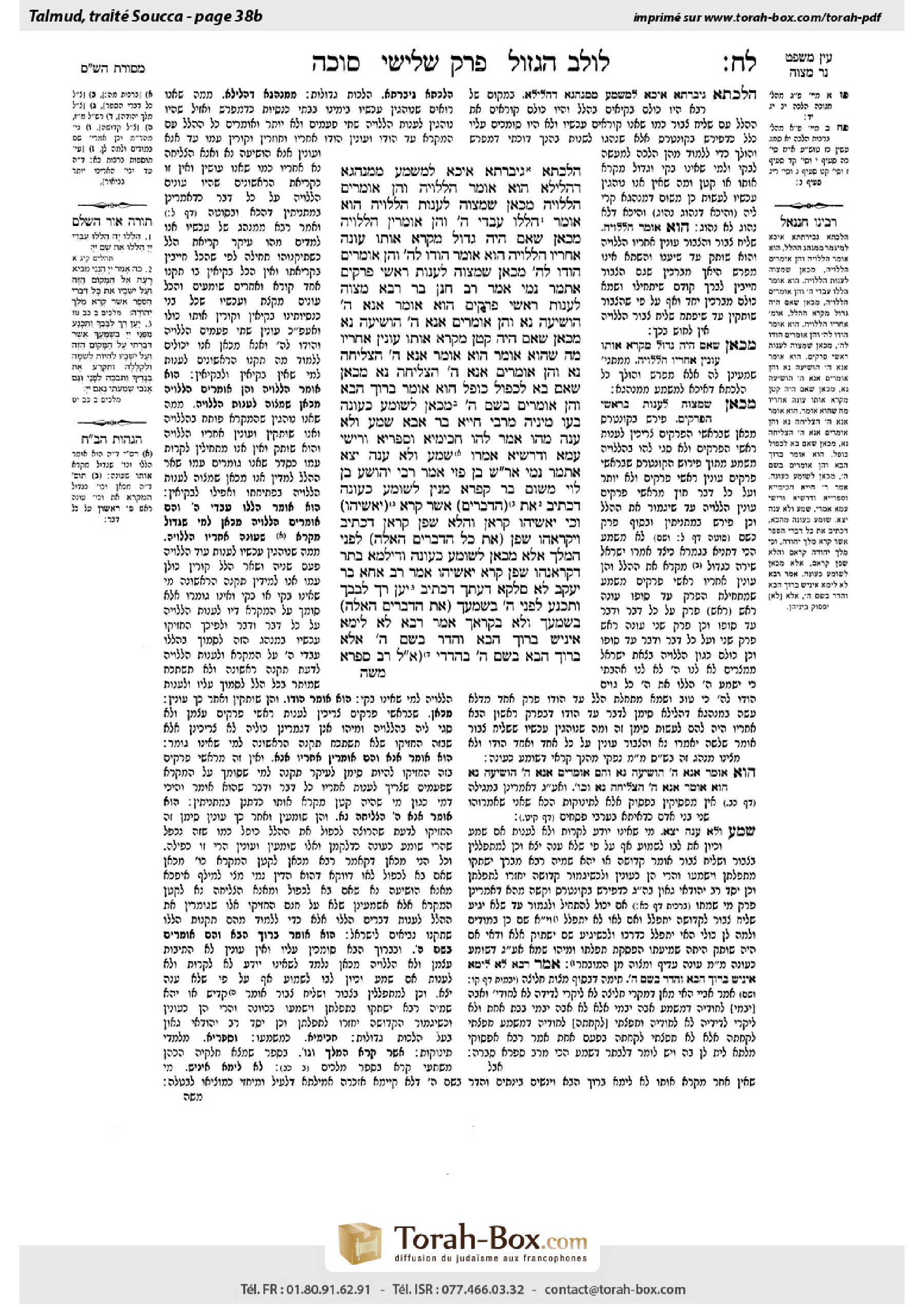
Sukkah 38b: Talmud study for Daf Yomi
Daf Yomi is the daily study of one Talmud folio. Explore 37 tractates with scans, Hebrew text, Sefaria English and AI-generated French translations where annotated.
Passage selection and English or AI-generated French translation are available where the scan has annotations. Daf Study is independent of Torah-Box and Sefaria.
Browse Sukkah · סוכה · All tractatesSukkah 38b text and translations
This page of Sukkah includes the Aramaic text, an English translation and an AI-generated French translation, alongside the scan above.
סוכה ל״ח ב · Aramaic and Hebrew text
הִלְכְתָא גִּיבָּרָתָא אִיכָּא לְמִשְׁמַע מִמִּנְהֲגָא דְהַלֵּילָא. הוּא אוֹמֵר: ״הַלְלוּיָהּ״, וְהֵן אוֹמְרִים: ״הַלְלוּיָהּ״ — מִכָּאן שֶׁמִּצְוָה לַעֲנוֹת ״הַלְלוּיָהּ״.
הוּא אוֹמֵר: ״הַלָּלוּ עַבְדֵי ה׳״, וְהֵן אוֹמְרִין: ״הַלְלוּיָהּ״ — מִכָּאן שֶׁאִם הָיָה גָּדוֹל מַקְרֶא אוֹתוֹ, עוֹנֶה אַחֲרָיו ״הַלְלוּיָהּ״. הוּא אוֹמֵר: ״הוֹדוּ לַה׳״, וְהֵן אוֹמְרִים: ״הוֹדוּ לַה׳״ — מִכָּאן שֶׁמִּצְוָה לַעֲנוֹת רָאשֵׁי פְרָקִים. אִתְּמַר נָמֵי, אָמַר רַב חָנָן בַּר רָבָא: מִצְוָה לַעֲנוֹת רָאשֵׁי פְרָקִים.
הוּא אוֹמֵר: ״אָנָא ה׳ הוֹשִׁיעָה נָּא״, וְהֵן אוֹמְרִים: ״אָנָּא ה׳ הוֹשִׁיעָה נָּא״, — מִכָּאן שֶׁאִם הָיָה קָטָן מַקְרֶא אוֹתוֹ, עוֹנִין אַחֲרָיו מַה שֶׁהוּא אוֹמֵר.
הוּא אוֹמֵר: ״אָנָא ה׳ הַצְלִיחָה נָּא״ וְהֵן אוֹמְרִים: ״אָנָּא ה׳ הַצְלִיחָה נָּא״, מִכָּאן שֶׁאִם בָּא לִכְפּוֹל — כּוֹפֵל. הוּא אוֹמֵר: ״בָּרוּךְ הַבָּא״, וְהֵן אוֹמְרִים: ״בְּשֵׁם ה׳״ — מִכָּאן לְשׁוֹמֵעַ כְּעוֹנֶה.
בְּעוֹ מִינֵּיהּ מֵרַבִּי חִיָּיא בַּר אַבָּא: שָׁמַע וְלֹא עָנָה, מַהוּ? אֲמַר לְהוּ: חַכִּימַיָּא וְסָפְרַיָּא וְרֵישֵׁי עַמָּא וְדָרָשַׁיָּא אָמְרוּ: שָׁמַע וְלֹא עָנָה — יָצָא.
אִתְּמַר נָמֵי, אָמַר רַבִּי שִׁמְעוֹן בֶּן פַּזִּי אָמַר רַבִּי יְהוֹשֻׁעַ בֶּן לֵוִי מִשּׁוּם בַּר קַפָּרָא: מִנַּיִן לְשׁוֹמֵעַ כְּעוֹנֶה — דִּכְתִיב: ״אֶת (הַדְּבָרִים) אֲשֶׁר קָרָא (יֹאשִׁיָּהוּ)״. וְכִי יֹאשִׁיָּהוּ קְרָאָן? וַהֲלֹא שָׁפָן קְרָאָן, דִּכְתִיב: ״וַיִּקְרָאֵהוּ שָׁפָן (אֵת כׇּל הַדְּבָרִים הָאֵלֶּה) לִפְנֵי הַמֶּלֶךְ״. אֶלָּא, מִכָּאן לְשׁוֹמֵעַ כְּעוֹנֶה.
וְדִילְמָא בָּתַר דִּקְרָאנְהוּ שָׁפָן קְרָא יֹאשִׁיָּהוּ? אָמַר רַב אַחָא בַּר יַעֲקֹב: לָא סָלְקָא דַּעְתָּךְ, דִּכְתִיב: ״יַעַן רַךְ לְבָבְךָ וַתִּכָּנַע לִפְנֵי ה׳ בְּשׇׁמְעֲךָ (אֶת הַדְּבָרִים הָאֵלֶּה)״ — ״בְּשׇׁמְעֲךָ״ וְלָא ״בְּקׇרְאֲךָ״.
אָמַר רָבָא: לָא לֵימָא אִינִישׁ ״בָּרוּךְ הַבָּא״ וַהֲדַר ״בְּשֵׁם ה׳״, אֶלָּא ״בָּרוּךְ הַבָּא בְּשֵׁם ה׳״, בַּהֲדָדֵי. (אֲמַר לֵיהּ רַב סָפְרָא:
Sukkah 38b · English translation
Many significant halakhot can be learned from the custom of hallel based on the manner in which it was recited. In reciting hallel there are allusions to several halakhic matters and customs that the Sages instituted due to circumstances extant at the time. Although due to increased literacy and familiarity with the hallel liturgy the reasons no longer apply, these customs remain in practice. The prayer leader recites: “Halleluya” (Psalms 113:1), and the congregation recites: Halleluya, in response. From here is the source that there is a mitzva to respond: Halleluya.
Likewise, the prayer leader recites: “Give praise, servants of the Lord” (Psalms 113:1), and the congregation recites: Halleluya, in response. From here is the source of the halakha cited in the mishna that if an adult male was reciting hallel on his behalf, he answers: Halleluya. He recites: “Thank the Lord, for He is good” (Psalms 118:1), and they respond: “Thank the Lord, for He is good.” From here is the source that there is a mitzva to respond by reciting the beginnings of chapters. It was also stated that Rav Ḥanan bar Rava said: There is a mitzva to respond by reciting the beginnings of chapters.
Rava continued to cite the significant halakhot learned from hallel. The prayer leader recites: “Lord, please save us” (Psalms 118:25), and the congregation recites: “Lord, please save us,” in response. From here is the source of the halakha cited in the mishna that if a minor was reciting a portion that is not from the beginning of a chapter on one’s behalf, he recites after him precisely what he says.
The prayer leader recites: “Lord, please grant us success,” and the congregation recites in response: “Lord, please grant us success” (Psalms 118:25). From here is the source of the halakha that if one comes to repeat a particular verse in hallel twice, he may repeat it. The prayer leader recites: “Blessed is one who comes” (Psalms 118:26), and the congregation recites the rest of the verse: “In the name of the Lord” (Psalms 118:26), in response. From here is the source of the halakha that the halakhic status of one who hears a passage recited is equivalent to that of one who recites it, as the congregation fulfills its obligation even though it does not repeat the entire verse.
Apropos this halakha, the Gemara relates that the Sages raised a dilemma before Rabbi Ḥiyya bar Abba: If one heard a passage recited and did not recite it himself, what is the halakha? Did he fulfill his obligation or not? He said to them that the Sages, and the schoolteachers, and the heads of the nation, and the homiletic interpreters said: One who heard a passage recited and did not recite it himself fulfilled his obligation.
It was also stated that Rabbi Shimon ben Pazi said that Rabbi Yehoshua ben Levi said in the name of Bar Kappara: From where is it derived that the halakhic status of one who hears a passage recited is equivalent to that of one who recites it? It is as it is written: “All the words of the book which the king of Judea has read” (II Kings 22:16). And did King Josiah read them? Didn’t Shaphan read them, as it is written: “And Shaphan read it before the king” (II Kings 22:10)? Rather, from here it is derived that the halakhic status of one who hears a passage recited is equivalent to that of one who recites it, and it is as though Josiah read the words himself.
The Gemara asks: And perhaps after Shaphan read them Josiah read them again? Rav Aḥa bar Ya’akov said: It should not enter your mind to say so, as it is written: “Because your heart was tender and you humbled yourself before the Lord when you heard what I spoke in this place” (II Kings 22:19). The Gemara infers: “When you heard” is written in the verse, and not: When you read. In other words, immediately upon hearing Shaphan read the text, King Josiah sent for Huldah the prophetess, which shows that he humbled his heart. Clearly, the halakhic status of one who hears a passage recited is equivalent to that of one who recites it.
Apropos hallel, the Gemara cites additional halakhot. Rava said: Let a person not recite: “Blessed is one who comes,” and then, after pausing, recite: “In the name of the Lord.” Rather, let him recite without pause: “Blessed is one who comes in the name of the Lord.” Rav Safra said to Rava:
Sukkah 38b · Traduction française (IA)
De nombreuses halakhot importantes peuvent être déduites de la manière dont on avait coutume de réciter le hallel. La récitation du hallel renvoie à plusieurs questions halakhiques et à des coutumes instituées par les Sages en raison des circonstances qui prévalaient à l’époque. Bien que, du fait de l’alphabétisation croissante et d’une meilleure connaissance de la liturgie du hallel, les raisons de ces coutumes ne s’appliquent plus, celles-ci restent en vigueur. L’officiant récite : « Halleluya » (Psaumes 113,1), et l’assemblée répond : « Halleluya ». On en déduit qu’il y a une mitsva de répondre : « Halleluya ».
De même, l’officiant récite : « Louez, serviteurs du Seigneur » (Psaumes 113,1), et l’assemblée répond : « Halleluya ». On en déduit la halakha citée dans la Michna : si un homme adulte récite le hallel pour quelqu’un, celui-ci répond : « Halleluya ». L’officiant récite : « Rendez grâce au Seigneur, car Il est bon » (Psaumes 118,1), et l’assemblée répond : « Rendez grâce au Seigneur, car Il est bon ». On en déduit qu’il y a une mitsva de répondre en récitant les débuts de chapitres. Rav Ḥanan bar Rava a également dit : il y a une mitsva de répondre en récitant les débuts de chapitres.
Rava poursuivit en citant les halakhot importantes que l’on peut déduire du hallel. L’officiant récite : « Seigneur, je T’en prie, sauve-nous » (Psaumes 118,25), et l’assemblée répond : « Seigneur, je T’en prie, sauve-nous ». On en déduit la halakha citée dans la Michna : si un mineur récite pour quelqu’un un passage qui ne commence pas au début d’un chapitre, celui-ci répète après lui exactement ce qu’il dit.
L’officiant récite : « Seigneur, je T’en prie, accorde-nous la réussite », et l’assemblée répond : « Seigneur, je T’en prie, accorde-nous la réussite » (Psaumes 118,25). On en déduit la halakha selon laquelle celui qui souhaite répéter deux fois un verset particulier du hallel peut le faire. L’officiant récite : « Béni soit celui qui vient » (Psaumes 118,26), et l’assemblée répond par la suite du verset : « Au nom du Seigneur » (Psaumes 118,26). On en déduit la halakha selon laquelle celui qui entend un passage récité a le même statut halakhique que celui qui le récite, puisque l’assemblée s’acquitte de son obligation bien qu’elle ne répète pas le verset entier.
À propos de cette halakha, la Guemara rapporte que les Sages posèrent cette question à Rabbi Ḥiyya bar Abba : si quelqu’un entend un passage récité sans le réciter lui-même, quelle est la halakha ? S’est-il acquitté de son obligation ou non ? Il leur répondit que les Sages, les maîtres d’école, les chefs de la nation et les interprètes homilétiques ont dit : celui qui entend un passage récité sans le réciter lui-même s’est acquitté de son obligation.
Il a également été rapporté que Rabbi Shimon ben Pazi a dit au nom de Rabbi Yehoshua ben Levi, qui le tenait de Bar Kappara : d’où déduit-on que celui qui entend un passage récité a le même statut halakhique que celui qui le récite ? Du verset : « Toutes les paroles du livre que le roi de Juda a lues » (II Rois 22,16). Mais le roi Josias les a-t-il lues ? N’est-ce pas Shaphan qui les a lues, comme il est écrit : « Et Shaphan le lut devant le roi » (II Rois 22,10) ? On en déduit plutôt que celui qui entend un passage récité a le même statut halakhique que celui qui le récite, et que c’est comme si Josias avait lu lui-même ces paroles.
La Guemara demande : et peut-être Josias les a-t-il lues à nouveau après que Shaphan les eut lues ? Rav Aḥa bar Ya’akov dit : qu’il ne te vienne pas à l’esprit de dire cela, car il est écrit : « Parce que ton cœur a été sensible et que tu t’es humilié devant le Seigneur lorsque tu as entendu ce que j’ai dit en ce lieu » (II Rois 22,19). La Guemara déduit que le verset dit : « lorsque tu as entendu », et non : « lorsque tu as lu ». Autrement dit, dès qu’il eut entendu Shaphan lire le texte, le roi Josias envoya chercher la prophétesse Houlda, ce qui montre qu’il avait humilié son cœur. Il est donc clair que celui qui entend un passage récité a le même statut halakhique que celui qui le récite.
À propos du hallel, la Guemara cite d’autres halakhot. Rava dit : qu’une personne ne récite pas : « Béni soit celui qui vient », puis, après une pause : « au nom du Seigneur ». Qu’elle récite plutôt sans pause : « Béni soit celui qui vient au nom du Seigneur ». Rav Safra dit à Rava :
Traduction française générée par IA à partir de l’édition anglaise de Sefaria. Vérifie toujours un passage avec le texte source.
Text from Sefaria: William Davidson Edition - Vocalized Aramaic (CC BY NC); William Davidson Edition - English (CC BY NC).