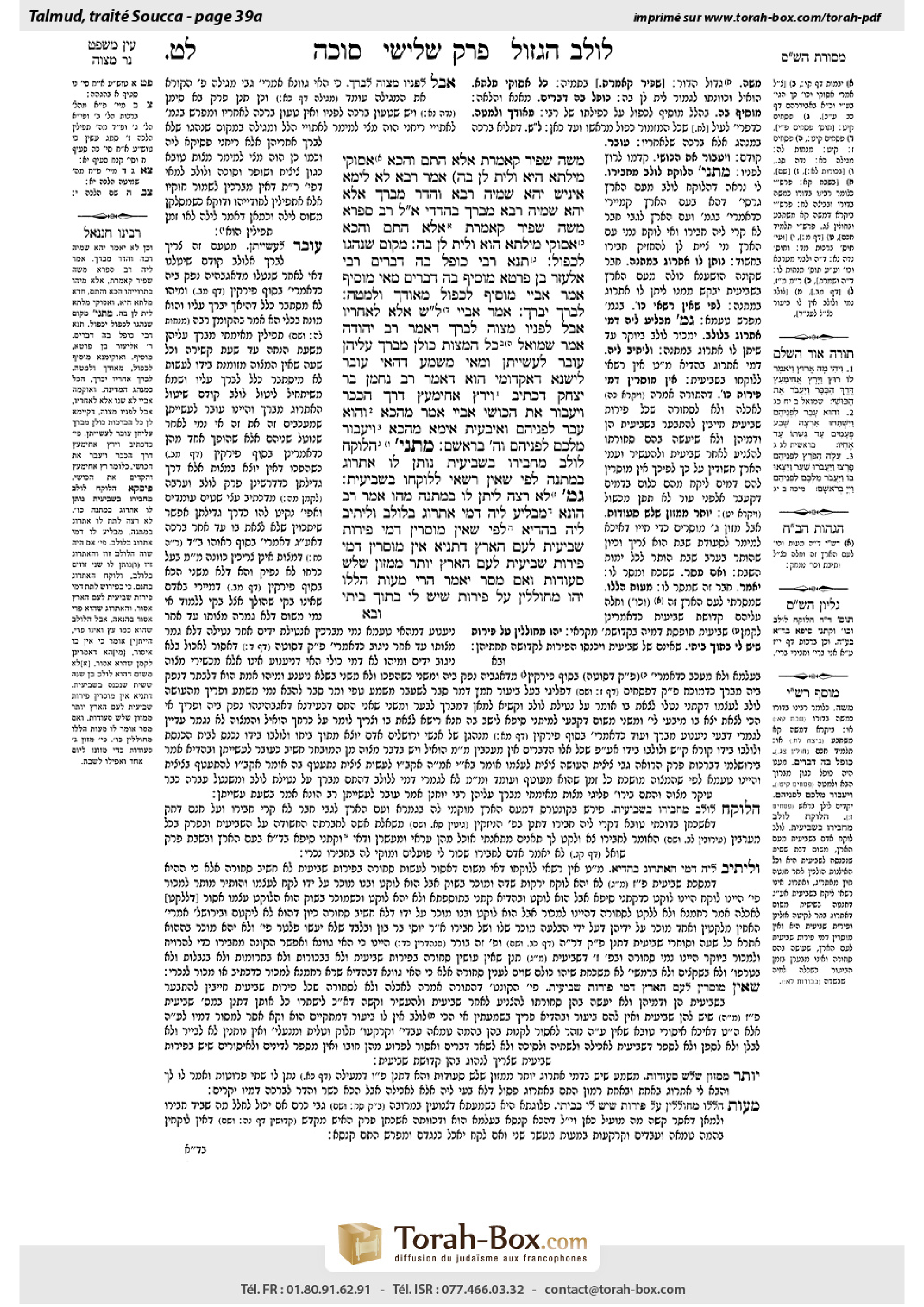
Sukkah 39a: Talmud study for Daf Yomi
Daf Yomi is the daily study of one Talmud folio. Explore 37 tractates with scans, Hebrew text, Sefaria English and AI-generated French translations where annotated.
Passage selection and English or AI-generated French translation are available where the scan has annotations. Daf Study is independent of Torah-Box and Sefaria.
Browse Sukkah · סוכה · All tractatesSukkah 39a text and translations
This page of Sukkah includes the Aramaic text, an English translation and an AI-generated French translation, alongside the scan above.
סוכה ל״ט א · Aramaic and Hebrew text
מֹשֶׁה, שַׁפִּיר קָאָמְרַתְּ?! אֶלָּא הָתָם וְהָכָא אַסּוֹקֵי מִילְּתָא הִיא, וְלֵית לַן בַּהּ). אָמַר רָבָא: לָא לֵימָא אִינִישׁ ״יְהֵא שְׁמֵיהּ רַבָּא״ וַהֲדַר ״מְבָרַךְ״, אֶלָּא ״יְהֵא שְׁמֵיהּ רַבָּא מְבָרַךְ״ בַּהֲדָדֵי. אֲמַר לֵיהּ רַב סָפְרָא: מֹשֶׁה, שַׁפִּיר קָאָמְרַתְּ?! אֶלָּא, הָתָם וְהָכָא אַסּוֹקֵי מִילְּתָא הוּא, וְלֵית לַן בַּהּ.
מָקוֹם שֶׁנָּהֲגוּ לִכְפּוֹל. תָּנָא: רַבִּי כּוֹפֵל בָּהּ דְּבָרִים. רַבִּי אֶלְעָזָר בֶּן פַּרְטָא מוֹסִיף בָּהּ דְּבָרִים. מַאי מוֹסִיף? אָמַר אַבָּיֵי: מוֹסִיף לִכְפּוֹל מֵ״אוֹדְךָ״ וּלְמַטָּה.
לְבָרֵךְ — יְבָרֵךְ. אֲמַר אַבָּיֵי: לֹא שָׁנוּ אֶלָּא לְאַחֲרָיו, אֲבָל לְפָנָיו — מִצְוָה לְבָרֵךְ. דְּאָמַר רַב יְהוּדָה אָמַר שְׁמוּאֵל: כׇּל הַמִּצְוֹת כּוּלָּן, מְבָרֵךְ עֲלֵיהֶן עוֹבֵר לַעֲשִׂיָּיתָן. וּמַאי מַשְׁמַע דְּהַאי ״עוֹבֵר״, לִישָּׁנָא דְּאַקְדּוֹמֵי הוּא? דְּאָמַר רַב נַחְמָן בַּר יִצְחָק דִּכְתִיב: ״וַיָּרׇץ אֲחִימַעַץ דֶּרֶךְ הַכִּכָּר וַיַּעֲבוֹר אֶת הַכּוּשִׁי״. אַבָּיֵי אָמַר, מֵהָכָא: ״וְהוּא עָבַר לִפְנֵיהֶם״. וְאִיבָּעֵית אֵימָא מֵהָכָא: ״וַיַּעֲבוֹר מַלְכָּם לִפְנֵיהֶם וַה׳ בְּרֹאשָׁם״.
מַתְנִי׳ הַלּוֹקֵחַ לוּלָב מֵחֲבֵירוֹ בַּשְּׁבִיעִית — נוֹתֵן לוֹ אֶתְרוֹג בְּמַתָּנָה, לְפִי שֶׁאֵין רַשַּׁאי לְלוֹקְחוֹ בַּשְּׁבִיעִית.
גְּמָ׳ לֹא רָצָה לִיתֵּן לוֹ בְּמַתָּנָה, מַהוּ? אָמַר רַב הוּנָא: מַבְלַיע לֵיהּ דְּמֵי אֶתְרוֹג בְּלוּלָב. וְלִיתֵּיב לֵיהּ בְּהֶדְיָא?
לְפִי שֶׁאֵין מוֹסְרִין דְּמֵי פֵּירוֹת שְׁבִיעִית לְעַם הָאָרֶץ. דְּתַנְיָא: אֵין מוֹסְרִין דְּמֵי פֵּירוֹת שְׁבִיעִית לְעַם הָאָרֶץ יוֹתֵר מִמְּזוֹן שָׁלֹשׁ סְעוּדוֹת. וְאִם מָסַר, יֹאמַר: הֲרֵי מָעוֹת הַלָּלוּ יְהוּ מְחוּלָּלִין עַל פֵּירוֹת שֶׁיֵּשׁ לִי בְּתוֹךְ בֵּיתִי,
Sukkah 39a · English translation
You, who are as great in this generation as Moses, did you speak well? It is not so; rather, both there and here, whether he recites it with or without pause, the latter part of the verse is the conclusion of the matter, and we have no problem with it, as it is clear that his intention is to recite the entire verse: “Blessed is one who comes in the name of the Lord.” Rava said: Let a person not recite in the kaddish prayer: May His great name, and then, after pausing, recite: Be blessed. Rather, let him recite without pause: May His great name be blessed. Rav Safra said to Rava: You, who are as great in this generation as Moses, did you speak well? It is not so, rather, both there and here, whether he recites it with or without pause, the latter part of the verse is the conclusion of the matter, and we have no problem with it.
§ The mishna continues: In a place where they were accustomed to repeat certain verses he too should repeat them. It was taught in the Tosefta: Rabbi Yehuda HaNasi repeats certain matters in hallel. Rabbi Elazar ben Perata adds certain matters in hallel. The Gemara asks: What does he add? Abaye said: He continues repeating additional verses in hallel, those from: I will thank You, and onward until the end of the psalm, as is the custom even today.
§ The mishna continues: In a place where the custom is to recite a blessing when reciting hallel, he should recite a blessing. Abaye said: The Sages taught that the obligation to recite a blessing is dependent on custom only with regard to the blessing recited after hallel. However, before hallel, there is a mitzva to recite a blessing, as Rav Yehuda said that Shmuel said: With regard to all the mitzvot, one recites a blessing over them prior to [over] their performance. The Gemara asks: From where may it be inferred that the word over is the language of priority? It is as Rav Naḥman bar Yitzḥak said that it is written: “And Ahimaaz ran by the way of the plain and overtook [vaya’avor] the Cushite” (II Samuel 18:23). Abaye said: It is derived from here: “And he passed [avar] before them” (Genesis 33:3). And if you wish, say instead that the proof is from here: “And their king passed [vaya’avor] before them and the Lord at their head” (Micah 2:13).
MISHNA: In the case of one who purchases a lulav from another who is an am ha’aretz during the Sabbatical Year, the seller gives him an etrog along with it as a gift, as he is not permitted to purchase the etrog during the Sabbatical Year because it is prohibited to engage in commerce with Sabbatical-Year produce.
GEMARA: The Gemara asks: If, the seller did not want to give him the etrog as a gift, what is the halakha? How should the buyer purchase the etrog? Rav Huna said: He incorporates the cost of the etrog into the price of the lulav. He should purchase the lulav at an inflated price to cover the cost of the etrog as well. The Gemara asks: And let the buyer give the seller the money for the etrog directly; why employ artifice in the transaction?
The Gemara answers: That is necessary because one may not transfer money used to purchase Sabbatical-Year produce to an am ha’aretz, lest he make improper use of money that has sanctity of the Sabbatical Year. As it is taught in a baraita: One may not transfer to an am ha’aretz money used to purchase Sabbatical-Year produce that is worth more than the value of food sufficient for three meals. One may use money that has sanctity of the Sabbatical Year to purchase food for his personal use. If the money is sufficient for three meals, presumably the seller will use it in a permitted manner. And if the buyer transferred more money than that, he should say: This money is deconsecrated by my redeeming it in exchange for non-Sabbatical-Year produce that I have in my house.
Sukkah 39a · Traduction française (IA)
Toi qui es, en cette génération, aussi grand que Moïse, as-tu bien parlé ? Ce n’est pas le cas. En réalité, ici comme là, qu’on le récite avec ou sans pause, la seconde partie du verset constitue la conclusion, et il n’y a pas de difficulté, puisqu’il est clair que son intention est de réciter le verset entier : « Béni soit celui qui vient au nom du Seigneur. » Rava dit : Qu’on ne récite pas, dans le kaddish : « Que Son grand nom », puis, après une pause : « soit béni ». Qu’on récite plutôt sans pause : « Que Son grand nom soit béni. » Rav Safra dit à Rava : Toi qui es, en cette génération, aussi grand que Moïse, as-tu bien parlé ? Ce n’est pas le cas. En réalité, ici comme là, qu’on le récite avec ou sans pause, la seconde partie du verset constitue la conclusion, et il n’y a pas de difficulté.
§ La Michna poursuit : Dans un lieu où l’on a coutume de répéter certains versets, lui aussi doit les répéter. Il a été enseigné dans la Tossefta : Rabbi Yehouda HaNassi répète certains passages du Hallel. Rabbi Elazar ben Perata ajoute certains passages au Hallel. La Guemara demande : Que rajoute-t-il ? Abaye dit : Il continue à répéter des versets supplémentaires du Hallel, à partir de « Je Te rendrai grâce » jusqu’à la fin du psaume, comme on le fait encore aujourd’hui.
§ La Michna poursuit : Dans un lieu où l’on a coutume de réciter une bénédiction lorsqu’on récite le Hallel, il doit réciter une bénédiction. Abaye dit : Les Sages ont enseigné que l’obligation de réciter une bénédiction dépend de la coutume uniquement pour la bénédiction récitée après le Hallel. En revanche, avant le Hallel, il y a une mitsva de réciter une bénédiction, car Rav Yehouda a dit au nom de Shmuel : Pour toutes les mitsvot, on récite une bénédiction avant [de les accomplir]. La Guemara demande : D’où déduit-on que le mot « sur » exprime l’antériorité ? C’est comme l’a dit Rav Naḥman bar Yitzḥak : il est écrit : « Ahimaaz courut par le chemin de la plaine et devança [vaya’avor] le Koushite » (II Samuel 18:23). Abaye dit : On le déduit d’ici : « Et il passa [avar] devant eux » (Genèse 33:3). Et si tu veux, dis plutôt que la preuve vient d’ici : « Leur roi passa [vaya’avor] devant eux et le Seigneur était à leur tête » (Michée 2:13).
MICHNA : Celui qui achète un loulav à un autre qui est un am ha’aretz pendant l’année sabbatique reçoit également de lui un etrog en cadeau, car il ne lui est pas permis d’acheter l’etrog pendant l’année sabbatique, puisqu’il est interdit de faire commerce des produits de l’année sabbatique.
GUEMARA : La Guemara demande : Si le vendeur ne voulait pas lui donner l’etrog en cadeau, quelle est la halakha ? Comment l’acheteur doit-il acquérir l’etrog ? Rav Houna dit : Il inclut le prix de l’etrog dans celui du loulav. Il doit acheter le loulav à un prix majoré, afin de couvrir également le coût de l’etrog. La Guemara demande : Pourquoi l’acheteur ne donnerait-il pas directement au vendeur l’argent de l’etrog ? Pourquoi recourir à un artifice dans la transaction ?
La Guemara répond : C’est nécessaire, car on ne peut pas remettre à un am ha’aretz de l’argent destiné à acheter des produits de l’année sabbatique, de peur qu’il fasse un usage impropre d’argent qui a la sainteté de l’année sabbatique. En effet, il est enseigné dans une baraïta : On ne peut pas remettre à un am ha’aretz de l’argent destiné à acheter des produits de l’année sabbatique dont la valeur dépasse celle de nourriture suffisante pour trois repas. On peut utiliser l’argent qui a la sainteté de l’année sabbatique pour acheter de la nourriture destinée à son usage personnel. Si la somme suffit pour trois repas, on peut présumer que le vendeur l’utilisera de manière permise. Et si l’acheteur lui a remis une somme supérieure, qu’il dise : « Cet argent est désacralisé, car je le rachète contre des produits qui ne proviennent pas de l’année sabbatique et que j’ai chez moi. »
Traduction française générée par IA à partir de l’édition anglaise de Sefaria. Vérifie toujours un passage avec le texte source.
Text from Sefaria: William Davidson Edition - Vocalized Aramaic (CC BY NC); William Davidson Edition - English (CC BY NC).