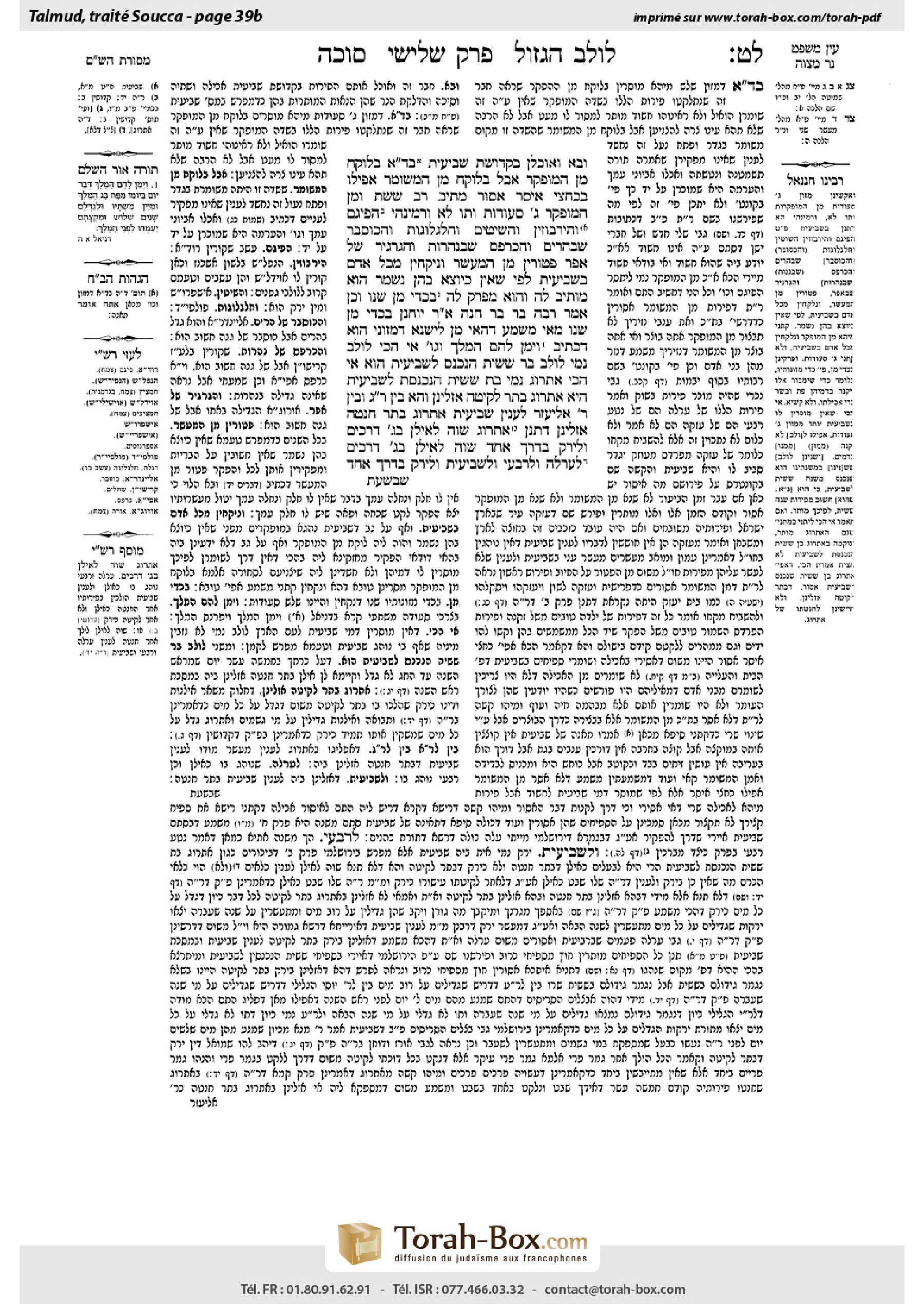
Sukkah 39b: Talmud study for Daf Yomi
Daf Yomi is the daily study of one Talmud folio. Explore 37 tractates with scans, Hebrew text, Sefaria English and AI-generated French translations where annotated.
Passage selection and English or AI-generated French translation are available where the scan has annotations. Daf Study is independent of Torah-Box and Sefaria.
Browse Sukkah · סוכה · All tractatesSukkah 39b text and translations
This page of Sukkah includes the Aramaic text, an English translation and an AI-generated French translation, alongside the scan above.
סוכה ל״ט ב · Aramaic and Hebrew text
וּבָא וְאוֹכְלָן בִּקְדוּשַּׁת שְׁבִיעִית.
בַּמֶּה דְּבָרִים אֲמוּרִים — בְּלוֹקֵחַ מִן הַמּוּפְקָר. אֲבָל בְּלוֹקֵחַ מִן הַמְשׁוּמָּר, אֲפִילּוּ בְּכַחֲצִי אִיסָּר — אָסוּר.
מֵתִיב רַב שֵׁשֶׁת: וּמִן הַמּוּפְקָר שָׁלֹשׁ סְעוּדוֹת וְתוּ לָא? וּרְמִינְהִי: הַפֵּיגָם וְהַיַּרְבּוּזִין וְהַשֵּׁיטִים וַחֲלֹגְלוֹגוֹת וְהַכּוּסְבָּר שֶׁבֶּהָרִים וְהַכַּרְפַּס שֶׁבַּנְּהָרוֹת וְהַגַּרְגִּיר שֶׁל אֲפָר — פְּטוּרִין מִן הַמַּעֲשֵׂר, וְנִיקָּחִין מִכׇּל אָדָם בַּשְּׁבִיעִית, לְפִי שֶׁאֵין כַּיּוֹצֵא בָּהֶן נִשְׁמָר.
הוּא מוֹתֵיב לַהּ וְהוּא מְפָרֵק לַהּ: בִּכְדֵי מָן שָׁנוּ. וְכֵן אָמַר רַבָּה בַּר בַּר חָנָה אָמַר רַבִּי יוֹחָנָן: בִּכְדֵי מָן שָׁנוּ. מַאי מַשְׁמַע דְּהַאי ״מָן״ לִישָּׁנָא דִּמְזוֹנֵי הוּא — דִּכְתִיב: ״וַיְמַן לָהֶם הַמֶּלֶךְ וְגוֹ׳״.
אִי הָכִי, לוּלָב נָמֵי! לוּלָב בַּר שִׁשִּׁית הַנִּכְנָס לִשְׁבִיעִית הוּא. אִי הָכִי אֶתְרוֹג נָמֵי — בַּת שִׁשִּׁית הַנִּכְנֶסֶת לִשְׁבִיעִית הִיא! אֶתְרוֹג, בָּתַר לְקִיטָה אָזְלִינַן.
וְהָא בֵּין רַבָּן גַּמְלִיאֵל וּבֵין רַבִּי אֱלִיעֶזֶר, לְעִנְיַן שְׁבִיעִית אֶתְרוֹג בָּתַר חֲנָטָה אָזְלִינַן! דִּתְנַן: אֶתְרוֹג שָׁוֶה לָאִילָן בִּשְׁלֹשָׁה דְּרָכִים, וְלַיָּרָק בְּדֶרֶךְ אֶחָד.
שָׁוֶה לָאִילָן בִּשְׁלֹשָׁה דְּרָכִים — לְעׇרְלָה וְלִרְבָעִי וְלִשְׁבִיעִית. וּלְיָרָק בְּדֶרֶךְ אֶחָד —
Sukkah 39b · English translation
And then he comes home and eats the produce in the appropriate manner and at the appropriate time, due to the sanctity of Sabbatical-Year produce.
The baraita continues: In what case is this statement said that it is permitted to transfer money used to purchase Sabbatical-Year produce to an am ha’aretz as long as it does not exceed the value of three meals? It is specifically in a case where one purchases produce that came from a field that was declared ownerless as required during the Sabbatical Year. In that case, the am ha’aretz who gathered the produce is paid only for the act of harvesting and not for the produce. However, if he buys produce that came from a field that was safeguarded for its owner in the manner that it is during the other years of the Sabbatical-Year cycle and was not declared ownerless, then even if one purchased produce worth half an issar, it is prohibited to transfer the money to him, as it is prohibited to utilize fruits that were safeguarded during the Sabbatical Year.
Rav Sheshet raised an objection: And is it permitted to purchase produce from an ownerless field worth only the value of three meals and no more? He raised a contradiction from a mishna (Shevi’it 9:1): Rue and sorrel, two types of herbs, and vegetables such as asparagus, purslane, coriander that is found in the mountains, water parsley of the rivers, and garden-eruca are all exempt from the requirement of tithes in all years, and they may be purchased from any person during the Sabbatical Year because there is no plant of their species that is safeguarded. These plants are not cultivated but grow wild, rendering them ownerless. Apparently, these plants that grow wild may be purchased in any quantity, even from an am ha’aretz, with no three-meal limit.
The Gemara continues. Rav Sheshet raised the objection, and he also resolved it: The Sages taught this halakha in the mishna with regard to food in the amount sufficient for his sustenance [man]. These plants that the mishna excludes from the prohibition against purchase from an am ha’aretz are still subject to the three-meal limit. And likewise, Rabba bar bar Ḥana said that Rabbi Yoḥanan said: The Sages taught this halakha in the amount sufficient for his sustenance [man]. From where may it be inferred that man is a term meaning sustenance? It is as it is written: “And the king appointed [vayman] for them a daily portion of the king’s food” (Daniel 1:5).
§ The Gemara asks: If so, if one may not purchase produce from an am ha’aretz lest he misuse the money, it should also be prohibited to give him money and purchase a lulav from him during the Sabbatical Year. The Gemara answers: The mishna is dealing with a case where the lulav is of the sixth year that is entering the seventh year. As it grew during the sixth year, it is permitted, even though it was removed from the tree during the seventh year. The fact that it remained on the tree between Rosh HaShana and Sukkot does not render it Sabbatical-Year produce. The Gemara objects: If so, the etrog, too, is an object of the sixth year that is entering the seventh year and should have the same status. The Gemara answers: With regard to an etrog, as opposed to a lulav, in determining its status we go according to its picking and not when it grew. Therefore, in that case, the etrog is considered to be Sabbatical-Year produce.
The Gemara objects: But both Rabban Gamliel and Rabbi Eliezer, who disagree about the status of an etrog that grew in one year and was picked in the following year in terms of determining its year for the halakhot of tithing, agree with regard to the halakhot of the Sabbatical Year that with regard to an etrog we go according to its ripening, as we learned in a mishna (Bikkurim 2:6): The halakhic status of the fruit of an etrog tree is like that of a typical fruit tree in three manners and like that of a vegetable in one manner.
The mishna elaborates: Its halakhic status is like that of a tree in three manners: With regard to orla, i.e., it is prohibited to eat of its fruit during the first three years after its planting; with regard to fourth-year produce, i.e., fruits that grow during the fourth year after the tree’s planting, which may not be used outside of Jerusalem unless they are deconsecrated by means of redemption; and with regard to the Sabbatical Year. With regard to all those halakhot, the year to which the fruit is ascribed is determined by when it ripens. And its halakhic status is like that of a vegetable in one manner:
Sukkah 39b · Traduction française (IA)
Il rentre alors chez lui et consomme les fruits de la manière qui convient et au moment opportun, en raison de la sainteté des produits de la septième année.
La baraïta poursuit : Dans quel cas a-t-on dit qu’il est permis de remettre de l’argent à un am ha’aretz pour acheter des produits de la septième année, à condition que leur valeur ne dépasse pas celle de trois repas ? Cela concerne précisément le cas où l’on achète des produits provenant d’un champ déclaré sans propriétaire, comme l’exige la loi pendant la septième année. Dans ce cas, l’am ha’aretz qui a récolté les produits est rémunéré uniquement pour le travail de récolte, et non pour les produits eux-mêmes. En revanche, s’il achète des produits provenant d’un champ que son propriétaire a gardé comme il le fait les autres années du cycle de la septième année, sans le déclarer sans propriétaire, il est interdit de lui remettre de l’argent, même si les produits achetés valent un demi-issar, car il est interdit d’utiliser des fruits qui ont été gardés pendant la septième année.
Rav Sheshet souleva une objection : Est-il permis d’acheter des produits provenant d’un champ sans propriétaire pour une valeur de trois repas seulement, et pas davantage ? Il opposa à cette affirmation une Michna (Shevi’it 9:1) : la rue et l’oseille, deux sortes d’herbes, ainsi que des légumes tels que l’asperge, le pourpier, la coriandre qui pousse dans les montagnes, le persil aquatique des rivières et la roquette de jardin sont tous exemptés de la dîme en toutes les années ; pendant la septième année, on peut les acheter à n’importe qui, car aucune plante de ces espèces n’est gardée. Ces plantes ne sont pas cultivées, mais poussent à l’état sauvage et sont donc sans propriétaire. Il apparaît donc qu’on peut acheter ces plantes sauvages en toute quantité, même à un am ha’aretz, sans limite de trois repas.
La Guemara poursuit. Rav Sheshet souleva l’objection, puis la résolut également : Les Sages ont enseigné cette halakha de la Michna au sujet d’une quantité de nourriture suffisante pour sa subsistance [man]. Les plantes que la Michna soustrait à l’interdiction d’acheter à un am ha’aretz restent soumises à la limite de trois repas. De même, Rabba bar bar Ḥana a dit au nom de Rabbi Yoḥanan : Les Sages ont enseigné cette halakha pour une quantité suffisante à sa subsistance [man]. D’où peut-on déduire que man signifie « subsistance » ? Du verset : « Le roi leur assigna [vayman] une portion quotidienne des mets du roi » (Daniel 1:5).
§ La Guemara demande : Si l’on ne peut acheter des produits à un am ha’aretz de crainte qu’il n’utilise mal l’argent, il devrait également être interdit de lui remettre de l’argent pour lui acheter un loulav pendant la septième année. La Guemara répond : La Michna traite du cas d’un loulav de la sixième année qui entre dans la septième. Comme il a poussé pendant la sixième année, il est permis, même s’il a été détaché de l’arbre pendant la septième année. Le fait qu’il soit resté sur l’arbre entre Roch Hachana et Souccot n’en fait pas un produit de la septième année. La Guemara objecte : Dans ce cas, l’étrog aussi est un fruit de la sixième année qui entre dans la septième et devrait avoir le même statut. La Guemara répond : Pour l’étrog, contrairement au loulav, le statut est déterminé d’après le moment où il est cueilli, et non d’après celui où il a poussé. Par conséquent, dans ce cas, l’étrog est considéré comme un produit de la septième année.
La Guemara objecte : Pourtant, Rabban Gamliel et Rabbi Eliezer, qui sont en désaccord sur l’année à laquelle rattacher, pour les halakhot de la dîme, un étrog qui a poussé une année et a été cueilli l’année suivante, s’accordent, en ce qui concerne les halakhot de la septième année, à dire que le statut de l’étrog est déterminé d’après sa maturation. C’est ce que nous avons appris dans une Michna (Bikkurim 2:6) : le statut halakhique du fruit de l’étrogier est semblable à celui d’un fruitier ordinaire à trois égards et à celui d’un légume à un égard.
La Michna précise : Son statut halakhique est semblable à celui d’un arbre à trois égards : pour l’orla, c’est-à-dire qu’il est interdit de manger ses fruits pendant les trois premières années suivant sa plantation ; pour les produits de la quatrième année, c’est-à-dire les fruits qui poussent la quatrième année après la plantation de l’arbre et qui ne peuvent être utilisés hors de Jérusalem à moins d’avoir été désacralisés par rachat ; et pour la septième année. Pour toutes ces halakhot, l’année à laquelle le fruit est rattaché est déterminée d’après le moment où il mûrit. Son statut halakhique est semblable à celui d’un légume à un égard :
Traduction française générée par IA à partir de l’édition anglaise de Sefaria. Vérifie toujours un passage avec le texte source.
Text from Sefaria: William Davidson Edition - Vocalized Aramaic (CC BY NC); William Davidson Edition - English (CC BY NC).