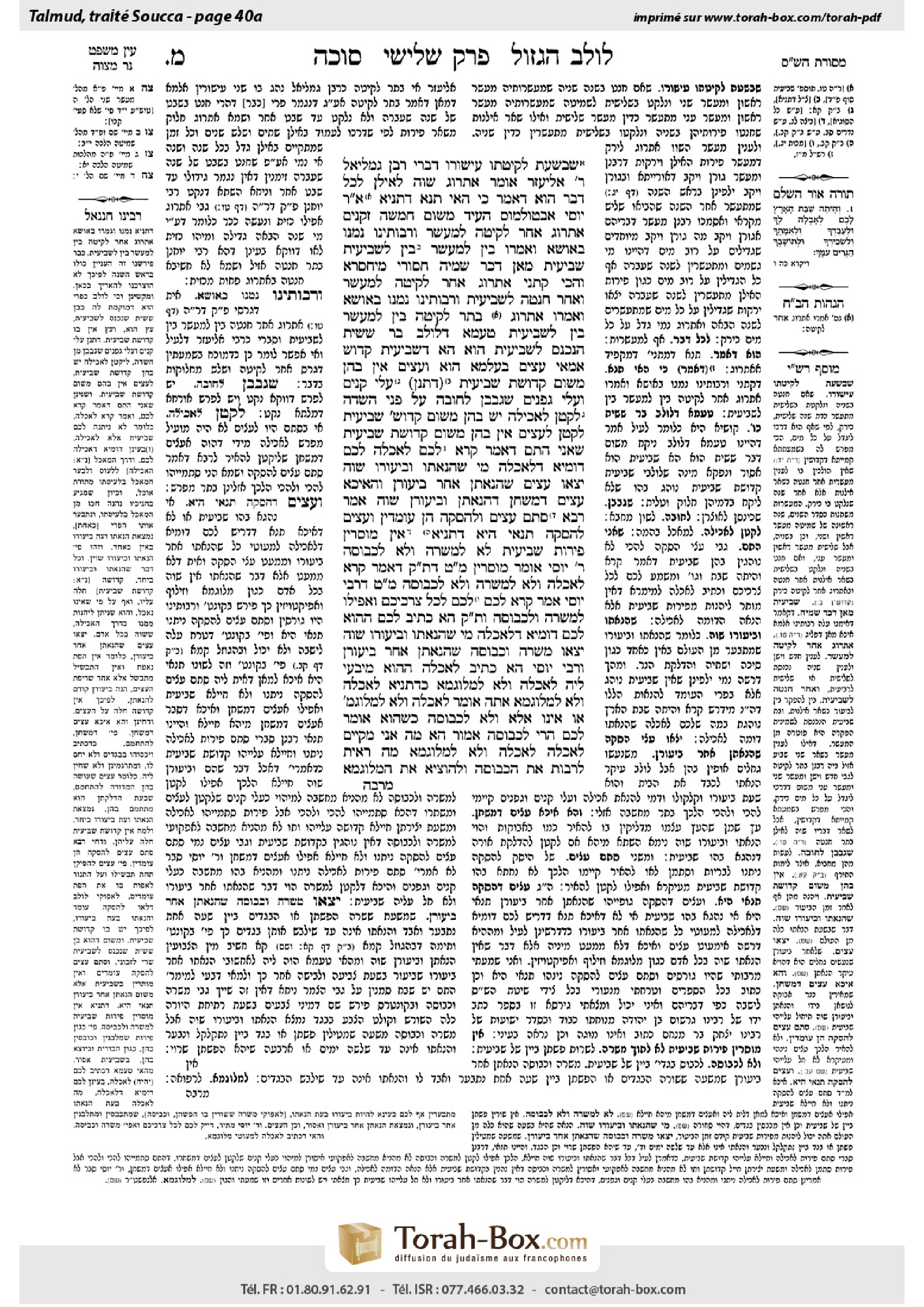
Sukkah 40a: Talmud study for Daf Yomi
Daf Yomi is the daily study of one Talmud folio. Explore 37 tractates with scans, Hebrew text, Sefaria English and AI-generated French translations where annotated.
Passage selection and English or AI-generated French translation are available where the scan has annotations. Daf Study is independent of Torah-Box and Sefaria.
Browse Sukkah · סוכה · All tractatesSukkah 40a text and translations
This page of Sukkah includes the Aramaic text, an English translation and an AI-generated French translation, alongside the scan above.
סוכה מ׳ א · Aramaic and Hebrew text
שֶׁבִּשְׁעַת לְקִיטָתוֹ עִישּׂוּרוֹ, דִּבְרֵי רַבָּן גַּמְלִיאֵל. רַבִּי אֱלִיעֶזֶר אוֹמֵר: אֶתְרוֹג שָׁוֶה לָאִילָן לְכׇל דָּבָר.
הוּא דְּאָמַר כִּי הַאי תַּנָּא דְּתַנְיָא: אָמַר רַבִּי יוֹסֵי: אַבְטוּלְמוֹס הֵעִיד מִשּׁוּם חֲמִשָּׁה זְקֵנִים: אֶתְרוֹג אַחַר לְקִיטָה לַמַּעֲשֵׂר, וְרַבּוֹתֵינוּ נִמְנוּ בְּאוּשָׁא וְאָמְרוּ בֵּין לַמַּעֲשֵׂר בֵּין לַשְּׁבִיעִית.
שְׁבִיעִית מַאן דְּכַר שְׁמֵיהּ? חַסּוֹרֵי מִיחַסְּרָא וְהָכִי קָתָנֵי: אֶתְרוֹג אַחַר לְקִיטָה לַמַּעֲשֵׂר, וְאַחַר חֲנָטָה לַשְּׁבִיעִית. וְרַבּוֹתֵינוּ נִמְנוּ בְּאוּשָׁא וְאָמְרוּ: אֶתְרוֹג בָּתַר לְקִיטָה, בֵּין לַמַּעֲשֵׂר בֵּין לַשְּׁבִיעִית.
טַעְמָא דְּלוּלָב בַּר שִׁשִּׁית הַנִּכְנָס לִשְׁבִיעִית הוּא, הָא דִּשְׁבִיעִית קָדוֹשׁ, אַמַּאי? עֵצִים בְּעָלְמָא הוּא, וְעֵצִים אֵין בָּהֶן מִשּׁוּם קְדוּשַּׁת שְׁבִיעִית! (דִּתְנַן:) עֲלֵי קָנִים וַעֲלֵי גְפָנִים שֶׁגִּבְּבָן לְחוּבָּה עַל פְּנֵי הַשָּׂדֶה, לִקְּטָן לַאֲכִילָה — יֵשׁ בָּהֶן מִשּׁוּם קְדוּשַּׁת שְׁבִיעִית, לִקְּטָן לְעֵצִים — אֵין בָּהֶן מִשּׁוּם קְדוּשַּׁת שְׁבִיעִית.
שָׁאנֵי הָתָם, דְּאָמַר קְרָא: ״לָכֶם לְאׇכְלָה״. ״לָכֶם״ דּוּמְיָא דִּלְאָכְלָה — מִי שֶׁהֲנָאָתוֹ וּבִיעוּרוֹ שָׁוֶה. יָצְאוּ עֵצִים, שֶׁהֲנָאָתָן אַחַר בִּיעוּרָן.
וְהָאִיכָּא עֵצִים דְּמִשְׁחַן, דַּהֲנָאָתָן וּבִיעוּרָן שָׁוֶה! אָמַר רָבָא: סְתָם עֵצִים, לְהַסָּקָה הֵן עוֹמְדִין.
וְעֵצִים לְהַסָּקָה, תַּנָּאֵי הִיא, דְּתַנְיָא: אֵין מוֹסְרִין פֵּירוֹת שְׁבִיעִית לֹא לְמִשְׁרָה וְלֹא לִכְבוּסָה. רַבִּי יוֹסֵי אוֹמֵר: מוֹסְרִין.
מַאי טַעְמֵיהּ דְּתַנָּא קַמָּא — דְּאָמַר קְרָא: ״לְאׇכְלָה״, וְלֹא לְמִשְׁרָה וְלֹא לִכְבוּסָה. מַאי טַעְמֵיהּ דְּרַבִּי יוֹסֵי — אָמַר קְרָא: ״לָכֶם״, ״לָכֶם״ לְכׇל צׇרְכֵיכֶם, וַאֲפִילּוּ לְמִשְׁרָה וְלִכְבוּסָה. וְתַנָּא קַמָּא, הָא כְּתִיב ״לָכֶם״! הַהוּא ״לָכֶם״ דּוּמְיָא דִּלְאׇכְלָה: מִי שֶׁהֲנָאָתוֹ וּבִיעוּרוֹ שָׁוֶה, יָצְאוּ מִשְׁרָה וּכְבוּסָה — שֶׁהֲנָאָתָן אַחַר בִּיעוּרָן.
וְרַבִּי יוֹסֵי, הָא כְּתִיב ״לְאׇכְלָה״! הַהוּא מִיבְּעֵי לֵיהּ ״לְאׇכְלָה״ וְלֹא לִמְלוּגְמָא. כִּדְתַנְיָא: ״לְאׇכְלָה״ — וְלֹא לִמְלוּגְמָא. אַתָּה אוֹמֵר ״לְאׇכְלָה״ וְלֹא לִמְלוּגְמָא, אוֹ אֵינוֹ אֶלָּא וְלֹא לִכְבוּסָה? כְּשֶׁהוּא אוֹמֵר ״לָכֶם״, הֲרֵי לִכְבוּסָה אָמוּר. הָא מָה אֲנִי מְקַיֵּים ״לְאׇכְלָה״ — ״לְאׇכְלָה״ וְלֹא לִמְלוּגְמָא. מָה רָאִיתָ לְרַבּוֹת אֶת הַכְּבוּסָה וּלְהוֹצִיא אֶת הַמְּלוּגְמָא?
Sukkah 40a · English translation
It is like a vegetable in that at the time of its picking it is tithed; this is the statement of Rabban Gamliel. If it was picked in the third year of the Sabbatical cycle, poor man’s tithe is separated although it ripened in the second year, when the obligation is to separate second tithe and not poor man’s tithe. Rabbi Eliezer says: The halakhic status of the fruit of an etrog tree is like that of a typical fruit tree in every matter. In any case, with regard to ascribing the status of Sabbatical-Year produce to the fruits, it is apparent from the mishna that the status of an etrog of the sixth year that was picked in the seventh year is that of sixth-year produce.
The Gemara answers: It was the tanna of the mishna that distinguishes between the lulav and the etrog who stated his opinion in accordance with the statement of that tanna, as it is taught in a baraita that Rabbi Yosei said that Avtolemos, one of the Sages, testified in the name of five Elders: The status of an etrog is determined by the time of its picking with regard to the halakhot of tithes. And our Sages were counted in Usha, reached a decision, and said: The status of an etrog is determined by the time of its picking both with regard to the halakhot of tithes and with regard to the halakhot of the Sabbatical Year.
The Gemara questions the formulation of the baraita: With regard to the Sabbatical Year, who mentioned it? As no previous mention was made of the Sabbatical Year, the discussion of the status of an etrog during the Sabbatical Year is a non sequitur. The Gemara answers: The baraita is incomplete, and this is what it is teaching: The status of an etrog is determined by the time of its picking with regard to the halakhot of tithes and determined by the time of its ripening with regard to the Sabbatical Year. And our Sages were counted in Usha and said: The status of an etrog is determined by the time of its picking both with regard to the halakhot of tithes and with regard to the halakhot of the Sabbatical Year.
§ The Gemara resumes its discussion of the mishna: The reason that a lulav may be purchased from an am ha’aretz during the Sabbatical Year is specifically that it is a lulav of the sixth year that is entering the seventh. This indicates by inference that a lulav of the seventh year is sacred with the sanctity of the Sabbatical Year. The Gemara asks: Why is it sacred? It is merely wood, and wood is not subject to the sanctity of the Sabbatical Year, as it was taught in a baraita: With regard to reed leaves and vine leaves that one piled for storage upon the field, if he gathered them for eating, they are subject to the sanctity of the Sabbatical Year; if he gathered them for use as wood, e.g., for kindling, they are not subject to the sanctity of the Sabbatical Year. Apparently, wood or any other non-food product is not subject to the sanctity of the Sabbatical Year.
The Gemara answers: It is different there, in the case of the reed and vine leaves, as the verse states: “And the Sabbatical produce of the land shall be for you for food” (Leviticus 25:6). From the juxtaposition of the term: For you, and the term: For food, it is derived: For you is similar to for food; the sanctity of the Sabbatical Year takes effect on those items whose benefit and whose consumption coincide. Wood is excluded, as its benefit is subsequent to its consumption. The primary purpose of kindling wood is not accomplished with the burning of the wood; rather, it is with the charcoal that heats the oven. Therefore, it is not subject to the sanctity of the Sabbatical Year.
The Gemara objects: But isn’t there wood used to provide heat (Rabbeinu Ḥananel), whose benefit coincides with its consumption? Rava said: Undesignated wood exists for fuel, i.e., charcoal, so its benefit is subsequent to its consumption.
§ The Gemara notes: The matter of whether kindling wood, whose benefit is subsequent to its consumption, is subject to the sanctity of the Sabbatical Year is a dispute between tanna’im, as it is taught in a baraita: One may neither transfer Sabbatical-Year produce, e.g., wine, for soaking flax to prepare it for spinning, as the benefit derived from the flax is subsequent to its soaking, when the soaked and spun thread is woven into a garment; nor for laundering with it, as the benefit derived is subsequent to the laundering when one wears the clean clothes. Soaking the flax or laundering the garment in wine is consumption of the wine, as it is no longer potable. Rabbi Yosei says: One may transfer Sabbatical-Year produce for those purposes.
The Gemara asks: What is the rationale for the statement of the first tanna? It is as the verse states with regard to Sabbatical-Year produce: “For food,” from which it is inferred: And not for soaking and not for laundering. What is the rationale for the statement of Rabbi Yosei permitting one to do so? It is as the verse states: “For you,” from which it is inferred: For you, for all your needs, and even for soaking and for laundering. The Gemara asks: But according to the first tanna, isn’t it written: “For you”? How does he explain that term? The Gemara answers: From that term “for you” it is derived: For you, similar to for food; the sanctity of the Sabbatical Year takes effect on those items whose benefit and whose consumption coincide, which excludes soaking and laundering, where the items’ benefit is subsequent to their consumption.
The Gemara asks: But according to Rabbi Yosei, isn’t it written: “For food,” indicating that it may not be used for any other purpose? The Gemara answers: He needs that phrase to teach: For food, and not for a remedy [melugma], as it is taught in a baraita: For food and not for a remedy. The baraita continues: Do you say: For food and not for a remedy, or perhaps it is only: For food and not for laundering? When the verse says: “For you,” for laundering is already stated as permitted since it includes all one’s bodily needs. How, then, do I uphold that which the verse states: “For food”? It is: For food, and not for a remedy. And should one ask: What did you see that led you to include the use of Sabbatical-Year produce for laundering and to exclude the use of Sabbatical-Year produce as a remedy?
Sukkah 40a · Traduction française (IA)
Elle est semblable à un légume en ce que la dîme en est prélevée au moment de sa cueillette ; telle est la déclaration de Rabban Gamliel. Si elle a été cueillie la troisième année du cycle sabbatique, on prélève la première dîme et la dîme du pauvre, bien qu’elle ait mûri la deuxième année, où l’obligation est de prélever la seconde dîme et non la dîme du pauvre. Rabbi Eliezer dit : Le statut halakhique du fruit du cédratier est, à tous égards, celui d’un arbre fruitier ordinaire. Quoi qu’il en soit, concernant l’attribution aux fruits du statut de produits de l’année sabbatique, il ressort de la Michna que le cédrat de la sixième année cueilli la septième année conserve le statut de produit de la sixième année.
La Guemara répond : C’est le tanna de la Michna qui distingue entre le loulav et le cédrat qui a exprimé son avis conformément à la position de ce tanna, comme il est enseigné dans une baraïta : Rabbi Yosei a dit qu’Avtolemos, l’un des Sages, témoigna au nom de cinq Anciens que le statut du cédrat est déterminé par le moment de sa cueillette en ce qui concerne les halakhot des dîmes. Nos Sages se réunirent à Ousha, prirent une décision et dirent que le statut du cédrat est déterminé par le moment de sa cueillette, tant en ce qui concerne les halakhot des dîmes qu’en ce qui concerne les halakhot de l’année sabbatique.
La Guemara s’interroge sur la formulation de la baraïta : Qui a parlé de l’année sabbatique ? Puisqu’il n’en a pas été question auparavant, évoquer le statut du cédrat pendant l’année sabbatique ne suit pas le fil du propos. La Guemara répond : La baraïta est incomplète, et voici ce qu’elle enseigne : Le statut du cédrat est déterminé par le moment de sa cueillette en ce qui concerne les halakhot des dîmes, et par le moment où il mûrit en ce qui concerne l’année sabbatique. Nos Sages se réunirent à Ousha et dirent que le statut du cédrat est déterminé par le moment de sa cueillette, tant en ce qui concerne les halakhot des dîmes qu’en ce qui concerne les halakhot de l’année sabbatique.
§ La Guemara reprend son étude de la Michna : Si l’on peut acheter un loulav à un am ha’aretz pendant l’année sabbatique, c’est précisément parce qu’il s’agit d’un loulav de la sixième année qui entre dans la septième. On en déduit qu’un loulav de la septième année est sacré de la sainteté de l’année sabbatique. La Guemara demande : Pourquoi est-il sacré ? Ce n’est que du bois, et le bois n’est pas soumis à la sainteté de l’année sabbatique, comme il est enseigné dans une baraïta : Quant aux feuilles de roseau et de vigne que l’on a entassées dans un champ pour les entreposer, si on les a ramassées pour les manger, elles sont soumises à la sainteté de l’année sabbatique ; si on les a ramassées pour les utiliser comme bois, par exemple pour allumer un feu, elles n’y sont pas soumises. Il apparaît donc que le bois, ou tout autre produit non alimentaire, n’est pas soumis à la sainteté de l’année sabbatique.
La Guemara répond : Le cas des feuilles de roseau et de vigne est différent, car le verset dit : « Les produits de l’année sabbatique de la terre seront pour vous une nourriture » (Lévitique 25, 6). Du rapprochement des termes « pour vous » et « une nourriture », on déduit que « pour vous » est comparable à « une nourriture » : la sainteté de l’année sabbatique s’applique aux choses dont le bénéfice et la consommation coïncident. Le bois en est exclu, car son bénéfice vient après sa consommation. Le but principal du bois de chauffage n’est pas atteint par sa combustion, mais par le charbon qui chauffe le four. Il n’est donc pas soumis à la sainteté de l’année sabbatique.
La Guemara objecte : Mais n’y a-t-il pas du bois utilisé pour produire de la chaleur (Rabbeinu Ḥananel), dont le bénéfice coïncide avec sa consommation ? Rava dit : Le bois non affecté à un usage particulier est destiné à servir de combustible, c’est-à-dire à produire du charbon ; son bénéfice vient donc après sa consommation.
§ La Guemara relève que la question de savoir si le bois de chauffage, dont le bénéfice vient après sa consommation, est soumis à la sainteté de l’année sabbatique fait l’objet d’une controverse entre tannaïm, comme il est enseigné dans une baraïta : On ne peut pas transférer des produits de l’année sabbatique, par exemple du vin, pour faire tremper du lin afin de le préparer au filage, car le bénéfice que l’on tire du lin vient après son trempage, lorsque le fil trempé et filé est tissé en vêtement ; on ne peut pas non plus les transférer pour faire la lessive, car le bénéfice n’est obtenu qu’après le lavage, quand on porte les vêtements propres. Le trempage du lin ou le lavage du vêtement dans le vin constitue une consommation du vin, puisqu’il n’est alors plus potable. Rabbi Yosei dit : On peut transférer des produits de l’année sabbatique à ces fins.
La Guemara demande : Quel est le fondement de l’avis du premier tanna ? Le verset dit, au sujet des produits de l’année sabbatique : « Pour une nourriture » ; on en déduit : pas pour le trempage ni pour la lessive. Quel est le fondement de l’avis de Rabbi Yosei, qui permet de le faire ? Le verset dit : « Pour vous » ; on en déduit : pour vous, pour tous vos besoins, y compris le trempage et la lessive. La Guemara demande : Mais le premier tanna ne voit-il pas qu’il est écrit « pour vous » ? Comment explique-t-il ce terme ? La Guemara répond : De ce terme « pour vous », on déduit que « pour vous » est comparable à « une nourriture » : la sainteté de l’année sabbatique s’applique aux choses dont le bénéfice et la consommation coïncident, ce qui exclut le trempage et la lessive, dont le bénéfice vient après la consommation.
La Guemara demande : Mais Rabbi Yosei ne voit-il pas qu’il est écrit « pour une nourriture », ce qui indique que les produits ne peuvent pas être utilisés à une autre fin ? La Guemara répond : Cette expression lui est nécessaire pour enseigner : « Pour une nourriture », et non pour un remède [melugma], comme il est enseigné dans une baraïta : « Pour une nourriture », et non pour un remède. La baraïta poursuit : Dis-tu : « Pour une nourriture », et non pour un remède, ou peut-être s’agit-il seulement de dire : « Pour une nourriture », et non pour faire la lessive ? Lorsque le verset dit « pour vous », la permission de faire la lessive est déjà énoncée, puisque cela inclut tous les besoins corporels. Comment donc comprendre ce que le verset dit : « Pour une nourriture » ? Cela signifie : « Pour une nourriture », et non pour un remède. Et si l’on demande : Qu’est-ce qui t’a conduit à inclure l’usage des produits de l’année sabbatique pour la lessive et à exclure leur usage comme remède ?
Traduction française générée par IA à partir de l’édition anglaise de Sefaria. Vérifie toujours un passage avec le texte source.
Text from Sefaria: William Davidson Edition - Vocalized Aramaic (CC BY NC); William Davidson Edition - English (CC BY NC).