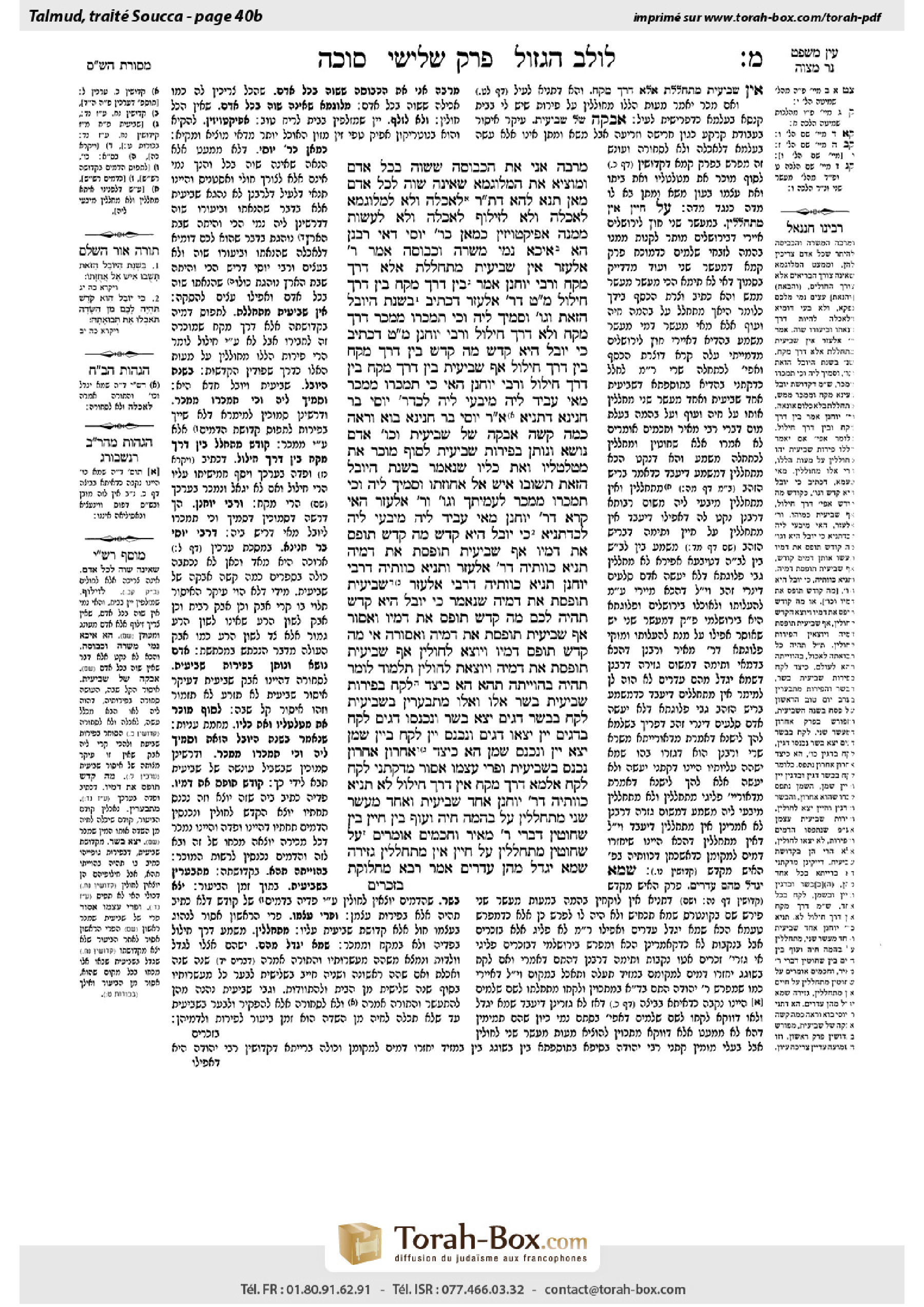
Sukkah 40b: Talmud study for Daf Yomi
Daf Yomi is the daily study of one Talmud folio. Explore 37 tractates with scans, Hebrew text, Sefaria English and AI-generated French translations where annotated.
Passage selection and English or AI-generated French translation are available where the scan has annotations. Daf Study is independent of Torah-Box and Sefaria.
Browse Sukkah · סוכה · All tractatesSukkah 40b text and translations
This page of Sukkah includes the Aramaic text, an English translation and an AI-generated French translation, alongside the scan above.
סוכה מ׳ ב · Aramaic and Hebrew text
מְרַבֶּה אֲנִי אֶת הַכְּבוּסָה שֶׁשָּׁוָה בְּכׇל אָדָם, וּמוֹצִיא אֶת הַמְּלוּגְמָא שֶׁאֵינָהּ שָׁוָה לְכׇל אָדָם.
מַאן תְּנָא לְהָא דְּתָנוּ רַבָּנַן: ״לְאׇכְלָה״ — וְלֹא לִמְלוּגְמָא, ״לְאׇכְלָה״ — וְלֹא לְזִילּוּף, ״לְאׇכְלָה״ — וְלֹא לַעֲשׂוֹת מִמֶּנָּה אַפִּיקְטְוִיזִין? כְּמַאן — כְּרַבִּי יוֹסֵי. דְּאִי רַבָּנַן, הָא אִיכָּא נָמֵי מִשְׁרָה וּכְבוּסָה.
אָמַר רַבִּי אֶלְעָזָר: אֵין שְׁבִיעִית מִתְחַלֶּלֶת אֶלָּא דֶּרֶךְ מִקָּח. וְרַבִּי יוֹחָנָן אָמַר: בֵּין דֶּרֶךְ מִקָּח בֵּין דֶּרֶךְ חִילּוּל.
מַאי טַעְמֵיהּ דְּרַבִּי אֶלְעָזָר? דִּכְתִיב: ״בִּשְׁנַת הַיּוֹבֵל הַזֹּאת וְגוֹ׳״, וּסְמִיךְ לֵיהּ: ״וְכִי תִמְכְּרוּ מִמְכָּר״, דֶּרֶךְ מִקָּח וְלֹא דֶּרֶךְ חִילּוּל. וְרַבִּי יוֹחָנָן מַאי טַעְמֵיהּ? דִּכְתִיב: ״כִּי יוֹבֵל הִיא קֹדֶשׁ״. מָה קֹדֶשׁ — בֵּין דֶּרֶךְ מִקָּח בֵּין דֶּרֶךְ חִילּוּל, אַף שְׁבִיעִית — בֵּין דֶּרֶךְ מִקָּח בֵּין דֶּרֶךְ חִילּוּל.
וְרַבִּי יוֹחָנָן, הַאי ״כִּי תִמְכְּרוּ מִמְכָּר״ מַאי עָבֵיד לֵיהּ? מִיבְּעֵי לֵיהּ לְכִדְרַבִּי יוֹסֵי בַּר חֲנִינָא. דְּתַנְיָא, אָמַר רַבִּי יוֹסֵי בַּר חֲנִינָא: בּוֹא וּרְאֵה כַּמָּה קָשֶׁה אֲבָקָהּ שֶׁל שְׁבִיעִית וְכוּ׳. אָדָם נוֹשֵׂא וְנוֹתֵן בְּפֵירוֹת שְׁבִיעִית, לְסוֹף מוֹכֵר אֶת מִטַּלְטְלָיו וְאֶת כֵּלָיו, שֶׁנֶּאֱמַר: ״בִּשְׁנַת הַיּוֹבֵל הַזֹּאת תָּשֻׁבוּ אִישׁ אֶל אֲחוּזָּתוֹ״, וּסְמִיךְ לֵיהּ: ״וְכִי תִמְכְּרוּ מִמְכָּר לַעֲמִיתֶךָ וְגוֹ׳״.
וְרַבִּי אֶלְעָזָר, הַאי קְרָא דְּרַבִּי יוֹחָנָן מַאי עָבֵיד לֵיהּ? מִיבְּעֵי לֵיהּ לְכִדְתַנְיָא: ״כִּי יוֹבֵל הִיא קֹדֶשׁ״. מָה קֹדֶשׁ תּוֹפֵס אֶת דָּמָיו — אַף שְׁבִיעִית תּוֹפֶסֶת אֶת דָּמֶיהָ.
תַּנְיָא כְּווֹתֵיהּ דְּרַבִּי אֶלְעָזָר, וְתַנְיָא כְּווֹתֵיהּ דְּרַבִּי יוֹחָנָן. תַּנְיָא כְּווֹתֵיהּ דְּרַבִּי אֶלְעָזָר: שְׁבִיעִית תּוֹפֶסֶת אֶת דָּמֶיהָ, שֶׁנֶּאֱמַר: ״כִּי יוֹבֵל הִיא קֹדֶשׁ תִּהְיֶה לָכֶם״, מָה קֹדֶשׁ תּוֹפֵס אֶת דָּמָיו — וְאָסוּר, אַף שְׁבִיעִית תּוֹפֶסֶת אֶת דָּמֶיהָ — וַאֲסוּרָה.
אִי, מָה קֹדֶשׁ תּוֹפֵס דָּמָיו — וְיוֹצֵא לְחוּלִּין, אַף שְׁבִיעִית תּוֹפֶסֶת אֶת דָּמֶיהָ — וְיוֹצֵאת לְחוּלִּין? תַּלְמוּד לוֹמַר: ״תִּהְיֶה״, בַּהֲוָיָיתָהּ תְּהֵא.
הָא כֵּיצַד? לָקַח בְּפֵירוֹת שְׁבִיעִית בָּשָׂר — אֵלּוּ וָאֵלּוּ מִתְבַּעֲרִין בַּשְּׁבִיעִית. לָקַח בַּבָּשָׂר דָּגִים — יָצָא בָּשָׂר וְנִכְנְסוּ דָּגִים. לָקַח בַּדָּגִים יַיִן — יָצְאוּ דָּגִים וְנִכְנַס יַיִן. לָקַח בַּיַּיִן שֶׁמֶן — יָצָא יַיִן וְנִכְנַס שֶׁמֶן.
הָא כֵּיצַד: אַחֲרוֹן אַחֲרוֹן נִכְנָס בַּשְּׁבִיעִית, וּפְרִי עַצְמוֹ אָסוּר. מִדְּקָתָנֵי ״לָקַח״ ״לָקַח״, אַלְמָא דֶּרֶךְ מִקָּח — אִין, דֶּרֶךְ חִילּוּל — לָא.
תַּנְיָא כְּווֹתֵיהּ דְּרַבִּי יוֹחָנָן: אֶחָד שְׁבִיעִית וְאֶחָד מַעֲשֵׂר שֵׁנִי מִתְחַלְּלִין עַל בְּהֵמָה חַיָּה וָעוֹף, בֵּין חַיִּין בֵּין שְׁחוּטִין, דִּבְרֵי רַבִּי מֵאִיר. וַחֲכָמִים אוֹמְרִים: עַל שְׁחוּטִין — מִתְחַלְּלִין, עַל חַיִּין — אֵין מִתְחַלְּלִין, גְּזֵירָה שֶׁמָּא יְגַדֵּל מֵהֶן עֲדָרִים.
אָמַר רָבָא: מַחְלוֹקֶת
Sukkah 40b · English translation
Rabbi Yosei could respond: I include laundering, which applies equally to every person, as everyone needs clean clothes, and I exclude a remedy, which does not apply equally to every person; it is only for the ill.
The Gemara asks: Who is the tanna who taught that which the Sages taught in a baraita with regard to Sabbatical-Year produce: For food, and not for a remedy; for food, and not for sprinkling wine in one’s house to provide a pleasant fragrance; for food, and not to make it an emetic [apiktoizin] to induce vomiting? In accordance with whose opinion is this baraita? It is in accordance with the opinion of Rabbi Yosei, as, if it were in accordance with the opinion of the Rabbis, isn’t there also soaking and laundering that should have been excluded in the baraita, as in their opinion, use of Sabbatical-Year produce for those purposes is prohibited?
§ Rabbi Elazar said: Sabbatical-Year produce is deconsecrated only by means of purchase; however, it cannot be deconsecrated through redemption. Merely declaring that the sanctity of that produce is transferred to money or other produce is ineffective. Rabbi Yoḥanan said: It is deconsecrated both by means of purchase and by means of redemption.
What is the rationale for the opinion of Rabbi Elazar? It is as it is written: “In this year of Jubilee you shall return every man unto his possession” (Leviticus 25:13), and juxtaposed to it it is written: “And if you sell an item to your neighbor” (Leviticus 25:14); this indicates that in the Jubilee Year, during which the halakhot of the Sabbatical Year are in effect, one deconsecrates the produce by means of purchase and not by means of redemption. The Gemara asks: And Rabbi Yoḥanan, what is the rationale for his opinion? It is as it is written: “For it is a Jubilee; it shall be consecrated unto you” (Leviticus 25:12); this indicates that just as one redeems consecrated items both by means of purchase and by means of redemption, so too, Sabbatical-Year produce can be redeemed both by means of purchase and by means of redemption.
The Gemara asks: And Rabbi Yoḥanan, what does he do with this juxtaposition of the Jubilee Year to the verse: “If you sell an item”? The Gemara answers: He needs it to derive a halakha in accordance with that statement of Rabbi Yosei bar Ḥanina, as it is taught in a baraita that Rabbi Yosei bar Ḥanina says: Come and see how severe even the hint of violation of the prohibition of the Sabbatical Year is; as the prohibition against commerce with Sabbatical-Year produce is not one of the primary prohibitions of the Sabbatical Year, and its punishment is harsh. A person who engages in commerce with Sabbatical-Year produce is ultimately punished with the loss of his wealth to the point that he is forced to sell his movable property and his vessels, as it is stated: “In this year of Jubilee you shall return every man unto his possession” (Leviticus 25:13), and juxtaposed to it, it is written: “And if you sell an item to your neighbor” (Leviticus 25:14).
The Gemara asks: And Rabbi Elazar, what does he do with this verse from which Rabbi Yoḥanan derived his opinion? The Gemara answers: He needs it to derive in accordance with that which is taught in a baraita: “For it is a Jubilee; it shall be consecrated unto you” (Leviticus 25:12); just as the sanctity of consecrated items takes effect on money or objects in exchange for which they are redeemed, so too, the sanctity of Sabbatical-Year produce takes effect on money or objects in exchange for which it is redeemed.
It is taught in a baraita in accordance with the opinion of Rabbi Elazar, and it is taught in a baraita in accordance with the opinion of Rabbi Yoḥanan. The Gemara elaborates that it is taught in a baraita in accordance with the opinion of Rabbi Elazar: Sabbatical-Year sanctity takes effect on money or objects in exchange for which the produce is redeemed, as it is stated: “For it is a Jubilee; it shall be consecrated unto you”; just as the sanctity of consecrated items takes effect on money or objects in exchange for which they are redeemed and it is prohibited to use the money for non-sacred purposes, so too, the sanctity of Sabbatical-Year produce takes effect on money or objects in exchange for which it is redeemed, and it is prohibited to use this money for purposes for which Sabbatical-Year produce may not be used.
Or perhaps extend the analogy and derive that just as the sanctity of consecrated items takes effect on money or objects in exchange for which they are redeemed, and the consecrated item assumes non-sacred status, so too, the sanctity of Sabbatical-Year produce takes effect on money or objects in exchange for which it is redeemed, and the Sabbatical-Year produce assumes non-sacred status. Therefore, the verse states: “It shall be consecrated unto you,” meaning: It shall be as it is. Although the sanctity of Sabbatical-Year produce takes effect on the money, the produce remains consecrated as well.
The Gemara explains: How so? If one purchased meat with Sabbatical-Year produce, both this, the produce, and that, the meat, must be removed during the Sabbatical Year. The meat may be eaten only as long as the produce in exchange for which it was purchased may be eaten, i.e., as long as produce of that kind remains in the field. However, if he purchased fish in exchange for the meat, the meat emerges from its consecrated status, and the fish assumes consecrated status. If he then purchased wine in exchange for the fish, the fish emerges from its consecrated status, and the wine assumes consecrated status. If he purchased oil in exchange for the wine, the wine emerges from its consecrated status, and the oil assumes consecrated status.
How so? The last item purchased assumes the consecrated status of produce of the Sabbatical Year, and the produce itself remains consecrated and forbidden and never loses its consecrated status. The Gemara notes: From the fact that the baraita teaches each case using the term: Purchased, purchased, apparently it means that by means of transaction, yes, the sanctity of the Sabbatical Year takes effect; however, by means of redemption, no, the sanctity of the Sabbatical Year does not take effect.
The Gemara continues: It is taught in a baraita in accordance with the opinion of Rabbi Yoḥanan. Both Sabbatical-Year produce and second-tithe produce are deconsecrated upon domesticated animals, undomesticated animals, and fowl, whether they are alive or whether they are slaughtered; this is the statement of Rabbi Meir. And the Rabbis say: Upon slaughtered animals, they are deconsecrated; upon animals that are alive, they are not deconsecrated. The reason is that a rabbinic decree was issued lest one raise flocks from them. If one breeds a herd from that consecrated animal, the entire herd would be sacred and the potential for misuse of second-tithe property would be great.
Rava said: This dispute between Rabbi Meir and the Rabbis
Sukkah 40b · Traduction française (IA)
Rabbi Yosse pourrait répondre : J’inclus le lavage, qui concerne chacun de la même manière, puisque tous ont besoin de vêtements propres, et j’exclus un remède, qui ne concerne pas chacun de la même manière, puisqu’il ne sert qu’aux malades.
La Guemara demande : Quel est le tanna qui a enseigné ce que les Sages ont enseigné dans une baraïta au sujet des produits de la septième année : ils sont destinés à la nourriture, mais pas à un remède ; ils sont destinés à la nourriture, mais pas à asperger de vin sa maison afin de lui donner un parfum agréable ; ils sont destinés à la nourriture, mais pas à en faire un vomitif [apiktoizin] pour provoquer des vomissements ? Selon l’opinion de qui cette baraïta a-t-elle été enseignée ? Selon celle de Rabbi Yosse. En effet, si elle était conforme à l’opinion des Rabbins, n’aurait-il pas également fallu exclure le trempage et le lavage dans la baraïta, puisque, selon eux, l’usage des produits de la septième année à ces fins est interdit ?
§ Rabbi Elazar a dit : La sainteté des produits de la septième année ne peut être transférée que par un achat ; elle ne peut toutefois pas l’être par rachat. Se contenter de déclarer que la sainteté de ces produits est transférée à de l’argent ou à d’autres produits est sans effet. Rabbi Yoḥanan a dit : Elle peut être transférée aussi bien par un achat que par un rachat.
Quel est le fondement de l’opinion de Rabbi Elazar ? Il est écrit : « En cette année du Jubilé, chacun retournera à sa propriété » (Lévitique 25:13), et le verset qui lui est juxtaposé dit : « Si tu vends quelque chose à ton prochain » (Lévitique 25:14). Cela indique que durant l’année du Jubilé, pendant laquelle les halakhot de la septième année sont en vigueur, on transfère la sainteté des produits par un achat et non par un rachat. La Guemara demande : Et quel est le fondement de l’opinion de Rabbi Yoḥanan ? Il est écrit : « Car c’est un Jubilé ; il sera saint pour vous » (Lévitique 25:12). Cela indique que, de même que l’on rachète les objets consacrés aussi bien par un achat que par un rachat, de même les produits de la septième année peuvent être rachetés aussi bien par un achat que par un rachat.
La Guemara demande : Et que fait Rabbi Yoḥanan de cette juxtaposition de l’année du Jubilé au verset : « Si tu vends quelque chose » ? La Guemara répond : Il en a besoin pour établir une halakha conformément à cette déclaration de Rabbi Yosse bar Ḥanina, car il est enseigné dans une baraïta que Rabbi Yosse bar Ḥanina dit : Viens et vois combien est grave même le moindre indice de transgression de l’interdit relatif à la septième année ; en effet, l’interdiction de faire commerce des produits de la septième année ne fait pas partie des interdits fondamentaux de la septième année, et pourtant la sanction est sévère. Celui qui fait commerce des produits de la septième année finit par être puni par la perte de ses biens, au point d’être contraint de vendre ses biens mobiliers et ses ustensiles, comme il est dit : « En cette année du Jubilé, chacun retournera à sa propriété » (Lévitique 25:13), et le verset qui lui est juxtaposé dit : « Si tu vends quelque chose à ton prochain » (Lévitique 25:14).
La Guemara demande : Et que fait Rabbi Elazar de ce verset dont Rabbi Yoḥanan a tiré son opinion ? La Guemara répond : Il en a besoin pour établir ce qui est enseigné dans une baraïta : « Car c’est un Jubilé ; il sera saint pour vous » (Lévitique 25:12). De même que la sainteté des objets consacrés s’applique à l’argent ou aux objets reçus en échange lors de leur rachat, de même la sainteté des produits de la septième année s’applique à l’argent ou aux objets reçus en échange lors de leur rachat.
Une baraïta est enseignée conformément à l’opinion de Rabbi Elazar, et une baraïta est enseignée conformément à l’opinion de Rabbi Yoḥanan. La Guemara précise que la baraïta enseignée conformément à l’opinion de Rabbi Elazar dit ceci : la sainteté de la septième année s’applique à l’argent ou aux objets reçus en échange des produits lors de leur rachat, comme il est dit : « Car c’est un Jubilé ; il sera saint pour vous ». De même que la sainteté des objets consacrés s’applique à l’argent ou aux objets reçus en échange lors de leur rachat, et qu’il est interdit d’utiliser cet argent à des fins profanes, de même la sainteté des produits de la septième année s’applique à l’argent ou aux objets reçus en échange lors de leur rachat, et il est interdit d’utiliser cet argent à des fins auxquelles les produits de la septième année ne peuvent servir.
Ou peut-être faut-il pousser l’analogie plus loin et déduire que, de même que la sainteté des objets consacrés s’applique à l’argent ou aux objets reçus en échange lors de leur rachat, tandis que l’objet consacré lui-même prend un statut profane, de même la sainteté des produits de la septième année s’applique à l’argent ou aux objets reçus en échange lors de leur rachat, tandis que les produits de la septième année eux-mêmes prennent un statut profane. Le verset dit donc : « Il sera saint pour vous », ce qui signifie : il reste tel qu’il est. Bien que la sainteté des produits de la septième année s’applique à l’argent, les produits eux aussi restent consacrés.
La Guemara explique : Comment cela ? Si quelqu’un achète de la viande avec des produits de la septième année, les deux, les produits et la viande, doivent être retirés à la fin de la période pendant laquelle ils peuvent être consommés durant la septième année. La viande ne peut être consommée que tant que les produits donnés en échange peuvent l’être, c’est-à-dire tant que des produits de cette espèce restent dans les champs. Toutefois, s’il achète du poisson en échange de la viande, la viande perd son statut consacré et le poisson acquiert ce statut. S’il achète ensuite du vin en échange du poisson, le poisson perd son statut consacré et le vin l’acquiert. S’il achète de l’huile en échange du vin, le vin perd son statut consacré et l’huile l’acquiert.
Comment cela ? Le dernier article acheté acquiert le statut consacré des produits de la septième année, tandis que les produits eux-mêmes restent consacrés et interdits, et ne perdent jamais leur statut consacré. La Guemara relève : Puisque la baraïta enseigne chaque cas en employant le terme « acheté », « acheté », cela semble indiquer que la sainteté de la septième année s’applique par une transaction, oui, mais pas par un rachat : la sainteté de la septième année ne s’applique pas.
La Guemara poursuit : Une baraïta est enseignée conformément à l’opinion de Rabbi Yoḥanan. Les produits de la septième année et ceux de la seconde dîme peuvent être transférés sur des animaux domestiques, des animaux sauvages et des oiseaux, qu’ils soient vivants ou abattus ; telle est la déclaration de Rabbi Meïr. Les Rabbins disent : lorsqu’il s’agit d’animaux abattus, la sainteté leur est transférée ; lorsqu’il s’agit d’animaux vivants, elle ne leur est pas transférée. La raison en est qu’un décret rabbinique a été pris, de peur que l’on n’élève des troupeaux à partir de ces animaux. Si quelqu’un fait reproduire un troupeau à partir de cet animal consacré, tout le troupeau serait consacré, et le risque d’un usage indu des biens de la seconde dîme serait grand.
Rava a dit : Cette controverse entre Rabbi Meïr et les Rabbins
Traduction française générée par IA à partir de l’édition anglaise de Sefaria. Vérifie toujours un passage avec le texte source.
Text from Sefaria: William Davidson Edition - Vocalized Aramaic (CC BY NC); William Davidson Edition - English (CC BY NC).