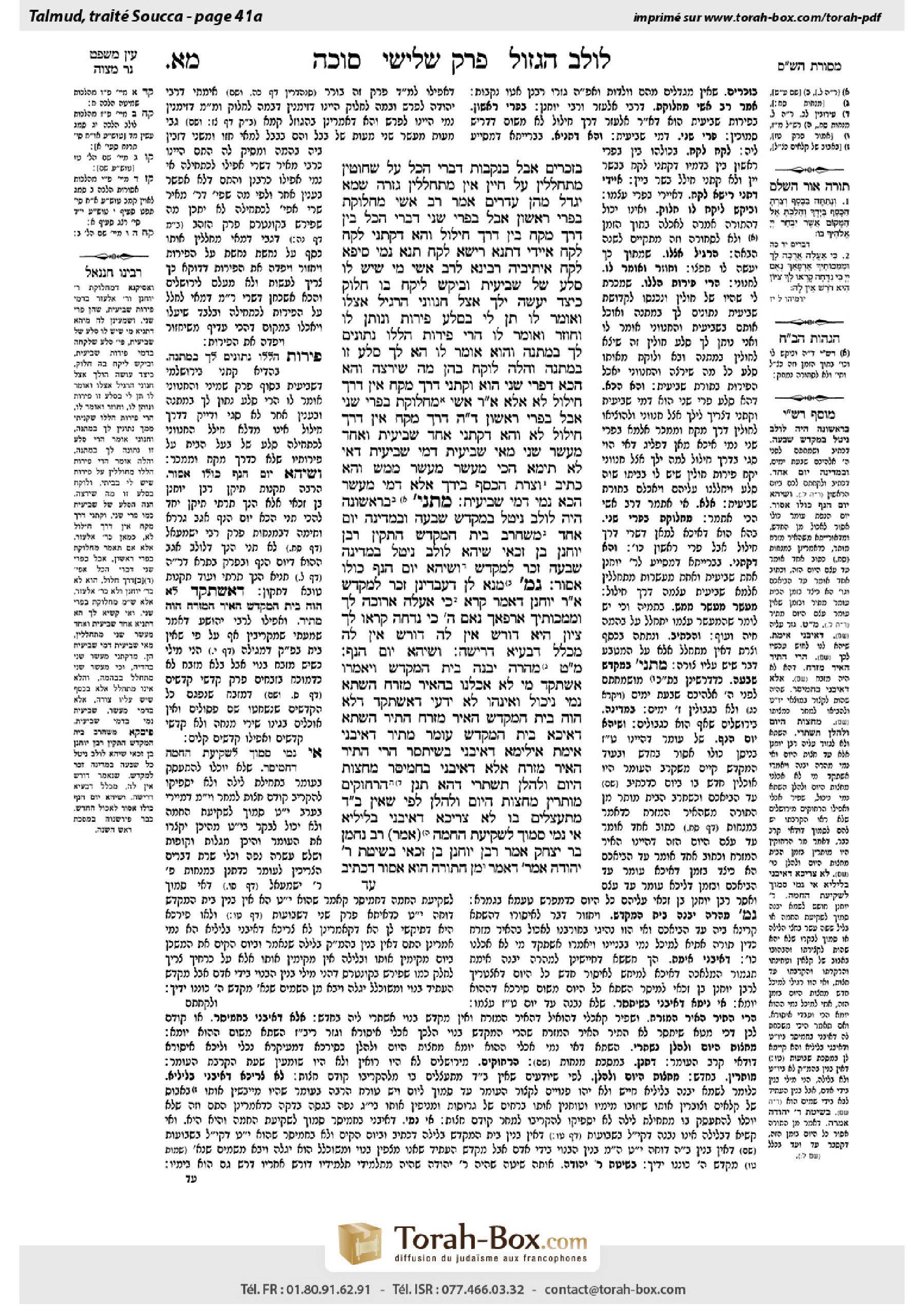
Sukkah 41a: Talmud study for Daf Yomi
Daf Yomi is the daily study of one Talmud folio. Explore 37 tractates with scans, Hebrew text, Sefaria English and AI-generated French translations where annotated.
Passage selection and English or AI-generated French translation are available where the scan has annotations. Daf Study is independent of Torah-Box and Sefaria.
Browse Sukkah · סוכה · All tractatesSukkah 41a text and translations
This page of Sukkah includes the Aramaic text, an English translation and an AI-generated French translation, alongside the scan above.
סוכה מ״א א · Aramaic and Hebrew text
בִּזְכָרִים, אֲבָל בִּנְקֵבוֹת — דִּבְרֵי הַכֹּל: עַל שְׁחוּטִין — מִתְחַלְּלִין, עַל חַיִּין — אֵין מִתְחַלְּלִין, גְּזֵרָה שֶׁמָּא יְגַדֵּל מֵהֶן עֲדָרִים.
אָמַר רַב אָשֵׁי: מַחֲלוֹקֶת בִּפְרִי רִאשׁוֹן, אֲבָל בִּפְרִי שֵׁנִי — דִּבְרֵי הַכֹּל: בֵּין דֶּרֶךְ מִקָּח בֵּין דֶּרֶךְ חִילּוּל. וְהָא דְּקָתָנֵי ״לָקַח״ ״לָקַח״, אַיְּידֵי דִּתְנָא רֵישָׁא ״לָקַח״, תְּנָא נָמֵי סֵיפָא ״לָקַח״.
אֵיתִיבֵיהּ רָבִינָא לְרַב אָשֵׁי: מִי שֶׁיֵּשׁ לוֹ סֶלַע שֶׁל שְׁבִיעִית וּבִיקֵּשׁ לִיקַּח בּוֹ חָלוּק, כֵּיצַד יַעֲשֶׂה? יֵלֵךְ אֵצֶל חֶנְווֹנִי הָרָגִיל אֶצְלוֹ, וְאוֹמֵר לוֹ: תֵּן לִי בְּסֶלַע פֵּירוֹת, וְנוֹתֵן לוֹ, וְחוֹזֵר וְאוֹמֵר לוֹ: הֲרֵי פֵּירוֹת הַלָּלוּ נְתוּנִים לְךָ בְּמַתָּנָה. וְהוּא אוֹמֵר לוֹ: הֵא לְךָ סֶלַע זוֹ בְּמַתָּנָה, וְהַלָּה לוֹקֵחַ בָּהֶן מַה שֶּׁיִּרְצֶה. וְהָא הָכָא, דִּפְרִי שֵׁנִי הוּא, וְקָתָנֵי: דֶּרֶךְ מִקָּח — אִין, דֶּרֶךְ חִילּוּל — לָא!
אֶלָּא אָמַר רַב אָשֵׁי: מַחֲלוֹקֶת בִּפְרִי שֵׁנִי, אֲבָל בִּפְרִי רִאשׁוֹן, דִּבְרֵי הַכֹּל: דֶּרֶךְ מִקָּח — אִין, דֶּרֶךְ חִילּוּל — לָא. וְהָא דְּקָתָנֵי: אֶחָד שְׁבִיעִית וְאֶחָד מַעֲשֵׂר שֵׁנִי — מַאי שְׁבִיעִית? דְּמֵי שְׁבִיעִית.
דְּאִי לָא תֵּימָא הָכִי, ״מַעֲשֵׂר״ — מַעֲשֵׂר מַמָּשׁ? וְהָא כְּתִיב: ״וְצַרְתָּ הַכֶּסֶף בְּיָדְךָ״. אֶלָּא דְּמֵי מַעֲשֵׂר — הָכָא נָמֵי דְּמֵי שְׁבִיעִית.
מַתְנִי׳ בָּרִאשׁוֹנָה הָיָה לוּלָב נִיטָּל בַּמִּקְדָּשׁ שִׁבְעָה, וּבַמְּדִינָה יוֹם אֶחָד. מִשֶּׁחָרַב בֵּית הַמִּקְדָּשׁ, הִתְקִין רַבָּן יוֹחָנָן בֶּן זַכַּאי שֶׁיְּהֵא לוּלָב נִיטָּל בַּמְּדִינָה שִׁבְעָה, זֵכֶר לַמִּקְדָּשׁ.
וְשֶׁיְּהֵא יוֹם הֶנֶף כּוּלּוֹ אָסוּר.
גְּמָ׳ מְנָא לַן דְּעָבְדִינַן זֵכֶר לַמִּקְדָּשׁ? אָמַר רַבִּי יוֹחָנָן, דְּאָמַר קְרָא: ״כִּי אַעֲלֶה אֲרוּכָה לָךְ וּמִמַּכּוֹתַיִךְ אֶרְפָּאֵךְ נְאֻם ה׳ כִּי נִדָּחָה קָרְאוּ לָךְ צִיּוֹן הִיא דּוֹרֵשׁ אֵין לָהּ״. ״דּוֹרֵשׁ אֵין לָהּ״, מִכְּלַל דְּבָעֲיָא דְּרִישָׁה.
וְשֶׁיְּהֵא יוֹם הֶנֶף. מַאי טַעְמָא? מְהֵרָה יִבָּנֶה בֵּית הַמִּקְדָּשׁ, וְיֹאמְרוּ: אֶשְׁתָּקַד מִי לֹא אָכַלְנוּ בְּהֵאִיר מִזְרָח? הַשְׁתָּא נָמֵי נֵיכוֹל. וְאִינְהוּ לָא יָדְעִי דְּאֶשְׁתָּקַד דְּלָא הֲוָה בֵּית הַמִּקְדָּשׁ — הֵאִיר מִזְרָח, הִתִּיר. הַשְׁתָּא דְּאִיכָּא בֵּית הַמִּקְדָּשׁ — עוֹמֶר מַתִּיר.
דְּאִיבְּנִי אֵימַת? אִילֵּימָא דְּאִיבְּנִי בְּשִׁיתְּסַר, הֲרֵי הִתִּיר הֵאִיר מִזְרָח! אֶלָּא דְּאִיבְּנִי בַּחֲמֵיסַר, מֵחֲצוֹת הַיּוֹם וּלְהַלָּן תִּשְׁתְּרֵי, דְּהָא תְּנַן: הָרְחוֹקִים, מוּתָּרִין מֵחֲצוֹת הַיּוֹם וּלְהַלָּן, לְפִי שֶׁאֵין בֵּית דִּין מִתְעַצְּלִים בּוֹ!
לָא צְרִיכָא, דְּאִיבְּנִי בְּלֵילְיָא, אִי נָמֵי סָמוּךְ לִשְׁקִיעַת הַחַמָּה. (אָמַר) רַב נַחְמָן בַּר יִצְחָק אָמַר: רַבָּן יוֹחָנָן בֶּן זַכַּאי בְּשִׁיטַת רַבִּי יְהוּדָה אֲמָרָהּ, דְּאָמַר: מִן הַתּוֹרָה הוּא אָסוּר, דִּכְתִיב:
Sukkah 41a · English translation
is specifically with regard to male animals, which do not bear offspring. However, with regard to female animals, everyone agrees that upon slaughtered animals, produce is deconsecrated, but upon animals that are alive, produce is not deconsecrated. The reason is that a decree was issued lest one raise flocks from the females, as typically they bear offspring. The Sages extended the decree to include males as well. From the fact that the baraita uses the term deconsecrated, and not the term purchased, apparently the sanctity of Sabbatical-Year produce takes effect by means of redemption as well.
Rav Ashi said: This dispute whether the sanctity of Sabbatical-Year produce takes effect by means of redemption or only by means of purchase is with regard to the original Sabbatical-Year produce itself. However, with regard to secondary produce purchased in exchange for Sabbatical-Year produce, everyone agrees that its sanctity takes effect both by means of purchase and by means of redemption. And the fact that the baraita cited in support of the opinion of Rabbi Elazar teaches: Purchased, purchased, employing that term even with regard to secondary produce, and not the terms deconsecrated or redeemed, does not prove that sanctity takes effect only by means of purchase. Rather, since the tanna of the baraita taught the first clause of the halakha employing the term purchased, he taught the latter clause employing the term purchased, even though sanctity takes effect even by means of redemption.
Ravina raised an objection to the opinion of Rav Ashi: With regard to one who has a sela coin that has the sanctity of the Sabbatical Year and seeks to purchase a garment with it, how should he do so? He should go to the storekeeper whose store he typically patronizes and say to him: Give me fruits in exchange for this sela, and the storekeeper gives him fruits. And then he says to the storekeeper: These fruits that you sold me and that assumed the sanctity of the Sabbatical Year are given to you as a gift. The storekeeper may then eat them as one eats Sabbatical-Year produce. And the storekeeper says to him: Here is a sela for you as a gift, and that person purchases with it whatever he wants, as the sela was deconsecrated. Ravina asks: But here, isn’t it secondary produce, as the sela had previously been exchanged for the original Sabbatical-Year produce, and nevertheless the baraita teaches: By means of purchase, yes, it is effective; by means of redemption, no, it is not?
Rather, Rav Ashi said, contrary to the suggestion above, that the dispute is specifically with regard to secondary produce; however, with regard to original produce, everyone agrees: By means of purchase, yes, it is deconsecrated; by means of redemption, no, it is not deconsecrated. And with regard to that which is taught in the baraita cited in support of the opinion of Rabbi Yoḥanan: Both Sabbatical-Year produce and second-tithe produce are deconsecrated upon cattle, undomesticated animals, and fowl, indicating that the sanctity of Sabbatical-Year produce takes effect through both purchase and redemption. What is the meaning of Sabbatical-Year produce? It is referring to money exchanged for Sabbatical-Year produce but not to the produce itself.
And the same must be said with regard to the second tithe mentioned in this baraita, as, if you do not say so but say instead that the second tithe referred to in the baraita is actual second-tithe produce, isn’t it written with regard to the second tithe: “Then shall you turn it into money and bind up the money in your hand…and you shall bestow the money for whatsoever your soul desires” (Deuteronomy 14:25–26), indicating that second-tithe produce can be redeemed only with money, with which other food items may be purchased? Rather, the baraita must be referring to money exchanged for second-tithe produce and not to the produce itself. Here, too, with regard to the Sabbatical Year, the baraita is referring to money exchanged for Sabbatical-Year produce and not to the produce itself.
MISHNA: Originally, during the Temple era, the lulav was taken in the Temple for seven days, and in the rest of the country outside the Temple it was taken for one day. Once the Temple was destroyed, Rabban Yoḥanan ben Zakkai instituted an ordinance that the lulav should be taken even in the rest of the country for seven days, in commemoration of the Temple.
And for similar reasons, he instituted an ordinance that for the entire day of waving the omer offering, it should be prohibited to eat the grain of the new crop. It is prohibited to eat the grain of the new crop until the omer offering is brought and waved in the Temple on the sixteenth of Nisan. The offering was sacrificed in the morning; however, after taking potential delays into consideration, the new crop remained prohibited until it was clear that the offering had been sacrificed. Practically speaking, it was prohibited to eat the new grain until the sixteenth of Nisan was over; it was permitted only on the seventeenth. Once the Temple was destroyed and there was no longer an omer offering sacrificed, it was permitted to eat the new crop on the sixteenth. However, Rabban Yoḥanan instituted an ordinance that eating the new grain would remain prohibited until the seventeenth to commemorate the Temple.
GEMARA: The Gemara asks: From where do we derive that we institute ordinances in commemoration of the Temple? Rabbi Yoḥanan said that it is as the verse states: “For I will restore health unto you and I will heal you of your wounds, says the Lord; because they have called you an outcast, she is Zion, there is none that seeks her” (Jeremiah 30:17). From the fact that the verse states: “There is none that seeks her,” it can be learned by inference that it requires seeking, i.e., people should think of and remember the Temple. That is the reason for Rabban Yoḥanan ben Zakkai’s ordinance.
§ The mishna continues: Rabban Yoḥanan instituted that for the entire day of waving the Omer offering, it is prohibited to eat the grain of the new crop. The Gemara asks: What is the reason for this ordinance? It is that soon the Temple will be rebuilt, and people will say: Last year, when the Temple was in ruins, didn’t we eat of the new crop as soon as the eastern horizon was illuminated, as the new crop was permitted immediately with the advent of the morning of the sixteenth of Nisan? Now, too, let us eat the new grain at that time. And they do not know that although last year, when there was no Temple, the illuminating of the eastern sky permitted one to eat the new grain immediately, now that there is a Temple, the omer offering permits one to eat the new grain. Until the omer offering is sacrificed, the new grain is not permitted.
The Gemara asks: When is it that the Temple will be rebuilt in this scenario? If we say that it will be rebuilt on the sixteenth of Nisan, since in the morning the Temple was not yet built, the illuminating of the eastern sky permitted one to eat the new grain, as the omer offering could not yet be brought. Rather, say that it will be rebuilt on the fifteenth of Nisan or on some earlier date, in which case the new grain would not become permitted by the illuminating of the eastern sky. In that case, from midday and onward let it be permitted to eat the new grain, as we learned in a mishna in tractate Menaḥot: The people distant from Jerusalem, who are unaware of the precise time when the omer was brought, are permitted to eat the new grain from midday and onward because the members of the court are not indolent with regard to the omer and would not postpone bringing the offering after midday.
The Gemara says: No, it is necessary to institute the ordinance only in the case where the Temple will be rebuilt at night, on the evening of the sixteenth, and there was no opportunity to cut the omer that night. Alternatively, it was necessary to institute the ordinance in the case where the Temple was built adjacent to sunset on the fifteenth because there would not be sufficient time to complete all the preparations and sacrifice the offering by noon the next day. Therefore, Rabban Yoḥanan ben Zakkai instituted that the new grain is prohibited for the entire day of the sixteenth. Rav Naḥman bar Yitzḥak said: That is not the reason; rather, Rabban Yoḥanan ben Zakkai stated his ordinance in accordance with the opinion of Rabbi Yehuda, who said: It is prohibited by Torah law to eat the new grain until the seventeenth of Nisan, as it is written:
Sukkah 41a · Traduction française (IA)
Cela concerne spécifiquement les animaux mâles, qui n’engendrent pas de petits. En revanche, au sujet des animaux femelles, tous conviennent que les fruits sont désacralisés en échange d’animaux abattus, mais pas en échange d’animaux vivants. En effet, un décret a été prononcé, de peur que l’on n’élève des troupeaux à partir des femelles, puisqu’elles mettent habituellement bas. Les Sages ont étendu ce décret aux mâles également. Puisque la baraïta emploie le terme « désacralisés » et non le terme « achetés », il semble que la sainteté des fruits de l’année sabbatique puisse également prendre effet par le biais d’un rachat.
Rav Ashi dit : Cette controverse, qui porte sur la question de savoir si la sainteté des fruits de l’année sabbatique prend effet par le biais d’un rachat ou uniquement par le biais d’un achat, concerne les fruits originels de l’année sabbatique eux-mêmes. En revanche, au sujet des fruits secondaires achetés en échange de fruits de l’année sabbatique, tous conviennent que leur sainteté prend effet aussi bien par le biais d’un achat que par celui d’un rachat. Le fait que la baraïta citée à l’appui de l’opinion de Rabbi Elazar enseigne « achetés, achetés », employant ce terme même au sujet des fruits secondaires, et non les termes « désacralisés » ou « rachetés », ne prouve pas que la sainteté ne prend effet que par le biais d’un achat. En effet, puisque le tanna de la baraïta a employé le terme « achetés » dans la première partie de la halakha, il l’a également employé dans la dernière partie, bien que la sainteté prenne effet même par le biais d’un rachat.
Ravina objecta à l’opinion de Rav Ashi : Celui qui possède une pièce d’un séla investie de la sainteté de l’année sabbatique et souhaite acheter un vêtement avec elle, comment doit-il procéder ? Il doit se rendre chez le commerçant auprès duquel il a l’habitude d’acheter et lui dire : « Donne-moi des fruits en échange de ce séla. » Le commerçant lui donne alors des fruits. Puis il lui dit : « Ces fruits que tu m’as vendus et qui ont reçu la sainteté de l’année sabbatique, je te les donne en cadeau. » Le commerçant peut alors les manger comme on mange des fruits de l’année sabbatique. Le commerçant lui dit ensuite : « Voici un séla en cadeau pour toi. » Cet homme achète alors avec lui ce qu’il veut, car le séla a été désacralisé. Ravina demande : Mais ici, ne s’agit-il pas de fruits secondaires, puisque le séla avait auparavant été échangé contre les fruits originels de l’année sabbatique ? Pourtant, la baraïta enseigne que la sainteté prend effet par le biais d’un achat, mais pas par celui d’un rachat.
Rav Ashi dit alors, à l’inverse de ce qui a été suggéré précédemment, que la controverse concerne spécifiquement les fruits secondaires. En revanche, au sujet des fruits originels, tous conviennent que par le biais d’un achat, ils sont désacralisés, mais pas par celui d’un rachat. Quant à la baraïta citée à l’appui de l’opinion de Rabbi Yoḥanan, qui enseigne que les fruits de l’année sabbatique comme ceux de la seconde dîme sont désacralisés en échange de bétail, d’animaux sauvages et de volailles, ce qui semble indiquer que la sainteté des fruits de l’année sabbatique prend effet aussi bien par le biais d’un achat que par celui d’un rachat, que signifie ici l’expression « fruits de l’année sabbatique » ? Elle désigne l’argent échangé contre les fruits de l’année sabbatique, et non les fruits eux-mêmes.
Il faut dire la même chose au sujet de la seconde dîme mentionnée dans cette baraïta. En effet, si l’on ne dit pas cela et que l’on prétend plutôt que la baraïta parle des fruits mêmes de la seconde dîme, n’est-il pas écrit à son sujet : « Alors tu la convertiras en argent, tu prendras l’argent dans ta main […] et tu dépenseras cet argent pour tout ce que ton âme désirera » (Deutéronome 14, 25-26) ? Cela indique que les fruits de la seconde dîme ne peuvent être rachetés qu’au moyen d’argent, avec lequel d’autres aliments peuvent être achetés. La baraïta doit donc parler de l’argent échangé contre les fruits de la seconde dîme, et non des fruits eux-mêmes. De même, au sujet de l’année sabbatique, elle parle de l’argent échangé contre les fruits de l’année sabbatique, et non des fruits eux-mêmes.
MICHNA : À l’origine, à l’époque du Temple, on prenait le loulav pendant sept jours dans le Temple et pendant un jour dans le reste du pays, en dehors du Temple. Après la destruction du Temple, Rabban Yoḥanan ben Zakkaï institua que l’on prenne le loulav pendant sept jours également dans le reste du pays, en souvenir du Temple.
Pour des raisons analogues, il institua que, pendant toute la journée où l’on agitait l’offrande de l’omer, il soit interdit de manger du grain de la nouvelle récolte. Il est interdit d’en manger jusqu’à ce que l’offrande de l’omer soit apportée et agitée dans le Temple, le seize nissan. L’offrande était sacrifiée le matin ; toutefois, compte tenu des retards éventuels, le grain de la nouvelle récolte restait interdit jusqu’à ce qu’il soit certain que l’offrande avait été sacrifiée. En pratique, il était interdit d’en manger jusqu’à la fin du seize nissan ; il n’était permis d’en manger qu’à partir du dix-sept. Après la destruction du Temple, puisqu’on ne sacrifiait plus l’offrande de l’omer, il fut permis de manger de la nouvelle récolte dès le seize. Cependant, Rabban Yoḥanan institua que le grain nouveau demeure interdit jusqu’au dix-sept, en souvenir du Temple.
GUEMARA : La Guemara demande : D’où savons-nous qu’il faut instituer des ordonnances en souvenir du Temple ? Rabbi Yoḥanan dit que cela découle du verset : « Car je te rendrai la santé et je guérirai tes blessures, dit l’Éternel ; car ils t’ont appelée la repoussée, elle, Sion, dont nul ne se soucie » (Jérémie 30, 17). Puisque le verset dit : « dont nul ne se soucie », on peut en déduire qu’il faut s’en soucier, c’est-à-dire que les gens doivent penser au Temple et s’en souvenir. Telle est la raison de l’ordonnance de Rabban Yoḥanan ben Zakkaï.
§ La Michna poursuit : Rabban Yoḥanan institua que, pendant toute la journée où l’on agite l’offrande de l’omer, il soit interdit de manger du grain de la nouvelle récolte. La Guemara demande : Quelle est la raison de cette ordonnance ? Le Temple sera bientôt reconstruit, et les gens diront : « L’année dernière, lorsque le Temple était en ruines, n’avons-nous pas mangé de la nouvelle récolte dès que l’horizon oriental s’est éclairé, puisque le grain nouveau était permis dès l’aube du seize nissan ? Mangeons donc, cette fois encore, du grain nouveau à ce moment-là. » Ils ne sauront pas que si, l’année dernière, en l’absence de Temple, l’éclaircissement du ciel à l’est permettait de manger immédiatement du grain nouveau, maintenant qu’il y a un Temple, c’est l’offrande de l’omer qui en autorise la consommation. Tant que l’offrande de l’omer n’a pas été sacrifiée, le grain nouveau n’est pas permis.
La Guemara demande : À quel moment le Temple sera-t-il reconstruit dans ce scénario ? Si l’on dit qu’il sera reconstruit le seize nissan, puisque le Temple ne serait pas encore bâti le matin, l’éclaircissement du ciel à l’est permettrait de manger du grain nouveau, car l’offrande de l’omer ne pourrait pas encore être apportée. Il faut plutôt dire qu’il sera reconstruit le quinze nissan ou à une date antérieure, auquel cas l’éclaircissement du ciel à l’est ne rendrait pas le grain nouveau permis. Alors, qu’il soit permis d’en manger à partir de midi, comme nous l’avons appris dans une Michna du traité Menaḥot : Les habitants éloignés de Jérusalem, qui ignorent à quel moment précis l’omer a été apporté, sont autorisés à manger du grain nouveau à partir de midi, car les membres du tribunal ne sont pas négligents au sujet de l’omer et ne retarderaient pas l’apport de l’offrande au-delà de midi.
La Guemara répond : Non, cette ordonnance est nécessaire dans le cas où le Temple serait reconstruit pendant la nuit, au début du seize nissan, et où il n’aurait pas été possible de couper l’omer cette nuit-là. Autre possibilité : l’ordonnance est nécessaire dans le cas où le Temple aurait été reconstruit juste avant le coucher du soleil le quinze nissan, car il n’y aurait pas eu suffisamment de temps pour achever toutes les préparations et sacrifier l’offrande avant midi le lendemain. C’est pourquoi Rabban Yoḥanan ben Zakkaï institua que le grain nouveau soit interdit pendant toute la journée du seize. Rav Naḥman bar Yitzḥak dit : Telle n’est pas la raison ; Rabban Yoḥanan ben Zakkaï énonça plutôt son ordonnance conformément à l’opinion de Rabbi Yehuda, qui dit qu’il est interdit par la Torah de manger du grain nouveau jusqu’au dix-sept nissan, comme il est écrit :
Traduction française générée par IA à partir de l’édition anglaise de Sefaria. Vérifie toujours un passage avec le texte source.
Text from Sefaria: William Davidson Edition - Vocalized Aramaic (CC BY NC); William Davidson Edition - English (CC BY NC).