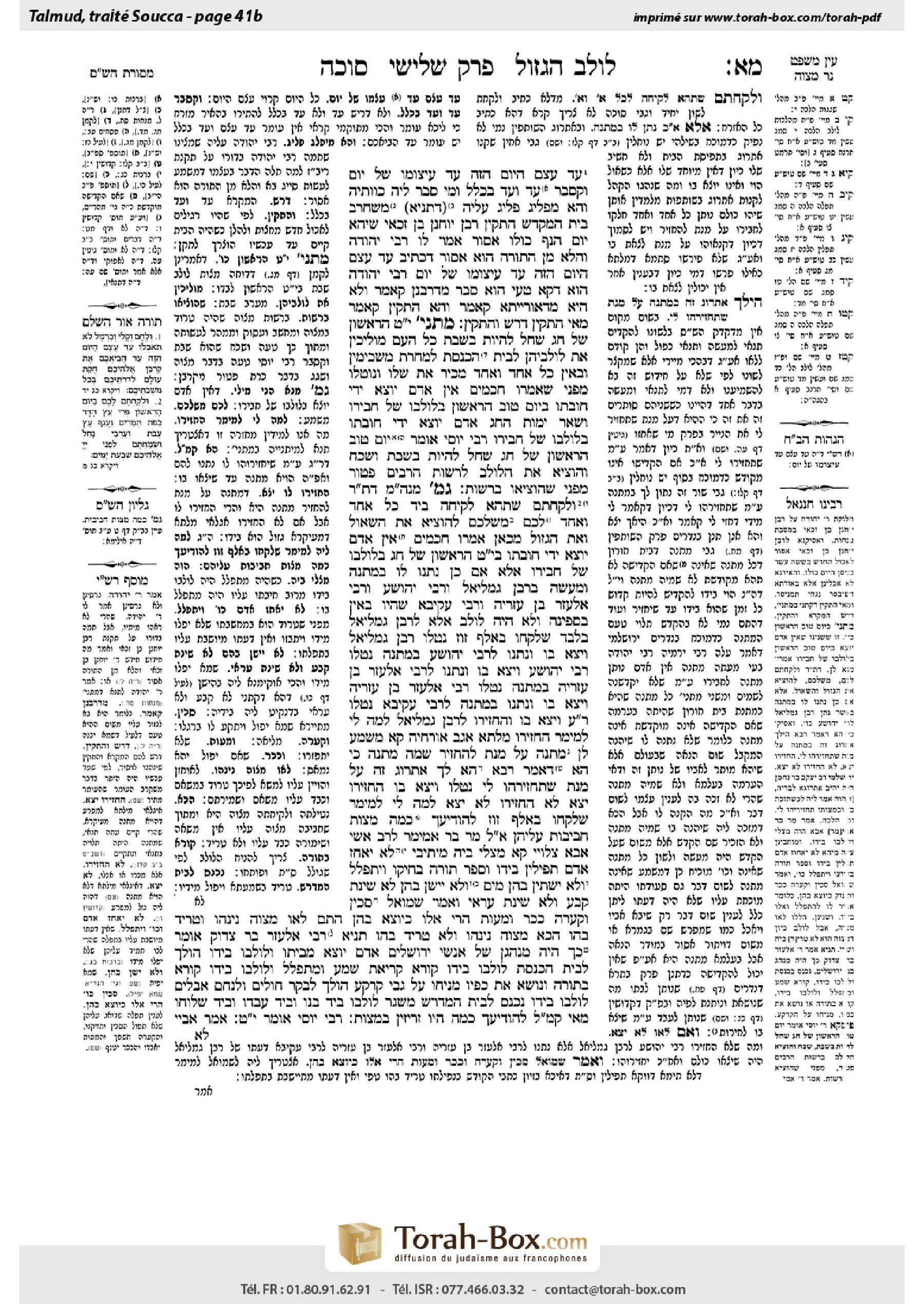
Sukkah 41b: Talmud study for Daf Yomi
Daf Yomi is the daily study of one Talmud folio. Explore 37 tractates with scans, Hebrew text, Sefaria English and AI-generated French translations where annotated.
Passage selection and English or AI-generated French translation are available where the scan has annotations. Daf Study is independent of Torah-Box and Sefaria.
Browse Sukkah · סוכה · All tractatesSukkah 41b text and translations
This page of Sukkah includes the Aramaic text, an English translation and an AI-generated French translation, alongside the scan above.
סוכה מ״א ב · Aramaic and Hebrew text
״עַד עֶצֶם הַיּוֹם הַזֶּה״ — עַד עִיצּוּמוֹ שֶׁל יוֹם, וְקָסָבַר ״עַד״ וְעַד בַּכְּלָל.
וּמִי סָבַר לֵיהּ כְּווֹתֵיהּ? וְהָא מִפְלָיג פְּלִיג עֲלֵיהּ, (דְּתַנְיָא:) מִשֶּׁחָרַב בֵּית הַמִּקְדָּשׁ, הִתְקִין רַבָּן יוֹחָנָן בֶּן זַכַּאי שֶׁיְּהֵא יוֹם הֶנֶף כּוּלּוֹ אָסוּר, אָמַר לוֹ רַבִּי יְהוּדָה: וַהֲלֹא מִן הַתּוֹרָה הוּא אָסוּר, דִּכְתִיב: ״עַד עֶצֶם הַיּוֹם הַזֶּה״ — עַד עִיצּוּמוֹ שֶׁל יוֹם!
רַבִּי יְהוּדָה הוּא דְּקָא טָעֵי, הוּא סָבַר מִדְּרַבָּנַן קָאָמַר. וְלָא הִיא, מִדְּאוֹרָיְיתָא קָאָמַר. וְהָא ״הִתְקִין״ קָאָמַר! מַאי ״הִתְקִין״ — דָּרַשׁ וְהִתְקִין.
מַתְנִי׳ יוֹם טוֹב הָרִאשׁוֹן שֶׁל חַג שֶׁחָל לִהְיוֹת בְּשַׁבָּת, כׇּל הָעָם מוֹלִיכִין אֶת לוּלְבֵיהֶן לְבֵית הַכְּנֶסֶת. לַמׇּחֳרָת מַשְׁכִּימִין וּבָאִין, כׇּל אֶחָד וְאֶחָד מַכִּיר אֶת שֶׁלּוֹ וְנוֹטְלוֹ, מִפְּנֵי שֶׁאָמְרוּ חֲכָמִים: אֵין אָדָם יוֹצֵא יְדֵי חוֹבָתוֹ בְּיוֹם טוֹב הָרִאשׁוֹן בְּלוּלָבוֹ שֶׁל חֲבֵירוֹ, וּשְׁאָר יְמוֹת הַחַג — אָדָם יוֹצֵא יְדֵי חוֹבָתוֹ בְּלוּלָבוֹ שֶׁל חֲבֵירוֹ. רַבִּי יוֹסֵי אוֹמֵר: יוֹם טוֹב הָרִאשׁוֹן שֶׁל חַג שֶׁחָל לִהְיוֹת בְּשַׁבָּת, וְשָׁכַח וְהוֹצִיא אֶת הַלּוּלָב לִרְשׁוּת הָרַבִּים — פָּטוּר, מִפְּנֵי שֶׁהוֹצִיאוֹ בִּרְשׁוּת.
גְּמָ׳ מְנָא הָנֵי מִילֵּי? דְּתָנוּ רַבָּנַן: ״וּלְקַחְתֶּם״, שֶׁתְּהֵא לְקִיחָה בְּיַד כׇּל אֶחָד וְאֶחָד. ״לָכֶם״, מִשֶּׁלָּכֶם — לְהוֹצִיא אֶת הַשָּׁאוּל וְאֶת הַגָּזוּל. מִכָּאן אָמְרוּ חֲכָמִים: אֵין אָדָם יוֹצֵא יְדֵי חוֹבָתוֹ בְּיוֹם טוֹב הָרִאשׁוֹן שֶׁל חַג בְּלוּלָבוֹ שֶׁל חֲבֵירוֹ אֶלָּא אִם כֵּן נְתָנוֹ לוֹ בְּמַתָּנָה.
וּמַעֲשֶׂה בְּרַבָּן גַּמְלִיאֵל וְרַבִּי יְהוֹשֻׁעַ וְרַבִּי אֶלְעָזָר בֶּן עֲזַרְיָה וְרַבִּי עֲקִיבָא שֶׁהָיוּ בָּאִין בִּסְפִינָה, וְלֹא הָיָה לוּלָב אֶלָּא לְרַבָּן גַּמְלִיאֵל בִּלְבַד, שֶׁלְּקָחוֹ בְּאֶלֶף זוּז. נְטָלוֹ רַבָּן גַּמְלִיאֵל וְיָצָא בּוֹ, וּנְתָנוֹ לְרַבִּי יְהוֹשֻׁעַ בְּמַתָּנָה. נְטָלוֹ רַבִּי יְהוֹשֻׁעַ וְיָצָא בּוֹ, וּנְתָנוֹ לְרַבִּי אֶלְעָזָר בֶּן עֲזַרְיָה בְּמַתָּנָה. נְטָלוֹ רַבִּי אֶלְעָזָר בֶּן עֲזַרְיָה וְיָצָא בּוֹ, וּנְתָנוֹ בְּמַתָּנָה לְרַבִּי עֲקִיבָא. נְטָלוֹ רַבִּי עֲקִיבָא וְיָצָא בּוֹ, וְהֶחְזִירוֹ לְרַבָּן גַּמְלִיאֵל.
לְמָה לִי לְמֵימַר הֶחְזִירוֹ? מִלְּתָא אַגַּב אוֹרְחֵיהּ קָא מַשְׁמַע לַן: מַתָּנָה עַל מְנָת לְהַחְזִיר — שְׁמָהּ מַתָּנָה.
כִּי הָא דְּאָמַר רָבָא: ״הֵא לְךָ אֶתְרוֹג זֶה עַל מְנָת שֶׁתַּחְזִירֵהוּ לִי״. נְטָלוֹ וְיָצָא בּוֹ, הֶחְזִירוֹ — יָצָא, לֹא הֶחְזִירוֹ — לֹא יָצָא.
לְמָה לִי לְמֵימַר שֶׁלְּקָחוֹ בְּאֶלֶף זוּז? לְהוֹדִיעֲךָ כַּמָּה מִצְוֹת חֲבִיבוֹת עֲלֵיהֶן.
אֲמַר לֵיהּ מָר בַּר אַמֵּימָר לְרַב אָשֵׁי: אַבָּא צַלּוֹיֵי קָא מְצַלֵּי בֵּיהּ. מֵיתִיבִי: לֹא יֹאחַז אָדָם תְּפִילִּין בְּיָדוֹ וְסֵפֶר תּוֹרָה בְּחֵיקוֹ וְיִתְפַּלֵּל. וְלֹא יַשְׁתִּין בָּהֶן מַיִם, וְלֹא יִישַׁן בָּהֶן לֹא שֵׁינַת קֶבַע וְלֹא שֵׁינַת עֲרַאי.
וְאָמַר שְׁמוּאֵל: סַכִּין וּקְעָרָה, כִּכָּר וּמָעוֹת — הֲרֵי אֵלּוּ כַּיּוֹצֵא בָּהֶן. הָתָם לָאו מִצְוָה נִינְהוּ, וּטְרִיד בְּהוּ. הָכָא מִצְוָה נִינְהוּ, וְלָא טְרִיד בְּהוּ.
תַּנְיָא, רַבִּי אֶלְעָזָר בַּר צָדוֹק אוֹמֵר: כָּךְ הָיָה מִנְהָגָן שֶׁל אַנְשֵׁי יְרוּשָׁלַיִם, אָדָם יוֹצֵא מִבֵּיתוֹ — וְלוּלָבוֹ בְּיָדוֹ. הוֹלֵךְ לְבֵית הַכְּנֶסֶת — לוּלָבוֹ בְּיָדוֹ. קוֹרֵא קְרִיאַת שְׁמַע וּמִתְפַּלֵּל — וְלוּלָבוֹ בְּיָדוֹ. קוֹרֵא בַּתּוֹרָה וְנוֹשֵׂא אֶת כַּפָּיו — מַנִּיחוֹ עַל גַּבֵּי קַרְקַע. הוֹלֵךְ לְבַקֵּר חוֹלִים וּלְנַחֵם אֲבֵלִים — לוּלָבוֹ בְּיָדוֹ. נִכְנַס לְבֵית הַמִּדְרָשׁ — מְשַׁגֵּר לוּלָבוֹ בְּיַד בְּנוֹ, וּבְיַד עַבְדּוֹ, וּבְיַד שְׁלוּחוֹ.
מַאי קָא מַשְׁמַע לַן? לְהוֹדִיעֲךָ כַּמָּה הָיוּ זְרִיזִין בְּמִצְוֹת.
רַבִּי יוֹסֵי אוֹמֵר יוֹם טוֹב. אָמַר אַבָּיֵי:
Sukkah 41b · English translation
“And you shall eat neither bread, nor roasted grain, nor fresh grain, until this selfsame [etzem] day, until you have brought the offering of your God” (Leviticus 23:14), indicating until the essence [itzumo] of the day, and not the night before. And he holds that when the verse states: “Until,” the word until is inclusive, meaning that the grain is permitted only after the conclusion of the sixteenth.
The Gemara asks: And does Rabban Yoḥanan ben Zakkai hold in accordance with the opinion of Rabbi Yehuda? But doesn’t he disagree with him, as it is taught in a baraita: Once the Temple was destroyed, Rabban Yoḥanan ben Zakkai instituted that for the entire day of waving the omer offering, it should be prohibited to eat the grain of the new crop. Rabbi Yehuda said to him: Isn’t it prohibited by Torah law, as it is written: “Until this selfsame day,” which means: Until the essence of the day? Apparently, they have two divergent opinions.
The Gemara answers: It is Rabbi Yehuda who is mistaken. He thought that Rabban Yoḥanan ben Zakkai is saying it is prohibited by rabbinic law. And that is not so; he is saying it is prohibited by Torah law. The Gemara asks: But didn’t the mishna say: Rabban Yoḥanan ben Zakkai instituted, indicating that it is a rabbinic ordinance? The Gemara answers: What is the meaning of instituted? It means that he interpreted the verses in the Torah and instituted public notice for the multitudes to conduct themselves accordingly.
MISHNA: If the first day of the festival of Sukkot occurs on Shabbat, all of the people bring their lulavim to the synagogue on Shabbat eve, as it is prohibited to carry in a public domain on Shabbat. The next day, on Shabbat, everyone rises early and comes to the synagogue. Each and every one recognizes his lulav and takes it. This emphasis that each and every one recognizes his own lulav and takes it is because the Sages said: A person does not fulfill his obligation to take the lulav on the first day of the Festival with the lulav of another, and on the rest of the days of the Festival a person fulfills his obligation even with the lulav of another. Rabbi Yosei says: If the first day of the Festival occurs on Shabbat, and he forgot and carried the lulav out into the public domain, he is exempt from liability to bring a sin-offering for this unwitting transgression because he carried it out with permission, i.e., he was preoccupied with the performance of the mitzva and carried it out.
GEMARA: From where are these matters derived, that one does not fulfill his obligation with the lulav of another on the first day of the Festival? It is as the Sages taught that it is written: “And you shall take for yourselves on the first day the fruit of a beautiful tree, branches of a date palm, and boughs of a dense-leaved tree, and willows of the brook” (Leviticus 23:40). The use of second person plural in the phrase: “And you shall take,” indicates that there should be taking in the hand of each and every person. The word yourselves in the phrase “take for yourselves” means: From your own, to exclude a borrowed or stolen lulav. From here the Sages stated: A person does not fulfill his obligation on the first day of the Festival with the lulav of another unless the other gave it to him as a full-fledged gift, as in that case it belongs to him.
There was an incident involving Rabban Gamliel, and Rabbi Yehoshua, and Rabbi Elazar ben Azarya, and Rabbi Akiva, who were all traveling on a ship during the festival of Sukkot and only Rabban Gamliel had a lulav, which he had bought for one thousand zuz. Rabban Gamliel took it and fulfilled his obligation with it and then gave it to Rabbi Yehoshua as a gift. Rabbi Yehoshua took it and fulfilled his obligation with it and gave it to Rabbi Elazar ben Azarya as a gift. Rabbi Elazar ben Azarya took it and fulfilled his obligation with it and gave it to Rabbi Akiva as a gift. Rabbi Akiva took it and fulfilled his obligation with it and returned it to Rabban Gamliel.
The Gemara asks: Why do I need to say that Rabbi Akiva returned the lulav to Rabban Gamliel? The crux of the story is that each of the Sages fulfilled his obligation with the same lulav after receiving it as a gift. The Gemara answers: By including that detail, the tanna teaches us another matter in passing, namely that a gift given on the condition that it be returned is considered a full-fledged gift. Even if the owner stipulates from the outset that the gift would be returned, since he gives it as a gift in the interim, its halakhic status is that of a full-fledged gift.
This is like that which Rava said, that in the case of one who says to another: Here is an etrog for you on condition that you return it to me, and the recipient took it and fulfilled his obligation with it, if he returned the etrog, he fulfilled his obligation of taking the etrog. However, if he did not return the etrog, he did not fulfill his obligation. Since he did not fulfill the condition, retroactively he never acquired the gift at all.
The Gemara asks: Why do I need to say that Rabban Gamliel bought this lulav for one thousand zuz? The Gemara answers: It is to inform you how beloved mitzvot were to them to the extent that he was willing to pay an exorbitant sum to purchase a lulav.
§ Mar bar Ameimar said to Rav Ashi: My father would pray with the four species in his hand in an expression of his love for the mitzva. The Gemara raises an objection: A person should not hold phylacteries in his hand or a Torah scroll in his lap and pray while doing so; neither should he urinate with them in his hand; nor should he sleep with them in his hand, neither a deep sleep nor a brief nap.
And Shmuel said: With regard to a knife, a bowl full of food, a loaf of bread, or money, these items are similar to those mentioned above; since he is concerned lest these items fall from his hand, he is distracted and he unable to concentrate on his prayers. Why, then, is that not the case with regard to lulav? It should be prohibited to hold the lulav during prayer for the same reason. The Gemara answers: There, in the cases listed above, they are not related to performance of a mitzva, and he is preoccupied with them. Therefore, that preoccupation distracts his focus from his prayers. Here, in the case of the four species, they are related to performance of a mitzva, so he is not preoccupied with them in a manner that will distract him from his prayers.
The Gemara cites support for the custom mentioned above, as it is taught in a baraita that Rabbi Elazar bar Tzadok says: This was the custom of the people of Jerusalem during the festival of Sukkot. A person leaves his house, and his lulav is in his hand; he goes to the synagogue, and his lulav is in his hand; he recites Shema and prays, and his lulav is in his hand; he reads the Torah and a priest lifts his hands to recite the priestly benediction, and he places it on the ground because he cannot perform those tasks while holding the lulav. He goes to visit the ill or to console mourners, and his lulav is in his hand; he enters the study hall to study Torah, and he sends his lulav home in the hands of his son, in the hands of his slave, or in the hands of his agent.
The Gemara asks: What is the baraita teaching us by relating all these details that appear to establish the same practice? The Gemara explains: It is to inform you how vigilant they were in the performance of mitzvot and how much they cherished them.
§ The mishna continues: Rabbi Yosei says that if the first day of the Festival occurs on Shabbat, and one forgot and carried the lulav out into the public domain, he is exempt from liability to bring a sin-offering. Abaye said:
Sukkah 41b · Traduction française (IA)
« Vous ne mangerez ni pain, ni grain rôti, ni grain frais jusqu’à ce jour même [etzem], jusqu’à ce que vous ayez apporté l’offrande de votre Dieu » (Lévitique 23,14). Cela indique : jusqu’à l’essence [itzumo] du jour, et non la nuit qui le précède. Il soutient que lorsque le verset dit « jusqu’à », ce terme inclut la limite : le grain n’est donc permis qu’après la fin du seizième jour.
La Guemara demande : Rabban Yoḥanan ben Zakkaï est-il donc d’accord avec l’opinion de Rabbi Yehouda ? Pourtant, il est en désaccord avec lui, comme l’enseigne une baraïta : Après la destruction du Temple, Rabban Yoḥanan ben Zakkaï institua que, pendant toute la journée de la présentation de l’offrande du omer, il serait interdit de manger le grain de la nouvelle récolte. Rabbi Yehouda lui dit : N’est-ce pas interdit par la Torah, comme il est écrit : « jusqu’à ce jour même », ce qui signifie : jusqu’à l’essence du jour ? Apparemment, ils ont deux opinions divergentes.
La Guemara répond : C’est Rabbi Yehouda qui se trompe. Il pensait que Rabban Yoḥanan ben Zakkaï disait que l’interdiction relevait de la loi rabbinique. Mais ce n’est pas le cas : il dit qu’elle relève de la Torah. La Guemara demande : Mais la Michna n’a-t-elle pas dit que Rabban Yoḥanan ben Zakkaï institua cette règle, ce qui indique qu’il s’agissait d’une ordonnance rabbinique ? La Guemara répond : Que signifie « institua » ? Cela signifie qu’il interpréta les versets de la Torah et institua qu’un avis public soit donné afin que les foules se conduisent en conséquence.
MICHNA : Si le premier jour de la fête de Souccot tombe un Chabbat, tous apportent leurs loulavim à la synagogue la veille de Chabbat, car il est interdit de transporter dans le domaine public le Chabbat. Le lendemain, le Chabbat, tous se lèvent tôt et viennent à la synagogue. Chacun reconnaît son loulav et le prend. Cette précision — chacun reconnaît son propre loulav et le prend — s’explique par le fait que les Sages ont dit : Le premier jour de la fête, une personne ne s’acquitte pas de son obligation de prendre le loulav avec le loulav d’autrui ; les autres jours de la fête, elle s’en acquitte même avec le loulav d’autrui. Rabbi Yossi dit : Si le premier jour de la fête tombe un Chabbat et qu’une personne oublie et transporte le loulav dans le domaine public, elle est exemptée de l’obligation d’apporter un sacrifice expiatoire pour cette transgression involontaire, car elle l’a transporté avec autorisation, c’est-à-dire qu’elle était occupée à accomplir la mitsva et l’a transporté.
GUEMARA : D’où déduit-on qu’on ne s’acquitte pas de son obligation avec le loulav d’autrui le premier jour de la fête ? Les Sages l’ont enseigné à partir de ce qui est écrit : « Vous prendrez le premier jour le fruit d’un bel arbre, des branches de palmier, des rameaux d’un arbre touffu et des saules du torrent » (Lévitique 23,40). L’emploi de la deuxième personne du pluriel dans l’expression « vous prendrez » indique que chacun doit prendre le loulav en main. Le mot « vous-mêmes » dans l’expression « vous prendrez pour vous-mêmes » signifie : « provenant de ce qui vous appartient », ce qui exclut un loulav emprunté ou volé. De là, les Sages ont dit : Le premier jour de la fête, une personne ne s’acquitte pas de son obligation avec le loulav d’autrui, à moins que celui-ci le lui ait donné comme un don à part entière, auquel cas il lui appartient.
Il y eut un épisode concernant Rabban Gamliel, Rabbi Yehoshoua, Rabbi Elazar ben Azarya et Rabbi Akiva, qui voyageaient tous sur un bateau pendant la fête de Souccot. Seul Rabban Gamliel avait un loulav, qu’il avait acheté pour mille zouzim. Rabban Gamliel le prit et s’acquitta de son obligation avec celui-ci, puis le donna en cadeau à Rabbi Yehoshoua. Rabbi Yehoshoua le prit et s’acquitta de son obligation avec celui-ci, puis le donna en cadeau à Rabbi Elazar ben Azarya. Rabbi Elazar ben Azarya le prit et s’acquitta de son obligation avec celui-ci, puis le donna en cadeau à Rabbi Akiva. Rabbi Akiva le prit et s’acquitta de son obligation avec celui-ci, puis le rendit à Rabban Gamliel.
La Guemara demande : Pourquoi faut-il préciser que Rabbi Akiva rendit le loulav à Rabban Gamliel ? L’essentiel de l’épisode est que chacun des Sages s’acquitta de son obligation avec le même loulav après l’avoir reçu en cadeau. La Guemara répond : En incluant ce détail, le tanna nous enseigne incidemment une autre règle, à savoir qu’un cadeau donné à condition d’être rendu est considéré comme un don à part entière. Même si le propriétaire stipule d’emblée que le cadeau devra être rendu, puisqu’il le donne comme cadeau dans l’intervalle, son statut halakhique est celui d’un don à part entière.
Cela correspond à ce que Rava a dit : si quelqu’un dit à un autre : « Voici un étrog pour toi, à condition que tu me le rendes », et que le destinataire le prend et s’acquitte de son obligation avec celui-ci, s’il rend l’étrog, il s’est acquitté de son obligation de prendre l’étrog. En revanche, s’il ne le rend pas, il ne s’est pas acquitté de son obligation. Puisqu’il n’a pas respecté la condition, il s’avère rétroactivement qu’il n’a jamais acquis le cadeau.
La Guemara demande : Pourquoi faut-il préciser que Rabban Gamliel avait acheté ce loulav pour mille zouzim ? La Guemara répond : C’est pour vous informer de l’importance qu’avaient les mitsvot à leurs yeux, au point qu’il était prêt à payer une somme exorbitante pour acheter un loulav.
§ Mar bar Ameimar dit à Rav Ashi : Mon père priait en tenant les quatre espèces à la main, pour témoigner de son amour de la mitsva. La Guemara soulève une objection : Une personne ne doit pas tenir des téfilines à la main ni poser un rouleau de Torah sur ses genoux pendant qu’elle prie ; elle ne doit pas non plus uriner en les tenant à la main, ni dormir en les tenant à la main, que ce soit d’un sommeil profond ou d’un bref somme.
Et Shmouel a dit : Un couteau, un bol rempli de nourriture, un pain ou de l’argent sont comparables aux objets mentionnés plus haut ; comme on craint qu’ils ne lui échappent des mains, la personne est distraite et ne peut pas se concentrer sur ses prières. Pourquoi n’en serait-il pas de même pour le loulav ? Il devrait être interdit de tenir le loulav pendant la prière pour la même raison. La Guemara répond : Dans les cas mentionnés plus haut, ces objets ne sont pas liés à l’accomplissement d’une mitsva, et la personne est préoccupée par eux. Cette préoccupation détourne donc son attention de la prière. Ici, dans le cas des quatre espèces, elles sont liées à l’accomplissement d’une mitsva ; la personne n’en est donc pas préoccupée au point d’être distraite de sa prière.
La Guemara apporte un appui à la pratique mentionnée plus haut, car une baraïta enseigne que Rabbi Elazar bar Tsadok dit : Telle était la coutume des habitants de Jérusalem pendant la fête de Souccot. Une personne quitte sa maison, son loulav à la main ; elle se rend à la synagogue, son loulav à la main ; elle récite le Chéma et prie, son loulav à la main ; elle lit la Torah et, lorsqu’un prêtre lève les mains pour réciter la bénédiction sacerdotale, elle pose son loulav à terre, car elle ne peut accomplir ces tâches tout en le tenant. Elle rend visite aux malades ou va consoler des endeuillés, son loulav à la main ; elle entre à la maison d’étude pour étudier la Torah et renvoie son loulav chez elle entre les mains de son fils, de son esclave ou de son mandataire.
La Guemara demande : Que nous enseigne la baraïta en rapportant tous ces détails, qui semblent établir une seule et même pratique ? La Guemara explique : C’est pour vous informer de la vigilance dont ils faisaient preuve dans l’accomplissement des mitsvot et de l’attachement qu’ils leur portaient.
§ La Michna poursuit : Rabbi Yossi dit que si le premier jour de la fête tombe un Chabbat et qu’une personne oublie et transporte le loulav dans le domaine public, elle est exemptée de l’obligation d’apporter un sacrifice expiatoire. Abayé a dit :
Traduction française générée par IA à partir de l’édition anglaise de Sefaria. Vérifie toujours un passage avec le texte source.
Text from Sefaria: William Davidson Edition - Vocalized Aramaic (CC BY NC); William Davidson Edition - English (CC BY NC).