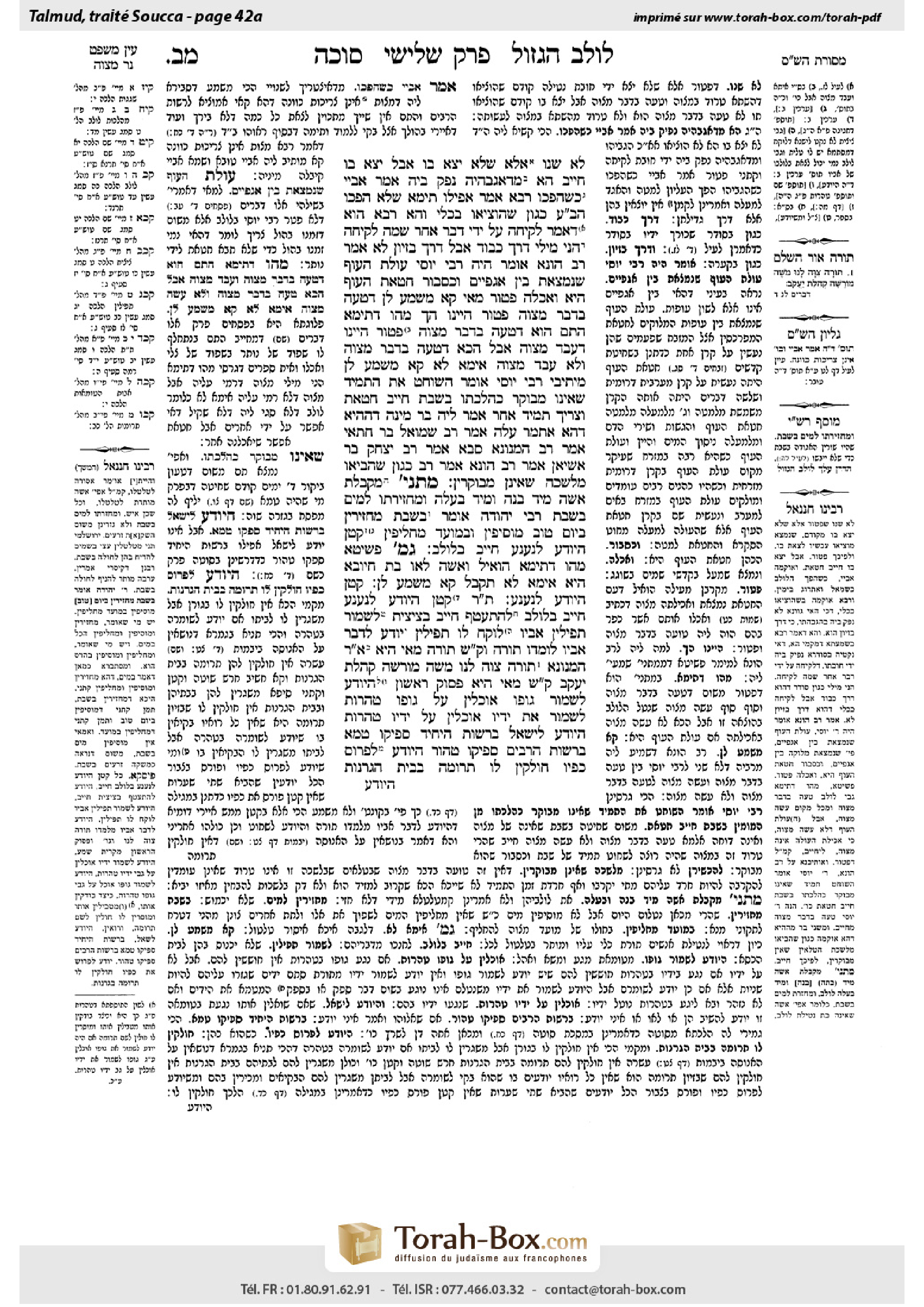
Sukkah 42a: Talmud study for Daf Yomi
Daf Yomi is the daily study of one Talmud folio. Explore 37 tractates with scans, Hebrew text, Sefaria English and AI-generated French translations where annotated.
Passage selection and English or AI-generated French translation are available where the scan has annotations. Daf Study is independent of Torah-Box and Sefaria.
Browse Sukkah · סוכה · All tractatesSukkah 42a text and translations
This page of Sukkah includes the Aramaic text, an English translation and an AI-generated French translation, alongside the scan above.
סוכה מ״ב א · Aramaic and Hebrew text
לֹא שָׁנוּ אֶלָּא שֶׁלֹּא יָצָא בּוֹ, אֲבָל יָצָא בּוֹ — חַיָּיב. הָא מִדְּאַגְבְּהֵיהּ נְפַק בֵּיהּ! אָמַר אַבָּיֵי: כְּשֶׁהֲפָכוֹ.
רָבָא אָמַר: אֲפִילּוּ תֵּימָא שֶׁלֹּא הֲפָכוֹ, הָכָא בְּמַאי עָסְקִינַן: כְּגוֹן שֶׁהוֹצִיאוֹ בִּכְלִי. וְהָא רָבָא הוּא דְּאָמַר: לְקִיחָה עַל יְדֵי דָּבָר אַחֵר — שְׁמָהּ לְקִיחָה! הָנֵי מִילֵּי דֶּרֶךְ כָּבוֹד, אֲבָל דֶּרֶךְ בִּזָּיוֹן — לָא.
אָמַר רַב הוּנָא: אוֹמֵר הָיָה רַבִּי יוֹסֵי, עוֹלַת הָעוֹף שֶׁנִּמְצֵאת בֵּין אֲגַפַּיִים, וּכְסָבוּר חַטַּאת הָעוֹף הִיא וַאֲכָלָהּ — פָּטוּר. מַאי קָא מַשְׁמַע לַן, דְּטָעָה בִּדְבַר מִצְוָה — פָּטוּר? הַיְינוּ הָךְ!
מַהוּ דְּתֵימָא: הָתָם הוּא דְּטָעָה בִּדְבַר מִצְוָה פָּטוּר — הַיְינוּ דַּעֲבַד מִצְוָה. אֲבָל הָכָא, דְּטָעָה בִּדְבַר מִצְוָה וְלָא עֲבַד מִצְוָה — אֵימָא לָא, קָא מַשְׁמַע לַן.
מֵיתִיבִי, רַבִּי יוֹסֵי אוֹמֵר: הַשּׁוֹחֵט אֶת הַתָּמִיד שֶׁאֵינוֹ מְבוּקָּר כְּהִלְכָתוֹ בַּשַּׁבָּת — חַיָּיב חַטָּאת, וְצָרִיךְ תָּמִיד אַחֵר!
אֲמַר לֵיהּ: בַּר מִינַּהּ דְּהַהִיא. דְּהָא אִתְּמַר עֲלַהּ, אָמַר רַב שְׁמוּאֵל בַּר חַתַּאי אָמַר רַב הַמְנוּנָא סָבָא אָמַר רַב יִצְחָק בַּר אַשְׁיָאן אָמַר רַב הוּנָא אָמַר רַב: כְּגוֹן שֶׁהֱבִיאוֹ מִלִּשְׁכָּה שֶׁאֵינָן מְבוּקָּרִין.
מַתְנִי׳ מְקַבֶּלֶת אִשָּׁה מִיָּד בְּנָהּ וּמִיַּד בַּעְלָהּ, וּמַחְזִירָתוֹ לְמַיִם בְּשַׁבָּת. רַבִּי יְהוּדָה אוֹמֵר: בַּשַּׁבָּת מַחְזִירִין, בְּיוֹם טוֹב מוֹסִיפִין, וּבַמּוֹעֵד מַחְלִיפִין.
קָטָן הַיּוֹדֵעַ לְנַעְנֵעַ — חַיָּיב בְּלוּלָב.
גְּמָ׳ פְּשִׁיטָא? מַהוּ דְּתֵימָא: הוֹאִיל וְאִשָּׁה לָאו בַּת חִיּוּבָא הִיא, אֵימָא לָא תְּקַבֵּל, קָא מַשְׁמַע לַן.
קָטָן הַיּוֹדֵעַ לְנַעְנֵעַ. תָּנוּ רַבָּנַן: קָטָן הַיּוֹדֵעַ לְנַעְנֵעַ — חַיָּיב בְּלוּלָב, לְהִתְעַטֵּף — חַיָּיב בְּצִיצִית, לִשְׁמוֹר תְּפִילִּין — אָבִיו לוֹקֵחַ לוֹ תְּפִילִּין, יוֹדֵעַ לְדַבֵּר — אָבִיו מְלַמְּדוֹ תּוֹרָה וּקְרִיאַת שְׁמַע.
תּוֹרָה מַאי הִיא? אָמַר רַב הַמְנוּנָא: ״תּוֹרָה צִוָּה לָנוּ מֹשֶׁה מוֹרָשָׁה קְהִלַּת יַעֲקֹב״. קְרִיאַת שְׁמַע מַאי הִיא? פָּסוּק רִאשׁוֹן.
הַיּוֹדֵעַ לִשְׁמוֹר גּוּפוֹ — אוֹכְלִין עַל גּוּפוֹ טְהָרוֹת. לִשְׁמוֹר אֶת יָדָיו — אוֹכְלִין עַל יָדָיו טְהָרוֹת. הַיּוֹדֵעַ לִישָּׁאֵל, בִּרְשׁוּת הַיָּחִיד — סְפֵיקוֹ טָמֵא, בִּרְשׁוּת הָרַבִּים — סְפֵיקוֹ טָהוֹר. הַיּוֹדֵעַ לִפְרוֹס כַּפָּיו — חוֹלְקִין לוֹ תְּרוּמָה בְּבֵית הַגֳּרָנוֹת.
Sukkah 42a · English translation
The Sages taught that he is exempt only in a case where he did not yet fulfill his obligation. However, if he already fulfilled his obligation and he carries the lulav out, he is liable to bring a sin-offering. The Gemara asks: Is it possible to carry the lulav without fulfilling one’s obligation? Didn’t he, from the moment that he lifted it, fulfill his obligation with it? Abaye said: It is referring to a case where he overturned it and lifted it. One fulfills his obligation only when lifting it in the manner in which it grows.
Rava said: Even if you say that it is referring to a case where he did not invert it, with what are we dealing here? It is with a case where he took the lulav out in a vessel and did not fulfill his obligation. The Gemara asks: But isn’t Rava the one who said that taking by means of another object is considered taking? The Gemara answers: This applies only when the addition is in a deferential manner, for wrapping or ornamentation. But if the addition is in a degrading manner, as in this case, where one places the lulav into a vessel and carries it that way, no, it is not considered taking.
Rav Huna said that Rabbi Yosei would say: In the case of a bird sacrificed as a burnt-offering that is found among other birds in one of the corners of the altar, and the priest thought that it was a bird sacrificed as a sin-offering and he ate it, as sin-offerings are eaten by priests, he is exempt from liability to bring a guilt-offering for misuse of consecrated items. The Gemara asks: What is Rav Huna teaching us? Is it that if one erred in the matter of a mitzva, he is exempt? This is identical to that statement of Rabbi Yosei; what novel element is introduced by Rav Huna?
The Gemara answers: It is lest you say that it is only there, in the case of carrying the lulav, that one who erred in a matter of a mitzva is exempt and that is because he performed a mitzva; however, here, with regard to mistakenly identifying the bird-offerings, where he erred in the matter of a mitzva but did not perform a mitzva at all, say no, in that case he would not be exempt from liability to bring a guilt-offering. Therefore, Rav Huna teaches us that he is in fact exempt.
The Gemara raises an objection. Rabbi Yosei says: With regard to one who slaughters the daily offering on Shabbat that is not properly inspected, and a blemish is discovered that disqualifies the sacrifice, he unwittingly performed the prohibited labor of slaughtering on Shabbat. He is liable to bring a sin-offering, and he needs to bring a different daily offering. Even though he erred in a matter of a mitzva, he is liable.
Rav Huna said in response to the objection: Proof may be cited, except not from that baraita, as it was stated concerning that baraita that Rav Shmuel bar Ḥatai said that Rav Hamnuna Sava said that Rav Yitzḥak bar Ashian said that Rav Huna said that Rav said: It is referring to a case where they brought the sheep for the daily offering from a chamber in which there were sheep that are not inspected. Since under no circumstances should one take a sheep for the daily offering from uninspected sheep, his error cannot be attributed to preoccupation with the mitzva. Therefore, although he was engaged in performance of a mitzva, he is not exempt from liability to bring a sin-offering.
MISHNA: A woman may receive a lulav from her son or from her husband and return it on Shabbat to the water in which it had been placed. Rabbi Yehuda says: On Shabbat one may return the lulav to the water; and on the Festival one may even add fresh water to the vessel so the lulav will not wilt; and during the intermediate days of the Festival, one may even change the water.
A minor who knows how to wave the lulav is obligated in the mitzva of lulav due to the requirement to train him in the performance of mitzvot.
GEMARA: With regard to the halakha in the mishna that a woman may receive the lulav, the Gemara asks: That is obvious. Why would it be prohibited? The Gemara answers that it is necessary to state this lest you say: Since a woman is not subject to the obligation of the four species, as it is a time-bound, positive mitzva, say that she should not receive the lulav, as for her, moving the lulav is tantamount to moving set-aside objects and would therefore be prohibited. Therefore, the mishna teaches us that it is permitted.
§ It is taught in the mishna: A minor who knows how to wave the lulav is obligated in the mitzva of lulav. The Sages taught: A minor who knows how to wave the lulav is obligated in the mitzva of lulav; one who knows how to wrap himself in a garment, is obligated in the mitzva of ritual fringes; if he knows to preserve the sanctity of phylacteries in a state of cleanliness, his father buys him phylacteries; if he knows how to speak, his father immediately teaches him Torah and Shema.
The Gemara asks: And in this context, what is the Torah taught to a child who has just learned to speak? Rav Hamnuna said: It is referring to the verse: “Moses commanded us Torah, an inheritance of the congregation of Jacob” (Deuteronomy 33:4), underscoring the relationship between the Jewish people and the Torah. The Gemara asks further: And what is Shema taught to a child who has just learned to speak? The Gemara answers: It is referring to the first verse of Shema.
The Sages continued: If the minor is one who knows to protect his body from ritual impurity, it is permitted to eat ritually pure food that came into contact with his body. If he is one who knows to protect his hands from ritual impurity, it is permitted to eat ritually pure food that came into contact with his hands. If he is one who knows to be asked and accurately clarify which objects he touched, his status is like that of an adult based on the following distinction: If the question was with regard to ritual impurity in the private domain and it is a case of uncertainty, the item in question is deemed impure. However, if the question was with regard to ritual impurity in the public domain and it is a case of uncertainty, the item in question is deemed pure. If the minor is a priest who knows how to spread his hands and recite the priestly benediction, one distributes teruma to him in the granary as one would to any other priest.
Sukkah 42a · Traduction française (IA)
Les Sages enseignent qu’il est exempt uniquement s’il n’a pas encore accompli son obligation. En revanche, s’il l’a déjà accomplie et qu’il transporte le loulav à l’extérieur, il est tenu d’apporter un sacrifice expiatoire. La Guemara demande : Est-il possible de transporter le loulav sans s’être acquitté de son obligation ? Dès l’instant où il l’a soulevé, ne s’en est-il pas déjà acquitté ? Abaye répond : Il s’agit d’un cas où il l’a retourné avant de le soulever. On ne s’acquitte de son obligation qu’en le soulevant dans le sens où il pousse.
Rava dit : Même si l’on admet qu’il ne l’a pas retourné, de quel cas s’agit-il ici ? D’un cas où il a sorti le loulav dans un récipient et ne s’est pas acquitté de son obligation. La Guemara demande : Mais n’est-ce pas Rava qui a dit que prendre au moyen d’un autre objet est considéré comme une prise ? La Guemara répond : Cela ne vaut que lorsque l’ajout est respectueux, par exemple pour envelopper ou orner. Mais si l’ajout est dégradant, comme ici, où l’on place le loulav dans un récipient pour le transporter ainsi, alors non, cela n’est pas considéré comme une prise.
Rav Houna rapporte que Rabbi Yossé enseignait : Si un oiseau destiné à l’holocauste se trouve parmi d’autres oiseaux dans l’un des angles de l’autel, et que le prêtre, pensant qu’il s’agit d’un oiseau destiné au sacrifice expiatoire, le mange — puisque les sacrifices expiatoires sont consommés par les prêtres —, il est exempt d’apporter un sacrifice de culpabilité pour détournement d’objets consacrés. La Guemara demande : Qu’est-ce que Rav Houna nous apprend ? Que celui qui se trompe en matière de mitsva est exempt ? Cela revient exactement à cette déclaration de Rabbi Yossé ; quelle nouveauté Rav Houna apporte-t-il ?
La Guemara répond : Il aurait pu sembler que, dans le cas du transport du loulav, celui qui se trompe en matière de mitsva est exempt parce qu’il a accompli une mitsva ; mais ici, lorsqu’il identifie par erreur les oiseaux offerts en sacrifice, il s’est certes trompé en matière de mitsva, mais n’a accompli aucune mitsva. On aurait donc pu dire qu’il ne serait pas exempt d’apporter un sacrifice de culpabilité. Rav Houna nous apprend qu’il en est effectivement exempt.
La Guemara soulève une objection. Rabbi Yossé dit : Celui qui égorge le sacrifice quotidien le Chabbat sans l’avoir fait examiner correctement, et chez lequel on découvre un défaut qui le rend impropre, a involontairement accompli le travail interdit d’égorger le Chabbat. Il est tenu d’apporter un sacrifice expiatoire et doit apporter un autre sacrifice quotidien. Bien qu’il se soit trompé en matière de mitsva, il est passible d’un sacrifice expiatoire.
Rav Houna répond à l’objection : On peut citer une preuve, mais pas cette baraïta, car il a été enseigné à son sujet que Rav Chmouel bar Ḥataï a dit que Rav Hamnouna Sava a dit que Rav Yitsḥak bar Achian a dit que Rav Houna a dit que Rav a dit : Il s’agit d’un cas où ils ont pris le mouton destiné au sacrifice quotidien dans une chambre où se trouvaient des moutons qui n’avaient pas été examinés. Puisqu’en aucun cas on ne doit prendre un mouton destiné au sacrifice quotidien parmi des moutons non examinés, son erreur ne peut être attribuée au fait qu’il était absorbé par la mitsva. Par conséquent, bien qu’il ait été occupé à accomplir une mitsva, il n’est pas exempt d’apporter un sacrifice expiatoire.
Michna : Une femme peut recevoir le loulav de son fils ou de son mari et le remettre le Chabbat dans l’eau où il avait été placé. Rabbi Yehouda dit : Le Chabbat, on peut remettre le loulav dans l’eau ; le jour de fête, on peut même ajouter de l’eau fraîche dans le récipient afin que le loulav ne se fane pas ; et pendant les jours intermédiaires de la fête, on peut même changer l’eau.
Un mineur qui sait agiter le loulav est tenu d’accomplir la mitsva du loulav, conformément à l’obligation de l’éduquer à l’accomplissement des mitsvot.
Guemara : À propos de la halakha de la Michna selon laquelle une femme peut recevoir le loulav, la Guemara demande : Cela va de soi. Pourquoi serait-ce interdit ? La Guemara répond qu’il était nécessaire de l’enseigner, de peur que l’on dise : Puisqu’une femme n’est pas soumise à l’obligation des quatre espèces, car il s’agit d’une mitsva positive liée au temps, elle ne devrait pas recevoir le loulav ; pour elle, le déplacer équivaudrait à déplacer un objet mouktsé, ce qui serait donc interdit. La Michna nous enseigne par conséquent que cela est permis.
§ La Michna enseigne : Un mineur qui sait agiter le loulav est tenu d’accomplir la mitsva du loulav. Les Sages enseignent : Un mineur qui sait agiter le loulav est tenu d’accomplir la mitsva du loulav ; celui qui sait s’envelopper dans un vêtement est tenu d’accomplir la mitsva des franges rituelles ; s’il sait préserver la sainteté des phylactères en les gardant propres, son père lui achète des phylactères ; s’il sait parler, son père lui enseigne immédiatement la Torah et le Chéma.
La Guemara demande : Dans ce contexte, quel passage de la Torah enseigne-t-on à un enfant qui vient d’apprendre à parler ? Rav Hamnouna répond : Il s’agit du verset : « Moïse nous a prescrit la Torah, héritage de l’assemblée de Jacob » (Deutéronome 33, 4), qui souligne le lien entre le peuple juif et la Torah. La Guemara demande encore : Et quel passage du Chéma enseigne-t-on à un enfant qui vient d’apprendre à parler ? La Guemara répond : Il s’agit du premier verset du Chéma.
Les Sages poursuivent : Si le mineur sait préserver son corps de l’impureté rituelle, il est permis de manger des aliments rituellement purs qui ont été en contact avec son corps. S’il sait préserver ses mains de l’impureté rituelle, il est permis de manger des aliments rituellement purs qui ont été en contact avec ses mains. S’il sait être interrogé et indiquer avec exactitude quels objets il a touchés, son statut est celui d’un adulte, selon la distinction suivante : si la question porte sur une impureté rituelle dans le domaine privé et que le cas est incertain, l’objet en question est considéré comme impur. En revanche, si la question porte sur une impureté rituelle dans le domaine public et que le cas est incertain, l’objet en question est considéré comme pur. Si le mineur est un prêtre qui sait étendre les mains et réciter la bénédiction sacerdotale, on lui distribue de la terouma à l’aire de battage, comme à tout autre prêtre.
Traduction française générée par IA à partir de l’édition anglaise de Sefaria. Vérifie toujours un passage avec le texte source.
Text from Sefaria: William Davidson Edition - Vocalized Aramaic (CC BY NC); William Davidson Edition - English (CC BY NC).